Showing posts with label Video games. Show all posts

Thursday, 11 September 2025

Appendices N

A number of blogs have been putting out Appendix N posts as part of a bandwagon. I'm not going to do so - in part because I already have two. 

  • The first is for Punth: A Primer and may be found here
  • The second is for The Rest of All Possible Worlds and may be found here.

In similar vein, my 250th Anniversary post also has a certain resemblance to an Appendix N in its long list of media discussed here.

If anyone really was waiting with bated breath for my entry...here it is. More interesting things are on their way!


Saturday, 9 August 2025

Cold War, Fever Dreams

The looming, biomechanical, Freudian image of the Alien franchise may not immediately hint at the Cold War. Certainly, the first few films were made during the 1970s and 1980s, but there's not much in them immediately about the NATO-Soviet clash. Weyland-Yutani might be part of the military industrial complex, but there's little enough that would demonstrate that in Alien. Aliens shows us the Colonial Marines, with all their Vietnam-era looseness of discipline, wildness of manner and military overconfidence, though that's in some ways quite partial. Where we really get a Cold War image is in the un-produced material by William Gibson for Alien 3; this situates the United Americas against the Union of Progressive Peoples (the Soviet Union, Germany, China, Vietnam). Gibson's screenplay is even set in a pair of space stations facing one another along a boundary line. The UPP have continued to crop up in wider Alien material since. So, a Greater US of A and a re-jigged Second World with a patched Sino-Soviet split. All sensical enough, given how Alien has an aesthetic and sensibility continually with one foot in the 70s and 80s. 

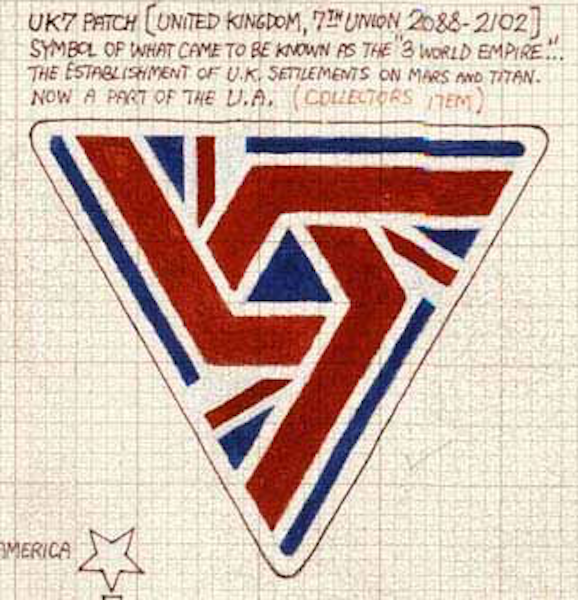
But I'm missing something here. Something stranger. In the material of the very first film, we have mention of a 'Three World Empire'. Ron Cobb's notes suggest this as something like a stage of Britain's spacefaring development. One notes the mix of British and American cast in Alien - which was filmed in Britain.
Later material indicates that the Three World Empire is a merging of Japan and Britain (along with a number of Commonwealth and South-East Asian countries). 

In some ways, this is sort of silly. Taking the Weyland-Yutani merger - a name derived from Leyland (the British car company) and a neighbour of Cobb's** - and having the political sphere mirror the commercial. It's a little too close to really convince, without some greater form of detail.***

And yet...the name, with the faintly occult overtones. The Union Flag three-sided vortex, which hints at the British Leyland symbol. The presence of a junior partner in the West of this new Cold War. The fish-hook nerd-bait of 'Okay, but how does this actually work?' I can't help feeling that this should be more interesting to people than it is. There should be fan-art and Woyjak material galore. As it is....well, this is it

I have to wonder what more could be done with this 70s-echoing Anglo-Japanese culture and economy. Butskellism on a diet of Bushido, courtesy of the MITI? Morning suits for statesmen imported back to Westminster from the National Diet? Consumer electronics and integrated circuits for both the Atlantic and Pacific? An Anglo-Japanese Concorde? James Clavell was Australian-born: perhaps there would be a BBC version of Shogun; or, indeed, Tai-Pan (would Hong Kong continue to be a flashpoint?). You may debate for yourselves the image of Milton Keynes with Zen gardens. 

***

The real time strategy game Red Alert 2, by contrast, is very much embossed with the Cold War. A branch of the Command and Conquer games, Red Alert (which I never played) supposed a removal of Hitler via time-travel and Stalin attempting a conquest of Europe in his place. Red Alert 2 (RA2) had a rejuvenated Soviet Union try again, with an invasion of the United States. 

So far, so Red Dawn. The main thing to discuss is tone (you can look up a more general review elsewhere). Both Allies and Soviets find themselves developing assorted implausible weaponry: Tesla coils, devastating zeppelins, laser tanks, invulnerability courtesy of the 'Iron Curtain', mind controlled giant squid countered by specially trained dolphins, assorted psychic abilities. There was some of this in Red Alert, but far more in RA2. The bigger difference is tone. Red Alert is (by reputation) far more serious. To my mind, this is only mostly true. My goggles tonight are rose-tinted, but there's a few elements of presentation that skew RA2 away from the full-blown cartoonishness of Red Alert 3.**** 

Both Red Alert and RA2 have the live-action cutscenes that are a C&C mainstay, though RA2's, being a few years later, are rather more polished. The characters are more often stereotypes than caricatures. Ray Wise as US President Dugan is in the lightly comic but not implausible role of portraying a personable politician clearly elected in peacetime trying to grapple with a Second Great War (perhaps I'm reading back from Twin Peaks, but is there an air of hidden desperation?). The assorted plot elements are somewhat wilder, though the destruction of Chicago by nuclear bomb is given a certain weight.

More interesting is perhaps the influence of the gameplay on tone. There's a level of pixelated detail to the cities your troops move through that implies a sufficient urban density. Being able to garrison civilian structures helps - there's an echo of Stalingrad in it all. Units frequently have secondary abilities, can gain experience over time  and benefit from close attention; especially so for the Allied faction, but not exclusively so.  When coupled with a campaign that had a number of limited-unit missions, this gives more weight to the lives of your soldiers. Campaign missions would also end with a victory screen giving your par time - the text given if you are under is rather more positive than if you are over. Compare the two texts for one mission here, another here (comparing the actual screens is difficult; apparently people don't like to show the internet that they didn't make the top of the list).

Is this all enough to make you take RA2 seriously? Probably not. Enough to invest you? I think so.

Anyway, I recently encountered and enjoyed a mercenary generator for TF2. Here's something like it for RA2. 
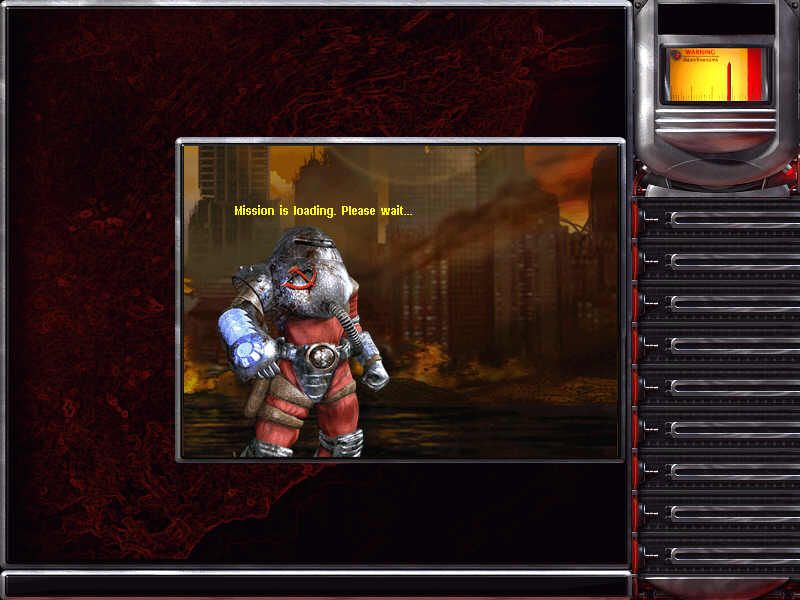
Command & Conquer: Red Alert 2 (Windows) screenshot: Loading a game

The Second Great War is over. You were a soldier. You aren't any more. You had a little money and a home. You haven't any more. There's rumour of a supply of gold reserves stashed in a devastated region. Perhaps you and some people with stories quite like yours could put these to better use than whatever's being done with them at the moment.

---You were a...[d8]

[1] Bog-standard infantryman (but you do bear a marked resemblance to Clint Eastwood).

[2] Rocket trooper

[3] Tank/APC driver

[4] Airship pilot or jetpack infantry

[5] Spy, saboteur or infiltrator

[6] Armoured exotic energy specialist

[7] Loyal but completely unpredictable dog

[8] Would-be psychic who deserted just before the pioneering brain surgery. You still went through all the training.

---You managed to grab a few things from the supply depot...[d10]

[1] Rapid-deploying portable foxhole

[2] Tesla gauntlet (rubber boots not included).

[3] Lots of dynamite with only the shortest of fuses.

[4] Tinnitus-inducing shoulder-mounted flak cannon

[5] Jetpack that was in the depot for vital maintenance

[6] Pyrokinetic focus module (broken targeting lobes)

[7] Plague-dart sniper rifle. Handle with care.

[8] Disguise Kit (might fool psychics, doesn't fool dogs)

[9] Briefcase of highly useful but curiously fragile tools

[10] Gun that erases people from time. You don't know how it works, how much power is left in the batteries or how you got it. But you do know that you really shouldn't have it, and everyone else knows it too.

---You also managed to obtain a set of wheels....[d8]

[1] Optical camouflage tank perpetually stuck in the form of a Scots pine. 

[2] Nippy little half-track.

[3] Teleporting supply hauler. It can instantly travel to a certain designated location within 30km, but it needs to be recharged by an industrial generator afterwards. Also really uncomfortable to drive.

[4] An airship. Full fuel tanks, full magazines, just had been fully refitted - but still very slow and very obvious. 

[5] Massive cumbersome tank with a set of propaganda speakers mounted on the rear.

[6] A big flat-bed trailer pulled by two skittering arachnoid terror drones.

[7] Six seats welded to a hovering robot tank.

[8] Truck carrying a big mobile radar jammer.

---The Gold is hidden....[d8]

[1] Somewhere at a disused military base in the Adirondacks.

[2] In the cellars of the inn of a remote Serbian mountain town.

[3] On an island in the Florida keys.

[4] At an abandoned mine in the Congo.

[5] Not far from a concealed airstrip in the southern half of Borneo.

[6] In a Mayan temple-cum-guerrilla camp in the Yucatan.

[7] At a farm in the north-east of Sichuan province.

[8] Beneath a major national monument.

---A local militia control the area with the power of.....[d8]

[1] Fleet of lightly-armed but highly mobile stealth helicopters.

[2] A pair of towers firing laser-like 'Prism' rays in a commanding location.

[3] Cloning vats. They can only make one kind of goon, but apparently that's all they need.

[4] Hacked feed to a spy satellite guaranteeing constant intel for the region.

[5] A big electromagnet that can pick up cars from twenty miles away.

[6] A self-propelled cryoshell artillery piece. 

[7] Something that looks like a UFO.

[8] Lots of mobile, customisable APCs - and a machine shop churning out spare parts.

---They are led by a warlord....[d10]

[1] A Frenchman who really likes Westerns.

[2] An incredibly handsome Russian nihilist.

[3] Captain Queeg, if Queeg had spent too long watching prism rays light up the dark.

[4] A bombastic Ruritanian cyborg who spends their free time listening to Wagner.

[5] An American journalist from the Midwest pretending to be a CIA agent. Or is it the other way round?

[6] The key member of a Yugoslav stay-behind network.

[7] Hollywood film star who had the money to get out of California at the right time, but not to get back.

[8] Korean submariner deprived of their submarine, and resentful about it.

[9] Peruvian psychic commando who had to spend three nights in No-Man's Land with a damaged interface unit experiencing hundreds of death agonies and went mad.

[10] Politician from a regional legislature who can't recall whether they were a willing collaborator, a mind-controlled puppet, a deep cover agent, was pretending to be one but not the other or just possibly was any of the above at different times - and really doesn't want anyone else to know.


Yes, it's Kelly's Heroes for RA2. Elements of Yuri's Revenge and certain RA2 mods included. The TF2 merc generator could do nicely for comrades or NPCs. 

Détruir tout: c'est une obligation.

***

By way of an ending, I will point you in the direction of S.M. Stirling's Lords of Creation series - which blend the Space Race with Edgar Rice Burroughs-style Sword and Planet fiction, so that you get American explorers dealing with the consequences of the (human, Bronze Age) Venusians getting their hands on AK-47s. The books are acceptable rather than good, but do offer a setting with a certain amount of potential. To my surprise, there's a third one on the way after seventeen years. 


*But then, I have long been of the opinion that David Lynch's Dune has the meme-making scope of the Star Wars prequels. Many do not act as if they share such a belief.

**I've seen that quote a number of times, but never where or when or to whom Cobb said it. I think the origin is in The Authorized Portfolio of Crew Insignias, by one Jeffrey Walker. 

***There is also comparison with Grenville's article on Brexotica: the dreadful rapacious amoral company is the result of the merger of Old-World hierarchy and the inscrutable Orient - against which freedom-loving American protagonists can rage. Not that (by implication) any polity in the Aliens universe comes across very well.

And yes, it seems that there was a Brexit-themed Aliens novel.

****Yes, Yuri's Revenge was rather more B-Movie. That was an expansion pack, and we may consider the base game without it. 

Thursday, 29 August 2024

July-August 2024 Miscellany

Marguerite Yourcenar, Memoirs of Hadrian, 1951
(trans. into English 1954 by the author and Grace Frick)

Historical fiction.

Read in light of a recent spell of reading historical fiction about classical antiquity - see also The Corn King and the Spring Queen and Gore Vidal's Creation

It purports to be the memoirs of the emperor Hadrian, written to a young Marcus Aurelius. Hadrian lays out the course of his life in a number of sections, from youth to military service to supreme authority to impending death. The sections are named for lines of a poem, apparently written in Hadrian's last days.

All well and good. But what makes this an interesting book and worth your time? For one, I find the style most appealing. Magisterial, in a way that rather fits. This was not just fun to read, but a work I very deliberately stopped myself from reading too quickly (unlike Vidal).

For another, the figure of Hadrian is beautifully drawn. Even considering the purposes of a memoir, it's a rare portrait of a historical figure that feels so natural and so unfamiliar. Compare and contrast the last paragraph here. The other obvious comparison is I, Claudius*. This differs - not least in being less explicitly drawn from Suetonius - in the approach. Unlike the afflicted, sensitive Claudius (who is, of course, also writing his memoirs - albeit to a mystical future audience rather than a defined successor) surrounded by a family variously boorish, hedonistic, Machiavellian or mad, Hadrian is far less of an outsider. He writes as one immersed in his work as a soldier or imperial administrator, one clearly with factional leanings and politics, if not as a partisan. When he is finally made Emperor, he is able to use that office far more adroitly than Graves's Claudius. This is coupled with a sort of measured indulgence on his part - Epicurean rather than gluttonous - which makes him more obviously vital. 

Further, he appears to have a far more developed religious belief than Graves's characters. He participates in rites of a dozen different cults and undertakes magical experiments. When someone in I, Claudius is proclaimed a god - especially if they proclaim themselves a god - eyes are rolled and eyebrows are raised and the whole business is treated as lamentable (largely). When it happens in the Memoirs of Hadrian it is far more natural; an exceptional event, to be sure, but not an unthinkable one. 

The death of Antoninus is interesting, and connects with the portrayal of those events in Mike Walker's Caesar! But Hadrian narrates this story and his grief is the equal of his distance. 

I shall be re-reading this. I shall also look out for more of Yourcenar's work; she seems to have lived an interesting early life, ending up on an island off the coast of Maine. There is a book of essays - The Dark Brain of Piranesi and Other Essays - which not only has some material that complements the Memoirs of Hadrian but also deals with that perennial OSR figure Piranesi

[On that Note .... time for some carefully separated nerd-talk. Hadrian is an accomplished imperial figure, a decorated soldier - he's well-liked, physically active, well-travelled. He delves into the occult, is a member of numerous secretive religious bodies, sees the sacrifice of those near him, is willing to consider that he may become a god.

He would be, I think, a fascinating model for an ambitious somewhat sympathetic sorcerer-king type. Think Paul Atriedes in imperial mode. It's been at least a decade since I opened any of Jordan's Wheel of Time, but I suspect that later books had this kind of approach to the messianic Rand al'Thor. Even Warhammer 40,000's God-Emperor of Mankind (at least in his 30k not-yet-a-plot-device version) works. Hadrian's background and mortality feels far more natural to producing the grandiose golden armoured chap than the whole perpetual and/or shamans business.]


*Have a brief reminder of some of Brian Blessed's best work as Augustus

***

Robert Sobel, For Want of A Nail, 1973

Historical, fiction?

There's an experience some of you may recognise. You find out about alternate history and it's sold as exploring a world where (say) Julian the Apostate was far more successful or a British Civil War broke out over the Abdication Crisis. 

But then you read one or two famous works, and it seems that it's less about that world than using it to explore something else. Alternate history as a means to explore questions of identity, to re-iterate moral lessons from the past, to assess the tendencies of the present or to parallel the sweeping effects of a technology, to ground a work's aesthetic or genre roots (Dystopia, adventure fiction)....

Think, in the last few years, how many have picked up a copy of The Man in the High Castle after seeing the television series. 

Anyway, For Want of a Nail is that rare thing - an alternate history that is just a history. A history from another timeline, complete with references and GNP figures and election results - and a critique from another author at the end. And in 1973, rather than from an obscure forum in 2006. However, this is a novel of three elements. 

It is a world where - as the subtitle say - Burgoyne won at Saratoga. The American War of Independence dies in its cradle and a new settlement is implemented - the Confederation of North America. Meanwhile a number of defeated rebels travel into Texas to found the state of Jefferson - which will eventually merge in the aftermath of war to create the United States of Mexico.

Yes, this is a world without the United States - though one shouldn't assess the CNA and USM as merely 'Greater Canada' and 'Greater Mexico'. There's a more to it than that, and Sobel is going to explain as much over many chapters. 

The history and dynamics of both are laid out in a fairly convincing way - the statistics might be made up, but seem to be fairly consistent. There are things that a contemporary history wouldn't do, or would feel obliged to mention - but that very fact makes one think about the business of writing history, especially when one knows the whole thing is very much fake. Either way, it's quite convincing - nothing too spectacular, nor so conspicuously hard-nosed and materialistic to look fake. Men - even quite wealthy men - are swayed by appeals to grand causes, or to national pride, or to utopian ideals. 

That is the first element, a well-confected not-history. The second element is a boardroom drama in which Ayn Rand was given a brief spell as script doctor.
The USM gives birth to a firm, Kramer Associates. Which slowly gains power in a number of vital industries, influencing the fate of the USM and being actively involved in its elections. One can only assume its directors all look as (fittingly) smug and self-satisfied as Steve McQueen in The Thomas Crown Affair

Anyway, even when Kramer Associates gets booted out of Mexico, it hops over to the Philippines and then Taiwan. Then detonates it's own nuclear device. I'm well aware of powerful corporations in our own past - as the East India Companies (Dutch or British) or those that gave us the phrase 'banana republic'. Even so, Kramer's continual success is a trifle too dramatic to take entirely seriously, though I will grant it is arresting.

The third element is the history of the rest of the world, which occasionally produces some eyebrow-raising moments - as when the Global War in the 1930s and 40s between (largely) the British Empire and the German Confederation (The CNA sits this one out) leads to things like the Germans going from Ottoman Turkey to Indochina conquering most everything in their path in three years. Rather than indulge an image of turbo-Blitzkrieg, I will quietly assume that those territories were only ever lightly held. 

But the first element is the dominant one, and that remains interesting. A deal to profitably chew over here.

***

The mod Fallout London has been released, to much fanfare and comment. I have written on this before and had an eye on it for a while.

I haven't yet played (and I'm not altogether likely to). But I have dug into some material online. Is it impressive? Yes, it is a tremendous accomplishment. Have I revised my opinions of it? Not quite, in the same way as I can admire the work put into (say) a skyscraper while disliking the building itself. No matter how many obscure firearms appear in the game.

Among other things, and acknowledging the limitations of a mod, I'm a little disappointed by the lack of a status quo ante ending (Cf. siding with the NCR in New Vegas). Although I would be intrigued to learn if the conclusion to The Prisoner influenced one part of it. 

***

HCK over at Grand Commodore has recorded a reading of 'Hell Screen' by Ryunosuke Akutagawa - I enjoyed it! An interesting comparison with Togo Igawa's version for BBC Radio.

***

A tantalising project coming up from the False Machine - a novel called Queen Mab's Palace, about 'an adventure through a decaying, dying space-ship inhabited by crazed transhumanist radicals, through the eyes of a Medieval Scribe.' One to keep an eye on. 

Thursday, 28 December 2023

December '23 Miscellany

The same form of miscellany post as ever - nothing immediately festive, though I hope you have feasted.

***

I watched a film: Danger Close - about the battle of Long Tan, this being a prominent event in the Australian experience of the Vietnam War. 

The film is (in the nicest possible way) unexceptional. An interesting event, to be sure, and appealing in the way that films from outside Hollywood are - you've never seen any of these actors before, and can't attach stereotypes or type casting to them. And, of course, it's Vietnam shorn of the accumulated imagery and emotion of the American experience. Further, Danger Close has an utterly explicable but still faintly funny trait, in that it is a film from, for and by an English-speaking country about the Vietnam War that shows more Viet Cong faces than American ones. 

So why am I talking about it here? Well, it has some very fine procedural elements: we see the actions and reactions of platoons, of D Company (6th Battalion, Royal Australian Rifles), of the battalion's Lieutenant Colonel, of the task-force commander at Nui Dat. As well as the actions of artillery sections, fire control officers and air force liaisons. Communication, for artillery barrages, ammunition resupply and airstrikes - to say nothing of simple reports -  is a running feature. Hence, the title: Danger Close

Communication - accurate, timely, swift and clear communication - of this kind is a challenge.  Is this one that should be worked into tabletop play more? 'Roll a d20 to blow the correct notes on your bugle'?  Well, that's less satisfying. And I'm not sure the presence of (say) harmonicas or mobile phone keyboards at the table would be terribly pleasing either. 

One point of comparison is the video game Radio Commander, a strategy in which you keep track of units (once again in Vietnam) via conversations. Though the pre-recorded selectable responses there are a little dissatisfying when all else is raw and comparatively grounded.

I dare say this is the sort of thing that the more traditional sort of wargaming has worked out somewhere. More research needed.

***

The degree of 'punk' in Steampunk is a perennial discussion here and on associated other blogs. Generally, I've held that '__punk' is an artefact as a label and that Retrofuturist is a more helpful designation. 


Well, here's a gentleman tracing the history of Steampunk and making the case for punkishness. You might compare it with some of the ideas discussed in my Faufreluches posts. I can't say that I necessarily agree with the conclusions in the last part, but otherwise it's rather good. 

***

I found a second-hand Penguin edition of the Lais of Marie de France. They're pretty short, authentically of their time and nicely spiky. A useful reference point for Medieval Europe, as well as full of assorted supernatural happenings and vengeances. Read a couple over lunch.

***

Investigating Censor is a work on Itch.io by Dave Greggs - AKA HCK, the chap behind Grand Commadore, whose work may be known to readers of this blog. You'll find a few samples over at Grand Commodore if you want to go over those before taking the plunge.

Anyway, 'Investigating Censor is a dark rules-light RPG wargame set amidst a campaign by oracular warrior monks to eliminate a sect of human-sacrificing pirates.' For more first impressions, here's some art. 

It's been interesting interacting with a piece of Greggs's work as a PDF rather than a blog post. Things have a little more room to breathe. Greggs writes a lot - and I like it! But I do sometimes idly wonder what would happen if a seven-foot hairy-chested Editor with a pick handle and a set of brass knuckles sat behind him as he wrote. 

"So, Dave, what are you working on this morning?"

A few things I like about Investigating Censor:

Player Characters Organisation - Players are the titular Censors. It's a wonderfully evocative set of ideas - the mix of legal, customary and religious authority could be quite heady. The very title of 'Censor' throws you into a different set of social expectations and ideas. This is a strength of Dave Greggs, I would say - the Investigating Censor, the detectives of Starling and Shrike. It's reminiscent of 40k's Inquisitors or Rogue Traders, and rather more successful than Mass Effect's Spectres.

Setting - A febrile coastal region, recently gone through regime change and approaching some measure of equilibrium. I suppose I associate it largely with South-East Asia, but it's clearly not a neat one-to-one comparison. Appendix N of IC urges readers to make and share regions for IC, so I may have to do just that! 

(I also quite like Appendix P's tonal variants.)

Framing - The various districts you move into are described socially with 'Centres of Gravity' and 'Key Personalities'. I quite like this encounter framing: whether the local magnate is Young and Feckless or Old, Careworn and Senile or a vigorous Capital-S Schemer to rival Iago, there's still an awful lot that has to go on around them. Whether the planet is volcanic or stable, it is a planet and the moons better recognise that.

Layers - Every level of social encounter has a variety of motivations proposed, with further reaching in as needed. Naturally, a Vice District has its own set of power struggles and problems and obsessions - but then there are region-wide political plays, or secret societies trying to accumulate clout and leverage - or just run-of-the-mill psychopaths. 
  Add to this the various tendencies of your NPC Allies, who do not have your monastic background. Antipathy, opportunity, infatuation, addiction, social pressure can all make them crack. (Maybe you could treat this like Darkest Dungeon's afflictions. The Investigating Censor sending out another expedition is not unlike the Heir sending out another band....)

Alchemy, Fetches and Fetishes - This is a world rich with low-level magics and wonders, without falling into the video game-esque problem of brigands carrying Claymores that shoot Ball Lightning. The presence of Alchemy and various charms enhances this, and feels apt. IC is about a prosperous land ill-used, rather than a blasted heath. This wealth finding its way into narcotics and easing nostrums works better than some potions in RPGs.

I disliked nothing immediately in Investigating Censor. Some worked examples might be good, but one has been released on Grand Commodore. I might care for a little more unifying detail for the Cult of Protection, though it's not strictly speaking a bad choice to keep them loosely sketched against the strong presences of the Censors themselves. (In any case, too strict a 'Pirate Code' will make them sound altogether too Blackbeard-Caribbean).

If the above wasn't quite clear, this may be considered a recommendation. 


Friday, 3 March 2023

Diplomacy, Protagonists, Macbeth, Tully and Caithness

A recent post at Monsters and Manuals set my mind going. I don't watch a great deal of television and would likely endorse the moral of the story that no-one reaches up from their deathbed to say 'I wish I'd watched more TV'. But more to the point: I grew up with - possibly even to a greater degree than television - games (and books more than either, but this was a jumping-off point). The early 2000s had their share of real-time strategy games, but I suspect that Age of Empires (and sequels/derivatives) loomed highest in my mind. There's two things that these do or did to my developing preferences and understanding of (faintly realist) fiction (in a variety of media). The notion of multiple players who may succeed and the process of organisation and resource management. 

Firstly, there is the notion that anyone can win. However advantageous it may be to start as the Julii in Rome: Total War the notion of an entirely Carthaginian Balkans or a Seleucid Iberia is not implausible. I've not played the Paradox grand strategy games (Europa Universalis, Victoria, Hearts of Iron) but they at least allow this to an even greater degree. There is not always a protagonist, no-one chosen for victory. The mind goes to the board game Diplomacy, with its particularly obvious balance of forces: every player starts with three armies or fleets - except Russia, whose size is as much hindrance as help. 

Hence, I suppose, the light scorn I thrust in the direction of the Song of Ice and Fire Tabletop Miniatures Game here (the paragraph beginning 'Even if...'). Eight nominal or near equals on Westeros: the notion that Tully interests are permanently shackled to Stark is irritating. You have to cultivate and maintain allies - you don't just plug their troops into your command structure and keep fighting. Am I really so incensed that I can't bring about GLORIOUS TULLY HEGEMONY? 

I take it this has activated some neurones.
(Found here, the best and clearest Westeros Diplomacy map I found online.)


Which brings one back round to television: I watched Game of Thrones for long enough to A) be aware of its flaws and B) Give up on it. Fun while at Uni and able to chat it over with housemates, but not worth revisiting. The finale has been dissected at length in a variety of forms, but a recurring theme is that it got to attached to big showy character moments, and neglected the underlying logic and social structures of its setting (EG, people writing here, here and here). Teleporting armies, curiously obedient subordinates, religion with no grip on the hearts of the faithful. 

Time is limited in an episode of television. Special effects are limited. Books have the room to put this stuff in; games demand it, as the price of moving an army north is part of the challenge. The cost of logistics, even if only sketched in, can be displayed. There are cheap jokes about all the walking in The Lord of the Rings, but footslogging is a reality of campaigning! 

More to the point, the treatment of non-protagonists. You're either the commander, the champion, or nobody. A butt of jokes, a burden. Costuming reinforces this: I accept that the Freys have an unenviable family resemblance, that their patriarch is a disagreeable fellow, that the rest of the nobility don't much care for them. But they are wealthy and use their leverage to the best of their ability: they should be near as armoured and colourful as any lord rather than dressing in leather the colour of mud and wearing unflattering coifs. They're nouveau riche, not swamp-dwellers - and 'Betrayed by Unappealing but Vital Ally' is more interesting than 'Stabbed in the back by a bunch of Obviously Shifty Bastards'.

Specifics aside, if you've opened a broadsheet's Arts and Culture section in the last decade, you've probably read something about the importance of who we make protagonists, or representation, or similar questions. It's the sort of idea discussed here by Palmer and Walton, who extend it to the question of protagonists and chart the decline of Tapestry books (do read that link!). It's something I've speculated on before, and Noisms moots in the post that started this all off 'it is almost as though [Television] were designed to destroy our capacity to develop a fully-fledged theory of mind.' Terrifying if true. 

Well, that's all wonderful. But do I want a literal 'World without Extras' in my fiction? I approvingly cited Diplomacy above, but only the great powers get a say there (and depending on how many can make it for a game, we might kick Italy out of that club. Guess the Risorgimento went down in flames!). I still have to acknowledge that there are limits to the size of a novel or the processing power of software. 

My mind goes to Macbeth. I have no particular objections to Macbeth and, frankly, it would mean very little indeed if I did. Macbeth starts the play as Thane of Glamis, he becomes Thane of Cawdor also. Macduff is Thane of Fife. Banquo is clearly a peer of Macbeth: I don't believe he is referred to as Thane in the text of the play, but both Holinshed's Chronicles (Volume 2 of the 1577 Edition) and Hector Boece's earlier History of Scotland (Book Twelve) a source for Holinshed, refer to him as Thane of Lochaber. The Thanes of Angus, Ross, Caithness, Mentieth and Lennox appear, with or without lines. 

Do I really suppose that Macduff would as willingly usurp Duncan I as Macbeth? Well, that's a question for the philosophers and theologians. Who, other than Orson Welles, knows what evil lurks in the hearts of men? Do I want a play which plausibly might end with GLORIOUS CAITHNESS HEGEMONY?

Flag of Caithness.svg
They do have a pretty cool flag these days.

I know full well that that wouldn't be Macbeth. But I would hope that the Thane of Glamis is dressed and staged in a comparable fashion to his peers. The rest of Scotland's nobility are not yet cowed by him*, driven into embarrassing spectacles - and useful or useless, you can't ignore Drunken Incompetent Regional Magnates. I'm leaving out much here - the world view of Shakespeare's England, to say the least. 

So, Macbeth may not be something that needs the above 'Diplomacy-perspective.' But there's room in my library for Portraits and Tapestries alike. The possibility that society will only start making (or praising, or honouring, or writing about, or otherwise considering to the exclusion of others) is a little unnerving. Compare this extended basketball analogy.

Perhaps we need some sort of Rawlsian Original Position. You might end up as any of these characters, so you should write something that at least considers any of these characters. Of course, the veil of ignorance doesn't always work quite as intended


*You thought that The Death of Stalin invented tense dinners of horseplay with moustachioed Dictators?


2026: A new copy was required....

Saturday, 19 June 2021

Fallout, Britain and the 1950s Apocalypse

A friend of mine recently sent me the reveal trailer for the Fallout 4 mod Fallout: London. Now, the notion of a Southern England-set Fallout is something familiar to me. And, even if I haven't played every game in the series, I have enjoyed them - and the shared reference point of Fallout: New Vegas among a number of my friends that gave birth to Fallout: Home Counties in the first place means that I have a certain affection for it. 

What I'm saying is, it feels like I have a stake in this matter.

Now, I'm going to pick at some of the elements of this mod in such a way as may be less than gracious. I will freely admit to a partial knowledge of the mod and that I have nary a fraction of their digital ability. Further, that the team are limited by the constrains of the base game. The team includes a reasonable contingent of British people in it as well - this will not be an outside-looking-in depiction of a culture.

Secret Nuclear Bunker | Like the sign says, they like to kee… | Flickr

That said....

There are a few things I would like to address regarding the mod and its presentation of a post-apoclyptic London. 

Firstly, I think it can hardly be denied that the Fallout universe is one where 'the 1950s never ended'. We largely see this in the US, but, well, Cold War Paranoia, technology, culture, politics - all act out a continuation of the 1950s in some sense. Despite decades passing, this remains the case; no 1960s, no Woodstock, no cultural revolution, no Watergate thus no end to an Imperial Presidency.... 

(I can find no references to the Civil Rights movement, but Jim Crow certainly appears to be over - perhaps brought about by the same kind of top-down government that would turn fifty states into thirteen commonwealths).

To lay things out: the 1950s in Britain, even sketched in broad nigh-on-cliche terms was not the 1950s of the United States. The winding down of Empire is only part of it. National Service would only end in 1957; not only did British forces remain in Germany, but fought in Korea, Malaya, Cyprus, Kenya and the Suez Crisis. Domestically, you have the pinch of Rationing together with the post-war political consensus getting on with the work of rebuilding. You have a country devastated by bombing (apt!) being rebuilt by idealistic (hubristic?) architects and city planners - removing slum housing, producing high-rises and new towns - like Milton Keynes with its numbered streets (the same movement that would produce a barracks like this and the Barbican).

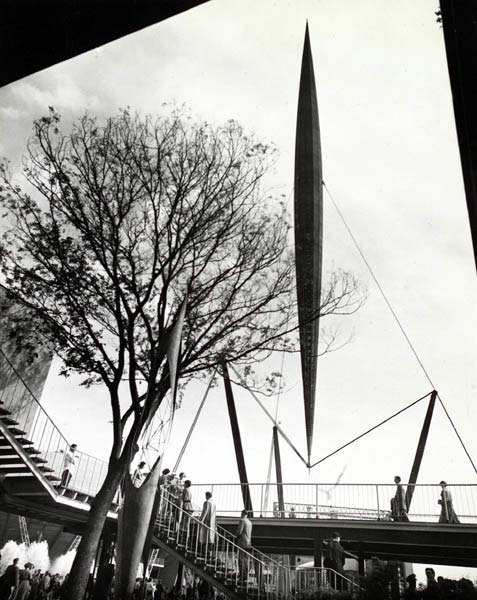
To say nothing of the Festival of Britain and the Skylon.
(Image via those nice chaps on Wikipedia)

Frankly, I can do little better than to recommend the linked series of reviews if you want a quick dive into things. They are reviews/summaries of David Kynsaton's social history of post-war Britain, with useful timelines and the occasional acid comment. The blog's same reviews of period fiction are also helpful.

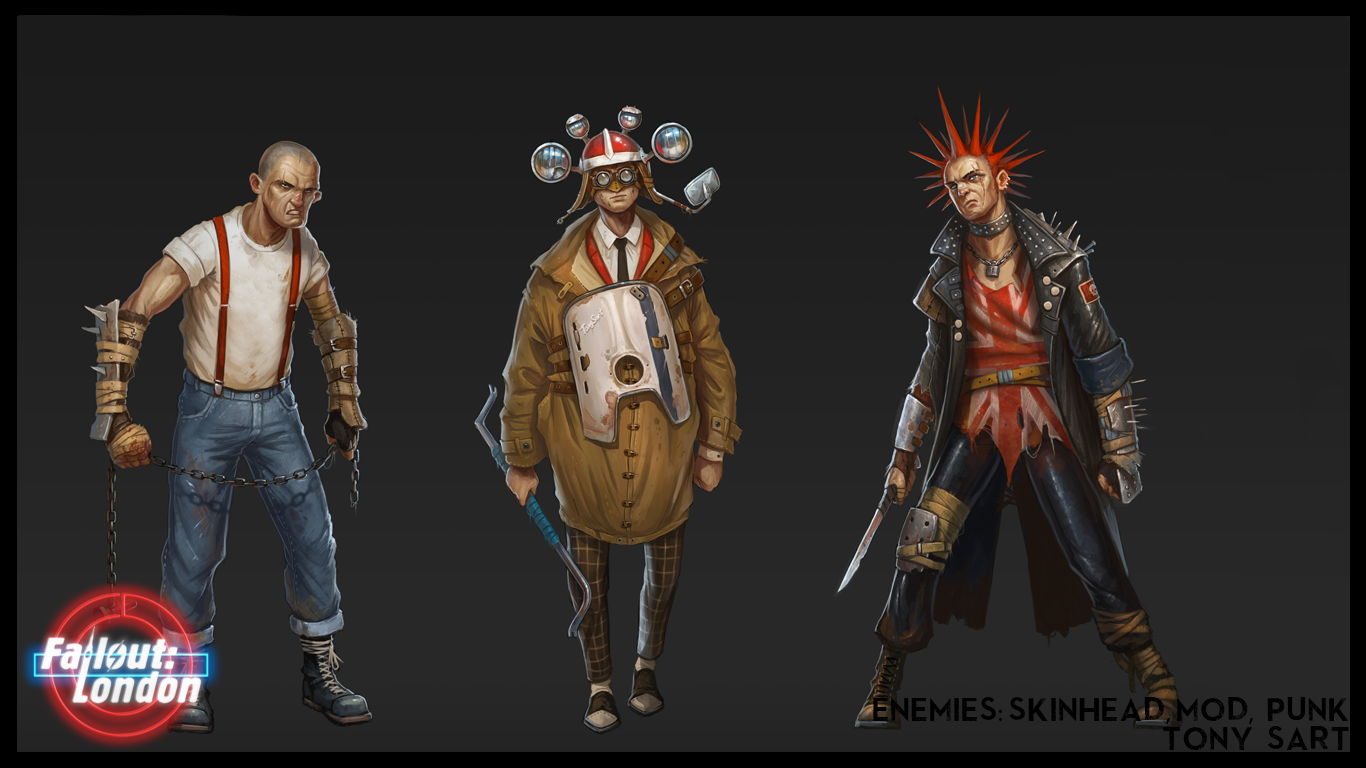
There is little evidence, however, that Fallout: London has gathered any of this raw material into the mod. If in Fallout America never has Woodstock, Britain never has the Beatles and Carnaby Street. What do we have instead? Barrage balloons (against the A-Bomb?!?), Vera Lynn (excusable, thanks to Kubrick), Tommies, 'Fascist pamphleteers', London street gangs, Peaky Blinders, a 'Feudal Aristocratic hegemony'. This is all the stuff of the 1930s and the Second World War. [I leave aside the invocation of post-1950s subcultures - where are the Teddy Boys?] A post-war Establishment involves more technocrats, middle-class intellectuals and union leaders; a post-war revolution involves more communists. It's like mixing up (for an American setting) the Industrialists and Railway Barons of the Gilded Age with the Cold War Military-Industrial Complex. Not the biggest or strangest of mistakes, but a notable error nonetheless.

The view we get of London is mostly Victorian-red brick ruins and war-scarred landmarks. Closest thing to a modernist monolith is the 'blast-proof' walls of Westminster (shown below) (the Ministry of Truth is still around, however). This bit of concept work seems to have the right idea.

I know all this might be a little too much like looking for historical accuracy in a counterfactual setting. Besides, vanilla Fallout is as often Mad Max as 1950s ruination. But Fallout: London does seem to have strayed a little from the setting notes. There is perhaps something in a Britain that indulges nostalgia about the 1940s in a way that America might indulge nostalgia about the 1950s - but I'm not sure that Fallout: London actually does this.

The Fallout games also use not only the trappings of 1950s history, but also (science) fiction. There seems less of this in Fallout: London. No John Wyndham on display; no Death of Grass, no Quatermass Experiment. Not a hint of Ridley Walker. Triffids seem tailor-made for Fallout! I've covered this sort of thing on the blog before, if in a rather amateurish format. Where are the lonely concrete left-over RAF bases, as in 'The Hour that Never Was'? Where are the Ealing comedies? Where is Molesworth? Looming post-war tyrannies, as in Orwell's Nineteen Eighty-Four or Lewis's That Hideous Strength are perfect for Fallout - perhaps there's some of them in the background. 

The problem may be that the iconography and choices of Fallout: London are all, I suppose, those of the path of least resistance. The equivalent of the Big Ben and Rule, Britannia identifying shot and musical sting in a film (Cf, this). The Guards Division in bearskins and red tunics. Buckingham Palace, the Palace of Westminster, Tower Bridge, Trafalgar Square. Red buses and pillarboxes. Tommy Atkins, street gangs. King Arthur and Camelot. It reminds one of a tourist shop bulging with ugly postcards, Royal bobbleheads and Union flags. It's (almost) a hair's breadth from Dick Van Dyke dancing on rooftops. [Harsh!]

Of course, again, I don't know enough about this mod.  I couldn't tell you how good it is, where it will end up or how Shandified it is. But I think I can tell you what's not there.

Sunday, 12 April 2020

More Unlikely Golems

Another bid to produced golems divorced from the elemental concept. These are inspired less by a distinction from Natural or Elemental ideas and more from a viewing of portions of the From Software video game Sekiro: Shadows Die Twice. I saw portions of this and was captivated by the textured appearance of the exaggerated, semi-mythic Feudal Japan it depicts.

My knowledge of the Sengoku era of Japan isn't that detailed or well-grounded, but the courtyards and turrets of the castles, gardens, shrines and monasteries seem in some case more an arena with appropriate set dressing than a realistic depiction. All the same, the drifts of leaves or bristling straw coats were curiously evocative of a closeness to and use of nature (despite having castles, monasteries, gunpowder, massive swords, &c), which does evoke a certain image of Japan.

Anyway, without necessarily being Japanese in any direct sense, it is a 'material-that-shows-its-natural-origin' that is meant to define these golems.

Basket Golem
In appearance: a wicker man, but without the sacrificial offerings. The head is squarish and larger than human proportions. Three main openings into the hollow centre - one in the head and one at the base of each leg (above the 'ankle' at the front').

Capabilities and properties: Hollow, flexible, lightweight. Capable of carrying a great deal inside itself.

Intended purpose: generally found in the ownership of agricultural buyers, touring rural districts with the golem as a self-propelled grain silo. (A basket golem made for a grain buyer is tighter woven than one for a dealer in potatoes, for obvious reasons). Some golems, as a cost-saving measure, have a seat for travel built into them. This can be rickety and precarious.

Location of the words of power that give it motion and purpose: Suspended on a plaque from the rim of the square head.


Dead Leaf Golem
In appearance: a greater drift of dead leaves, linked by vermillion threads that glints gently. If it rears up, it looks a little like a flat Green Man.

Capabilities: An excellent broom of sorts, gently picking across a floor to remove loose detritus.

Intended purpose: Cleaning, if stepped on they crackle alarmingly and can alert people to your presence. (Pine Needle Golems, a very expensive variant can muffle sound instead).

The words of power: Sewed into the one green, living leaf in the drift.

Compost Golem
In appearance: Largely like a regular clay golem. But made of compost. A broad funnel replaces the head. One arm is not compost, but wood, with a trowel in the end of it.

Capabilities: It's a walking compost heap, fed through the funnel. That knows when to extract portions of itself and spread them as directed.

Intended purpose: Composting.

The words of power: Set in a slot in the upper part of the wooden trowel arm.

Tile Golem
In appearance: Like a man in a sandwich board. But the sandwich board is made of lots of little sandwich boards. And so is the man's head and arms. His face looks a bit like several dormer windows. His head is topped with an ornamental antefix.

Capabilities: The tile golem can angle itself in several different ways, even bending right over backwards to form a shallow roof.

Intended purpose: A walking shelter, capable of holding itself in place over something for quite a while. More robust tile golems are used to shift great quantities of loose earth or other materials, forming a sort of whole-body smart-scoop.

The words of power: generally just behind the antefix, to prevent damage.

Moss Golem
In appearance: A teddy bear, with only a gentle dome at the neck instead of a head.

Capabilities: They walk quietly, blend in very well into undergrowth and have a soft skin on top of a solid centre. A moss golem is incapable of rolling.

Intended purpose: Moss golems can lift delicate things without breaking them, and are prized by ceramicists or antique dealers for that reason. They are also remarkable as stealth troops or commandos - if one remembers that stealth is a relative term given their size and weight.

The words of power: Carved into the head dome. This is frequently done to give the impression of a distinct 'face' uncovered by moss.

(Bonus thematically different golem!)

Distiller's Golem
In appearance: A normal clay or wattle-and-daub golem - but with a smoking metal chimney, and a hollow centre accessible by doors in the chest.

Capabilities: It is a normal golem, but with an arrangement of boilers, pipes and alembics inside to distill alcoholic spirits. Some advanced models can control parts of the distilling process themselves.

Intended purpose: by the laws of the land, a household is permitted to distil a quarter of a firkin of alcoholic spirits for its own use. Travelling distillers use these golems to move between rural homes offering their services.
Of course, said travelling distillers are often judged guilty of breaching the law on home distilling. Thus, their golems are often carefully made to look like run of the mill country golems.
The vicious rumour that some distillers have fitted their golem with a spigot and lighter to function as an eau-de-vie fuelled flamethrower has absolutely no truth to it.

The words of power: In a tablet in the head, generally - and concealed. A distiller may well have had an enchanter discreetly change the base spell.

[This is more France than Appalachia.]


Thursday, 13 February 2020

Rogue Trooper: Nightmare Machines, Endless War and the First Person

Rogue Trooper began life in the British comic 2000AD, the work of Gerry Findlay-Day and Dave Gibbons. The time? The future. The place is Nu-Earth, a paradise world at a hyperspace junction devastated by years of war between two great alliances, the Norts and the Southers. This planet is so poisoned by chemical weapons that in most places humans cannot survive without a sealed chemsuit.

Hence the Southers created the GIs - Genetic Infantrymen - who can survive the poison atmosphere with no mask. But in their first action they were betrayed by a Souther general and massacred. One survived to hunt down the traitor outside the military chain of command- the titular Rogue Trooper. He is accompanied by the remains of his friends, personalities implanted in biochips attached to his war-gear, still speaking to him as he roams the poison wastes.

Enough of the summary. This is inspired by a reread of the first omnibus volume put out by 2000AD. There's some of Dave Gibbons's characteristic black and white art in that link, and you may conjure his name in connection with another blue post-human.

Originally found here: http://www.bbc.co.uk/cult/comics/2000adstrips/rogue/roguetrooper01.shtml
Many thanks to the chaps at the BBC.

The lone solider figure of Rogue is a familiar enough one, haunted literally and figuratively by his dead comrades - hoping not just to find the traitor, but to find new bodies for the biochips in his gear. His progress is told episodically, with miniature tale after miniature tale linked together - as one might expect from a weekly comic.

His own side, the Southers are rarely depicted in full view. We see odd units and the occasional glimpse of a distant (literally, on a satellite) command 'Millicom'.

(There is a constant interweaved future slang: Nu-Earth, the ruined city of Nu-Paree, with the Mitterrand Tower, 'Synth' applied to everything, the Nort exclamation of 'Nain!' or 'Stak!'. A bit goofy, maybe, but it gives a rolling gentle distinction to the language.)

Souther speech and habits look rather Anglophone; in time we would even see a Nort push into the 'Dix-i front'. Perhaps somebody had spotted the North-South angle. Either way, there is a sprinkling of American Civil War references: the cities of Memfizz and Nu Atlanta, the Georgia Volunteers, the song 'When the South goes marching in', the historic battle of Mek-Bull Run - even the port of Harpo's Ferry! [John Brown's body is a-rolling in it's grave...]

The Norts, however, are a far more interesting bunch. The Civil War angle is meant to perhaps imply some equivalence between the warring sides (in that both sides in a civil war are part of the same nation - they are kindred), though this is hardly how the Norts are portrayed. Inspired by the Nazis of Second World War comics (with a few Slavic overtones), they are by turns vicious and ugly, wearing full-face masks rather than the armoured astronaut-like Southers. Of course, we see far more of them. Rogue will walk into a firefight with some beleaguered Souther boys against an oncoming Nort force with superior weapons and help defeat them.

And such weapons! Guns, yes, but also vibro-daggers and lazookas. 'Decapitators' - hovering mines full of shrapnel. Automated sentry pillboxes. Drill-probes emerging from trench floors. Nort desert raiders riding genetically engineered 'Stammels'. Mountain troops on motorised snowboards. 'Blackmare' tanks the size of houses. The 'hard rain' of chem-suit piercing flechettes. Plantlike barbed wire, that traps and strangles its victims. Hallucinogen spraying tanks, that can appear as nightmarish vast spiders or snakes - or a float full of flowers and women. Laser-projected propaganda 'Holo-beam messages'. Poison saboteurs, nicknamed by the Southers 'Filth columnists'. The bizarre sight of the Sun Legions, Nort troopers apparently hang-gliding into battle from orbit (a notion so absurd they were later said to be extinct).

Well, what's the point of all this? Bizarre weapons and over-complex plans have some delight to them, to be sure. The need for a new hazard every few weeks also must have fuelled some creativity in the writers of the first run. But their is a sheer variety of complex industrial might levelled against the one lone trooper. It exudes a certain kind of atmosphere, found in a certain sub-genre.

The Protagonist has a weapon or two, and belongs to a nebulously defined organisation, often without clear ranks. The Antagonists are many, belong to a vast hierarchy and a equipped with startling variety. Not the Lone Wolf of Rogue Male, but something bigger, pulpier, set among the stars. Lone Space Wolf? [Sorry.] It's a matter I've considered before.

Of course, the Nort multiplicity of organisations (Army, Navy, Scum Marines, Sun Legion, Kashan Legions) is presumably meant to conjure up the different forces of Nazi Germany - the Wehrmacht, the SS, the SA, the Gestapo. Nonsense, in some ways - the Allies had quite as many different organisations and they could be just as characterful. A Gordon Highlander or Bengal lancer is a picturesque a sight as a soldier in full SS black.

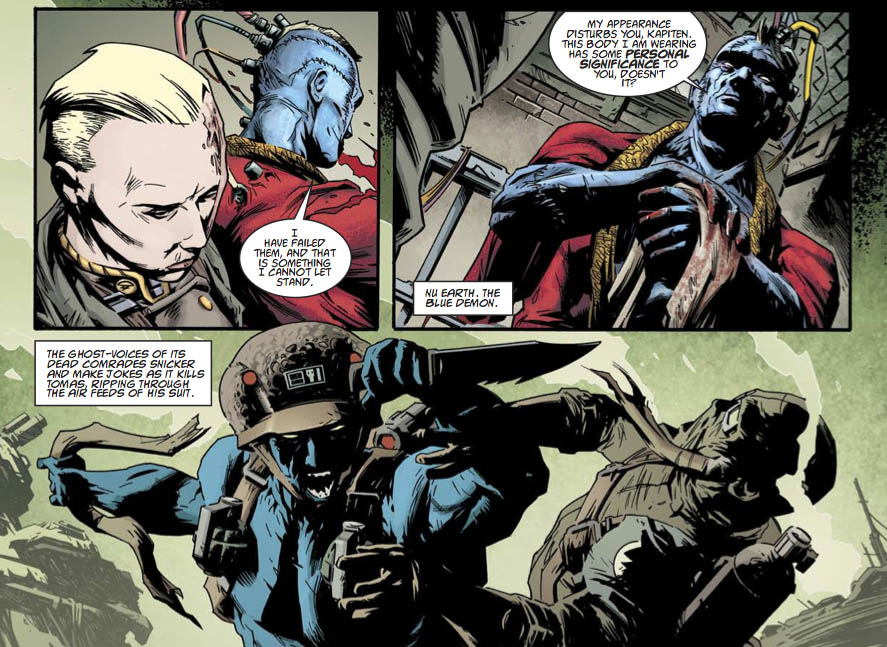
Rogue Trooper has had a few spin-offs after the original run fell apart after the traitor general was found; Jaegir is perhaps the best, though it suckles from the teat of the grimdark rather. It tells the story of a Nort Kapitan-Inspector in the 'Office of Public Truth'.

Complete with traumatic memories of Nu-Earth and the protagonist of the original!
From Jaegir: Circe, 2000AD Progs 1893-1899

It was made into a video game - a First Person Shooter, for which its narrative was almost perfectly suited. A lone soldier, the superior of any other, fighting hoards of enemies who can prove a challenge both in quality and quantity? Unfortunately, I am told by a relative who actually played it, that it was not much good. Duncan Jones is apparently adapting it for the screen - which will hopefully be better.

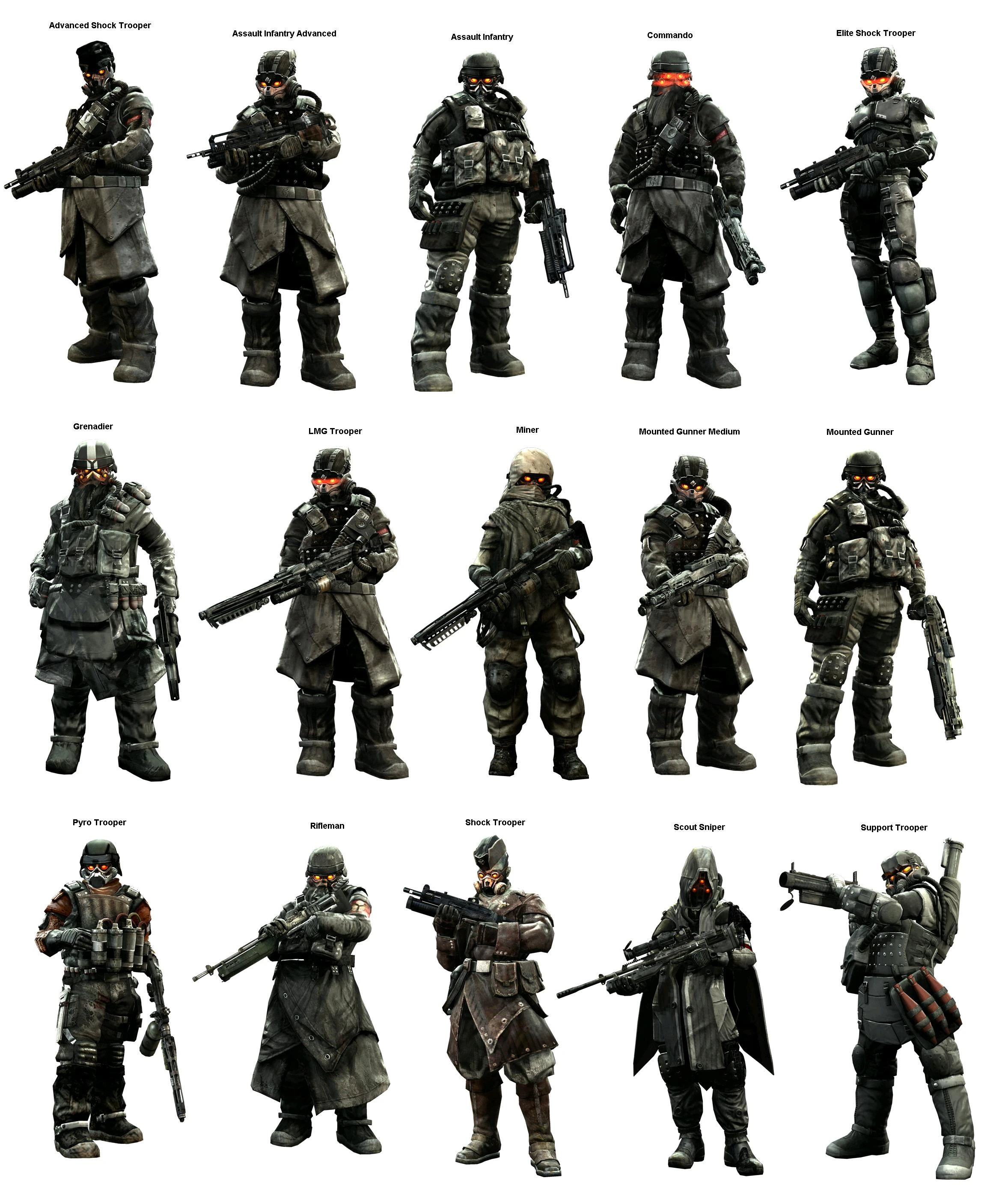
Speaking of FPSs, however, Rogue Trooper surely has a descendant in Killzone. I did not play them, but this brief series of games had a war between the Interplanetary Strategic Alliance (boring, vaguely American) and the Helghast (cool name, gas mask, black armour, British accents, swastika-like emblem). I invite you to consider their respective wiki pages.

Quite what the difference is between a Shock Trooper and an Assault Infantryman, I should not like to say.
Found here: https://killzone.fandom.com/wiki/Helghast_Army

If the above does not suggest a Rogue Trooper parallel, perhaps the hazardous, polutted Helghan will.

It's an odd question - why not have well-defined Protagonist factions? Time is one factor - how long do you have to tell your audience about a place? A negative portrayal is probably quicker to rouse up than a positive one. The slow start of Peter Jackson's adaptation of Lord of the Rings allows for this, having to do quite a bit of heavy lifting for a presumed newcomer to Tolkien. Even here, of course, the portrayal is mixed: The Shire is innocent, but ignorant. Rivendell is the seat of wisdom, but lacking in the power it once had.

Why can I not get excited about the prospect of the ISA Constitution and Statue of Liberty? An ill-defined state can be whatever you want it to be, of course. Perhaps I'd rather have that than Gears of War with it's Coalition of Ordered Governments, created seemingly solely for the pun but giving obvious direction towards an authoritarian angle. Though the comparison between the Evil Empire (rules-based, governed, uniformed) and the Alliance of Freedom (anyone can pick up a gun and join) is one that may appeal to the libertarian. More than all this though, the lack of detail is sort of insulting - Shabby. Incomplete.

(The FPS antidote to the Lone Wolf may be early Call of Duty. As this chap lays out at length, each narrative gives a view of several units of ordinary men on several fronts. Call of Duty 3 may tread well-worn ground in Normandy and Western Europe, but does so switching between Americans, the British, the French Resistance, Canadians and Poles.)

Well, it all makes me appreciate tabletop wargames all the more. Each faction to be laid out with a variety of fascinating, characterful units; each to receive a ration of lore to back them. Rogue Trooper probably gave something to the feel of Warhammer 40,000; 2000AD was certainly an influence. I suppose this is what I enjoy in my war stories, or any story of great deeds. Multiple perspectives, variety, details, verisimilitude. I've been reading The Cruel Sea; Monserrat has some of these. Tom Clancy also, sometimes. I'm not sure that sort of story is always possible on film, however.

I have room for the mythic, indeterminate, bizarre or pulpy, and enjoy Rogue Trooper. There's something almost Passion-Play like about it. But it has some odd echoes elsewhere.