Showing posts with label Comics. Show all posts

Tuesday, 18 April 2023

Faufreluches: Feudal Future

Faufreluches: the rigid rule of class distinction enforced by the Imperium. 
'A place for every man and every man in his place'.

I'm calling this after the above concept from Dune because I've never been able to chase down its derivation. Anyway, as the last post made clear, the idea of the 'feudal future' has been on my mind a bit - perhaps, really, since this post by semiurge. 

Anyway, the question I have put to myself - and, by extension, to you: where does the appeal of the Feudal Future lie?

We can trace the derivation of the concept, certainly - Patrick Stuart does that nicely enough here. But there's a distinction between an idea emerging and its longevity. I think we must claim some degree of longevity for the popularity of the Feudal Future: Dune has gone through several adaptations - the last even being fairly well regarded. Warhammer 40,000 persists, even thrives. Leaving aside specific series or universes, recent science fiction has its share of space empires shown, to some degree, from within (no isolated farmboys): Martine's Memory of Empire, Leckie's Ancillary Justice, Muir's Gideon the Ninth. That Galactic Empires were the subject of parody or jest as early as Harrison's Bill, the Galactic Hero (1965) or Fit the Ninth of The Hitchhiker's Guide to the Galaxy (first broadcast 1980) is at least one further way to gauge this.

(From Fit the Ninth: 'The term imperial is kept though it is now an anachronism. The hereditary Emperor is now nearly dead, and has been for several centuries. This is because in his last dying moments he was, much to his imperial irritation*, locked in a perpetual stasis field. All his heirs are now of course long dead, and the upshot of all this....'

A dying but never dead space emperor? Nothing new under the fading suns.)

A working definition is in order. A Feudal Future is not necessarily one where monarchies exist - the Klingon Empire (or any given monarchy encountered by the heroes) does not make Star Trek a Feudal Future; likewise Le Guin's Rocannan's World and The Left Hand of Darkness. It must be in the future - the All-American Flash Gordon getting whisked off to Mongo is out. It must be off Earth, I would assert - which rules out the post-apocalyptic (e.g., The History of the Runestaff) and the near-future dystopian (Lazarus). A Canticle for Liebowitz must be considered influential, but not necessarily representing an entry in the annals of Feudal Futures. There must be a feudal sensibility among the protagonist's civilisation - which I think rules out Star Wars, which leans either to the blandly liberal or the totalitarian, despite the presence of Princess Leia (the NPR Radio version might sneak under the wire, however). Compare and contrast the populations governed by Firefly/Serenity's various cattle barons and planetary magistrates. 

You may dispute all the above - but that's what I'm working from in this. 

Alas, Anderson's High Crusade must also be excluded.

Anyway, a few possible answers, some inspired by contributions of my fellows. 

+++

Scale and Distance

The distance between the stars mean that any interstellar polity will have to have regional governors wielding significant power; whether they are consuls of the Greater American Republic or lords-lieutenant of the African Planetary Union or satraps of the Malay Star Empire. They don't have to be drunken or incompetent, but they will end up with a somewhat feudal affect. Even if one only has a veneer of historical knowledge, there's a sensical element to it.

Simplicity/Familiarity - Borrowing from History/Historical Fiction

'Knights in Space take cues from previous depictions of Knights, Blog Readers Unsurprised.'

To offer a trifle more detail on this - Feudal systems have lots of display of rank and lineage, lots of ties to personal motivations: We fight not over trade or human rights or the succession of our preferred heirs to the throne of Ruritania, but because my Father killed your Father. And we do it wearing our distinctive heraldry. (There's a difference, of course, between real feudal histories and fictional ones in the streamlining and simplifications of systems and groups. Even works that draw from a realist palette can be boiled down to Team Wolf versus Team Lion in the telling, no matter how long and thorough the appendices. Boil down further for adaptation; distill once more for water-cooler discussion.)

Space Opera may originally have been coined in reference to Soap Operas or Horse Operas, but larger-than-life depictions of interpersonal conflict in soaring language with obvious visual cues mean that the likeness to Wagner-Handel-Beethoven-Verdi opera would eventually be made. 

All this allows for various complexities to be spun around a simple, comprehensible plot and inter-character relations. As an image of this, consider the literal (well, translated) text of the libretto compared with all the on-stage goings on in this version of Giulio Cesare. Imagine how all that might be described in a novel, and the implications in the reader's reception of all the costume and set and so forth.

Mix-up possibilities

There is the joy and interest of seeing the familiar juxtaposed with the new. This is true of every science fiction work that referenced a New Frontier or a Wagon Train to the Stars - and the contrast is heightened when it is not merely rugged frontiersman in space but mendicant friars, or samurai, or fifteen-foot robotic knights. Vary as necessary for institutions, stock characters, &c.

Reaction to Secular/Rational Futures 

Let us say that the Feudal Future explodes into the wider consciousness with Dune in 1965, with Foundation as a respected forerunner. We get Lord of Light in 1967. Some of this is simply part of New Wave SF - though one wouldn't call (say) Dangerous Visions really related to any Feudal Future elements. We should also look to the wider 1960s cultural shifts.

Anyway, if the clean, smooth, bland, secular, rational, vaguely egalitarian (probably Western) future (or present) was being questioned, it should not be entirely a surprise that it might be questioned by dirty, jagged, vivid, zealously religious, instinctual, hierarchical futures**. Dune, The Incal, Lord of Light - all Dionysian rather than Apollonian. (Of course, this doesn't mean that every author longed for a dirty, jagged, &c, future. It may mean only that they wished to explore profitably ideas that might be encountered in such a future.)

It has not escaped me that the 1960s was a while ago and that Feudal Futures have persisted in popularity. But cultural trends don't spread evenly, and the very reaction I speak would reoccur in later generations***.  

Detail and Variety - Across the Board

Now, works of Science Fiction before any given Feudal Future may have imagined a number of different worlds or aliens or technologies. Wonder and strangeness form part of the appeal. But would these have been applied to the protagonist and the civilisation around him? Less likely. 

Of course, an Atriedes or a Hawkwood is more approachable and familiar than a Harkonnen or Decados. But for all that they act as (ostensibly) nice clean White Hat factions, they are participating in the wider space empire - with Bene Gesserit and swordmasters and mentats on their staff. Compare 40k; zoom out from that squad of guardsmen - who might as well be GIs with laser rifles - and you find commissars in gold braid, psychic email servers and cyborg priests singing a hymn in praise of the rack and pinion gear. 

It's not that a non-Feudal Future couldn't do this, necessarily. Think of Banks's Culture: as strange, in its fashion, as the Idrians or the Empire of Azad. Still, this is, I think, part of the attraction: participating in the Grim Darkness of the Far Future, rather than being a tourist. No chance of beaming back aboard the Enterprise.

Add to this - and tying into the above point on Reaction - there's the aesthetic element: a rebellion against Little Boxes on the Hillside. Characters dressed in hulking Gothic armour or elaborate uniforms, interiors with handworked furniture and traditional portraiture, buildings (to say nothing of megastructures) dripping in statues and ornament. Hence my writing this so soon after reading Emphyrio, which both has an element of appreciation of the products of an isolated, stratified world and condemnation of the laws, mores and living conditions its inhabitants endure (aside from other ethical conditions).

Motivated Borrowing 

I've called this 'Motivated Borrowing' to fit in with the above; if one may borrow from history or historical fiction for plot reasons or a sense of delight, one may also do so with an explicit agenda (and a more focused one than the cultural motives I suggest above). It should come as no surprise that we depict history in a variety of ways: 'the Golden Age', the 'Time of Barbarism', and so forth. These may be caveated or hung about with subtleties as desired, or as the skill of the writer permits. These depictions may be consciously used to advance a particular view.

You know all this already: I, stepping a degree further, venture to suggest that the same is true of fictions aping history. This is most apparent in historical plays in modern dress - but could readily be extended to feudal futures. Obviously, a work positing a certain quasi-familiar but fictional political arrangement is in an excellent position to discuss government and politics. 

This is all in addition to those Feudal Future works that actively announce themselves as a satire, of course; Nemesis the Warlock is perhaps the definitive example. 

Anyway, another source of appeal: to have one's worldview reinforced by a depiction of the future referencing the past. Speaking in general terms, a left-winger might look at a Feudal Future and say 'How terrible! We should purge or reform the warlike and superstitious elements of our society!'; a right-winger might look at it and say 'Even in the distant future, conflict and belief will still be with us: we cannot rid ourselves of these and any attempt to do so will fail or cause great harm!' 

Of course, any depiction of a Feudal Future presumably could possess no more authority than its author possesses and correctly communicates knowledge of human nature - something which is difficult to assess. The two puppets in the last paragraph are both mistaken and any actual human being holding such a belief similar to either expressed would be capable of (at the very least) camouflaging them in caveats and subtleties. 

I don't think this is necessarily one of the stronger draws: there's a reason I separated 'Motivated Borrowing' and other Cultural Reactions. But it's not not there.

+++

Two questions, at the end of this remain to me:

1) What have I missed? What element of Feudal Futures draws you, if any?

2) Having assembled such a list can I devise, if not the greatest Feudal Future, at least an adequate one?

Contributions in the comments for 1). For 2)...watch this space.


* "Son of a bitch, they Golden-Throned me! What in the name of Almighty Zarquon do I do now?"

**Emmy Allen positions such a questioning under the horror umbrella in this post

***HCK's post 'Embodying Existential Debate' is a near-perfect example of just this.

Monday, 10 April 2023

February-March '23 Miscellany

A few things to mention here. 

***

Layer Cake is a 2004 film. It is not about baking. 

It's about a business-like cocaine dealer in contemporary London getting into escalating situations within the criminal underworld beyond his cosy specialist niche. It may get mentally grouped with Guy Ritchie, but is in fact the directorial debut of Matthew Vaughn and adapts a novel by a chap called J.J. Connolly who appears to have done very little since. Daniel Craig as the nameless protagonist. All packed into a lovely compact one hour and forty-five minutes.

I don't suppose this is a spectacular looking film - though I do get a (vaguely nostalgic) 'Blair-era' sense from it. Not that I myself associate that period with drug deals - it's something in the way they make London look (institutions that once might have been stuffy looking open and casual), the mobile phones, the music in the nightclubs. There's some long slow sequences that work quite well. The bits dealing with the actual, tense, protracted business of being a middleman dealing in proscribed substances are worth imitating. 

You will find people who call this film 'Daniel Craig's audition to play Bond'. Not altogether untrue, I suppose, but don't go in expecting a performance like that in Casino Royale. If there is any Bond in it, it's the Bond of Fleming's books, which has only vaguely been captured by Toby Stevens in the BBC Radio dramas. 

(Perhaps also the bachelor pads, alcohol, stake-outs, tight-lipped meetings and vertiginous sense of being on over one's head contribute; Re. that last point - Fleming-Bond is not an expert in volcano lairs [is anyone?] and isn't supposed to deal with regiments of goons. Neither, I suppose, is Movie-Bond - but Pastiche, Parody and so forth eventually prevail). 

Craig offers a callous professionalism and relative lack of suave-ness. His Bond, though moderately craggy, is a rather polished marketable craggy.

Frankly, though, stand-offs and gunfights are the least interesting bits about Layer Cake. It's really about the monologues: narration from Craig's anonymous protagonist, speeches from scarred underworld veterans and his crime lord superiors - who have a wonderful sense of presence themselves; look out for Michael Gambon and Colm Meaney. 

And much of these are well-delivered and charismatic and not blatantly boastful or false - and to some degree self-serving or deceptive or manipulative. Or set rules that are promptly jettisoned when convenient. This is most obvious in the opening sequence - "I'm not a gangster, I'm a businessman whose commodity happens to be cocaine" - but it persists throughout. If gangster films are about power and society, this is a very middle-class film (that the opening sequence contrasts Craig with yobbos behaving badly abroad may be of note; see also the code-switching in the nightclub). Has the phrase 'a thriller of manners' been coined?

*** 

Pilgrim. Found at Itch.Io by Mateo Diaz Torres, who also did A Most Thoroughly Pernicious Pamphlet. Anyway...

You have been chosen. As a member of one of the tower-sanctioned expeditions known as pilgrimages, you must descend into the unspeakable chaos of the ruined old world. As you go, you will be charting unknown territories and setting foot in ancient, powerful, and extraordinarily dangerous places. Should you return alive, the rewards will be great. [...] However you see your journey personally is irrelevant to the architects. They need information, technology, and updates from the world outside to keep the horrors below on the other side of the spire’s walls. Regardless of your reasoning, it is not a choice. You must go.

Appetite whetted? It's a neat little eighty-three page setting about adventuring into the ruins of the old world, full of indecipherable tech, killer robots and yet stranger things. The comparison that struck me reading it was Philip Reeve's Mortal Engines - more in tone than content, though the megastructures of both are a more direct point of comparison. Both are very busy, bustling post-apocalyspes. 

There's some low-lying religious theming (the idea of pilgrimage, a Babel-ish tower, demons, a fallen world), but not enough to become obvious or onerous. Evocative rather than blatant: there doesn't appear to be a definite kind of story you should be telling. Which I appreciate.

It also looks good. Sketch illustrations like those in the Pamphlet, boxes and borders in a simple but distinctive style. Compare Punth: A Primer or In the Hall of the Third Blue Wizard - apparently, I'm a fan. Not so fond of the Microsoft Word shape art used to fill in some of the white space. I see what it's going for in the slightly-gnomic blocks and geometric patterns, but it needs to look a little more finished if it's going to work properly. 

But if that's my biggest problem, this is at least a work worthy of your time. Pay what you want on Itch, so go and take a look.

***

Jodorowsky and Gimenez's The Metabarons. I've been mulling over some thoughts on 'Feudal Future'-style space opera, and wanted to take this in. I'd read The Incal previously, and come across the whole semi-mythologised Jodorowsky's Dune. 

I've seen people call The Incal inconsistent, lacking in coherent world-building (which isn't everything, of course, but given the galaxy-spanning subject....). So it's no real surprise that Metabarons takes advantage of an episodic, generational tale to dart around a bit and use a series of left-over ideas - Cf. the castrated Othon von Salza and (Jodorowsky's) Duke Leto, and their method of making an heir.

Going into this knowing some of that, and plugged into the Grand Narrative of The Incal (which may or may not have been retconned?) almost makes this into, what, Funhouse Dune? The satyr play to Dune's Classical Tragedy? (But the Satyrs are Robots without the usual desire for drink and sex as a kind of meta-humour??) Though, actually, it's all too sincere and full of big Metabaronial emotion to be parodic, no matter how many times they mention 'Paleo-Marx'.  

Enough of this. Time to examine The Metabarons in isolation. It feeds you a stack of ideas and scenes and galactic institutions in quick succession. You never see an isolated farming planet; it's always a farming planet with a mystical secret at its core or a sect of psychic botanists growing beetroot the size of a Citroen 2CV by stroking iridescent beetles. Presumably there's a bunch of boring planets out there: the court of generic decadent nobles have to get their wealth from somewhere. 

And this is good fun! Inventive and notable and carefully illustrated. It's big and it doesn't stop being big. Further, it's unremittingly personal. It doesn't turn into being about Freedom or Justice or The Cause - rather, it stays about this Metabaron and their desires, and the interlocking of sexual desire and the wish for an heir. A most operatic space opera - especially how some modern productions can dial up the eroticism.  The Metabarons manages to work; that's the main thing. 

***

Random second-hand fine: Jack Vance's Emphyrio


I had my expectations semi-set for this from the noisms post 'On Emphyrio and Vance's Libertarianism'. Still, such an interpretation didn't stay at the forefront of my mind as I read: there's enough world-building and simple entertainment. That must be a good rule-of-thumb for quality, no? If you read an article saying X is really about Y but you read it and you note Y but also interesting ideas or images A, B and C?

Anyway, the assorted craftsmen of the planet Halma live under Lords, Guilds and a snooping bureaucratic Welfare Agency (all libertarianism's foes combined into one Legion of Doom?). The Lords, in addition to owning key portions of their infrastructure, also export their finished pieces across space. There's got to be a planet of these fellows in every feudal future setting, right? Some fiefdom in Dune turning out cabinets for Atriedes and Harkonnen alike, some ascetic cyborg Chippendale in Metabarons. The emphasis just on Halma and the city of Ambroy keeps this pleasingly 'grounded'. 

I agree, incidentally, with noisms that the father of the protagonist, Amiante, is the real hero. Ghyl Tarvoke's deeds are clearly of an heroic stature, but they feel sort of perfunctory next to the slow, careful resilience of Amiante. 

The wonder of the goods produced on Halma and the resistance to mechanical reproduction is interesting - in an age of Ikea, the care spent on these by the narrative and the characters feels desirable. Of course, this might lead one to believe that the government and culture of Halma was likewise desirable, in that it protects and sustains such things - but the snooping and sniping by the Welfare Agency rather undercuts any argument in that direction.

Tonally, it rather differs from The Dying Earth or Lyonesse (the only other Vance I know). An exception for the leaping religion of Halma, which seems like it could slot as an episode in Cugel very neatly. This actually feels a little like a weakness to the novel: religion should fill or purport to fill some human need, and quite what it offers is never as clear compared to the Guilds or Agency. 

(Is it a problem of any novel of political rebellion that we never inhabit the mind of a true believer for the regime? Ghyll spends much of the first act confused or neutral.)

The actual final revolt feels oddly Burgher-ish. Like some event from Swiss or Flemish or Dutch history, with a foreign power routed and an honest-but-angered citizenry. 

Another novel worth your time, and one that has sparked a few ideas. Watch this space.

***

Last and First Men; a strange film adaptation of Olaf Stapledon's history of the future. Released in 2020 posthumously by the Icelander Jóhann Jóhannsson and first introduced to me at Coins and Scrolls

I regret not watching this on the big screen. There's films that do not benefit from being watched on my laptop; this is one of them. 

I have read Stapledon, but a while back. I'm not sure there's a better way to adapt Last and First Men and still have it feel like 'a movie' rather than an art project. So: long, even narration by Tilda Swinton and lonely decontextualised cyclopian monuments. More than the sum of its parts? If properly approached. Moving? Maybe not. Something to appreciate? Yes.

***

War of the False Primarch: a blog fleshing out a conflict from Warhammer 40,000. An interesting fan-led project; a bit too Space Marine-heavy for my tastes - but it's fun seeing what people come up with an the various conversions it involves.

Stodgy to read, and I wouldn't mind a PDF of the material instead. But worth dipping a toe in the water and seeing what people have come up with.

Thursday, 26 January 2023

January '23 Miscellany

At time of writing, the Kickstarter for Yoon-Suin's second edition is still ongoing. But you probably knew that.

***

The Dragon Waiting, by John M Ford. Another second-hand find, another Fantasy Masterworks edition. No introduction by Neil Gaiman, but he did apparently review it in 1985.

So, this one's a little troublesome. There's a tendency in this little corner of the Blogosphere to talk about that reaction a reader gets when they find some very D&D-esque moment in a book published before 1975. (For my money, early Fafhrd and the Grey Mouser is the place to go.) Well, this was published 1983.

To continue: It is 15th century Europe - or Ford's strange variation on it, where Julian the Apostate died far later in life, allowing the various classical religions to live on in an atmosphere of state secularism. Yet all the same, Edward IV, Lorenzo the Magnificent, Louis XI and other historical figures exist with roughly similar roles to those they possess in reality. There is no Cathedral in York, but there is a Pantheon. The Hagia Sophia is the Kyklos Sophia - 'Circle of Wisdom'. The Dragon Waiting is subtitled 'A Masque of History', and this is so - historical figures in a series of masks and guises. But there are traditional alternate history elements - a still-potent Byzantine Empire with territory in southern France, for instance. Oh, and magic is real.

The Masterworks edition, image found on Goodreads.

[The Masterworks edition errs heavily by describing it on the back as 'an alternate world in which Byzantium was not extinguished in 1453'. Yes, but that's not the point of divergence!]

Hence, then, my remarks about 'D&D-esque' - medieval characters (including a wizard and a fighter and a doctor...) apparently worshipping pagan deities but with odd analogues to Christian structures. It's probably a personal failing that I was lightly vexed by this at first: "Why do we get identical Medicis and a very similar Florence despite the point of divergence! It doesn't make any sense!", but you have to get your mind out of the 'What if Napoleon won the Battle of Leipzig?' mode. Ford tells you upfront: this is a Masque of History. A 'Historical Note' in the front matter points out that section heading quotations are from Shakespeare's Richard III - itself famously a masque of history. The list of real-world personages are set in a section called 'Shadows as they Pass'. Approach it more like Philip K Dick's Man in the High Castle and less like Robert Harris's Fatherland.

So, that's the attitude in which you should approach it. Is it in fact worth taking all that effort to read it? Frankly, the question will be how entertained you are by Ford's characters and the background. Pastiche (not that this is a pastiche) can feel a little cold, not losing itself to laugh-out-loud comedy (as parody) or a deliberate message (as satire). Ford is playful, but you might find it a trifle arch - "Dante Alighieri's Commedia dell'Uomo? Oho, well played, Mr Ford." (Cue sensible chuckle.)

But that's not all, I'm glad to say. There's a world ticking away under a thin mask, fully realised and interesting. The integration of magic feels quite naturalistic (no fireballs); the pressure of a Byzantine Empire that has preserved this great diversity of faiths yet seeks dominance is well-sketched. There's travel involved (Florence to London) that takes an appropriate amount of time, and apt limits to the power and reach of a pre-modern state. 

The religious elements are not outright fanciful, either. There's an interesting feature with men belonging to all-male Mithraic cults and women worshipping Cybele - a whole 'men's mysteries/women's mysteries' thing that feels out of place (and therefore fascinating) in a (quasi-) Renaissance context - the sort of thing that would be interesting in the implicit setting here

Aside from this, there are sort of two responses to Medieval figures worshipping classical deities. First is to associate it with the sort of (Occidentalist?) Japanese video game where (as it might be) Sir Percival, Joan of Arc, Miyamoto Mushashi and Ulysses S. Grant are all (secretly?) devotees of Athena and fight Siegfried, Toyotomi Hideyoshi, Mary Queen of Scots and Isaac Newton, who are champions of Hades. That's not entirely wrong for a book in which Richard the Lionheart worshipped Apollo and Saladin was a Zoroastrian, but it's not exactly right either.

Second is to observe that the division of the Medieval world into Christian and Pagan is fairly artificial: the Nine Worthies included Hector and Alexander the Great, Chroniclers tracked the foundation of Britain back to Troy and Chaucer's Knight's Tale invokes Theseus and Saturn. This is leaving aside, for instance, the flowering of Classical subjects in art produced under the patronage of the aforementioned Lorenzo de Medici. Again - this is a Masque. There is no great distress if (when?) the costumes come off.

That I've written all the above is hopefully indicative that there's at least something to chew on here. People agree with me - hence the website Draco Concordance (read the book first!) which tracks certain story elements (and made writing this a lot easier). Gene Wolfe called it 'The best mingling of history with historical magic that I have ever seen,' and in my research for this I was unsurprised to learn that Ford enjoyed Wolfe's work. There's more I could write about this - which is a good sign.

***

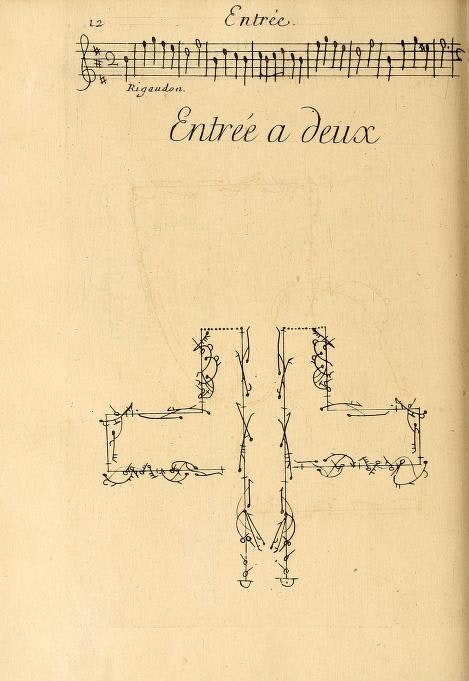
Baroque Dance Notation, more especially the Beauchamp-Feuillet notation: something an old friend introduced me to. I've been doing some reading on it since, from the odd place between supremely detailed art and academic history. Quite fascinating and beautiful, really. It would make a fascinating pattern for wall-paper. See here for more.

Image

My avant-garde ideas on interior design aside, I imagine that there are a number of constructs or golems in TRoAP that use this as a pattern for motion. It has a likeness to the stuff in The Search for the Perfect Language that inspired the Polytaxists. Presumably the hyper-detialled Appendix P version of Inquisitor uses it. Or the Terpsichorean Sodality

***

The Vikings in Clown Trousers idea, illustrated. Just try getting Hollywood A-Listers into some of those outfits.

***

Lazarus & World of Lazarus

I reviewed World of Lazarus here and re-read bits of Lazarus in the process. I was arguably a little harsh to the latter in that post (though I left out my niche pointless Soleri gripe) - there's a decent techno-thriller element to them, with plenty of in-universe documents and messages and the like. Still, 'not always good' is more frustrating than 'definitely bad'.

***

The Medici: Gangsters, Bankers, Popes

Speaking of feudalism, corporations and a family mentioned in The Dragon Waiting, another trio of Mike Walker's history plays was broadcast on BBC Radio 4. His dynastic history plays are going to get their own post soon, but these appeared in January 2023 and so get a mention here. 

Wednesday, 18 January 2023

World of Lazarus: Some Thoughts

Lazarus, come forth.

I have been repeatedly disappointed by Greg Rucka and Micheal Lark's Lazarus. It always seemed to skirt the edge of being good and ended up as, well, adequate. Well drawn (if a little too close visually to something that a high-end television studio might produce), fascinatingly detached in its depiction of violence, suggesting a great deal. It's been running on-off since 2013: Green Ronin applied it to its Modern AGE system in 2018, publishing World of Lazarus. That's where I come in.

The premise is this: the year is X + 65. In the year X, the sixteen wealthiest families in the world signed the Macau Accords and divided up the globe amongst themselves. Nation states broken or eroded by crises and catastrophe folded relatively easily. A new age of feudalism begins: there is Family, there are Serfs and there are Waste. 

Why is this setting called Lazarus? Well, each family has a champion, enhanced by the technology of the new era. They are stupendously capable in combat and may survive injuries that would be death in the unaugmented. Accordingly, if you want to kill a Lazarus, apparently you need to dismember them: therefore, each Lazarus carries a large sword, or something of the sort. A Lazarus is one of the Family, and is quite possibly a propaganda icon. The series focuses on Forever, Lazarus of House Carlyle. 

***

At this point, some of you will be rolling your eyes. I sort of am myself. Would these amoral capitalists really set up a world where the term for their chief enforcers is Lazari? Is one of them also at work on the Icarus Project?

Allow me to suggest the following, springing in part from the 'Chimpanzees in Cambridge' debate. Most grand speculative settings have in them some key element that, simply, looks really cool to somebody regardless of how much sense it makes. There's exceptions here and there, I suppose - largely I should imagine alternate history, which occasionally produces literal histories of another world rather than a thriller set in another timeline - but the beautiful pearl is created by some speck of grit in the oyster. You can extend this further, if desired - how many historians writing detailed papers on barley production in Swabian monasteries got their start reading about Agincourt?

That's probably not too controversial a thesis. But I rather enjoy (and am not alone in enjoying) settings that hold together: where vast armies don't teleport, where horses need oats and curry-brushes and horseshoes, where rulers have to acknowledge laws and customs even if they wish to ignore or trample them. There's some tension with all that and wizards or dragons or psychics or laser swords or Lazari - and resolving that is an interesting problem! Likewise, not resolving it or failing to find an adequate fig-leaf is dissatisfying: some critiques of the latter seasons of Game of Thrones focused on this. 

And so this leads back to Lazarus. Sometimes it all clicks together and works wonderfully, sometimes it lapses into smallness - not quite the 'worst of all possible worlds' version of it this discussion in the LA Review posits, but still not great. It can dwell on the few members of a Family without much regard for the greater system around them (be they Serfs or other Families - Cf. treatments of House Tully or Tyrrell). Which is what engages me about the possibilities of an RPG for Lazarus

***

So, some thoughts on World of Lazarus

  • This isn't a review of the Modern AGE system from Green Ronin, but from what I can see it looks a touch unwieldy. Characters get Backgrounds, Professions, Drives, Specialisations and more - I'm used to something a little lighter. Where's the 52 Pages for assault rifles, smartphones and defibrillators?
  • Various modes of play are suggested based on a group of Wastes, Serf or Family - survival, service and intrigue being the centre of each. 
  • This said, the specimen Campaign seems rather railroad like, darting from Scene to Scene. Waste campaigns at least should have a rather more open form of play (A Hexcrawl through contested Morray/D'Souza territory in Columbia? Guerrilla operations against Vassalovka?), and Family constraints are limited (though subtle). 
  • An Appendix contains notes for how to play as Lazari. The variant where a Lazarus is a shared PC sounds best, and most like the depictions of Lazari as military assets or political footballs. 
  • There's a nice section on how an organisation a GM creates might grow and plot to advance itself. A component I can see myself using elsewhere. 
  • The two major families in the former United States - Carlyle and Hock, divided by the Mississippi - receive the most development. This is in part due to their place in the comics, and the contrast between Carlyle's 'Longitudinal Capitalism' and what we might term Hock's pharmaceutically assisted juche is pronounced. 
  • All the same, one finds a use for this evergreen image.
  • Sub-genre taxonomy enthusiasts! Worry not! World of Lazarus has you covered: Isn't this cyber punk? .... In cyberpunk, corporations are faceless, implacable......In Lazarus, the Families are anything but faceless. These sixteen dynasties make their political dramas and infighting aggressively personal.  
  • Grumble One: Why do so many of the Families dress in business casual? What sort of Neo-Feudal future is this?
  • Grumble Two: If you are including maps of a setting that is dynamically changing (EG, Rausling absorbing Bittner territory) those maps should be clearly dated. That those maps have the Americas at the centre is understandable (see above) if hardly comfortable.
  • Before the aforementioned absorption. 

  • A nice touch of the worldbuildng contained in Lazarus is that not all the families grew from big obviously sinister tech or pharma companies: sugar processing, entertainment, insurance and 'Elfsaga video game cartridges' enabled some of them to get their start.
  • There's some appropriate variations on the Family-Serf-Waste schemee in different territories: different terms used or attitudes taken. (EG, Carragher serfs refer to themselves as Workers and shun conspicuous consumption. This does not necessarily make their lives any less comfortable.)
  • Inamura's intensive use of robotics for labour feels, if not stereotypical, then uninspired (Japan = Hi-Tech). One notes the problems of an ageing Japanese population in the present day, though this seems like it would be corrected by one means or the other in X + 65.
  • Armitage is based in 'The United Kingdom of Great Britain and Ireland-Made-One'; the head of Armitage eventually became the Duke of Lancaster and benefited by the marriage of his daughter into the Royal Family. The authors of World of Lazarus note: 'Armitage arguably benefited from a culture more readily familiar with its feudal roots and class system than almost any other Territory.' Hmmm.
  • The Armitage Lazarus is a Bond pastiche named Sir Thomas Huston, complete with Idris Elba references.
  • Minetta (apparently descended from a family associated with the Dutch East India Company) is described as 'the last true Capitalist power' for being more centred on trade than territorial dominance, and relatively laissez-faire internally. They are willing to work with 'local powers—be they warlords, junior signatories, religious leaders, or others', which explains how they've kept hold of Iran.
  • The effects of climate change are felt in Lazarus: indeed, 'The vast majority of the Meyers-Qasimi Serf population live in idyllic, microclimate-controlled safety in cities such as such as Tel Aviv, Riffa, Cairo, and Dubai'.
  • Speaking of which, a recurring security issue for Meyers-Qasimi is religious fundamentalism. The old world does not die so quietly.
  • Vassalovka was once a Lesser House in service of Sidorov, the initial signatory. The vastness of their territory means they have given up on enforcing a shared culture and a great deal of autonomy is given to Lesser Houses.
  • The impact of social media seems to be downplayed in Lazarus - perhaps unsurprisng in a setting dreamt up around 2012. Still, later material on Vassalovka does have a certain emphasis on Grief Farms and social media personalities. 
There's more I could note for your attention; I'm not certain it's super necessary to go over tech levels or what have you. Does World of Lazarus provide the information you'd need to write your own material in this setting? Yes. Do you really want to? Well, that's the question. I don't suppose I've sold it marvellously here. There's potential untapped. But I wouldn't tap it in this system.


Thursday, 13 February 2020

Rogue Trooper: Nightmare Machines, Endless War and the First Person

Rogue Trooper began life in the British comic 2000AD, the work of Gerry Findlay-Day and Dave Gibbons. The time? The future. The place is Nu-Earth, a paradise world at a hyperspace junction devastated by years of war between two great alliances, the Norts and the Southers. This planet is so poisoned by chemical weapons that in most places humans cannot survive without a sealed chemsuit.

Hence the Southers created the GIs - Genetic Infantrymen - who can survive the poison atmosphere with no mask. But in their first action they were betrayed by a Souther general and massacred. One survived to hunt down the traitor outside the military chain of command- the titular Rogue Trooper. He is accompanied by the remains of his friends, personalities implanted in biochips attached to his war-gear, still speaking to him as he roams the poison wastes.

Enough of the summary. This is inspired by a reread of the first omnibus volume put out by 2000AD. There's some of Dave Gibbons's characteristic black and white art in that link, and you may conjure his name in connection with another blue post-human.

Originally found here: http://www.bbc.co.uk/cult/comics/2000adstrips/rogue/roguetrooper01.shtml
Many thanks to the chaps at the BBC.

The lone solider figure of Rogue is a familiar enough one, haunted literally and figuratively by his dead comrades - hoping not just to find the traitor, but to find new bodies for the biochips in his gear. His progress is told episodically, with miniature tale after miniature tale linked together - as one might expect from a weekly comic.

His own side, the Southers are rarely depicted in full view. We see odd units and the occasional glimpse of a distant (literally, on a satellite) command 'Millicom'.

(There is a constant interweaved future slang: Nu-Earth, the ruined city of Nu-Paree, with the Mitterrand Tower, 'Synth' applied to everything, the Nort exclamation of 'Nain!' or 'Stak!'. A bit goofy, maybe, but it gives a rolling gentle distinction to the language.)

Souther speech and habits look rather Anglophone; in time we would even see a Nort push into the 'Dix-i front'. Perhaps somebody had spotted the North-South angle. Either way, there is a sprinkling of American Civil War references: the cities of Memfizz and Nu Atlanta, the Georgia Volunteers, the song 'When the South goes marching in', the historic battle of Mek-Bull Run - even the port of Harpo's Ferry! [John Brown's body is a-rolling in it's grave...]

The Norts, however, are a far more interesting bunch. The Civil War angle is meant to perhaps imply some equivalence between the warring sides (in that both sides in a civil war are part of the same nation - they are kindred), though this is hardly how the Norts are portrayed. Inspired by the Nazis of Second World War comics (with a few Slavic overtones), they are by turns vicious and ugly, wearing full-face masks rather than the armoured astronaut-like Southers. Of course, we see far more of them. Rogue will walk into a firefight with some beleaguered Souther boys against an oncoming Nort force with superior weapons and help defeat them.

And such weapons! Guns, yes, but also vibro-daggers and lazookas. 'Decapitators' - hovering mines full of shrapnel. Automated sentry pillboxes. Drill-probes emerging from trench floors. Nort desert raiders riding genetically engineered 'Stammels'. Mountain troops on motorised snowboards. 'Blackmare' tanks the size of houses. The 'hard rain' of chem-suit piercing flechettes. Plantlike barbed wire, that traps and strangles its victims. Hallucinogen spraying tanks, that can appear as nightmarish vast spiders or snakes - or a float full of flowers and women. Laser-projected propaganda 'Holo-beam messages'. Poison saboteurs, nicknamed by the Southers 'Filth columnists'. The bizarre sight of the Sun Legions, Nort troopers apparently hang-gliding into battle from orbit (a notion so absurd they were later said to be extinct).

Well, what's the point of all this? Bizarre weapons and over-complex plans have some delight to them, to be sure. The need for a new hazard every few weeks also must have fuelled some creativity in the writers of the first run. But their is a sheer variety of complex industrial might levelled against the one lone trooper. It exudes a certain kind of atmosphere, found in a certain sub-genre.

The Protagonist has a weapon or two, and belongs to a nebulously defined organisation, often without clear ranks. The Antagonists are many, belong to a vast hierarchy and a equipped with startling variety. Not the Lone Wolf of Rogue Male, but something bigger, pulpier, set among the stars. Lone Space Wolf? [Sorry.] It's a matter I've considered before.

Of course, the Nort multiplicity of organisations (Army, Navy, Scum Marines, Sun Legion, Kashan Legions) is presumably meant to conjure up the different forces of Nazi Germany - the Wehrmacht, the SS, the SA, the Gestapo. Nonsense, in some ways - the Allies had quite as many different organisations and they could be just as characterful. A Gordon Highlander or Bengal lancer is a picturesque a sight as a soldier in full SS black.

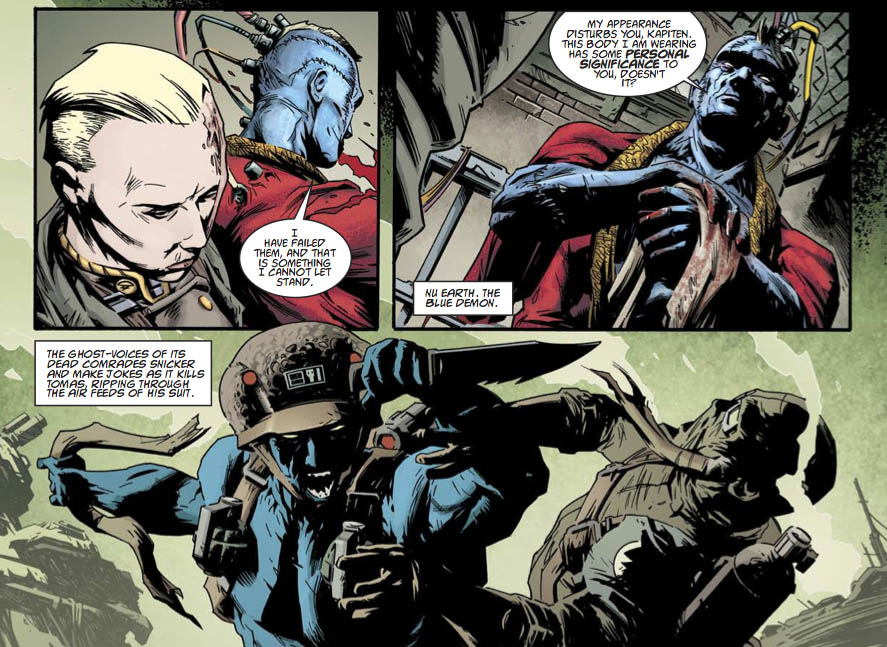
Rogue Trooper has had a few spin-offs after the original run fell apart after the traitor general was found; Jaegir is perhaps the best, though it suckles from the teat of the grimdark rather. It tells the story of a Nort Kapitan-Inspector in the 'Office of Public Truth'.

Complete with traumatic memories of Nu-Earth and the protagonist of the original!
From Jaegir: Circe, 2000AD Progs 1893-1899

It was made into a video game - a First Person Shooter, for which its narrative was almost perfectly suited. A lone soldier, the superior of any other, fighting hoards of enemies who can prove a challenge both in quality and quantity? Unfortunately, I am told by a relative who actually played it, that it was not much good. Duncan Jones is apparently adapting it for the screen - which will hopefully be better.

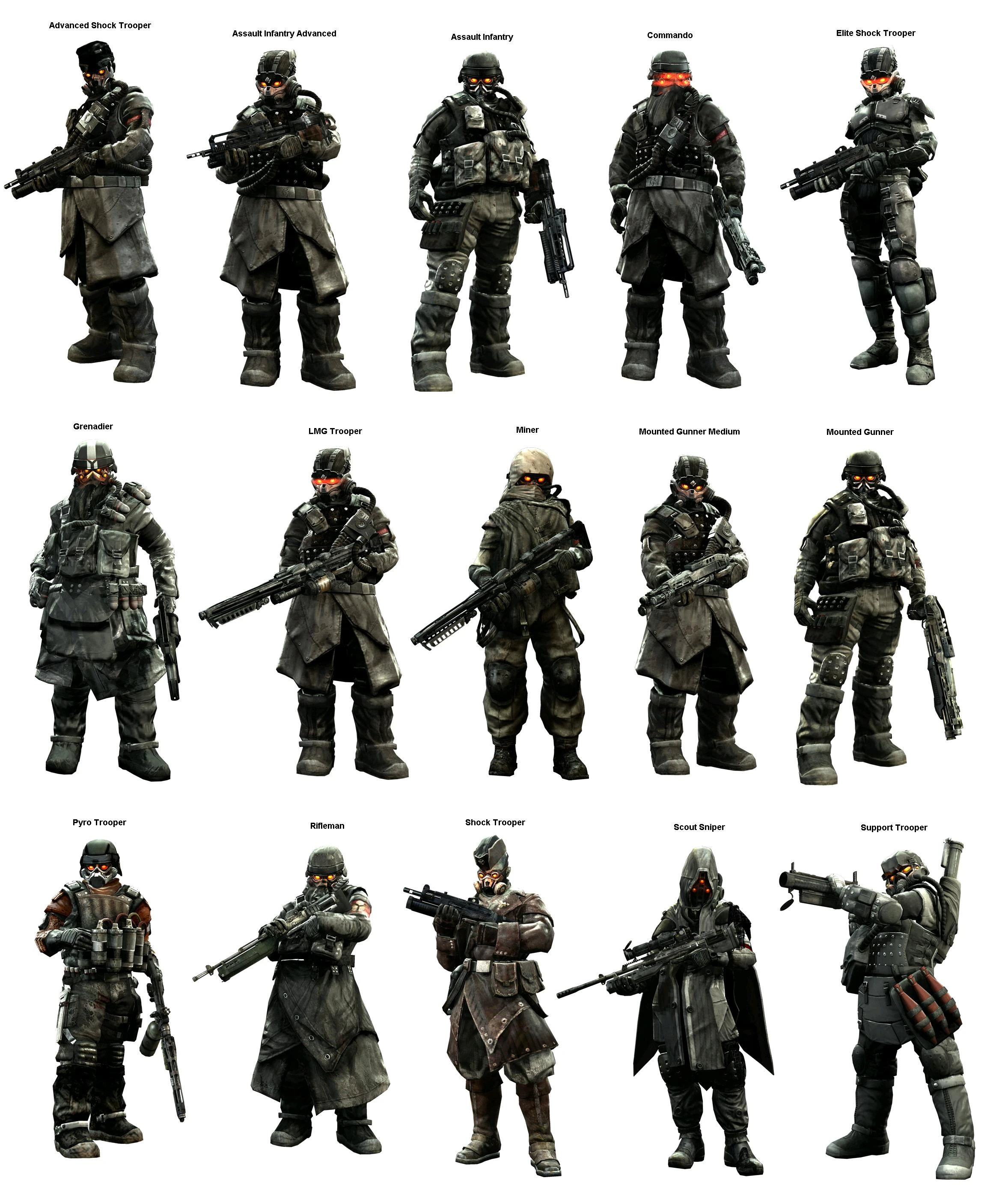
Speaking of FPSs, however, Rogue Trooper surely has a descendant in Killzone. I did not play them, but this brief series of games had a war between the Interplanetary Strategic Alliance (boring, vaguely American) and the Helghast (cool name, gas mask, black armour, British accents, swastika-like emblem). I invite you to consider their respective wiki pages.

Quite what the difference is between a Shock Trooper and an Assault Infantryman, I should not like to say.
Found here: https://killzone.fandom.com/wiki/Helghast_Army

If the above does not suggest a Rogue Trooper parallel, perhaps the hazardous, polutted Helghan will.

It's an odd question - why not have well-defined Protagonist factions? Time is one factor - how long do you have to tell your audience about a place? A negative portrayal is probably quicker to rouse up than a positive one. The slow start of Peter Jackson's adaptation of Lord of the Rings allows for this, having to do quite a bit of heavy lifting for a presumed newcomer to Tolkien. Even here, of course, the portrayal is mixed: The Shire is innocent, but ignorant. Rivendell is the seat of wisdom, but lacking in the power it once had.

Why can I not get excited about the prospect of the ISA Constitution and Statue of Liberty? An ill-defined state can be whatever you want it to be, of course. Perhaps I'd rather have that than Gears of War with it's Coalition of Ordered Governments, created seemingly solely for the pun but giving obvious direction towards an authoritarian angle. Though the comparison between the Evil Empire (rules-based, governed, uniformed) and the Alliance of Freedom (anyone can pick up a gun and join) is one that may appeal to the libertarian. More than all this though, the lack of detail is sort of insulting - Shabby. Incomplete.

(The FPS antidote to the Lone Wolf may be early Call of Duty. As this chap lays out at length, each narrative gives a view of several units of ordinary men on several fronts. Call of Duty 3 may tread well-worn ground in Normandy and Western Europe, but does so switching between Americans, the British, the French Resistance, Canadians and Poles.)

Well, it all makes me appreciate tabletop wargames all the more. Each faction to be laid out with a variety of fascinating, characterful units; each to receive a ration of lore to back them. Rogue Trooper probably gave something to the feel of Warhammer 40,000; 2000AD was certainly an influence. I suppose this is what I enjoy in my war stories, or any story of great deeds. Multiple perspectives, variety, details, verisimilitude. I've been reading The Cruel Sea; Monserrat has some of these. Tom Clancy also, sometimes. I'm not sure that sort of story is always possible on film, however.

I have room for the mythic, indeterminate, bizarre or pulpy, and enjoy Rogue Trooper. There's something almost Passion-Play like about it. But it has some odd echoes elsewhere.