Showing posts with label Art. Show all posts

Monday, 19 May 2025

Phases of the Moon of Gomrath

I recently acquired an old copy of Alan Garner's Moon of Gomrath. I recognise that this name may not be a familiar one to readers. To my mind he is best described as an author of low fantasy, very heavily rooted in certain parts of the British countryside - not as in a generalised sense or spirit of a region, but as in very precise, real bits of Cheshire. If Tolkien is all languages and chronicles, Garner is archaeology and parish registers. I encountered him as a child (perhaps too young), but his works always seemed to need a little push to fully get, which I couldn't (wouldn't?) give*. (And I suspect that the business of adulthood and the effects of the internet mean that I never quite will get it.) Indeed, while I think he will still be praised by writers in (say) forty years, I wonder if he will be read or circulated in libraries. This is for reasons other than the usual declining literacy notions: there is something in Garner that probably only makes sense if you've been twelve and stayed in a cottage with no television and precious little radio reception in the middle of nowhere.

Anyway, you can compare and contrast all this to the various opinions collected on Wikipedia

To return to The Moon of Gomrath. Two children, a brother and sister live on Alderley Edge. This is a sequel to The Weirdstone of Brisingamen, which introduced them to the supernatural and fantastical. They don't quite literally 'save the world' but they have thwarted evil on a fairly grand scale. Is it implausible that so many of the great secret powers of the world should be tied to this bit of Cheshire? (How parochial, how nationalistic....) Implausible? Maybe, but that rather misses some of the point: without being too didactic, the notion that the battle between good and evil can be waged in your back garden should not be a surprising one. 

Ignore the scene-setting: the main point is this. There is a passage when something that you might as well think of as the Wild Hunt is summoned up. This chapter has stuck with me, thrilled me for years (even as other bits of Garner didn't)**.

A sample: 

'Wakeful are the sons of Argaton! Wakeful Ulmrig, Ulmor, Ulmbeg! Ride, Einheriar of the Herlathing!'

A breeze stirred the mist into dancing ribbons, and the flames trembled and it seemed that there was movement within them, and voices. 'We ride! We ride!' And out of the fire came three men.

Their cloaks were white, fastened with clasps of gold, and a whip was in the hand of each. Their hair was yellow, tight curled as a ram's head, and their horses white as the first snow of winter on the black mountain of the lean north wind.

Other such horsemen are woken:

'Wakeful is the son of Dunarth, north-king, mound-king! Wakeful is Fiorn in his hill! Ride, Einheriar of the Herlathing!'

'I ride! I ride!'

A lone figure came from the trees. His face as stern, heavy-browed, his beard plaited, two-forked, his mane black, awful, majestic. He wore a tunic of coarse hair without any cloak, and a round shield with five gold circles on it, and rivets of white bronze, hung from his neck. In his hand was an iron flail, having seven chains, triple-twisted, three-edged, with seven spiked knobs at the end of every chain. His horse was black, and gold-maned.

Another:

'Wakeful are the sons of Ormar! Wakeful Maedoc, Midhir, Mathramil! Ride, Einheriar of the Herlathing!'

'We ride! We ride!'

Their cloaks were blue as rain-washed day, their yellow manes spread wide upon their shoulders: five-barbed javelins in their hands, and their silver shields with fifth knobs of burnt gold on each, and the bosses of precious stones. They shone in the night as if they were the sun's rays. The horses' hoofs were polished brass and their hides like cloth of gold.

Well, there's the pattern.

Now, before I continue, allow me to say that I like and respect Garner's work. 

Having said that, you know I'm now going to say something odd. Here it is: these are, on some level, silly. Even at the age of nine or so, I knew that a flail with than many chains was....unlikely. A five-barbed javelin might work, but seemed a bit unnecessary if not fishing for eels. It was thrilling, but almost a little stupid (and not in an OTT way, as depictions of Warhammer and chainswords). And all this set alongside Garner's other historical detail and sense of place. Even in the descriptions of the 'Einheriar of the Herlathing' the images of patterned shields with 'burnt gold' or 'white bronze' provide a note of solid, tangible grave goods out of the untracked past. 

Note that most of the fantastical beings that carry weapons in Gomrath carry fairly ordinary swords and things. The Einheriar of the Herlathing are part of the 'Old Magic', deeper and wilder. So, part of their weapons and accoutrements is meant to show this: a five-barbed javelin is less a five-barbed javelin than it is an indication of some heaviness, some great mass of reality in them that can only be expressed by elaborate items and heavy colours. Don't confuse this approach with other things: it's different to 'The dread spectre held something that looked like a scythe'.***

Does this mean we should never see the Einheriar of the Herlathing? Now, obviously, the mind's eye will do its work here, and Garner has given a detailed description that could allow one to make an image of them. Indeed, they have. The copy I found is below.

Cover image by George Adamson.
Laid out with the lovely Albertus (lovely until one gets to the ampersand, that is).

And here is another cover that I recall in the local library. 
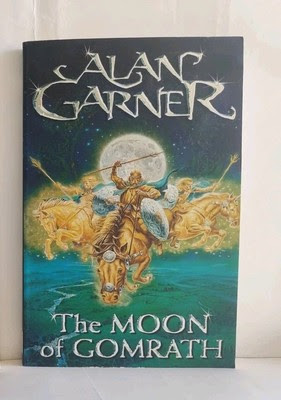
This image found on Ebay. The cover to the Collins edition; I believe this is by David Wyatt - who I have learnt did any number of fantasy covers from my youth (I don't think that this is one of his best, but I do remember it - though happily, I'd forgotten that sparkly font for Garner's name). 

Anyway, I think that it will be agreed that the above depict A) Fiorn, mound-king and B) Maedoc, Midhir, Mathramil, the sons of Ormar. Working from my paragraph above on the 'thrilling but silly' nature of their descriptions and the meta-real (perhaps) idea of the horsemen and the hunt, I'm almost minded to suggest that you shouldn't try and depict these figures at all. 

It's not that I believe it could never look good or right (though there's surely an element of that). Fantasy art has shown itself more than able over the last few decades to depict remarkable and elaborate arms and costume in a satisfactorily realistic, lovingly detailed way. Somewhere, there's no doubt an artist whose version of (say) the Horsemen of Donn utterly succeeds. 

But would this flatten it? Undo it? Pin the drifting butterfly to the card? Collapse the wave function? Of course, given that I'm writing about this one chapter of a children's novel from the 1960s, the covers above haven't utterly undone or obliterated the worth of Garner's work. But I think it would be a mistake to film or animate Gomrath. Other books by Garner are fair game (and indeed have been adapted into television series).

To end: two things you can chew over. Firstly, are there any more uses of description like those above that you can picture? Secondly, is there anything else in fiction of this kind that you think really shouldn't be depicted? I recall a friend once saying that there should never be an attempted map of Gormenghast. 


*I'd have never understood Red Shift if I had found a copy at the time.

** I wasn't thinking of it at the time, but if a recording angel of the celestial bureaucracy were to tell me that it inspired parts of The Orrery of Golems, I'd have little reason to doubt them. 

*** To say nothing of the discussions one sees on the Wings of the Balrog.

Saturday, 16 November 2024

September-October 2024 Miscellany

Orlando Furioso

As referenced previously, I have been reading Orlando Furioso, the work of Ariosto. In some ways, actually saying commenting on this is superfluous - it has been so influential, whether it be known or not, that further remark is probably less than useful. 

I examined previously one segment of it, perhaps the wildest (in terms of sheer wonder). But the piling up of overlapping quests, ensorcellments and duels is most impressive - and will probably bring to mind the longer-lasting kind of heroic fantasy series (be it a novel or something animated).

Interestingly, there's little hint of the 'National Epic' about it. The specific ties to place and people relate to patrons and local rulers in Italy. No wonder it drifted out of memory in a (Romantic, post-Wagner) world. 

***

Speaking of, I recently watched Die Walküre for the first time. Perhaps you won't be so very charmed by Siegmund and Sieglinde's circling interaction, but the frustrated machinations of Wotan, caught between ambition, law, familial affection and his own prideful nature are fascinating. It's the sort of grand conflicted potency that still animates certain strands of popular media.   

***

Megalopolis, dir. Francis Ford Coppola

I don't generally bring to my readers' attention something I think less than good, or at least interesting. I suppose this is an exception.

Perhaps you've already seen the critical responses. This film has a poor reputation. I went in unknowing (beyond certain actors and 'America as modern Rome').

What a strangeness; what a lack of subtlety and deftness and invention. Perhaps we may expect that from a film calling itself a fable, that implicitly develops on the broad lessons and characters of Fritz Lang's Metropolis.

THE HEART MUST BE THE MEDIATOR
BETWEEN THE HEAD AND THE HANDS!

But then it does so while spinning together an over-complex plot, a series of lush visual references that are far too specific (in their 2024-ness and their Roman-ness) to make sense. Cf. again Lang.

  
[You can find this intertitle on a shower curtain
In order to imply what about your ablutions?!]

This goes doubly so when referencing the Catiline Conspiracy, and all the associated cultural connotations. If you are going to invoke Marcus Tullius Cicero*, it would be a mistake to place him as a power-hungry blowhard. Certainly a Cicero-esque figure can be an antagonist, an opponent - but what a waste to invoke a great public speaker and lawyer, and then equip him with the poorest of arguments. This is aside from the various suggestions the trial of a traitor to a republic might bring to mind. 

If it's a fable, it's far too specific. If a fantasia, it's too obvious. If a 'relevant' political-social drama in an uchronia, too blatant and unnatural. 

***

A recent discovery (when looking up images of Balaam and his Ass) was Ephraim Moses Lilien (1874-1925). A Jew, born in Austro-Hungarian Galicia - now in the western part of Ukraine. He became an artist, with a line in both Art Nouveau and Orientalism.


See this image of a young Moses (and an old Moses):


or an older King David:

Note the Lammasu.

His image of Judea is a Near Eastern people among Near Eastern peoples. To say nothing of a muscular one: consider Moses above, and this (bearded, explicitly masculine) angel confronting Balaam.


From all that, it may not be a surprise to learn that he was involved in early Zionism, even visiting then-Ottoman Palestine. 

I don't mean to imply that his work only focused on such themes - he was an illustrator who took commissions. Including some lovely bookplates.


This bookplate is straight out of E.R. Eddison.

At any rate, I'm quite enchanted by some of these.

Samson in captivity. Remind you of something?

An invite to the Inhalatorium

***

The Dark Brain of Piranesi and Other Essays, Marguerite Yourcenar, 1962

This pairs (to a certain extent) with Jacques Barzun, whose Dawn to Decadence I've been working through. In both cases, we have a French writer, writing in English (Yourcenar lists a translator, but at the time most of these were written, she had lived off the coast of Maine for many years - I'm moderately sure that translator here means 'editor for Anglophone consumption') on a variety of literary and historical topics from across Europe. Piranesi is front and centre, but there are pieces on Thomas Mann, Agrippa D'Aubigne and the Swedish writer Selma Lagerlöf (never heard of her before). So, in part, this is a fascinating survey and introduction. Unlike Barzun, of course, it isn't drawn into a grander scheme. 

So, these are new (to me). They are well-situated in European letters. They are also beautifully written - delightfully clear and frequently beautiful. To say nothing of funny:

"A client of necromancers and astrologers, Catherine [de Medici] would doubtless have been less surprised to find herself accused of the crime of sorcery by d'Aubigne than acquitted of it by scholars who no longer believe in the powers of the Evil One."

As with the Memoirs of Hadrian, throughly recommended. 

***

It's been interesting reading reviews of Hugh Cook over at False Machine - see here and here. Just from the reviews, The Worshippers and the Way sounds oddly like Punth avant la lettre - I'd be fascinated to hear from any readers who could say for sure!


*As once portrayed by Anton Lesser

Thursday, 15 February 2024

Early February 2024 Miscellany

A little less highbrow than other iterations, but perhaps of use all the same.

***

Are you in need of a random background table for your next Character? Get out three d1000 and roll them in any order.

Using the United States Department of Labour's Dictionary of Occupational Titles we have a wealth of material! This was published between the 1930s and 1990s, and clearly has roots in that style of mid-century managerialism and compromise between state and corporation. Flipping through entries brings to mind all manner of stereotypes about vast sprawling heartless bureaucracies - but you shouldn't spurn it for this reason. In its precision (or, rather, precise tone) and comprehensive overview, it can suggest a possibilities of focus one never contemplated otherwise. 

Example: You roll:  231 - 503 - 034

There's no exact match, but we have something either side.

230.687-010 ADVERTISING-MATERIAL DISTRIBUTOR (any industry) alternate titles: distributor, advertising material

    Distributes advertising material, such as merchandise samples, handbills, and coupons, from house to house, to business establishments, or to persons on street, following oral instructions, street maps, or address lists. May be designated according to type of advertising material distributed as Handbill Distributor (any industry); Pamphlet Distributor (any industry); Sample Distributor (any industry).

GOE: 07.07.02 STRENGTH: L GED: R1 M1 L1 SVP: 2 DLU: 77

and

235.132-010 CENTRAL-OFFICE-OPERATOR SUPERVISOR (tel. & tel.)

    Supervises and coordinates activities of CENTRAL-OFFICE OPERATORS (tel. & tel.) engaged in operating telephone switchboards: Conducts on-the-job training for inexperienced operators. Assists operators in placing unusual types of calls. May discuss service problems directly with customers. Performs other duties as described under SUPERVISOR (clerical) Master Title.

GOE: 07.04.06 STRENGTH: L GED: R4 M2 L3 SVP: 6 DLU: 77

Round up or down, according to choice. 

Not enough for you? Well, lets get out of the clerical and sales section.

689.387-010 CLOTH GRADER (textile) alternate titles: cloth classer; hand inspector; seconds grader; seconds inspector; table inspector

    Classifies cloth into grades according to number of defects: Examines cloth for defects marked in previous inspection and determines whether corrections can be made to restore cloth to standard quality. Cuts defects from cloth with scissors or routes cloth to mending, dyeing, or refinishing department for reprocessing. Classifies cloth that cannot be restored to first quality according to standards for various grades. Records disposition of cloth rehandled. May inform weaving room of repeated imperfections requiring loom adjustments.

GOE: 06.03.01 STRENGTH: L GED: R3 M1 L2 SVP: 5 DLU: 77

--

550.685-010 BATCH MIXER (soap & rel.)

    Tends mixer that compounds cleaning powder: Opens valves to admit specified quantities of ingredients into mixer or weighs and dumps ingredients into mixer, using scale. Presses button or moves lever to activate mixer that blends ingredients for designated time. Stops machine and opens valve to discharge cleaning powder into storage bins. May draw sample of blended ingredients for laboratory analysis. May keep production log.

GOE: 06.04.19 STRENGTH: M GED: R2 M1 L1 SVP: 3 DLU: 77

--

613.362-018 ROUGHER (steel & rel.) alternate titles: bulldogger

    Operates roughing mill roll stands to reduce steel billets, blooms, and slabs to specified dimensions, using knowledge of rolling practices and steel properties: Reads rolling order to determine setup specifications. Installs rolling equipment, such as roll stands, guides, bar turners, and repeaters on rolling line, using handtools, bars, levers, and sledges. Moves controls to set specified draft between rolls at each stand. Observes color of heated steel to determine rolling temperature and starts roughing stands. Examines product passing through mill for surface defects, such as scratches and cracks. Verifies specified gauge of product after each pass, using calipers. Gives directions to mill crew in readjusting roll draft and realigning guides. May set up and monitor computerized roughing roll stands. May be designated according to type of mill operated as Rougher, Bar Mill (steel & rel.); Rougher, Hot-Strip Mill (steel & rel.); Rougher, Merchant Mill (steel & rel.).

GOE: 06.02.02 STRENGTH: L GED: R3 M3 L3 SVP: 7 DLU: 78

--

737.387-010 DROP TESTER (ordnance)

    Tests cartridge primers for sensitivity to impact by dropping weight onto sample primers from measured heights: Secures primer or primed cartridge case in test fixture and positions firing pin over primer. Raises steel ball in electromagnetic holder to specified height on calibrated column. Presses switch to cut power from electromagnet which drops ball onto firing pin in test fixture to detonate primer. Tests groups of primers from same production sample at several specified drop-heights, and records percentage of fires and misfires at each height. May plot test results on graph to develop primer sensitivity curve, or apply standardized statistical formulas to estimate sensitivity characteristics of entire production lot of primers.

GOE: 06.03.01 STRENGTH: L GED: R3 M3 L2 SVP: 3 DLU: 77

--

[Obligatory snigger.]

825.361-014 VIBRATOR-EQUIPMENT TESTER (machinery mfg.) alternate titles: tester, vibrator equipment; top-lift and automatic-window repairer

    Tests electrical and mechanical vibrator feeders and conveyors for conformance to specifications: Clips cable of test board to electric vibrator equipment. Turns dials and observes meters to operate electric vibrator equipment at specified cycle, voltage, and amperage levels. Holds end of scale against vibrator equipment to pick up vibration. Reads scale mark that shows distinct double image and determines vibrating frequency on conversion chart. Starts motor of mechanical vibrator equipment and verifies vibrating frequency. Advises ASSEMBLER (machinery mfg.) to add or remove vibrator bars from electrical vibrator equipment or weights from drive shaft of mechanical vibrator equipment, to correct vibrating deficiencies. May inspect vibrator equipment for loose bearings and bolts, using stethoscope. Records test data.

GOE: 06.01.05 STRENGTH: L GED: R3 M3 L3 SVP: 6 DLU: 77

-- 

I find some of these quietly fascinating. "Did you know that XYZ was a job? Do you reckon it still is?" (Which presumably says something a little unflattering about a desk worker as myself.) Anyway, one to use for Electric Bastionland?

***

Does Heraldry seem too mainstream for your new campaign? Do you spurn mon that you may ward off the label  'Nipponophile'?  Perhaps you can consider horse-racing colours!

***

Charles Sargeant Jagger: a British sculptor, whose most prominent work is the Royal Artillery Memorial in London. The clearly-lined central howitzer is certainly eye-catching (Wikipedia calls it Phallic). The artillerymen round the edge are fascinating pieces of realism - the gunner's harness full of shells and exposed, bulging forearms are noteworthy.

(Said shells are definitely not ones meant to go in the howitzer - which is a breech-loading 9.2 inch howitzer, firing an eye-watering 290lb shell.)

His work in less specifically historical pieces have an more distinct Art Deco line - as, perhaps, this image of Britannia, or these lions. He died in 1934, but this all looks like it would fit in quite well to something in the 50s - as the Festival of Britain logo

To return to an old punching-bag, it's something Fallout: London might have found of use. Returning to that soon-to-be-completed project, incidentally, there are a few signs of something a trifle less stereotypical - as the use here of 'Protect and Survive' iconography. Still a bit less than focused, though. ('Constable Cruel' indeed!)

***

A recent find: Urgent Copy, a 1968 collection of literary essays and reviews by Anthony Burgess. I have found that I prefer Burgess's non-fiction to his fiction (if you want a flavour of both, try 1985), so was delighted to find this. Burgess is clear in his introduction that this is journalism (hence the title) - but I think it a rung or two above that. A good review, which hasn't been written with too many refereences to that year's fashions or people or debates can help you pin down your own views by acting as a fixed point. 

A certain amount of it, therefore, is given to decades-old literary debates. I have little objection to this; I find Burgess's style fairly readable and have enough assorted background knowledge to skate through pieces on things I've never read. It's not like this is homework, though I suspect the sheer number of authors mean that Urgent Copy could profitably be used in an intense course surveying English literature. 

Further, there is a use in reading over old literary debates - aside from the fact that you may find a faction to your liking. If you know how this stuff has sintered out in the past, there's an extent to which you won't get bent out of shape by it when it crops up again. Cf. These discussions of Milton.

Burgess's subjects include: Milton, Kipling, Dickens, Joyce, Shaw, Saul Bellow, Waugh, Greene, Harriet Beecher Stowe, Bagehot, Marlowe, The Brothers Grimm. The pieces sometimes relate to a new book or a new edition of some work (as the first volume of Waugh's autobiography, or Robert Graves's 1967 translation of The Rubaiyat - inevitable comparison with Fitzgerald). 

There is also a few pieces dealing with censorship and cultural shifts - 'What is Pornography?' is a fascinating essay to look back on. 

More diverting is Burgess's review 'The Democracy of Prejudice' of Fifty Works of English Literature We Could Do Without by Brophy, Levey and Osborne. It steps away from the discussion of an author's work or influence, and instead looks at a contemporary piece of popular criticism. Burgess is in an entertaining and vitriolic mode. It's curiously familiar, modern-feeling both for a 'Digital Era' spiky, combative style and 'Who stays in the canon' content and/or discussion. I know next to nothing about Fifty Works... other than what I have read of it. Here and here are two modern reviews. I note in passing that I have read perhaps half of the Fifty Works mentioned (often without the urging of a schoolmaster, sometimes even on this blog!) before ever hearing of Brigid Brophy, Michael Levey or Jonathan Osborne. 

[If you wish to review the contents for yourself, check the first exterior link.]

You may wish to compare this to Burgess's own Ninety-Nine Novels: The Best in English since 1939 — A Personal Choice (An occasionally eclectic list, Cf. PJS-led discussions of the Hidden Genre Canon). The International Anthony Burgess Foundation has a podcast centred around these - I've not found the few I've listened to terribly interesting so far, but you may differ. 

***

There has been a second series of the radio series Medici, subtitled 'The Inheritors'. The first series was discussed as part of this post, along with much other of Mike Walker's work. The inheritors in question are Alessandro de Medici and Catherine de Medici.

Alessandro I hadn't heard of - granted, he died fairly quickly in an assassination attempt as part of a sexual encounter. Catherine Johnson wrote his episode, which dwells on his reputed Moorish ancestry. I've only made a brief survey of the field, but this appears to be at least somewhat disputed by historians. Certainly, he was nicknamed 'The Moor' and the rumour that his mother was a slave was repeated after his death. His portraits certainly show a man with darker skin and tight curly hair - though obviously in the same costume and context as other wealthy Italian men. 

Johnson writes Alessandro's episode as if his Moorish background was basically true....with some caveats. Firstly, the narrator is Alessandro himself - who feels the sting of these insults, as he might either if they were true or if he felt they indicated some truth about him and how he would never be accepted in Florence (&c, &c.) There are some scenes with his mother, who appears as a beggar - but no-one other than Alessandro seems to speak with her, and he downplays the encounters. Could he be hallucinating? It's an interesting approach, and one that I think can be deployed fairly well on Radio.  

I'd heard of Catherine, of course - as a noteworthy personality of Early Modern France. Her presence as an outsider is emphasised across two episodes (Alessandro gets just the one).  The net of personages - King, Heir, Queen, Mistress, Catholics, Huguenots - is an impressive feature of the two episodes, and I would call it a good primer on the mood of Early Modern Europe before the Thirty Years War. One to contemplate for would-be WFRP games?

No Anton Lesser, sad to say. There may be repercussions...

"Gentlemen - the Medici have spurned us for the last time!"

***

So, apparently principal photography has concluded on the Rogue Trooper movie. Which I rather thought might have withered on the vine. Website here; if you wish to gen up on the Genetic Infantryman in advance of the film and - doubtless - become the envy of your friends and co-workers, you may read an old blog post on it here

Tuesday, 8 August 2023

GW's Jackson's Tolkien's Middle-Earth

In a post over at Tales of the Lunar Lands I threatened to put together a grouchy nostalgia-fuelled comparison of Middle-Earth designs made by Games Workshop. Well, this is it - although I don't want this blog to become my Bespoke Whinge Manufactory. So the aim here is, if you'll pardon the phrase, ad astra per nostalgia

A note on my relationship with Tolkien: I am of an age to have seen and enjoyed the Peter Jackson Lord of the Rings films during their first release into cinemas. However, even then I was in a position to recognise the problems of adaptation. I had read The Hobbit and The Lord of the Rings, and portions of The Silmarillion. I had leafed pretty thoroughly through a copy of David Day's Tolkien Dictionary and seen the variety of illustrations there - Ian Miller, Jaroslav Bradac, Victor Ambrus and others. I had also found, in the local library, a copy of the BBC Radio adaptation of Lord of the Rings on CD (Ian Holm as Frodo, Bill Nighy as Samwise, John Le Mesurier as Bilbo. Music composed by Stephen Oliver).

All that is to say that I was capable (as a callow youth) of recognising the deficiencies of and gaps in Jackson's films - beyond the simple 'They left out Tom Bombadil!' approach. The use as broad comic relief of Merry, Pippin and Gimli. A skateboarding Legolas (however briefly). There was something off, to my youthful image of the Medieval world, for the armies of Minas Tirith to be clad in complete plate armour.

But they still had something to recommend them. And I am inclined to believe this still: they could have been considerably worse. A few years on, 'Good with Distinctive Flaws' seems like a near miracle.

I saw The Hobbit films. Even for research into this post, I have chosen not to see them again. If you are reading this blog, it is more than likely that you have seen them yourselves and have well-developed opinions on them.

At the same time as the Jackson LoTR films were being released, Games Workshop started putting out a range of miniatures and rules for the Lord of the Rings Strategy Battle Game. There was cooperation with Jackson and New Line for this: the GW LoTR SBG Frodo looks like Elijah Wood, their Uruk-Hai are painted with the purply-red skin tones of the films. Designers Alan Perry, Michael Perry and Alessio Cavatore got cameos in The Return of the King as Rohirrim. My friend group got interested, as did I. We were apparently not alone - according to White Dwarf, the Fighting Uruk-Hai box outsold Space Marine Tactical Squads that year. 

The production of miniatures is easier than that of cinema. So GW delved deeper into Tolkien's world than the films could. Here we return to my initial post in the Lunar Lands - accordingly, there are designs from GW that would later be contradicted by The Hobbit films. 

So, on the left is GW's Radagast. Perhaps a bit basic, a rather simple 'nature wizard' - but quite logical as an explicitly rustic, nature-orientated version of Ian McKellan's Gandalf. On the right is a model of Radagast as portrayed by Sylvester McCoy. I rather think there is something off about portraying an Istari with Ragged Trousers.

Here, into the bargain is an interior illustration from Shadow and Flame showing Radagast.

Who looks like he wants you to get off not just his lawn,
but his entire damn forest. Perhaps he could be played by Clint Eastwood?

This is Thranduil, looking nothing like Lee Pace. I'm not terribly fond of the miniature - sword and bow and staff looks a trifle indecisive, but the background inspiration of 'regal, mature version of Orlando Bloom's Legolas' makes sense.


The Elves of Mirkwood are in evidence as well: these were designed as Wood Elf troops to go with Thranduil, along with these musical sentinels. Compare the stripped-down, sparse look - Jackson LoTR elves minus the armour - with The Hobbit-derived rangers and household guard

***

By the way, I'm not intending to list every such point of comparison. You may peruse a catalogue from before The Hobbit films here. In a quick overview Wikipedia lists the material published - including rules for Tom Bombadil, the Scouring of the Shire, an extended Harad. But there are a few more things I want to touch on. 

Incidentally, the memorable characters of Lord of the Rings and recognisable actors in the Jackson films means that there are a great many character models for the Strategy Battle Game - as displayed to greatest effect in this post.

***

Gondor's fiefdoms would get attention from GW that the Jackson films could never offer. Firstly, in the form of an article detailing suggested conversions, and then in miniatures for Prince Imrahil of Dol Amroth (Middle-Earth's resident Lohengrin impersonator and the real hero behind the Defence of Minas Tirith) and his men. I'm not too fond of these Clansmen of Lamedon ('Clans? Mountains? They must be Highland Scots, give them kilts and claymores.')

Better is Arnor, which would get their own short-lived range, who strike me as a sort of 'Arthurian Gondor' with their helmet torses and green, fringed, banners. See also King Arvedui's fur-trimmed robe and general affect. 

The Variags of Khand are Mongols with Axes and Sometimes Chariots - linking them to the Wainriders defeated by Gondor in the Third Age. (That's a lot of Central Asian peoples GW has skipped over: as ever, The Wicked City is a blessed alternative). Easterlings are all of the scale-armoured exotic look shown in The Two Towers film, but I have some appreciation for the palanquin.  

Some of the Haradrim expansions are sensible enough: cavalry and an elite guard (who look as if they've stepped right out of the Hyperborean Age). The appearance of assassins, desert ninjas and (for want of a better term) thickset Harem wardens we will pass over swiftly. From Far Harad, we have Mahud camelry.

Who make me ask vexed questions about the price of ivory south of Gondor.


In addition to the strange 'mounted Maasai' look, I am reminded of a comment by Fitzgerald of Middenmurk about how 'the Osprey Men-at-Arms series of books will interpret everything in the fightingest way possible'.

Speaking of the Kingdoms of Men, GW would eventually produce unique models for the Nazgul. These were first produced as the black-robed spectres of The Fellowship of the Ring: in time, the Witch-King and Khamûl the Easterling (the only ones that Tolkien identifies, if I recall correctly) would receive models. The rest followed


I don't care for the names ('The Betrayer', 'The Shadow Lord', 'The Dark Marshall') but I prefer these relatively mild designs to the inhuman animate armours of Dol Guldur shown in The Hobbit films (here's a longer break-down by another chap). GW also did a 'Sauron as the Necromancer' model before The Hobbit films, which works well as an 'incorporeal presence' Dark Lord.

***

All this aside, there is one productive comparison I think can be made between GW's Middle-Earth and Jackson's. Let us look to the Dwarves. 

In the Jackson LoTR films, we don't really see the Dwarves. We get Gimli and the other members of the Dwarven delegation at Rivendell, the desiccated remains in Moria, the 'Dwarf kings' of the opening sequence. The Dwarves were one of the first principally-designed-by-GW factions in 2003's Shadow and Flame

So: GW had relatively limited room to work. The Dwarves have to look like part of the world shown by the Jackson films. The Dwarves also can't look too like the Dwarfs of Warhammer Fantasy (I don't know that Cavatore or either Perry or someone actually stood up and ever said or wrote that, but I think that has to have been on their minds). It's an interesting set of limitations on a creative project, and an almost comic situation - we made a wargame with significant reference to Tolkien, now we have to make a Tolkien wargame without diluting either of these products.

I think they accomplished this. Here are the first few miniatures of LoTR-Dwarves; here are several images of WHF-Dwarfs. Aside from the obvious differences - ranks of square-based miniatures vs scattered round-based, no helicopters, no gunpowder, no crossbows, no mohawks - there's a few deliberate touches. Less ornament and figurative designs on the LoTR-Dwarves, smaller axes (frequently skeletonised), more exposed areas of cloth. No cartoonish touches - as the WHF-Dwarf Miners, or horned helmets, or vast runes. 


We have Dwarven heroes not shown by the films: Dain Ironfoot and Balin (Shadow and Flame contained a series of scenarios set during the reclamation of Moria). Dain looks like an ornamented version of John Rhys-Davies's Gimli, in a commanding static pose. Balin has a different approach - he is pointing onward, inward and wears a sort of crown with angular cheekpieces which looks (in a fashion) very Dwarven. 'He's so much a Dwarf that he has armour-plated his cheekbones.'

Later LoTR-Dwarf miniatures follow in this line. A more extensive range of Dwarf Warriors - shown painted with plain wooden shields, quite unlike any WHF-Dwarfs. The Rangers would make a good base for Thorin et al in The Hobbit and are an excellent contrast to WHF-Dwarfs in their lack of ironmongery. 

(If I say 'war games need more civilians' it will sound terribly strange, but I rather think that there should be some designs in miniature war gaming that refer to civilian life, rather than ONLY WAR. The profession of arms is not necessarily a common one, even if it has a distinctive costume - a pre-modern state should have few if any walking tanks. Anyway, the Rangers linked above look like they could have been working in the smithy half an hour ago.)

The Iron Guard are slightly ludicrous - how does dual-wielding help you protect trade routes? - but aren't out of place among their peers. The Vault Warden team seems to have derived solely from that cave troll wielding a trident in the film of The Fellowship of the Ring. Given that they must fight underground, direct fire is of more use than indirect, so LoTR-Dwarves have a ballista not a catapult. It hurls stones, which is at least fitting.

I trust you get the point: GW managed to balance things out fairly well. A variety of new Dwarven units in new but not unfitting designs. Then came along The Hobbit movies. Dain and Balin receive brand new designs. We see whole regiments of Dwarves pouring out of the Iron Hills or fighting at Azanulbizar. And they aren't remotely the same as those that have come before. 

Jackson and the team filming The Hobbit did not (of course) feel bound to copy GW's designs. Nor do I think they should have been compelled to do so - there is a difference in tone between The Hobbit and The Lord of the Rings, there is a difference in forms between a tabletop miniature and a costume for a film, and in any case I would prefer to err on the side of artistic freedom rather than constraint. None of this means I like the armies of Dwarves shown in The Hobbit films.

Designs become more complex and aggressive. There are greater layers of armour, to a dehumanising degree. There is an unmistakably industrial look to it all - where the LoTR films fairly obviously pointed towards an anti-industrial theme. These chaps with mattocks aren't too bad, but seem to be entirely clad in oily-looking gun-metal grey armour. GW has shown masked Dwarves from the beginning, but these chaps are practically identical next to the Khazad Guard. Perhaps it would help if the beards were different colours. Likewise, contrast these Warriors with the Rangers. Why do they all have the same colour jerkin? I'm also not quite certain about those flanges below the spearhead - which in any case is suddenly quite large. 

I'm equally less than enchanted by these crossbow-carrying Dwarves. How the hell is that supposed to work? Where's the string? Moreover, it is so stripped down and vicious it looks like something an Orc would carry. Had we forgotten - 'Now goblins are cruel, wicked, and bad-hearted. They make no beautiful things, but they make many clever ones.' As I recall, the only ones in the LoTR films with crossbows are the Uruk-Hai.

***

You take my point. Dwarves go from being akin to the other folk of Middle-Earth to suddenly and dramatically different. There's a few things I would suggest this illustrates.

Firstly, the change in what the LoTR films did to what The Hobbit films did. A different look, a different impression. There is the problem of the success of the LoTR films: battle scenes had to be equalled, martial ingenuity matched. Perhaps there is the effect of success: entering production of the first films with trepidation and the second set of films with swaggering confidence.

I don't know enough about the use of CGI to meaningfully compare the LoTR films and The Hobbit films, but the latter struck me as that much more egregious. Not merely bulking out battle scenes, but creating them. I know this will sound terribly rose-tinted (The films from my youth got it right! The films of the same series from my maturity got it wrong!) but I am going to stand by it. CGI is very useful for when you don't have thousands of Soviet troops to dress up as redcoats and grognards, but shouldn't dictate your art, in the same fashion that one doesn't plan a meal of any great worth around the capabilities of the microwave.  

I also invite a comparison between the audience receiving (and the people making) the LoTR films in the early 2000s and the The Hobbit films in the early 2010s. How many artists and designers in the 2010s had a set of cues from internet nerddom; from complex digital art, from video games? The Neal Stephenson novel Reamde refers to a conflict in a MMORPG between groups of players: the Forces of Brightness set against the Earthtone Coalition. Designs in The Hobbit films are hardly literally as bright as a World of Warcraft avatar, but if one adjusts for a notion of 'conceptual brightness', it applies. I don't know how life changed at (say) Weta Workshop between those two times, but it would be interesting to know. How many of them had encountered GW products, or things inspired by GW products? It's at least tempting to make the poetic suggestion that GW's success in one set of products utterly and unpredictably warped another set of their products.

Be this true or not, we see the strange intertwined and distorting nature of these franchise juggernauts. There's something unpleasant - even presuming a lack of malevolence on the part of all involved - of designing a piece of (near-original) art only to have it memory-holed not a generation later.

So, yes: Bennett of the Lunar Lands has it correct. There should be many, many interpretations of Tolkien's work at your fingertips. Even if I like or liked the consistency of GW's extension to Jackson's vision of Middle-Earth, Jackson's Middle-Earth should not be the only starting point. 

Wednesday, 21 September 2022

The Rest of All Possible Worlds: Appendix N (+1)

Somebody's got to have made an N+1 joke before about the Appendix. Still, it fits in this case: only the first and second parts of the below details the inspirations for the continent of Calliste and its residents. 

Some of this has already been discussed in this post, or in passing in TRoAPW posts. Footnotes added where apt. [Square brackets] indicate something unfinished or unread. This doesn't quite include every piece of fiction or non-fiction or art or <Other> set in or around the Long Eighteenth Century that I've read, but hopefully there's enough. 

This is Appendix material, so I suppose it's Spoilers, in a vague sense. A peek behind the curtain. But, well, some of the references in (say) my post on Pavaisse were not subtle.

Image added to break up the text - and to remind the reader that there is a Classical Antiquity for Calliste one may refer to with a different set of influences.

Inspirational Fiction
Candide, Voltaire
The Baroque Cycle, Neal Stephenson
Mason & Dixon, Thomas Pynchon
The Island of the Day Before, Umberto Eco
An Instance of the Fingerpost, Iain Pears
A History of Henry Esmond, Esq, William Thackeray
The Luck of Barry Lyndon, William Thackeray (& Barry Lyndon, 1975, Dir. Stanley Kubrick)
The Three Musketeers, Alexandre Dumas (& the 1973 film of the same name, Dir. Richard Lester)
Guns of the Dawn, Adrian Tchaikovsky
On Stranger Tides, Tim Powers*
Gulliver's Travels, Jonathan Swift
The poetry of John Dryden
'The Cavalier of the Rose', in Anthony Burgess's collection The Devil's Mode (this is a prose version of Der Rosenkavalier - though actually listening through one of Handel's operas wouldn't hurt).

Inspirational Non-Fiction
Map of a Nation, Rachel Hewitt

An Answer to the Question: 'What is Enlightenment?', Immanuel Kant 
The Search for the Perfect Language, Umberto Eco 
The Age of Wonder, Richard Holmes
Peter the Great, Robert K Massie
Imperial Spain 1469-1716, JH Elliot
Prince Eugen of Savoy, Nicholas Henderson

These would fit neatly into the world of TRoAPW. 
Against the Wicked City, Joseph Manola**
Hot Springs Island, Jacob Hurst
Qelong, Kenneth Hite
[Behind Gently Smiling Jaws, David McGrogan]
[There is therefore a Strange Land, David McGrogan]

These offer images of a magical past and future. 
Cthonic Codex, Paolo Greco
[Ars Magica]***
Magical Industrial Revolution, Skerples
The Lord Darcy mysteries, Randall Garrett

These don't necessarily inspire the world in which Calliste is set, but rather some of the magical systems and ideas behind it or offered as possibilities by TRoAPW.
Anathem, Neal Stephenson
The Dream-Quest of Unknown Kadath (et al), HP Lovecraft
The Blazing World, Margaret Cavendish
The Chronicles of Earthsea, Ursula Le Guin
Perdido Street Station, China Mieville
Warhammer Fantasy
Chronicles of Amber, Roger Zelazny
The Anubis Gates, Tim Powers
Tales of The Dying Earth, Jack Vance
[Planescape]****
Fafhrd and The Grey Mouser, Fritz Lieber*****

* The 2011 Pirates of the Caribbean film differs so significantly that it will not be cited in the same breath as the book. Still, scrubbed of the franchise elements, the movie could be used as a TRoAPW plot.

** I've not been shy about my appreciation for Against the Wicked City, or employing posts like this. Of course, the clockpunk elements of AtWC don't quite cohere with TRoAPW (nor do, I should say, the Romantic elements), and there's already a thumbnail sketch of 'Europe' and expanding powers

    But none of that outright bars the various states of Calliste from existing alongside the Great Road. Honestly, I quite like the idea also that while 'Europe' is running round debating the definitions of spells schools or the use of grimoires, 'Central Asia' is tinkering and fiddling and making and doing in a thousand different workshops (and you can get clockwork prosthetics and airships and robots and The King Is Watching You Through His Statues and.....)

    Maybe one day this could make Calliste ready for an explosively effective magical Industrial Revolution (Cf. Part Two of this post, in the para starting 'I'm going to tangent...') - but that hasn't happened yet.

*** Unread - see here.

**** Unread, but there's plentiful internet material on the subject. 

***** An RPG references Lankhmar? Unheard of! But, of course, the reference here is less the City of Sevenscore Thousand Smokes and more of an option for magical antecedents: see here. See also McKilip's Forgotten Beasts of Eld, which I should reread. 

† I guess The Gardens of Ynn and The Stygian Library should be here as well. But, well, their ability to be plugged into a game is part of their selling point.

‡ Cthonic Codex could be the 'Magic of Late Antiquity RPG'; Ars Magica the 'Magic of the High Middle Ages RPG'. Magical Industrial Revolution is, as I wrote in my review, a possible result in my mind to TRoAPW. 

    The world Garrett makes for his Lord Darcy mysteries is clearly Victorian in tone (gas lamps, revolvers, steam trains, evening dress) but the magicians and the laws and mores around magic make it rather more like a world in which very few of the reforms proposed by mages in TRoAPW happened (or were defanged, or overturned, or....). The Medieval elements of Lord Darcy (Western Christian practice without a Reformation, an enduring Anglo-French Angevin Empire) naturally reinforce this. 

    Perhaps Lamentations of the Flame Princess could be a 'Magic of the Reformation and Wars of Religion RPG'. But I think that LotFP doesn't quite counts as a fully fledged setting, and while I appreciate its use of Early Modern Europe, it's rarely consciously about that time. It may be that some LotFP publications would fit in this proposed niche.


***

Your chance, chaps. What am I missing? What is there that I really ought to read?

Thursday, 19 August 2021

The Hobbesian Theory of Tabletop War Games

This is me laying claim to and expanding upon an old comment over at Monsters and Manuals. That was on a Clauswitzian look at Warhammer 40,000 (hereafter 40k). 

Anyway, here is the relevant text of the comment:

I have recently come to consider 40k as in some sense fuelling a 'Hobbesian' theory of tabletop wargames in a fictional setting: of a war of all against all.
To be more precise: every faction should have a reason in the background to fight every other faction AND to fight amongst themselves.

(To make it clear: the Imperium's internal struggles are perhaps only matched by their external ones, Chaos is self-explanatory on this point, as are the Orks, the Eldar probably don't want to kill one another on an ideological level but are so arrogant and splintered that they might well end up doing so, the Dark Eldar are backstabbers to a man, the Tau are very much unified - with one important exception that allows for the rule to stand, the Tyranids will feed on each other as much as on others and the Necrons have come out of stasis with all their old grudges intact.) [I believe this also stands for the former Warhammer Fantasy; Age of Sigmar perhaps not.]

Why should this be? Well, it allows for the maximum amount of in-person play, not needing any specific faction to have a game. Granted, it's going to look odd if one company of Ultramarines fight another company, but hardly unprecedented. 


What we do we mean by Hobbesian? Well, Thomas Hobbes (of Malmsbury) was a 17th century English philosopher, best known for Leviathan - an account of political structures and social contract theory with an amazing cover. 

Thank you, Wikipedia.

Hobbes was notorious in his time* - more, I would suggest, for the methods used in his account of political society than his actual conclusions (see here for Ada Palmer's account of this). Of course, he wasn't a libertine or atheist like Rochester (at least, not of the kind of unbelief we would readily recognise). Hobbes doesn't end up by coming out in favour of direct democracy or a workers' cooperative; in as much as Leviathan may be called prescriptive rather than descriptive, it suggests something close to the absolutism of the 17th century, with some caveats. 

The enduring image of Hobbes is in Part One of Leviathan, depicting a vision of mankind without government; this is then used to build up the parts of a Christian Commonwealth. 

Whatsoever therefore is consequent to a time of war, where every man is enemy to every man, the same consequent to the time wherein men live without other security than what their own strength and their own invention shall furnish them withal. In such condition, there is no place for industry; because the fruit thereof is uncertain: and consequently no culture of the earth; no navigation, nor use of the commodities that may be imported by sea; no commodious building; no instruments of moving, and removing, such things as require much force; no knowledge of the face of the earth; no account of time; no arts; no letters; no society; and which is worst of all, continual fear, and danger of violent death; and the life of man, solitary, poor, nasty, brutish, and short.

Leviathan, Part One, Ch XIII, 9 

It's a pessimistic view of the 'state of nature' (I believe this term is coined by John Locke. Hobbes refers to 'the natural condition of mankind'), but an enduring one. Hobbesian, therefore, refers to this imagined state of constant struggle, or a state of being much like it. This definition is, certainly, not as partial and derogatory as when we use Machiavellian to refer to sinister conspirators, but is still incomplete.

***

So, then, to the Tabletop. Let us consider three categories of war game settings.

First, war games set in real-world history, or something very like it. Players refight the Battle of Marathon, or the Corunna Campaign, or the Russo-Japanese War - or even something smaller and less formal, like the Gunfight at the OK Corral or the Siege of Sidney Street (stretching the definition of 'War', I know - but I imagine a war game should include the possibility of portraying insurgencies and non-state actors). We might include counterfactuals on this list as well - IE, a hypothetical Seige of Washington DC after a Confederate victory at Gettysburg. 

Team Yankee, which deals with the Cold War breaking out into open conflict using conventional weapons, like Tom Clancy's novel Red Storm Rising, would count here. It is imagining a third world war fought with the expected weapons and alliances of the 1980s; even if the imagined conflict is driving military innovation, we don't see brand new models of tank on the battlefield, still less NATO laser artillery and Soviet airships

At any rate, this first sort of war game is not really Hobbesian. The Austro-Hungarian Empire won't betray Germany at the drop of a hat in 1916; there are expected alignments and relationships

Second, we may refer to war games set in pre-existing fictional settings. The Middle-Earth Strategy Battle Game (once The Lord of the Rings Strategy Battle Game known to my youth) sorts its factions into Good and Evil very neatly (a game based on The Silmarillion might do differently, given that history of rash oaths, treachery and kin-slaying, but the Strategy Battle Game as given is pretty firmly wedged in the Third Age of Middle-Earth). Star Wars miniature games seem to largely do likewise - it would be a strange Star Wars piece of media that portrayed the Rebel Alliance breaking down into sectarian violence. 

Even if we are were to imagine a war game based on a property without Black Hats and White Hats, the notion that factions and characters stick to their canonical allegiances and motivations shines through. Even A Song of Ice and Fire (adapted for television as A Game of Thrones), in its war game (A Song of Ice and Fire Tabletop Miniatures Game) portrays House Tully and House Tyrell as integral parts of the forces of House Stark and Baratheon, respectively. This despite them both being great houses and nominal equals in their own right - and despite the oft-Hobbesian tone of the battles and intrigues of ASoIaF. In my survey of the above website, I think you could assemble an independent Tully/Mercenary force that adhered to the rules as given- but I don't know how competitive it would be.

Anyway, this second type of war game appears to be rarely Hobbesian. So you'll guess that the Third category (of three) will be the Hobbesian one. And you'd be right.

The Third category is, then, those war games set in an original setting designed for the sake of the game (or, potentially, for a universe conceived from the beginning to work in a variety of media). Again, 'Every faction should have a reason in the background to fight every other faction AND to fight amongst themselves.' I've laid out how 40k meets the conditions above**; Warhammer Fantasy as was meets them as well, more or less.

[Ahem: The Empire and Bretonnia are divided feudal polities very ready to do battle over honour or religion; Chaos Warriors, Daemons, and Beastmen are self explanatory, as are Orks and Goblins; the Skaven's internal competition is rabid; Ogre Kingdoms are like the Skaven but boisterous instead of manic; Dwarfs will go to war over five unpaid farthings; Vampire Counts are haughty, self-absorbed and competitive; the Tomb Kings have risen from the sands with all their pride and grudges intact; Dark Elves are malevolence personified, quite ready to betray one another; Wood Elves have a streak of fey wildness to them that would give rise to conflict - and at least one elf-hating Dryad; High Elves are comparatively harmonious and well-adjusted - but are collectively proud and arrogant, to say nothing of somewhat isolationist; Lizardmen may argue over the ruins of the Great Plan, and there are those beyond Lustria and the guidance of the Slann]

Well, so much for Warhammer, great overwhelming monolith that it is. What of other Third-category war games?

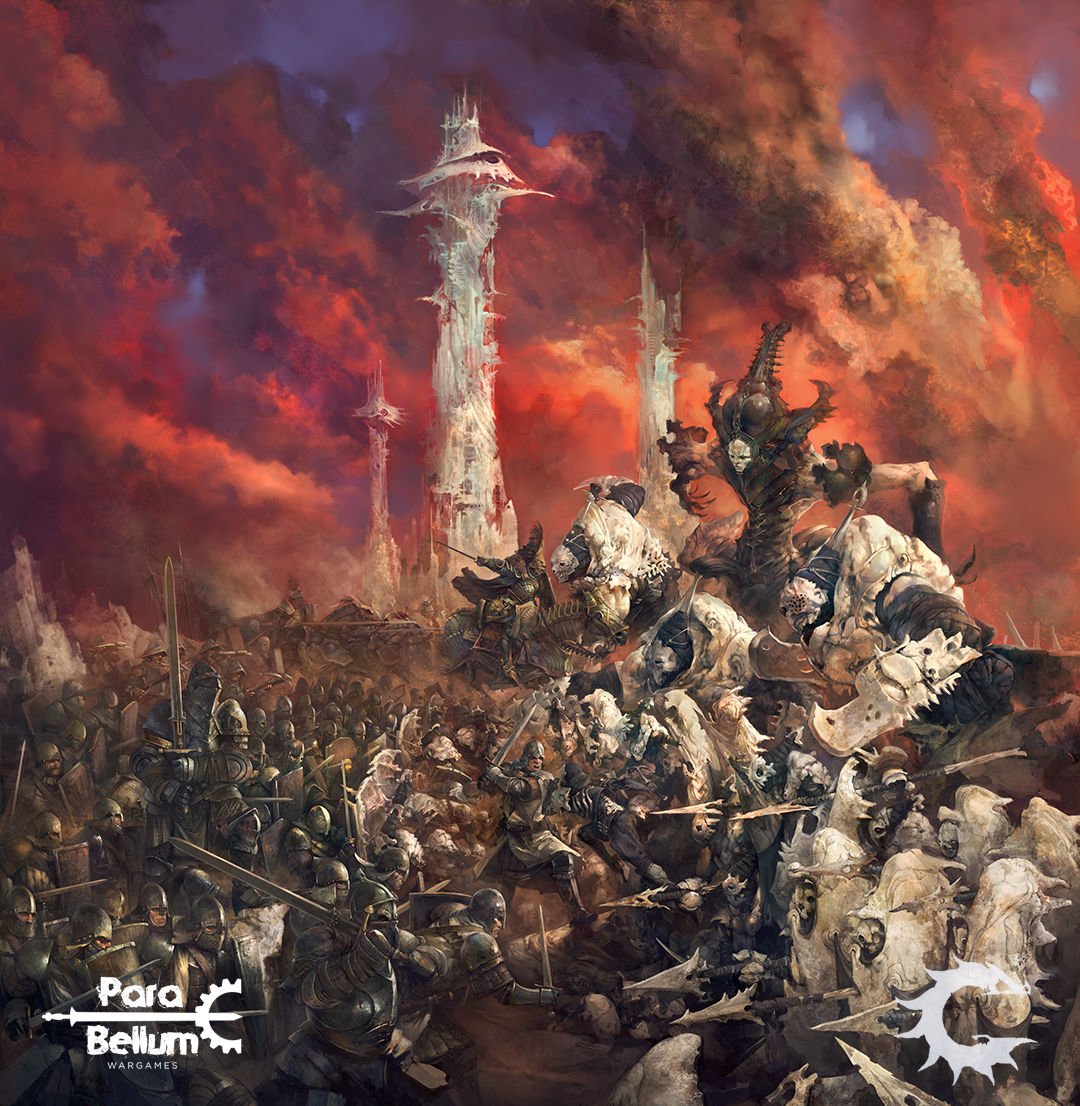
Consider Conquest: The Last Argument of Kings, by Para Bellum (an illustration for which is below).

As found here.
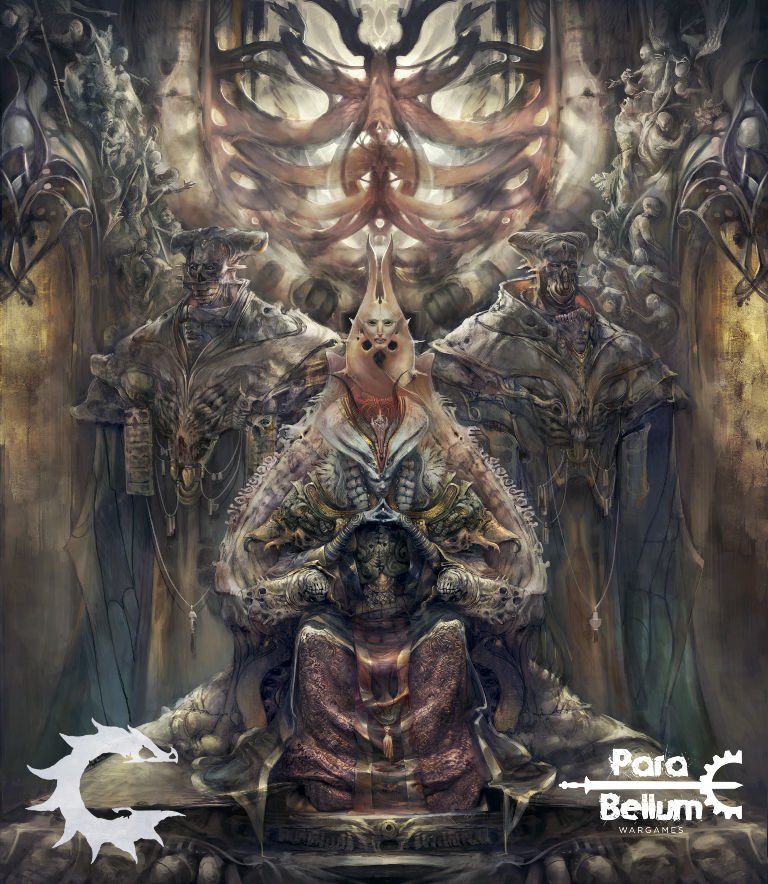
I feel that this style of fantasy illustration - lush, painterly, deeply coloured, detailed without the glossy primped look that characterises some artwork - is something I've seen quite a bit of lately (think Karla Ortiz's cover to Sorcerer of the Wildeeps and some of the art for 28). I wish I had a good name for it. 


As a survey of the setting's lore suggests, they fit the Hobbesian mould pretty well. A shattered empire of A Hundred Kingdoms, the cruel biotech-wielding precursors of the Spires, savage and potent outland raiders, wrath-corrupted delvers - and each with it's own set of sub-factions, providing not only unit variety but also competing forces.

As found here. Another example of the unnamed style.

So much for Conquest. And you might say that this follows too close to Games Workshop to really count - compare Warhammer's Empire with the Hundred Kingdoms, or 40k's (Dark) Eldar with the Spires. Let's pick out a few more examples. 

A Very British Civil War is an alternate history - a counterfactual in the same vein as Team Yankee above. There are some relatively outlandish or eccentric forces, but nobody appears to have taken up a form of technology beyond the 1930s. The background is that the Abdication Crisis of 1936 has resulted in constitutional turmoil and finally civil war. Fascists, Socialists, Edward VIII-loyalists, Anglicans, Scotch nationalists and more compete for rule of Great Britain (games in the Empire are possible, but out of focus; foreign intervention is present in the form of volunteers and aid rather than armies).

Now, obviously, this differs from a fantasy setting, or the far-off 41st millennium. There's also a difference in tone - consider the illustrations, miniatures made or suggested for the game and the presentation and discussion of VBCW. Grimdark it ain't.  If there is a single inspiration for it, it would be the 1995 film adaptation of Richard III*** set in an alternate 1930s - a part of the mannered, artificial (in the sense of 'crafted') text of Shakespeare's history plays carries over. Of course, the tone could be skewed more towards the realities of the (comparable) Spanish Civil War. But the default has the relative lightness suggested above. 

Grimdark or not, it fits: every faction should have a reason in the background to fight every other faction AND to fight amongst themselves. It is a time of civil war - brother is already fighting brother (literally, given Edward and Albert....)  - so further shifting allegiances are to be expected. Further, given how isolated and cut off some of these forces may be, it should not surprise us that one Royalist regiment might find itself attacking another. 

One more. Infinity by Corvus Belli lays out a science fiction setting; colonised star systems, new frontiers, exciting and powerful technologies. The inspiration of Infinity lies in an inter-connected, Information Age world, full of smooth, colourful stylings and with a primarily Asian derived group of interstellar factions (it even has its own manga). The battles depicted are 'secret missions, black ops and covert actions' rather than grinding trench warfare or frenetic melee combat. It is distinct, therefore, from the decay, zealotry, Gothic architecture and gloom of 40k .... despite the power-armoured religious military orders.

None of this makes Infinity a pleasant future to consider, per se. There is an extra-terrestrial threat, rebellion and the sleek outlines of postcyberpunk futures may well conceal pain and suffering. But again it fits the Hobbesian requirements for a world of wetwork and realpolitik. Sub-factions ('sectorials') once again abound - as to be expected in interplanetary polities. Left hand may not know what the right hand is doing (or know and dislike it intensely, or think it knows, or feels it needs to find out just in case....)

***

Assuming, therefore, that you are with me as far as this division of war games and my conclusions about their Hobbesian nature goes, why does this matter? I would suggest that this is a rule that appears obvious once you know it, informing the structure of war games without it being explicit and that it is a useful tool if one is debating the aesthetics and lore (and their implications) of war games in that third category. There will be a tendency to the Grimdark, at the very least. 

Compare this to the origins of the Horus Heresy. Now a novel series of over fifty books, some of them bestsellers (as well as audio dramas, miniatures, artwork, reams of online discussion &c) - and it all came about because of the cost of making new moulds for miniatures****. The Hobbesian theory lurks in the foundations of war gaming in just the same manner. 

Is any of the above consciously noted by war game designers? I wouldn't like to say. Does it matter? Once a given war game is popular enough that plenty of people play it and the number of factions and sub-factions swell, the need for a Hobbesian world abates. (You might be able to say this for Games Workshop's Age of Sigmar. I'm not sure I care to do so here - I don't know enough.) Besides, this only really counts for impromptu games. Tournaments will presumably try to organise things that the Armageddon Steel Legion player won't have to fight other Armageddon Steel Legion (or other Guard regiments, or the forces of the Imperium). This goes doubly so for grand international event campaigns - which works for in-universe explanations; even the most hot-headed or scheming of Imperial commanders know this really isn't the time.

Yet, a note of the Hobbesian persists - in lore, in rules, in structures. Like evolutionary advantages that make more sense for the Savannah, but still persist despite life in (say) 1986 Vancouver. I assert that an understanding of a war game of the Third category and the materials that develop from it is improved by at least considering the Hobbesian theory.


*And I imagine that any present-day politician that cited Hobbes as an influence or inspiration would catch a fair amount of flak for their trouble.

**I left out sub-factions &c, but even tightly-knit compact factions like the Adeptus Custodes have institutions like the Blood Games. Exodites are sufficiently clannish to clash with one another; Harlequins would do it for the art. Genestealer Cults, as criminal/insurrectionary organisations would certainly jostle with one another - and, quite possibly, their Tyranid puppeteers. 

***Suffering catfish, that trailer - no wonder they changed it for the rerelease!

****(VW Talos, 'Crafting the Imperium's Greatest Heel-Face Turn', 28, Vol. 2, February 2020 pp 96-103)