Showing posts with label Fallout:HC. Show all posts

Saturday, 19 June 2021

Fallout, Britain and the 1950s Apocalypse

A friend of mine recently sent me the reveal trailer for the Fallout 4 mod Fallout: London. Now, the notion of a Southern England-set Fallout is something familiar to me. And, even if I haven't played every game in the series, I have enjoyed them - and the shared reference point of Fallout: New Vegas among a number of my friends that gave birth to Fallout: Home Counties in the first place means that I have a certain affection for it. 

What I'm saying is, it feels like I have a stake in this matter.

Now, I'm going to pick at some of the elements of this mod in such a way as may be less than gracious. I will freely admit to a partial knowledge of the mod and that I have nary a fraction of their digital ability. Further, that the team are limited by the constrains of the base game. The team includes a reasonable contingent of British people in it as well - this will not be an outside-looking-in depiction of a culture.

Secret Nuclear Bunker | Like the sign says, they like to kee… | Flickr

That said....

There are a few things I would like to address regarding the mod and its presentation of a post-apoclyptic London. 

Firstly, I think it can hardly be denied that the Fallout universe is one where 'the 1950s never ended'. We largely see this in the US, but, well, Cold War Paranoia, technology, culture, politics - all act out a continuation of the 1950s in some sense. Despite decades passing, this remains the case; no 1960s, no Woodstock, no cultural revolution, no Watergate thus no end to an Imperial Presidency.... 

(I can find no references to the Civil Rights movement, but Jim Crow certainly appears to be over - perhaps brought about by the same kind of top-down government that would turn fifty states into thirteen commonwealths).

To lay things out: the 1950s in Britain, even sketched in broad nigh-on-cliche terms was not the 1950s of the United States. The winding down of Empire is only part of it. National Service would only end in 1957; not only did British forces remain in Germany, but fought in Korea, Malaya, Cyprus, Kenya and the Suez Crisis. Domestically, you have the pinch of Rationing together with the post-war political consensus getting on with the work of rebuilding. You have a country devastated by bombing (apt!) being rebuilt by idealistic (hubristic?) architects and city planners - removing slum housing, producing high-rises and new towns - like Milton Keynes with its numbered streets (the same movement that would produce a barracks like this and the Barbican).

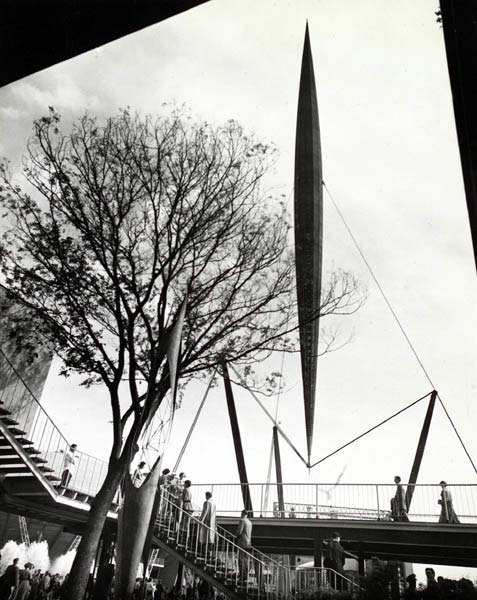
To say nothing of the Festival of Britain and the Skylon.
(Image via those nice chaps on Wikipedia)

Frankly, I can do little better than to recommend the linked series of reviews if you want a quick dive into things. They are reviews/summaries of David Kynsaton's social history of post-war Britain, with useful timelines and the occasional acid comment. The blog's same reviews of period fiction are also helpful.

There is little evidence, however, that Fallout: London has gathered any of this raw material into the mod. If in Fallout America never has Woodstock, Britain never has the Beatles and Carnaby Street. What do we have instead? Barrage balloons (against the A-Bomb?!?), Vera Lynn (excusable, thanks to Kubrick), Tommies, 'Fascist pamphleteers', London street gangs, Peaky Blinders, a 'Feudal Aristocratic hegemony'. This is all the stuff of the 1930s and the Second World War. [I leave aside the invocation of post-1950s subcultures - where are the Teddy Boys?] A post-war Establishment involves more technocrats, middle-class intellectuals and union leaders; a post-war revolution involves more communists. It's like mixing up (for an American setting) the Industrialists and Railway Barons of the Gilded Age with the Cold War Military-Industrial Complex. Not the biggest or strangest of mistakes, but a notable error nonetheless.

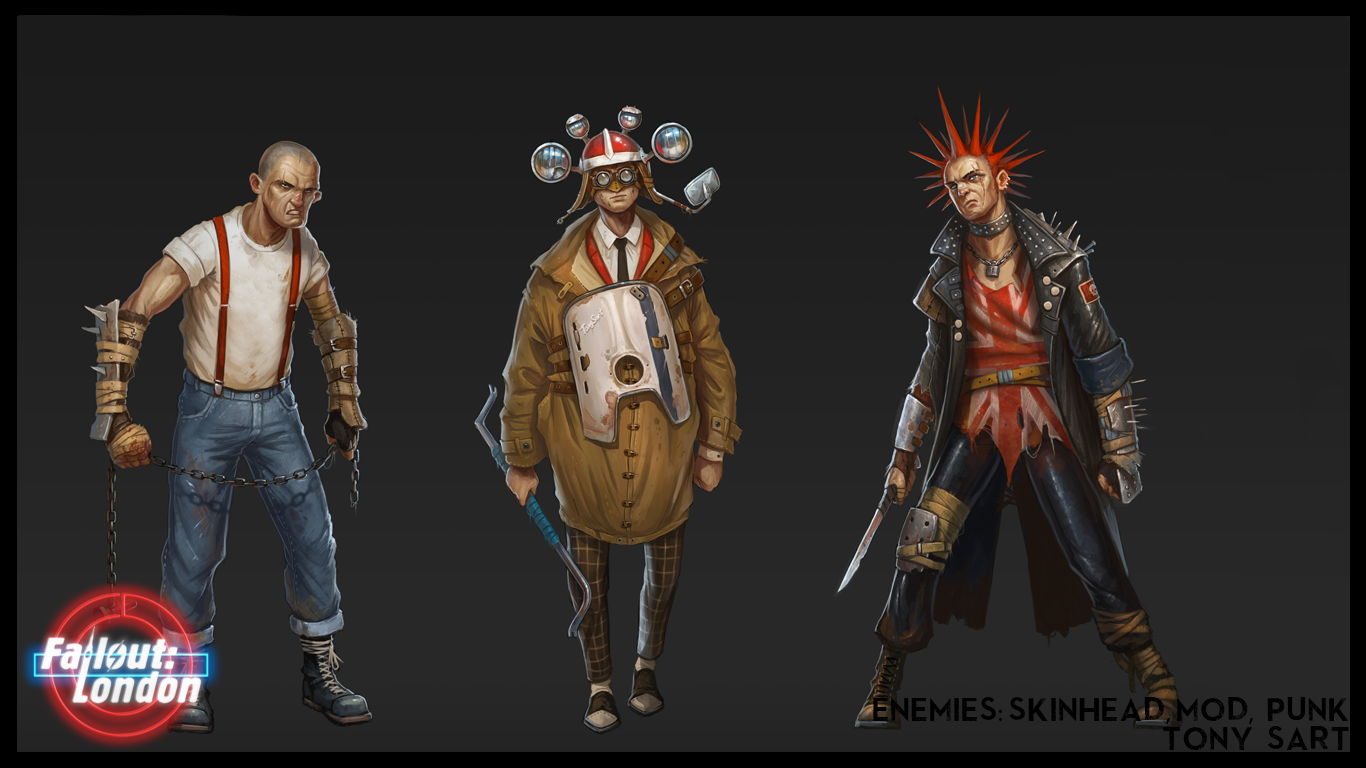
The view we get of London is mostly Victorian-red brick ruins and war-scarred landmarks. Closest thing to a modernist monolith is the 'blast-proof' walls of Westminster (shown below) (the Ministry of Truth is still around, however). This bit of concept work seems to have the right idea.

I know all this might be a little too much like looking for historical accuracy in a counterfactual setting. Besides, vanilla Fallout is as often Mad Max as 1950s ruination. But Fallout: London does seem to have strayed a little from the setting notes. There is perhaps something in a Britain that indulges nostalgia about the 1940s in a way that America might indulge nostalgia about the 1950s - but I'm not sure that Fallout: London actually does this.

The Fallout games also use not only the trappings of 1950s history, but also (science) fiction. There seems less of this in Fallout: London. No John Wyndham on display; no Death of Grass, no Quatermass Experiment. Not a hint of Ridley Walker. Triffids seem tailor-made for Fallout! I've covered this sort of thing on the blog before, if in a rather amateurish format. Where are the lonely concrete left-over RAF bases, as in 'The Hour that Never Was'? Where are the Ealing comedies? Where is Molesworth? Looming post-war tyrannies, as in Orwell's Nineteen Eighty-Four or Lewis's That Hideous Strength are perfect for Fallout - perhaps there's some of them in the background. 

The problem may be that the iconography and choices of Fallout: London are all, I suppose, those of the path of least resistance. The equivalent of the Big Ben and Rule, Britannia identifying shot and musical sting in a film (Cf, this). The Guards Division in bearskins and red tunics. Buckingham Palace, the Palace of Westminster, Tower Bridge, Trafalgar Square. Red buses and pillarboxes. Tommy Atkins, street gangs. King Arthur and Camelot. It reminds one of a tourist shop bulging with ugly postcards, Royal bobbleheads and Union flags. It's (almost) a hair's breadth from Dick Van Dyke dancing on rooftops. [Harsh!]

Of course, again, I don't know enough about this mod.  I couldn't tell you how good it is, where it will end up or how Shandified it is. But I think I can tell you what's not there.

Sunday, 8 April 2018

State of Play 2,018

A drop in posts over Easter, but I am still about. Further, somehow this little Blog with a mealy-mouthed name has garnered over 2,018 views. Many thanks! A slightly arbitrary number to commemorate, but not entirely unfitting.

Points about the Blog I am mulling over:

  • An explicitly international audience, though the quantity of views apparently coming from Algeria is somewhat baffling. The bulk of readers seem to be Anglosphere.
  • A lack of comments. If you have a pertinent remark, I should be interested to hear it.
  • The 'default orange' look of the site. I might spruce things up at some point.
  • The most popular posts are: Azoth, Fifty Religious Processions, Majipoor and both Sphinxes.


A few things for the near future:

-I might have said I was done with Terrae Vertebrae for a bit, but I have at least one thing of that setting I should like to put before you. Given Terrae Vertebrae's somewhat generic status, this should be easy enough to tailor to fit other settings. It started in my mind as (North) Western European Medieval, but elements of it could fit in quite nicely with what I know of Tang Dynasty China (for instance).

-That said, I should like to put the Land of Punth, the Qryth and some of the surroundings in a separate category (A new label will be affixed to posts). Besides it having an explicit different flavour to the rest of Terrae Vertebrae, it would be an easy 'unit of setting' for somebody to drop into a game un-tailored. Though I should like to flesh it out a little more first. A few random encounter tables, another hexcrawl perhaps, a partial list of the Codes and a few access points to Punth (Austergate being an example). 

-Progress grinds slowly on the 18th Century setting (referenced initially here, hinted at elsewhere), which probably would be (sub-) titled White Hot Sparks from the Crucible of the Enlightenment. I have some moderately fleshed-out World-Building stuff so I have named cities or gulfs or kingdoms. But the trick with this seems rather to be a feeling of magic that participates in the nature of the Enlightenment and that systematising of knowledge. I might post a reading list of things I've been looking at. 

-In mock-tribute to this post over at Monsters and Manuals, and with an eye kept on this, there will likely be further C.S. Lewis posts. (Though I can't say the same for Terry Goodkind or some others on that list).

-I should like to put Fallout: Home Counties in some sort of finished state, though any serious work on it is unlikely until I can ground myself well in a system that might support it.

-A few more reviews might accumulate.

***

Finally, to ensure this post isn't purely self-regarding and inward-looking, have a d8 list of encounters based on a collection of beer caps I recently saw.

1. A thistle half the height of a man. A red eye stares balefully from its centre. Its leaves rustle, even when there is no wind.
2. Crescent hounds, backs twisted into the curve of the moon scamper across the moor, yapping and snapping at anything crossing their path. How are these dog's backs bent into that cruel shape? No-one knows, or no-one tells.
3. The skull of a drowned mariner, still wreathed in seaweed. Who took it so far from the coast?
4. An elongated badger seeks something in the ground. There must be something in the beast to stretch it's body so - or to bring it out during the day.
5. A harp all of black - soundboard, pegs, strings, column. What kind of music does it make?
6. On a rock, the mark of a red hand. There is nothing out here to point towards; surely nothing to be avoided. Who spent time cutting and staining the stone?
7. Leaves grow through a red, demonic skull. Vines entwine barbed crimson limbs. Is this a possessed dryad or an ensnared devil?
8. Could that be a windmill on the horizon? What else would stand so tall - or wave its arms so?

***

Any thoughts would, as ever, be appreciated.

Thursday, 30 November 2017

Fallout Home Counties: The Fisher Kingdoms

I just started chomping my way through Riddley Walker. So that means.....

The Fisher Kingdom concept came from a number of sources: most obvious, Arthurian myth - but that's a small piece of the pie. The second big one was the Isle of Thanet; and, indirectly of Sheppey. Whatever Thanet is known for now, it was once in fact an actual island - the beachhead for the Saxons. To have it as an independent kingdom was obvious.

After all that, I recalled the Fallout faction called the Enclave. What would such a group look like if it were faintly benevolent? High technology, high ideals, limited manpower, limited results.

The terms Fisher Kingdom lends itself instantly to Naval power; the exterior nature of the Fisher Kingdom to other factions made it an outsider - this and Sussex smugglers (see the Kipling poem 'A Smuggler's Song' from Puck of Pook's Hill) lend themselves to smuggling - of goods and people (smuggling even being mentioned in the inspiration post) Lovers of freedom, especially from the White Horse Brethren.

One final element: age. The Enclave is a remnant of another time; let us have The Fisher Kingdom be so likewise, with a population of ageing idealists sustained by pre-apocalypse technology which they are slow to share. The connections of longevity brings the whole thing round back to Arthurian myth.

What do they do then, these Fisherfolk? Fight against the White Horse Brethren (they dislike serfdom), takes goods and people across the Channel (Flanders and Normandy probably aren't that wholesome; giving the Fisher Kingdom a connection in Brittany is quite fitting). They fish for much of their diet - there are plentiful stocks of mutant North Sea cod. But they aren't many, and they aren't welcoming, bring a little too mindful of their own pleasures. They do not have much land to sustain themselves on.

There is something of twentieth century American foreign policy about this: broadly benevolent, but not necessarily in it for the long haul. Certainly more democratic, more liberal than the White Horse Brotherhood - but not exerting a great hold over the Home Counties, and unlikely to if they stay on this course. A little like a merchant republic - but not exactly an open city.


The Fisher Kingdom AT BEST: Heroes who cruise in, kill the evil emperor, cure Little Timmy’s consumption, give the starving villagers 1000000000000 fish fingers and go on to the next adventure.
AT WORST:  They cruise in, blow up the overlord’s palace and cruise out again, trusting that democracy and free trade will spring up among the villagers, keeping all the best toys for themselves.

Wednesday, 5 July 2017

Fallout: Home Counties - The Three Sabres Mercenary Company

The Three Sabres Mercenary Company exist as a deliberate reference to the Essex county coat of arms; three sabres on a red field. The sabres are notched, making them technically 'seaxs', for those who wish to know. 

Anyway, these are the brute faction. No great scheme, no great plan; just a relatively organised and coordinated protection racket. Arguably, the most laissez-faire faction of them all, both in terms of how they treat those they have power over and the direction given to regional commanders. 

A few notes I made back in the day read as follows: Ethically, they’re somewhere between Mal and Jayne from Firefly. They look like your usual wasteland lot, though I can’t help thinking red and black tones would be used for their official (I use the term loosely) regalia. There’s a suggestion of a loose, rough and ready democracy to the mercenaries – no one’s going to force them into anything. One imagines a divide between those assigned to cushy posts in the Protectorate interior looking after the villages that support them and the towns that act as their headquarters and offer them the chance for R&R. 

If they have a literary or cultural precedent, it lies in the history of Essex as a relatively militarised region: I call to witness the Colchester garrison and Tilbury Fort (scene of Elizabeth I's "heart and stomach of a king" speech during the Spanish Armada). The late twentieth century notions of the 'Essex man' and 'Essex girl' (if you don't know, count yourself blessed) have little to do with this - though the rural idyll notion runs stronger in Kent or the Cotswalds than it does in Essex, which rather effects the way things ended up. The seaside towns of Essex and the East Coast have a degree of mid-century significance; I quite like the notion of how such places go from holiday grounds to hives of scum and villainy. A bid thudding and obvious, but that's The Three Sabres for you.

At Best, they are Lovable Rogues who'll protect you for a cost and can be negotiated with on easy terms. At Worst, they are racketeers with all the guns and all the cards who'll steal your daughter, kill your dog and eat your baked beans.

Tuesday, 20 June 2017

Fallout: Home Counties - London

London is an old city; with many regions possessing identities of their own - because in centuries past, they were independent villages in the county of Middlesex. This has been a theme in novels of the twentieth century; notably, the G. K. Chesterton story The Napoleon of Notting Hill and Neil Gaiman's Neverwhere  - even if the borough identities and histories of Chesterton are explicitly fabricated and although the attention of Neverwhere is not always on the character of the city, the boroughs have secret natures hidden in the cracks from those in London Above.

London has been brought low. Literally; the populace has retreated into the Underground, or has fled into the countryside. Sustaining such an existence is tricky; the Underground has little to offer in the way of arable land. Thus, those machines that can sustain some variety of life are jealously guarded. Some have managed to trade their way to prosperity, importing food to sustain themselves, wielding power over the poorer inhabitants of the tunnels.

These are the Great Companies; the Hammering Smiths, the Shepherds, the inheritors of whatever scraps of old world know-how they could claw together and pass on.

The Underground, in maps, is rather cheery and simple. Bright colours, simple lines - a complex network, to be sure, but a comprehensible one. The reality is different. This is not a system built for humans; it is one of tunnels lined with equipment and refuse, taking meandering, crooked routes. To be forced to live in these tunnels breeds a certain type of person, hardy and lean.

Hence, the dwellers of the new London -the fractious dwellers in the colour-coded tunnel-bands and the haughty, powerful Guilds.

At Best, these Guilds are Valiant Preservers of Old-World know-how, selling quality goods and services at a reasonable rate. At Worst, they are Monopolies with a chokehold on London, cloaked in tradition and secrecy.

At Best, the Colour Lines are full of hardy, plucky folk who have embodied a latter-day Blitz Spirit for longer than any might have imagined. At Worst, they are feckless tunnel dwellers who'll steal anything not nailed down.

Edit: a fairly scant section, I know. But I have a certain fondness for the main literary hooks in it; the Canticle for Liebowitz style religious (or pseudo-religious) orders preserving knowledge in a second Dark Age*. 

The visual hook of the bright, smooth lines of the Underground map and the gloom of the tunnels is a good one. Even if the Tube map design dates from the 1930s, the contrast of the human-friendly face and intent of technology with the sordid reality is very Fallout. The cinematic application of this is obvious. Start zoomed in on bright well-lit tube map, whilst "We'll meet again" plays; drift back and out to show cramped tunnels and darkness, lit by gunfire.

*Possibly made darker "by the lights of a perverted science". Winston Spencer Churchill, 18th June 1940.

Tuesday, 6 June 2017

Fallout: Home Counties - Material and Domestic Culture in the White Horses

This was purpose designed as a narrative; an instructional day-in-the-life story. Perhaps not exciting, but useful.

It’s a cold October afternoon. The fields are being tended by serfs. The fallout has left this part of England fairly intact, but some vegetables are still unearthed bloated and tasteless, fit only for animal feed. Generally the crop yield is more than sufficient for the Brethren and serfs of this manor, enabling them to make the export tithe demanded by the Brethren Council for sale in London. The fields are regularly reseeded and rotated with the seasons, which requires the backbreaking labour of the serfs. 

The serfs wear either pre-war overalls or rough smocks from the London looms in Shepherd’s Bush. The coarse clothes are about adequate to keep them sheltered from the piercing wind, but they still feel the chill.

By contrast, the Castellan’s men watching them are well dressed. They have heavy padded jackets and flat caps. Over this they wear stiff armoured vests, often bearing the mark of a rearing white horse, and belts, with clubs and side-arms hanging from them. The automatic rifles and shotguns in the holsters on the quad-bikes behind them are not needed at the moment, but the raiders may come at any time. If no more, the long guns are a potent reminder of the Brethren’s power over the serfs. The Brethren take different tones of command with the serfs, either speaking with all the choler, spleen and dreadful sarcasm of a Drill Sergeant or the sardonic, amused tolerance of the aristocrat. The civilian-garbed Brother Ploughman monitors the work with wrath in his voice for the slothful.

Those of the Castellan’s men not overseeing the fields are up in the outposts of the manor, monitoring the perimeter. Two figures can barely be seen at the top of a tower, one with a rifle with a powerful sight; the other with a field scope and a flare gun. The edge of the manor is protected by tall earth banks and palisades; adequate to slow raiders at the least. The few gates in this are bulky things perhaps eleven feet high made stronger with ruined cars filled with earth. These were recently refreshed last month by Sister Sapper and a band of serfs. The next project the Sister hopes to complete is a set of telephone lines out to the towers to assists with early warning signals.
Inside the main building complex of the estate, the Seneschal and the men and women under her work through the cold afternoon. It is easier to tell their profession from their garments; Brother Lawspeaker and the teachers wear formal brown Brethren robes. Brother Apothecary and Sister Surgeon wear long white aprons over tunics and britches. Brother Baker, being the hands-on sort, wears something similar as he pitches in alongside the kitchen serfs. Brother Smith, by contrast, is happy to oversee and review the work of the younger Brethren under him and the forge serfs.
Across from the forge are the stables and the powerful destriers ridden by the Brethren. Post-war equines, they have all the bulk of a pre-war plough horse with the proportions of a racer. Sister Farrier looks after them, though they are hardy animals not much in need of care, having developed a larger, stronger hoof that rarely needs to be shod.

In a squat building off the serf barracks, the laundry is being done. The serfs give up their clothes for fresh ones, yet to be stained by the weeks work. The washing is done in great cauldrons, made foamy with pre-war washing powder – an increasingly rare commodity, though enterprising individuals in London have started to try and produce their own soap, even if it has so far proven to be frequently low quality.

Freshly dressed, the serfs collect mess tins and cutlery, and then tramp towards the food hall.  The dining room in the main manor is set for dinner, with a varied collection of pre-war enamelware and porcelain. Any complete dinner services are carefully hoarded and a complete tea set can fetch a hefty price in the London markets, as can the tea itself.

The serfs and Brethren from the fields come in for dinner in the gathering dusk. The guards on the outposts have been relived by freshly-fed men and women. Both groups eat similar meals; vegetable stews and bread, both from the fields of the estate.  The difference between to two meals lies in quality. Serfs have coarse bread and somewhat oily stews. The manor is lucky enough to have an old Nutrient Preparation machine which, when supplied with organic material, spits out squares of tasteless beige foam apparently offering half the necessary minerals, proteins, vitamins and suchlike needed for a human adult.  The Brethren have bread made of fine, export grade flour with fresh butter. The stew might, perhaps once or so a week, have a little meat in it.

Both butter and beef come from the animals of the estate, of which there are a few, for the crops are the priority of the Brethren.  The cattle are divided into Milchers for dairy produce and the Oxoes which are raised for meat. As with the Destriers, the two breeds have had their bred-for traits exaggerated by the effects of the Atomic Wars. Pigs either come in the docile and placid Field-Pig or Snuffler and the Hedge-Pig or Tusker. The Hedge-Pig is a spiny, hostile, heavily tusked beast, and is hunted by the Brethren in the game of ‘Pigsticking’.  Such game must be carefully checked for taint before consumption. Chickens, however, are still chickens.

Midway through the meal, the Warden and his riders return from their progress. They’ve been riding the bounds of lands around the estate, checking in on the extra-mural communities and free serfs. They were long coats of waxed cotton and wide hats to keep off the rain. Their destriers are swiftly stabled and the tables set for them. The Warden takes his meal with the Castellan and the Seneschal in the Council Chamber; somewhat antisocial, if common enough when business must be discussed.  
After dinner, serfs and Brethren retire. The serfs often live in the longhouses in the Barracks; crowded places, which families or individuals will divide up into sections with curtains and partitions. Some serfs reside in shacks out on such scrubland as exists in the bounds of the estate, created with materials purchased by an extended indenture. Some of these have been long occupied by serf families who have never quite paid off their indentures.

The Brethren occupy their own chambers in the manor. Families will have perhaps two rooms to themselves for parents and children. Young men and women will often sleep two or three to a chamber in gender-segregated rooms. The rooms of the Three Officers – Seneschal, Warden and Castellan – have attached studies to them and are perhaps the most luxurious in the house.
On the subject of plumping, water must be drawn from the well and purified in great boilers in the kitchens, then taken to the rooms for washing using jugs and washbasins. Within the manor, chamberpots are the rule. Without, outhouses and the like are usual. Long tubs are provided for the serfs for washing once or so a week.

Such a washing will take place in the morning; for tomorrow is to be an occasion. The clean clothes of the serfs are the best they possess as Sunday best. The Brethren, by contrast have a number of options. While the long robes they wear will do for formal ceremonies, this is a party. A number of the young Brothers and Sisters from a nearby manor are to visit for a dance, and this will allow pleasant conversation, meetings between young men and women and all the other benefits of social interaction. The journey between the two manors is not a hard or dangerous one, but the some of the Warden’s rangers are now monitoring the route, hard men and women in camouflage ponchos with rifles, knifes and silent, deadly longbows.

Those Brethren lucky enough to own pre-war suits or gowns will don them. Those without wear clothes of good broadcloth from the Shepherds of Shepherds Bush in London. Such new suits tend to lack lapels or ties. Many layers are general; waistcoats and jackets, for central heating is by no means guaranteed. They have britches and boots cut for riding rather than slacks and dress shoes. Such apparel is like to remind the historian of 18th century costume, but emphasising athleticism and the equestrian and worn (especially by the young twenty-something’s) by both sexes. Post-bomb gowns are not unknown, though they are worn mostly by pregnant women who would find britches uncomfortable or (presumably once-pregnant) matrons who have not the years or will to ride.
The serfs are allowed to share in this endeavour. They will prepare a meal for the visitors and make up the guest rooms in the attic. This done, their own party is put into place: an Oxo is roasted on the spit. There will likewise be dancing and this manor is lucky enough to have serfs with handed-down instruments.   In imitation of the Brethren and the hunting-fishing – riding-shooting they enjoy, feats of strength and aggression such as boxing, wrestling and the quarterstaff will take place. This is frequently betted on by the serfs, using the stamped tin exchange tokens issued at the discretion of individual Brothers and Sisters. Such a token may be exchanged for goods or time of the indenture with the Seneschal. It is quite worthless otherwise.  Such gambling is frequently monitored by the Brethren. A few talented and abstemious prizefighters have made enough in their time to pay off the indenture, but this is difficult and having left the protection of the Brethren they must leave their friends and families to go into unfamiliar and hostile surroundings.

The Brethren that arrive will be greeted with that most precious of drinks: tea! This will have come from the Gardeners of Kew at great cost. Alcoholic beverages will be served throughout the evening; cider from the orchards, beer from the Fisher Kingdoms via London and spirits. Wine is uncommon, as is whisky. Pre-war liquor can be most valuable. Most manors distil some form of rotgut for the serfs – generally of a sort safe to drink; unapproved distilling could result in stuff of unknown potency and toxicity. The serfs drink grog that at least won’t send you blind. A few talented serfs have made themselves important and comparatively wealthy by brewing concoctions actually derisible for their taste, making a form of gin from such botanicals as available. The Brethren, naturally, love it.

With such fuel, the night looks to be good one; the few tapes the Seneschal has of dance music will be played, the old piano wheeled out and the talented induced to sing. A splendid time is anticipated.  The next such event will be a Yuletide, in the Festival of Darkness on the Earth. This has rather more spiritual significance to it; Brother Lawspeaker will draw marks in soot and ash upon the faces of the Brethren prior to the Rising of the Sun. The Seneschal is already worrying about parts for the Mystery Play; Brother Alfred and Sister Gytha will doubtless once again play Brontologion and Pyrologion, the Spirits of the Bomb, but who is to play the doddering, short-sighted City Father?
At the end of the night, couples will have slipped away. Serf must barter or blag their way into free spaces and alcoves for privacy and perhaps intimacy; some enterprising individuals rent out their shacks for a fee. Chaperonage, largely unofficial, is rather better known among the Brethren. Nevertheless, a stroll in the moonlight is not frowned upon. The use of unoccupied rooms by the young is common enough. However, to ride out of the manor is foolish at best and drastically irresponsible and culpable at worst.

Marriages may be conducted with pomp among the Brethren or perfunctory ceremony by the Castellan among the serfs. Children among the former will tend to have an established and recorded surname; among the latter they tend to take patro- or matro-nymics depending on circumstances and preference. Contraception is largely unknown or inaccessible.


Thus it continues, this strange admixture of cultures: a Late Medieval level of resources with anachronistic 20th and 21st century features with something like an Early Modern result. 

Fallout: Home Counties - The White Horse Brotherhood

In origin, this was a simple reference to the symbol of Kent - a white horse on a red background. These were the ingredients: the fact it was a brotherhood, with all the semi-religious connotations that indicates, and  that it was Kentish in origin. Naturally, this had to be fleshed out a little.

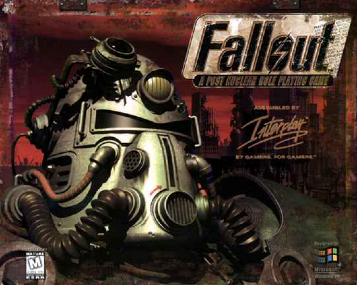
The Fallout games have always had a nod towards the romanticised past: in the subverted 1950s nostalgia, in the cowboy antics of life in the post-apocalyptic Wild West - but I am now thinking of the Brotherhood of Steel, images of which are prominent on the box art of the games, who borrow conspicuously from images of knighthood, chivalry - and from militant religious orders. Naturally, this is not that simple all the time. They aren't quite paladins; they are portrayed as being well-intentioned, strictly disciplined, knowledgeable, technologically able - and, even if the morality of their actions is left for the viewer to decide, in many cases ineffectual.

The cover of the first Fallout, (courtesy of Wikipedia) with the Brotherhood of Steel front and centre.

The White Horse Brotherhood take a similar look at chivalry and take a different approach. Rather than human ironclads stamping around the smoking remains of Guildford, a different angle of feudalism would be apparent. These would be, like the Brotherhood of Steel, former soldiers and other  persons who escaped the missiles. But rather than holing up in a bunker with whatever technology they could carry or take, they would be landowners.

In claiming patches of less irradiated land, they could thrive and survive in the long term better than raiding parties or hoarders. The first few years would be hard; fortifying and defending manors, existing on half-rations until the new harvest appeared. But in the generations that came after the blast, they would be the most prosperous, a network of roughly self-sustaining manor houses across Kent and Sussex.

With this has come a devotion to the land - not quite religious, but with a clear agrarian cultural ethos, associating the city with the apocalypse, human fallibility and sin. Who can blame them? Their farms have sustained them where the ruins of London would not. They have become, in time, the grain basket of the Home Counties and responsible for the current wealth and rising population of these ravaged lands.

However, this comes at a cost. There is a very clear stratification in the territories protected by the Brotherhood. The White Horses rule and defend; the peasantry farm the land. Peasants might originally have been captured raiders or refugees looking for a sanctuary. They would receive protection, if they would work until they showed a distinct profit to the wealth of the manor, offering much more than they took. Some would have the opportunity to join the Brotherhood, or to leave and make homes of their own. Most did not; and families would go further into the debt of the Brotherhood by the birth of children. In time, a formal indenture system would be orchestrated.

The life of an indentured serf is a hard one, with farm labour conducted under the eyes of the White Horses. Much of this is done by hand, combine harvesters being somewhat short in supply after the Atomic Wars. Food and safety are guaranteed by the Brotherhood; some luxuries are offered by them as well as other minor freedoms. But life in the serf barracks is cramped and exhausting and to build a home of your own adds a great deal to the cost of your indenture.

The Brotherhood, meanwhile, occupy three type of position: those reporting to the Seneschel of the Manor, responsible for administration and certain specialised trades; those reporting to the Warden, who patrol the lands around the Manor, and those reporting to the Castellan - who is primus inter pares of these three, and has overall responsibility for the safety and well-being of the manor - this being the first priority of the Brotherhood.

The White Horse Brotherhood might remind one of Medieval Europe, with armed landowners having the most power, or of the Antebellum South (though no racial divide exists as such), or of Eighteenth Century rural squires, affable, brisk and paternal.

At Best, they are noble lords protecting their people, providing food and shelter for all by their efforts. At Worst, they are blinkered aristocratic bullies, living the high life by trading the products of forced labour.

I shall add in another post a little piece I wrote on life in the White Horse Brotherhood.

Friday, 2 June 2017

Fallout: Home Counties and British SF: A few notes

EDIT: This post probably explains this matter more coherently - and in a more timely fashion.

Closer to the 50’s
John Wyndham – it’s in the spec. [One Part Fallout to One Part The Napoleon of Notting Hill. Still well. Pour in a measure of Wyndham. Garnish with Neverwhere.]
In detail: Triffids everywhere as a monster. There’s something v. 50s about them; the “We’re always going to need oil” approach to life – no Solar powered cars! Also fits into the Resource Wars of Fallout Canon. [Think also of British Petroleum in Persia]
The Crysalids is a big post-apocalyptic text. Should have some “Blessed is the Norm” stuff – White Horses or some tribe. In the book, it was in Newfoundland. Also psychics.
The Kraken Wakes – Beasties from the sea! More monsters. Problem for the Fisher Kingdoms?
The Midwich Cuckoos – Creepy psychic kids. [“Widdle Wamplight!”. Imagine that in your cranium.]

Dr Who. Inevitable really. I’ve said everything looks like a South Wales quarry, but what’s more.....
HORDES. OF. DROKKING. ROBOTS.
In the short stories we’ve already had Dalek like automatons as used to pull carts [Three Sabres; pepperpots; “Physical Manipulation Unit”]. I quite like this as a subtle dig at the fearsome beasties; they’re not destroyers but porters; push, pull, drag, lift. Could even have them controlling trains before the Bombs started dropping. Imagine the terror of that....
Dr Who Androids as other robots: Cybermen, autons. Slightly more technically adept models.  Human interaction. K9 is also an option; robot dogs are not unknw in Fallout.

Thunderbirds, and other Gerry Anderson bits. The future is big, shiny and jet powered. It is not small, full of silicon chips, covered in a fetching floral pattern and able to fit into the pocket of a pair of skinny jeans. To quote stuff I’ve written elsewhere “Wikipedia? Fuck you, here’s the Encyclopaedia Britannica on 24 microfilm vidslugs.”
The world that was looked pretty darn Thunderbirdsy. Think uniforms. Think transport. Think technological devices that take you from place to place without having to get up and show quite how badly you walk. Nobody gets to fly Thunderbird 1, but one suspects that the Fisher Kingdoms have a scaled-down something like Thunderbird 2 as their vertibird/ airship moment. Perhaps it’s even painted like a giant flying haddock.

The Quatermass Experiment (& co). Yes, yes, yes. Tweedcoated scientists (it would not be unfitting to be able to dress like one; see also the costumes of the various Doctors); the British Experimental Rocket Group; fear of Nuclear War. Aliens infesting Westminster Abbey (Or mutants, I guess.). The Scarlet Capsule (Quatermass and the Pit).

Dan Dare. Thrilling space adventures; the Mekon and his Treens. Doesn’t really need an explanation. Some images the same; green uniforms; square jaws. The astronauts presumably a touch less international so far as make up goes.

The Prisoner. Obligatory, really. Any virtual reality bits probably bear a resemblance. As do the nicer bits of the Fisher Kingdoms. And some of the crazier chaps in London. It is an option to dress like an inhabitant of the village.

The Avengers (John Steed and Mrs Peel). Go watch a few episodes if you haven’t before. Not SF really, but the high-tech world of tomorrow spy stuff is relevant. Additional weird spy stuff like The Prisoner. There will always be room for bowler hats in the future. I’ve written before about solid ink.

That Hideous Strength. 1945. The NICE would not be out of place among the governmental institutions of Fallout Canon. The transhumanism expressions also chime nicely with the New Model ARMY.

1984. The SF elements tend to be downplayed versus themes of dystopia (see pre-Bomb Fallout canon), surveillance &c, but telescreens are worth considering. See also Floating Fortresses, Rocket Bombs- functionally the same as some of the weapons of the Second World War, but with a certain twist so far as flavour goes. One should be able to find Victory Gin everywhere.

Not so close to the 50s
Star Wars. I know it isn’t British per se, but the connections (Alec Guinness, Peter Cushing, West Country Darth Vader, Princess Leia’s mid-Atlantic accent, protocol droids, the Dambusters, Elstree Studios) are there. Should be some reference – IE, protocol droids, Officers of one sort or the other saying ‘Rebel Scum’, brown robed White Horses teachers. The used-future aesthetic of the original trilogy is relevant. How many times did the Millennium Falcon break down?

Elric, the White Wolf. Fantasy, I know. It’s a tiny detail, but where American Fallout uses a Conan knockoff called Grognar for background material, Home Counties ought to use an Elric knockoff.
Where Conan is a barbarian, of a young vigorous tribe, hardy, strong, averse to sorcery and so forth (all traits exaggerated in stories not written by Robert E Howard), Elric is an enfeebled albino princeling of an ancient and decadent line (a cruel island empire called Melnibone), and only given power by magic and the demon soul-eating blade he carries. Written by a British man (Michael Moorcock) appeared in print 1961. Not just anti-Conan, but certainly worth comparing. A more British creation.

2000 AD. Not 50s/ 60s, but definitely a British comic. Judge Dredd and Mega City One don’t have much of a place in Fallout (the Cursed Earth is an exception; somehow Vegas survived the Nuclear War in the pages of 2000 AD also), but the blasted, poisonous, war-ravished world [“Nu-Earth”] of Rogue Trooper and its baroque weaponry deserve a mention.
(That weaponry includes lazookas, sure; see also hallucinogen spewing mirage tanks, poisonous saboteurs called Filth Columnists and the immortal line “And wherever you go, the sound of our Souther martial music will accompany you and your heroic deeds! Play, boys –play the digi-marches!” – played, of course, on the Synthi-bugle.)

Strontium Dog’s oppressed mutant minority also deserves a mention. Who wouldn’t want bounty hunter (good for the Western angle) Johnny Alpha as a companion?

Details again, but for exotic weaponry Dredd’s lawgiver seems favourite [“Hotshot!” “High Explosive!”]. Johnny Alpha had something similar [“Switching to cartridge No. 4!” - EDIT known as the Westinghouse Variable Cartridge Pistol.]. See also the power-fist like ‘ElectroKnux’ of Strontium Dog.

A touch of The Hitchhiker’s Guide to the Galaxy seems apt. A hapless protagonist only wanting material comfort and security. Having Not-Ford Prefect helping our faceless hero when they get out of the vault would be cool. The graphics of the TV series also are worthy of note.
An element of the Guide is the extent the premise is a parody (little too humorous to just be a pastiche; not pointed enough to be a satire) of Dr Who – our protagonist just wants to go home, no comfortable TARDIS to travel in; you have to hitch-hike; the person showing you the wonders of time and space isn’t an eccentric benevolent Time Lord but a somewhat lazy travel writer who gets his advice from a fairly ropy source.

If we are going to have Not-Arthur Dent appear, he should be more like Simon Jones than Martin Freeman. (I’ve seen Jones called a grammar school boy compared with Freeman; not entirely relevant as an everyman for the 21st C. All the better for F: HC; the BBC of Fallout probably casts more grammar school boys as everymen than not.) original cast only!
All a question of flavour. Not a direct influence –though computers (even impressive space computers that can talk) with ticker tape seems relevant. 

Monday, 29 May 2017

Fallout: Home Counties - Introductions


The New Model A.R.M.Y have taken over the forbidden City of Westminster.
The Chiltern Hundreds are excavating the secret vaults underneath Chequers.
There’s a bounty on your head put there by The Three Sabres Mercenary Company.
The Brethren of the White Horse continue their battle against smugglers from a hidden base on the Isle of Thanet.

The Forgemasters of Hammersmith are in a trade dispute with the Shepherds of Shepherd’s Bush, The Temple of Blackfriars are sending out crusades from their fortresses on the Embankment and the Barbican against the sinful Circuses of Piccadilly and Oxford, strange things that go on all fours have been seen near Limehouse and Battersea, something Yellow and Feathery is lurking in the Docklands and nobody knows what’s going on in Mornington Crescent.....
Welcome to Fallout: Home Counties

That was how it started.  A simple enough tongue in cheek little remark. All those on the FB feed for the Terrae Vertebrae game were well enough versed in Computer RPGs; including the Fallout series – principally Fallout 3 and New Vegas, I shall confess.

But the joke was one that stuck; taking the violent, devastated, barbaric world of Fallout and throwing it into the Home Counties. I am aware of the views this blog gets and know that some of you are Canadian or American (Hello! You are most welcome!); therefore, to explain things a little. The Home Counties are those English counties directly around London, forming a heart, a centre – a homeland. The cultural impression the phrase ‘Home Counties’ elicits is one of wealth, with the well-to-do enjoying the country life but working in Greater London, or the comparative Arcadia that is not so very far from the Metropolis in the Cotswolds.

Now, these genteel elements are scarcely the whole truth – there are less than pretty places in the Home Counties, as well as less than wealthy people - and there are a few sizable cities. But the air of country quiet persists nonetheless in Kent, Essex, Sussex and Hertfordshire. So the gag – Mad Max gangs and road chases through country lanes past drystone walls and thatched cottages – is at heart terribly simple.

But once one has recovered from the sheer hilarity of all this, the mind dwells on it a little. The sheer Americanness of Fallout is difficult to ignore. After all, the starting premise is rather good, relying as it does with the tensions implicit in the United States in the 1950s: post-war optimism, wealth and science-fiction wonders brought to life – contrasted bleakly with the looming Cold War, Racism – as expressed in laws and in the deeds of the citizens-, McCarthyism and all that followed it. This isn’t just in the background as setting details, it is a primary part of the aesthetic: finding oneself having a shootout with Buck Rogers ray guns over tins of food in the ruins of a white-picket-fence American suburb.

It’s a strong contrast, and a powerful setting for a story. There are a few things like it in the popular mind; of all things, one might point to Austin Powers, with the contrast of suave Sean Connery espionage and its enduring cool with dated 1960s fashion trends. Played for comedy rather than tragedy, of course, but nonetheless an effective contrast. Those pieces of steampunk literature that one might call relatively Hard (in the SF sense of the word) also play this up; the splendour and wonder of Victorian discovery and glamour contrasted with the squalor of the age and the fact of what that power might do in the hands of a world whose morals we now so frequently decry (The Difference Engine might be the best example of this.).

Anyway, I had lived all my life in or near the Home Counties (at the time we were all in Kent) and had a good working knowledge of some of the cultural influences one could draw on. There was some online discussion, but a certain amount of it was (I believe I may say) all my own work.

The following premises guided me.

  • Firstly, it was in response to British 1950s themes and experiences – and would draw to a certain degree upon the Science Fiction of that time (a separate post for that later).
  •          ….though the key elements of Fallout canon would be there: IE, the laser rifles work on roughly the same principally and patterns – even if there might be different models produced on different sides of the Atlantic.
  •          Speaking of such canon, if Washington DC isn’t just a crater, neither is London. The theatre of operations is the South East of England – including the ruins of London. But those areas once though rural will have a vitality and life that the centre does not.
  •          Following in the footsteps of one rather persuasive critical video, the importance of having a world that made some logical sense was important.
  •          In the Nuclear War, the fallout was blown to the north and east of London; quantities of farmland were preserved fairly well in the Home Counties. Kent especially did well; it was surrounded on three sides by the sea, and was subject to fewer incursion from raiders and similar desperate fellows than other regions.
  •          This has resulted in a number of factions forming around London in the Home Counties. These factions are, in the fashion of New Vegas various shades of grey rather than black hats-white hats.


So, that’s something in the nature of a starting premise. Whether everyone would latch onto the same things I did in the creation of what eventually came about is another matter. More on that to come.

Finally, I came up with the following little conceptual recipe: One Part Fallout to One Part The Napoeleon of Notting Hill. Stir well. Pour in a measure of Wyndham and allow to settle.