Showing posts with label Electronic Media. Show all posts

Monday, 23 March 2020

Electric Bastionland: Worked Examples (2)

(Part One)

Deep Water: The Twining Sea

Currents
The Wick - swifter than expected; not as choppy as the other currents round the islands
Whale Lane - colder, deeper and clearer than other stretches of water.
Ungungstruk - draws silt from the coastal islets and deltas. A thick, dark current.

Features
A - Windshook: a rocky island dotted with high columns, seemingly natural (in fact partial ruins built of an abnormally smooth stone).
B - Vansittart Cluster: a number of little islands, with a few scattered houses. (A few sheep farms remain here, but the bulk of the population is currently a film crew).
C - Puffin Perch: a squarish black rock, covered in puffins (if the puffins leave, you may find the body of a nihilist, a straight razor and a cryptic letter)
D - Tescel: privately owned island, known for an artist's colony (many of the artists in question are past their prime; a lack of strong drink and narcotics has set some on edge).
E - Bruning's Knot: a tangle of weed and wreckage caught between the currents (a small family of wrecked sailors reside here and know the way through).
F - Three-Schilling: a watch station on an island (the station head does a good Black Market trade in Coast Guard supplies).
G - Angel's Plait: twining sandbanks, decorated with birds (pools of water between the banks can reveal stranded wildlife until the tides return).

Complications
Whale Lane, circling B: rough waves threaten to drive your vessel onto the rocks of Brensen, uppermost island of the Cluster.
Whale Lane, passing A: a giant squid, bearing the seal of a foreign power on its power harness. An eye swivels towards your vessel.
Whale Lane, far past D: in the distance, the shape of a vast albatross. It stoops and soars down to perch on your deck. About its neck - the corpse of a sailor. It begins to speak....

The Wick, past B: the missionary barge, the Heart of Skegness starts proselytising in morse code.
The Wick, approaching G: the sandbanks are covered by water - can you recall where they lay?
The Wick, in sight of C: a piratical submarine lurks in these waters and will surface and attack you purely for the opportunity of some fresh air and new faces.

Ungungstruk, skirting E: a strong wind draws you closer to the Knot.
Ungungstruk, circling D: a weather balloon appears to be following your ship.
Ungungstruk, in sight of F: the Coast Guard stage a surprise inspection. There has been a change the nautical licensing code.


The Underground: Deep Beneath the Hotel Messala


Rooms and Passages 
A - Corroded Substation - an electricity substation; corroded, flaking fuses and rheostats between blank concrete walls. Arcs of electricity play off the depths of the substation, which sits in a sunken chamber at the junction.
B - Auto-Triage: a medical station with rows of examination coffers (someone placed in a coffer is categorised according to the severity of their wounds. Little or no medical assistance is offered by the automated systems).
C - Emergency District Information Hub - a small, well-equipped print shop and a formal room with a stage, pulpit and magic lantern projector (a hidden safe at the back of the printshop has partial details of civil defence regulations and the degrees of emergency law that may be imposed in time of war. You have not heard of any of the regulations involved, nor of some of the things they apparently ward against.).
D - Heliotrope Helix: a series of spiral tunnels, the ceilings of which gleam like the sun. (Intended so that people in the shelters could change environment and experience something like sunlight - but in a short space of time. Stay too long inside and you will get badly sunburnt).
E - Gaudy Street Seal: an internal gate in the emergency conduit, with a defensive bubble-turret. Named for the street above in chalked letters on the lintel. (Once closed, the gate will seal shut until the system detects that the gas attack has passed. The system is not in good working order.)
F - The Hive of Chains - a shaft, rising up into the regular basements of the Hotel. Chains, ready to lift or lower platforms hang down at every hand. (Some of the chains clatter ceaselessly; something below is shaking them.)
G - Automated Exchange: banks of enamelled stations, where telephone calls can be put through. But the wires are moving all by themselves. (The only calls being made are test calls between emergency stations, introduced by a unique piece of electronic music and a string of numbers).
H - The Discretionary Reception - a plush-carpeted room and four elevators. (An entrance to the hotel for guests desiring secrecy. Far larger than one would expect....)
I - Steel Cookhouse: two long metal counters, two stoves, two sinks. (Approach, and a number of unlabelled tins drop out of a chute. A voice will urge you to cook the best meal possible with these random ingredients.)
J - The Waste Disposal Offices - a dull door with a conspicuous nameplate. Inside, an office with several battered cupboards and a hatch. (This is where hotel employees gather to dispose of discarded luxuries, overlooked delicacies and other valuable items. There is a dumbwaiter directly from the kitchens.)
K - Guest Vault: A series of heavy metal doors, each with a code lock. Each door has a large sealed compartment through which objects may be passed. (You may find the guests inside, in one state or another).
L - The Cellar of Last Resort: the place where the rarest beverages for the hotel above are stored. They are hermetically sealed in individual caskets. (Discovering which casket is which requires knowledge of the symbols and abbreviations used by the caste of sommeliers).

Complications
A-B - A leaking pipe has spread water across the passage; this has been electrified.
B-C - As you pass down this corridor, the sensation of touch is completely absent from you. Even if you are clutching something tightly, you cannot feel it.
B-K - Several automated cleaning trolleys block passage. They are scouring the walls into harsh, acidic cleanliness.
C-D -  Phosphoric primroses bloom from the iron of the floor grids. Do not tread on these.
C-K - Numerous jukeboxes begin playing music as you approach. Armed figures watch you approach; they do not react to this sound.
D-E - A fierce, disorientating buzzing intensifies as you approach E.
D-L - Birds sit in the passage; magpies, with wings of platinum and black iron. They eyes you in a hostile fashion.
E-H - Custodian Concierge: a respectful but very firm Concierge would like you to go no further away from H. Either go up, or go out.
F-I - Ahead of you, the floor begins to heat up. One more step, and you may fry.
I-C - The concrete slabs and iron grids of the floor fluctuate like the ripples of a pool.
I-J - A revolutionary cell is meeting here, and they do not wish to be disturbed or observed.
J-D - A turnstile bars your path. Several red lights blink into existence as you approach. Something is watching.
K-L - Clockwork scribes tick through here, trailing lists and inventories in their wake. Prepare to be stamped, inspected, briefed, debriefed and numbered.
L-H - Before you in the passage, a pepperpot-shaped automaton pushes a large barrel. It does not appear inclined to stop.

Stretches
B-F
1. Familiar as this passage is, the air around you becomes close. There is a constant shaking and the choking smell of engine exhaust. The winding of great tracks begins, only to stop at the sound of regular shrill plinking. A cannon roars.
2. Former foundations: vaults designed to support a structure that stood where the hotel now is stretch ahead of you. They are not always safe. Some are partially flooded.
3. Ahead of you the corridor is quite lightless. Nothing cuts through the darkness, though pale smoke can somehow still be seen in the air. From somewhere comes a great wind, and the walls no longer appear to be present.
4. Rubble ahead, the bitter scent of ash, and shrapnel fragments. But no bomb could pierce these cellars, surely? And no aerial raids have yet been spotted.
5. The piercing scent of bile is on the air. The tunnel narrows at the top, becoming the shape of an equilateral triangle in cross-section, walls covered in white and orange tiles. A hook-footed crab-like being clicks behind you along the corridor, oil oozing from its joints.
6. A white-painted corridor; coloured lines on the floor, with multiple dog-legs and a gentle slope. Deer of boiled leather and brass wire prance along it. If they come near you, they will entangle you in twining, tentacle like brass antlers.

Lessons and Conclusions

You are meant to have all the notes on the page with the map - but A) that's not as such a blog-friendly format and B) I started drawing maps on A5 paper and so had to continue. So, draw your maps in an A5 space on an A4 sheet, I suppose.
(Like so)

It was a little difficult to establish a proper frame of reference on the currents on the Deep Water map for the complications - quite what a 'stretch of current' is isn't clear from the things on the map. Perhaps my 'Skirting Point X' or 'In Sight of Y' works.

I'm not China MiĆ©ville; it has been a little difficult to really put my mind to a living, breathing, self-contradicting metropolis. Bits of what I've done feel a little too much like a stage set, or an orrery  Perhaps that makes this a useful thing to do again. Turning my Silent Quarter post into a borough of Bastion might be worthwhile..


Thursday, 19 March 2020

Electric Bastionland: Worked Examples (1)

Using the Mapping pages from Electric Bastionland I have created several maps using the guidelines provided. There are two more to come...

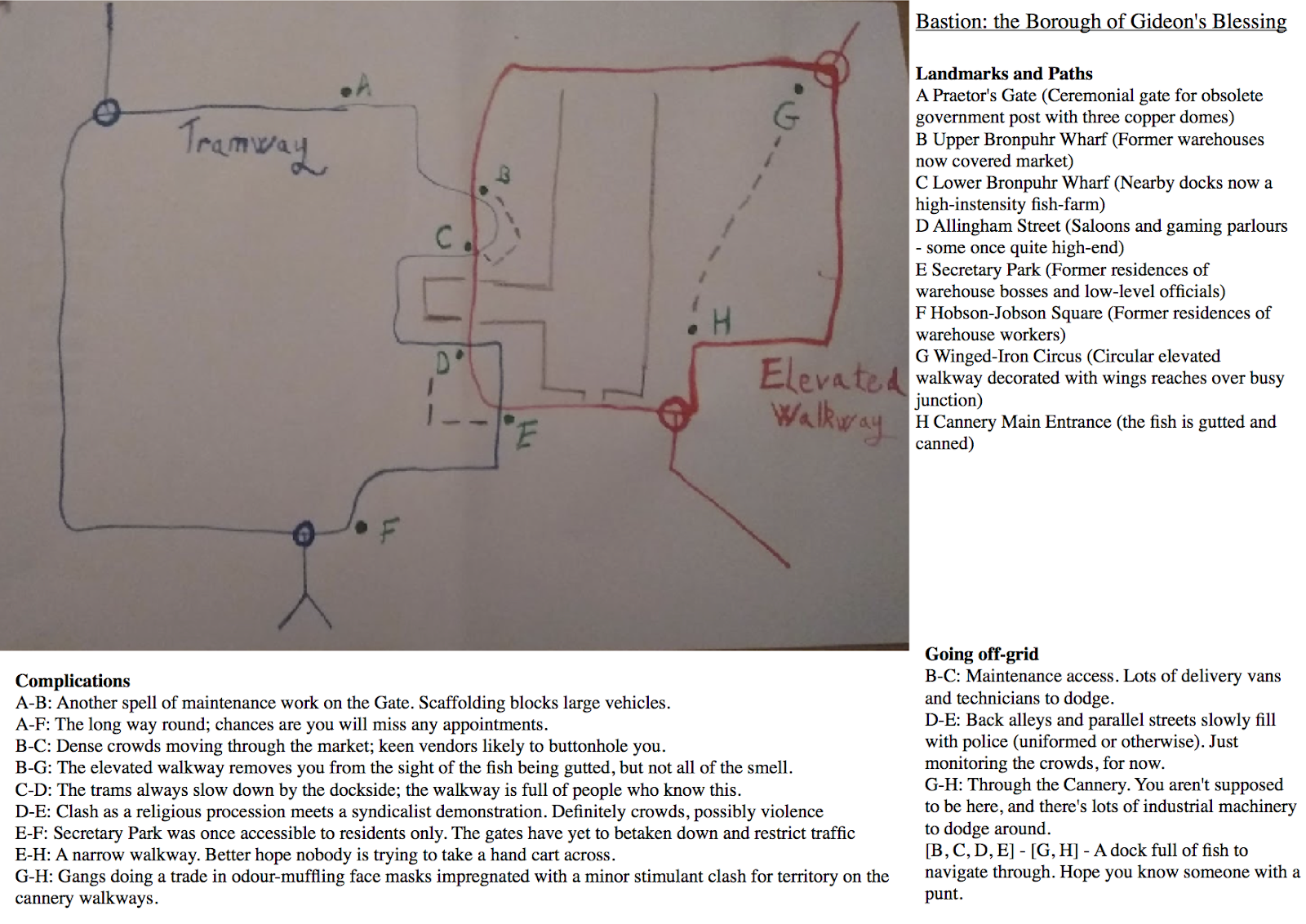
Bastion: the Borough of Gideon's Blessing


Landmarks and Paths
A Praetor's Gate (Ceremonial gate for obsolete government post with three copper domes)
B Upper Bronpuhr Wharf (Former warehouses now covered market)
C Lower Bronpuhr Wharf (Nearby docks now a high-instensity fish-farm)
D Allingham Street (Saloons and gaming parlours - some once quite high-end)
E Secretary Park (Former residences of warehouse bosses and low-level officials)
F Hobson-Jobson Square (Former residences of warehouse workers)
G Winged-Iron Circus (Circular elevated walkway decorated with wings reaches over busy junction)
H Cannery Main Entrance (the fish is gutted and canned)

Complications
A-B: Another spell of maintenance work on the Gate. Scaffolding blocks large vehicles.
A-F: The long way round; chances are you will miss any appointments.
B-C: Dense crowds moving through the market; keen vendors likely to buttonhole you.
B-G: The elevated walkway removes you from the sight of the fish being gutted, but not all of the smell.
C-D: The trams always slow down by the dockside; the walkway is full of people who know this.
D-E: Clash as a religious procession meets a syndicalist demonstration. Definitely crowds, possibly violence
E-F: Secretary Park was once accessible to residents only. The gates have yet to betaken down and restrict traffic
E-H: A narrow walkway. Better hope nobody is trying to take a hand cart across.
G-H: Gangs doing a trade in odour-muffling face masks impregnated with a minor stimulant clash for territory on the cannery walkways.

Going off-grid
B-C: Maintenance access. Lots of delivery vans and technicians to dodge.
D-E: Back alleys and parallel streets slowly fill with police (uniformed or otherwise). Just monitoring the crowds, for now.
G-H: Through the Cannery. You aren't supposed to be here, and there's lots of industrial machinery to dodge around.
[B, C, D, E] - [G, H] - A dock full of fish to navigate through. Hope you know someone with a punt.

Deep Country: The Approach to the Joelite Range


Landmarks and Paths
A Second Nun Bend (A railway station largely dedicated to repairing the track dow to the river valley)
B Burn Reeving (A watch station is maintained at this point, despite the lack of river traffic or fishing trade)
C Pardoner's Crossing (The trains from the mines need to pass through here. That's all the importance it has.)
D Manciple Station (A former town, known for the cattle trade. Empty stockyards now inhabited by things other than cattle)
E Topaz Junction (Railway yard, with signal box and other buildings decorated with low-grade semi-precious stones from the mines)
F The Husband's Bath (By the junction of the rivers a large hole has been dug. Local stories claim a lazy husband was forcibly scrubbed there.)
G Barton Franklin (Once known for the quality of the waters; now known as the town you stop at one the way to the mines)

Complications
A-C Scree has blocked one of the rail lines
B-C A river toll levied at Pardoner's Crossing
C-E The signal station at Topaz Junction refuses to let anyone through. Desperate brigands hide there.
C-F The river is full of sharp rocks.
D-E Only one train in ten has any reason to stop at Manciple.
E-G The Prefecture Warden's deputies are conducting a search of the moors. You may be held at a way-station and interrogated.

Going Off-Route
Between A-C-F: Steep Slopes (Loose scree, dust, precipitous drops)
Between E-G: Damp Heath (hills, dense scrub, heather)
Downriver from F: Former Proving Grounds (Unexploded munitions, shell craters, barbed wire)
E-X: Out on the moors, a former hunting lodge can be seen. Behind it, something tall, covered in scaffolding.
F-X Across the river, the sandbag-clad bulk of an observation post.
G-X Below the railway cutting, a former sanatorium in heavily wooded grounds.

Part Two here.

Saturday, 14 March 2020

Electric Bastionland: First Thoughts

I put in a spot of money for the Electric Bastionland Kickstarter, and was duly rewarded with a PDF. So then, a few words on it, for the general discussion.

The book is roughly divided into three section: An Introduction with details of the Into the Odd rules, a list of character Failed Careers backgrounds and advice for play, involving details of the setting.

A presumed party of would-be adventurers automatically start with a debt and someone (or something) to whom they owe money. This skips neatly over the improbabilities of player characterisation and, frankly, allows a probable cause for the dangerous work of dungeon crawling in a city buzzing with money and possibility. Also, it adds an automatic contact - a mentor or benefactor, though also a predator. It's an elegant source of motivation.

This is bolstered by a list of Failed Careers and people you owe money to. It gives superb variety; there are about a hundred careers, each with unique items and skills attached. The city of Bastion, much like (for instance) Virconium or Gormenghast does not really have an official map or set of parameters. So the list of careers is the meat of the setting - setting up the main flavour of Bastionland. On top of that, the black and white art, full of blank faces and thin lines gives a very good impression of squalor, shabbiness, brash fashion and detached stylish opulence. There is a deliberate urban 'cool' to it in places.

Following this, as I said, is a set of advice for play. This is good, frankly. Neatly laid out, with bullet points grouped into threes. The advice for play and for the Conductor (GM or similar) seems sound - and, even if were you disagree with the philosophy, it is nearly laid out and comprehensible.

Electric Bastionland is not a toolkit for describing cities. Yes, as it says, Nobody's Bastion is incorrect, but Bastion is not a description of early-mid 20th century city life (and how to use that for tabletop RPGs). It is a more poetic rendering of the city, where the world is divided into Bastion, Deep Country, the Underground and the Living Stars. Other cities exist, but none can compete with Bastion. The City is moves and changes at astonishing rate - with nothing like a central authority, the Country is supremely hidebound, the Underground spectacularly dark.

One principles of the city boroughs of Bastion is that there is always a crowd; that if possible, a problem or obstacle should always be a human being. 'Mastery of People is Mastery of Bastion'. The city is always crowded, always living. Bastion has no business districts deserted at the weekend, no vibrant provincial towns with artistic colonies, no stifling domestic suburbs, no demands of a central government, no national spirit (nationalism within Bastion seems possible, but probably not of any simple type).  Maybe I am thinking too much of the late twentieth century, mass communication and mass transit - but Metro-land and the Holloway of Diary of a Nobody certainly predate this.

It is a poetic cityscape, an archetype put into formal, almost ritualised terms for use on the tabletop. That isn't automatically bad - I've never felt that RPGs have to be simulations - but I like some of my wider context to be a little granular. It is so unremittingly urban-centric that I want to rejig my anti-urban setting to act as a mental counterweight. It works, and can work for a great many things.

I suppose I would square the circle by having Bastion as the metropole of a larger empire/alliance/federation &c, rather than the literal City beyond all Cities, even if it is that for all intents and purposes.

I like Electric Bastionland. I want to use Electric Bastionland. You may do so as well. I might post a few worked examples here. But remember what it is before you try to use the setting as it is on the page.


Monday, 27 May 2019

Beggarstaffs, Ruin and the Great Outdoors

A recent exhibition at the Fitzwilliam Museum, near me in Cambridge occasioned a visit. This set out some of the work of William Nicholson and James Pryde. The two are most famous for cooperating to create posters - as 'Beggarstaffs' - but the exhibition dealt with more than this. Portraiture, illustrations and other scenes from both artists were on display.

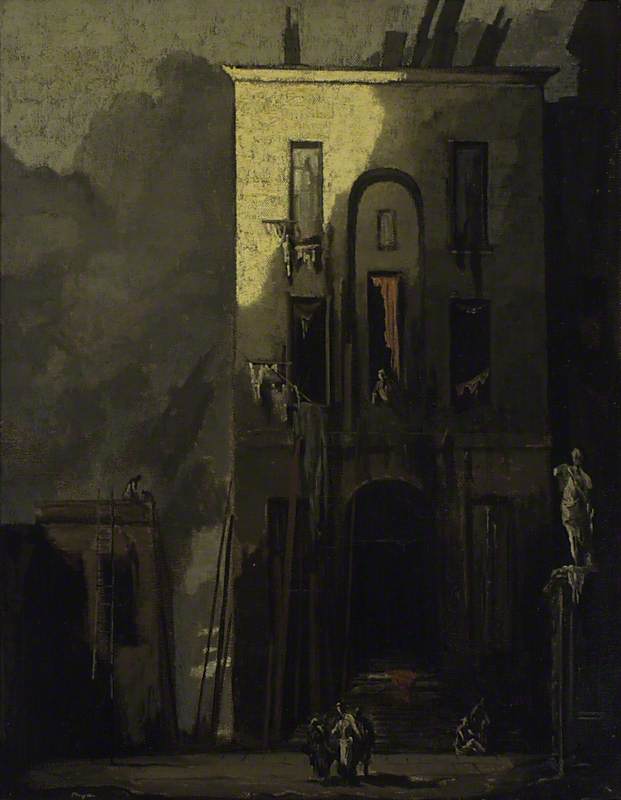
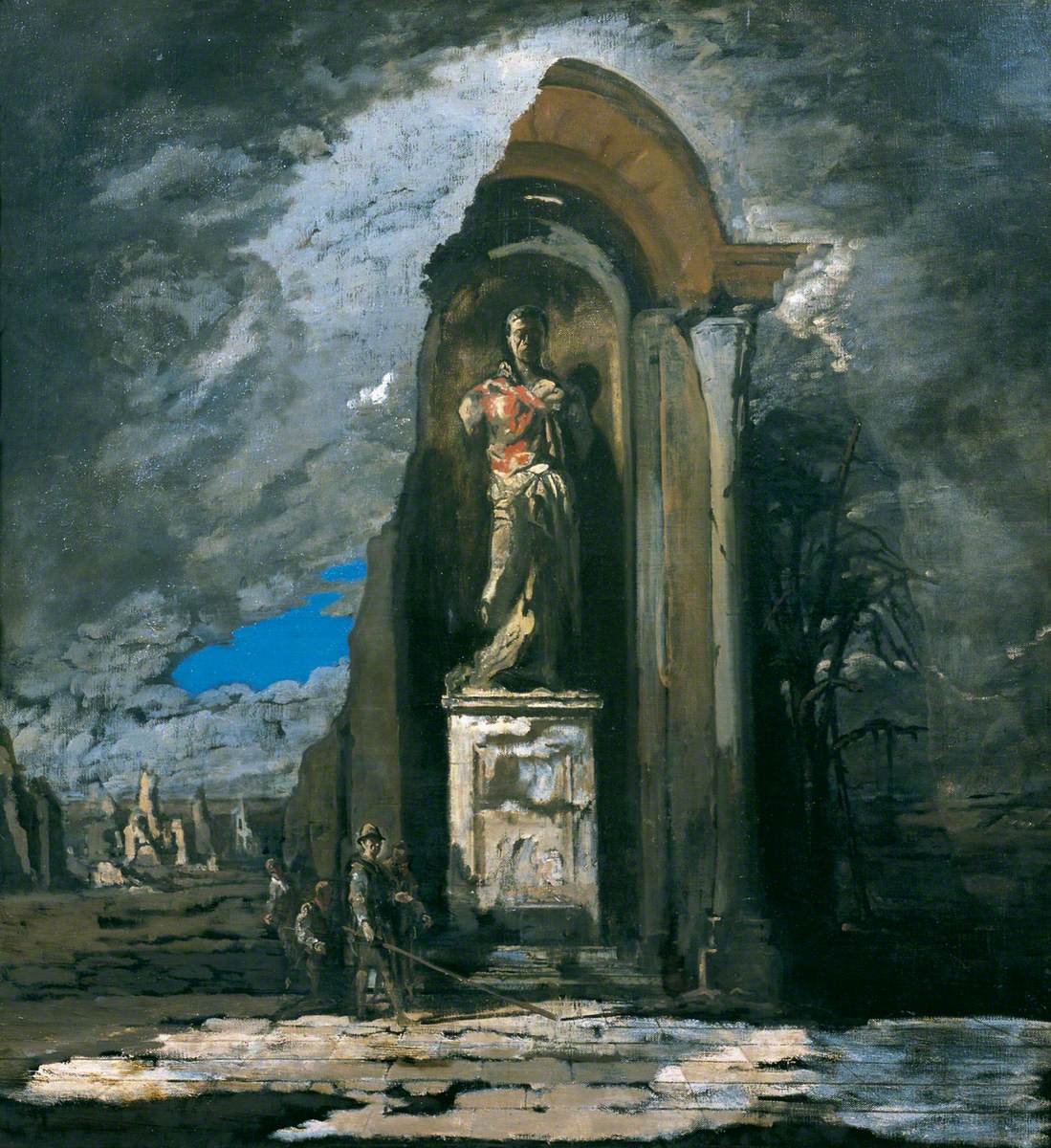
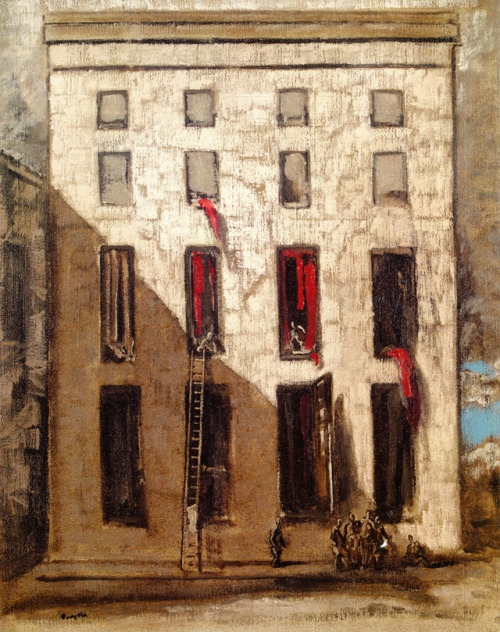
Among these were a series of gloomy city scenes by Pryde, generally focusing on an archway as an overriding feature.
The Slum, 1916
Image found here: https://artuk.org/discover/artworks/the-slum-142570

The Monument
You'd never guess these were made around the First World War, would you?
Image found here: https://artuk.org/discover/artworks/the-monument-29078

I don't want to give the impression these all involved arches. I think this one involved Venice.
Anyway, the combination of ruins, deprivation and the miserable inhabitants of heroic scale monumental architecture produced one notable response in me: OSR Aesthetics of Ruin. I know, I've written about this before (beware the man of only one blog post!). But Pryde may be worth adding to the index of artists for such material.

***

That might have been where the post finished, but no. My reading of late has taken in The Old Ways by Robert Macfarlene, as well as Patrick Stuart's Silent Titans (which I might write a dedicated response to later on). Either way, my mind has been homing in on landscapes.

Does the the corner of tabletop roleplaying I am interested in have much scope for the large, the slow - the geological? Hexcrawls abound, but they have a tendency to seem a little unnatural - oddly curated. Perhaps it is the GM's jobs to smooth the discrete hexes into the flow of a realistic landscape.  Enclosed spaces: Dungeons, Cities, Mazes, Caves - these are the places in which the most impressive work has been done. Even if the scale is inflated it is still an enclosed, finite space. Puzzle-box environments, full of mechanisms.

Could this be done in a natural (or largely natural environment)? The Gardens of Ynn are rather too managed (or, formerly managed) for this to take place, and the Wir-Heal of Silent Titans has been so comprehensively fractured on the dimensional level I'm not sure either count. The video game Fallout: New Vegas had Zion National Park, with its maze of canyons and possibilities for verticality, which comes pretty close to this.

However, thinking of the sweep of the landscape one encounters on walks: in which each spur seems to promise the tip of the headland, where long empty skies change the system of thought, where the terrain under foot changes your whole mode of walking (try going from a sandy beach to a pebble beach).  The scale of landscapes seen from above in Peter Jackson's Lord of the Rings, bare and vast. T. E. Lawrence, in Seven Pillars of Wisdom, writes about how dramatic a change of rock was to campaigning in the desert, because of what it meant for vehicles or beasts of burden. Reading about this made it seem as dramatic as a minefield or an obstacle like an enemy bunker, because of the hostility of the desert (Lawrence is good when writing about rocks).

Perhaps the small-party-of-adventurers is the wrong unit for a game to talk about landscapes. Even mounted, they don't necessarily move quickly enough to take it in. Joseph Manola's Against the Wicked City is good about discussing the sweep of Central Asia, but passes over much of the countryside proper (see the comments in that last link). This is hardly blameworthy; Manola wishes to make Against the Wicked City, not Steppe Simulator Five.

Perhaps the place to look is to vehicle combat as a central gameplay feature. Mad Max is the touchstone - not in terms of the internal combustion engine, the post-apocalyptic or Australia, but in terms of speed, the importance of relative position, the possibilities of open space, the consequences of terrain (not that you can't traverse something, but what it will do to you as you traverse it).

This may merit further research, as well as mooting a series of simple settings suitable for this kind of combat.

Wednesday, 28 November 2018

Pistol Crossbows: A Jaundiced View


I am not fond of pistol crossbows appearing in media with a somewhat medieval theme. If someone says that they want to use one, I roll my eyes. They don't strike me as strictly possible even in a world of wizards, Dwarven metallurgy and the like. (I take it that the pistol crossbow is always intended as a faintly plausible mechanical device rather than something that works because it has been so heavily enchanted that it is effectively a crossbow themed magic wand). To make one of these roughly as powerful as a crossbow or handgun seems that it would need devices and materials beyond the abilities of the age. Crossbows are hard work; there is a reason why they possessed stirrups to fit your foot into or large cranks to bend the limbs of the bow. There is something static about them - for use behind the battlements, or behind a pavisse. They are not assault rifles; if a modern comparison had to be made, perhaps the anti-tank rifle is the correct equivalent: heavy, cumbersome, requiring a fixed position.

Thus, idea of people walking round with them like gunslingers is silly. The idea of being a gunslinger in a medieval or pseudo-medieval setting is silly, especially in a game. You, a twenty-first century player are trying to cope with challenges using a different set of ideas, resources or skills. You cannot act like Jim Lassiter, James Bond or Harry Callahan. There is a range of anachronistic comedy to be mined by this (a man asks for a martini in a world that doesn't drink much in the way of spirits, has no formal image of the cocktail and nothing resembling a cocktail shaker to be shaken, not stirred in).  But that isn't quite the same thing. Try and act with Bond's suaveness or Callahan's brashness (and their tactical equivalents) in the wrong setting and it will end poorly.

I suppose this is less a cry for absolute realism, but rather for the limitation of anachronism. But this is not an article full of invective for invective's sake. What brought this on? Honestly, a new film. A film I haven't even seen; the new Robin Hood picture. Here's a trailer, here's a shorter professional review, here's a longer more discursive review.  The appearance of automatic crossbows*, riot shields and casino-like parties put me in the frame of mind to think on this topic.

On reflection, there were a few pieces of media where I could stomach or even actively approve of such a thing as the pistol crossbow. In the later Discworld books they appear, in a moderate fashion (The Ankh-Morpork City Watch has been using crossbows throughout, but I always pictured these as carbine sized, and so a little more reasonable - besides the fact that the Watch rarely contends with heavily armoured targets).

Image result for paul kidby discworld watch
As in the front row here, Paul Kidby's cover to Night Watch.

However, in The Fifth Elephant one has mention of an assassin's weapon in the vein of the pistol crossbow: concealable, vicious, prohibited. It has the appearance of 'a long-handled hammer or perhaps a strangely-made telescope', it is readily concealable, though difficult to load: a strong man says he 'practically ruptured myself cocking it against a rock'. It is explicitly a one-shot device and may very well be the same thing as the 'spring-gonne' mentioned in The Truth (L-Space, the Discworld Wiki certainly thinks so). It is prohibited both by official law enforcement and the better regulated criminal world.

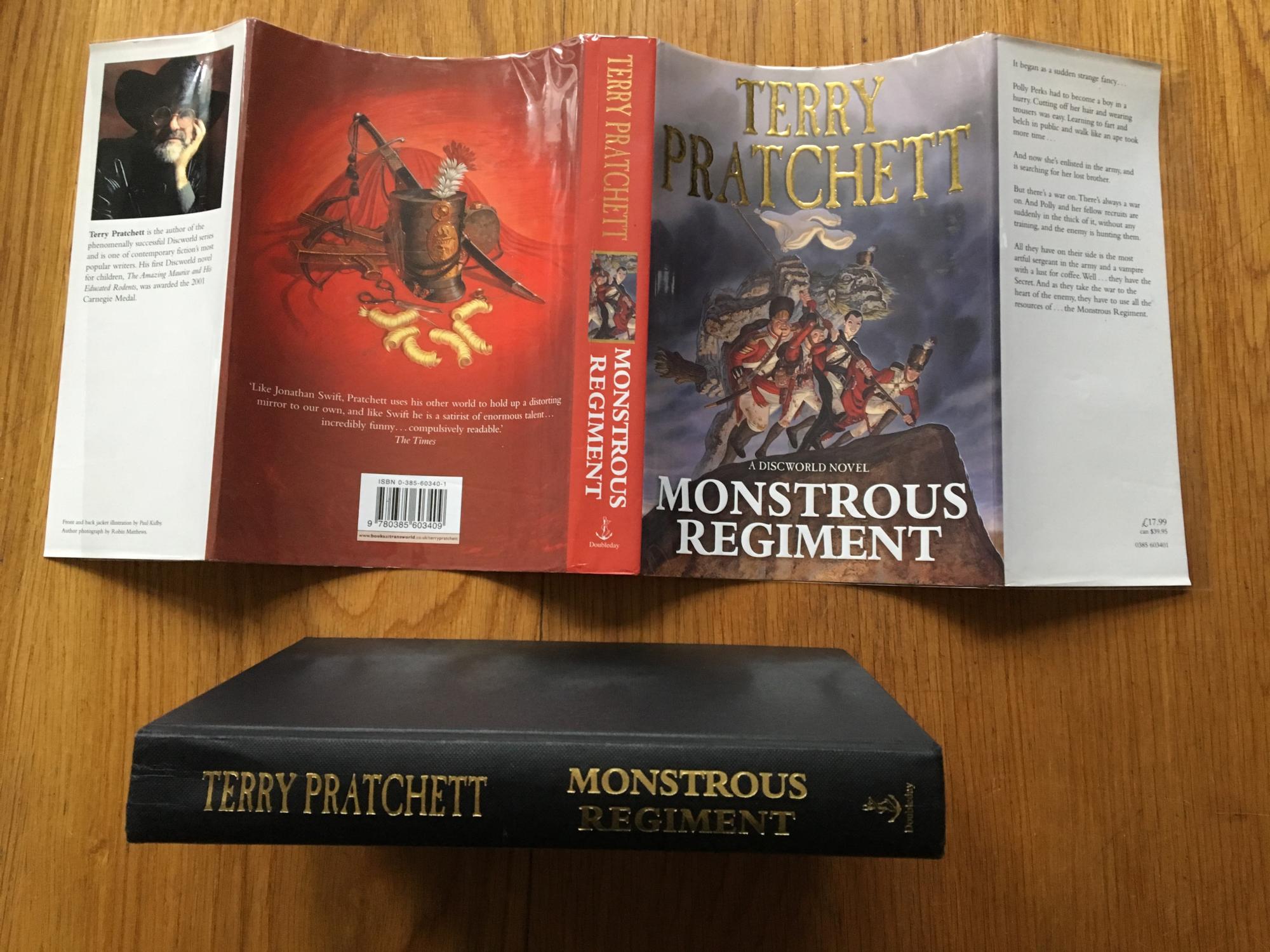
In terms of conventional warfare, Monstrous Regiment mentions the horsebow, as carried (at first) by an elite heavy cavalry regiment from a well-funded military. I quote from my worn 2004 Corgi Books paperback:

'She'd acquired two of the horsebows. stuck awkwardly through the straps of her pack. They were horrible things, rather like a combination of a small crossbow and a clock. There were mechanisms in the thick shaft, and the bow itself was barely six inches across; somehow, if you leaned your weight on it, you could cock it with enough stored energy to fire a nasty little metal arrow through an inch-thick plank. They were blued metal, sleek and evil. But there is an old milt'ry saying: better me firing it at you than you firing it at me, you bastard.'

The British first edition of Monstrous Regiment had a dust-jacket by Paul Kidby with a still-life on the back cover,
depicting what I take to be horsebows, left and to the back of the shako.
I was lucky enough to find this picture of it on Abe Books.
To see them more clearly, you may wish to open this image to full-size in another tab.
I quite like this as far as pistol crossbows go: technologically advanced, relatively rare and difficult to use. Note also the main characters distaste for them; perhaps echoing the feelings of the British author: this is not simply a thing to point at the bad guys until they fall down. We get an explicit image of its potential for harm.

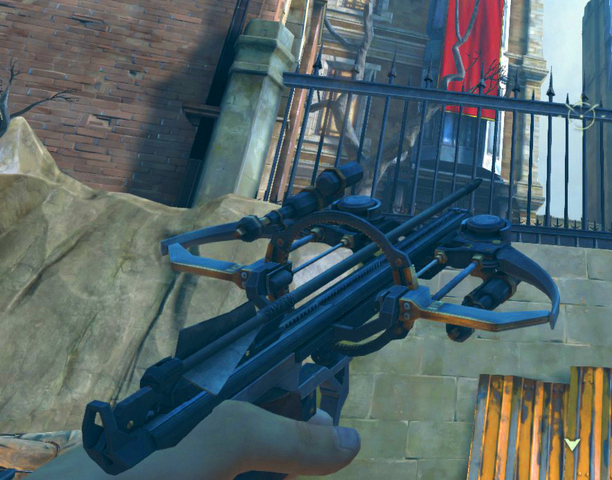
Stepping away from the Discworld (but not too far; I am told that Ankh-Morpork, among other things was an inspiration) the video game Dishonored** features a pistol crossbow. It is compact and quiet - fitting for a character that must climb over the masonry of the city of Dunwall and remain unseen. It is slow to reload, fitting the style of stealth gameplay: gentle movement, preparation, restricted resources. In this it resembles the silenced pistol of the popular imagination.

More images to be found on the Dishonored Wiki, but this one will serve as an example.
As for plausibility - well, there is only one of its kind, seemingly. It is made and upgraded by the protagonist's pet inventor. For all of its metal parts, it looks delicate somehow, as a microscope. Like dropping it would bend one of the mechanisms or jar something out of place. You certainly wouldn't try and pistol-whip someone with it.

(Bioshock Infinite: Burial at Sea featured a pistol crossbow of much the same type as Dishonored, albeit less fragile looking and Art Deco. See here for details. )

A mention should be made of the pistol crossbows of the Mad Max films, most prominently in the second film, The Road Warrior. They appear mounted on the wrist of many of the rampaging antagonists of that film***. They are compact and lightweight for those who must concentrate on driving a motorcycle, dune buggy or other heavily modified automobile.
Such as this gentleman. 
In a world with a limited supply of firearms or ammunition, they offer a viable alternative. They might not be terribly powerful, but no-one appears to be wearing terribly thick armour in the heat of the Australian wastes (to say nothing of clothing choices). Moreover, they are generally used at close range: speed up to the target, loose the bolt, drop back again. What one might refer to as a Perthian Shot.

* * *

Having gone over all these so thoroughly, what positive contribution can I make?

I have a few alternatives to the pistol crossbow, for compact projectile weapons - for preference, able to be used one handed.

1. Darts
2. Throwing knives
3. Sling (requires slingstones or bullets)
4. A slim weight on the end of a line - can be whipped out with tremendous force from a sleeve.
5. Shuriken, or similar slim throwing weapons
6. Slingshot (of the Y-frame and flexible strap variety)
7. Throwing axes; the sawn-off shotgun to the throwing knife's pistol.
8. Just give in and allow gunpowder weapons.

However, if you do insist on the presence of the pistol crossbow, here are a few ways to make it a little more interesting - by which I mean troublesome and palatable to my tastes. A pistol crossbow may be fast, cheap or good. Pick two.

1. It is a pistol crossbow, only slightly less deadly than a fullsize crossbow - but it breaks frequently. The bow is the weakest point.
2. The Discworld 'horsebow'. Expensive and difficult to source - there are few artisans that make them; those that do are contracted by the military and discouraged from selling their talents elsewhere. Reloading is hard; a military unit would have a reloading device clamped to a robust wagon in order to make this easier for the quartermaster.
3. The bow works fine, but cannot muster enough force to penetrate armour/thick monster scales, hide, &c. In order to correct this, a remarkablely potent (and expensive) poison has been smeared onto the bolts.
4. The bow works fine, but cannot muster enough force to penetrate armour/thick monster scales, hide, &c. In order to correct this it fires small pellets of asphyxiating, pain inducing spices and chemicals. Congratulations, you now have an expensive long-range pepperspray.
5. The bow works fine, but cannot muster enough force to penetrate armour/thick monster scales, hide, &c. In order to correct this, it fires thin tubes containing a potent acid. The acid is not uncommonly expensive; but the bolts with their aerodynamic hollow glass heads are.
6. The bow works fine, but cannot muster enough force to penetrate armour/thick monster scales, hide, &c. Instead, it fires a thin tough bolas intended to tangle, trip or throttle an opponent. This bolas is difficult to make,both due to the materials involved and the business of making it fly as intended.
7. Pistol crossbows exist, and are not uncommon - but are for sporting purposes only.  They might be accurate and more-or-less reliable, but they have approximate stopping power of an air rifle.
8. This pistol crossbow reloads quickly, doesn't break and will penetrate an inch of steel. This is because there is a demon (or Djinn, or mighty spirit, or other Demon-equivalent) trapped inside it. You are now carrying around the equivalent of a nuclear reactor on your hip.  Both purchasing this and keeping it are likely to be, in one fashion or the other, expensive.


*Thanks to Age of Empires II, I have long been aware of the Chinese repeating crossbow. This is quite clearly something else.
** I haven't played the second game in the series, but I believe most of my points still apply.
*** Of all places, something similar turned up in the Arthurian 1997 film Prince Valiant attached to knights' gauntlets.

Tuesday, 26 June 2018

Age of Mythology: A Checklist of Beasts

I have been in the midst of a moderate nostalgia kick for Age of Mythology, a real-time strategy computer game from 2005. The premise of setting civilisations and their various deities, monsters and heroes at one another's throats was moderately irritable. The inclusion of a scenario editor was a very good choice - however poor I was at using it versus the versions found in Age of Empires. If you want more of a background or assessment, here's Wikipedia and here's a podcast.

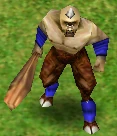
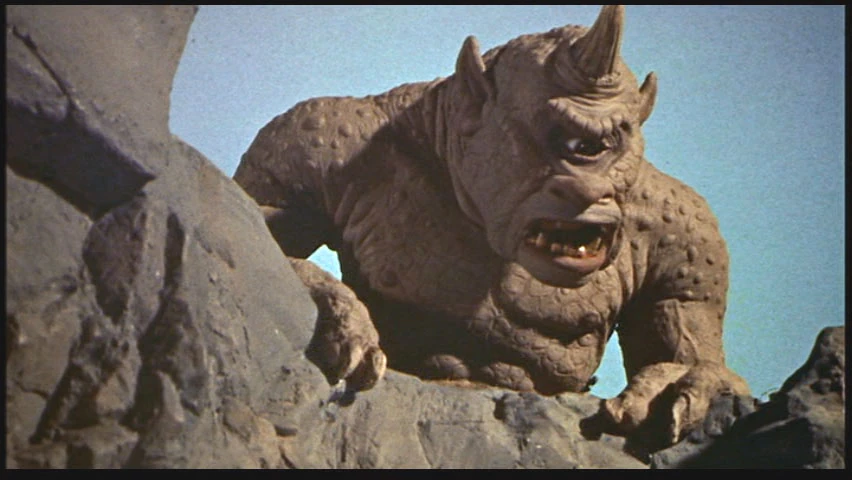
One thing, however, that might appeal to readers is the visual inspiration. Many of the monsters - 'myth units' - took their cues from cinema. Hence, the cyclops looked like this:


reminiscent of this cyclops from Ray Harryhausen.

Image result for cyclops from Ray Harryhausen.

Likewise, the Gorgon carried a bow and had a serpentine lower half - just as Medusa in Clash of the  Titans. This continues across the civilisations - Greek, Egyptians and Norse (Atlanteans* were added in a less well-received expansion). The Egyptians seem to have come straight out of The Mummy or The Ten Commandments.

But the use of popular culture elements as inspiration, as well as the mix of mythological origins is, on reflection, more than a little reminiscent of Dungeons and Dragons et al**. This said, the best known monsters get used as myth units pretty quickly and the creators (Ensemble Studios) had to fill in the gaps - sometimes using their imaginations pretty freely. It's interesting to see how they plug the gaps.

So, below is a list of myth units from Age of Mythology and The Titans Expansion with notes about each one and if it has appeared elsewhere (that I know of). Age of Mythology wiki link with more information here (elements of the in-game encyclopaedia are hilarious). Reference is made to the first edition Monster Manual in the first instance.

Greek
Pegasus - must be one out there somewhere.
Cyclops - yup.
Minotaur - in skeletal form, even.
Centaur - ahumph.
Manticore - yes.
Nemean Lion - functionally a dire lion.
Hydra - multiheaded dragons are known; not so certain about regenerating heads.
Scylla - basically a multi-headed plesiosaur, rather than a woman with multiple dogs at her waist and a serpentine tail.
Chimera - yes.
Medusa - the correct term would be gorgon, but yes.
Carcinos - giant bloody crab.
Colossos - a bit like Ted Hughes's Iron Giant. But Grecian and with a sword. Think a mass-market Talos.

Egyptian
Anubite - jackal-headed humanoids with two blades. Can jump very far. Found purely as a homebrew.
Wadjet - winged serpent from the Pharonic crown, but scaled up to bigger than a man. Spits poison.
Sphinx - ahumph x 2.
Scarab - no longer tiny. Bigger than a four-door saloon; massive pincers to tear down buildings. Nothing new about giant beetles.
Petsuchos - bejewled laser crocodile. Based on a sacred crocodile, probably without the lasers. Giant crocodiles one can find; lasers are extra.
Roc - giant bird that serves to transport people. See the giant vulture - complete with cage - from Clash of the Titans.
Leviathan - also serves as a transport. Old Testament references now; see Jonah.
Scorpion Man - there's one in the Peridot.
Avenger - nothing to do with John Steed. Mini-Horus with two swords.
Mummy - not hard to find. Can convert you into a minion.
Phoenix - yes, these can be found.
War Turtle - sodding great turtle.

Norse
Troll - these ones throw stones and can get an extra head.
Valkyrie - Nordic-themed mounted female paladin with obligatory Wagnerian metallic bodice.
Einherjar - spirit of heroic Norse warrior. Bit like a Death Knight.
Frost Giant - yes. Elite frost giants get horns, for some reason.
Mountain Giant - standard issue giant with beard and club. 
Kraken - not quite as big as some examples.
Battle Boar - golden boar; think a mass-market Gullinbursti.
Fire Giant - yes. Somewhat like a hornless demon.
Fenris Wolf Brood - functionally a dire wolf; gain greater strength in packs (beyond there being more dire wolves, that is).
Jormund Elver - sea serpent. Though also referred to as elvers - giant eels are also a staple.

Atlantean
Promethean - golem (Prometheus made men out of clay - were these prototypes?). Split into two smaller versions after death.
Automaton - robot suit of armour.
Caladria - winged healer. Doesn't fight herself.
Servant - benevolent water elemental. _ of Oceanus is implicit in the name.
Satyr - ahumph x 3.
Neriad - aquatic woman on a shark with a trident.
Behemoth - triceratops meets armadillo. Eighteen feet long. Old Testament again.
Stymphalian Bird - bird that slings razor sharp metal feathers at you. Can't find any likely suspects.
Argus - floating octopus that can drool acid. Many eyes.
Lampedes - Underworld nymph that keeps Persephone company. Looks a bit like a Drow sorceress.
Man o' War - jellyfish that shoots lightening.
Heka Gigantes - Only four arms, but still giant. 

Go forth and investigate further, if you've a will to.  The game is full of details that could be plucked for ideas. I personally should like to see more laser crocodiles on the tabletop.


* In the first game, Atlantis was Greek with a few extra bits of set decoration. In the expansion, the Atlanteans become Titan-worshipers drawing on Roman elements (IE, Murmillo are the standard infantry unit) with a scattering of other stuff (IE, llamas, implying theories about some Native American civilisations being Atlantean).

It's all a little unconvincing next to the semi-realistic other civilisations - the Greeks have actual hoplites and triremes, for instance. But at the same time, the designers have had freedom to make it all up as they went along. So you get a masonry and metal-heavy semi-Modern architecture, and hints in the flavour text at a slightly egalitarian society. To say nothing of the occasional gem of strange gameplay justification lore:

A Contarius distinguished in battle, upon returning to Atlantis, was presented with a lance made from petrified wood found in one of Atlantis’s most distant western colonies. When the stone lance of a Contarius broke, the soldier’s name was carved on its shaft and the fragments were returned in honor to Atlantis. These fragments were arranged in a palisade around the Palace of the Theocrat. It did not take long for the competitive Contarii to begin seeking out targets that would most swiftly break their lances - namely buildings. 

[Source]

Splendidly evocative stuff, but ultimately not enough of it to satisfy, however daft it all is.

** To say nothing of the unlikely pin-up illustration high fantasy renditions of the gods and goddesses involved (Theia, Hekate and Hyperion spring to mind). Some look reasonable enough; others are begging to have the numbers filed off and to be re-used elsewhere.