Showing posts with label J R R Tolkien. Show all posts

Friday, 25 August 2023

August '23 Miscellany - and a Notion Entertained

A few things to flag up for you, largely unrelated to recent posts - as well as brief section once again Entertaining a Notion.

***

A Return to Saxherm: if you hadn't already encountered it, HCK over at Grand Commodore has recently posted an audio version of his story 'The Crimes of Jack Daw', set in my own Saxherm, which was created using his city-state creator. (Check the comments of that post for a series of people drawing up their own cities, and perhaps make your own!)

***


I enjoy the work of Tim Powers, and so when I saw a paperback by his fellow Ashbless scholar James P. Blaylock, I decided to pick it up. That was The Stone Giant, and it rather left me cold. The obliviousness of its main character mixed oddly with the very directly fantastical elements. 

But seeing a copy of The Last Coin, I decided to try again.

This is more like his pal Powers. Set in Seal Beach, California (part of the greater Los Angeles area; I assumed reading it that it was a pastiche of somewhere rather than a real place), contemporary with the book's publication (1988) it is about the assembly of the Thirty Pieces of Silver paid to Judas Iscariot by an old man called Pennyman. But most of it is told from the point of view of Andrew Vanbergan, who is trying to open an inn, and deal with aged relatives, and get the right kind of breakfast cereal, and...

There is the perennial comment about how stupid people in horror films are, how they ought long ago to have gone down to the basement, and sat there with a shotgun pointed at the door. Vanbergan is, like the lead of The Stone Giant, oblivious and fussy and caught up with his own mundane troubles - and this is exactly as he should be. It is a wild leap for a man in 1988 to work out that someone is gathering thirty very particular pieces of silver, even if we know it from the prologue or the blurb. Watching someone not quite notice and not quite understand what is going on is exactly how this should be going. 

The grubby, furtive - petty, even - Vanbergan is an unlikely paladin (not that he ever really becomes one). Compare Indiana Jones, who is supposed to be somewhat ruthless and morally compromised, another unlikely saviour - but who has a handsome jawline and good suits and a winning smile, and eventually becomes another Hollywood icon. Obviously this man rescues the Holy Grail: that's just what he does. (Cf. Bond: 4/5 of his assignments were meant to be run of the mill, and lots of the books start with him grousing about paperwork. Fleming even intended his name to be boring! But a decade or so of movies and...) Anyway, Blaylock gets a portion of Grade-A kudos for maintaining the unlikeliness of his unlikely hero. 

The best book of its kind I've read? By no means. But the midpoint mix of obscure signs and obliviousness, mundanity and creeping horror is quite good. If I knew more about David Lynch, perhaps I'd call it Lynchian.

***

The Pantographia of Edmund Fry. A 1799 work collecting as many alphabets, scripts and writing systems as the author could get his hands on. It may be found here at the Internet Archive.

Rather lovely in its broad sweep and unique collection of printed scripts. Good to flip through, even if online. Fry does not quite distinguish continually between a script and an alphabet (e.g, on one page we have both the Gothic script found in High Medieval manuscripts and the alphabet of the Goths); likewise Danish is produced in the Latin Alphabet. Things like the Philosophic language of John Wilkins, Bishop of Chester are included - Cf. The Search for the Perfect Language, Umberto Eco. (Pantographia is at least of the spirit of TRoAPW).

Using it as a reference, it would irritate me that English and Saxon are distinguished - especially when one entry under English reproduces something by Alfred the Great. See also the entries for both High Dutch and German, or Ancient British and Celtic. The Pantographia reproduces languages from across the globe, some of them from quite far off and quite recent discoveries to Fry and his audience: see entries under 'Nootka Sound' or 'Friendly Isles'.

The colonial and imperial aspects are baked in, of course: the entry for New England (sandwiched between [pre-Rosetta Stone] Egyptian and English) does not appear to be in a dialect of the Pilgrims, but is possibly Wampanoag (see also Virginia and New Zealand). This practice is not consistent - see Ecclemach. The specimen text for many languages is the Lord's Prayer, be it Siamic, Orcadian, Formosan or Mohawk.

Terms are also unfamiliar - Esthonian, Esquimaux, EthiopicSclavonian, Manks, Saracen (as well as Arabic), Servian, Thibetan. I am unable so far to identify 'Molqueeren'; it looks like Dutch and is perhaps a sort of Frisian. 

Fry also introduces as Welch the 'Bardic Alphabet' of Edward Williams. There's something of a collision in this between the Romanticism (and Nationalism) of the late 18th and 19th centuries and the (mid-18th) Enlightenment project of encyclopaedias and catalogues: see also Ossian. It's tempting to view this as a narrative of Romantic-Nationalist passions and obsessions colliding with Enlightenment naïve benevolence - but that's perhaps a little too neat. Cf. the 'alphabet of Charlemagne'.

Anyway, none of those last few paragraphs should prevent you from at least leafing through this online. An interesting work and I would very much like to see an annotated version.

***

Tales of the Alhambra: a collection of stories and essays by Washington Irving of Sleepy Hollow and Old Christmas fame, written while mixing travel and diplomatic work in Europe, published in 1832. It is set in and around (surprisingly) the palace of the Alhambra in Granada. This was a chance find and an interesting one. My edition was enhanced by a variety of colour plates: the publisher has not identified the artists, and the internet is little help. I have identified some, but others are made more troublesome to find, especially when they appear mirrored and differently coloured on image sites. (And yet still they lack the name of an artist! Pah!)

Tales is in part a description of the Alhambra and the countryside around it, together with sketches of its inhabitants. It is not as such uncharitable, but it is through the lens of a Protestant republican American observing the customs of a Catholic kingdom in the Old World. I would call it benignly disposed next to  The Monk or Browning's 'Soliloquy of the Spanish Cloister', but they share certain elements. 

Anyway, Irving's Alhambra is full of earthy peasants, genteel poverty, Royal officials, guitars being played, chaperoned maidens in mantilla and basquiña, muleteers, maimed veterans and roguish contrabandistas. It's a more colourful account than that Sackville-West gives - in part perhaps because of the relative climates of Avila and Granada.

The other portion of Tales is stories, dealing either with the distant past or the present inhabitants of the Alhambra. In many of these, the presence of Moorish Spain makes itself felt - though of course Irving has already spent much time describing the architecture of the Alhambra . Sometimes honest peasants are shown the way to stashes of buried treasure in the ruins, or enchanted caves. This is frequently the work of ghosts. In others, the story is set during the Middle Ages and the conflict of the Emirate of Granada and the Kingdom of Castille. Some of this, with the presence of astrologers, gallant princes, talking birds and flying carpets shows the hand of the Thousand and One Nights

Other pieces, such as the chapter 'Mementos of Boabdil' (Muhammed XII), display a more grounded approach, with Irving ruminating on the history of the Moors in Spain towards the end of the Reconquista. This is, of course, not colourless: 'the splendid drama of the Moslem domination in Spain', 'if it be a true representation of the man, he may have been wavering and uncertain, but there is nothing of cruelty or unkindness in his aspect'. Likewise, there are some stories of intrigues between the Governor of the Alhambra and the Captain-General of Granada.

[That is, Captain-General of the Kingdom of Granada: united with much of modern Spain under the Crown of Castile but de jure separate until the 19th century. English Wikipedia will guide you inevitably towards the Captains-General of the Spanish Empire in the New World or modern high-ranking officers.]

All that aside, reading this made me entertain a certain notion. I have of late been marinading in Tolkien. My mind went to a great citadel, of the country and yet not of the culture, once a chief stronghold of the enemy, ruined and upon a time glorious, in strange relation to its neighbours...

"The Tower of the Moon" by Ted Nasmith

Let us look to Minas Morgul.

Once Minas Ithil, tower of the moon, renamed after its conquest to the tower of sorcery. Counterpart to Minas Tirith. Aragon II, King of Gondor and Arnor, commanded that it would be destroyed and that none would dwell there (The Return of the King, Ch. 15, 'The Steward and the King'). Ithilien, the land East of the Anduin that was once its territory became the domain of Faramir, Prince of Ithilien.

But even King Elessar would in time die, and pass the crown to his heirs: likewise the children of Faramir and Eowyn would take up the title of Prince. And how readily may a city be utterly erased? Minas Morgul would endure a time.

Generations on, none is meant to dwell in the ruins of Minas Morgul. But a watch is kept on the land once called Mordor, and this means that a guard must be kept in the Morgul Vale, as a principal pass through the Mountains of Shadow. So there is a garrison in Minas Morgul. And where there are soldiers, there must be armourers, and farriers, and cooks. And with settled non-combatants, there are families. And all must be fed, so suppliers and procurators and traders come and go.

But they must not dwell there: all say, and all are told, that they will one day leave and never return. However, in the meantime there they pause, and tell tales of the ancient decorated halls: of stashes of coin and precious gems found in the walls, of ancient yet keen-edged weapons of strange make, of charms and enchantments in flowing scripts. 

Yet it is firm law that Minas Morgul will not be occupied: if any go there, it is by the King's authority alone. So the Castellan of the Morgul Vale is directly appointed, unlike his near neighbour the Prince of Ithilien, who inherited his title. But even if Prince and Castellan get along quite happily, the men under each will clash, and claims of jurisdiction must be judged. Furthermore, any Castellan would rather be the Castellan of Minas Ithil, rather than bear the infamous name of Morgul - though any Prince would have none of it. 

Who comes and - pauses - in Minas Morgul, in the ruins from which all shadows have been chased? The regular soldiery of Minas Tirith. Detachments from the Fiefdoms, serving their term: archers of the Blackroot Vale, hillmen from Lamedon, Lossarnach fighters with great axes. Men of Dol Amroth, who wished to leave their homes, but would not be sailors. Work crews, that must one day be road menders or masons and one day be sappers and eidoloclasts. The Castellan, and such of his household as he cared to take into Morgul. Couriers and rangers of the Prince of Ithilien. Opportunistic traders of Near Harad, or from the Kingdom of Dale and the Lonely Mountain. Elves from the Gardens in Ithilien (see Appendix A of LotR).

Anyway, were I forced to create a Tolkien-derived fantasy dungeon, that's perhaps what it would look like.

Tuesday, 8 August 2023

GW's Jackson's Tolkien's Middle-Earth

In a post over at Tales of the Lunar Lands I threatened to put together a grouchy nostalgia-fuelled comparison of Middle-Earth designs made by Games Workshop. Well, this is it - although I don't want this blog to become my Bespoke Whinge Manufactory. So the aim here is, if you'll pardon the phrase, ad astra per nostalgia

A note on my relationship with Tolkien: I am of an age to have seen and enjoyed the Peter Jackson Lord of the Rings films during their first release into cinemas. However, even then I was in a position to recognise the problems of adaptation. I had read The Hobbit and The Lord of the Rings, and portions of The Silmarillion. I had leafed pretty thoroughly through a copy of David Day's Tolkien Dictionary and seen the variety of illustrations there - Ian Miller, Jaroslav Bradac, Victor Ambrus and others. I had also found, in the local library, a copy of the BBC Radio adaptation of Lord of the Rings on CD (Ian Holm as Frodo, Bill Nighy as Samwise, John Le Mesurier as Bilbo. Music composed by Stephen Oliver).

All that is to say that I was capable (as a callow youth) of recognising the deficiencies of and gaps in Jackson's films - beyond the simple 'They left out Tom Bombadil!' approach. The use as broad comic relief of Merry, Pippin and Gimli. A skateboarding Legolas (however briefly). There was something off, to my youthful image of the Medieval world, for the armies of Minas Tirith to be clad in complete plate armour.

But they still had something to recommend them. And I am inclined to believe this still: they could have been considerably worse. A few years on, 'Good with Distinctive Flaws' seems like a near miracle.

I saw The Hobbit films. Even for research into this post, I have chosen not to see them again. If you are reading this blog, it is more than likely that you have seen them yourselves and have well-developed opinions on them.

At the same time as the Jackson LoTR films were being released, Games Workshop started putting out a range of miniatures and rules for the Lord of the Rings Strategy Battle Game. There was cooperation with Jackson and New Line for this: the GW LoTR SBG Frodo looks like Elijah Wood, their Uruk-Hai are painted with the purply-red skin tones of the films. Designers Alan Perry, Michael Perry and Alessio Cavatore got cameos in The Return of the King as Rohirrim. My friend group got interested, as did I. We were apparently not alone - according to White Dwarf, the Fighting Uruk-Hai box outsold Space Marine Tactical Squads that year. 

The production of miniatures is easier than that of cinema. So GW delved deeper into Tolkien's world than the films could. Here we return to my initial post in the Lunar Lands - accordingly, there are designs from GW that would later be contradicted by The Hobbit films. 

So, on the left is GW's Radagast. Perhaps a bit basic, a rather simple 'nature wizard' - but quite logical as an explicitly rustic, nature-orientated version of Ian McKellan's Gandalf. On the right is a model of Radagast as portrayed by Sylvester McCoy. I rather think there is something off about portraying an Istari with Ragged Trousers.

Here, into the bargain is an interior illustration from Shadow and Flame showing Radagast.

Who looks like he wants you to get off not just his lawn,
but his entire damn forest. Perhaps he could be played by Clint Eastwood?

This is Thranduil, looking nothing like Lee Pace. I'm not terribly fond of the miniature - sword and bow and staff looks a trifle indecisive, but the background inspiration of 'regal, mature version of Orlando Bloom's Legolas' makes sense.


The Elves of Mirkwood are in evidence as well: these were designed as Wood Elf troops to go with Thranduil, along with these musical sentinels. Compare the stripped-down, sparse look - Jackson LoTR elves minus the armour - with The Hobbit-derived rangers and household guard

***

By the way, I'm not intending to list every such point of comparison. You may peruse a catalogue from before The Hobbit films here. In a quick overview Wikipedia lists the material published - including rules for Tom Bombadil, the Scouring of the Shire, an extended Harad. But there are a few more things I want to touch on. 

Incidentally, the memorable characters of Lord of the Rings and recognisable actors in the Jackson films means that there are a great many character models for the Strategy Battle Game - as displayed to greatest effect in this post.

***

Gondor's fiefdoms would get attention from GW that the Jackson films could never offer. Firstly, in the form of an article detailing suggested conversions, and then in miniatures for Prince Imrahil of Dol Amroth (Middle-Earth's resident Lohengrin impersonator and the real hero behind the Defence of Minas Tirith) and his men. I'm not too fond of these Clansmen of Lamedon ('Clans? Mountains? They must be Highland Scots, give them kilts and claymores.')

Better is Arnor, which would get their own short-lived range, who strike me as a sort of 'Arthurian Gondor' with their helmet torses and green, fringed, banners. See also King Arvedui's fur-trimmed robe and general affect. 

The Variags of Khand are Mongols with Axes and Sometimes Chariots - linking them to the Wainriders defeated by Gondor in the Third Age. (That's a lot of Central Asian peoples GW has skipped over: as ever, The Wicked City is a blessed alternative). Easterlings are all of the scale-armoured exotic look shown in The Two Towers film, but I have some appreciation for the palanquin.  

Some of the Haradrim expansions are sensible enough: cavalry and an elite guard (who look as if they've stepped right out of the Hyperborean Age). The appearance of assassins, desert ninjas and (for want of a better term) thickset Harem wardens we will pass over swiftly. From Far Harad, we have Mahud camelry.

Who make me ask vexed questions about the price of ivory south of Gondor.


In addition to the strange 'mounted Maasai' look, I am reminded of a comment by Fitzgerald of Middenmurk about how 'the Osprey Men-at-Arms series of books will interpret everything in the fightingest way possible'.

Speaking of the Kingdoms of Men, GW would eventually produce unique models for the Nazgul. These were first produced as the black-robed spectres of The Fellowship of the Ring: in time, the Witch-King and Khamûl the Easterling (the only ones that Tolkien identifies, if I recall correctly) would receive models. The rest followed


I don't care for the names ('The Betrayer', 'The Shadow Lord', 'The Dark Marshall') but I prefer these relatively mild designs to the inhuman animate armours of Dol Guldur shown in The Hobbit films (here's a longer break-down by another chap). GW also did a 'Sauron as the Necromancer' model before The Hobbit films, which works well as an 'incorporeal presence' Dark Lord.

***

All this aside, there is one productive comparison I think can be made between GW's Middle-Earth and Jackson's. Let us look to the Dwarves. 

In the Jackson LoTR films, we don't really see the Dwarves. We get Gimli and the other members of the Dwarven delegation at Rivendell, the desiccated remains in Moria, the 'Dwarf kings' of the opening sequence. The Dwarves were one of the first principally-designed-by-GW factions in 2003's Shadow and Flame

So: GW had relatively limited room to work. The Dwarves have to look like part of the world shown by the Jackson films. The Dwarves also can't look too like the Dwarfs of Warhammer Fantasy (I don't know that Cavatore or either Perry or someone actually stood up and ever said or wrote that, but I think that has to have been on their minds). It's an interesting set of limitations on a creative project, and an almost comic situation - we made a wargame with significant reference to Tolkien, now we have to make a Tolkien wargame without diluting either of these products.

I think they accomplished this. Here are the first few miniatures of LoTR-Dwarves; here are several images of WHF-Dwarfs. Aside from the obvious differences - ranks of square-based miniatures vs scattered round-based, no helicopters, no gunpowder, no crossbows, no mohawks - there's a few deliberate touches. Less ornament and figurative designs on the LoTR-Dwarves, smaller axes (frequently skeletonised), more exposed areas of cloth. No cartoonish touches - as the WHF-Dwarf Miners, or horned helmets, or vast runes. 


We have Dwarven heroes not shown by the films: Dain Ironfoot and Balin (Shadow and Flame contained a series of scenarios set during the reclamation of Moria). Dain looks like an ornamented version of John Rhys-Davies's Gimli, in a commanding static pose. Balin has a different approach - he is pointing onward, inward and wears a sort of crown with angular cheekpieces which looks (in a fashion) very Dwarven. 'He's so much a Dwarf that he has armour-plated his cheekbones.'

Later LoTR-Dwarf miniatures follow in this line. A more extensive range of Dwarf Warriors - shown painted with plain wooden shields, quite unlike any WHF-Dwarfs. The Rangers would make a good base for Thorin et al in The Hobbit and are an excellent contrast to WHF-Dwarfs in their lack of ironmongery. 

(If I say 'war games need more civilians' it will sound terribly strange, but I rather think that there should be some designs in miniature war gaming that refer to civilian life, rather than ONLY WAR. The profession of arms is not necessarily a common one, even if it has a distinctive costume - a pre-modern state should have few if any walking tanks. Anyway, the Rangers linked above look like they could have been working in the smithy half an hour ago.)

The Iron Guard are slightly ludicrous - how does dual-wielding help you protect trade routes? - but aren't out of place among their peers. The Vault Warden team seems to have derived solely from that cave troll wielding a trident in the film of The Fellowship of the Ring. Given that they must fight underground, direct fire is of more use than indirect, so LoTR-Dwarves have a ballista not a catapult. It hurls stones, which is at least fitting.

I trust you get the point: GW managed to balance things out fairly well. A variety of new Dwarven units in new but not unfitting designs. Then came along The Hobbit movies. Dain and Balin receive brand new designs. We see whole regiments of Dwarves pouring out of the Iron Hills or fighting at Azanulbizar. And they aren't remotely the same as those that have come before. 

Jackson and the team filming The Hobbit did not (of course) feel bound to copy GW's designs. Nor do I think they should have been compelled to do so - there is a difference in tone between The Hobbit and The Lord of the Rings, there is a difference in forms between a tabletop miniature and a costume for a film, and in any case I would prefer to err on the side of artistic freedom rather than constraint. None of this means I like the armies of Dwarves shown in The Hobbit films.

Designs become more complex and aggressive. There are greater layers of armour, to a dehumanising degree. There is an unmistakably industrial look to it all - where the LoTR films fairly obviously pointed towards an anti-industrial theme. These chaps with mattocks aren't too bad, but seem to be entirely clad in oily-looking gun-metal grey armour. GW has shown masked Dwarves from the beginning, but these chaps are practically identical next to the Khazad Guard. Perhaps it would help if the beards were different colours. Likewise, contrast these Warriors with the Rangers. Why do they all have the same colour jerkin? I'm also not quite certain about those flanges below the spearhead - which in any case is suddenly quite large. 

I'm equally less than enchanted by these crossbow-carrying Dwarves. How the hell is that supposed to work? Where's the string? Moreover, it is so stripped down and vicious it looks like something an Orc would carry. Had we forgotten - 'Now goblins are cruel, wicked, and bad-hearted. They make no beautiful things, but they make many clever ones.' As I recall, the only ones in the LoTR films with crossbows are the Uruk-Hai.

***

You take my point. Dwarves go from being akin to the other folk of Middle-Earth to suddenly and dramatically different. There's a few things I would suggest this illustrates.

Firstly, the change in what the LoTR films did to what The Hobbit films did. A different look, a different impression. There is the problem of the success of the LoTR films: battle scenes had to be equalled, martial ingenuity matched. Perhaps there is the effect of success: entering production of the first films with trepidation and the second set of films with swaggering confidence.

I don't know enough about the use of CGI to meaningfully compare the LoTR films and The Hobbit films, but the latter struck me as that much more egregious. Not merely bulking out battle scenes, but creating them. I know this will sound terribly rose-tinted (The films from my youth got it right! The films of the same series from my maturity got it wrong!) but I am going to stand by it. CGI is very useful for when you don't have thousands of Soviet troops to dress up as redcoats and grognards, but shouldn't dictate your art, in the same fashion that one doesn't plan a meal of any great worth around the capabilities of the microwave.  

I also invite a comparison between the audience receiving (and the people making) the LoTR films in the early 2000s and the The Hobbit films in the early 2010s. How many artists and designers in the 2010s had a set of cues from internet nerddom; from complex digital art, from video games? The Neal Stephenson novel Reamde refers to a conflict in a MMORPG between groups of players: the Forces of Brightness set against the Earthtone Coalition. Designs in The Hobbit films are hardly literally as bright as a World of Warcraft avatar, but if one adjusts for a notion of 'conceptual brightness', it applies. I don't know how life changed at (say) Weta Workshop between those two times, but it would be interesting to know. How many of them had encountered GW products, or things inspired by GW products? It's at least tempting to make the poetic suggestion that GW's success in one set of products utterly and unpredictably warped another set of their products.

Be this true or not, we see the strange intertwined and distorting nature of these franchise juggernauts. There's something unpleasant - even presuming a lack of malevolence on the part of all involved - of designing a piece of (near-original) art only to have it memory-holed not a generation later.

So, yes: Bennett of the Lunar Lands has it correct. There should be many, many interpretations of Tolkien's work at your fingertips. Even if I like or liked the consistency of GW's extension to Jackson's vision of Middle-Earth, Jackson's Middle-Earth should not be the only starting point. 

Monday, 14 February 2022

The Names of the Stars

I've used the geocentric or Ptolemaic model of the Solar System, (with the planets visible to the naked eye) as the basis for a few posts.  

This understanding of the cosmos is also employed, with variations, by C.S. Lewis, in one place or the other (Planet Narnia was a revelation). He's not alone. Dante models his Paradise after the Solar System, though this may be less well-remembered than the layers of the Inferno. Closer to home are the crystal spheres of Spelljammer. The classes of Sidereal Exalted derive from the visible planets and their associations; the list is completed by the Lunar and Solar Exalted. The esoteric panoply of astrological and alchemical symbols are a connected part of fantasy aesthetics; e.g, the cover of A Most Thoroughly Pernicious Pamphlet

While the Signs of the Zodiac as we know them seem to be out of the running, astrological conventions are not unknown in fantasy. To chose a fairly mainstream example, the Birthsigns of The Elder Scrolls series of video games (which strike me as, well, thuddingly obvious - 'You were born under the Sign of the Thief, guess what you're good at'). Where Capricorn, Scorpio et al appear it tends to be in the form of a somewhat arbitrary decision; see the Twelve Colonies of Kobol. They're a 'complete set' of images and can thus be used as an (uncontroversial?) artistic motif - as in the Wisconsin State Capitol, for one. The combination of completeness and variation associated with the Zodiac when taken as a whole perhaps explains their use on the dust jackets of The Reprint Society in the 1950s (see below), unconnected to the content of the book.

Image found here. Other variations on the theme are available.

But let's set all that aside. This isn't the time to discuss the planets - or the Zodiac, or indeed any given constellation. To give the bounds of my discussion, I am looking at the names of the stars that reach us out of the distant past. As interesting as the recent decisions of the IAU may be, I shall be considering the list of names below, found in an old copy of Norton's Star Atlas (the below being the 17th Edition from 1978).


The various naming conventions of star catalogues that give us, say, α Leonis, are useful but do not concern us here. 

Where, then, do the names of the stars appear? An obvious place to start is with science fiction. The (nominally) harder sort of science fiction uses them; witness the use of Rigel, Algol or Alnitak in Star Trek, Deneb in Blake's 7, Altair in Forbidden Planet, or Sid Meier's Alpha Centauri. Of course, the rather looser Hitchhiker's Guide to the Galaxy will also happily refer to Barnard's Star, Betelgeuse or 'an Arcturan megadonkey'. 

The use of such names is perhaps to be expected in a future history of mankind among the stars - though, in the case of sentient alien life emerging on the planets of one of these stars, the question of what name is used to refer to it would be a matter of dispute. It would be a suitable characteristic for an expansionist human star empire to apply the old Terran names of the stars - whatever the native population or a breakaway human colony think of that. 

You would expect this to come up in Warhammer 40,000. It doesn't; on second thought unsurprisingly, given the years of decay and ruin. The names of the stars do appear but as part of the lexicon of history and myth from which authors can draw names of people, places, organisations, &c: Vega, Antares, Arcturus, Sirius, Polaris, Polaris (duplication should not surprise us). A number of planets have been named for stars: AlgolDeneb - can one witness a sunset if one is standing on a star? Altair VII - presumably the seventh planet to orbit Altair - is a pleasing exception. The Imperial Stars don't have much more that a name and a colour scheme, but if anyone is going to make an army of them, I think we have a few names they can use. [Edit: Oct 2022. In Rath's Assassinorum: Kingmaker, an assassin without any particular astronomical or artistic education recognises Ursa Major from the ceilings of cathedrals, portraying the sky as seen from Holy Terra. Of course the old constellations would be a religious-artistic motif.]

Star Wars is, of course, set in a galaxy far far away, but one can't help thinking that Alderaan and Aldebaran share a certain kinship as names. Besides this, the very nature of the names of the stars gives the model of proper names - the majority of planets in Star Wars appear to have these rather than codes or catalogue-type names; Yavin 4 being an honourable exception. 

To shift genres briefly, fantasy gives us an entirely different use of the names of the stars. A number of names in Harry Potter are taken directly from the above list: Sirius, Regulus, Bellatrix - all members of the same family (names derived from constellations are among the wider family as well: Cygnus, Orion, Andromeda, Draco). The Blacks are among the older and richer families of wizarding Britain: the aristocratic pretensions of stellar, Latinate names are presumably to be contrasted with earthier, more typical names - further, these snobby, prejudiced people with the strange names aren't a bit like us and the protagonists. This isn't the sole reasons for such names, of course: Sirius is the Dog Star and, if you did not know it already, you can guess what sort of animal Sirius Black can turn into.

Weird fiction has a number of uses of the names of the stars; Carcosa, famously, is among the Hyades. Lovecraft wrote a story called 'Polaris', featuring the remote gaze of the stars on an ancient polar civilisation (as well as the sort of racial prejudice that is absolutely text rather than sub-text). More pertinent is A Voyage to Arcturus. This describes Arcturus as a double star, but it is no such thing - though this is hardly the limt of the novel's strangeness. It almost needn't have been set on Arcturus at all. However, I would note that the use of the stars as ancient (hence the deliberate use of the older names) and distant is the point. 

Martian canals were being charted by Schiaperelli in 1877 and in 1897 H.G. Wells revealed to us that Martians were blood-sucking machine-using imperialists who are vulnerable to disease (that is to say, just like Human Beings). Edison conquered Mars soon after. Later sword-and-planet fantasies like A Princess of Mars (1912) or the Northwest Smith stories of C.L. Moore (1933 onward) don't just involve journies through space but time as well. Therefore, in order to get distant, alien Weird Fiction, David Lindsay has to portray an interstellar journey, not merely an interplanetary one. 

You may be aware that A Voyage to Arcturus was an inspiration for C.S. Lewis's Cosmic Trilogy - but that these take place on the planets of our own Solar System. In such this case, the nearness of Mars (Malacandra) to Earth (Thulcandra) is no handicap: it is part of the revelations of that series that space is by no means as dark and unfriendly as the denizens of fallen, sinful Earth - the titular Silent Planet - would believe. 

Speaking of Lewis, I have highlighted above the use of Medieval cosmology in his work. As for stars, I would note the astronomy lesson of the half-dwarf tutor Doctor Cornelius given to Prince Caspian (in Chapter Four of Prince Caspian). Here they watch as 'Tarva, the Lord of Victory, salutes Alambil, the Lady of Peace.' The epithets 'Lord of Victory' and 'Lady of Peace' seems more apt for planets than the stars ('Mars, the Bringer of War', 'Mercury, the Winged Messenger') but a planet is, after all, a wandering star. (This neglects the stars in human form like Coriakin or Ramandu encountered on The Voyage of the Dawn Treader, but neither are currently being a star so I shan't discuss them).

Tolkien would place among his Valar Varda, Queen of the Stars (the subject of all those Elven songs invoking Elbereth Gilthoniel). The stars of Middle-Earth come in to being before the Sun and Moon with dews of the Silver Tree Telperion (vitally, the Elves awaken under the stars) and form Constellations similar to our own. 'Wilwarin, Telumendil, Soronúmë and Anarríma' are named by the Silmarillion. 'Menelmacar with his shining belt' is presumably Orion. Valacirca, the Sickle of the Valar, is the Plough rotated ninety degrees.'Carnil and Luinil, Nénar and Lumbar, Alcarinquë and Elemmírë' are named as individual stars, some with distinct colours. The Tolkien Gateway cites The History of Middle-Earth to indicate that these are the planets of the Solar System, but more named stars exist: Borgil, for one - which appears to be the Red Giant Aldebaran.

The Valar have as their responsibility Middle-Earth and indeed are based there for many ages before Valinor is lifted from Arda. In this regard, Varda's stars are not (cosmically) distant and unfeeling, but rather visible and amiable markers. One might compare them to the weathercock atop a Church spire in a nearby village: you will never touch it, but in returning from a long journey you may see it and be comforted. 

Fritz Lieber has Fafhrd and the Grey Mouser directed as to timing by their wizardly patrons in 'The Bazaar of the Bizarre' using the green star Akul - which is apparently visible even in the night sky of Lankhmar, City of Sevenscore Thousand Smokes. Perhaps it is made visible to the pair - the story does make use of wizardly enhancements of sight. 

That's been something of a digression, but I shall return to the subject at hand. Historical fiction will of course use the names of the stars, but one particular use stands out. This is the association of the people of Arabia with the stars. An early example is Lew Wallace's 1880 Ben-Hur (A Tale of the Christ). The horses of Sheik Ilderim (i.e, those used for the famous chariot race) are named for the stars: Mira, Sirius, Rigel, Antares, Aldebaran, Atair. The associations between the Arab World and astronomy can be as plain and superficial as the star and crescent symbol of Islam. A goodly number of the above names of the stars derive from Arabic - one thinks of Alnitak (al-nitaq), Megrez, or Algol (al-ghul) and the practice of Arab astronomy is witnessed by star catalogues like the Book of Fixed Stars. Ilderim in Ben-Hur explains this as the result of being in the desert at night, an explanation I recall from my schooldays (if with no firmer source than that). 

Of course, another explanation (also brought up by Ben-Hur) is the Magi of the Christmas Story, perhaps the most famous of astronomers royal. The Gospel of Matthew has them as 'wise men from the east' (μάγοι ἀπὸ ἀνατολῶν) in its Second Chapter. The Persian origin of the word 'Magi' aside, they are clearly not of Judea and the Near East, but from further off - the Middle East.  Later tradition would bring in the 'Three Kings' portion (echoing Old Testament prophecy about Kings worshipping the Messiah) and give them names (Balthasar, Caspar, Melchior) and countries of origin. Despite the precise countries varying, they do seem to stay between Ethiopia and India (there's the occasional Greek). Balthasar appears in Ben-Hur as an Egyptian. 

I note that a title as mainstream as the first Assassin's Creed video game had its Arab protagonist named Altaïr Ibn-La'Ahad. The name Altair may be as much in reference to the Aquiline characteristics of the game's order of asssassins as the star α Aquilae - but Assassin's Creed was made by Ubisoft Montreal and had what appears to be a group of Canadian and American writers, artists and designers. It would not suprise me if one of them encountered the name of the star (and its derivation) first.

Aside from fiction, there are many military uses of the names of the stars. Ships take names like HMS Sirius, HMS CastorUSS Mizar, USS Bellatrix.  Italian military aviation units are named for Antares or Vega. Star names are safe, aspirational, classical, respectable - and pay homage to the connection between astronomy and seamanship (they aren't as in-your-face as HMS Venomous or HMS Antagonist). One sees why they were used in cases like that of the USS Mizar (see Merak and Tarazed) in wartime expansions of a fleet; preferred, I should imagine, to the names that were given to the Flower-Class corvettes and sloops. Consider also the Polaris missile, not only safe, aspirational, &c but also conveying ideas of pre-eminence (literally at the top of the world), coldness, leadership and perhaps polarisation. A perfect name for Cold War American hegemonic efforts. 

[I feel compelled to include the USS Cor Caroli. Cor Caroli was a relatively recent star to be catalogued, being most firmly mapped in England in 1673 and named 'Cor Caroli', the Heart of Charles -  Restoration loyalties praising the heart of Charles I, King Charles the Martyr (Cf. Georgium Sidus). The USS Cor Caroli was built and launched under similar conditions to the USS Mizar and I take it the name was chosen for similar reasons - but it is still a cause of amusement to think that a ship of the United States Navy in the twentieth century was cruising round called 'The Heart of Charles I'!]

That may conclude an eclectic survey. You might start further investigation here. My thoughts above may also answer the question What is it to use the Real-World Names of the Stars in my work?

[An absence of the Names of the Stars - any stars - that catches my eye is in the Stormcast Eternals of Warhammer: Age of Sigmar. Sigmar himself might be God-King of the Celestial Realm, but this only seems to manifest in the ubiquitous comet and lightning motifs. The very names of the Eternals tend to the 'Lucius Skywalker' pattern - Latinate first name, second name noun-noun or adjective-noun (though there is some Punic representation in the shape of Hamilcar Bear-Eater). And yet the names of the stars make for great colourful High Fantasy names - as well as having a Warhammer-suitable thudding obviousness. Consider: Saiph Lionpuncher. Mizar Cometcrafter. Vindemiatrix Bronzehawk. Procyon Refeshingbeveragemaker.]

Two questions also occur: What is it to have named stars in your secondary world? What is it to have named stars be of consequence?

Well, Tolkien's named stars are right in the same mould as the stars of our world: they are named for similar reasons and organised in similar ways. Even if one imagines that the Elves when the world was young named and catalogued the stars in a very different fashion to the stargazers of (say) Bronze-Age Babylon. 

At any rate, it implies a measure of peace, security and scholarship to be able to track and name (say) around fifty stars - as well as, perhaps, permanent settlement. No doubt a nomadic people could recognise and track different stars, but the nature of star catalogues is such that I suspect they would be more likely to appear in a fixed community. (And if there aren't star catalogues but names of stars are acknowledged sufficiently widely, it means that this society is putting a quantity of work into transmitting those names). It also implies the preeminence of one set of star catalogues in a given culture: that red star is the Crimson Jewel, not the Scarlet Cross. Well, if everyone is speaking 'Common' no doubt they refer to the same stars and involve themselves in fewer disagreements over the names of nations.

What, then, is it for these stars to be of consequence? What if each School of Wizardry or Religious Figure or Blood-Oath Sorority of Magical Warriors is connected with a star? It's the difference between working in a office with ten people and working in an office of fifty. The dynamics and the feel of working and being in that group differ. A worshipper that has to answer to the various commands of the Twelve Olympians is someone with a different religious life to one answering the commands of the Fifty Star Archons (though that's still under Dunbar's Number). Those connotations of distance return once again.

I'm not certain those are very firm or very sound conclusions. And I've been in plenty of campaigns where I didn't have to refer to the stars at all to bring about the completion of a quest. But I hope this indicates some of the ways the Names of the Stars have enhanced or could enhance a work.


My thanks to the Three Mile Tree Brain Trust for their contributions in this matter. 

Thursday, 19 August 2021

The Hobbesian Theory of Tabletop War Games

This is me laying claim to and expanding upon an old comment over at Monsters and Manuals. That was on a Clauswitzian look at Warhammer 40,000 (hereafter 40k). 

Anyway, here is the relevant text of the comment:

I have recently come to consider 40k as in some sense fuelling a 'Hobbesian' theory of tabletop wargames in a fictional setting: of a war of all against all.
To be more precise: every faction should have a reason in the background to fight every other faction AND to fight amongst themselves.

(To make it clear: the Imperium's internal struggles are perhaps only matched by their external ones, Chaos is self-explanatory on this point, as are the Orks, the Eldar probably don't want to kill one another on an ideological level but are so arrogant and splintered that they might well end up doing so, the Dark Eldar are backstabbers to a man, the Tau are very much unified - with one important exception that allows for the rule to stand, the Tyranids will feed on each other as much as on others and the Necrons have come out of stasis with all their old grudges intact.) [I believe this also stands for the former Warhammer Fantasy; Age of Sigmar perhaps not.]

Why should this be? Well, it allows for the maximum amount of in-person play, not needing any specific faction to have a game. Granted, it's going to look odd if one company of Ultramarines fight another company, but hardly unprecedented. 


What we do we mean by Hobbesian? Well, Thomas Hobbes (of Malmsbury) was a 17th century English philosopher, best known for Leviathan - an account of political structures and social contract theory with an amazing cover. 

Thank you, Wikipedia.

Hobbes was notorious in his time* - more, I would suggest, for the methods used in his account of political society than his actual conclusions (see here for Ada Palmer's account of this). Of course, he wasn't a libertine or atheist like Rochester (at least, not of the kind of unbelief we would readily recognise). Hobbes doesn't end up by coming out in favour of direct democracy or a workers' cooperative; in as much as Leviathan may be called prescriptive rather than descriptive, it suggests something close to the absolutism of the 17th century, with some caveats. 

The enduring image of Hobbes is in Part One of Leviathan, depicting a vision of mankind without government; this is then used to build up the parts of a Christian Commonwealth. 

Whatsoever therefore is consequent to a time of war, where every man is enemy to every man, the same consequent to the time wherein men live without other security than what their own strength and their own invention shall furnish them withal. In such condition, there is no place for industry; because the fruit thereof is uncertain: and consequently no culture of the earth; no navigation, nor use of the commodities that may be imported by sea; no commodious building; no instruments of moving, and removing, such things as require much force; no knowledge of the face of the earth; no account of time; no arts; no letters; no society; and which is worst of all, continual fear, and danger of violent death; and the life of man, solitary, poor, nasty, brutish, and short.

Leviathan, Part One, Ch XIII, 9 

It's a pessimistic view of the 'state of nature' (I believe this term is coined by John Locke. Hobbes refers to 'the natural condition of mankind'), but an enduring one. Hobbesian, therefore, refers to this imagined state of constant struggle, or a state of being much like it. This definition is, certainly, not as partial and derogatory as when we use Machiavellian to refer to sinister conspirators, but is still incomplete.

***

So, then, to the Tabletop. Let us consider three categories of war game settings.

First, war games set in real-world history, or something very like it. Players refight the Battle of Marathon, or the Corunna Campaign, or the Russo-Japanese War - or even something smaller and less formal, like the Gunfight at the OK Corral or the Siege of Sidney Street (stretching the definition of 'War', I know - but I imagine a war game should include the possibility of portraying insurgencies and non-state actors). We might include counterfactuals on this list as well - IE, a hypothetical Seige of Washington DC after a Confederate victory at Gettysburg. 

Team Yankee, which deals with the Cold War breaking out into open conflict using conventional weapons, like Tom Clancy's novel Red Storm Rising, would count here. It is imagining a third world war fought with the expected weapons and alliances of the 1980s; even if the imagined conflict is driving military innovation, we don't see brand new models of tank on the battlefield, still less NATO laser artillery and Soviet airships

At any rate, this first sort of war game is not really Hobbesian. The Austro-Hungarian Empire won't betray Germany at the drop of a hat in 1916; there are expected alignments and relationships

Second, we may refer to war games set in pre-existing fictional settings. The Middle-Earth Strategy Battle Game (once The Lord of the Rings Strategy Battle Game known to my youth) sorts its factions into Good and Evil very neatly (a game based on The Silmarillion might do differently, given that history of rash oaths, treachery and kin-slaying, but the Strategy Battle Game as given is pretty firmly wedged in the Third Age of Middle-Earth). Star Wars miniature games seem to largely do likewise - it would be a strange Star Wars piece of media that portrayed the Rebel Alliance breaking down into sectarian violence. 

Even if we are were to imagine a war game based on a property without Black Hats and White Hats, the notion that factions and characters stick to their canonical allegiances and motivations shines through. Even A Song of Ice and Fire (adapted for television as A Game of Thrones), in its war game (A Song of Ice and Fire Tabletop Miniatures Game) portrays House Tully and House Tyrell as integral parts of the forces of House Stark and Baratheon, respectively. This despite them both being great houses and nominal equals in their own right - and despite the oft-Hobbesian tone of the battles and intrigues of ASoIaF. In my survey of the above website, I think you could assemble an independent Tully/Mercenary force that adhered to the rules as given- but I don't know how competitive it would be.

Anyway, this second type of war game appears to be rarely Hobbesian. So you'll guess that the Third category (of three) will be the Hobbesian one. And you'd be right.

The Third category is, then, those war games set in an original setting designed for the sake of the game (or, potentially, for a universe conceived from the beginning to work in a variety of media). Again, 'Every faction should have a reason in the background to fight every other faction AND to fight amongst themselves.' I've laid out how 40k meets the conditions above**; Warhammer Fantasy as was meets them as well, more or less.

[Ahem: The Empire and Bretonnia are divided feudal polities very ready to do battle over honour or religion; Chaos Warriors, Daemons, and Beastmen are self explanatory, as are Orks and Goblins; the Skaven's internal competition is rabid; Ogre Kingdoms are like the Skaven but boisterous instead of manic; Dwarfs will go to war over five unpaid farthings; Vampire Counts are haughty, self-absorbed and competitive; the Tomb Kings have risen from the sands with all their pride and grudges intact; Dark Elves are malevolence personified, quite ready to betray one another; Wood Elves have a streak of fey wildness to them that would give rise to conflict - and at least one elf-hating Dryad; High Elves are comparatively harmonious and well-adjusted - but are collectively proud and arrogant, to say nothing of somewhat isolationist; Lizardmen may argue over the ruins of the Great Plan, and there are those beyond Lustria and the guidance of the Slann]

Well, so much for Warhammer, great overwhelming monolith that it is. What of other Third-category war games?

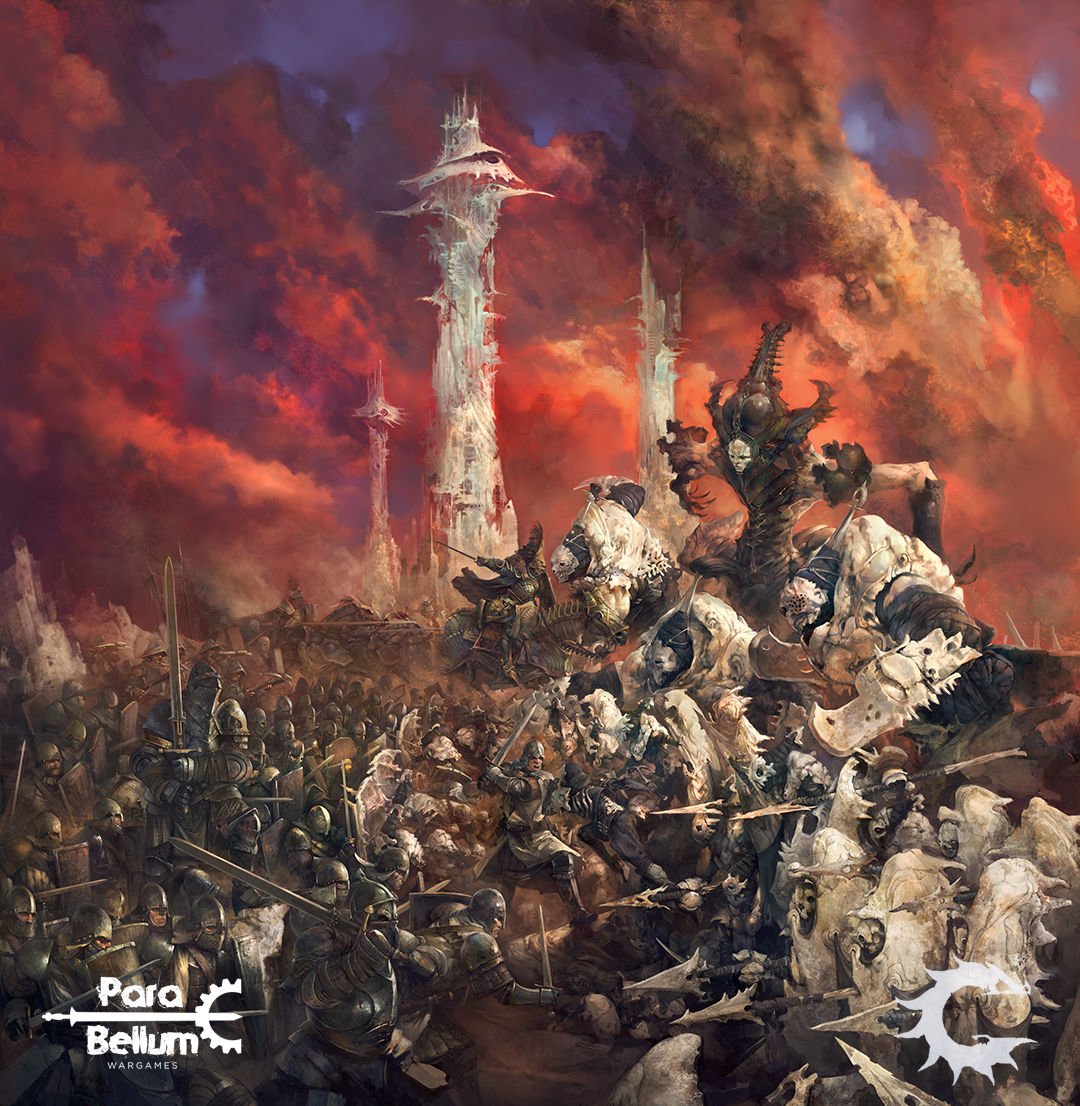
Consider Conquest: The Last Argument of Kings, by Para Bellum (an illustration for which is below).

As found here.
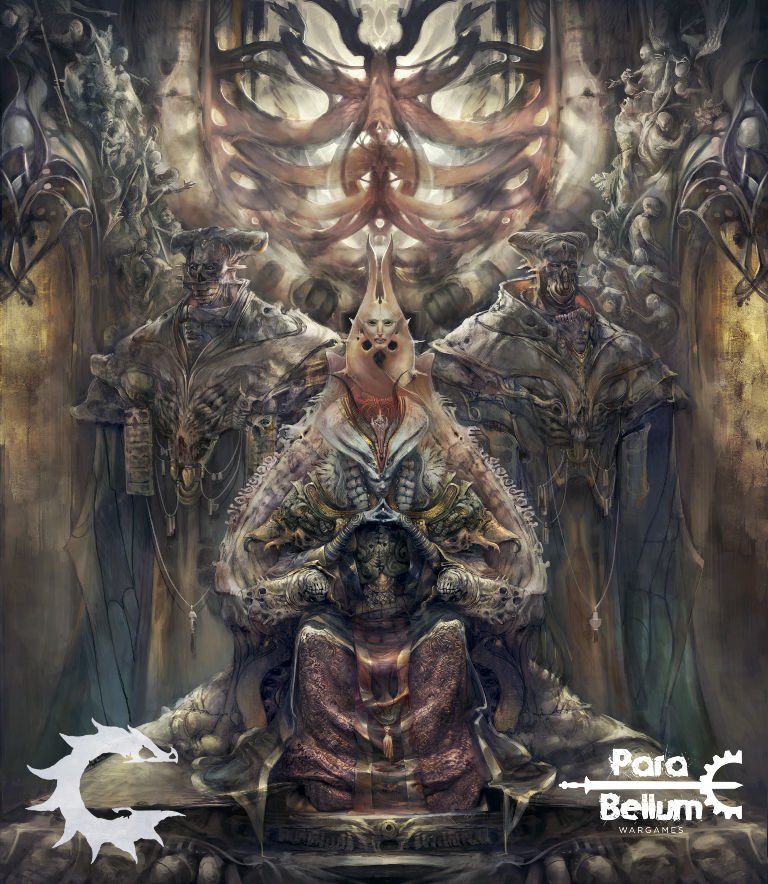
I feel that this style of fantasy illustration - lush, painterly, deeply coloured, detailed without the glossy primped look that characterises some artwork - is something I've seen quite a bit of lately (think Karla Ortiz's cover to Sorcerer of the Wildeeps and some of the art for 28). I wish I had a good name for it. 


As a survey of the setting's lore suggests, they fit the Hobbesian mould pretty well. A shattered empire of A Hundred Kingdoms, the cruel biotech-wielding precursors of the Spires, savage and potent outland raiders, wrath-corrupted delvers - and each with it's own set of sub-factions, providing not only unit variety but also competing forces.

As found here. Another example of the unnamed style.

So much for Conquest. And you might say that this follows too close to Games Workshop to really count - compare Warhammer's Empire with the Hundred Kingdoms, or 40k's (Dark) Eldar with the Spires. Let's pick out a few more examples. 

A Very British Civil War is an alternate history - a counterfactual in the same vein as Team Yankee above. There are some relatively outlandish or eccentric forces, but nobody appears to have taken up a form of technology beyond the 1930s. The background is that the Abdication Crisis of 1936 has resulted in constitutional turmoil and finally civil war. Fascists, Socialists, Edward VIII-loyalists, Anglicans, Scotch nationalists and more compete for rule of Great Britain (games in the Empire are possible, but out of focus; foreign intervention is present in the form of volunteers and aid rather than armies).

Now, obviously, this differs from a fantasy setting, or the far-off 41st millennium. There's also a difference in tone - consider the illustrations, miniatures made or suggested for the game and the presentation and discussion of VBCW. Grimdark it ain't.  If there is a single inspiration for it, it would be the 1995 film adaptation of Richard III*** set in an alternate 1930s - a part of the mannered, artificial (in the sense of 'crafted') text of Shakespeare's history plays carries over. Of course, the tone could be skewed more towards the realities of the (comparable) Spanish Civil War. But the default has the relative lightness suggested above. 

Grimdark or not, it fits: every faction should have a reason in the background to fight every other faction AND to fight amongst themselves. It is a time of civil war - brother is already fighting brother (literally, given Edward and Albert....)  - so further shifting allegiances are to be expected. Further, given how isolated and cut off some of these forces may be, it should not surprise us that one Royalist regiment might find itself attacking another. 

One more. Infinity by Corvus Belli lays out a science fiction setting; colonised star systems, new frontiers, exciting and powerful technologies. The inspiration of Infinity lies in an inter-connected, Information Age world, full of smooth, colourful stylings and with a primarily Asian derived group of interstellar factions (it even has its own manga). The battles depicted are 'secret missions, black ops and covert actions' rather than grinding trench warfare or frenetic melee combat. It is distinct, therefore, from the decay, zealotry, Gothic architecture and gloom of 40k .... despite the power-armoured religious military orders.

None of this makes Infinity a pleasant future to consider, per se. There is an extra-terrestrial threat, rebellion and the sleek outlines of postcyberpunk futures may well conceal pain and suffering. But again it fits the Hobbesian requirements for a world of wetwork and realpolitik. Sub-factions ('sectorials') once again abound - as to be expected in interplanetary polities. Left hand may not know what the right hand is doing (or know and dislike it intensely, or think it knows, or feels it needs to find out just in case....)

***

Assuming, therefore, that you are with me as far as this division of war games and my conclusions about their Hobbesian nature goes, why does this matter? I would suggest that this is a rule that appears obvious once you know it, informing the structure of war games without it being explicit and that it is a useful tool if one is debating the aesthetics and lore (and their implications) of war games in that third category. There will be a tendency to the Grimdark, at the very least. 

Compare this to the origins of the Horus Heresy. Now a novel series of over fifty books, some of them bestsellers (as well as audio dramas, miniatures, artwork, reams of online discussion &c) - and it all came about because of the cost of making new moulds for miniatures****. The Hobbesian theory lurks in the foundations of war gaming in just the same manner. 

Is any of the above consciously noted by war game designers? I wouldn't like to say. Does it matter? Once a given war game is popular enough that plenty of people play it and the number of factions and sub-factions swell, the need for a Hobbesian world abates. (You might be able to say this for Games Workshop's Age of Sigmar. I'm not sure I care to do so here - I don't know enough.) Besides, this only really counts for impromptu games. Tournaments will presumably try to organise things that the Armageddon Steel Legion player won't have to fight other Armageddon Steel Legion (or other Guard regiments, or the forces of the Imperium). This goes doubly so for grand international event campaigns - which works for in-universe explanations; even the most hot-headed or scheming of Imperial commanders know this really isn't the time.

Yet, a note of the Hobbesian persists - in lore, in rules, in structures. Like evolutionary advantages that make more sense for the Savannah, but still persist despite life in (say) 1986 Vancouver. I assert that an understanding of a war game of the Third category and the materials that develop from it is improved by at least considering the Hobbesian theory.


*And I imagine that any present-day politician that cited Hobbes as an influence or inspiration would catch a fair amount of flak for their trouble.

**I left out sub-factions &c, but even tightly-knit compact factions like the Adeptus Custodes have institutions like the Blood Games. Exodites are sufficiently clannish to clash with one another; Harlequins would do it for the art. Genestealer Cults, as criminal/insurrectionary organisations would certainly jostle with one another - and, quite possibly, their Tyranid puppeteers. 

***Suffering catfish, that trailer - no wonder they changed it for the rerelease!

****(VW Talos, 'Crafting the Imperium's Greatest Heel-Face Turn', 28, Vol. 2, February 2020 pp 96-103)

Sunday, 25 March 2018

Civic Elves

The concept of Elves in the City may conjure up a number of images to you. A standard one might come from something like the Shadowrun games; an urban setting inspired by a mix of fantasy and cyberpunk, dropping woodland creatures into the urban sprawl of the twentieth century. Elves with leather jackets and piercings, with keyboards and terminals, with switchblade and uzi.

[Incidentally, if there isn't a late twentieth century Role playing system called With Switchblade and Uzi, there ought to be.]

Your mind might turn to the Dragon Age games: the setting - the world of Theldas, draws from Medieval Europe (unlike Shadowrun). A certain section of the Elven population dwells in human cities, in ghettos known as Alienages. As you might expect, the friction between the two groups is greater than in other examples of fantasy games or books.

These are hardly the only examples of their kind. The Warhammer Fantasy pseudo-Atlantis of Ulthuan is filled with Elven cities. Tolkien himself describes Elven cities: Gondolin being perhaps the most famous. More recently, I understand the Netflix motion picture Bright to have linked elves very directly with twenty-first century Western affluence (the porcelain complexion elves have been often portrayed with being likely relevant).

I should like, however, to draw a line swiftly under these images. Let us discard the elf directly influenced by a twenty-first century conception of urban life; let us also put to one side the pure-Elven cities of high fantasy. A more cosmopolitan city (probably human-run) is brought for your consideration - one with Elven districts, rather than alienages or ghettoes.

However, these are still Elves on the Tolkien model. Long lived, skilful, thoughtful, graceful. What sort of communities might they build?

It might look a little like the Inns of Court, or an Oxbridge college. The comparison is made not in terms of social function, or professions of the inhabitants - though Elves could certainly be professors or barristers; an Elven judge doesn't just make precedent, he IS precedent.... [The notion of Elf-Rumpole must be quashed immediately.]

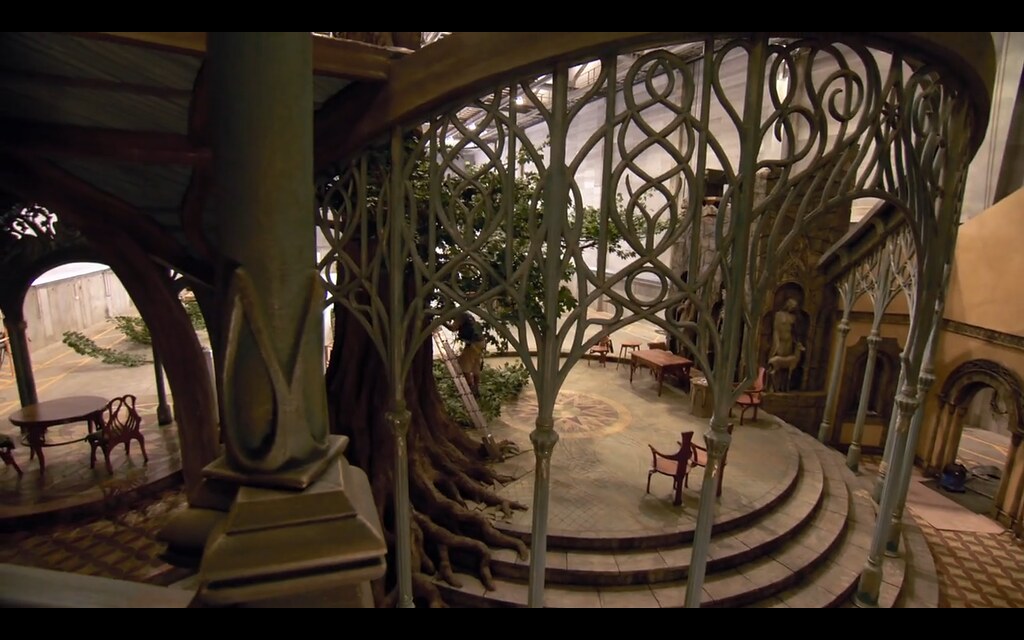
No, the comparison is made in terms of architecture and institutional process. The architectural angle suggests itself easily enough: relatively self-contained regions, well-madeplaces with wealth enough to keep them maintained (elves, even if not necessarily hugely wealthy, are presumably willing to work hard at keeping their homes up to scratch), cobblestones worn smooth and glossy by innumerably footsteps. The Gothic and Jacobean buildings possessed by some of Inns of Court or colleges are fitting: Peter Jackson's cinematic adaptation of Lord of the Rings uses a sort of Gothic revival style for Elven buildings, focussing on the naturalistic features of Gothic architecture and snipping away any very bright colours. (Although this gentleman makes the comparison to Art Nouveau).

(Incidentally, I am not suggesting that Oxbridge colleges or the Inns of Court have always been neat, clean, 'Elf-worthy' spots. In the days of Dr Johnson and Oliver Goldsmith, for instance, I am by no means sure that the Temple was.)

[I have discussed the Arts and Crafts movement, roughly contemperenous with the Gothic revival here - this article may be considered a companion piece of sorts.]

From Peter Jackson's The Lord of the Rings. Consider that tracery; other views available here.
The pillars and colonnades in this clip are also a good from the Gothic revival point of view, though the
painted artwork is rather more naturalistic than below - and the arches less pointed.


Consider for comparison...

Interior, All Saints' Church, Cambridge (Image from Wikipedia)
...or...


Interior, All Saints, Margaret Street, London - once again from Wikipedia.
...or indeed, the Palace of Westminster.

Of course, Elven architecture would be less ecclesiastical (if not, however, irreligious). The images of Rivendell above also have something of the vernacular about them (Cf. Dragestil).  Perhaps Gothic revival Elves or Oxford Movement Elves are something for another day.

One could also have Elves take up a more Classical or Georgian form - in which case perhaps an Elven community might look like New Town, Edinburgh next to the cramped tenements around the Castle and crags. However, enough of architecture for a time.

Let us also think on the nature of the institutions referenced above. Old fashioned in certain regards. Wealthy, if not as wealthy as corporations - and with a less profit-driven motive (regardless of how much money gets made). Prestigious and influential, certainly - bur prestige and influence not based on raw power or numbers or deep coffers. (Wizards often get the University model thrust towards them in fantasy fiction - but I feel Elves could have it attributed to them successfully).

Elves don't strike me as terribly antisocial: capable of being alone and prospering, certainly. But the notion that they would adhere to one another in the metropolis - so that one might have of refuge from the follies and transience of the human life (without the Elves in question actively despising humanity - those that do like as not stay in the forest or the isles).

Moreover, if one were to ask after the foundation of such a place it might be that the courts and gardens of the Elven Quarter were built after they had been exiled, when the Dark Lord occupied the forests of the Verdant Dale...(&c.).  Migrations into cities for Tolkien-esque Elves does not seem a process that would occur naturally.

I bear no grudge to Shadowrun or Bright. But here is a vision not of the Urban fantasy sub-genre, though it is firmly based in the city - hence the title I have used here, Civic Elves. Elves in the city not entirely divorced from their roots in Tolkien - or indeed his inspirations.