Showing posts with label Self-Indulgent. Show all posts

Sunday, 12 April 2026

Mortal Ingenuity: A Retrospective of Mortal Engines

It was a dark, blustery afternoon in spring, and the city of London was chasing a small mining town across the dried-out bed of the old North Sea.

These are the first lines of Mortal Engines, by Philip Reeve - published 2001, and I suspect that I read it for the first time fairly soon afterwards. Frequenters of this blog (being handsome, discerning and well-read) will twig the similarity to the opening lines of Nineteen Eighty-Four - and I suspect that they will recognise how this might hook a young reader, or even an old one. I was that young reader, of course. 

Indeed, I am now also that old reader. A month or so ago I noticed that the 2018 film of Mortal Engines was available in the free-with-advertisements section of YouTube (the box office results may say why). I put it on while about a few household chores, and half-watched the entire thing. I had avoided the film when it came out - and, having watched it, this was not an unreasonable step to take. But a bad version of a good thing can make one think of the good thing, and it sent me back to read the books. Indeed, it also disposed me to take a look at the assorted thoughts of the internet - which have been blighted by the film or didn't touch on some worthwhile aspect, and so on - so, in I dive to get my thoughts down. 

My scope is limited to the initial Mortal Engines Quartet, published 2001-2006: Mortal Engines, Predator's Gold, Infernal Devices and A Darkling Plain. Other books in the same universe, if in different eras, have been published, as have short stories and some collected timeline and 'lore' material. Some reference may be made to these (not that I've kept fully abreast of new entries in the series) and, where vaguely useful, to the film. 

Premise

I don't intend to summarise the books here. But a few details may well be useful.

There has been an apocalypse, the Sixty Minute War. This took place around 2100 between (what Mortal Engines characters call) the American Empire and Greater China. Civilisation, and much of the planet was smashed up - by things that appear to have left the atomic bomb in the dust. North America is 'the dead continent'. As above, the North Sea is mostly gone. New mountain ranges cropped up. Many centuries later, civilisations have risen and fallen - as civilisations tend to. 

The great paradigm of the current age is that of the Traction City. Mankind either dwells on mobile cities - greater or smaller; see above London and the 'small mining town', Salthook - or in static settlements. Said static settlements band together in the Anti-Traction League, opposing the Traction Cities. Traction Cities (principally) move and (notably) will devour one another - as well as static settlements, so said League makes sense. (Traction Cities will harvest or gather natural resources, and trade, but after a millennium of the 'Traction Era' there is less possibility of the former outside the strongholds of the League). The practice of one Traction City consuming another has given rise to a school of thought, or even an ideology - 'Municipal Darwinism'.

The Mortal Engines quartet focuses on Tom Natsworthy (of London) and his journey with Hester Shaw out of London and into the wider world. Both characters are fifteen in Mortal Engines; Wikipedia labels the Quartet as 'young adult'. As nebulous as that phrase is, it's a useful-ish indicator of tone and approach - though we will see both grow to adulthood in a perilous and bustling world, full of moving cities, armies, airships, wastelands, pirates and the lost, fearful, technologies of the Ancients. 

Wikipedia will give you plot details if you want them, though frankly this post probably is most useful for someone who has read all four books. I'm not going to wallow in spoilers, but I shan't dodge them either. Anyway, be warned.


David Frankland did the original covers, which I still think quite the best.  There's a clear sense of the grimy and the mechanical, coupled with those limited colour backgrounds, that suggest something like a 1920s travel poster and the associated sense of adventure. 

In no particular order, then - 

Names

Reeve's characters have three sorts of names.

Cool: names right out of pulp adventure*. Thaddeus Valentine. Anna Fang. General Naga. Magnus Crome. Wolf von Kobold. Dr Zero.

Pompous: likely British, at least faintly and probably overtly posh. Herbert Melliphant, Chudleigh Pomeroy, Cynthia Twite, Thomas Natsworthy, Freya Rasmussen, Clytie Potts, Nimrod Pennyroyal, Dr Popjoy.

Gimmicky: displaced old-world phrases, faintly comic. Chrysler Peavey, Stilton Kael, Nintendo Tharp, Napster Varley, Saab Peabody.

Actually, this is quite a good indication of overall tone. If you can tolerate - or actively enjoy - the sort of sensibilities that these three sorts of names suggest, then you might enjoy Mortal Engines. The 'Gimmick' aspect and vein of comedy is more present in books beyond the quartet, where it can wear out its welcome a little. 

Whimsy and Humour

But such things are a balancing act. The presence of 'Tunbridge Wheels' as a mobile city is a sensical pun (and demands a Sensible Chuckle?); likewise the Arctic predator suburb of Wolverinehampton. Reeve has written what I take to be more overtly comic works for a younger audience than Mortal Engines, but can dial it back sufficiently. (A newspaper called The Wantage Weekly Waffle only has one mention, happily; this is distractingly comic - one says, risking the fate of the po-faced - and more to the point, not quite comic in the way the scene demands.)

You will sometimes see this sort of thing referred to as whimsy - and, indeed, there is a whimsical element in the notion of a moving city (still less one that retains some of its static characteristics: don't ask how they tend the vines in Bordeaux-Mobile, or what the terroir is like). Reeve is also an illustrator, and some of his renditions of traction cities make them seem rather charming. 

Not all his humour is quite so direct, of course. A firm of publishers is named Fewmet and Spraint; as those who recall The Once and Future King will know, this is a quiet indication as to the quality of some of what they publish. 

Consequences

Alongside such things is a real sense of weight to violence. Men may die quickly, but this is never exactly cathartic - especially not for our protagonists. Accident may kill as readily as intention, and it will absolutely kill your allies and would-be collaborators. Deep wounds, even if non-fatal, have later effects - very real disfigurement or long-term health conditions.

It goes a little further than that, mind you. Hurt feelings stay hurt, emotions flare high - deeds done in haste reverberate to dreadful effect. Which sounds like just what you should expect from a novel, but I suspect shouldn't be counted on in every book of the same kind as Mortal Engines.

While we're thinking of bodies, I note that there's a fair amount of urination and defecation in these. Which contributes to that sense of what bodies are and do. I wonder what age Reeve's children were when he was writing these? 

More to the point, this allows for some powerful blows when the time comes: the last paragraph of Mortal Engines has some fairly touching unsentimental sentiments, if you'll pardon the oxymoron.

Britishisms

Philip Reeve is British. He did not have an international audience in mind when he wrote Mortal Engines - indeed, that the United States is a wasteland may not have done much for his sales. I've noted some of the names above for their British characteristics: that London is front and centre in the first (emblematic) book is also important. 

Of course, London isn't Britain, nor is the traction city of London an inheritor of Britain (but it was in an earlier version of Mortal Engines). Britain is gone: some place names and other markers remain - but that there is a portion of London called Crouch End doesn't count for much.
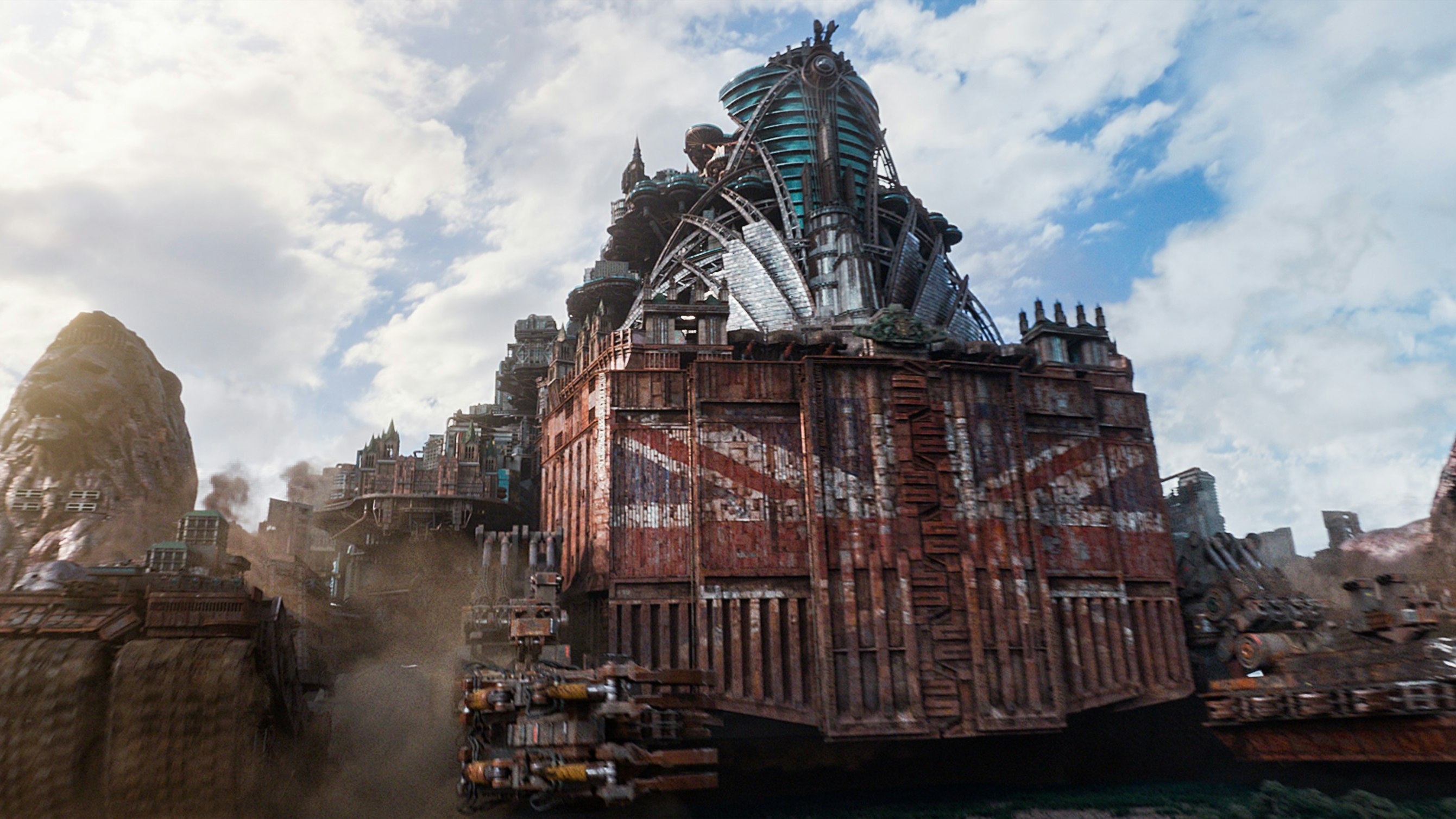
This is something that the 2018 film - with its Union Flag bedecked-maw and Trafalgar Square lions -  didn't take on board.

London's military elite are Beefeaters, not the Brigade of Guards or the SAS or the Gordon Highlanders or Cromwell's Ironsides. It is governed by a Mayor and a guild elite, not the King-in-Parliament. The focal point, the identifying feature of an exterior which is otherwise as vast and complex as Breughel's Tower of Babel is St Paul's Cathedral, not St James's Palace or Westminster Abbey or Tower Bridge (the film couldn't help itself, and included the Palace of Westminster; the guildhall even faintly resembles the former Greater London City Hall). A piece of concept art by Ian McQue shows even more - the Shard and the BT Tower and Battersea Power Station, in an artistic fantasia reminiscent of one of Laubin's capricci

I would argue this misses the point of St Paul's Cathedral. There's something eerie about the fact that it has survived when so much else has not (the London Museum of Mortal Engines is clearly akin to the British Museum and the Natural History Museum, but is in fact neither). When you learnt something of the Polytheism much of the world practices in the Traction Era, it becomes even stranger that this Christian temple survives intact. That it is finally the vessel containing the ancient and terrible superweapon MEDUSA bears this out. 

The David Frankland cover again. Think on how St Paul's is just discernible, think how it offers a sense of scale. Think also of the red, livid sky.

Airfix Characteristics

A world-building trick of Reeve's is to refer to makes and models of machinery in universe. Airships are Goshawk 90s or Murasaki Fox Spirits (and this will extend to parts: Jeunet-Carot aëro-engines, an envelope of Silicon-Silk from Shaun Guo....). A small revolver is a .38 Schadenfreude. Something like Jane's Fighting Ships for the Traction Era appears. Granted, significant parts of A Darkling Plain are set on the frontlines, but the business of bunkers and half-tracks and rocket troops conjure the same notion. That Germanic traction cities are frequently named 'Panzerstadt' may contribute to this.

If we are addressing this as a sensibility outside of genre features and expectations, I think the term 'Airfix Characteristics' is good, as in X with Airfix Characteristics. Science fiction with Airfix characteristics; Firefly has them, Star Trek doesn't.**

Extend as necessary, or as amuses: Steampunk with Airfix Characteristics. Bedroom Farce with Airfix Characteristics. Ostern with Airfix Characteristics. Southern Ontario Gothic with Airfix Characteristics.  

Airship (and flying machine) names, incidentally, fall into something like the pulp/pompous/gimmick division above. The 13th Floor Elevator. The Jenny Haniver. The Itsy Bitsy Teeny Weeny Yellow Polka-Dot Machiny. Group Captain Mandrake. The Shadow Aspect. The ArchaeopteryxDie Leiden des Jungen Werther. The Plum Blossom Spring. The Combat Wombat. The Requiem Vortex.

References and Nerdery

As the above may suggest, Reeve enjoys shoving a reference or two into Mortal Engines - frequently something at least faintly nerdy. The very name derives from Othello: Act III, Scene III. A certain amount of this is the product of inspiration. Star Wars and Lord of the Rings had their influence on Reeve - the former quite unsurprising, given that Mortal Engines has a climax with a super-weapon encroaching on a previously unassailable redoubt.*** Other influences exist. 

That a range of mountains is known as the Tannhäuser Mountains might well owe something to Blade Runner (could there be a narrow pass in those mountains, do you think? A defile, a passage, a gate?). Spear-carriers of fighter pilots are known as Ginger and Algy. That a German traction city is called Moloch-Maschinenstadt presumably indicates that it is an unpleasant place even by the standards of traction cities (unless things are unusually clean?). 

Historical periods are also addressed in a familiar and adroit way: the Blue Metal culture, the Raffia Hat Culture.

The Chapter names are rather telling in this regard: The Cabinet of Dr Popjoy, the Land of Mists, Brighton Rocks, The Childermass Experiment, The Sleeper Wakes.

Incidentally, Mortal Engines predates a general consciousness of Steampunk being its own thing. It fits into the aesthetic nicely, but it doesn't get bogged down in genre trappings.

***

There's a line in Predator's Gold that ties a lot of the above together. 

The sky was the colour of packet custard, streaked with rhubarb cloud.

  • It's whimsical: the sky as humdrum domestic dessert.
  • It's actually not a bad description for a certain sort of dawn, with pinkish clouds and soft yellowish light. Rhubarb, if not processed into pap, is in fact streaky.
  • It's quite possibly a reference to Neuromancer: 'The sky above the port was the colour of television, tuned to a dead channel.'
  • Rhubarb and custard is a British boiled sweet - and as a combination, would not be unlikely to be served as a dessert. 'Packet custard' presumably refers to Bird's Instant, or something quite like it.
Anyway, I liked this line. Though one wonders how any of the characters know what custard is in this world, like Winston Smith and rice spirit (thank you, Anthony Burgess).

***

Polytheism

As above, the Traction Era is Polytheistic. Clio, Muse of History is frequently called on by the Guild of Historians (there is a reference to her being 'blown backwards by progress into the future', which sounds unintentionally Buckleyesque). Ice Gods and Wind Gods are mentioned. Quirke was the Mayor who turned London into a Traction City, who has been deified. Statues and shrines dot cities and sit in airships. 

There's an extent to which this pushes Mortal Engines into a grand, varied, Faufreluchean setting, like the forehead tattoos of London guildsmen. It's also something that indicates that Reeve can 'do religion' in a way that George Lucas (for instance) doesn't. St Paul's Cathedral aside, Christianity has survived the Sixty Minutes War, even with Bishops and T.S. Eliot (though neither show up on London). The monotheist elements - 'I believe in one God, the Father, the Almighty...' - are seemingly unknown to unbelievers. Strangely, no other Abrahamic faith seems to have lasted, nor have Eastern Axial Age faiths like Jainism or Buddhism. There's monks and prayer flags in the Himalayas, but that's not necessarily the same thing.

Metafiction

There's bunch of metafictional elements that come into Mortal Engines. That several principal characters are historians - narrative-crafters, from a certain point of view - helps, of course. The history of the world is discussed, and later characters even go on to write up the events of the novels they are in (Predator's Gold is also the name of an in-universe sensational history). The final chapter of A Darkling Plain even involves that thing where a character begins telling the tale of the story they're in, beginning 'It was a dark, blustery afternoon in spring...'

Reputation (to be chased into the cannon - the mortal engine's - mouth) plays its own role in all this. In the course of the Quartet, reputations are made and lost, secrets are revealed. People tell stories about themselves.

Bildungsroman and Stalkers

Mortal Engines is about (among other things) youth. Tom Natsworthy and Hester Shaw come of age and begin making their own decisions. Happily, they don't have to spend an entire quartet doing this: there is a sixteen year time skip between Predator's Gold and Infernal Devices. But more to the point: these four books spend a fair amount of time thinking on how children are raised. Plenty of characters are the genre-standard orphans, but who they are raised by counts for a lot: the antiquarian Guild of Historians, an inhuman cyborg, a Fagin-like master of pickpockets, a dwindling population of loyal subjects. Further, have they been raised as a Tractionist or an Anti-Tractionist? This isn't just an ideological difference: in a rather town mouse and country mouse sense, traction city dwellers struggle when they have earth under their feet rather than a deckplate (those from static settlements don't seem to struggle in a comparable way - see Wren in Brighton in Infernal Devices).

Anyway, on top of all this are the Resurrected Men. Old Tech mechanical brains and devices are wired into corpses to bring them back into hideous life - principally to serve in combat. Given the lack of knowledge of Old Tech by the Mortal Engines period, this is an unreliable process - and not all Old Tech is created equal. So some Stalkers have half-memories of past lives, and the desire to learn more, and those who brought them back may wish them to have (or not have) those very memories. Stalkers, like children, must be raised: just ask Victor Frankenstein. 
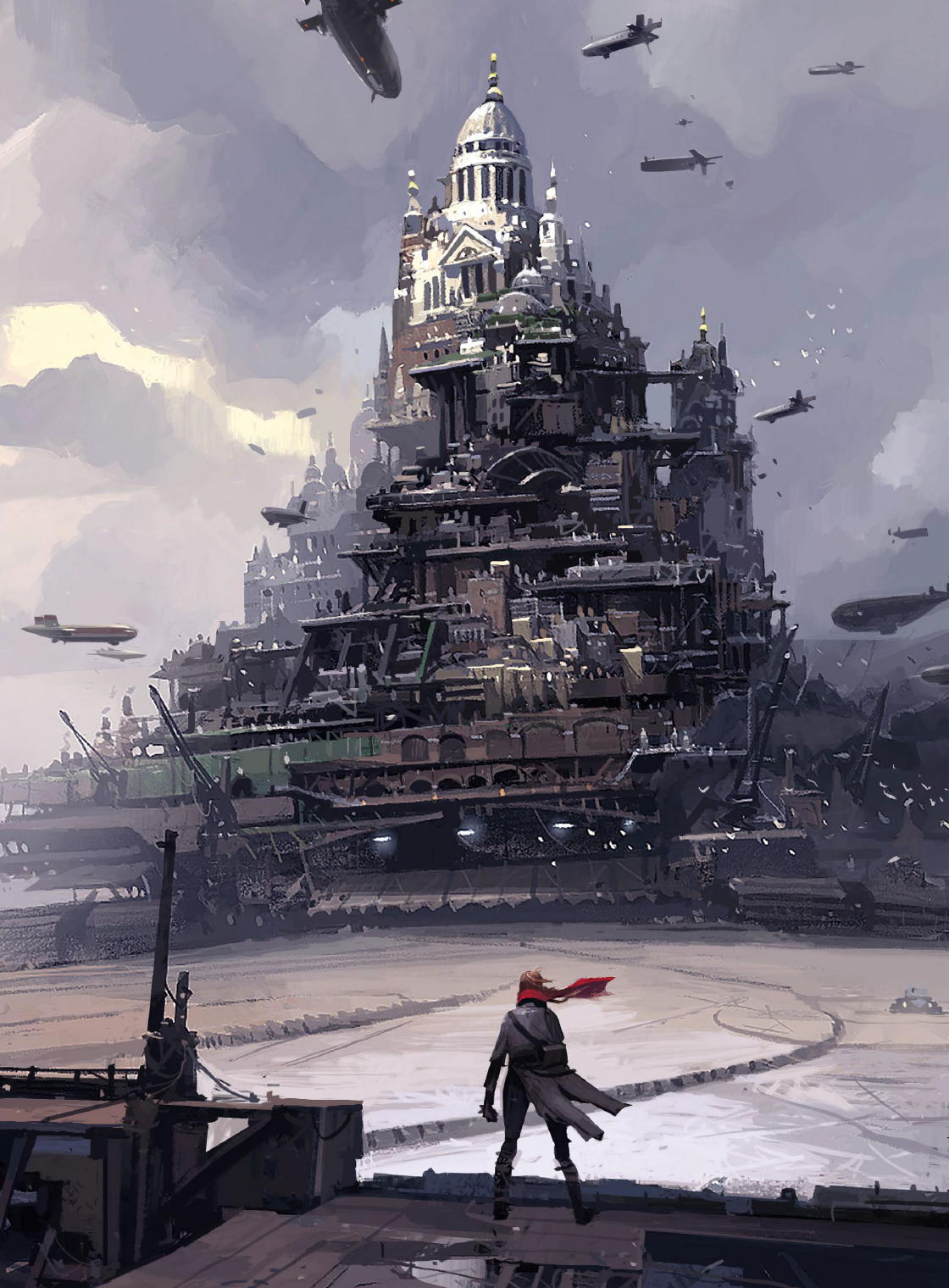
Ian McQue also did a cover for Mortal Engines. Not bad, despite the disproportionate St Paul's. It has some of the right spirit, even if it makes me think a little much of Disco Elysium.

Predators, Gold

There is an interpretation of Traction Cities and Municipal Darwinism, holding that the entire thing is really about capitalism, expansionism and exploitation. A specimen of this interpretation is here (though I think it a ramshackle piece). I am compelled to say that this isn't altogether wrong. The text makes it clear that Tractions Cities can be pretty unpleasant places to live, and Reeve knew what he was doing when he named the goddess of 'Unfettered Municipal Darwinism' as Thatcher - who is given a faintly Hindu aspect in her depictions: multi-limbed, dancing, all-devouring, as Shiva Nataraja.

Fine, it's not wrong, but it misses a few things, especially when stated baldly. Reeve has stated that part of the inspiration for Municipal Darwinism comes from the growth of Brighton into a conurbation - which (whether welcome or not) is far less malevolent than anything out of a Traction City. Also, Reeve, as Tolkien, dislikes allegory - and has stated that it's not a heartfelt metaphor for Capitalism.

That aside, I think that it's also informative to consider Mortal Engines in the light of the Cold War; indeed, especially from the point of view of a young, fairly liberal British man in the last decades of the Cold War.

[It feels a little odd making this slightly cavalier reading of biography and background, and I hope that Philip Reeve will pardon me if he reads this; I did meet him once, years ago - he signed my books and was really quite kind and charming.]

So: The world is imperilled by dreadful weapons [MEDUSA, ODIN], invented by those long dead (Oppenheimer dies in 1967, wunderwaffen maker von Braun dies in 1977; see also Richard Rhodes here again) for another country [The Ancients] and a cause not your own [The Sixty Minute War]. You [Tom Natsworthy] find yourself aligned (by birth as much as anything else) with those [the leadership of London] pointing those weapons at a foe with a very different way of life [the Anti-Traction League]. Learning more about that foe, it emerges that they're (reasonably) terrified of annihilation; it should not surprise you that they take steps against it [Anna Fang] - and even if you don't approve of it, that they should produce an extreme reaction to the threat [the Green Storm]. Naturally, you become quite disillusioned with childhood heroes [Thaddeus Valentine], though there's no guarantee you'll join with your old foe [Tom and Hester take to the Bird Roads].

[EDIT: Cf. this remark on '80s Britain.]

This is the sort of perspective that forgets or erases the Gulags and the cellars of the Lubyanka and Khrushchev burying the west, but it's not one that I find utterly unsympathetic - or utterly disconnected from reality. But the geopolitical-historical interpretation fits the outlines of Mortal Engines better than the blunt Municipal-Darwinism-bad expression.

The Anti-Traction League, it must be said, is not the Soviet Union or Warsaw Pact, and the Shield Wall of Batmunkh Gompa is defending against a threat in a way that the Berlin Wall wasn't. Russian traction cities (Arkangel, Traktiongrad, Gorky, Novaya-Nizhni, Smolensk, Omsk†) exist. The League seems to draw as much or more on the Third World as the Second World: there are no parades in Red Square or Five-Year Plans or Khrushchevka apartment blocks or Stakhanovite efforts in the factories (though that Northern Fleet of airships and the fuel and ammunition and spare parts for same had to come from somewhere...‡ ). One gets a more Maoist impression from the Green Storm and their cult of personality. Reeve is, happily, unwilling to make this monolithic: the mountainous strongholds of the Anti-Traction League might be in East Asia, the Indian Subcontinent and East Africa but Traction Cities include Zanzibar, Bamako, Perfume Harbour and Juggernautapur. 

Before anyone gets too keen about raising the left-wing banner over Mortal Engines, I would note that Reeve does not strike me as at all partisan or a zealot, and unwilling to engage very publicly with politics. Moreover, the sympathetic portrayal and actions of the Guild of Historians in Mortal Engines suggest a sort of small-c conservative position against progress and expansion: couple this with the non-Green Storm League elements and perhaps one arrives at some sort of 'Ealing Studios' Social Democracy; something which wouldn't much please Ayn Rand, Michael Foot or Robespierre. Indeed, the dreams of Magnus Crome and the Guild of Engineers that transcend the limitations of Municipal Darwinism as we know it (Mortal Engines, Ch. 34) remind one of nothing so much as the visions of progress by H.G Wells, a devoted socialist. 

Municipal Darwinism and Tractionism never gets an articulate spokesman, mind you - only prejudices and Tom Natsworthy at his most callow (unless there's one hiding in the very recent Thunder City or Bridge of Storms). Where is the Adam Smith of Municipal Darwinism? After a millennium there must have been one! Anti-Tractionism fits the reader's default position, and the text has to work less hard. ††

We may also consider the image of Tractionism as aping the sacrifices and trade-offs of the industrial revolution; something heightened by the nickname 'mossies' for the static settlements and the Green Storm, who openly vow 'death to cities'. It would make a certain amount of sense to me if a wider range of goods were available in traction cities, if medical technology were more advanced, if a greater range of culture was available. While no polity in Mortal Engines appears to be a liberal democracy as we may think of them, the concentration of population in a traction city might well mean that there is a greater chance of mass political engagement. None of this means life is necessarily any better: you could end up in back-breaking labour somewhere vile in a traction city due to central planning or competitive examination or one city consuming another - but you are far less likely to end up doing  back-breaking labour somewhere vile due to being of the wrong faith or caste. Slavery is not seen in the Anti-Traction League, though given how accepted it is elsewhere, it would be strange for it not to be present in one of the many members of the League (again, that air-fleet came from somewhere). 

It's worth noting, finally, that Philip Reeve appears to quite like Traction Cities. Certainly more than Swift did Laputa or Orwell did Manor Farm. An exception to the rule of Municipal Darwinism appears early in Mortal Engines in the form of Airhaven; the cooperation of the Traktionstadtsgesellschaft and the resort city of Brighton muddy the waters later. The conclusion of A Darkling Plain, with the birth of an ecologically friendly New London, complicates things further - as does the future state sketched in the final chapter. 

Traction Cities have been noted from the first have developed from nomadism - and the nomadism of those clans or the airship-travelling protagonists is treated quite sympathetically. Is this enough to to make them more than Infernal Devices (Predators seeking Gold on Darkling Plains)? Are they more than Mortal (threatening, fearful, deathly) Engines doomed to mortality? 

Frankly, the best way for you to decide is to read them. They were worth reading twenty-five years ago, they're worth reading today.


Previous Mortal Engines-related content here.

* "Catholics don't light candles any more, Brick."
"I do, sir. I'm Irish and my mother - "
"For Pete's sake! Bronson's not an Irish name."
"What kind is it, sir?"
"It's a pulp name. Now get going."
           'The Last Thrilling Wonder Story', Gene Wolfe 

** Compare remarks on las-pistols here.

***Reeve has a blogpost (5th May 2015) on seeing the first Star Wars in his youth, the interest he had in Ralph McQuarrie and how Star Wars 'was so popular that it even put an end to World War 2. Before Star Wars, schoolboys played Brits vs Germans in the playground, watched Colditz and Where Eagles Dare, and made model kits of Spitfires and Messerschmidt 109s.  After it, we played rebels vs stormtroopers and watched Blake's Seven and Battlestar Galactica.' It's quite good as a reminisce and I'm irritated that I can now only get hold of it through this blog viewer

† Incidentally, Anchorage, with its palaces, fur coats, glasses of tea and aristocracy certainly reads as more Russian than Alaskan. Maybe that just comes with Tractionist culture up on the ice.

‡ I can conceive a spirit-of-the-text answer where League arms works are mostly kept in moth-balls in peacetime, with the volunteer machinists keeping them in order outside of seasonal re-supply use or until the threat of a Traction City draws near.

†† It would be interesting to sketch out how an idealised peaceful consumption of one city by another would look as expressed by such a thinker. The gods of one Traction City brought into the fanes and temples of another, the merging of institutions (with senior and junior partners), the language barriers, the demographic transformation.

Monday, 16 March 2026

Solomon and Saturn: Saxon Sages

I recently discovered the Old English dialogue of Solomon and Saturn. This is, of course, highly relevant to my interests

There are several of these dialogues, either in poetry or prose. They appear back to back in the same manuscript and are largely thought to have been written at the end of the first millennium. Saturn is here a Prince of the Chaldeans, though not without some measure of knowledge. Solomon is still Solomon, but without some of the more oriental aspects with which he is sometimes presented (see Kipling, for instance, aside from the whole business of summoning demons). 

Saturn calls on Solomon, setting him a series of questions, sometimes with a reward. He either trying to get details of the power of the Lord's Prayer, or quizzing him about the state of the life of man, the nature of creation and God's will. In the former he is sceptical and offers a sounding-board for Solomon's long discussions of the power of prayer. In the latter, he becomes a testing, probing presence; not diabolic, but clearing pushing at a few boundaries. 

Here's an example of the text:

SALOMON cwæð:

Þæt gepalmtwigude  Pater Noster
heofnas ontyneð,  halie geblissað,
Metod gemiltsað,  morðor gefilleð
adwæsceð deoflesfyr,  Dryhtnes onæleð.

Solomon said: The palm-twigged Paternoster opens heaven, blesses the holy, makes the Lord mild, fells murder, extinguishes the devil's ire, kindles the Lord's.

The Lord's Prayer is not only potent, but highly decorated: 'Golden is the word of God, studded with gems, it hath silver leaves...'. The letters of it are themselves given magical and specific associations.

prologa prima  ðam is . ᛈ . P. nama;
hafað guðmæcga  gierde lange,
gyldene gade,  ond a ðone gr[im] man feond
swiðmod sweopað;  ond him on swaðe fylgeð
. ᚪ . A . ofermægene  ond hine eac ofslihð.
. ᛏ . T . hine teswað  ond hine on ða tungan sticað,
wræsteð him ðæt woddor  ond him ða wongan brieceð.

prologa  prima,  which  is
named . ᛈ . P.: the warrior has a long staff, with
a golden goad, and brave he ever swipes at the
grim fiend; and in the track . ᚪ . A . pursues him
with mighty power and also strikes him. . ᛏ . T.
injures him and stabs him in the tongue, twists
his throat, and shatters his jaws.

The prose dialogue features a battle where between the devil and the Paternoster where they take on various forms:

Solomon said: The devil first will be in youthfulness, in the likeness of a child, then the Pater Noster will be in the likeness of the Holy Spirit. In the third instance the devil will be in the likeness of a dragon; in the fourth instance the Pater Noster will be in the likeness of an arrow, which is called brahhia dei. In the fifth instance the devil will be in the likeness of darkness; in the sixth instance the Pater Noster will be in light’s likeness. In the seventh instance the devil then will be in the likeness of a wild animal; in the eighth instance the Pater Noster will be in the likeness of a whale that is called Leuiathan.

Saturn even desires to know of the Features of the Paternoster.

Saturnus quoth. But what kind of head hath the Pater Noster?
Salomon quoth. The Pater Noster hath a golden head and silver hair; an although all the waters of the earth should be mingled with a the waters of heaven into one channel, and it should begin to rain them together upon the earth and all its creatures, yet might it stand dry under a single lock of the Pater Noster's hair; and his eyes are twelve thousand times brighter than all the earth, though it be overspread with the brightest lily-blossoms, and the leaf of every blossom should have twelve suns, and every blossom twelve moons, and every individual moon should be twelve thousand times brighter than it was ere Abel's murder.

'The world was young, the mountains green, no stain yet on the moon was seen'?

And in the Pater Noster’s right hand is the likeness of a golden sword, unlike all other weapons; its gleam is clearer and brighter than all the constellations of the heavens, than there are ornaments and fairness of gold and silver in all the earth: and the right edge of the lordly weapon, is milder and more moderate than all the sweetness or the perfumes of the earth; and the left edge of the same weapon, is fiercer and sharper than all [middle-earth], though between its four pinnacles it should be driven full of wild-beasts, and every individual beast should have twelve horns, and every horn twelve tines of iron, and every tine twelve points and every point should be twelve thousand times sharper than an arrow which has been tempered by a hundred and twenty hardeners. 

The assorted hyperbole and vast numbers and shifts of perspective are somewhat psychedelic, even faintly Hindu in a certain light.

Solomon was more famous; however, Saturn, the bold strategist, had the keys of certain books in which learning was locked. He wandered through all the lands: the land of India, the East Cossias, the kingdom of the Persians, Palestine, the city of Nineveh, and the North Parthians, the treasure halls of the Medes, the land of Marculf, the kingdom of Saul – where it lies south by Gilboa and north by Gadara – the halls of the Philistines, the fortress of the Cretans, the forest of the Egyptians, the waters of the Midians, the cliffs of Horeb, the kingdom of the Chaldeans, the skills of the Greeks, the race of the Arabians, the learning of Libya, the land of Syria, Bithynia, Bashan, Pamphylia, the border of Porus, Macedonia, Mesopotamia, Cappadocia, Christ’s homeland – Jericho, Galilee, Jerusalem.

Saturn is well-travelled, well-read - but not quite supernatural. He might be associated with gloom and be a fairly melancholy type and ask questions about old age, but isn't the god of old age.

Saturnus cwæð:
Nieht bið wedera ðiestrost,  ned bið wyrda heardost,
sorg bið swarost byrðen,  slæp bið deaðe gelicost.

Solomon cwæð:
Lytle hwile  leaf beoð grene;
ðonne hie eft fealewiað,  feallað on eorðan,
ond forweorniað,  weorðað to duste.
Swa ðonne gefeallað  ða ðe fyrena ær
lange læstað,  lifiaðhim in mane,
hydað heahgestreon,  healdað georne
on fæstenne  feondum to willan,

Saturn said: Night is the darkest weather, need the hardest of fates, sorrow the most oppressive burden, sleep is most like death.

Solomon said: Leaves are green for a short while, then later they fade, fall on the earth and decay, turn to dust. Just so, then, fall those who earlier persist for a long time in their sins – they live in crime, they hide great treasures, they hold them eagerly in strongholds, to the delight of  the enemies....

I've been dancing between two translations here, accessible by an academic library: that of Dr Daniel Anlezark and that of John Kemble. You can find the latter here and a third partial for comparison here.

It's not a unique piece of work: one sage setting riddles for another is a familiar enough pattern for Norse legend. But the introduction of Saturn and Solomon as protagonists is noteworthy, though not unique. There's a few interpretations I've come across since encountering this on the shelves a few days ago; that this is a form of catechesis is one. 

But I've not tapped the limits of what's in this poem - for instance, the vast bird, feared by the Philistines (and by Saturn) and called by them Vasa Mortis, due to appear at Doomsday. Anlezark says in his commentary 'the Vasa Mortis passage ranks as one of the most obscure in Old English'. Anyway, there's a greater variety here (if perhaps less focused) than in the tale of St Erkenwald. For your consideration?

Saturday, 9 August 2025

Cold War, Fever Dreams

The looming, biomechanical, Freudian image of the Alien franchise may not immediately hint at the Cold War. Certainly, the first few films were made during the 1970s and 1980s, but there's not much in them immediately about the NATO-Soviet clash. Weyland-Yutani might be part of the military industrial complex, but there's little enough that would demonstrate that in Alien. Aliens shows us the Colonial Marines, with all their Vietnam-era looseness of discipline, wildness of manner and military overconfidence, though that's in some ways quite partial. Where we really get a Cold War image is in the un-produced material by William Gibson for Alien 3; this situates the United Americas against the Union of Progressive Peoples (the Soviet Union, Germany, China, Vietnam). Gibson's screenplay is even set in a pair of space stations facing one another along a boundary line. The UPP have continued to crop up in wider Alien material since. So, a Greater US of A and a re-jigged Second World with a patched Sino-Soviet split. All sensical enough, given how Alien has an aesthetic and sensibility continually with one foot in the 70s and 80s. 

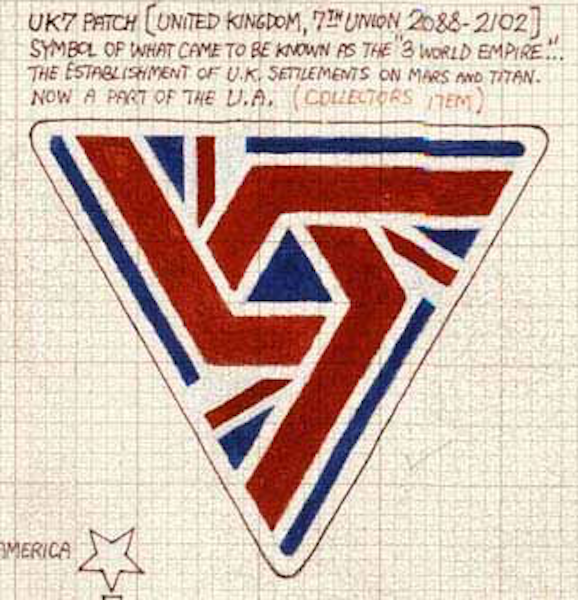
But I'm missing something here. Something stranger. In the material of the very first film, we have mention of a 'Three World Empire'. Ron Cobb's notes suggest this as something like a stage of Britain's spacefaring development. One notes the mix of British and American cast in Alien - which was filmed in Britain.
Later material indicates that the Three World Empire is a merging of Japan and Britain (along with a number of Commonwealth and South-East Asian countries). 

In some ways, this is sort of silly. Taking the Weyland-Yutani merger - a name derived from Leyland (the British car company) and a neighbour of Cobb's** - and having the political sphere mirror the commercial. It's a little too close to really convince, without some greater form of detail.***

And yet...the name, with the faintly occult overtones. The Union Flag three-sided vortex, which hints at the British Leyland symbol. The presence of a junior partner in the West of this new Cold War. The fish-hook nerd-bait of 'Okay, but how does this actually work?' I can't help feeling that this should be more interesting to people than it is. There should be fan-art and Woyjak material galore. As it is....well, this is it

I have to wonder what more could be done with this 70s-echoing Anglo-Japanese culture and economy. Butskellism on a diet of Bushido, courtesy of the MITI? Morning suits for statesmen imported back to Westminster from the National Diet? Consumer electronics and integrated circuits for both the Atlantic and Pacific? An Anglo-Japanese Concorde? James Clavell was Australian-born: perhaps there would be a BBC version of Shogun; or, indeed, Tai-Pan (would Hong Kong continue to be a flashpoint?). You may debate for yourselves the image of Milton Keynes with Zen gardens. 

***

The real time strategy game Red Alert 2, by contrast, is very much embossed with the Cold War. A branch of the Command and Conquer games, Red Alert (which I never played) supposed a removal of Hitler via time-travel and Stalin attempting a conquest of Europe in his place. Red Alert 2 (RA2) had a rejuvenated Soviet Union try again, with an invasion of the United States. 

So far, so Red Dawn. The main thing to discuss is tone (you can look up a more general review elsewhere). Both Allies and Soviets find themselves developing assorted implausible weaponry: Tesla coils, devastating zeppelins, laser tanks, invulnerability courtesy of the 'Iron Curtain', mind controlled giant squid countered by specially trained dolphins, assorted psychic abilities. There was some of this in Red Alert, but far more in RA2. The bigger difference is tone. Red Alert is (by reputation) far more serious. To my mind, this is only mostly true. My goggles tonight are rose-tinted, but there's a few elements of presentation that skew RA2 away from the full-blown cartoonishness of Red Alert 3.**** 

Both Red Alert and RA2 have the live-action cutscenes that are a C&C mainstay, though RA2's, being a few years later, are rather more polished. The characters are more often stereotypes than caricatures. Ray Wise as US President Dugan is in the lightly comic but not implausible role of portraying a personable politician clearly elected in peacetime trying to grapple with a Second Great War (perhaps I'm reading back from Twin Peaks, but is there an air of hidden desperation?). The assorted plot elements are somewhat wilder, though the destruction of Chicago by nuclear bomb is given a certain weight.

More interesting is perhaps the influence of the gameplay on tone. There's a level of pixelated detail to the cities your troops move through that implies a sufficient urban density. Being able to garrison civilian structures helps - there's an echo of Stalingrad in it all. Units frequently have secondary abilities, can gain experience over time  and benefit from close attention; especially so for the Allied faction, but not exclusively so.  When coupled with a campaign that had a number of limited-unit missions, this gives more weight to the lives of your soldiers. Campaign missions would also end with a victory screen giving your par time - the text given if you are under is rather more positive than if you are over. Compare the two texts for one mission here, another here (comparing the actual screens is difficult; apparently people don't like to show the internet that they didn't make the top of the list).

Is this all enough to make you take RA2 seriously? Probably not. Enough to invest you? I think so.

Anyway, I recently encountered and enjoyed a mercenary generator for TF2. Here's something like it for RA2. 

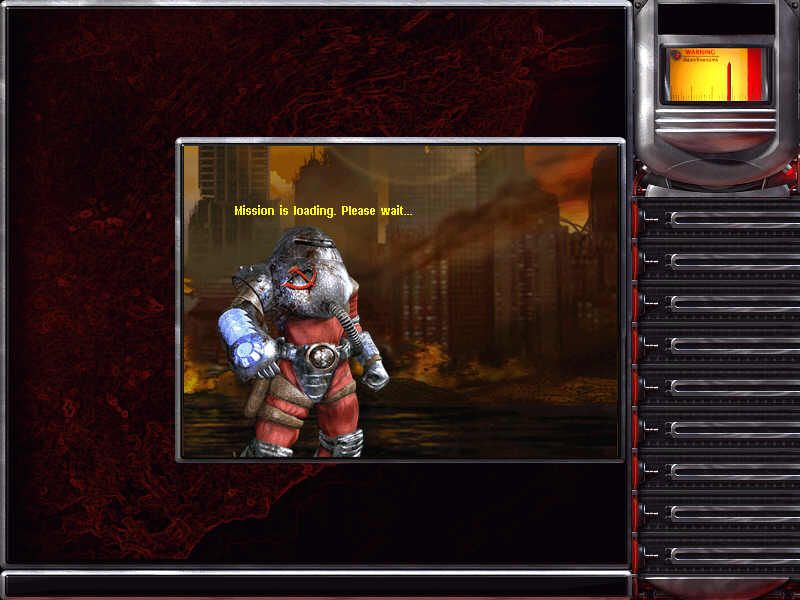
Command & Conquer: Red Alert 2 (Windows) screenshot: Loading a game

The Second Great War is over. You were a soldier. You aren't any more. You had a little money and a home. You haven't any more. There's rumour of a supply of gold reserves stashed in a devastated region. Perhaps you and some people with stories quite like yours could put these to better use than whatever's being done with them at the moment.

---You were a...[d8]

[1] Bog-standard infantryman (but you do bear a marked resemblance to Clint Eastwood).

[2] Rocket trooper

[3] Tank/APC driver

[4] Airship pilot or jetpack infantry

[5] Spy, saboteur or infiltrator

[6] Armoured exotic energy specialist

[7] Loyal but completely unpredictable dog

[8] Would-be psychic who deserted just before the pioneering brain surgery. You still went through all the training.

---You managed to grab a few things from the supply depot...[d10]

[1] Rapid-deploying portable foxhole

[2] Tesla gauntlet (rubber boots not included).

[3] Lots of dynamite with only the shortest of fuses.

[4] Tinnitus-inducing shoulder-mounted flak cannon

[5] Jetpack that was in the depot for vital maintenance

[6] Pyrokinetic focus module (broken targeting lobes)

[7] Plague-dart sniper rifle. Handle with care.

[8] Disguise Kit (might fool psychics, doesn't fool dogs)

[9] Briefcase of highly useful but curiously fragile tools

[10] Gun that erases people from time. You don't know how it works, how much power is left in the batteries or how you got it. But you do know that you really shouldn't have it, and everyone else knows it too.

---You also managed to obtain a set of wheels....[d8]

[1] Optical camouflage tank perpetually stuck in the form of a Scots pine. 

[2] Nippy little half-track.

[3] Teleporting supply hauler. It can instantly travel to a certain designated location within 30km, but it needs to be recharged by an industrial generator afterwards. Also really uncomfortable to drive.

[4] An airship. Full fuel tanks, full magazines, just had been fully refitted - but still very slow and very obvious. 

[5] Massive cumbersome tank with a set of propaganda speakers mounted on the rear.

[6] A big flat-bed trailer pulled by two skittering arachnoid terror drones.

[7] Six seats welded to a hovering robot tank.

[8] Truck carrying a big mobile radar jammer.

---The Gold is hidden....[d8]

[1] Somewhere at a disused military base in the Adirondacks.

[2] In the cellars of the inn of a remote Serbian mountain town.

[3] On an island in the Florida keys.

[4] At an abandoned mine in the Congo.

[5] Not far from a concealed airstrip in the southern half of Borneo.

[6] In a Mayan temple-cum-guerrilla camp in the Yucatan.

[7] At a farm in the north-east of Sichuan province.

[8] Beneath a major national monument.

---A local militia control the area with the power of.....[d8]

[1] Fleet of lightly-armed but highly mobile stealth helicopters.

[2] A pair of towers firing laser-like 'Prism' rays in a commanding location.

[3] Cloning vats. They can only make one kind of goon, but apparently that's all they need.

[4] Hacked feed to a spy satellite guaranteeing constant intel for the region.

[5] A big electromagnet that can pick up cars from twenty miles away.

[6] A self-propelled cryoshell artillery piece. 

[7] Something that looks like a UFO.

[8] Lots of mobile, customisable APCs - and a machine shop churning out spare parts.

---They are led by a warlord....[d10]

[1] A Frenchman who really likes Westerns.

[2] An incredibly handsome Russian nihilist.

[3] Captain Queeg, if Queeg had spent too long watching prism rays light up the dark.

[4] A bombastic Ruritanian cyborg who spends their free time listening to Wagner.

[5] An American journalist from the Midwest pretending to be a CIA agent. Or is it the other way round?

[6] The key member of a Yugoslav stay-behind network.

[7] Hollywood film star who had the money to get out of California at the right time, but not to get back.

[8] Korean submariner deprived of their submarine, and resentful about it.

[9] Peruvian psychic commando who had to spend three nights in No-Man's Land with a damaged interface unit experiencing hundreds of death agonies and went mad.

[10] Politician from a regional legislature who can't recall whether they were a willing collaborator, a mind-controlled puppet, a deep cover agent, was pretending to be one but not the other or just possibly was any of the above at different times - and really doesn't want anyone else to know.


Yes, it's Kelly's Heroes for RA2. Elements of Yuri's Revenge and certain RA2 mods included. The TF2 merc generator could do nicely for comrades or NPCs. 

Détruir tout: c'est une obligation.

***

By way of an ending, I will point you in the direction of S.M. Stirling's Lords of Creation series - which blend the Space Race with Edgar Rice Burroughs-style Sword and Planet fiction, so that you get American explorers dealing with the consequences of the (human, Bronze Age) Venusians getting their hands on AK-47s. The books are acceptable rather than good, but do offer a setting with a certain amount of potential. To my surprise, there's a third one on the way after seventeen years. 


*But then, I have long been of the opinion that David Lynch's Dune has the meme-making scope of the Star Wars prequels. Many do not act as if they share such a belief.

**I've seen that quote a number of times, but never where or when or to whom Cobb said it. I think the origin is in The Authorized Portfolio of Crew Insignias, by one Jeffrey Walker. 

***There is also comparison with Grenville's article on Brexotica: the dreadful rapacious amoral company is the result of the merger of Old-World hierarchy and the inscrutable Orient - against which freedom-loving American protagonists can rage. Not that (by implication) any polity in the Aliens universe comes across very well.

And yes, it seems that there was a Brexit-themed Aliens novel.

****Yes, Yuri's Revenge was rather more B-Movie. That was an expansion pack, and we may consider the base game without it. 

Sunday, 29 December 2024

Conquistadors of Tartarus: The Murmuring Fraternity

There are those who will assure you that Hades is sunless. That warmth and light and the rest of the sun's qualities are quite unknown to the underworld; that even if there is sight, then that sight is blurred, obfuscated by the realm of darkness, accepted only as much as it needs must be.

Those who assure you of this have not been there. Now, in the Year of Grace 1580 - or as near as can be told, after the cataclysm at Lepanto - there are settlements on the Styx inhabited by more than ghosts. In the pious fortress of God's Ravelin, or the impromptu forum of Rome Oldest and Newest, the techniques of Hadean astronomy are developing. There is day, and there is night. The sun's rays produced the metal gold in the Earth, and continue to filter down into the Underworld. Even those who do not opine that Hades is truly in the earth admit that it is paraterrestrial - so that the sun reaches even them.

Not that this is sunlight as men know it. So we see the bleak light of Wanhope as the vaults of Hades brighten, the livid clarity of Febriterce, the aching monotony of Rackhour and the sulking slow dwindling of Bittergloam. These are strange states to dwell in - and those who know the surface world still find themselves caught out by the passage of 'days' in the underworld. One or two clocks, in point of fact, did survive the trip down from the Gulf of Patras; given the state of sixteenth century clockwork, no-one is really sure that Wanhope to Wanhope really is twenty-four hours, or even that Febriterce even falls at the same time every day.

Still, there are some effects of the light that equal those on the surface. During Bittergloam, there appear in certain places great gatherings of things like birds. They are dark and small, but bearing about their heads a sort of intangible sorcerous veil. Flying one way, they are distant but clear points in the distance - flying another, they are deceptive little specks that one must focus on carefully, like frogspawn. Flocks wing together in the near-dusk, forming assorted patterns in groups ten thousand or more strong: now a great disc, now a twisting serpent, an unwinding helix, a sinuous crescent, a wolf's head. Then after perhaps an hour, they disperse. 

Given the lack of predictable natural life in Hades, these are not merely birds going about the unclear but ordinary business of avian life. Theories have been proposed by residents of the Underworld. By some it is thought that these are souls of the thoughtless, of those who obeyed in error - who now follow nothing in particular, save that they follow. By others, they are traces of birds as they dwell on the surface, set as a half-measure in the half-realm below. 

An interesting notion holds that these are the souls of humans in purgatory, showing themselves to living Christians and Virtuous Pagans below, indicating that the proper process of human redemption and the afterlife is going on, somewhere. As souls in Purgatory are going through a form of penitence, the birds naturally wear supernatural hoods and there is a soft noise of myriad whispered prayers. 

A variation on this holds that these are not souls in Purgatory (who are really far too busy going through Purgatory) but souls of those on Earth - who sin, or think on sin, and so are brought near to the realms of gloom and flame. They swarm and group and gather as vice and hope war in them, as one sin or another grips them. A spectral trail follows them, trace of their spiritual journey - and, even when briefly set as a bird, the seat of their spirit-handling intellect is the head.

Whatever their origin, it is these last two theories that give rise to the name of the Murmuring Fraternity. 

Monday, 17 June 2024

Faufreluches: O Sister, where art thou?

The eye-catching, vaguely-uncharitable and banally-provocative title of this post being something like 'Your Sisters of Battle suck - HERE is why!'

The Sisters of Battle - the Adepta Soriatas - are one of the more characteristic factions within Warhammer 40,000. A militant order of space nuns, zealous enforcers of the Imperial Creed, simultaneously the strong right arm of the Ecclesiarchy and those who once purged its overlord. 40k being the size it is, they seem to have leaked over into other properties, influencing things in the same fashion as the wider Warhammer look and approach did. I doubt, for one, that the Vestal of Darkest Dungeon (ostensibly more of a piece with Warhammer Fantasy) has quite such a confrontational look without the Sisters of Battle.

Behold, said Vestal.

This extends, of course, to other GW properties - Mordenheim's Sisters of Sigmar appear after the introduction of the Sisters of Battle, and serve as a localised fantasy pastiche of their Far-Future predecessors. I don't mean to suggest that the Sisters of Battle are somehow unique, mind you. They stake out a corner of the ground within which lies Paladin Girl. Indeed, they aren't even the only Pulpy Battle Nun creation of the 1990s. Other forerunners are the Fish Speakers of the later Dune books and the Vestal Vampires of Termight in Nemesis the Warlock.

Of course, the icon of the 41st Millennium is (for better or worse) that horrifying merger of rifleman, astronaut and templar, the Space Marine. The Sisters were left rather adrift for many years. No new models, no new rules, far few books. Yet they kept making an appearance, and it's difficult to imagine the Grim Darkness of the Far Future without them. 

But, while you may have an image of a Sister of Battle in your mind right now - and it may be a detailed and characterful image - it may well be the only image. Further: how many of their characters can you name? How many can you tell apart? Certainly, the various fan projects, art and discussions one encounters (that is, those trying to not to drift too far from the canon...) seem to stick to a fairly narrow stereotype. Even if their miniatures line may have been expanded, I would suggest that we don't have enough models of the Sisters.

Nothing but Joans of Arc, as far as the eye can see.

Why is this? Well, we might point to the mantle of zealous enforcers given to the Sisters. If they are in that role for (quote) 'the cruellest and most bloody regime imaginable' it should be no surprise that they are rigid and unvarying. Further, the Ecclesiarchy has more obvious centralising, uniform cultural tendencies that other Imperial factions - both as a matter of in-universe lore and in the wider parodic-satiric aspects it bears. (This overview of an old Sisters codex rather concludes that the Ecclesiarchy-themes and material rather dominate any separate identity the Sisters might have.)

The answer of 'Misogyny' is a little pat, but not necessarily untrue. I don't have the background or knowledge base to properly consider that, but I'd feel foolish not mentioning it. 

There's another aspect, which requires a bit of explaining. I'm going to propose three types of variation for a group principally portrayed as tabletop miniatures, as the Sisters. 

  • Football-Strip Variation
  • Plurality Variation
  • Top-to-bottom - or, more aptly - Cap-à-Pie Variation
Football-Strip Variation is easily explained. Different paint schemes, as developed by individual modellers or suggested by the publishers of the model line. This can even by facilitated by things like transfers with different symbols on.

Plurality Variation is where many but not a majority of elements of the model - and the character represented - are changed. A distinct likeness to the original remains. A sub-faction would be well-represented by this, but a sub-faction can exist with only a few additional models being Plurality-Varied. Both individual modellers or the publishers of the model line could create this.

Cap-à-Pie Variation is top-to-bottom transformation. If we are producing a Chapter of Inca-inspired Space Marines, there will be significant sculpting to add Incan details to their armour. This is really something only individual modellers could do: if the publishers of the model line do this, then the something new has like as not been created. Grey Knights are no longer Space Marines. (Shut up, you know what I mean.) 

All these forms of variation can be seen on (say) fan art as well as in modelling. 

(Incidentally, if a passing semiotician or theorist of aesthetics wants to tell me that there are existing terms for all this, I'd love to hear them.)

Football-Strip Variation is always very likely. A different colour scheme is a simple process. Likewise, I think that there will always be a sprinkling of people who want to go all in on customisation and will produce Cap-à-Pie Variation. 

But I think that Plurality Variation is harder to produce, and is more important for producing a broad range of images for a given line of models. Smith painting Space Marines teal and burnt umber is just teal-and-umber Space Marines. Smith painstakingly converting Samurai Orks or Tau using Necron weapons is just Smith's Samurai Orks. There's a certain point between the two necessary for breadth.

Hence, for instance, the Space Marines. This portion of an interview with Gav Thorpe details the core theme of four Chapters who received Plurality Variation - who could then be taken as a model of (EG) the Unorthodox going forward.

And this ties into something greater. Let's go over some Imperial factions. 

  • Our Plurality Variations of Space Marines are those of Warriors - Vikings, Mongols, Arthurian Knights, Plains Indians. Easy to gasp, easy to add to.

(If you encounter a Plurality or Cap-à-Pie Variation which is very clearly drawing from 20th or 21st century military looks, then it's almost certainly resting on 'Special Forces imagery' - which hits the individual and self-directed elements of the Warrior concept . Cf. The various remarkably code-named characters of Metal Gear Solid, et al.)

  • Similarly, our Plurality Variations of the Imperial Guard are Soldiers - generic Western NATO types, the Red Army of WWII, Desert Rats, Redcoats, a deliberate mix of everyone in the Vietnam War (except the French). 
  • Inquisitors and their followers are, as discussed elsewhere, to some degree professional PCs. Variation is in-built. 
  • The tech-priests of the Adeptus Mechanicus are relatively new to having their own faction. But we have multiple instances of characterful, varied tech-priests over the years. They are, to put not too fine a point on it, Nerds (their basic Skitarii infantry are even goggle-eyed and stick-limbed!) and Mad Scientists of which there are variations a-plenty. A whole cult of Victor Frankensteins.

But when it comes to the Sisters - there, we falter. A majority of players/fans/[other] can't provide Plurality Variations of clergy. Our images of religious life are far too limited.

At this point, you might be saying to yourself 'I can imagine all sorts of priests and monks! Haughty Bishops, serene Buddhist monks, Hellenic pagans reading the entrails, ranting Televangelists, mild Vicars, knowing melancholic Rabbis, gold-sickled druids, Hindu ascetics...' 
    Or, for that matter 'I can conjure up a Sister with inner doubts, a Sister who is hiding a bitter loss, a Sister who rejoices in slaughter, a Sister who is enthusiastic about a particular period of poetry....'

This doesn't quite work, of course. The former is far too broad for Plurality Variation; the latter is perfectly good, but off the peg rather than tailored to fit. Compare the proposed Dwarves in Paras 4-6 here. It also runs the risk of the wrong emphasis: consider those adaptations of Chesterton's Father Brown that make him a detective who sometimes says a Mass, rather than a Priest who solves crimes.

I recognise that this is not a new complaint. Neal Stephenson was writing about a lack of religious knowledge and empathy in the aftermath of the Waco siege in the essay 'Blind Secularism'. Less loftily, my praise for Fading Suns had some of this in it. But I will maintain it all the same.

"That's some lovely Polymorphonic Carbon there, be a shame is something happened to it."
Image found in this article on Emperor of the Fading Suns.

[Incidentally, what would this a comparable Plurality Variation look like for Sisters? Well, to point to the Imperial Guard, we have standard khaki-and-rifles army men, scrappy irregulars, heavy-coated gas-masked trenchfighters, troopers for various environments and troopers in dress uniforms.  One would seek at least this level of visual difference, whatever the extent of different characterisation.

Thus, we might suggest Sisters in very plain, functional wargear. Perhaps this Order frequently serves as missionaries, cut off from the normal supply lines. Their devotion to the Emperor is that of loyal servants: ornament and honour is reserved for the altars and reliquaries.

(This is, to be clear, an outline of a sort of order, that a player can tailor closer to fit their preferences. And, of course, they likely aren't only missionaries.)

An obvious contrast is found with a highly ornamental Order, dripping with devotional iconography and decorative elements, drawing heavily on the familiar work of John Blanche. There may be a sense of affective piety among them, stressing a sense of emotional connection to the Emperor - and a willingness to endure his pains. Cue the hairshirt, and other forms of mortification of the flesh. Conspicuous piety of this kind makes them a natural fit for the centre rather than the fringes of the Imperium.

There is also the Sister as enforcer and observer - a Praetorian Guard at the side of a Cardinal, as ready to defend them as to purge them. There's a stress on formality, purity and observation. Think of them drawing from the iconography of the black-and white wimpled and veiled nun - and the black-suited white-shirted secret service agent. Starched white veils concealing high-tech surveillance gear. Gleaming bolter muzzles peaking from under broad black cloaks.

Finally, we might consider an image of the witchfinder. An up-armoured, imposing figure, with exotic weaponry - to both even the odds against the rogue Psyker and, possibly, to take them alive. We might see touches of the SWAT team in them. The inclusion of some in Capotain 'Puritan' hats would be a familiar touch; some of the ferocious elements in the design of the Sisters of Silence might also be apt.

Missionary, Celebrant, Enforcer, Witchfinder. Two outward-facing, two inward. Two plainer, two ornamented. One practical, one passionate, one reserved, one pugnacious. Perhaps this works.]

All very well, though it's unlikely that Games Workshop will come knocking at my door any time soon. So how do I apply all this in my own feudal future  - faufreluchaen* - setting?

+++

Quote:  The Regent knew that Mankind was Changing. The Pastorate are there to make sure that Mankind knows it too. Teachers, counsellors, ritualists - bearers of the vision for all mankind.

As that suggests, the Regent isn't quite viewed as a deity. But a mediator? A prophet? An intercessor? Well, he's managed to be all of those things. Then panegyrics of his own life - and half-life - positioned him as a tool of destiny - undeniably blessed - chosen by chance, by fate - by the universe - by existence itself. This isn't damnable, or even strictly wrongheaded. It may be a misconception, but the Pastorate would rather work with misconceptions that not work at all. 

Established terminology: Ministers as the base representative of the Pastorate, headquartered in temples. Training to occur in seminaries. Witchfinders ('The Office of Detection') and Wardens are among the Pastorate's paramilitary arms. Arch-Pastors to oversee large cities (and their hinterlands), Metropolites to oversee star systems. Typically 'black-clad'. The name of the Regent is repeated once a terrestrial year in the ceremony of the Perennial Obituary

So far, so loosely sketched. How do we draw this out into Plurality Variation? 

Well, as Fading Suns, we might have sects still roughly bound together. We should avoid, however, an idea of castes or specialised departments. What we have are circles and networks. Ministers and Pastorate officials align into informal groups - which harden into societies - which put their members to work - which develop talents and specialities - which grow in influence and dominance over a certain discipline, or a certain province, or a certain system. 

It would be very rare for every minister on a fully-settled planet to be of one Circle. It would not be rare for Nine out of Ten Senior Ministers, Arch-Pastors, Seminary Heads or Provincial Pastorate Clarks (PPCs) to be of a Circle.
    It's not quite like being a member of a monastic order (though of course certain Ministers may take certain life-long vows and gather into communities governed by a certain rule), or a political party (though of course Ministers can play politics), or a social clique (though naturally Ministers have a social life). But it's not not like those things.

Time for some examples. 

The Journeying Circle - Have their roots in travelling Ministers, of the first days of the Pastorate. They are no longer mendicants, but continue to use the iconography of travel. This covers devotional literature, rhetoric, art and dress - wide-brimmed hats, robust boots, clothing cut to accommodate space suits even if they never leave their planet. 

They make significant efforts to unearth Psychics, and when they find them spend a lot of time minutely recording their actions within isolated, specially prepared cloisters. 

Their advice and instruction focuses on the constant effort to move forward and develop.

Journeying Circle institutions include the Pilgrims' Sodality, the Geofric Monks, the Seven-Path Trust and the Saiph Sector Pastorate Journal and Record.

The Lector Circle - Prioritise teaching and knowledge, in both the Circle's own lodges and in public libraries. Keen educators, omnivorous readers - irritating know-it-alls, inflexible disciplinarians. A notable mark of a Circle member is the wide lattice-patterned collar; some may carry the flat 'scribe's satchel'. Many will carry the flat square string of Mnemonic beads; each bead is set with a series of Lectorine shorthand marks that allow the carrier to readily recall a long block of text.

They focus both on teaching themselves, on enabling teaching, and on regulating what is and isn't taught.   

Their advice might typically focus on programmes of study and specialist instructors. 

Lector Circle institutions include the Agatho Development Commission, the House of Learned Repose and the Amaranth Echelon.

The Beacon and Banner Circle - can be directly traced to a Minister of the world Bagdemagus, Belisar. He is now 'Celebrated Belisar' in the Pastorate's Glyptotheque of Notables, where slabs of the native rock of their home worlds bear the names and great deeds of those the Pastorate considers the best of humanity. Belisar was chronicler and companion to the Paladin Chrysogon. The Beacon and Banner Circle follow his example, tracking the Paladins that emerge from the Massif, cultivating ties with the Maiors and recording the words and deeds of Paladins past and present.

If not actively tracking a Paladin or agent of the Palace, they will hold revivalist meetings, focussing audiences on their bonds to distant Terra.  Psychics they encounter are left to roam freely, though they are constantly watched. 

Their advice deals often with exemplars or inspirational narratives. 

Beacon and Banner institutions include the Guild of Esoteric Methods, the Yeomen's Benevolence Society, the Rifle-Sisters of Rigel and the College of Celb. Mavrasar.

+++

That's likely enough to give some flavour of what could be apt. The comparison with the Sisters of Battle is loose, I know, but it struck me as a worthwhile exercise all the same. The Circles described above are a bit squishy - but it offers opportunities to focus in on a specific example, which can then be backed by the wider body.


*Semiurge's work is generally good; it is especially nice when it is inspired by my own work!

Tuesday, 12 March 2024

Conquistadors of Tartarus

There was a great wind, and darkness on the face of the sea. Then the proud ships vanished.

In 1571, the Holy League was fighting the Ottoman Empire. Their ships met in the Gulf of Patras, atop the Peloponnese. Spaniards, Savoyards, Venetians and Tuscans all fought the forces of Selim II from an assortment of ships. 

And then they didn't. They disappeared, on the cusp of victory. A great enchantment fell upon them, and  they were sent below.

Rumours abound: some say the spell was cast by a Turkish wizard. Others, that it was a disaffected Christian, a Transylvanian woman with a fixed grin. Some set the blame on a wizened Egyptian. One piece of esoteric gossip places the blame on a blank-faced boy North-East of Babylon. One utterly discredited suggestion suggests the culprit was a disgraced German academic. 

What happened to them? Where did that battling knot of warring ships end up?

They went below.

Tantalus, by Hendrick Goltzius

The ships fell. And then they slipped into the Styx. Thousands of confused, bloodthirsty knights and marines and sailors thrust into Hades. They found there sulphur and charcoal, and lead from fetters - and so there was gunpowder and shot. And there were allies among the Shades of the Dead, and the heroes of legend: Alexander and Pompey and Agamemnon.  

Ixion, by Hendrick Goltzius


So there are fiefdoms in the underworld, and rivalries - at first good natured, but developing swiftly. And there is struggle, against giants or beasts or furies or demons. 

Some of the Holy Alliance, driven by Renaissance ideals of the Classical World have banded together with the 'Virtuous Pagans' to create a New Rome. Yes, another one. 

Those Turks that were taken down into the Underworld have formed their own enclaves, and follow the old patterns of trade and conflict with the Christians. 

Set against both are the hardliners and restorationists, dedicated to crawling out of the shadowy pit they find themselves in. 

They all find themselves, it must be said,  in a world where Cervantes is allying with the Giants to destroy dark Satanic mills.....

From Matteo Perez D'Aleccio's Engravings of the Siege of Malta.

SO, WHAT IS THIS?

Conquistadors in the Classical Underworld of the Renaissance. Mannerist in style, muscular and elaborate. Ghost-fighting Spanish tercios supported by centaur squadrons and led by Julius Caesar. 

Captain of Infantry, Hendrick Goltzius (Netherlandish, Mühlbracht 1558–1617 Haarlem), Engraving
This guy's probably there. He got that sash for cutting one of Cerberus's Heads off. 

Alchemy and diabolism. Penitent brotherhoods in conical fire-proof robes. Jesuits arguing with the shade of Heraclitus. Achilles getting into arm-wrestling contests with landsknechts. Stray Protestants keeping very quiet. 

undefined
Imagine these guys lobbing rocks at descending Furies. 

Inspirational Media:

Dante's Inferno.

I guess some of the guys from The Faerie Queene are there. 

16th Century depictions of Classical Antiquity. 


[This post written after trying to figure out where the River Acheron was said to emerge on the west coastline of Greece, and a hazy memory of Lepanto being in the area.]

Saturday, 2 December 2023

A Milestone and A Millstone

You blink, and then it turns out you've hit Two Hundred and Fifty posts. I'm not certain that there's a really good way to mark this (though the suggestion of 250 paragraphs of 250 words each on 250 topics was advanced). Well, instead I have compiled the following list: 250 artworks, topics, images and so forth discussed by this blog. If the entry is in bold, there's probably most of a post devoted to it. That's at least one way to review the changing character of the blog.

To make this more than a list, please see also a little piece of writing afterwards. There is an extent to which the former is a clue to the latter, but I shall say no more.
  1. Jack Vance's Dying Earth
  2. Goblin Market
  3. Wolfe's The Wizard Knight
  4. The Song of Roland
  5. The Kalevala
  6. The Stress of Her Regard
  7. The Cosmic Trilogy
  8. The Banner Saga
  9. Procopius
  10. Count Belisarius
  11. Marco Polo in the Court of Kublai Khan
  12. The Pillow Book
  13. The Book of the New Sun
  14. Gormenghast
  15. Virconium
  16. Julie Taymor's Titus
  17. Richard Holmes's The Age of Wonder
  18. Neal Stephenson's Baroque Cycle 
  19. Gulliver's Travels
  20. The Chronicles of Narnia
  21. Van Dyck
  22. The 52 Pages
  23. King Solomon's Mines
  24. The Pilgrim's Regress
  25. The Pilgrim's Progress
  26. John Ruskin
  27. Fahfrd and the Grey Mouser
  28. The Mignola-illustrated Fahfrd and the Grey Mouser
  29. Macbeth
  30. Coriolanus
  31. Othello
  32. MR James
  33. Where Eagles Dare
  34. Ice Cold in Alex
  35. Shadowrun
  36. Tim Powers's Declare
  37. The Ill-Made Knight
  38. Anathem
  39. Sir Gawain and the Green Knight
  40. Mass Effect
  41. Last of the Mohicans
  42. Castle of the Otter
  43. Aguirre, The Wrath of God
  44. Mad Max
  45. The Anabasis
  46. Yoon-Suin
  47. The Thousand and One Nights
  48. Snow Crash
  49. The Tower of Babel
  50. Barsoom
  51. Cyclopean architecture
  52. Ruritania
  53. Appendix N
  54. Popski's Private Army
  55. Evelyn Waugh's Sword of Honour
  56. The Mughal Empire
  57. Henry the Navigator
  58. Dune
  59. Fallout 
  60. The Difference Engine
  61. The Napoleon of Notting Hill
  62. The Hitchhiker's Guide to the Galaxy
  63. Shada
  64. Dirk Gently's Holistic Detective Agency
  65. Discworld
  66. John Wyndham
  67. The Quatermass Experiment
  68. Dan Dare
  69. The Prisoner
  70. Elric
  71. Strontium Dog
  72. Judge Dredd
  73. Rogue Trooper
  74. The Children of Men
  75. Neverwhere
  76. A Canticle for Liebowitz
  77. The Saga of Recluce
  78. Silverberg's Majipoor
  79. The Third Man
  80. Erast Fandorin
  81. Rendezvous with Rama
  82. Star Trek
  83. The Culture
  84. Firefly
  85. The Blazing World
  86. Lamentations of the Flame Princess
  87. Map of a Nation: A Biography of the Ordnance Survey
  88. Blake's image of Urizen in The Ancient of Days
  89. The Man who would be King
  90. William Morris
  91. The Poetic Edda
  92. J R R Tolkien
  93. A Sing of Ice and Fire
  94. Tom Holt
  95. Mere Christianity
  96. Izaak Walton, The Compleat Angler
  97. Isaac Watts
  98. Isle of the Unknown
  99. The Winter's Tale
  100. The Aeneid
  101. Twelfth Night
  102. The Tempestuous Voyage of Hopewell Shakespeare
  103. Pygmalion and Galatea
  104. The Steel Bonnets
  105. The Dark Tower (CS Lewis)
  106. Riddley Walker
  107. Puck of Pook's Hill
  108. Nathan J Anderson's Malacandra illustrations
  109. Castle of Days
  110. The Rivan Codex
  111. The Mysteries of Udolpho
  112. The Mausoleum of Thoedoric
  113. Maria Lack Abbey
  114. Trier Cathedral
  115. The Book of the Long Sun
  116. A Voyage to Arcturus
  117. Nebulous
  118. Iain Moncrieffe and Don Pottinger's Simple Heraldry - Cheerfully Illustrated
  119. Clark Ashton Smith in the Gollancz Fantasy Masterworks edition The Emperor of Dreams 
  120. The Monk
  121. The Castle of Otranto
  122. Ivanhoe
  123. Arms and the Man
  124. Flashman
  125. The Mask of Demitrios
  126. Barry Lyndon
  127. Veins of the Earth
  128. All Saints, Margaret Street
  129. Edward Bulwer-Lytton's The Coming Race
  130. Journey to the Centre of the Earth
  131. The Gardens of Ynn
  132. The Talos Principle
  133. The Critias
  134. The Timaeus
  135. Journey to the West
  136. Equestrian Portraits of Charles I
  137. St Mary Le Strand
  138. Raiders of the Lost Ark
  139. The Diamond Age
  140. The architecture of John Outram
  141. The Ishtar Gate
  142. Age of Mythology
  143. St Peter and St Paul's Church, Pickering
  144. Seeing Like a State
  145. Reflections on the Revolution in France
  146. 'Catapaulta' by Edward Poynter
  147. The Stygian Library
  148. The Name of the Rose
  149. Roger Corman's 1964 film of The Masque of the Red Death
  150. Paul Kidby's Discworld illustrations
  151. Votan
  152. Not For All the Gold in Ireland
  153. The Ancient Greece of Odysseus
  154. Marian and Trinitarian columns
  155. Ilium and Olympos
  156. Thackeray’s History of Henry Esmond 
  157. Thomas Pynchon’s Mason & Dixon
  158. A Song of Ice and Fire
  159. The art of William Nicholson and James Pryde
  160. Silent Titans
  161. Seven Pillars of Wisdom
  162. Shardik
  163. Vita Sackville-West, The Eagle & The Dove
  164. An Atlas of the Soviet Union
  165. Doctor Syn
  166. Mythago Wood
  167. Stardust
  168. Rogue Male
  169. The Day of the Jackal
  170. HCK's Maximalist City-State World
  171. The Fall of the House of Usher
  172. The House on the Borderlands 
  173. HMS Apollyon
  174. Excalibur
  175. The Cruel Sea
  176. Electric Bastionland
  177. Francis Spufford's Red Plenty
  178. Mistress of Mistresses
  179. Tip & Run: The Untold Tragedy of the Great War in Africa
  180. The Vorrh Trilogy
  181. Tumanbey
  182. The Well of the Unicorn
  183. Joseph Wright of Derby, 'A Philosopher Lecturing on the Orrery', 1766
  184. Appian's Roman History
  185. Arkady and Boris Strugatsky's Monday Starts on Saturday
  186. Garth Nix's 'Down to the Scum Quarter'
  187. Fallen Empire
  188. The Shooting Company of Frans Banning Cocq and Willem van Ruytenburch
  189. A Tale of Two Cities
  190. Costumes from the 1883 Cambridge Greek Play production of The Birds
  191. Fading Suns
  192. Passion Plays
  193. Richard III (1995)
  194. Candide
  195. Indiana Jones and the Last Crusade
  196. Magical Industrial Revolution
  197. Tales from the Mausoleum Club
  198. Max Beerbohms's Seven Men and Two Others
  199. Henry Kuttner, Fury
  200. Northwest Smith
  201. Fever-Dreaming Marlinko and Slumbering Ursine Dunes
  202. The Bas-Lag Cycle
  203. The Search for Immortality: Tomb Treasures of Han China 
  204. State of Emergency
  205. The Taheiki
  206. Anvil of Ice
  207. The Cthonic Codex of Paolo Greco
  208. Thomas Hobbes, Leviathan
  209. Warhammer Fantasy
  210. A Very British Civil War
  211. Conquest: the Last Argument of Kings
  212. Demon Bone Sarcophagus
  213. Time Bandits
  214. John Dryden
  215. Hic Sunt Myrmeleones
  216. Spanish-suited playing cards
  217. They Were Defeated
  218. Lazarus and World of Lazarus
  219. The Dragon Waiting
  220. The history plays of Mike Walker
  221. The Dream of the Red Chamber
  222. Jack Vance's Emphyrio
  223. The Metabarons & The Incal
  224. Pilgrim (not the radio plays)
  225. Layer Cake
  226. The Search for the Perfect Language
  227. Dr Zhivago
  228. The Ring Cycle
  229. The High Crusade
  230. Giulio Cesare in Egitto
  231. Lord of Light
  232. Dorothy L Sayers
  233. The Papers of Samuel Marchbanks
  234. The Autocrat of the Breakfast Table
  235. The Knight in Panther Skin
  236. The Last Coin
  237. Tales of the Alhambra
  238. Middle-Earth Strategy Battle Game
  239. Mouse or Rat?
  240. An Instance of the Fingerpost, Iain Pears
  241. Conan the Barbarian
  242. Diplomacy
  243. Holinshed's Chronicles
  244. Tales of Hoffman
  245. Indo-Saracenic architecture
  246. Ely Cathedral
  247. Ronald Blythe's Akenfield
  248. Towers of Trebizond
  249. Evelyn Waugh's Helena
  250. Troika!
***
So, you've probably been cursed.

You opened the book. You touched the little statue in the dark alcove. It was something like that, surely. Now you see things.
    There's a world beyond this one. A world of constant violence, of struggle. You see men there, or things very like men. They fight and they talk: they talk about fighting, they fight about talking, they fight about fighting, they talk about talking. It's riveting, but it shouldn't be a surprise to you. The ancients, after all, could enjoy rhetoric and wrestling both.
    For a time - for a few times still - you walk the pavements, you sit at your desk, you sway in the train carriage, and there's a thrill to it. You know what's waiting for you when you close your eyes. There a world beyond this one, and there's always something happening there, monumental in every moment. The details flash into your head: place, costume, mannerisms, scene, weapons, names, faces, deeds. 
    And then you concentrate a little, and you see a little more. There's someone telling you all this. Even if there's no narrator's voice, there's a choice in what you see, what you hear. So you think about them, and maybe there isn't only one. Or maybe there wasn't ever any more. But you are locked into the deciphering process. When you sleep, when you speak, when you drink, part of you is working away at it. Work is fun: don't let anyone tell you otherwise. Labouring away at something you love is rewarding and satisfying and occasionally beautiful, and now you can do it all the time. 
    Really, you're quite lucky.
    But anyway, that part of it all aside, you also reflect on the events playing out. The characters - who fold and refold on one another, archetypes or commentaries or variations upon a source. If the things you see didn't vary so wildly in its people and moments or appear on so vast a scale, you might become dizzy with the degrees of sameness. And this too is a mystery, and thus an amusement. The ticking of your brain, as familiar and as alien as your heartbeat, or the music of the spheres, is slowly changing its rhythms to match.
    Then there's a slight change in the visions. It started with a slowing, an approach to the sort of crescendo you expect. It didn't quite stay that slow, and it didn't quite ever stop being that slow. There's an oddness to it. Figures - men - beasts - demigods - angels - circle you, warring and declaiming and crying out and beating their breasts. They clash and reset: swing, address, return. The motion round you is faster and faster, the figures ever more solid, ever better-defined in detail, ever more ready to spring to life. It is like staring at a circle of monoliths, framed gloriously against the sun, and knowing at the deepest conceivable level that these rocks will leap, will blur into sudden, astounding motion - and perhaps they did, and perhaps they did. 
    Again, you think again. You dip your head in cold water. You stretch. You ease your body. There are those sorts of problems that you need to step away from occasionally. Again, you think, again.
    It isn't like it was - well, of course it isn't! Never could be: some processes change you. Not something to lament overlong. But maybe you can capture a glimpse of what it was, once in a while. 
    Perhaps you might talk it over with someone. But this isn't really the sort of thing for polite conversation. Too much finicky background to lay out. Too much violence, too much religion, too much politics. Other people must know of it, though, mustn't they? 
    You can't recall who gave you the book. If it was a book. The picture. The play. The mezzotint. But it had to have come from somewhere. The world - this world - is not so strange that such things can creep up on you all on there own. There was a chain of cause and effect. Somebody gave you the book, long ago.
    So you search, and you do not search in vain. There are people who have seen something of what you've seen. But they won't talk about it, or they'll talk about all the wrong bits in tedious detail and in obvious ignorance of all the most vital points. The process is fruitless, and you get some very scathing looks into the bargain. 
    That doesn't matter, though. You've got work before you, and a handful of social ties to cultivate and maintain, and at the end of it all, a whole other world to go back to. 
    So you do. There's something coming, you can feel it. Something terrible and thrilling and revelatory, so literally apocalyptic, in its content and implications. 
    And then it's not there. Not there at all. Neither climax nor anticlimax, but still it persists. Believe it or not. The stone gathers neither moss nor speed, but it does keep rolling. There's a hint of tedium in the air, like the fug of men trapped too long indoors. Hell's bells, but it's dull. Still, you have to dig in. The initiate into new knowledge undergoes several trials, remember. 
    There is a biting of the bottom lip, a gnawing of fingernails, a wanness of countenance. Has someone commented on it? Vanity: most people you know have far better things to do than comment on your appearance. Whether or not they are, you apply nose to grindstone for a solid fortnight. They might call you a boring So-and-So now, but that's probably preferable than remarks about bloodshot eyes.
    You go back. You think things have changed. Perhaps they even have. Things move slowly, like a cinema reel put into a slide projector. There's a whirring from somewhere, and the sight of dust motes in a beam of light. The image is changing, slowly, resolving before your eye into what you always knew it would be. There should be comfort in that.
    The day is overcast. It is cool, but not chill. Your lunch hour is almost over. You pick up the little book from the bench, and slip it into your pocket. You'll be going back soon. 
***