- Jack Vance's Dying Earth
- Goblin Market
- Wolfe's The Wizard Knight
- The Song of Roland
- The Kalevala
- The Stress of Her Regard
- The Cosmic Trilogy
- The Banner Saga
- Procopius
- Count Belisarius
- Marco Polo in the Court of Kublai Khan
- The Pillow Book
- The Book of the New Sun
- Gormenghast
- Virconium
- Julie Taymor's Titus
- Richard Holmes's The Age of Wonder
- Neal Stephenson's Baroque Cycle
- Gulliver's Travels
- The Chronicles of Narnia
- Van Dyck
- The 52 Pages
- King Solomon's Mines
- The Pilgrim's Regress
- The Pilgrim's Progress
- John Ruskin
- Fahfrd and the Grey Mouser
- The Mignola-illustrated Fahfrd and the Grey Mouser
- Macbeth
- Coriolanus
- Othello
- MR James
- Where Eagles Dare
- Ice Cold in Alex
- Shadowrun
- Tim Powers's Declare
- The Ill-Made Knight
- Anathem
- Sir Gawain and the Green Knight
- Mass Effect
- Last of the Mohicans
- Castle of the Otter
- Aguirre, The Wrath of God
- Mad Max
- The Anabasis
- Yoon-Suin
- The Thousand and One Nights
- Snow Crash
- The Tower of Babel
- Barsoom
- Cyclopean architecture
- Ruritania
- Appendix N
- Popski's Private Army
- Evelyn Waugh's Sword of Honour
- The Mughal Empire
- Henry the Navigator
- Dune
- Fallout
- The Difference Engine
- The Napoleon of Notting Hill
- The Hitchhiker's Guide to the Galaxy
- Shada
- Dirk Gently's Holistic Detective Agency
- Discworld
- John Wyndham
- The Quatermass Experiment
- Dan Dare
- The Prisoner
- Elric
- Strontium Dog
- Judge Dredd
- Rogue Trooper
- The Children of Men
- Neverwhere
- A Canticle for Liebowitz
- The Saga of Recluce
- Silverberg's Majipoor
- The Third Man
- Erast Fandorin
- Rendezvous with Rama
- Star Trek
- The Culture
- Firefly
- The Blazing World
- Lamentations of the Flame Princess
- Map of a Nation: A Biography of the Ordnance Survey
- Blake's image of Urizen in The Ancient of Days
- The Man who would be King
- William Morris
- The Poetic Edda
- J R R Tolkien
- A Sing of Ice and Fire
- Tom Holt
- Mere Christianity
- Izaak Walton, The Compleat Angler
- Isaac Watts
- Isle of the Unknown
- The Winter's Tale
- The Aeneid
- Twelfth Night
- The Tempestuous Voyage of Hopewell Shakespeare
- Pygmalion and Galatea
- The Steel Bonnets
- The Dark Tower (CS Lewis)
- Riddley Walker
- Puck of Pook's Hill
- Nathan J Anderson's Malacandra illustrations
- Castle of Days
- The Rivan Codex
- The Mysteries of Udolpho
- The Mausoleum of Thoedoric
- Maria Lack Abbey
- Trier Cathedral
- The Book of the Long Sun
- A Voyage to Arcturus
- Nebulous
- Iain Moncrieffe and Don Pottinger's Simple Heraldry - Cheerfully Illustrated
- Clark Ashton Smith in the Gollancz Fantasy Masterworks edition The Emperor of Dreams
- The Monk
- The Castle of Otranto
- Ivanhoe
- Arms and the Man
- Flashman
- The Mask of Demitrios
- Barry Lyndon
- Veins of the Earth
- All Saints, Margaret Street
- Edward Bulwer-Lytton's The Coming Race
- Journey to the Centre of the Earth
- The Gardens of Ynn
- The Talos Principle
- The Critias
- The Timaeus
- Journey to the West
- Equestrian Portraits of Charles I
- St Mary Le Strand
- Raiders of the Lost Ark
- The Diamond Age
- The architecture of John Outram
- The Ishtar Gate
- Age of Mythology
- St Peter and St Paul's Church, Pickering
- Seeing Like a State
- Reflections on the Revolution in France
- 'Catapaulta' by Edward Poynter
- The Stygian Library
- The Name of the Rose
- Roger Corman's 1964 film of The Masque of the Red Death
- Paul Kidby's Discworld illustrations
- Votan
- Not For All the Gold in Ireland
- The Ancient Greece of Odysseus
- Marian and Trinitarian columns
- Ilium and Olympos
- Thackeray’s History of Henry Esmond
- Thomas Pynchon’s Mason & Dixon
- A Song of Ice and Fire
- The art of William Nicholson and James Pryde
- Silent Titans
- Seven Pillars of Wisdom
- Shardik
- Vita Sackville-West, The Eagle & The Dove
- An Atlas of the Soviet Union
- Doctor Syn
- Mythago Wood
- Stardust
- Rogue Male
- The Day of the Jackal
- HCK's Maximalist City-State World
- The Fall of the House of Usher
- The House on the Borderlands
- HMS Apollyon
- Excalibur
- The Cruel Sea
- Electric Bastionland
- Francis Spufford's Red Plenty
- Mistress of Mistresses
- Tip & Run: The Untold Tragedy of the Great War in Africa
- The Vorrh Trilogy
- Tumanbey
- The Well of the Unicorn
- Joseph Wright of Derby, 'A Philosopher Lecturing on the Orrery', 1766
- Appian's Roman History
- Arkady and Boris Strugatsky's Monday Starts on Saturday
- Garth Nix's 'Down to the Scum Quarter'
- Fallen Empire
- The Shooting Company of Frans Banning Cocq and Willem van Ruytenburch
- A Tale of Two Cities
- Costumes from the 1883 Cambridge Greek Play production of The Birds
- Fading Suns
- Passion Plays
- Richard III (1995)
- Candide
- Indiana Jones and the Last Crusade
- Magical Industrial Revolution
- Tales from the Mausoleum Club
- Max Beerbohms's Seven Men and Two Others
- Henry Kuttner, Fury
- Northwest Smith
- Fever-Dreaming Marlinko and Slumbering Ursine Dunes
- The Bas-Lag Cycle
- The Search for Immortality: Tomb Treasures of Han China
- State of Emergency
- The Taheiki
- Anvil of Ice
- The Cthonic Codex of Paolo Greco
- Thomas Hobbes, Leviathan
- Warhammer Fantasy
- A Very British Civil War
- Conquest: the Last Argument of Kings
- Demon Bone Sarcophagus
- Time Bandits
- John Dryden
- Hic Sunt Myrmeleones
- Spanish-suited playing cards
- They Were Defeated
- Lazarus and World of Lazarus
- The Dragon Waiting
- The history plays of Mike Walker
- The Dream of the Red Chamber
- Jack Vance's Emphyrio
- The Metabarons & The Incal
- Pilgrim (not the radio plays)
- Layer Cake
- The Search for the Perfect Language
- Dr Zhivago
- The Ring Cycle
- The High Crusade
- Giulio Cesare in Egitto
- Lord of Light
- Dorothy L Sayers
- The Papers of Samuel Marchbanks
- The Autocrat of the Breakfast Table
- The Knight in Panther Skin
- The Last Coin
- Tales of the Alhambra
- Middle-Earth Strategy Battle Game
- Mouse or Rat?
- An Instance of the Fingerpost, Iain Pears
- Conan the Barbarian
- Diplomacy
- Holinshed's Chronicles
- Tales of Hoffman
- Indo-Saracenic architecture
- Ely Cathedral
- Ronald Blythe's Akenfield
- Towers of Trebizond
- Evelyn Waugh's Helena
- Troika!
Saturday, 2 December 2023
A Milestone and A Millstone
Friday, 24 March 2023
Riddles and Housekeeping in the Red Chamber
I have been reading the first volume of Cao Xueqin's 1760 novel The Story of the Stone, better known perhaps as The Dream of the Red Chamber. The translation is by David Hawkes, first published in 1973. It's one of the great classics of Chinese literature and a novel of manners; it even has its own field of study: Redology.
Anyway, Chapter 22 has a number of riddles, told as part of a game. I shall list these, with answers below under the picture - they all have fairly mundane answers, but Hawkes's translation, and the anthropomorphism of the riddles mean they could be used to describe divine messengers or elementals or other spirits.
- My Body's square
Iron-hard am I.
I speak no word,
But words supply.
[A useful object.] - At my coming the devils turn pallid with wonder
My body's all folds and my voice is like thunder.
When, alarmed by the sound of my thunderous crash,
You look round, I have already turned into ash.
[An object of amusement.] - Man's works and heaven's laws I execute,
Without heaven's laws my workings bear no fruit.
Why am I agitated all day long?
For fear my calculations may be wrong.
[A useful object.] - In spring the little boys stand up and stare
To see me ride so proudly in the air.
My strength all goes when once the bond is parted,
And on the wind I drift off broken-hearted.
[An object of amusement.] - At court levée my smoke is in your sleeve:
Music and beds to other sorts I leave.
With me, at dawn you need no watchman's cry,
At night, no maid to bring a fresh supply.
My head burns through the night and through the day,
And year by year my heart consumes away.
The precious moments I would have you spare,
But come fair, foul, or fine, I do not care.
[A useful object.] - My 'eyes' cannot see and I'm hollow inside,
When the lotuses surface I'll be by your side.
When the autumn leaves fall I'll bid you adieu,
For our marriage must end when summer is through.
[A useful object.]
- An inkstone.
- A firework.
- An abacus.
- A kite.
- An incense-clock.
- A 'bamboo wife' - that is, one of 'those wickerwork cylinders which are put between the bedclothes in summertime to make them cooler'.
A brief piece of housekeeping for the blog - there's a number of posts I've written, on city or a region or a location, some moderately popular but without being tied to any given setting in particular and (generally) written to be quite self-contained. These are now under the label Translucent Polities, which seemed correct. Browse at your leisure.
Friday, 22 April 2022
A Double Century and Noisy Sheep Shearing
- John Le Carre
- Dad's Army
- Open-air musuems
- The Fetial Priesthood
- The Great Fold
- In The Hall of the Third Blue Wizard (Submissions, Kickstarter)
- The Ordnance Survey and Thomas Pynchon's Mason-Dixon.
- Herodotus and Xenophon
- My creations: Punth: A Primer (and how it grew out of Terrae Vertebrae) and The Rest of All Possible Worlds.
Sunday, 2 January 2022
Rogue Movie & 2021
Recent viewing (well, as recently as last year) has been the 1976 Rogue Male. I've praised Geoffrey Household's 1939 novel on here before, and so happily picked up a BFI DVD (a dedicated set of notes on which is here) when I saw it. Made for the BBC, directed by Clive Donner, script by Frederic Raphael (who also did script work on that seasonal favourite, Eyes Wide Shut).
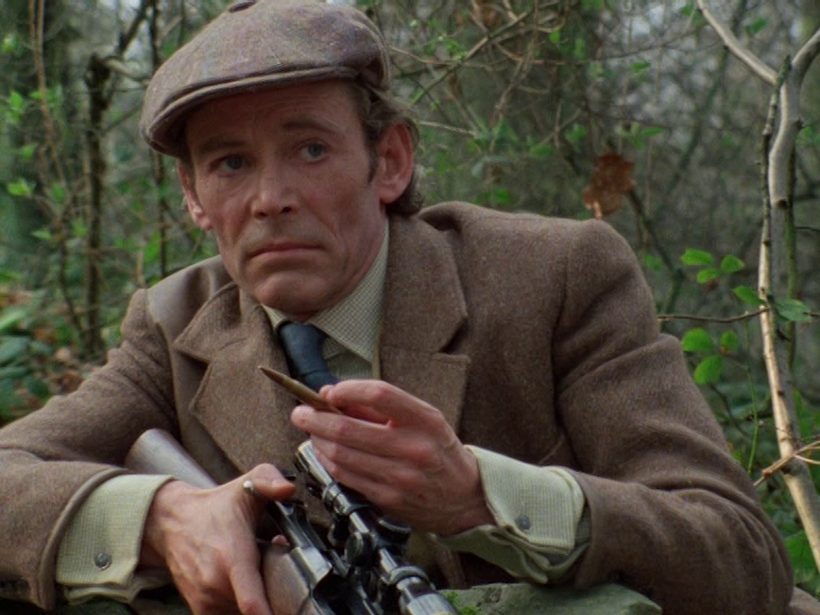
Peter O'Toole plays the protagonist, unnamed - indeed, deliberately anonymous - in the original, but here given the name 'Sir Robert Hunter' allowing a normal flow of conversation; and for the credits to read 'HUNTER - Peter O'Toole'. Other characters played by Alastair Sims, John Standing, Michael Byrne and Harold Pinter (yes, that Harold Pinter).
Rogue Male had been adapted before - by Fritz Lang, no less - under the name Man Hunt in 1941. This had altered the story rather and bore the weight of anti-Nazi propaganda efforts in 1941.
Of course, Rogue Male is a suitable source for such a thing. The book features the nameless protagonist and narrator (an English aristocrat and hunter) taking aim at an unnamed dictator from a state that borders Poland. Well, Household was being relatively discreet in 1939, but the feel of the protagonist's torture, escape and pursuit through both the unnamed foreign power and Britain suggest Nazi Germany rather than the Soviet Union. Household would later confirm that he was thinking of Germany; to my mind the ambiguity of the framing narrative is part of the essence of the novel, but there is no real harm in knowing this. Naturally, the film would struggle to make an actor (and the set, and the costumes, and the spearcarriers....) look like either Hitler or Stalin. Maybe it could be done in some form of animation, but hardly live action.
![]() |
| Va tacito e nascosto, quand'avido è di preda, l'astuto cacciator! |
The narrator is caught and contends that he was only going to point his rifle at [Possibly Hitler]; it was a sporting stalk against the most dangerous game of all. Here is one of the major points of divergence between book and film: the text of the book has been written by the protagonist (even noting where he stopped work and started again). It takes time for him to admit - both to us, and seemingly, to himself, that he A) intended to kill [Possibly Hitler] and B) did it because of his love for a woman killed by the tyrannical regime.
Of course, this slow-maturing portion of the novel cannot be reproduced in the film. Flashbacks, imagined sequences and montage make Sir Robert's motivation fairly clear. Further, other characters know of his romance, originally oddly concealed in an otherwise somewhat well-known man.
Further, the film introduces Alastair Sim as a doddering Earl and government member to explain the delicate political situation of 1939 - things the book's protagonist could work out for himself. I can't find it in myself to complain about his presence, though the first name references to 'Neville' and 'Winston' are a bit much. Likewise, the plausibly Jewish lawyer of the book, Saul, is made definitely Jewish (Saul Abrahams, played by Harold Pinter). There is at least one piece of clearly framed British Union of Fascists graffiti shown on Sir Robert's return to London. The half-German adversary who uses the name 'Major Quive-Smith' is in the film no more than he appears - a Nazi sympathiser and English hunter, played by John Standing.
So, the 1976 film is less veiled than the book, and is made with a dollop of hindsight. But it still captures the mood well; even if we cannot get so much technical information about Sir Robert's burrow or the surrounding farms, or miss his musings on British society, the impressions of his efforts in concealment, or the nature of his interactions with wider society are adequate. If O'Toole and Sim are perhaps sometimes over-arch or stereotyped (an escape through London is probably more compelling if Sir Robert knows how to ride the Underground!), well, it's all very finely done. Even if the protagonist's injuries are downplayed - who wants to cover up any leading man's face, let alone Peter O'Toole's? - we get a very strong impression of what has been done to him and the problems this causes. It all looks very good, as well. Strong, well-placed actors and settings.
As ever, read the book first (or listen to the Michael Jayston reading). But I enjoyed this, certainly.
***
I'm not given to reviews of the year, but 2021 did see at least one watershed for this blog with the launch of Punth: A Primer - bolstered by some kind words and good publicity. TRoAPW is the next such item on the agenda, but is still half-formed. My review of Magical Industrial Revolution was popular, and I may have to do a little more review work.
In the meantime, enjoy the last days of Christmas and Epiphany, and let us see what 2022 brings.
[Postscript to say that this has got a lot of views for such a brief, commonplace post - perhaps more interesting is this other Rogue.]
Thursday, 12 August 2021
The Monastery on the Sword: Part Three
First, a few things to mention:
Apologies for a month or so's absence. Things got away from me - and I had to devote a little time to back up the contents of this blog (it comes to over 150,000 words!).
During this time, there has been a massive spike in views, largely from Sweden. I'm not sure why this should be, but Swedish readers are, naturally, very welcome.
Also, a recent entry - Tsoldiers of Tsymric, which is part of the ongoing 'Fantastical Enlightenment' material I've been putting together. Other popular posts are reviews or based on something more famous - so why one of my setting posts should be so attractive is beyond me. Perhaps it is some sort of code?
Readers may also wish to take a look at the recent Kickstarter from Patrick Stewart of False Machine: Demon Bone Sarcophagus. There is also the first instalment of David McGrogan's Fixed World to consider.
Signals boosted; bulletins announced. We return to the usual content.
This is the - much delayed - capstone (figuratively and something like literally) to an older project of mine, set within Terrae Vertebrae. Here are the first two parts: One, Two.
We look now to the top of the Sword, as detailed in entry No. 3 in Part Two. The Abbot and several monks live at the top of the sword, lowering baskets for supplies, waste disposal and the occasional visitor - as well as to accept deposits. Several gantries are laced with rigging, offering a place for the favoured monks to make their devotions and for the storage of some few necessities. The Abbot is given a favoured spot, in the shape of an open pavilion on the very pommel.
The height of the monastery means that newcomers are at a constant disadvantage from the height and winds. Vertigo will not only through off a swordsman's blow, but also a spellcaster's charms.
In the map below -
Black indicates the outline of the sword.
Red the timbers and platforms around it.
Green certain mechanisms.
Blue ropes and rigging.
Orange the hollowed-out vault in the hilt, as well as the Abbot's pavilion.
- Spare coils of rope for the winches at 9 and 13, and for the scouring mechanisms.
- The shaft of the sword. Nigh-on impossible to climb.
- The storage platform - access to 4 and 1 from here.
- Thick, abrasive scouring pads hang here, to be used to clean the shaft of the sword.
- 5 and 8 are sides of the access platform. People and items raised up from the ground are received here, and other utilitarian functions performed.
- The cross-guard of the sword. Ancient, solid wood, pitted with monkish scrimshaw.
- A treadwheel here can used to raise baskets from the ground or drag scouring pads. It is powered by Patience the mule. Patience works harder than you. Patience deals with heights better than you. Patience might fundamentally just be a better person than you are.
- 5 and 8 are sides of the access platform. People and items raised up from the ground are received here, and other utilitarian functions performed.
- A wheel here guides a line dropping down to the ground. It can either be powered by a counterweight at 13, or by the treadwheel at 7.
- 10 and 12 are sides of the widest platform. In so much as the monks assemble with their brethren on the ground, they do it here.
- Two extended beacons are set here, together with flammable materials. These are the most obvious emergency signalling system on the hilt.
- 10 and 12 are sides of the widest platform. In so much as the monks assemble with their brethren on the ground, they do it here.
- A wheel here guides a line dropping down to the ground. It can either be powered by a counterweight at 9, or by the treadwheel at 7.
- Prayer platforms extend from either side of the hilt at 14 and 16. At 14, a bore-hole four inches in diameter leads into the vault as a deposit slot (one of the monks has a staff with an appropriate scoop at the top).
- Here lies the main vault, carved into the hilt over generations. The treasures stored here are far from mundane - this is not a bank, being too far from most merchants. It is the rare, the dangerous or certain last-resort stashes that you find in the numerous cubby holes and niches of the vault.
- Prayer platforms extend from either side of the hilt at 14 and 16.
- The pommel of the sword.
- The Abbot's Pavilion. The entrance to the vault is here.
Sunday, 8 April 2018
State of Play 2,018
Points about the Blog I am mulling over:
- An explicitly international audience, though the quantity of views apparently coming from Algeria is somewhat baffling. The bulk of readers seem to be Anglosphere.
- A lack of comments. If you have a pertinent remark, I should be interested to hear it.
- The 'default orange' look of the site. I might spruce things up at some point.
- The most popular posts are: Azoth, Fifty Religious Processions, Majipoor and both Sphinxes.
A few things for the near future:
-I might have said I was done with Terrae Vertebrae for a bit, but I have at least one thing of that setting I should like to put before you. Given Terrae Vertebrae's somewhat generic status, this should be easy enough to tailor to fit other settings. It started in my mind as (North) Western European Medieval, but elements of it could fit in quite nicely with what I know of Tang Dynasty China (for instance).
-That said, I should like to put the Land of Punth, the Qryth and some of the surroundings in a separate category (A new label will be affixed to posts). Besides it having an explicit different flavour to the rest of Terrae Vertebrae, it would be an easy 'unit of setting' for somebody to drop into a game un-tailored. Though I should like to flesh it out a little more first. A few random encounter tables, another hexcrawl perhaps, a partial list of the Codes and a few access points to Punth (Austergate being an example).
-Progress grinds slowly on the 18th Century setting (referenced initially here, hinted at elsewhere), which probably would be (sub-) titled White Hot Sparks from the Crucible of the Enlightenment. I have some moderately fleshed-out World-Building stuff so I have named cities or gulfs or kingdoms. But the trick with this seems rather to be a feeling of magic that participates in the nature of the Enlightenment and that systematising of knowledge. I might post a reading list of things I've been looking at.
-In mock-tribute to this post over at Monsters and Manuals, and with an eye kept on this, there will likely be further C.S. Lewis posts. (Though I can't say the same for Terry Goodkind or some others on that list).
-I should like to put Fallout: Home Counties in some sort of finished state, though any serious work on it is unlikely until I can ground myself well in a system that might support it.
-A few more reviews might accumulate.
***
Finally, to ensure this post isn't purely self-regarding and inward-looking, have a d8 list of encounters based on a collection of beer caps I recently saw.
1. A thistle half the height of a man. A red eye stares balefully from its centre. Its leaves rustle, even when there is no wind.
2. Crescent hounds, backs twisted into the curve of the moon scamper across the moor, yapping and snapping at anything crossing their path. How are these dog's backs bent into that cruel shape? No-one knows, or no-one tells.
3. The skull of a drowned mariner, still wreathed in seaweed. Who took it so far from the coast?
4. An elongated badger seeks something in the ground. There must be something in the beast to stretch it's body so - or to bring it out during the day.
5. A harp all of black - soundboard, pegs, strings, column. What kind of music does it make?
6. On a rock, the mark of a red hand. There is nothing out here to point towards; surely nothing to be avoided. Who spent time cutting and staining the stone?
7. Leaves grow through a red, demonic skull. Vines entwine barbed crimson limbs. Is this a possessed dryad or an ensnared devil?
8. Could that be a windmill on the horizon? What else would stand so tall - or wave its arms so?
***
Any thoughts would, as ever, be appreciated.
Monday, 29 May 2017
Fallout: Home Counties - Introductions
- Firstly, it was in response to British 1950s themes and experiences – and would draw to a certain degree upon the Science Fiction of that time (a separate post for that later).
- ….though the key elements of Fallout canon would be there: IE, the laser rifles work on roughly the same principally and patterns – even if there might be different models produced on different sides of the Atlantic.
- Speaking of such canon, if Washington DC isn’t just a crater, neither is London. The theatre of operations is the South East of England – including the ruins of London. But those areas once though rural will have a vitality and life that the centre does not.
- Following in the footsteps of one rather persuasive critical video, the importance of having a world that made some logical sense was important.
- In the Nuclear War, the fallout was blown to the north and east of London; quantities of farmland were preserved fairly well in the Home Counties. Kent especially did well; it was surrounded on three sides by the sea, and was subject to fewer incursion from raiders and similar desperate fellows than other regions.
- This has resulted in a number of factions forming around London in the Home Counties. These factions are, in the fashion of New Vegas various shades of grey rather than black hats-white hats.
Saturday, 27 May 2017
Terrae Vertebrae: A Summation
Nonetheless, there are a few things that might stand a re-visitation or use elsewhere; not that are not only useful but pleasing.
The Giants and Half-Giants I like as a blend of influences; the willful semi-divine ids straight out of Tim Powers; the Atlantis as Iceland picture of vast ruins built for another race in another age; the opportunity to play a race twice the size of a man. All a little stronger and more resonant than the Caprines, the other house rules race.
Kapelleron has a wonderful through line in conception; if you ever want to play a Reconquista-Boer-Wild West-Mormon character, this is the place to be. It feels like Cormac McCarthy could do some pontificating on the whole business.
The Faith of the Eight is pretty robust, but does not perhaps stand out. The Heavenly Jury, meanwhile, has more potential.
The one entry in the canon that I think perhaps pleases me the most is the Land of Punth and its denizens; not only adventure friendly (all that wilderness, that hostile regime!) but the influences are a worthy blend of literary and pulp (Winston Smith rebels against the Ministry of Love inside the Tower of Babel by riding sandworms and fighting the Tharks!). The in-universe clash of Eurocentric Vertebreans against Near Orientalist-flavoured sword-and-planet folks is rather lovely in some ways. It almost seems worthy of a trans-dimensional setting as in False Machine's Great Fold.
Anyway, having reframed and cleaned up a lot of my old notes for this blog, it seems time to move on a little. I might come back to all this in time, but let this be a stopping point for now.