Showing posts with label Speculation. Show all posts

Friday, 25 August 2023

August '23 Miscellany - and a Notion Entertained

A few things to flag up for you, largely unrelated to recent posts - as well as brief section once again Entertaining a Notion.

***

A Return to Saxherm: if you hadn't already encountered it, HCK over at Grand Commodore has recently posted an audio version of his story 'The Crimes of Jack Daw', set in my own Saxherm, which was created using his city-state creator. (Check the comments of that post for a series of people drawing up their own cities, and perhaps make your own!)

***


I enjoy the work of Tim Powers, and so when I saw a paperback by his fellow Ashbless scholar James P. Blaylock, I decided to pick it up. That was The Stone Giant, and it rather left me cold. The obliviousness of its main character mixed oddly with the very directly fantastical elements. 

But seeing a copy of The Last Coin, I decided to try again.

This is more like his pal Powers. Set in Seal Beach, California (part of the greater Los Angeles area; I assumed reading it that it was a pastiche of somewhere rather than a real place), contemporary with the book's publication (1988) it is about the assembly of the Thirty Pieces of Silver paid to Judas Iscariot by an old man called Pennyman. But most of it is told from the point of view of Andrew Vanbergan, who is trying to open an inn, and deal with aged relatives, and get the right kind of breakfast cereal, and...

There is the perennial comment about how stupid people in horror films are, how they ought long ago to have gone down to the basement, and sat there with a shotgun pointed at the door. Vanbergan is, like the lead of The Stone Giant, oblivious and fussy and caught up with his own mundane troubles - and this is exactly as he should be. It is a wild leap for a man in 1988 to work out that someone is gathering thirty very particular pieces of silver, even if we know it from the prologue or the blurb. Watching someone not quite notice and not quite understand what is going on is exactly how this should be going. 

The grubby, furtive - petty, even - Vanbergan is an unlikely paladin (not that he ever really becomes one). Compare Indiana Jones, who is supposed to be somewhat ruthless and morally compromised, another unlikely saviour - but who has a handsome jawline and good suits and a winning smile, and eventually becomes another Hollywood icon. Obviously this man rescues the Holy Grail: that's just what he does. (Cf. Bond: 4/5 of his assignments were meant to be run of the mill, and lots of the books start with him grousing about paperwork. Fleming even intended his name to be boring! But a decade or so of movies and...) Anyway, Blaylock gets a portion of Grade-A kudos for maintaining the unlikeliness of his unlikely hero. 

The best book of its kind I've read? By no means. But the midpoint mix of obscure signs and obliviousness, mundanity and creeping horror is quite good. If I knew more about David Lynch, perhaps I'd call it Lynchian.

***

The Pantographia of Edmund Fry. A 1799 work collecting as many alphabets, scripts and writing systems as the author could get his hands on. It may be found here at the Internet Archive.

Rather lovely in its broad sweep and unique collection of printed scripts. Good to flip through, even if online. Fry does not quite distinguish continually between a script and an alphabet (e.g, on one page we have both the Gothic script found in High Medieval manuscripts and the alphabet of the Goths); likewise Danish is produced in the Latin Alphabet. Things like the Philosophic language of John Wilkins, Bishop of Chester are included - Cf. The Search for the Perfect Language, Umberto Eco. (Pantographia is at least of the spirit of TRoAPW).

Using it as a reference, it would irritate me that English and Saxon are distinguished - especially when one entry under English reproduces something by Alfred the Great. See also the entries for both High Dutch and German, or Ancient British and Celtic. The Pantographia reproduces languages from across the globe, some of them from quite far off and quite recent discoveries to Fry and his audience: see entries under 'Nootka Sound' or 'Friendly Isles'.

The colonial and imperial aspects are baked in, of course: the entry for New England (sandwiched between [pre-Rosetta Stone] Egyptian and English) does not appear to be in a dialect of the Pilgrims, but is possibly Wampanoag (see also Virginia and New Zealand). This practice is not consistent - see Ecclemach. The specimen text for many languages is the Lord's Prayer, be it Siamic, Orcadian, Formosan or Mohawk.

Terms are also unfamiliar - Esthonian, Esquimaux, EthiopicSclavonian, Manks, Saracen (as well as Arabic), Servian, Thibetan. I am unable so far to identify 'Molqueeren'; it looks like Dutch and is perhaps a sort of Frisian. 

Fry also introduces as Welch the 'Bardic Alphabet' of Edward Williams. There's something of a collision in this between the Romanticism (and Nationalism) of the late 18th and 19th centuries and the (mid-18th) Enlightenment project of encyclopaedias and catalogues: see also Ossian. It's tempting to view this as a narrative of Romantic-Nationalist passions and obsessions colliding with Enlightenment naïve benevolence - but that's perhaps a little too neat. Cf. the 'alphabet of Charlemagne'.

Anyway, none of those last few paragraphs should prevent you from at least leafing through this online. An interesting work and I would very much like to see an annotated version.

***

Tales of the Alhambra: a collection of stories and essays by Washington Irving of Sleepy Hollow and Old Christmas fame, written while mixing travel and diplomatic work in Europe, published in 1832. It is set in and around (surprisingly) the palace of the Alhambra in Granada. This was a chance find and an interesting one. My edition was enhanced by a variety of colour plates: the publisher has not identified the artists, and the internet is little help. I have identified some, but others are made more troublesome to find, especially when they appear mirrored and differently coloured on image sites. (And yet still they lack the name of an artist! Pah!)

Tales is in part a description of the Alhambra and the countryside around it, together with sketches of its inhabitants. It is not as such uncharitable, but it is through the lens of a Protestant republican American observing the customs of a Catholic kingdom in the Old World. I would call it benignly disposed next to  The Monk or Browning's 'Soliloquy of the Spanish Cloister', but they share certain elements. 

Anyway, Irving's Alhambra is full of earthy peasants, genteel poverty, Royal officials, guitars being played, chaperoned maidens in mantilla and basquiña, muleteers, maimed veterans and roguish contrabandistas. It's a more colourful account than that Sackville-West gives - in part perhaps because of the relative climates of Avila and Granada.

The other portion of Tales is stories, dealing either with the distant past or the present inhabitants of the Alhambra. In many of these, the presence of Moorish Spain makes itself felt - though of course Irving has already spent much time describing the architecture of the Alhambra . Sometimes honest peasants are shown the way to stashes of buried treasure in the ruins, or enchanted caves. This is frequently the work of ghosts. In others, the story is set during the Middle Ages and the conflict of the Emirate of Granada and the Kingdom of Castille. Some of this, with the presence of astrologers, gallant princes, talking birds and flying carpets shows the hand of the Thousand and One Nights

Other pieces, such as the chapter 'Mementos of Boabdil' (Muhammed XII), display a more grounded approach, with Irving ruminating on the history of the Moors in Spain towards the end of the Reconquista. This is, of course, not colourless: 'the splendid drama of the Moslem domination in Spain', 'if it be a true representation of the man, he may have been wavering and uncertain, but there is nothing of cruelty or unkindness in his aspect'. Likewise, there are some stories of intrigues between the Governor of the Alhambra and the Captain-General of Granada.

[That is, Captain-General of the Kingdom of Granada: united with much of modern Spain under the Crown of Castile but de jure separate until the 19th century. English Wikipedia will guide you inevitably towards the Captains-General of the Spanish Empire in the New World or modern high-ranking officers.]

All that aside, reading this made me entertain a certain notion. I have of late been marinading in Tolkien. My mind went to a great citadel, of the country and yet not of the culture, once a chief stronghold of the enemy, ruined and upon a time glorious, in strange relation to its neighbours...

"The Tower of the Moon" by Ted Nasmith

Let us look to Minas Morgul.

Once Minas Ithil, tower of the moon, renamed after its conquest to the tower of sorcery. Counterpart to Minas Tirith. Aragon II, King of Gondor and Arnor, commanded that it would be destroyed and that none would dwell there (The Return of the King, Ch. 15, 'The Steward and the King'). Ithilien, the land East of the Anduin that was once its territory became the domain of Faramir, Prince of Ithilien.

But even King Elessar would in time die, and pass the crown to his heirs: likewise the children of Faramir and Eowyn would take up the title of Prince. And how readily may a city be utterly erased? Minas Morgul would endure a time.

Generations on, none is meant to dwell in the ruins of Minas Morgul. But a watch is kept on the land once called Mordor, and this means that a guard must be kept in the Morgul Vale, as a principal pass through the Mountains of Shadow. So there is a garrison in Minas Morgul. And where there are soldiers, there must be armourers, and farriers, and cooks. And with settled non-combatants, there are families. And all must be fed, so suppliers and procurators and traders come and go.

But they must not dwell there: all say, and all are told, that they will one day leave and never return. However, in the meantime there they pause, and tell tales of the ancient decorated halls: of stashes of coin and precious gems found in the walls, of ancient yet keen-edged weapons of strange make, of charms and enchantments in flowing scripts. 

Yet it is firm law that Minas Morgul will not be occupied: if any go there, it is by the King's authority alone. So the Castellan of the Morgul Vale is directly appointed, unlike his near neighbour the Prince of Ithilien, who inherited his title. But even if Prince and Castellan get along quite happily, the men under each will clash, and claims of jurisdiction must be judged. Furthermore, any Castellan would rather be the Castellan of Minas Ithil, rather than bear the infamous name of Morgul - though any Prince would have none of it. 

Who comes and - pauses - in Minas Morgul, in the ruins from which all shadows have been chased? The regular soldiery of Minas Tirith. Detachments from the Fiefdoms, serving their term: archers of the Blackroot Vale, hillmen from Lamedon, Lossarnach fighters with great axes. Men of Dol Amroth, who wished to leave their homes, but would not be sailors. Work crews, that must one day be road menders or masons and one day be sappers and eidoloclasts. The Castellan, and such of his household as he cared to take into Morgul. Couriers and rangers of the Prince of Ithilien. Opportunistic traders of Near Harad, or from the Kingdom of Dale and the Lonely Mountain. Elves from the Gardens in Ithilien (see Appendix A of LotR).

Anyway, were I forced to create a Tolkien-derived fantasy dungeon, that's perhaps what it would look like.

Wednesday, 20 October 2021

__punk, Cities and Detectives

There have been a few posts over at Monsters and Manuals on __punk (Cyber-, Steam-, Diesel-, &c). Reading them over reminded me of an old, short piece of writing I once did....


Times are tough in New Ur. The mammoth-drivers guild are in the third week of strikes, the fire-priests have raised the spark tariff again and the palm wine has gone bad. But in the shadow of the great ziggurats, rumours have come to the ears of a secret informer about a new technology that can successfully preserve for all time the secret speech of the Grand Hierarch....and that somewhere in the city, one woman can help him get it.


The point was, in so many words, to gently satirise the tendency of __punk works to end portray a world drawing greatly from images of hard-boiled detectives and urban life of the twentieth century (see also this other post on the Victims of the New). 


Now, one sees the worth of the private investigator as A) a protagonist that can go to all parts of the society being portrayed - slums and spires alike - in search of the truth, uncovering sins and secrets - and B) someone who can get into thrilling fist-fights, gun battles, &c. (Among other examples: Rick Deckard is a re-activated former policeman, Section 9 might be government agents but have a usefully wide remit - the private eye model is a useful one).


But the notion that the cities of humanity would always end up as something like, say, The Naked City or Taxi Driver - or the pastiches of the same .... is odd. And the visions of cities shown in __punk works don't quite have the strong 'sense of place leading to verisimilitude' that we might see in (say) Chinatown. Gotham is (or can be) a background for our hero; New York is an ongoing intrusive reality. They can feel oddly generic, despite megastructures and future-tech - where generic is '20th century western world, probably Anglophone'. This is foolish, even if one was born in the twentieth century in the Anglophone world; it becomes more foolish to apply it to counterfactuals and uchronia.


Hence, well, my moderate scorn. I've communicated the same thing here: the 'snarky, streetwise magician' is now quite well known. The appearance of a portentous, pompous decidedly uncool scholar-mage in the vein of Carnacki or Gilbert Norrell would be somewhat refreshing (drop one of them into a Marvel film: unsightly, quip-less, irritable and apparently completely sincere when speaking of 'the most dreadful peril unto your very soul.')


So, what is there to say for my Blade Runner but Flintstones mock blurb? Not a lot. (Neanderthals as replicants?) It might be complete in some fashion to make a Bastionland district out of it, but that's all. 


However, beyond the above, it does make me want to think about the kind of cities one portrays. Setting aside (or at least non-centrally) the crowded metropolises of Dickensian derivation and 20th century mass transit, though avoiding the stagey puzzlebox cities of Italo Calvino (Invisible Cities is good, but not quite what is wanted).


To suggest examples: 

  • The manufactured new cities of a centrally planned economy, with districts ordered by industry. 
  • A conquered city, now governed by a distrustful coalition of four powers, whose representatives travel everywhere in quartets. 
  • A city distorted by the central lump of a palace complex in its centre, and by the demands of ritual centres around it.
  • Fortress cities are nothing new (see Minas Tirith*; contrast Osgiliath), but the image of a fortress city full of perpetually humourless guards, bunkers and chokepoints, difficult to traverse even for residents ....I've rarely seen the like, with the exception of Abnett's vision of Cadia. 
  • A city riven by municipal factionalism manifesting in sporting contests, brawls, and sporting contests that produce brawls. Your entire life may be bound up in the district: your place of worship, your family, your friends, your trade.....

Now, I concede that this is just me casting out somewhat loosely: actually connecting any of the given above schemes with a retro-futurist setting/aesthetic/message/theme/&c may be more difficult. But I hope that this can suggest alternatives to the cliches and defaults that __punk produces. 


*Incidentally, if you were to tell me that prior to The Return of the King Dol Amroth was a much nicer place to live than the capital, I'd believe you. The threat of Mordor aside, you're living in an actual city (comparable in age and fame) rather than an inflated barracks, and you aren't under the gaze of Denethor.

Friday, 12 March 2021

Sprezzaturra on the Breeze

The slowly evolving Enlightenment-inspired setting (White Hot Sparks, I suppose) includes, among other things, a desire to talk about magic and how it manifests in different ways, thus leading to theorising and speculation on the part of in-universe magicians. Thus, the appearance of magical prospectors and surveyors in recent posts: one is seeking for magic as one would search for a vein of metal, the other tracking ley-lines, assessing connections and distances. 

Part of me was concerned about running dry on ways to properly describe this sort of thing, but then I struck upon a useful source: the Winds of Magic in Warhammer Fantasy.

These are the most characteristic features of magic from Warhammer; a brief history of their appearance and treatment may be found here, courtesy of Joseph Manola. 

From The Empire army book from 2000, the 6th edition of Warhammer Fantasy. 

Image found via Lexicanum.

Men learned [from the Elves] how the raw power of magic blew from the northern realms of Chaos in the form of eight sorcerous winds that represented unique types of magic....

The magical energies of Hysh are the most effusive of all kinds of magic and quickly penetrate solid things and soak away even into the very rocks....

The magical energies of Ghyran precipitate like rain upon the earth, forming pools and eddies which only those attuned to the sight of magic can see....

The magical energies of Ulgu boil across the ground like a shifting mist.....evoking only a sense of mistrust and concealment to ordinary folk. It is the most affected by the mortal winds....rears into mighty clouds beneath the influence of storms and gales.

Aqshy.....gutters like flame in the breeze and runs wild over hot sands and sun-baked fields.

Well, that gives you some idea of the premise. These are the base sorts of magic, that some wizards combine. The Imperial Colleges of Magic teach only one each. In successive editions of Warhammer, the single-colour magics have become more prominent - to the point that Age of Sigmar, in its role as the successor to Warhammer Fantasy is characterised by the existence of eight realms, each named and characterised after a Wind of Magic.

***

Why do I mention this, other than to cite it as an example? Well, it struck me that there was something well-constructed about the Winds of Magic as presented by Warhammer Fantasy.

Firstly, it doesn't feel over-planned. It has established the themes and flavours of each Wind without worrying over much about fitting it all together perfectly. Yes, Life and Death are there, but conceivably Light and the Heavens could be the same thing, likewise Life and Beasts. They haven't felt the need to balance out Fire with water or ice or what have you.

Similarly the names of the Colleges: The Light Order, the Jade Order, the Celestial Order, the Grey Order. They didn't feel the need to name each for a colour, or even to be have the names of the orders follow any one given pattern: gemstones, colours and adjectives all mix together.

Sprezzatura is the Italian term coined by Castiglione's Art of the Courtier, referring to a certain nonchalance on the part of the courtier: whatever effort and artistry has gone into your speech or dress, however many hours you spent on those verses, are not to be reflected in their presentation. 

Some measure of Sprezzatura - or something like it - goes into the presentation of the Colleges. They do not look overworked; there is a pleasing variety to them. The very names - 'The Amber Order' - provide a greater implication of subtlety and variety, over the abstract image of a single colour. The base ideas - alchemists, druids, astronomers - are gently twisted into a distinctly strange image. None of them are trying too hard to convey the Grave Import of their work: magical study seems insular indeed - though we are aware through the context of a wargame that these wizards are called up to serve in the field and lob fireballs at Beastmen, Goblins and Chaos Marauders. WFRP 1st Ed's Realms of Sorcery lays out more of this, as Manola discusses in the above link (unfortunately, I cannot find any good images of the black and white illustrations - far better than the technicolour depictions of the Winds found from later editions). 

Image of an Amber Wizard, found via Lexicanum.
Not a man who cares how people look at him in the street.

Anyway, to contrast this with other grand arrays of magic or cosmic powers, this is quite unlike the bizarre conglomeration of ideas that were combined for the various Lantern Corps of DC Comics. Likewise, however beloved Avatar: the Last Airbender might be, the elevator pitch for it sounds moderately hokey. I suggest that Warhammer's Winds of Magic and Colleges are slightly more compelling (at least, in bare-bones lore terms) because of their relative 'artlessness' and ramshackle demeanour.

Consider the naming of institutions. Oxbridge colleges, founded over many centuries take on several different types of name. They are named for religious figures (St John, St Hilda, &c), places (Girton, Newnham, &c), founders and donors (Balliol, Downing, Queens', Queen's, &c) - or simply as University or New College. What is more, there is ample crossover between names. Cambridge sports not only Christ College and Jesus College, but also Corpus Christi College and Emmanuel College. Likewise, there is not only Trinity College, but also Trinity Hall. There is St John's College, but also Peterhouse...named for St Peter.

To take another example, see the naming of (Association) Football clubs. Certainly, they are named for their city or district but with various additions: City, County and United (Coventry City, Derby County, Leeds United) will be familiar enough, but see teams named for the day of the week their founders had off work (Sheffield Wednesday), occupations (Queen's Park Rangers, Bolton Wanderers), plants (Partick Thistle), works of fiction and fictional characters (Heart of Midlothian, Tottenham Hotspur).

The point being drawn is that for any fictional organisation or group of such to be too neatly symmetrical in its structure or conventions looks rather odd. The neat regularity of American Football team names strikes me, at least, as slightly comic and rather on the nose. 

Well, that's probably an opinion you can safely ignore, but ask yourself: is there any city in Christendom that named its first twelve Churches after the Apostles? (It sounds like something Umberto Eco might confect: the twelve districts of a medieval city are named for the Twelve Apostles, the four colleges are named for the Great Doctors of the Western Church, each gate into the city is named for an Old Testament Prophet....) But while I haven't gone so far as to check terribly hard, I would warrant that no such thing took place. However neat the scheme might be, other Saints loom larger in the Christian mind - the letters of St Paul cement his place above the lesser-known Apostles, the Virgin Mary has a status all of her own, and this leaves aside the appeal of local or national Saints. 

The point I'm driving at is probably clear by now. Overmuch uniformity can strain credulity, no matter how well-concieved it is. Consider including some redundancy or clutter in your world-building. Of course, planned cities or perfectly square-bordered states or revolutionary calendars have all been known. Further, the scientific marvels of the far future or visits to other planes of being could maintain such a state beyond human frailty or expectation: the very alien-ness of such a state could be apt, aside from the potential for GRAND COSMIC UNDERSTANDING. (In successful media doing this sort of thing, I always suspect that a certain amount of arbitrariness is the key: 'Look, old boy, there's seven of them and they all begin with D, just go along with it.')

But I'm acting under the assumption you want to include a human level of understanding and history and mess in your work. In this regard, the Colleges of Magic, being both evocative in name and irregular in nature are a fine example.

Wednesday, 6 January 2021

Monday Starts on Saturday

Over December and into Christmas, I read a number of books. One that stood out was Arkady and Boris Strugatsky's Monday Starts on Saturday (the Gollancz Science Fiction Masterworks edition). You may know the Bros. Strugatsky from Roadside Picnic (the inspiration for Stalker) or Hard to be a God; suffice it to say they were authors of science fiction in the Soviet Union in the 1950s and 60s. The constraints of publishing in Russia at that time are interesting and relevant to their work - the SF Masterworks editions of the above have afterwords by Boris Strugatsky detailing their difficulties - however, this isn't quite what I'm here to write about today.

Monday Starts on Saturday is (effectively) three linked novellas that deal with a young programmer who gets drawn into the 'Scientific Research Institute of Sorcery and Wizardry' - which is abbreviated to 'NiiChaVo', a pun on the Russian 'nichero', 'Don't mention it!'. Andrew Bromfield's translation renders this as the National Institute for the Technology of Witchcraft and Thaumaturgy, IE, NITWIT.  With a name like that, you will have grasped that the vein of comedy in Monday Starts on Saturday lies fairly close to the surface. 
Cover of the Gollancz SF Masterworks edition. 
I'm not over-enamoured of it, but it's not unfitting.


What you have is an organisation with somewhat similar responsibilities and power to the titular Laundry of Charles Stross's Laundry Files or the BPRD of Hellboy but, a) seemingly pretty civilian in its applications (this might simply be a matter of focus - Koschei the Deathless is locked up in the basement while prosecutors labour to complete the immense list of charges against him) and b) largely tangled up with it's own problems. At any rate, Monday Starts on Saturday is more a satire of scientific research than a blood-and-thunder adventure. Certain aspects of this passed me by - I didn't pick up on some of the veiled references to Lysenko, even if the general shape of scientific theories agreeable to the governing ideology of the Soviet Union was apparent. 

Apart from all the above, there's a certain air to the mishaps and goings-on of Monday Starts on Saturday. It's something in the vein of the campus or varsity novel - talented, spritely people in a communal setting not always doing much work, having conversations and passing among a fairly mixed group of characters. Even if the tone or setting of the books changes, both Brideshead Revisited and The Secret History serve well in this regard. Lucky Jim is a little too centred on its main character; parts of AS Byatt's Possession may also be worthy of attention. 

I don't suppose that I have to explain the present appeal of this kind of setting, but it did put me in mind of something comedic (in the Classical sense of the word) or pastoral. It's a tone not often evoked, I think, by role-play. There have been very campus-like, academic materials produced: this post on Coins and Scrolls, this post on Against the Wicked City - and one should not forget the Chthonic Codex of Paolo Greco. 

At any rate, it put me in mind of a hibernating project of my own, provisionally if cumbersomely entitled White Hot Sparks from the Crucible of the Enlightenment. There have been a few posts devoted to this, and I have been looking over a few of my old notes (I think there might even be a short story somewhere on a hard drive....). I haven't yet read Skerples's Magical Industrial Revolution (jolly well ought to) but it seems it may cover much of the same ground. 

Monday Starts on Saturday, whatever it may be 'About' or remind me of, is still a worthwhile read. If nothing else, it is a reminder of the stakes that may come from magic even when no-one is threatening you with extinction.

Tuesday, 28 January 2020

Fields of Light

Let us consider the 'big Empire' concept talked about by Joseph Manola in his (excellent) WFRP reviews. So we are on the same page, let's say that it can be expressed in the following way:

The Empire [or other generic Realm of Men] is big, but hollow. Between the cities are deep forests and mountains. There are few roads and fewer people; dark things lurk there. A fragile connection between towns and cites is maintained. The cities are full of people and wealth, protected by walls and cannon - but the a different darkness lurks there, in the sewers and slums and secret cult meetings.

Now, I realise that this could describe quite a few fantasy roleplaying settings. You can buy more things in cities, and the perils in them are likely to be different. But the Empire and the Old World will do best to illustrate this.

What if we deliberately invert this? I'll maintain (something like) the Mitteleuropean setting of Warhammer, for ease of reference.

***

We find ourselves in a world where the cities have been abandoned, with only high citadels enduring in the ruins of broken stone and crumbling houses. The plague took them, the famine took them - the rats took them. As the soldiers that still defend a few harbours and bridges might tell you, there is such a thing as Skaven.* Some brave or mad fools try and find wealth in the abandoned cities - a fruitless errand, for so little was left there.

Resettled, the countryside is full of wealth and well-populated. Population density is lesser than in cities, of course, but farmhouses are filled by extended families and household servants. There is no tiny isolated community as such; every village can produce a sufficient numbers of able-bodied workers or fighters.**

Trade goes on, but there are few places where merchants are permanently gathered. Rather, fairs are held at periodic times throughout the year in suitable locales. Even the grandest of these do not erect permanent structures to facilitate these. Merchants are not quite nomadic; they will rather store goods and coin in secure compounds in their own village.

The King? Only the greatest of local lords now, burdened with the expense of the royal progress. It would be unwise to tell him that, though. Besides, someone is expected to lead, or look like they are leading.

The great (though not sole) deity of these lands is Ypsilon, Lord of the Plough. Ypsilon of the Straight Furrow, Ypsilon of the Hedges, Ypsilon of the Silver Sickle. He is said to have been the first man to clear the fields and grow wheat - and then to defend those fields. His clergy make ritual journeys about the field boundaries, sanctifying the crop. The faithful are expected to pay a great deal of attention to the calendar, to set about their labours without complaint - and to take their spears with them to the field. The Harvest Festival is pretty hardcore. There are no cathedrals for the overseers of the faith - they sanctify the roads while the parish clergy bless the fields.

Learning is not found in the urban schools or universities, but in the independent monasteries set in fertile fields. High walls and full storerooms protect the libraries, as monks gather to dicsuss faith, magic and natural philosophy. Each monastery may evolve a particular speciality - alchemy, geometry, metallurgy, enchantment. Pilgrims wending their way between them carry books, ideas and devices. Each year, the world is further revealed.

Life in the country is good; a full day's work hopefully means a full belly, and the villages are safer by far than the towns. But despite this, there are whispers of rites in thorn-choked places, beyond the field edges. Worship of the gods of unbounded nature; the gods of unearned abundance, of choking rot, of hateful cold and of raw meat. Who knows what the villagers are hiding behind their hospitality? What lurks in the shadows of the orchard? What force could shatter a millstone?


I started with Early Modern Europe and I turned it into something like the Dark Ages: a loose net of civilisation, rather than points of light. A bit it of makes me think of 17th century Puritan New England, as well. Something far more focused on 'rural feudal' I suppose. But despite the bucolic edge makes a difference. Secret cults in creepy forests or isolated villages are perhaps expected; secret cults in hospitable taverns and village greens, perhaps not. 


*Rather like Vermintide, I suppose. Not that I've ever played it.
**This isn't quite 'Tory Utopia'. But a certain form of agrarian conservatism would be at home in it.

Wednesday, 30 October 2019

Something for Your Shelves: Mythago Wood


Another book up for discussion - curiously, once again with an introduction by Neil Gaiman: Robert Holdstock's Mythago Wood. I'm going to discuss matters in the book and its wider context below, but, yes,  I can recommend it.
This edition published 2014.

It is curious that quite a few places I have read about this it tends to get touted for it's originality. I don't disagree that it is a well-crafted and unique work, but it does seem to fit into a sub-sub genre niche quite nicely. I'd be tempted to place it alongside Alan Garner, Kipling's Puck of Pook's Hill (and Rewards and Fairies - which is the original context for the much-quoted 'If...' and arguably puts a different complexion on things), bits of TH White and Gaiman's own Stardust (noisms's discussion of rustic fantasy here may be relevant). I don't know if 'wooded wonderland full of historical/legendary figures in the British countryside' is its own category, but it almost feels like it should be, with its own sub-par parody. Categorisation, however, is not everything.

The rural (sylvan, even) setting aside, the proximity of the fantastical realm to the mundane is important and serves to separate this from a whole hinterland of vaguely Celtic fantasies. You'll note also that Mythago Wood is explicitly for an older audience that those mentioned above. It is perhaps easier to conceive that the wood (even a small wood) is full of fairies, knights and hunters as a child; Holdstock takes his time before entering the forest proper, spending at least half the book making the prospect of mythagos and a vast trackless woodland real.

The mythagos themselves - creatures of the imagination, particular to the mind of an individual but springing from wider cultural images - are notable. It is perhaps a sign of the times that I kept waiting   for this to turn into some wider point about the power of imagination (like something from a Gaiman-pastiche or a popular animated movie). Or indeed, for a darker, Pygmalion-esque angle to enter the picture (this makes me interested to read the sequels, the first of which has a female protagonist). In neither case does this happen, I am glad to say. The titular mythagos remain attached to myth: individual mouldings of a known archetype.

In the same way, part of me wondered if one character taking a firearm into the historic otherworld would be somehow punished by the story. There would be something odd about claiming a particular evil for gunpowder and cordite when so many die at the hands of those wielding Bronze or Stone Age weapons. But the mythagos come up to twentieth century, and gunpowder in the British Isles is older than that.

There's something of the Gothic to it. The crumbling ancestral house next to a source of occult terror, the shadow of a family behind and about you - The Fall of the House of Usher or the House on the Borderlands may come to mind. However, our protagonist is no aristocrat (it is a family of well-off yeomen, friendly but not close to the local squire - money is never quite a problem, but often looks like it might be and certainly would be if not for a quest leaving the world of banks behind) or occultist, whatever explorations his father may have made.

I wonder, could this story have been set in any other landscape? The wide places of a plain leave a little too much open to the eye, the featureless wastes of a desert are so barren of human habitation that the density of cultures and myths could not evolve in the same way and the mountains allow for a curious moment of revelation at the peak (a mythago version of Stardock could be something). A jungle seems too dense; a hedge-crossed bocage too cultivated, if almost as mysterious. An Earthsea (or Odyssey) style isle-studded sea could work. Something for the tabletop? Well, noisms casts doubt on that. But it won't hurt your play to read this.

***

One other thing: Mythago Wood is written in the first person, and shows a constant awareness of the weariness caused by travel and fatigue. This is an appealing trait in some forms of genre fiction and fuels my appreciation for thrillers like Rogue Male or The 39 Steps or The Day of the Jackal. Low-tech, lone man tales. You'll find out why I mention those next time....

Tuesday, 26 June 2018

Age of Mythology: A Checklist of Beasts

I have been in the midst of a moderate nostalgia kick for Age of Mythology, a real-time strategy computer game from 2005. The premise of setting civilisations and their various deities, monsters and heroes at one another's throats was moderately irritable. The inclusion of a scenario editor was a very good choice - however poor I was at using it versus the versions found in Age of Empires. If you want more of a background or assessment, here's Wikipedia and here's a podcast.

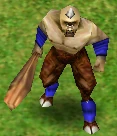
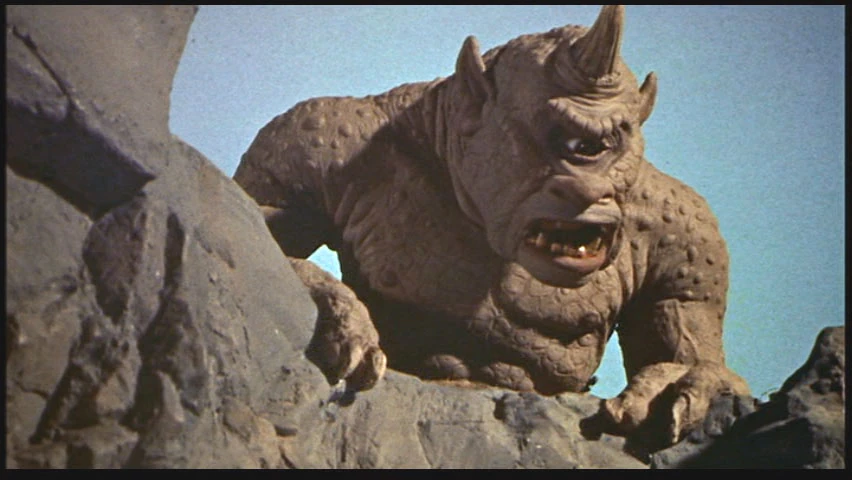
One thing, however, that might appeal to readers is the visual inspiration. Many of the monsters - 'myth units' - took their cues from cinema. Hence, the cyclops looked like this:


reminiscent of this cyclops from Ray Harryhausen.

Image result for cyclops from Ray Harryhausen.

Likewise, the Gorgon carried a bow and had a serpentine lower half - just as Medusa in Clash of the  Titans. This continues across the civilisations - Greek, Egyptians and Norse (Atlanteans* were added in a less well-received expansion). The Egyptians seem to have come straight out of The Mummy or The Ten Commandments.

But the use of popular culture elements as inspiration, as well as the mix of mythological origins is, on reflection, more than a little reminiscent of Dungeons and Dragons et al**. This said, the best known monsters get used as myth units pretty quickly and the creators (Ensemble Studios) had to fill in the gaps - sometimes using their imaginations pretty freely. It's interesting to see how they plug the gaps.

So, below is a list of myth units from Age of Mythology and The Titans Expansion with notes about each one and if it has appeared elsewhere (that I know of). Age of Mythology wiki link with more information here (elements of the in-game encyclopaedia are hilarious). Reference is made to the first edition Monster Manual in the first instance.

Greek
Pegasus - must be one out there somewhere.
Cyclops - yup.
Minotaur - in skeletal form, even.
Centaur - ahumph.
Manticore - yes.
Nemean Lion - functionally a dire lion.
Hydra - multiheaded dragons are known; not so certain about regenerating heads.
Scylla - basically a multi-headed plesiosaur, rather than a woman with multiple dogs at her waist and a serpentine tail.
Chimera - yes.
Medusa - the correct term would be gorgon, but yes.
Carcinos - giant bloody crab.
Colossos - a bit like Ted Hughes's Iron Giant. But Grecian and with a sword. Think a mass-market Talos.

Egyptian
Anubite - jackal-headed humanoids with two blades. Can jump very far. Found purely as a homebrew.
Wadjet - winged serpent from the Pharonic crown, but scaled up to bigger than a man. Spits poison.
Sphinx - ahumph x 2.
Scarab - no longer tiny. Bigger than a four-door saloon; massive pincers to tear down buildings. Nothing new about giant beetles.
Petsuchos - bejewled laser crocodile. Based on a sacred crocodile, probably without the lasers. Giant crocodiles one can find; lasers are extra.
Roc - giant bird that serves to transport people. See the giant vulture - complete with cage - from Clash of the Titans.
Leviathan - also serves as a transport. Old Testament references now; see Jonah.
Scorpion Man - there's one in the Peridot.
Avenger - nothing to do with John Steed. Mini-Horus with two swords.
Mummy - not hard to find. Can convert you into a minion.
Phoenix - yes, these can be found.
War Turtle - sodding great turtle.

Norse
Troll - these ones throw stones and can get an extra head.
Valkyrie - Nordic-themed mounted female paladin with obligatory Wagnerian metallic bodice.
Einherjar - spirit of heroic Norse warrior. Bit like a Death Knight.
Frost Giant - yes. Elite frost giants get horns, for some reason.
Mountain Giant - standard issue giant with beard and club. 
Kraken - not quite as big as some examples.
Battle Boar - golden boar; think a mass-market Gullinbursti.
Fire Giant - yes. Somewhat like a hornless demon.
Fenris Wolf Brood - functionally a dire wolf; gain greater strength in packs (beyond there being more dire wolves, that is).
Jormund Elver - sea serpent. Though also referred to as elvers - giant eels are also a staple.

Atlantean
Promethean - golem (Prometheus made men out of clay - were these prototypes?). Split into two smaller versions after death.
Automaton - robot suit of armour.
Caladria - winged healer. Doesn't fight herself.
Servant - benevolent water elemental. _ of Oceanus is implicit in the name.
Satyr - ahumph x 3.
Neriad - aquatic woman on a shark with a trident.
Behemoth - triceratops meets armadillo. Eighteen feet long. Old Testament again.
Stymphalian Bird - bird that slings razor sharp metal feathers at you. Can't find any likely suspects.
Argus - floating octopus that can drool acid. Many eyes.
Lampedes - Underworld nymph that keeps Persephone company. Looks a bit like a Drow sorceress.
Man o' War - jellyfish that shoots lightening.
Heka Gigantes - Only four arms, but still giant. 

Go forth and investigate further, if you've a will to.  The game is full of details that could be plucked for ideas. I personally should like to see more laser crocodiles on the tabletop.


* In the first game, Atlantis was Greek with a few extra bits of set decoration. In the expansion, the Atlanteans become Titan-worshipers drawing on Roman elements (IE, Murmillo are the standard infantry unit) with a scattering of other stuff (IE, llamas, implying theories about some Native American civilisations being Atlantean).

It's all a little unconvincing next to the semi-realistic other civilisations - the Greeks have actual hoplites and triremes, for instance. But at the same time, the designers have had freedom to make it all up as they went along. So you get a masonry and metal-heavy semi-Modern architecture, and hints in the flavour text at a slightly egalitarian society. To say nothing of the occasional gem of strange gameplay justification lore:

A Contarius distinguished in battle, upon returning to Atlantis, was presented with a lance made from petrified wood found in one of Atlantis’s most distant western colonies. When the stone lance of a Contarius broke, the soldier’s name was carved on its shaft and the fragments were returned in honor to Atlantis. These fragments were arranged in a palisade around the Palace of the Theocrat. It did not take long for the competitive Contarii to begin seeking out targets that would most swiftly break their lances - namely buildings. 

[Source]

Splendidly evocative stuff, but ultimately not enough of it to satisfy, however daft it all is.

** To say nothing of the unlikely pin-up illustration high fantasy renditions of the gods and goddesses involved (Theia, Hekate and Hyperion spring to mind). Some look reasonable enough; others are begging to have the numbers filed off and to be re-used elsewhere.

Thursday, 31 May 2018

The Military Machine, the Archeologist, and the Rebel

A viewing of some of the Indiana Jones films prompts this thought: in these films, the military machine is evil, is the enemy and can be turned against itself.

Forget the religious artefact at the centre of the film; think of many of the action scenes. Raiders of the Lost Ark (RotLA) has that business with the twin-rotored aeroplane and the chase scene with the convoy (many separate vehicles, one figurative machine). The Last Crusade (TLC) has a many-turreted tank with restricted vision - with a convoy behind it. In both cases, one man (on a horse) wreaks havoc on it.

[Of course, there are two kinds of machine in these films. The modern military device and the ancient dungeon full of traps. Both are dangerous - might we say that only one is malevolent?]

This is partly because it provides amble opportunity for peril and derring-do. But the repetition of this kind of scene gives (if you will) a little license to unpick this.

I would not think of this as technophobic, or luddite. But our hero does not fight against the villain not as liberty-loving American to Nazi or archaeologist to soldier - but as man (and horse) against machine, the perpetual spanner in the works. Which could be construed as odd. The Indiana Jones films, even if they never portray the Second World War, constantly invoke it. Kingdom of the Crystal Skull (KotCS) even confirmed what I imagine everyone already conjectured: that Jones had continued to thwart Nazi occult ambitions in the Second World War - before Pearl Harbour, even.

Though, of course, we can never see this. Indiana Jones cannot take part in D-Day even if he is of the same spirit as D-Day. This would bind him too closely to a vast military machine. But just such machinery helped ensue Allied victory in the Second World War.  Clearly, of course, Jones is not a druid or an ascetic. He buys tickets on aeroplanes, he carries a revolver. There is still a friction, when one begins to think on it. The stonewalling bureaucrats at the end of RotLA hint at this; the McCarthy era G-Men in KotCS confirm it. KotCS also gets to have the cake and eat it, by having a first Act with Soviet baddies dressed as American GIs. To say nothing of the horror of an American nuclear weapons test.

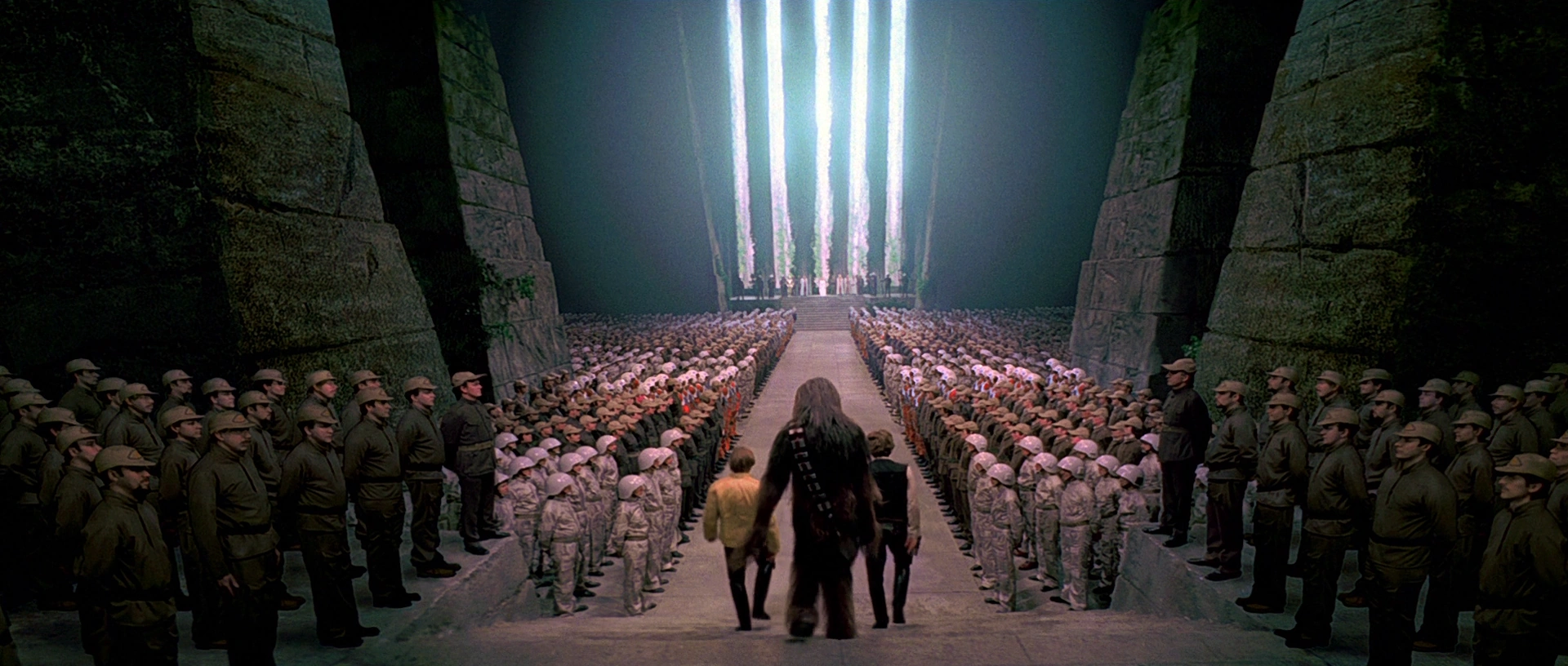
Star Wars - certainly the more recent films - suffers something similar. The Rebel Alliance is talked about in terms like the French Resistance - and it certainly is a resistance movement, against a vaster tyrannical force. But when we see it in Episode Four, it brings to mind the Royal Air Force in the Battle of Britain: unquestionably on the back foot, but still with the might of a World Power behind it. We see established chains of command, radio operators and ground crew, fighter wings, rank badges, call signs - all quite explicitly military and systematic rather than the ad hoc arrangements of a resistance. To say nothing of that orchestrated, disciplined medal ceremony at the end.
Image result for medal ceremony star wars
Pictured: Rebellion.
[From the 1977 motion picture Star Wars, Dir. George Lucas]

I dare say there's some excellent in-universe explanation for all this. The parts of the puzzle still don't quite fit, or don't fit pleasingly.

(Incidentally, if you cannot guess the comparisons between the concept of a military machine and the Death Star, I have just made it. The arguing boardroom of generals with the Dr Strangelove table is a good touch. Further, Episode 4 ends with the inexperienced pilot in the unspecialised machine with the targeting computer off succeeding where the experienced bomber commander with the computer on fails.)

This doubles in later films. The explicitly distancing of the Resistance in Episodes Seven and Eight from the New Republic is odd; are we meant to understand by the finale of Episode Eight that a credible fighting force can be rebuilt from a platoon of soldiers onboard the Millennium Falcon? Allow me to raise the Battle of Britain comparison once more - the whole matter becomes a little risible, even if that last British platoon has Churchill, Monty, Douglas Bader, Orde Wingate, Dowding, Alan Turing, Barnes Wallis and Popski in its ranks. (The explicit condemnation of arms manufacturers should also be considered.)

[Am I complaining of a lack of realism in this tale of space wizards and funny robots? No, but, the verisimilitude of ground crews and radio operators and flight suits (rather than spandex) and so forth is part of the strength of this realised, lived-in world. I would say the same for troop numbers.]

So what is to come of all this? What are the reasons for the above phenomena? What conclusions can we draw?

It has been observed by critics before the strange distance between soldier and military in modern (frequently American or American influenced). Soldier good and sympathetic; military - especially staff officers - bad and unsympathetic. This is not simply, I should say, a party lines issue. One can imagine the heroic individualistic protagonist defying or breaking with his orders so that he may capture the villain - or summarily execute him. Indiana Jones and Star Wars have fuelled or continue to fuel this horror of organised hierarchical systems as much as Dirty Harry or Rambo, in their way.

What to blame? The Vietnam War would be a favourite candidate, but it cannot accept all the blame.  The face of warfare itself has changed; the mass troop movements, conscription and industrial output of the World Wars are not to be seen. Not that the modern Western military does not face troubles of logistics - think of the Falklands Conflict, fought on the other side of the globe by Britain. But it does not need rifles by the thousand and tanks by the score to face terrorists. The squad comes into focus, not the regiment. This dovetails with the surrogate family narratives that seem to abound in adventure flicks these days - whatever the setting. But a regiment (or something regiment-like), however familial it might be in some respects, sits directly inside larger systems and is just too large. Trying to inject the former inside the latter doesn't sit correctly.

Yet the military machine - or any vast hierarchical system - has its uses. If those bits of the world most influenced by the films and narratives here discussed ever had to fight a war en masse, there would be some very odd dynamics at play within the stories that would then be told. We will not be saved by less than a dozen amiable, snarky 'badasses' with a deep interpersonal bond, but by vast numbers of people from a variety of backgrounds and with a variety of personalities who may not even get on terribly well. Neal Stephenson's The Diamond Age puts it thusly: It is the hardest thing in the world to make educated Westerners pull together”. The internet may have changed that, but it enables all those pulling together to pull just as much as they wish to and in the precise way they wish to. This may not necessarily be objectionable to you, but it is something to consider. 

Is there an antidote, for those than desire it? Tom Clancy novels, perhaps. But little on the big screen these days. Perhaps someone will make a 'military procedural'. But not yet. We Were Soldiers might be something to contemplate, though I can think of little that would be set in the contemporary. At any rate, I doubt there will be anything of the sort made in speculative fiction, no matter how many Star Wars spinoffs are made.


[If you want the tabletop take on it, go here and mine the archive for the follow-up posts.]

Saturday, 12 May 2018

Centaurs outside Eden

As the last post, design principle for Terrae Vertebrae was that initially that the races elder to humanity all balance against one another; see libertarian Dwarves, community-centric Elves. But I lacked a proper balance against Fauns and Satyrs (Caprines). I had invented them as a Gnome substitute, but since associated them with the 'Southern Influence' of C.S.Lewis's The Pilgrim's Regress (which is a blasted odd thing to grasp at for Character Alignment, but there you are).

What balances Caprines? Speculations at the time included Dvergar, Hrossa and centaurs.  Thinking about it now, a Marshwiggle would make a good contrast: deriving from Lewis, known for their gloom, enduring of the cold and ultimately, disciplined and logical (consider Puddleglum's role in the climax of The Silver Chair). [See also comments to this; the Caprine, as 'not a Gnome' is also 'not a Halfling'].

But creating a Northerner or Anti-Caprine class that slots into a putative 'Proto-Vertebrea' setting as a Prophet replacement requires a bit of mythological heft - which knocks out the Marshwiggle for this role (though by no means out of the picture altogether).

All caught up? Now, read on....

Dvergar are too similar to Dwarves. Hrossa, as Marshwiggles, lack that heft. As the title suggests, I think centaurs are the solution.

'But' says the Classically educated reader 'Centaurs are violent and savage, despite exceptions. They are unsuitable as a Regress-Northern species. Besides, they have a basis in Greek accounts of horse-borne nomads, set against the static and agrarian Greek city-states. Not quite Northern. This will not do.'

These are not unreasonable arguments against the centaur as the Anti-Caprine. However, my influences are relatively widespread.

First, consider the horse as a symbol. Yes, the wild horse is most Romantic and spectacular. But the horse as known to Western civilisation is a draught animal; hardly the lowest beast of burden, but not one let to roam free either. The horse's might and splendour is seen as something that is governed, and enhanced by being governed. Consider the uses of the horse in the Equestrian Portraits of Charles I.

Think also of the chariot and the stagecoach: horses - more than four, even - cooperating in drawing the burden across the countryside. Mention of the Chariot draws us nicely to the Allegory of the Chariot. Horse(s) and Man together are the (civilised) Human Soul. This is not the only link between the Rational and the Equine: consider Gulliver's Houynhnms - Rational to a fault and certainly inimical to humanity. Orderly and peaceable beasts, to be sure - but not altogether pleasant ones. Let us not forget that Lewis conjured the Northern as a diversion from the true course.

[A game for those of you who wish amusement: watch an episode of Star Trek and mentally replace every mention or appearance of Vulcans with Houynhnms.]

Speaking of Lewis, let us not neglect our Appendices N. Much twentieth [-first] century literature conjures the centaur as a wise teacher (every dwarf is Gimli; every centaur is Chiron). Narnia is an example; Harry Potter another.

What is more, the Northern temperament in The Pilgrim's Regress is not opposed, as such, to savagery or indulgence - even if austerity is one manifestation of it. The giant 'heroic nihilist' Savage feasts and drinks (from the skulls of his enemies, no less). Among his followers, one tribe is listed as 'Gangomani' (others being Marxomanni, Mussolimini and Swastici). Given the Northern temperament and the time of writing, the persons conjured are more likely the loyal triggermen of Capone-esque mob bosses than desperate muggers and school drop-outs. The Gangster, as conjured, is hardly teetotal or celibate - but rather indulges his passions at a given moment. Consider the stoic, cold maxim of Coppola's The Godfather: "It's not personal. It's strictly business."

So, yes, you can do a Marlon Brando impression as a centaur mob boss and not have be out of place. Moving away from such a specific genre trope, the 'work hard-play hard' culture would not be unfitting for a Regress-Northern character. Indeed, if the most Regress-Northern one can be is somewhat like Savage, the most 'centaur-esque' centaur need not be unlike the violent, rapacious classical centaur. 

Having taken you on that little journey, let's descend back to a firmer footing.  What does a Fifty-Two Pages centaur class look like?

THE CENTAUR

Size: 2

HP - d6+1+ CON +/-.

Attack Modifiers - None, initially
Mind Save 7 + WIS +/-
Speed Save 5 + DEX+/-
Body Save  7 + CON +/-

Knowledge    Notice Detail   Hear Noise   Handiwork   Stealth   Athletics
      [XX]               [ ]                        [X]              [ ]              [X]             [X]

Starts with one extra Language, and Spells: 2+INT bonus.

Level Advancement: +1 Melee, +1 Missile every Fourth Level
                                    +1 to all Saves every Odd Level
                                    +2 Spells per level

Centaur movement is as a Heavy Warhorse; that is, 15. However, climbing or anything that involves gripping with the feet is more difficult. Even a simple obstacle counts as Hard.

Spells cast as Prophet. A Centaur, as Regress-Northern belongs to "rigid systems whether sceptical or dogmatic, Aristocrats, Stoics, Pharisees, Rigorists, signed and sealed members of highly organised 'Parties'." This limits their spell choice, just as a Prophet's faith does.

Likewise, it gives them a 'sacred' weapon. There is a weapon emblematic of their creed; one they are trained or accustomed to use. To return to the Gangster-Centaur, this may merely be that Our Gang uses Baseball bats and The Gang the Next Block Over uses straight razors. (This starts to sound less like The Godfather and more like The Warriors).

Centaur encumbrance, as a dwarf, is as a STR 18 character. However, a third of these slots must be packed and unpacked by another character. (The human torso cannot turn 360 degrees.)

A Centaur can be ridden as a horse (though there may be taboos about this). However, it encumbers (as riding a horse) and may interfere with the centaur's abilities.

Much as Half-Giants, for armour to count as full-body, it must be built for a centaur. A humanoid mail-shirt (or similar cuirass) can be worn, but counts as Partial.

***

I am not an equestrian myself and have concentrated in this post more on cultural ideas than biological ones. Readers may wish to examine the SFF and Equines column from Tor Books. There are even some centaur specific posts, with this convenient diagram.

Sunday, 25 March 2018

Civic Elves

The concept of Elves in the City may conjure up a number of images to you. A standard one might come from something like the Shadowrun games; an urban setting inspired by a mix of fantasy and cyberpunk, dropping woodland creatures into the urban sprawl of the twentieth century. Elves with leather jackets and piercings, with keyboards and terminals, with switchblade and uzi.

[Incidentally, if there isn't a late twentieth century Role playing system called With Switchblade and Uzi, there ought to be.]

Your mind might turn to the Dragon Age games: the setting - the world of Theldas, draws from Medieval Europe (unlike Shadowrun). A certain section of the Elven population dwells in human cities, in ghettos known as Alienages. As you might expect, the friction between the two groups is greater than in other examples of fantasy games or books.

These are hardly the only examples of their kind. The Warhammer Fantasy pseudo-Atlantis of Ulthuan is filled with Elven cities. Tolkien himself describes Elven cities: Gondolin being perhaps the most famous. More recently, I understand the Netflix motion picture Bright to have linked elves very directly with twenty-first century Western affluence (the porcelain complexion elves have been often portrayed with being likely relevant).

I should like, however, to draw a line swiftly under these images. Let us discard the elf directly influenced by a twenty-first century conception of urban life; let us also put to one side the pure-Elven cities of high fantasy. A more cosmopolitan city (probably human-run) is brought for your consideration - one with Elven districts, rather than alienages or ghettoes.

However, these are still Elves on the Tolkien model. Long lived, skilful, thoughtful, graceful. What sort of communities might they build?

It might look a little like the Inns of Court, or an Oxbridge college. The comparison is made not in terms of social function, or professions of the inhabitants - though Elves could certainly be professors or barristers; an Elven judge doesn't just make precedent, he IS precedent.... [The notion of Elf-Rumpole must be quashed immediately.]

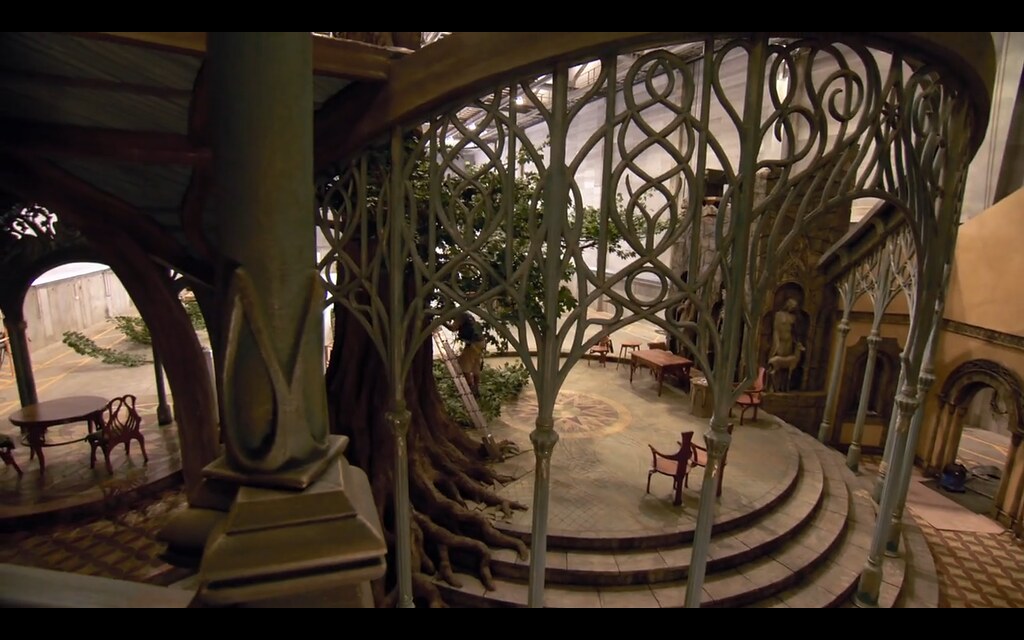
No, the comparison is made in terms of architecture and institutional process. The architectural angle suggests itself easily enough: relatively self-contained regions, well-madeplaces with wealth enough to keep them maintained (elves, even if not necessarily hugely wealthy, are presumably willing to work hard at keeping their homes up to scratch), cobblestones worn smooth and glossy by innumerably footsteps. The Gothic and Jacobean buildings possessed by some of Inns of Court or colleges are fitting: Peter Jackson's cinematic adaptation of Lord of the Rings uses a sort of Gothic revival style for Elven buildings, focussing on the naturalistic features of Gothic architecture and snipping away any very bright colours. (Although this gentleman makes the comparison to Art Nouveau).

(Incidentally, I am not suggesting that Oxbridge colleges or the Inns of Court have always been neat, clean, 'Elf-worthy' spots. In the days of Dr Johnson and Oliver Goldsmith, for instance, I am by no means sure that the Temple was.)

[I have discussed the Arts and Crafts movement, roughly contemperenous with the Gothic revival here - this article may be considered a companion piece of sorts.]

From Peter Jackson's The Lord of the Rings. Consider that tracery; other views available here.
The pillars and colonnades in this clip are also a good from the Gothic revival point of view, though the
painted artwork is rather more naturalistic than below - and the arches less pointed.


Consider for comparison...

Interior, All Saints' Church, Cambridge (Image from Wikipedia)
...or...


Interior, All Saints, Margaret Street, London - once again from Wikipedia.
...or indeed, the Palace of Westminster.

Of course, Elven architecture would be less ecclesiastical (if not, however, irreligious). The images of Rivendell above also have something of the vernacular about them (Cf. Dragestil).  Perhaps Gothic revival Elves or Oxford Movement Elves are something for another day.

One could also have Elves take up a more Classical or Georgian form - in which case perhaps an Elven community might look like New Town, Edinburgh next to the cramped tenements around the Castle and crags. However, enough of architecture for a time.

Let us also think on the nature of the institutions referenced above. Old fashioned in certain regards. Wealthy, if not as wealthy as corporations - and with a less profit-driven motive (regardless of how much money gets made). Prestigious and influential, certainly - bur prestige and influence not based on raw power or numbers or deep coffers. (Wizards often get the University model thrust towards them in fantasy fiction - but I feel Elves could have it attributed to them successfully).

Elves don't strike me as terribly antisocial: capable of being alone and prospering, certainly. But the notion that they would adhere to one another in the metropolis - so that one might have of refuge from the follies and transience of the human life (without the Elves in question actively despising humanity - those that do like as not stay in the forest or the isles).

Moreover, if one were to ask after the foundation of such a place it might be that the courts and gardens of the Elven Quarter were built after they had been exiled, when the Dark Lord occupied the forests of the Verdant Dale...(&c.).  Migrations into cities for Tolkien-esque Elves does not seem a process that would occur naturally.

I bear no grudge to Shadowrun or Bright. But here is a vision not of the Urban fantasy sub-genre, though it is firmly based in the city - hence the title I have used here, Civic Elves. Elves in the city not entirely divorced from their roots in Tolkien - or indeed his inspirations.

Friday, 23 March 2018

Sphinx Specimens

Having made this post suggesting a series of Sphinxes as dragon substitutes, I have been meaning to provide some examples. Consider the specimens below those very examples - the equivalent of Skerples' Grand Lair. The Reptilian corollary to the former post is in effect, after a fashion.

***
The ancient city of Ophidopolis was built atop the rocky bluffs of the Viprous Rise above the River that bisects the desert. The caverns below served any number of purposes for the residents; sewers, mines, middens, tombs. But they were also quite capable of sheltering other things. Warm-blooded things, that hide from the nurturing sun.

Now that Ophidopolis has dwindled, the bulk of trade and the population moving to the city's former harbour at Pythia's Cataract, they have only become more bold. Five of the greatest are monstrous sphinxes, amalgams of beasts with the wits of men....

***
Phalkus

Lair: The Rose-Red Canyon was once the main entrance to the caverns. In the warren of gates, shaft entrances, yards and offices, an Androsphinx has made a home.

Sphinx: Phalkus is the size of a lorry. His fur is constantly serving to catch the sand and dust that settles into the Rose-Red canyon, and has taken on this colour - unless he has been freshly groomed by his Servants, when his colour appears rather similar to tanned, leathery skin. The fur of an androshpinx is less extensive than other sphinxes - his skins is visible beneath the fur, though it is of a hue with it.

Phalkus can breathe out a great cloud to cover himself, so he can move through the canyon during the day without overheating. This makes his presence obvious, but it often disorients or discomforts those around him. Phalkus is willing to take advantage of this.

Desires: a regular flow of tribute and allegiance. Phalkus has no objections to letting folk into the caverns, but notes who has gone through and thus who precisely should be shaken down if they try to leave. He has a number of arrangements with possibly-legitimate businessmen in Pythia's Cataract to exploit the caverns for what can be found. Phalkus would happily deal with the City Fathers for something more permanent and secure, though they have not thought it wise or proper to deal with a sphinx.

Hoard: ledgers, markers, tally sticks. Records of who has passed by; items of their clothing with which to track them. Magic items that assist with the same, as well as enchanted parchment necessary for magically binding covenants.

Followers: a number of dog-kobolds, mostly resembling golden retrievers. They are fine trackers and scouts, often put to this use by the Sphinxborn warriors of Phalkus (and aided by his collection of scent-samples).

Phalkus's Sphinxborn are remarkable human-looking, differing principally in the shape of eyes and placement of ears. Their armour deliberately mimics lion limbs and paws, to get into the proper sphinx-attitude. They are called on more often as guards and bouncers than warriors, but should not be underestimated.

Phalkus's Sycophants tend to serve as scribes and witnesses or archivists, maintaining the ledgers and records. A few are skilled sketch artists, capable of making mug-shots for the archives. Phalkus himself can remember most of those who have passed by, but the kobolds and Sphinxborn need a helping hand. They tend to done rose-red clothing like the canyon. Many are undead or re-animated in some fashion, sustained by Phalkus's covenants and deals. Many are there unwillingly.

Alliances: deals regularly with Khyrsowex, but doesn't trust him. The bull-headed sphinx bruises his pride.

He dislikes the sincerity of Chindasuinth, though has a hidden awe for Gyravagne.

Trade Goods: information, principally. His kobolds make for fine trackers. Phalkus is always good for a loan of one kind or the other.

***
Gyravagne the Grey

Sphinx: A hiercosphinx, about the size of a Church, with the colouration of a peregrine falcon (grey head, back and wings, tawny/dappled belly and flanks). She is an extravagant beast, given to great spontaneous displays of might. The notion of a rehearsed procession or protocol is rather lost on her.

Gyravagne can breath whirlwinds and has almost total control of her environment for the one thing she enjoys best - flight.  Hieracosphinxes tend to be self-absorbed, she is no exception. Do not suggest that she might enjoy flying elsewhere. She has a notion of her limitations in the desert and does not care to consider them overmuch.

Lair: perched on the brink of a chasm, wide enough for Gyravagne to fly in. The chasm is very wide and is said to be bottomless. [It almost certainly leads to the Veins of the Earth.] A series of ramshackle dwellings for her Sphinxspawned circle a wide landing ground. A separate chamber for her moments of rare privacy is actually a naturally occurring opening in the side of the chasm. Some of her Sphinxspawned are digging shafts down to facilitate contact.

Desires: somewhere new to fly in. Some one to fly with. More ways of controlling the weather.

Hoard: flying machines, ancient and modern; an aviary; sphinx-size grooming and physical training devices.

Followers: her dog-kobolds tend to resemble greyhounds or whippets: aerodynamic and slight. Most like to make gliders and flying machines to imitate their mistress. She indulges them, like pets, often summoning the winds for them. However, the loss of one or two into the chasm does not appall her.

The Sphinxborn resemble raptors and birds of prey; for one to be born resembling Gyravagne is considered a great fortune. They are not built for flight and tend to spend their time obsessively patrolling the perimeter of the lair and putting the kobolds in their place. Gyravagne regards them as glum, fussy servants: useful, but rarely entertaining.

Her Sycophants are basically her ground crew: grooms, physiotherapists, meteorologists specialising in the microclimate of the chasm and the effects of her whirlwinds. They tend to have a genuine interest in her. A chosen few have ridden on her back as she flies. This is as exciting and as amazing as you think it is.

Alliances: None that seem lasting. Regards Chindasuinth as sufficiently disinterested in her interests to be a decent ally of convenience.

Gravagne regards Chelloron as insufferably low-minded and Phalkus as a grubby profiteer. However, she finds some measure of ground with the powerful and candid Khyrsowex.

Trade Goods: Gyavagne tends to get by on bluster and bravado. However, she has discovered sufficient seams of precious minerals in her flights, and prompts her followers to excavate them accordingly.

***
Chindasuinth the Confessor

Sphinx: A criosphinx, the size of a barn. His wool-cum-fur is white and fleecy. Obsessed with the correct method of any given process.

A priest of his own church, imitating as perfectly as possible the customs of a major established faith above ground, especially in matters of ritual. (To those venturing into his realm, this is deeply unsettling, like a dragon celebrating mass. It might say grace first, but it is still liable to eat you.) Chindasuinth's customs have naturally diverged somewhat from the orthodox path.

Chindasuinth regards the faith he has adopted as theologically sound and thorough: the right way to go about the matter of existing. He has no (as-such) plan of good works or welfare for his flock, but regards their presence in the rituals and schooling in the faith as the be-all and end-all of his duties (duties which he is incredibly attentive to).

Lair: a series of narrow caverns, honeycombed into one large Church like building. The portals in are watched closely. A number of warren-cloisters have been excavated for his followers.

The plan is very like that of a Church, but the high altar and all the places for the High Priest must be criosphinx-sized, rather distorting the proportions of certain sections.

Desires: converts, alignment with the above-ground hierarchy (whom he would no doubt regard as heresiarchs), the means to expand his church. Theological debate.

Hoard: theological tomes, liturgical vestments and gear, manuals and encyclopaediae from his former searches for meaning and method.

Followers: the kobolds around Chindasuinth are generally collie-like: upright and attentive. The can be found attending to smallholdings of fungus or in workshops when not at worship. Chindsasuinth regards them as lay brethren requiring careful shepherding.

His Sphinxborn bear a resemblance to really muscular fauns. They regard themselves as in training for the Defence of the Faith and are treat this with a very real seriousness: their neatest co-religionists are above ground.

The Sycophants around Chindasuinth fulfil all the specialised roles of divine worship: torchbearers, choir chorus, cantors, thurifers, Church wardens. None are as such mummified, but many cling to life tenuously through the patterns of Chindasuinth-led worship.

Alliances: Chindasuinth has a Don Camillo-Peppone thing ongoing with Chelloron. They are unlikely to work together, except against common enemy.

He regards Khyrsowex as making poor use of his flock; he actively spurns the worldly Phalkus.

Trade Goods: Worked goods: Chindasuinth's previous occupations do him good service in putting his flock to work. Religious art is also in abundance - if the work of kobold paws delights you.

***
Chelloron

Sphinx: a jackal-headed sphinx. She is gregarious, arch and patient. Her pelt is a rusty black. Chelloron is the approximate size of a village marketplace.

Chelloron makes use of all around her. Everything has a use; nothing is to be thrown away. Even her own refuse is considered as in some way an active part of her resources, no matter how worn, pointless or useless any given thing may happen to be. Even noxious substances can be kept and used - possibly as weapons [Germ warfare? She might ask why it is more terrible than other warfare.] She is an active utilitarian - largely divorced from any given code -, an improver - even a do-gooder, with all the negative and positive connotations that brings.

Lair: a former midden. A chasm to the surface, once a pit for all the refuse and spoil of the mine workings and the city above. It is not a foul place, many centuries on. Chelloron tends to perch on a ledge above it.

Desires: Space for her possessions and means of improving them. Whereupon that space will become her possession.

She is pragmatic enough to bargain for (for instance) ingots of steel when it would be to her advantage to have steel, but Chelloron is not discerning.

Hoard: a genuine bounty of objects, put to different uses. You will find very little that serves it's intended function.

Followers: her dog-kobolds are burrowers, nimble chasers, seekers - they resemble Dachshunds and are, relatively speaking,  even worse collectors and hoarders than Chelloron. They must be coaxed into use.

Her Sphinxspawn are not the sturdiest of their kind. They tend to the use of traps, of snipers, of ambuscades. They are patient and might be thorough -  more like Rangers than Fighters.

The sycophants around her tend to be fallen lords, failed conquerers and former politicians. They have a desperation, a need to put to use everything around them to bolster their cause. They know quite how fast and far one can fall.

Alliances: Chindasuinth has a Don Camillo-Peppone thing ongoing with Chelloron. They are unlikely to work together, except against common enemy.

She appreciates Khyrsowex's farms, but not his attitude. Phalkus amuses her, in a contemptuous fashion - why make use only of folk? How foolish!

Trade Goods: most any common or semi-rare item, but it is probably broken or defaced.

***
Khyrsowex

Sphinx: a bull-headed sphinx. Overbearing, chummy, thinks he has a winning air. Harsh and ruthless when crossed; generous when obeyed or dealt with in what he deems a respectful fashion.

If you want a real world reference, a Southern Gentleman of cliche. He is about the size of a large Church.

Lair: a tightly run and productive series of underground farms, largely rearing mushrooms. Khyrsowex's own habitual chamber lies at the centre of the many passages connecting them.

Desires: a few really good constitutional scholars, lawyers and teachers. He'd like educated servants and a moderately sophisticated society to run. While at it, an expansion of the amount of folk lucky enough to enjoy his enlightened rule would be nice.

Hoard: crops, contented servants, tools, weapons. Minor luxuries of many kinds.

Followers: Khyrsoex's dog-kobolds have the look of German Shepherds: trim and muscular, obedient. They work the fields and watch the boundaries.

His Sphinxspawn are broad, often horned like minotaurs - and surprisingly quick for such bulky creatures. Stronger than you, swifter than you and dedicated to defending their master.

Those sycophants that surround him tend to be merchants, former or current. They know the value of stability; the uses of a settled land and an obedient populous.

Alliances: not quite self-conceited enough to imagine that Phalkus obeys him, but imagines Phalkus fears him. He hopes to suborn Chindasuinth.

Trade Goods: Food, shelter, protection. As long as you want it. As long as you show that you want it.

However, if necessary, Khyrsowex will dip into the petty cash.

***
Why visit the caverns beneath old Ophidopolis?

Wealth. Magical items of unknown heritage. Desperation. Knowledge. Centuries old cultural artefacts. Obligation. All these might drive you in, but the Five above will drive you out.