Showing posts with label Architecture. Show all posts

Friday, 6 September 2024

A Map: Possibilities and Realities

I acquired a book called North Russian Architecture in a give-away a few months back. A small item, pages of heavy high-quality paper, a wood-effect hard cover. Published 1972 in the USSR, translation by Kathleen Cook. If it didn't have pages about six inches square in area, I might call it a coffee-table book.

Opening it the last few days, I found it to be quite charming - if the sort of volume replaced these days by Wikipedia and digital photography*. Many details on the wooden Churches in Lake Onega, for instance - which really are incredible. An interesting testimony to the abundance of a resource fuelling architectural creativity.

Among the material within, I found this map, showing Solovetsky Monastery, on the islands of the same name in the middle of the White Sea.

    The key is not conveniently positioned, so I reproduce it here:

Towers:
A - Spinning, B - Assumption, C - Watch, D - North, E - Kvass-Brewing, F - Kitchen, G- South, H - White

Gates:
I - Holy, II - Herring, III - St Nicholas, IV - Kvass-Brewing, V - Kitchen, VI - Assumption, VII - Archangel

Buildings:
1 - Cathedral of the Transfiguration (1558-66), 2 - Cathedral of the Assumption and refectory (1552-57), 3 - Trinity Cathedral (1859), 4 - Bell-tower (1777) and Church of St Nicholas (1834), 5 - Passage, 6 - Church of the Annunciation (1596-1601), 7 - Church of St Philip (1798-1859), 8 - Hospital building, 9-17 -  living quarters and domestic buildings, 18 - Water mill, 19 - Chambers (1615), 20 - Chambers (1642).


Heady stuff - with that assortment of gates and functions and religious areas. All the more so when one reads that Ivan IV (the Terrible) gave the monks cannons. So much that adventurers could tamper with, so many options. Is the herring gate somehow enchanted for monastic anglers? Does the spinning tower revolve?

If you were primed to assume that Solovetsky Monastery was made of wood - well, so was I. However, it is of brick and stone. Don't worry; your version - in northmost Tsymric? - can be wooden.


The other unexpected discovery was in my cross-checking; as it emerges, the Solovetsky Islands were the site of one of the earliest Soviet prison camps. This makes geographic sense: in 1923, the sites of the old Tsarist penal colonies in Siberia (EG) were cut off during the Civil War, and the Allied Archangel Expedition had wrapped up by then. The White Sea would be accessible by rail from the Muscovite heartland and the islands would make escape difficult. I had encountered this before, but it hadn't lodged in my mind like the names of (say) Alcatraz, Devil's Island, Wormwood Scrubs, Botany Bay or Dartmoor. Thankfully, I have encountered attractive maps to be questioned before and I do not regret picking this up by chance.

To end on a milder note - I have encountered few other things in following up for this post, including the Anglican Church in Riga (Cf. St Olaf's, Balestrand), the Estonian and Latvian naval jacks, and the source of the Pinega River, in the Krasnoborsk marshes, at the confluence of the Black and White Rivers - which sounds like something out of the Painted Lands.


*Occasionally it lapses from art-historian technicalities or tour brochure gloss to refer to something oddly specific. See this passage, when referring to old Autumn fairs:
'...they would trade in distaffs, clay toys, household utensils and birch-bark boxes. Similar boxes painted with strange green and red flowers with white and blue leaves are still made by Dmitri Matveyevich Novinsky, a local craftsman who lives not far from Verkhnyaya Uftyuga in the village of Novoandreyevka.'

Monday, 31 May 2021

Of Faith and Fences - A Visit to Saxherm

What is this? A few days ago Christmas Knight over at Grand Commodore threw together a 'Maximalist dreampunk weird fiction city-state creator'. I got out the dice, and over the course of a sunny afternoon put together the following. 

The below was originally posted on Grand Commodore in the comments of the original post. I have presented it here in one package, with screenshots of some of the comments for context. It will be of use to read or at least skim the city-state creator first.

A herm is, of course, a sort of statue 
- and saxum, saxi is Latin for rock.
An unsubtle name, but it sounds right.
[Source]


(2) Name Afterwards: Saxherm

Government

70          69-71 Religious Order


Religious Demography

65      61-75 Majority/Minority                     5%


Religions

74         74-76 Exemplar Polytheism (Maj)

95            93-97 Tutelary Deity   (Min)


Sources of Wealth

54     53-55 International Black Marketeer         3. Stolen goods

11         8-11 Beauty                                                            4. Ubiquitous statuary 


Distinctive Cultural Elements

94     93-100 Traditional Costumes  


Prevailing Conditions

53             52-53 Massive Economic Surplus

69         68-69 Predatory Entity                                 4. Destroying their memories


Biome

22     22-25 Distributed over several walled hilltops with bridges and/or tunnels


Most Prominent Architectural Feature

84     81-84 Theatre 


The city of Saxherm was founded on a series of hilltops, each with its own guardian spirit. As the burgeoning city spread between the hills, each court - each garden - each road - earned its own tutelary, carved in a distinctive style. Saxherm became known as a city of statues.


In the third century after its founding, flooded with the teachers and sophists of a neighbouring polity, the local faith was transformed. There were not countless gods of the road, there was one god of all roads. Then there was not a god of all roads, but a god of communications and travel - an archetype of trade and wayfaring. 

    The new faith found a home in the wealthy of the city - those who wished to look up-to-date and could afford the tutelage. The informal associations of sacred masons, iconographers and artisans gave way to well-connected sacred fraternities. The old Assembly and district regiments had bowed to the iconographers or been led by them in many matters. Assemblymen, municipal officials and regimental leaders saw a way to escape that influence now. 

    Through the fourth century, low-level conflict between the new faith and the old was the rule, as were ongoing spats between high and low. In time, however, temples to each of the archetypical deities were erected on each of the fortified hills, cementing their place in the hearts of Saxhermenes. The Assembly now largely overlapped the sacred fraternities; rather than blossoming in its own right, it withered once again into a junior partner.

    Each from their hilltop districts, the fraternities extend their rule of the city. Rather than all bowing to a given hierarch, a governing council made up of the heads of each regularly changes their chairman according to the calendar. (This is a complex thing, taking both lunar and solar influences into account, along with certain anniversaries and seasonal observances. Alterations to the calendar are fraught constitutional debates.) For a week it may be the shrewd-eyed grey-locked Matriarch who casts the final vote, then the sinister Grand Psychopomp, then a pale Vestal chosen by lot, then a masked Oracle from the copper domes of the Vatic Quarter.

    However, in the depths of the Plebeian districts, there are those who have never forgotten the Tutelary Deities. They petition for funds to maintain the statues and for a legal protected status, they decorate them with garlands of flowers, they leave coins in outstretched hands, they touch sponges soaked in wine or milk to stone lips. If this is condemned, it is generally as an unfortunate and stubborn superstition rather than as an appalling heresy. This minority is protected by a measure of civic pride in the statues, which are now an inseparable part of the city's character. The wealthy Assemblyman who has spent a lifetime in the Brethren of the Armed Ploughman will happily delve into his coffers to repair the statue of a tutelary deity he has only ever walked past. 


The traditional garb of Saxherm has taken a rather strange turn. A translation of philosophy into costume has taken place, and the custom is (for those who are not in some other uniform or practical garb) to wear an indication of the abiding technological influence on one's life on the person. This can be as simple as a smith wearing a sash decorated with hammers - but the owner of a textile company could as equally wear an embroidered badge showing a loom or a ledger. Foreign scholars have sometimes suggested that this Saxhermene custom could be an evolution of the tutelary concept, although all but the highest of the fraternities and religious societies embrace this form of dress. 


Aside from the numerous statues, Saxherm has been known as a clearing house for stolen goods. The Sodality of the Broken Threshold has long acknowledged the valour of the thief in challenging the wealthy and complacent; to steal, to trick, to count coup - these are sacred and praiseworthy acts. And the Sodality, in benevolent fraternal agreement with its peers, does not encourage too many sacred and praiseworthy acts in Saxherm itself, but will happily protect and assist the faithful of other lands. 


All this has meant that Saxherm is now a very well-to-do place (the Sodality of the Broken Threshold does not consider itself to be at all wealthy or complacent, but acknowledges its recent good fortune). Great wealth may be seen on the corners of the street, or in the new theatres. But someone must have stolen something they should not have. There are those in the Vatic Quarter who scream in the night with premonitions of what lurks among them. Plebeians and Society members alike have been set upon in the night and wake without knowledge of who they are. The lucky ones can still walk and eat. 


The statues have seen something, no doubt. But they aren't saying anything.


Thursday, 28 February 2019

Shrines and Columns

It's been quite a gulf since the last post. Here's something short, however, that I'd like to share.

You may recall that I have an interest in Church architecture and in where that sits in urban surroundings. One oversight from that post - pillars and columns. Not those sat on by stylites, nor memorials like Nelson's Column or the Monument to the Great Fire of London (known, helpfully, as the Monument). We might also consider the Islamic world and the place of the minaret.

I refer to Columns bearing Trinitarian or Marian images. Here's a simple-ish one, from Prague.

13-03-30-praha-by-RalfR-116.jpg
Thank you, Wikipedia.

Of course, this is hardly an unknown. Tall monuments, from Trajan's Column to Cleopatra's Needle to the Menhirs of Brittany are hardly news. But some of these get impressively Baroque.

From Vienna.
Thank you, Wikipedia - again.
My own understanding of Baroque architecture may have been muted by the English variety (all due respect to Sir Christopher Wren), but that is still an impressive piece of cloud-wreathed work. But let's go one better.

Sloup Nejsvětější Trojice, Olomouc.jpg
Thank you, Wikipedia - a third time.
This is from a city in Moravia. Wikipedia lists eighteen sculptures as well as many reliefs: the Holy Trinity above and numerous saints below. Yes, there is a small chapel inside. I very much hope it is still functional and that processions of priests will troop out to it occasionally, disturbing traffic in the town square.

It is deliciously complex and prominent as a setting for something. Perhaps it would be some manner of Peculiar in a fictional setting. Within the fabric of the city, it would certainly be the focus of municipal concern and the devotion of city-dwellers. The start or finish, perhaps, of a procession.

If you take nothing else from this, make it an understanding of how cramped and layered a European city could be - the strangeness of historical buildings and the uses thereof.

Saturday, 23 June 2018

Postmodern Architecture, John Outram and Babylon

Currently at the Sir John Soanes Museum of Lincoln's Inn fields in London, there is an exhibition on Postmodern Architecture; see this Link.  I have no notion of what you think of when you hear that, but it basically involves bring traditional forms back into a world of modernist clean lines and corners - though rather having a sense of fun with them, it would seem. Something beyond pastiche, though hardly parody.

Apparently the Vauxhall Cross ziggurat that currently houses the Secret Intelligence Service is an example of the style (you might have seen it in a James Bond flick, if nowhere else).

This is a small exhibition, but quietly fascinating - not because of any great reveals to me, but some of the conceptual designs and art displayed, along with models of the buildings in question. The most impactful stuff was by a chap called John Outram (there's an interview here).

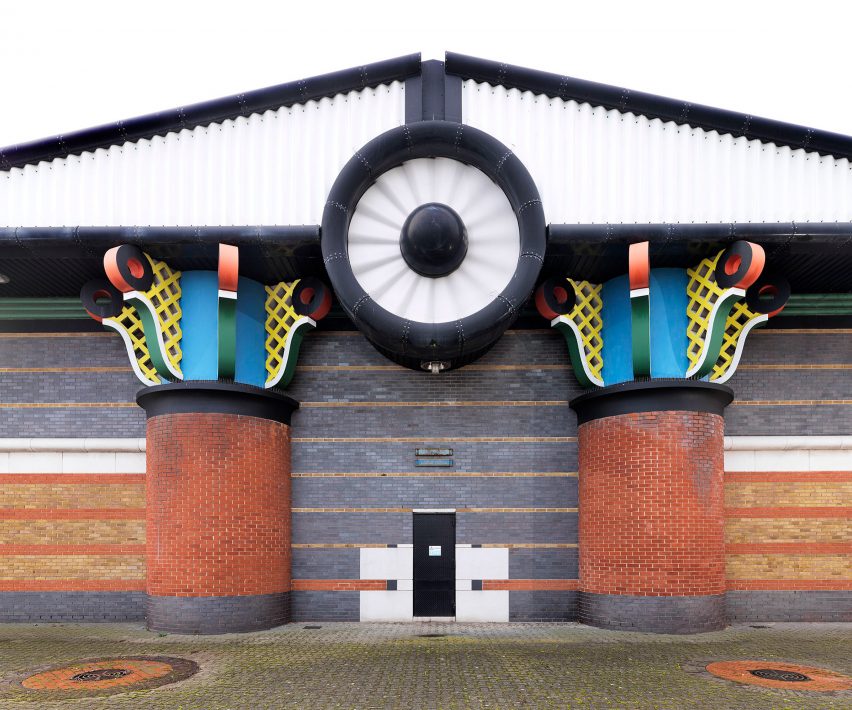
He did a pumping station in the Isle of Dogs that looks like this:
Those capitals are a bit much, really.

The pumping station is thought well enough of by certain of the powers that be that it has been listed. Not something that appeals to me, but some of Outram's other stuff is interesting. The Judge Business School in Cambridge, for instance.

https://en.wikipedia.org/wiki/Cambridge_Judge_Business_School#/media/File:Judge_Business_School_Cambridge.JPG

Or his design for 200 Queen Victoria Street. But for the best...


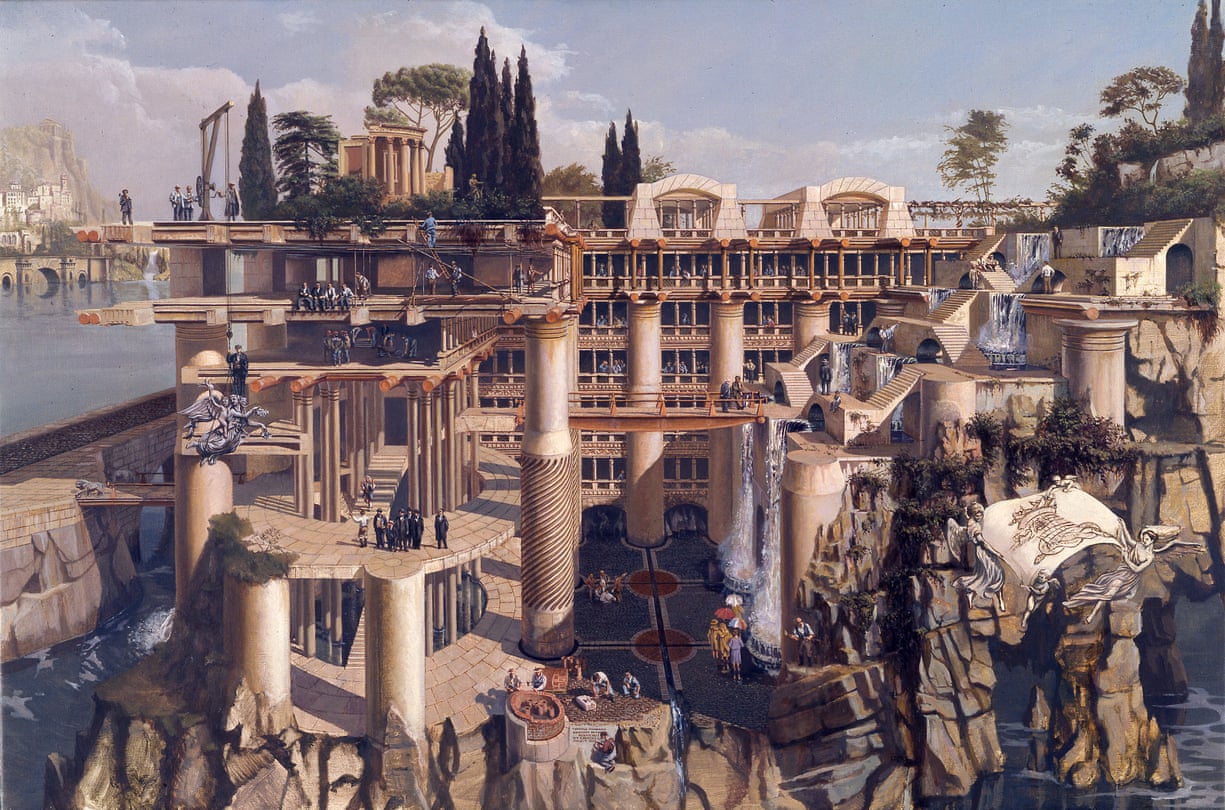
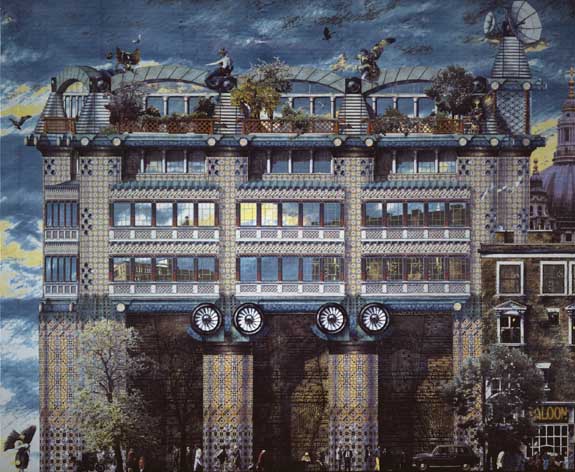
This painting, by Carl Laubin is an interpretation of Outram's design for a new building for the Financial Times:

Carl Laubin, Imago Terrarium, 1987. http://www.carllaubin.com/album/capricci.html#40

I should open it in a new tab to see it in the largest size possible.

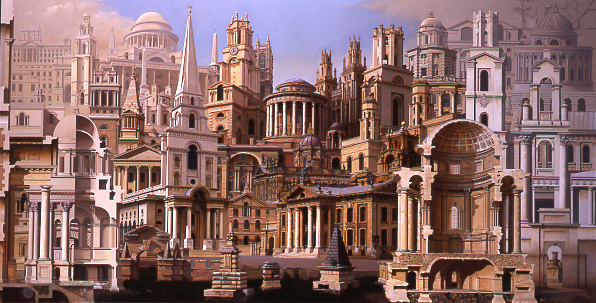
It is something, is it not? The Thames-flooded Middlesex around it, cypresses atop the ruins that serves as a cutaway diagram, the archeologists uncovering side by side with the builders raising it up. Laubin has done some other fun stuff, cramming architecture together like a Dark Souls map (not that I know a thing about that game).

Carl Laubin, Hawksmoor, 1996-2000, http://www.carllaubin.com/album/capricci.html#21
His website is here: http://www.carllaubin.com, if you want a look. Some of his plaza scenes are quite good.

I think both Outram and Laubin have a notion of a place in history for buildings, which I like. The obsession with ruins and the OSR has been noted, of course (there is even a comment about Sir John Soane as a patron and art of how the Bank of England will look, centuries from now when it is ruined....)

***

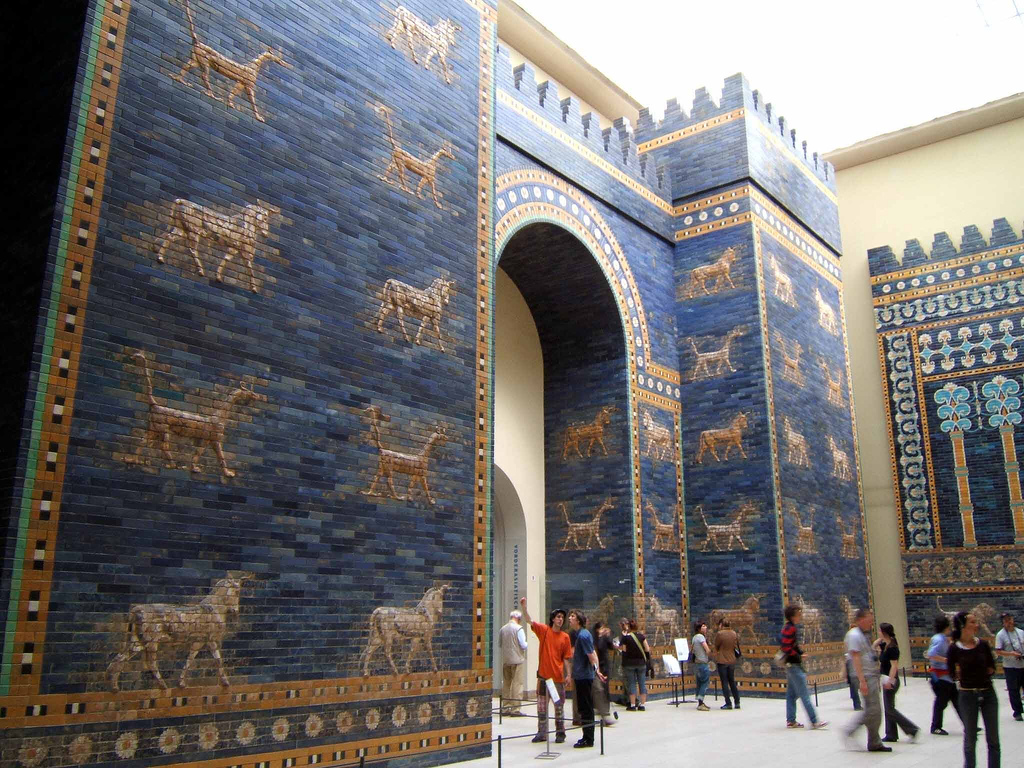
What use do I intend to make of this, however? Well, Outram's stuff all has a rather ancient Near/Middle East feel to it. Those aren't Grecian columns in the ruins above (he has even done some specifically Egyptian themed stuff).  The bright colours also rather point me towards Babylon: see the blue tile of the Ishtar Gate.

A reconstruction in Berlin. Doubtless the Punth equivalent depicts Qryth fang-lizards or Behemoth-bests
rather than oxen and dragons.
Now, my in-world Babylon is Punth. Which is fallen and ruined; first by the Tower of Babel equivalent, second by the decay of Qryth technological abilities.

So, a notion of Qryth architecture: when first made, the ziggurats, mansions, walls, &c. were all marvellously parti-coloured and bright - either because that was what the Qryth had, or just how their grand earthmovers and building machines dealt with strange materials. Now, however, the strange coloured panels are cracked, spalled and dusty. Later buildings imitate these in tile and brick (or tapestries, wall cloths or banners for interiors), but are never quite as vivid in tone as the Qryth originals.

This now is Punth: Orwellian four-armed green giants clutching half-functional ray-guns in dusty funhouse vastnesses and a brainwashed populous outside...