Showing posts with label Occasionally Frivolous. Show all posts

Sunday, 12 April 2026

Mortal Ingenuity: A Retrospective of Mortal Engines

It was a dark, blustery afternoon in spring, and the city of London was chasing a small mining town across the dried-out bed of the old North Sea.

These are the first lines of Mortal Engines, by Philip Reeve - published 2001, and I suspect that I read it for the first time fairly soon afterwards. Frequenters of this blog (being handsome, discerning and well-read) will twig the similarity to the opening lines of Nineteen Eighty-Four - and I suspect that they will recognise how this might hook a young reader, or even an old one. I was that young reader, of course. 

Indeed, I am now also that old reader. A month or so ago I noticed that the 2018 film of Mortal Engines was available in the free-with-advertisements section of YouTube (the box office results may say why). I put it on while about a few household chores, and half-watched the entire thing. I had avoided the film when it came out - and, having watched it, this was not an unreasonable step to take. But a bad version of a good thing can make one think of the good thing, and it sent me back to read the books. Indeed, it also disposed me to take a look at the assorted thoughts of the internet - which have been blighted by the film or didn't touch on some worthwhile aspect, and so on - so, in I dive to get my thoughts down. 

My scope is limited to the initial Mortal Engines Quartet, published 2001-2006: Mortal Engines, Predator's Gold, Infernal Devices and A Darkling Plain. Other books in the same universe, if in different eras, have been published, as have short stories and some collected timeline and 'lore' material. Some reference may be made to these (not that I've kept fully abreast of new entries in the series) and, where vaguely useful, to the film. 

Premise

I don't intend to summarise the books here. But a few details may well be useful.

There has been an apocalypse, the Sixty Minute War. This took place around 2100 between (what Mortal Engines characters call) the American Empire and Greater China. Civilisation, and much of the planet was smashed up - by things that appear to have left the atomic bomb in the dust. North America is 'the dead continent'. As above, the North Sea is mostly gone. New mountain ranges cropped up. Many centuries later, civilisations have risen and fallen - as civilisations tend to. 

The great paradigm of the current age is that of the Traction City. Mankind either dwells on mobile cities - greater or smaller; see above London and the 'small mining town', Salthook - or in static settlements. Said static settlements band together in the Anti-Traction League, opposing the Traction Cities. Traction Cities (principally) move and (notably) will devour one another - as well as static settlements, so said League makes sense. (Traction Cities will harvest or gather natural resources, and trade, but after a millennium of the 'Traction Era' there is less possibility of the former outside the strongholds of the League). The practice of one Traction City consuming another has given rise to a school of thought, or even an ideology - 'Municipal Darwinism'.

The Mortal Engines quartet focuses on Tom Natsworthy (of London) and his journey with Hester Shaw out of London and into the wider world. Both characters are fifteen in Mortal Engines; Wikipedia labels the Quartet as 'young adult'. As nebulous as that phrase is, it's a useful-ish indicator of tone and approach - though we will see both grow to adulthood in a perilous and bustling world, full of moving cities, armies, airships, wastelands, pirates and the lost, fearful, technologies of the Ancients. 

Wikipedia will give you plot details if you want them, though frankly this post probably is most useful for someone who has read all four books. I'm not going to wallow in spoilers, but I shan't dodge them either. Anyway, be warned.


David Frankland did the original covers, which I still think quite the best.  There's a clear sense of the grimy and the mechanical, coupled with those limited colour backgrounds, that suggest something like a 1920s travel poster and the associated sense of adventure. 

In no particular order, then - 

Names

Reeve's characters have three sorts of names.

Cool: names right out of pulp adventure*. Thaddeus Valentine. Anna Fang. General Naga. Magnus Crome. Wolf von Kobold. Dr Zero.

Pompous: likely British, at least faintly and probably overtly posh. Herbert Melliphant, Chudleigh Pomeroy, Cynthia Twite, Thomas Natsworthy, Freya Rasmussen, Clytie Potts, Nimrod Pennyroyal, Dr Popjoy.

Gimmicky: displaced old-world phrases, faintly comic. Chrysler Peavey, Stilton Kael, Nintendo Tharp, Napster Varley, Saab Peabody.

Actually, this is quite a good indication of overall tone. If you can tolerate - or actively enjoy - the sort of sensibilities that these three sorts of names suggest, then you might enjoy Mortal Engines. The 'Gimmick' aspect and vein of comedy is more present in books beyond the quartet, where it can wear out its welcome a little. 

Whimsy and Humour

But such things are a balancing act. The presence of 'Tunbridge Wheels' as a mobile city is a sensical pun (and demands a Sensible Chuckle?); likewise the Arctic predator suburb of Wolverinehampton. Reeve has written what I take to be more overtly comic works for a younger audience than Mortal Engines, but can dial it back sufficiently. (A newspaper called The Wantage Weekly Waffle only has one mention, happily; this is distractingly comic - one says, risking the fate of the po-faced - and more to the point, not quite comic in the way the scene demands.)

You will sometimes see this sort of thing referred to as whimsy - and, indeed, there is a whimsical element in the notion of a moving city (still less one that retains some of its static characteristics: don't ask how they tend the vines in Bordeaux-Mobile, or what the terroir is like). Reeve is also an illustrator, and some of his renditions of traction cities make them seem rather charming. 

Not all his humour is quite so direct, of course. A firm of publishers is named Fewmet and Spraint; as those who recall The Once and Future King will know, this is a quiet indication as to the quality of some of what they publish. 

Consequences

Alongside such things is a real sense of weight to violence. Men may die quickly, but this is never exactly cathartic - especially not for our protagonists. Accident may kill as readily as intention, and it will absolutely kill your allies and would-be collaborators. Deep wounds, even if non-fatal, have later effects - very real disfigurement or long-term health conditions.

It goes a little further than that, mind you. Hurt feelings stay hurt, emotions flare high - deeds done in haste reverberate to dreadful effect. Which sounds like just what you should expect from a novel, but I suspect shouldn't be counted on in every book of the same kind as Mortal Engines.

While we're thinking of bodies, I note that there's a fair amount of urination and defecation in these. Which contributes to that sense of what bodies are and do. I wonder what age Reeve's children were when he was writing these? 

More to the point, this allows for some powerful blows when the time comes: the last paragraph of Mortal Engines has some fairly touching unsentimental sentiments, if you'll pardon the oxymoron.

Britishisms

Philip Reeve is British. He did not have an international audience in mind when he wrote Mortal Engines - indeed, that the United States is a wasteland may not have done much for his sales. I've noted some of the names above for their British characteristics: that London is front and centre in the first (emblematic) book is also important. 

Of course, London isn't Britain, nor is the traction city of London an inheritor of Britain (but it was in an earlier version of Mortal Engines). Britain is gone: some place names and other markers remain - but that there is a portion of London called Crouch End doesn't count for much.
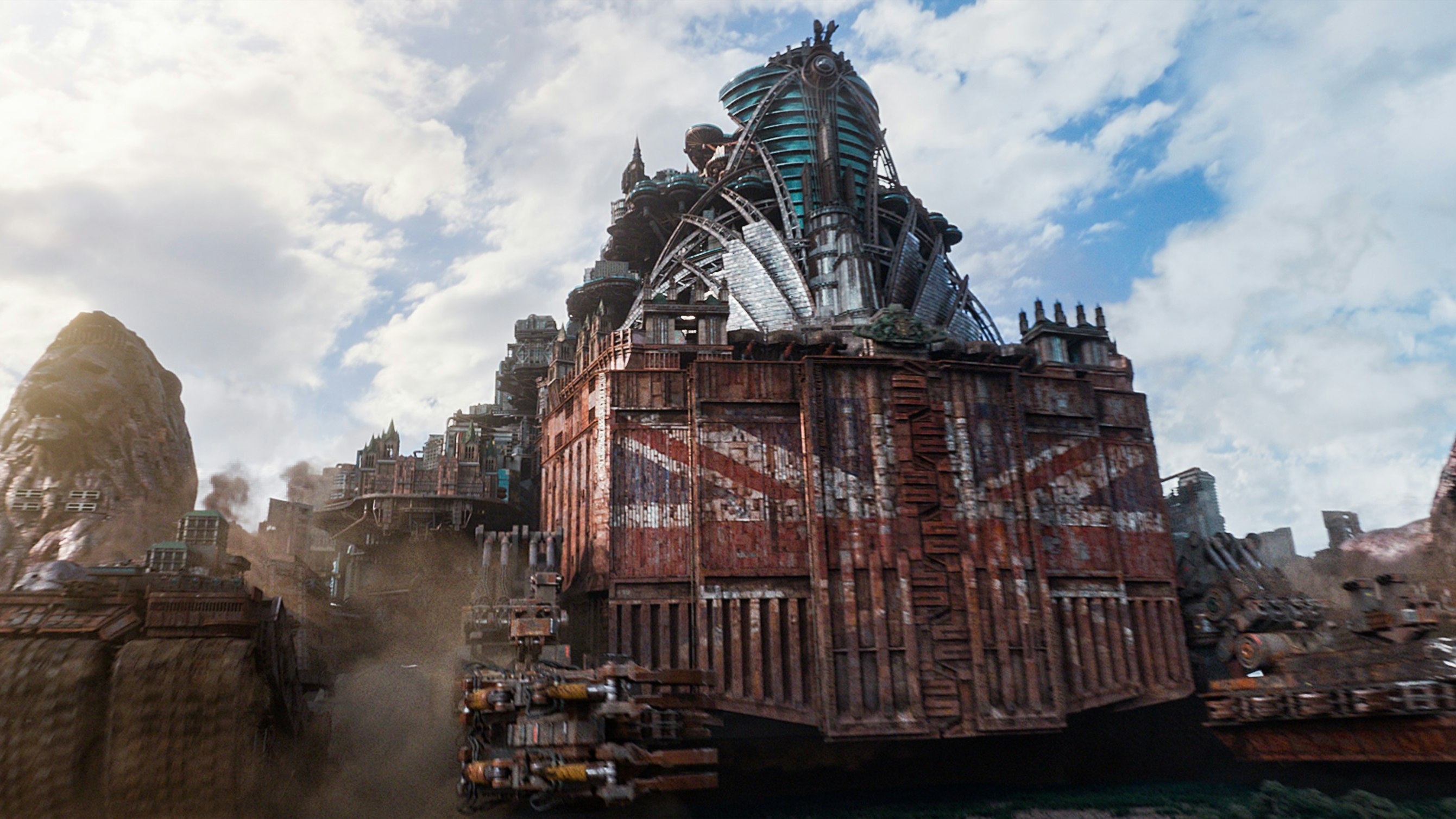
This is something that the 2018 film - with its Union Flag bedecked-maw and Trafalgar Square lions -  didn't take on board.

London's military elite are Beefeaters, not the Brigade of Guards or the SAS or the Gordon Highlanders or Cromwell's Ironsides. It is governed by a Mayor and a guild elite, not the King-in-Parliament. The focal point, the identifying feature of an exterior which is otherwise as vast and complex as Breughel's Tower of Babel is St Paul's Cathedral, not St James's Palace or Westminster Abbey or Tower Bridge (the film couldn't help itself, and included the Palace of Westminster; the guildhall even faintly resembles the former Greater London City Hall). A piece of concept art by Ian McQue shows even more - the Shard and the BT Tower and Battersea Power Station, in an artistic fantasia reminiscent of one of Laubin's capricci

I would argue this misses the point of St Paul's Cathedral. There's something eerie about the fact that it has survived when so much else has not (the London Museum of Mortal Engines is clearly akin to the British Museum and the Natural History Museum, but is in fact neither). When you learnt something of the Polytheism much of the world practices in the Traction Era, it becomes even stranger that this Christian temple survives intact. That it is finally the vessel containing the ancient and terrible superweapon MEDUSA bears this out. 

The David Frankland cover again. Think on how St Paul's is just discernible, think how it offers a sense of scale. Think also of the red, livid sky.

Airfix Characteristics

A world-building trick of Reeve's is to refer to makes and models of machinery in universe. Airships are Goshawk 90s or Murasaki Fox Spirits (and this will extend to parts: Jeunet-Carot aëro-engines, an envelope of Silicon-Silk from Shaun Guo....). A small revolver is a .38 Schadenfreude. Something like Jane's Fighting Ships for the Traction Era appears. Granted, significant parts of A Darkling Plain are set on the frontlines, but the business of bunkers and half-tracks and rocket troops conjure the same notion. That Germanic traction cities are frequently named 'Panzerstadt' may contribute to this.

If we are addressing this as a sensibility outside of genre features and expectations, I think the term 'Airfix Characteristics' is good, as in X with Airfix Characteristics. Science fiction with Airfix characteristics; Firefly has them, Star Trek doesn't.**

Extend as necessary, or as amuses: Steampunk with Airfix Characteristics. Bedroom Farce with Airfix Characteristics. Ostern with Airfix Characteristics. Southern Ontario Gothic with Airfix Characteristics.  

Airship (and flying machine) names, incidentally, fall into something like the pulp/pompous/gimmick division above. The 13th Floor Elevator. The Jenny Haniver. The Itsy Bitsy Teeny Weeny Yellow Polka-Dot Machiny. Group Captain Mandrake. The Shadow Aspect. The ArchaeopteryxDie Leiden des Jungen Werther. The Plum Blossom Spring. The Combat Wombat. The Requiem Vortex.

References and Nerdery

As the above may suggest, Reeve enjoys shoving a reference or two into Mortal Engines - frequently something at least faintly nerdy. The very name derives from Othello: Act III, Scene III. A certain amount of this is the product of inspiration. Star Wars and Lord of the Rings had their influence on Reeve - the former quite unsurprising, given that Mortal Engines has a climax with a super-weapon encroaching on a previously unassailable redoubt.*** Other influences exist. 

That a range of mountains is known as the Tannhäuser Mountains might well owe something to Blade Runner (could there be a narrow pass in those mountains, do you think? A defile, a passage, a gate?). Spear-carriers of fighter pilots are known as Ginger and Algy. That a German traction city is called Moloch-Maschinenstadt presumably indicates that it is an unpleasant place even by the standards of traction cities (unless things are unusually clean?). 

Historical periods are also addressed in a familiar and adroit way: the Blue Metal culture, the Raffia Hat Culture.

The Chapter names are rather telling in this regard: The Cabinet of Dr Popjoy, the Land of Mists, Brighton Rocks, The Childermass Experiment, The Sleeper Wakes.

Incidentally, Mortal Engines predates a general consciousness of Steampunk being its own thing. It fits into the aesthetic nicely, but it doesn't get bogged down in genre trappings.

***

There's a line in Predator's Gold that ties a lot of the above together. 

The sky was the colour of packet custard, streaked with rhubarb cloud.

  • It's whimsical: the sky as humdrum domestic dessert.
  • It's actually not a bad description for a certain sort of dawn, with pinkish clouds and soft yellowish light. Rhubarb, if not processed into pap, is in fact streaky.
  • It's quite possibly a reference to Neuromancer: 'The sky above the port was the colour of television, tuned to a dead channel.'
  • Rhubarb and custard is a British boiled sweet - and as a combination, would not be unlikely to be served as a dessert. 'Packet custard' presumably refers to Bird's Instant, or something quite like it.
Anyway, I liked this line. Though one wonders how any of the characters know what custard is in this world, like Winston Smith and rice spirit (thank you, Anthony Burgess).

***

Polytheism

As above, the Traction Era is Polytheistic. Clio, Muse of History is frequently called on by the Guild of Historians (there is a reference to her being 'blown backwards by progress into the future', which sounds unintentionally Buckleyesque). Ice Gods and Wind Gods are mentioned. Quirke was the Mayor who turned London into a Traction City, who has been deified. Statues and shrines dot cities and sit in airships. 

There's an extent to which this pushes Mortal Engines into a grand, varied, Faufreluchean setting, like the forehead tattoos of London guildsmen. It's also something that indicates that Reeve can 'do religion' in a way that George Lucas (for instance) doesn't. St Paul's Cathedral aside, Christianity has survived the Sixty Minutes War, even with Bishops and T.S. Eliot (though neither show up on London). The monotheist elements - 'I believe in one God, the Father, the Almighty...' - are seemingly unknown to unbelievers. Strangely, no other Abrahamic faith seems to have lasted, nor have Eastern Axial Age faiths like Jainism or Buddhism. There's monks and prayer flags in the Himalayas, but that's not necessarily the same thing.

Metafiction

There's bunch of metafictional elements that come into Mortal Engines. That several principal characters are historians - narrative-crafters, from a certain point of view - helps, of course. The history of the world is discussed, and later characters even go on to write up the events of the novels they are in (Predator's Gold is also the name of an in-universe sensational history). The final chapter of A Darkling Plain even involves that thing where a character begins telling the tale of the story they're in, beginning 'It was a dark, blustery afternoon in spring...'

Reputation (to be chased into the cannon - the mortal engine's - mouth) plays its own role in all this. In the course of the Quartet, reputations are made and lost, secrets are revealed. People tell stories about themselves.

Bildungsroman and Stalkers

Mortal Engines is about (among other things) youth. Tom Natsworthy and Hester Shaw come of age and begin making their own decisions. Happily, they don't have to spend an entire quartet doing this: there is a sixteen year time skip between Predator's Gold and Infernal Devices. But more to the point: these four books spend a fair amount of time thinking on how children are raised. Plenty of characters are the genre-standard orphans, but who they are raised by counts for a lot: the antiquarian Guild of Historians, an inhuman cyborg, a Fagin-like master of pickpockets, a dwindling population of loyal subjects. Further, have they been raised as a Tractionist or an Anti-Tractionist? This isn't just an ideological difference: in a rather town mouse and country mouse sense, traction city dwellers struggle when they have earth under their feet rather than a deckplate (those from static settlements don't seem to struggle in a comparable way - see Wren in Brighton in Infernal Devices).

Anyway, on top of all this are the Resurrected Men. Old Tech mechanical brains and devices are wired into corpses to bring them back into hideous life - principally to serve in combat. Given the lack of knowledge of Old Tech by the Mortal Engines period, this is an unreliable process - and not all Old Tech is created equal. So some Stalkers have half-memories of past lives, and the desire to learn more, and those who brought them back may wish them to have (or not have) those very memories. Stalkers, like children, must be raised: just ask Victor Frankenstein. 
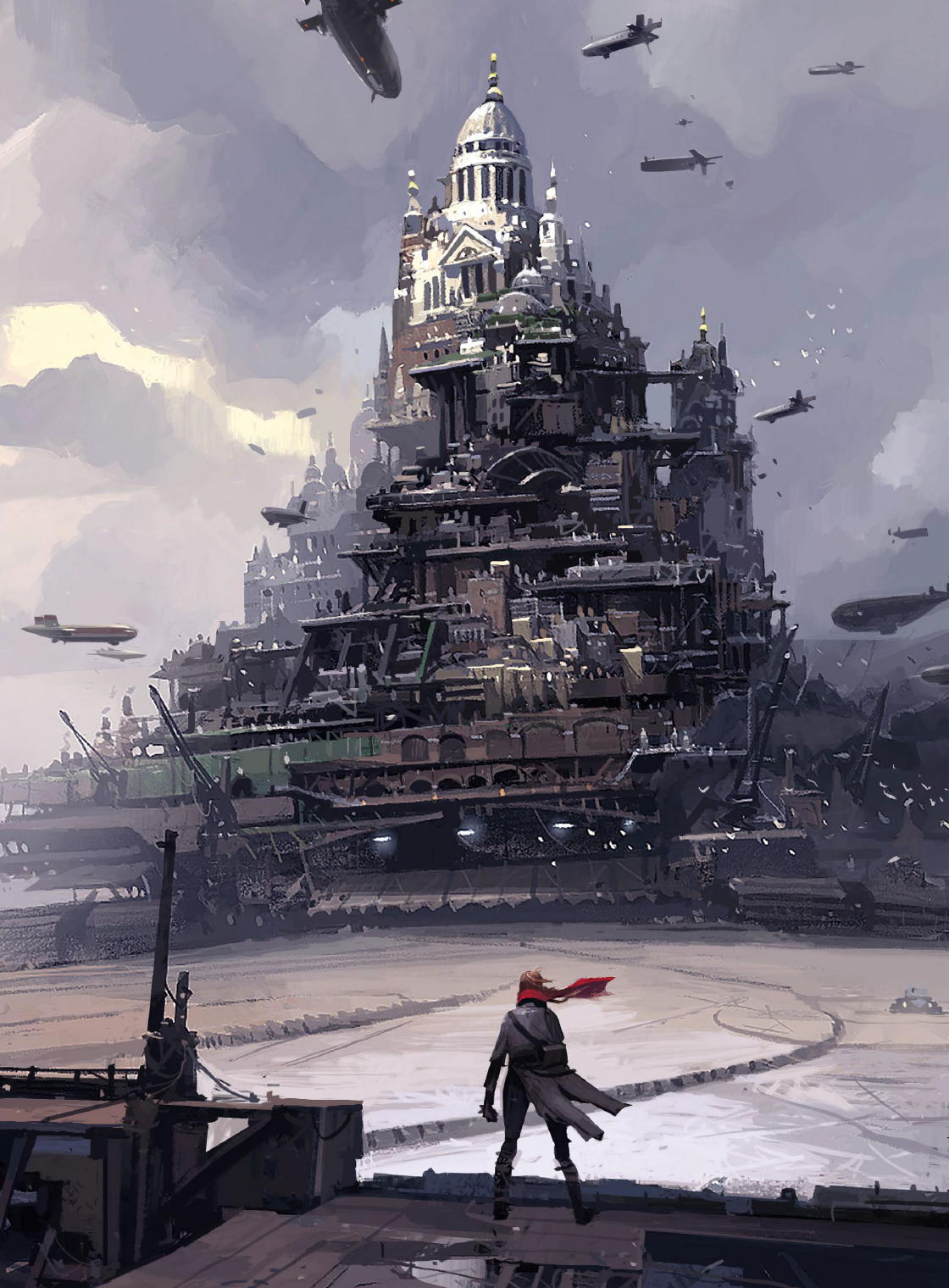
Ian McQue also did a cover for Mortal Engines. Not bad, despite the disproportionate St Paul's. It has some of the right spirit, even if it makes me think a little much of Disco Elysium.

Predators, Gold

There is an interpretation of Traction Cities and Municipal Darwinism, holding that the entire thing is really about capitalism, expansionism and exploitation. A specimen of this interpretation is here (though I think it a ramshackle piece). I am compelled to say that this isn't altogether wrong. The text makes it clear that Tractions Cities can be pretty unpleasant places to live, and Reeve knew what he was doing when he named the goddess of 'Unfettered Municipal Darwinism' as Thatcher - who is given a faintly Hindu aspect in her depictions: multi-limbed, dancing, all-devouring, as Shiva Nataraja.

Fine, it's not wrong, but it misses a few things, especially when stated baldly. Reeve has stated that part of the inspiration for Municipal Darwinism comes from the growth of Brighton into a conurbation - which (whether welcome or not) is far less malevolent than anything out of a Traction City. Also, Reeve, as Tolkien, dislikes allegory - and has stated that it's not a heartfelt metaphor for Capitalism.

That aside, I think that it's also informative to consider Mortal Engines in the light of the Cold War; indeed, especially from the point of view of a young, fairly liberal British man in the last decades of the Cold War.

[It feels a little odd making this slightly cavalier reading of biography and background, and I hope that Philip Reeve will pardon me if he reads this; I did meet him once, years ago - he signed my books and was really quite kind and charming.]

So: The world is imperilled by dreadful weapons [MEDUSA, ODIN], invented by those long dead (Oppenheimer dies in 1967, wunderwaffen maker von Braun dies in 1977; see also Richard Rhodes here again) for another country [The Ancients] and a cause not your own [The Sixty Minute War]. You [Tom Natsworthy] find yourself aligned (by birth as much as anything else) with those [the leadership of London] pointing those weapons at a foe with a very different way of life [the Anti-Traction League]. Learning more about that foe, it emerges that they're (reasonably) terrified of annihilation; it should not surprise you that they take steps against it [Anna Fang] - and even if you don't approve of it, that they should produce an extreme reaction to the threat [the Green Storm]. Naturally, you become quite disillusioned with childhood heroes [Thaddeus Valentine], though there's no guarantee you'll join with your old foe [Tom and Hester take to the Bird Roads].

[EDIT: Cf. this remark on '80s Britain.]

This is the sort of perspective that forgets or erases the Gulags and the cellars of the Lubyanka and Khrushchev burying the west, but it's not one that I find utterly unsympathetic - or utterly disconnected from reality. But the geopolitical-historical interpretation fits the outlines of Mortal Engines better than the blunt Municipal-Darwinism-bad expression.

The Anti-Traction League, it must be said, is not the Soviet Union or Warsaw Pact, and the Shield Wall of Batmunkh Gompa is defending against a threat in a way that the Berlin Wall wasn't. Russian traction cities (Arkangel, Traktiongrad, Gorky, Novaya-Nizhni, Smolensk, Omsk†) exist. The League seems to draw as much or more on the Third World as the Second World: there are no parades in Red Square or Five-Year Plans or Khrushchevka apartment blocks or Stakhanovite efforts in the factories (though that Northern Fleet of airships and the fuel and ammunition and spare parts for same had to come from somewhere...‡ ). One gets a more Maoist impression from the Green Storm and their cult of personality. Reeve is, happily, unwilling to make this monolithic: the mountainous strongholds of the Anti-Traction League might be in East Asia, the Indian Subcontinent and East Africa but Traction Cities include Zanzibar, Bamako, Perfume Harbour and Juggernautapur. 

Before anyone gets too keen about raising the left-wing banner over Mortal Engines, I would note that Reeve does not strike me as at all partisan or a zealot, and unwilling to engage very publicly with politics. Moreover, the sympathetic portrayal and actions of the Guild of Historians in Mortal Engines suggest a sort of small-c conservative position against progress and expansion: couple this with the non-Green Storm League elements and perhaps one arrives at some sort of 'Ealing Studios' Social Democracy; something which wouldn't much please Ayn Rand, Michael Foot or Robespierre. Indeed, the dreams of Magnus Crome and the Guild of Engineers that transcend the limitations of Municipal Darwinism as we know it (Mortal Engines, Ch. 34) remind one of nothing so much as the visions of progress by H.G Wells, a devoted socialist. 

Municipal Darwinism and Tractionism never gets an articulate spokesman, mind you - only prejudices and Tom Natsworthy at his most callow (unless there's one hiding in the very recent Thunder City or Bridge of Storms). Where is the Adam Smith of Municipal Darwinism? After a millennium there must have been one! Anti-Tractionism fits the reader's default position, and the text has to work less hard. ††

We may also consider the image of Tractionism as aping the sacrifices and trade-offs of the industrial revolution; something heightened by the nickname 'mossies' for the static settlements and the Green Storm, who openly vow 'death to cities'. It would make a certain amount of sense to me if a wider range of goods were available in traction cities, if medical technology were more advanced, if a greater range of culture was available. While no polity in Mortal Engines appears to be a liberal democracy as we may think of them, the concentration of population in a traction city might well mean that there is a greater chance of mass political engagement. None of this means life is necessarily any better: you could end up in back-breaking labour somewhere vile in a traction city due to central planning or competitive examination or one city consuming another - but you are far less likely to end up doing  back-breaking labour somewhere vile due to being of the wrong faith or caste. Slavery is not seen in the Anti-Traction League, though given how accepted it is elsewhere, it would be strange for it not to be present in one of the many members of the League (again, that air-fleet came from somewhere). 

It's worth noting, finally, that Philip Reeve appears to quite like Traction Cities. Certainly more than Swift did Laputa or Orwell did Manor Farm. An exception to the rule of Municipal Darwinism appears early in Mortal Engines in the form of Airhaven; the cooperation of the Traktionstadtsgesellschaft and the resort city of Brighton muddy the waters later. The conclusion of A Darkling Plain, with the birth of an ecologically friendly New London, complicates things further - as does the future state sketched in the final chapter. 

Traction Cities have been noted from the first have developed from nomadism - and the nomadism of those clans or the airship-travelling protagonists is treated quite sympathetically. Is this enough to to make them more than Infernal Devices (Predators seeking Gold on Darkling Plains)? Are they more than Mortal (threatening, fearful, deathly) Engines doomed to mortality? 

Frankly, the best way for you to decide is to read them. They were worth reading twenty-five years ago, they're worth reading today.


Previous Mortal Engines-related content here.

* "Catholics don't light candles any more, Brick."
"I do, sir. I'm Irish and my mother - "
"For Pete's sake! Bronson's not an Irish name."
"What kind is it, sir?"
"It's a pulp name. Now get going."
           'The Last Thrilling Wonder Story', Gene Wolfe 

** Compare remarks on las-pistols here.

***Reeve has a blogpost (5th May 2015) on seeing the first Star Wars in his youth, the interest he had in Ralph McQuarrie and how Star Wars 'was so popular that it even put an end to World War 2. Before Star Wars, schoolboys played Brits vs Germans in the playground, watched Colditz and Where Eagles Dare, and made model kits of Spitfires and Messerschmidt 109s.  After it, we played rebels vs stormtroopers and watched Blake's Seven and Battlestar Galactica.' It's quite good as a reminisce and I'm irritated that I can now only get hold of it through this blog viewer

† Incidentally, Anchorage, with its palaces, fur coats, glasses of tea and aristocracy certainly reads as more Russian than Alaskan. Maybe that just comes with Tractionist culture up on the ice.

‡ I can conceive a spirit-of-the-text answer where League arms works are mostly kept in moth-balls in peacetime, with the volunteer machinists keeping them in order outside of seasonal re-supply use or until the threat of a Traction City draws near.

†† It would be interesting to sketch out how an idealised peaceful consumption of one city by another would look as expressed by such a thinker. The gods of one Traction City brought into the fanes and temples of another, the merging of institutions (with senior and junior partners), the language barriers, the demographic transformation.


Monday, 21 October 2024

To the Moon, Like All Lost Things

I've been reading Orlando Furioso, the epic poem of Ludovico Ariosto.  

Lacking or ignoring the many heroic poems of the early Middles Ages, from the Song of Roland to the Germanic and Icelandic sagas, the chief Renaissance epics were a peculiar blend, created by four Italian poets: Boiardo, Pulci, Ariosto and Tasso. The first two begin to the 15C, the other pair to the 16th. Once as familiar throughout the West as Shakespeare and Goethe are now, those four names and their glory survive only in their country of origin. When the gondoliers of Venice sing for the tourist, it may be bits of Tasso's epic. As late as the beginning of the 19C, Ariosto and Tasso were read, quoted and enjoyed by educated Europeans. At the same time, Dante's Divine Comedy, also an epic adventure and now one of the "great books" was looked down on as Gothic, a piece of medieval obscurantism. What is the "more human" subject of the other four Italian epics? ... Instead of the old epic's warriorlike sober sadness, the provide for the sophisticated Humanists and courtiers the excitement of love-making and of what has been called the "The Marvellous", the miraculous, performed by black or white magic.

From From Dawn to Decadence, Jacques Barzun, 2000.

Alas, I've next to no Italian. I'm reading the translation by Guido Waldman - prose rather than the original verse, first published 1974 by Oxford University Press. 

Anyway, let's look at Canto 34. Orlando - Roland - is mad (furious, even). His English cousin Astolfo goes on a journey to recover his lost wits. He enters one of the chambers of Hell, then ends up in the Earthly Paradise with St John the Evangelist. The Saint then takes him to the Moon in Elijah's flaming chariot to recover the lost wits of Roland.

The chariot passes through a barrier of flame, that covers the earth (Cf. The Discarded Image). They ascend to the moon - which is as big as the earth, and in appearance like untarnished steel. It is apparently inhabited: castles and nymphs are mentioned. 

Then, as Waldman has it: He was led by the Holy Apostle into a valley shut in between two hills, where everything that is lost on earth (be that the fault of time or fate) fetches up miraculously. What is lost here collects up there. I do not mean only dominion and wealth, subject to the vagaries of fickle Fortune.....

Let's skip forward to compare a Canto, quickly:

75

Le lachryme e i ſoſpiri de gli amanti

inutil tempo che ſi perde a giuoco,

E l’otio lungo d’ huomini ignoranti

Vani diſegni che non han mai loco,

I vani deſideri ſono tanti

Che la piú parte ingombran di ql loco,

Ciò che in ſomma qua giú perderti mai

La ſu ſalendo ritrouar potrai.

  LXXV

 The lover's tears and sighs; what time in pleasure

And play we here unprofitably spend;

To this, of ignorant men the eternal leisure,

And vain designs, aye frustrate of their end.

Empty desires so far exceed all measure,

They o'er that valley's better part extend.

There wilt thou find, if thou wilt thither post,

 Whatever thou on earth beneath hast lost.

From the original.

From the William Rose translation.

Waldman: The tears and sighs of lovers, the useless time lost in gaming, the chronic idleness of ignorant men, the empty plans which know no rest, the vain desires are in such numbers that they  clutter almost the whole place. In short, no matter what you ever lost ere you would find if you went up there.

But we soon find some solid objects:

[Astolfo] noticing a lofty pile of tumid bladders from which seemed to emanate a hubbub of cries, he was told that these were the ancient crowns of Assyrians and of Lydia, of the Persians and Greeks - once so illustrious, now forgotten almost to their very names.

There's quite a few of these, so I'll add them in bullet point form - again, all Waldman.

  • 'gold and silver hooks...gifts made in hope of reward to kings, to greedy princes, to patrons'
  • 'garlands he saw which concealed a noose: all flattery....'
  • 'Verses written in praise of patrons wore the guise of exploded crickets'
  • 'gilded bonds, jewel-studded shackles' which are 'Love affairs pursued to little purpose'
  • 'eagles' talons....the authority which lords vest in their servants'
  • 'bellows littering the hillside....the praise given by princes and the favours conferred on their favourites'
  • 'Cities and castles and treasures....in a confused jumble of ruins. They were treaties, he was told, and ill-concealed plots.'
  • 'snakes with maidens' faces: the work of coiners and thieves'
  • 'broken phials: service as wretched courtiers'
  • 'A great mess of pottage....is the charity left by a person after his death'
  • 'a great mound of sundry flowers once sweet-smelling but now reeking....was the Donation of Constantine to good Sylvester'
  • 'quantities of bird-lime for ensnaring; your charms, good ladies'
  • 'Folly, however, whatever it's degree, is missing from there: it stays down here and never leaves us.'

Orlando's wits are eventually found. 'Wits' take the form of 'a soft, tenuous liquid, apt to vaporise if not kept tightly sealed'. They come in different size phials - and, of course, men lose them for many reasons: in loving, in search of honours, in search of wealth, in trusting princes, in magical baubles, in jewels or paintings. 'Here the wits of sophists, astrologers and poets abound.' 

***

Now, it would hardly be objectionable if you read this post and promptly went out to read Orlando Furioso. However, here's another use for it all.

Let us imagine that Ariosto's moon has some sort of magical realm. It has to be bigger than a vale between two hills - say a great spreading plain between mountain ranges. 

We have hazards to overcome: a wilderness with talons ready to scratch, oddly enticing bird-lime,  and the overpowering odour of rotting flowers. 

We have animal and human threats: serpents with the faces of beautiful young ladies, rival adventurers (who, having lost all folly) are dangerously clearsighted about the possibilities of applied force.

We have valuable magical artefacts: Bellows that can puff Charm Person, Golden shackles that men will willing don themselves. To say nothing of the prestige of an ancient crown or the eternally rare Wits of Men.

We have resources to compete over: pottage-lakes and sheltering ruins.

We have intersecting functions of powerful devices: crowns that can command talons, hooks that can pull down crowns, talons that can claw and maim hook-wielders.  

Anyway, a hexcrawl (say) journeying through all that could prove interesting. Like a more lively version of the Wilderness of Taroc.

Tuesday, 12 March 2024

Conquistadors of Tartarus

There was a great wind, and darkness on the face of the sea. Then the proud ships vanished.

In 1571, the Holy League was fighting the Ottoman Empire. Their ships met in the Gulf of Patras, atop the Peloponnese. Spaniards, Savoyards, Venetians and Tuscans all fought the forces of Selim II from an assortment of ships. 

And then they didn't. They disappeared, on the cusp of victory. A great enchantment fell upon them, and  they were sent below.

Rumours abound: some say the spell was cast by a Turkish wizard. Others, that it was a disaffected Christian, a Transylvanian woman with a fixed grin. Some set the blame on a wizened Egyptian. One piece of esoteric gossip places the blame on a blank-faced boy North-East of Babylon. One utterly discredited suggestion suggests the culprit was a disgraced German academic. 

What happened to them? Where did that battling knot of warring ships end up?

They went below.

Tantalus, by Hendrick Goltzius

The ships fell. And then they slipped into the Styx. Thousands of confused, bloodthirsty knights and marines and sailors thrust into Hades. They found there sulphur and charcoal, and lead from fetters - and so there was gunpowder and shot. And there were allies among the Shades of the Dead, and the heroes of legend: Alexander and Pompey and Agamemnon.  

Ixion, by Hendrick Goltzius


So there are fiefdoms in the underworld, and rivalries - at first good natured, but developing swiftly. And there is struggle, against giants or beasts or furies or demons. 

Some of the Holy Alliance, driven by Renaissance ideals of the Classical World have banded together with the 'Virtuous Pagans' to create a New Rome. Yes, another one. 

Those Turks that were taken down into the Underworld have formed their own enclaves, and follow the old patterns of trade and conflict with the Christians. 

Set against both are the hardliners and restorationists, dedicated to crawling out of the shadowy pit they find themselves in. 

They all find themselves, it must be said,  in a world where Cervantes is allying with the Giants to destroy dark Satanic mills.....

From Matteo Perez D'Aleccio's Engravings of the Siege of Malta.

SO, WHAT IS THIS?

Conquistadors in the Classical Underworld of the Renaissance. Mannerist in style, muscular and elaborate. Ghost-fighting Spanish tercios supported by centaur squadrons and led by Julius Caesar. 

Captain of Infantry, Hendrick Goltzius (Netherlandish, Mühlbracht 1558–1617 Haarlem), Engraving
This guy's probably there. He got that sash for cutting one of Cerberus's Heads off. 

Alchemy and diabolism. Penitent brotherhoods in conical fire-proof robes. Jesuits arguing with the shade of Heraclitus. Achilles getting into arm-wrestling contests with landsknechts. Stray Protestants keeping very quiet. 

undefined
Imagine these guys lobbing rocks at descending Furies. 

Inspirational Media:

Dante's Inferno.

I guess some of the guys from The Faerie Queene are there. 

16th Century depictions of Classical Antiquity. 


[This post written after trying to figure out where the River Acheron was said to emerge on the west coastline of Greece, and a hazy memory of Lepanto being in the area.]

Tuesday, 12 December 2023

How to Read the False Machine

TO REVEAL AN ANSWER: The piece of writing at the end of the last post was derived, basically, from some fairly negative and somewhat fantastical feelings about the experience of reading the Horus Heresy books. With a little element of the King in Yellow mixed in.

Roboute Guilliman: You, brother, should remove your armour.

Horus: Indeed?

Rogal Dorn: Indeed, it is time. We have all set aside our pauldrons except you.

Horus: I wear no pauldrons.

Roboute: [aside, to Rogal] No pauldrons? No pauldrons!

And on that revelation, trailing corposant, I move to another lurid book.


CONTEXT: P J Stuart, author of the blog False Machine, a version of Sir Gawain and the Green Knight  and several interesting RPG products ran a Kickstarter to take a majority of that blog material and preserve it in a weighty tome. Behold, the above. It is as larger as many editions of the Complete Works of Shakespeare, if a little lighter. (Quite a pleasing weight, really.) The cover is a distinct orange, with letters that seem to shift as you read them. That might just be a faulty bedside lamp, or fatigue on the part of Yr. Hmbl. Crrspndt., but I wouldn't put it past Patrick to have hexed it somehow. Illustrations from several artists, often former collaborators with PJS. Fascinating set of marbled end papers by Scrap Princess.

....but I don't need this. I've read a bunch of the original posts, even commented on them. (Some comments are reproduced in the text of the book above. It's remotely possibly I'm there, I haven't checked thoroughly yet. Full Disclosure, &c, &c.)

Anyway, if a charming visitor to my snug garret were to ask over a glass of Oloroso 'My dear, what is that fascinating book on your shelves?', how would I answer them?

[QUICK NOTE: the Blog is False Machine. The Book is Speak, False Machine, whatever it says on the cover. Occasionally, I'm going to need to compare the two so they need different names.]

MOVING ON: On one level, everything in False Machine is either an RPG product or fuel for RPGs. Patrick Stuart is a man who will read and review works of fantasy - EG, Gormenghast or The Worm Ouroborous, or histories of the sort of period that have inspired fantasy fiction, as A Distant Mirror  - as readily as a work on the Psychoanalysis of Fire. This isn't to posit this work as merely fuel for the capital-P Product, but it is to indicate that there is a final aim in place for much of the work in here, a set of objectives. 

Now, most of the stuff that went into the actual books isn't in Speak, False Machine. The posts for Veins of the Earth became Veins of the Earth. Good thing too. But this references character and action on the part of the author. So, a newcomer should think on that.

The various articles have been changed slightly. Spelling mistakes and ungainly turns of phrase have not been corrected, we are assured. But other things have changed. Some comments are included, many are not. Illustrations that offer context have gone. See for instance the post called on False Machine 'Five.. Four... Three.. Two... ONE!' It must be shorn of the referential images that indicate the origins of the work without interrupting the flow of the fiction, or the end table that lays out the similarities in several works. It must rely on the title alone, which may be reference enough

Of course, one understands why such images are not included, but something may be lost. To refer back to my own work at the top of the page - how clear was that little mystery?

The material is not only presented in a reduced form, it is also framed differently. Blog posts that may have been weeks or months apart can now be put side by side, and there is benefit in this. Now we can read all about the Horus Heresy back to back (Hoorah?).

Back to back, and also in two columns. This sounds silly to make into a point in a new paragraph, but if you're used to a post being in one column, with a predictable set of links and gadgets at the side, it is a little strange to see it in two columns, and have the experience of your eye wandering across.

TO CONTINUE: It is very online. Sometimes that phrase is used as an insult: in this case, it is basically descriptive. False Machine was and is a web-log. It should not surprise a reader that Speak, False Machine bears the hallmarks of the internet.

There's a freedom of tone. Speak, False Machine has a good number of reviews. There is also a great deal of flippancy, plenty of cursing and a pool of references deriving from online cultures (hence a section titled 'Weebery'.) As good as these reviews may be, they would not appear in this way in the pages of a high-brow weekly. Certainly not at this length: word limits online are a very different thing to those in print. Quotes can be longer, explorations more discursive.

Thus, the rough set of points or ideas expressed by the (hilarious) 'WWII - Written and Directed by JJ Abrams' could be expressed by the sort of less strait-laced weekly magazine, but would probably not take that form or be expressed to that degree and so would be X degrees of magnitude less memorable. Now, do I prefer the rough-hewn original of that post on False Machine, or the smoother-formatted version in Speak, False Machine? The former has my fondness as the original, but the latter is superior. The evenness of the columns and text allow the wit to shine that much more.

To speak also on something I have kept at arm's length - there is also a portion of interpersonal drama. False Machine allowed for others to comment on it: it is a social medium of a kind. Further, Patrick Stuart has and has had long-term collaborators. It was honest and correct to include it - certainly, I might have been tempted to leave it out. 

So, a mix of material. Review, essay, fiction, comment, verse. Sometimes niche, sometimes universal, usually interesting. 

But is it any good?

Yes. Some of it was probably more interesting to live than to read about, but this is not a Curate's Egg. 

Is it a book you would have lying around your own house? Is it a book that you would even wish your wife or your servants to read?

Well, I have no wife, but should a paramour in the midst of a certain charming entanglement of limbs and digits start talking about the Dover Beach Expanded Universe - well, my heart's beating would doubtless reach a furious tempo.

Can you not give us any real criticisms?

I suppose it's a little odd to be holding a weighty tome full of stuff that has the internet aura of disposability, but to that's more an issue with context than content. In any case, this is less offensive in that regard than some books of Current Events I've seen reproducing an activists social media posts.

I see. Thank you, Mr, umm, ... -

Thursday, 28 September 2023

Lost By Translation

Before you venture into the Dreadful Dungeon, it would be wise to acquire a map, or some record of those dreadful tunnels. But the only scraps of information you can find on the subject have been translated - either from a form of the Common Tongue so old as to be unrecognisable, or from the writings of another culture.  

Such translations are rarely exact, of course.

  1. Distances As it turns out, the Dwarven Foot is a little shorter than the Human Foot. Who knew? This is probably fine in Five Foot corridors, but when assessing longer distances, the difference will add up.
  2. Similar, but not Identical Perhaps as a result of 'False Friends', or some other linguistic custom, the difference between varieties of Goblinoid are not well marked in the language this guide was written in. One cannot readily tell whether these tunnels are infested with Goblins or Orcs.
  3. Genre The translator of this text describes a frieze depicting 'A Curious Static Dance, with Masks'. He appears to have no notion of stage drama.
  4. Zealotry The translator of this text renders 'Highly Potent Idols of the Spider God' as 'Ferocious Idols of the Spider God'. It seems that he does not believe that anything connected to the Spider God could be more than a Paper Tiger. 
  5. Biology The original text was written by a Dwarf (or possibly an Elf). They refer to Vinth and Aggal (or Ulvian and Briolant*) features on a tiled floor. The translator has not rendered this into a form humans can understand - possibly from a desire to remain literally accurate, possibly from a lack of knowledge concerning the tiles in question. At any rate, some of the tiles are trapped. 
  6. Idiom According to this translation, within a certain high-ceilinged suite of the Dungeon, Felids and Canids will descend to rule over you. 
  7. Prudery Be it a personal or cultural peculiarity, the translator has declined to uncover certain terms. The precise bodily features of a certain statue that must be pressed to open a secret door will remain a mystery.
  8. Poetry The original had it that in a certain room, witchfire would burst in thin but intense columns from a dozen sculpted ram's head. The translation merely refers to many ram's heads and much fire.

***

This quick little post is the result of being partway through Umberto Eco's Mouse or Rat? Translation as Negotiation. First published 2003 - there is a description of the use of translation software it would be interesting to follow back on two decades later. I found Mouse or Rat? quite readable, but it helped to have read a few of Eco's own works beforehand: he references the translations that were made of those on several occasions. 

Having written all this, I do realise that this is effectively a Rumour Table with extra steps. But sometimes those extra steps do add flavour to an adventure - there is a difference between getting your faulty information from (variously) the Soaks propping up the Bar in the Local Tavern, the Few Scraps High Command has been able to Piece Together or a Crumbling Tome of Eldritch and Forgotten Lore. 


*To say nothing of Jale, Ulfire and Dolm.

Friday, 7 July 2023

Six Strange Rivers

All these rivers resemble and behave like water. Most of the time. Sometimes it's murky water, luminescent water, weed-choked water, &c, but still water. Each river has a single course: there are no or few tributaries. Some may have gates, dams, cataracts and the like.

The Styx*

Flows Into: The Underworld.

Is the River of: Unbreakable Vows, Supernatural Boundaries.

One may cross it or travel it by means of: A dark, low, boat.

Piloted by: A grim, greasy, bearded ferryman.** 

At a charge of: A Coin, held in the mouth.

A Child dipped in the River: becomes Invulnerable.

Charon and Psyche, 1883, John Stanhope

The Bhallduin 

Flows Into: The Celestial Realm.

Is the River of: The Course of the Sun, Day and Night.

One may cross it or travel it by means of: A floating palace of mirrors and mosaics.

Piloted by: The Signs of the Zodiac, commanded by a Solar Hierophant.

At a charge of: The recitation of a litany from approved scripture.

A Child dipped in the River: Will never suffer the loss of his or her senses, other than by outright mutilation.

The Izonn

Flows Into: The Realm of the Forms.

Is the River of: Supernal Order.

One may cross it on: A giant bearded snake, with the voice of every single one of your schoolteachers speaking at once.

Piloted by: The snake decides where to go.

At a charge of: You must argue why you should get to ride the Snake in a dialogue with the Snake. 

A Child dipped in the River: Will always know what time it is, where they are and what is around them.

The Novar

Flows Into: The Prelapsarian Garden.

Is the River of: New Souls, the UnBorn, Virgil's Fourth Ecologue

One may cross it on: A canopied litter wreathed with plants carried by muscular tritons.

Piloted by: a pearl-white Pelican perched on the front of the litter.

At a charge of: One pomegranate per triton. (It is considered good manners to offer the pelican a fish.)

A Child dipped in the River: will be 'bonny and blithe and good and gay'.

The Thyrss

Flows Into: The Land of Cockaigne.

Is the River of: Intoxication, Second Helpings.

One may cross it on: A polychrome barge with numerous pavilions.

Piloted by: A mob of Maenads.

At a charge of: All the booze on your person.

A Child dipped in the River: will never suffer a hangover, or gout, or indigestion, or food poisoning.

The Sennus

Flows Into: The Dying Earth, the Age of Rust, the Æon of the Red Sun, the Slow Ragnarok.

Is the River of: Bitter Resolve, Leaden Darkness.

One may cross it on: A floating chariot decorated with Baroque statuettes pulled by moth-eaten mer-lions.

Piloted by: An old wounded soldier in a worn uniform.

At a charge of: A small bowl of your blood, mixed with myrrh.

A Child dipped in the River: will only die in battle.

The Eilex

Flows Into: The Blessed Lake and the Isle of Crowns.

Is the River of: Healing Rest, Useful Dreams.

One may cross it on: A carrack with an elaborate crenellated fo'c's'le. 

Piloted by: Twenty Assorted Medieval Kings under the command of a beautiful Damsel.

At a charge of: You must throw away all your weapons. Especially the magical ones.

A Child dipped in the River: will become a judge, a priest or a captain - if perhaps not literally, and in accordance with the circumstances they grow up in. 


***
You may decide for yourself what surrounds the river, and where in the realms of men it emerges. 
The cost of the ferryman's fee may be low, but actually making it as far as the ferry is hard. 
It is assumed that none of the various ferrymen below will drop you into the river accidentally.

This post is rather in the vein of Rheingold, et al - but somewhat less focused. 

* There's a bit of both Acheron and Styx here, admittedly. 
**Aeniad, 6.300

Sunday, 6 November 2022

Rheingold, et al.

A companion piece of sorts, to We use Every part of the Dragon.*

Rheingold

If you take the Rheingold and forge it into a suitable personal ornament, it will give you.....worldly power.

But you have to give up......Love.

And it is guarded by......Seductive beguiling maidens.

It was set there by a Demiurge who may well work against you -.......A maimed manipulator with a rune-carved sceptre.

Alberich, from Die Nibelungen: Siegfried (1924, Fritz Lang).
See also here.

Nile Tin

If you take the Nile Tin and forge it into a suitable personal ornament, it will give you.....Power over depictions.

But you have to give up......Artistic Taste

And it is guarded by......Ibises with poisoned talons and sagacious arguments.

It was set there by a Demiurge -.......A feather-cowled cosmic charioteer.

Ganges Iron

It will give you.....power over conflicts, contests and contention.

But you have to give up......Regret.

And it is guarded by......Humanoid snakes who know all your shameful secrets.

It was set there by a Demiurge -.......A four-faced mother of many riding a crocodile.

Mississippi Lead

It will give you.....power over transactions.

But you have to give up......All hate, wrath and enmity.

And it is guarded by......Ghostly, loathsome, mocking horsemen.

It was set there by a Demiurge -.......A dark-suited cigar-smoking shady patrician.

Yangtze Silver

It will give you.....power over records and truth-telling.

But you have to give up......Sleep, forgetfulness and the ameliorative effects of time.

And it is guarded by......Giant, officious, bureaucratic carp.

It was set there by a Demiurge -.......A smiling, flower-wreathed immortal Princess.


"I have been in love with [RHINE] gold. I love its colour, its brilliance, its divine heaviness. I love the texture of [RHINE] gold, that soft sliminess that I have learnt to gauge so accurately by touch that I can estimate the fineness of a bar to within one carat. And I love the warm tang it exudes when I melt it down into a true [RHINE] golden syrup. But, above all, Mr Bond [SIEGFRIED], I love the power that [RHINE] gold alone gives to its owner – the magic of controlling energy, exacting labour, fulfilling one’s every wish and whim and, when need be, purchasing bodies, minds, even souls."

Mekong Copper

It will give you.....power over the 'terrestrial spiritual'. You cannot bar the doors of heaven or hell, but you can lead people into temptation or block chakras or make the worldly man into a saintly hermit.

But you have to give up......Trust.

And it is guarded by......Singing mummified monks.

It was set there by a Demiurge -.......Spiteful, demonic twins.

Volga Zinc

It will give you.....power over wildness: human passions, beasts and wilderness.

But you have to give up......Any sense of community or togetherness. You can become 'one flesh' with a partner, but cannot bond with anyone else.

And it is guarded by......Restless, boisterous warriors clad in pelts. 

It was set there by a Demiurge -.......A muscular temperamental thaumaturge who carries his ever-glowing furnace on his back.

Niger Platinum

It will give you.....power over 'Higher feeling' - elevated, refined sentiments or anything aspiring to the same.

But you have to give up......Any sense of novelty, invention or discovery. Nothing will ever be new to you.

And it is guarded by......Abusive lion-headed apes.

It was set there by a Demiurge -.......A Crone in elaborate robes and a tall headdress.

Cover of Tom Holt's Expecting Someone Taller - an introduction to Wagner parody for me.
Don't pay too much attention to the cover.

If you gain and try to alloy any of the above metals, every single listed Demiurge will appear and start hitting you with cricket bats until you stop. 


*Other inspiration from this review. I have moved away from the previously encountered scheme of the metals of the ancients - getting liquid mercury out of a river seems a troublesome business. So, I refer to this list, excluding the non-metals, as well as mercury and bismuth.

† So.....The origin of the Rhiengold is never entirely clear, either in the Volsungsaga or the Ring Cycle. I have elected to associated each metal with some distant creator - with their precise level of power kept fairly vague - hence demiurge rather than deity, &c. This is in keeping with one piece of inspirational media and also with the whole 'Gods brought low by their own tools/schemes' element of the Ring Cycle. 

Monday, 31 January 2022

Something for Your Shelves: Fury

FURY. It's a somewhat abstract title; it has been apparently published under the title Destination: Infinity. Well, it was written by Henry Kuttner, first published in 1947 and re-issued by Gollancz for the Golden Age Masterworks collection in 2019. I found a copy of the latter kind second-hand.

Kuttner was born in 1915, lived in Los Angeles and died in 1958. He married the writer CL Moore (creator of Jirel of Joiry and Northwest Smith); husband and wife collaborated on a variety of stories under pseudonyms. He corresponded with Lovecraft and assisted Leigh Brackett in getting her first stories published. I'm not sure a biographical lens is the most useful with this book, but that gives you a measure of context.

It is several centuries in the future. Weapons of mass destruction have devastated Earth; humanity survives in sunken Keeps beneath the oceans of Venus. It has been at this long enough to lose any sense of real angst over having killed a planet and conditions in the domed Keeps are comfortable for enough people. The text describes it as 'stable but moribund'. Receding into the past are the names of mercenary groups that fought proxy wars - notably 'the Free Companions'. 

(Each Keep seems to be named for an American state - Delaware Keep, Montana Keep, Virginia Keep. The only exception I noticed was 'Canada Keep'; Wikipedia informs me that every Canadian province excepting the maritimes has a greater population than either Delaware or Montana. Did no-one else make it off Earth? Has the Soviet Union gone to the Red Planet? In the grim darkness of underwater Venus, there are only Yanks.

The vast majority of names, incidentally, are Anglophone.)

If this wasn't bad enough, several lineages of immortal mutants have risen to power within the Keeps (the Keeps themselves are formally democratic, but as the text notes: 'In the Keeps, the Immortals simply knew more than the non-Immortals. Psychologically a certain displacement became evident......Unconsciously the short-lived peoples of the Keeps began to look with dependence upon the Immortals....The Immortals, who knew what long, empty centuries were ahead of them, took pains to ensure that those centuries would not be so empty.'). 

The Immortals look entirely human, but live many centuries in reasonable health (they aren't sustained by constant medical intervention). An early book family gathering contains five generations of Immortals. One family of Immortals, perhaps the most influential are the Harkers.

Anyway, Fury is about a man called Sam Reed, born in Delaware Keep and coming to age in its slums. Anger and a focused, bitter drive propels him through the ranks of criminality to win a measure of prosperity and ability. This eventually leads him into contact with an Immortal called Robin Hale who plans to colonise the surface islands of Venus - against the long set policy of the majority of Immortals (who look to colonise the surface eventually, but not soon) - including the Harkers. A decades-long confrontation ensues.

Reed is a vindictive, energetic, unpleasant man. This is apparently just what is needed to drive the colonisation effort and enervate the society of the Keeps - including the Immortals.

***

Well, I shan't spoil the entire plot for you. But a number of things interested me about Fury

Firstly, the character of the Keeps and Sam Reed. The Keeps are dense urban constructs, full of paranoia about the native fauna and flora. Lots of narcotics use; enough crime to make people rich but not enough to endanger the system as a whole. Sullen, perhaps rather than squalid. Reed is the same way; remarkable but unpleasant; Byronic, perhaps. Both are somewhat more grimy than the Golden Age SF stereotype.

The exception might be the world of the Immortals. There's a careless ease to this, as well as a luxury. Couples lapse in and out of centuries long marriages. The wry, ironic, knowing strain in the Immortal character repeats itself; Reed occasionally connects them to Egypt - ancient, mysterious, wealthy.  This style of wealth strikes me as rather of the 1920s. Fury is not alone in this; reading about them, I thought back to Bester's The Stars my Destination (first published as Tiger, Tiger) and The Demolished Man. The future elites of all three do seem to share this Roaring Twenties-esque pattern to them (weren't we meant to be having one of those around now? I'd rather have the Charleston than NFTs).


The other obvious comparison for the long-lived of the future might be Heinlein's Methuselah's Children; but that space-faring road trip is an entirely different kettle of fish. The response of Heinlein's baseline humans to immortals is, of course, rather different to Kuttner's - but the destruction of Earth rather does change matters. 

The 1920s aside, the model of society in Fury has some obvious medieval overtones. The Keeps, for one. The aristocracy of the Immortals. The naming of a mercenary group as 'Free Companies'. The institution of a carnival, with the Immortals moving more freely in society. Religion is relatively muted, but there is the appearance of a 'Temple of Truth' with its Logicians that fills an interesting adjunct to the story. The 'moribund but stable' verdict echos a sort of traditional view of the Middle Ages. 

A medieval-inspired moribund post-apocalyptic humanity trapped in great imprisoning structures? Well, I didn't mention grim darkness for nothing. But it is a reminder that the novelty of cyberpunk was nothing to do with a class of tyrants in towers. 

The games of Immortal planning and intrigue - breeding a lineage of the short-lived as assassins for a certain Immortal target - is fascinating, but under-explored. Reed takes centre stage, so the hints of slow-grinding Immortal power, on-off marriages and careful manipulation remain just hints. The Immortals themselves seem more self-serving than villainous; their ills are echoed in Reed. 

Fury is not one of my new favourites. The prose is functional, but the plot just skips along where a few more heartfelt chapter breaks and a more formal structure could have done some good. Along with more Immortals. But it struck me by surprise, and got me to write a blog post on it. Something hooked me.

***

To add a final note of Bathos to proceedings, and in line with earlier references, I have recently been introduced to the following Twitter bot by a cunning gentleman.