Friday, 14 October 2022

Demon Bone Sarcophagus: Some Thoughts

A recent edition to my library is Demon Bone Sarcophagus, the latest production from Patrick Stuart (of False Machine) and Scrap Princess (of Monster Manual Sewn From Parts). The two have cooperated jolly successfully on several other things (Deep Carbon Observatory, Veins of the Earth, Fire on the Velvet Horizon), so I rather wanted to see what this adventure would be like.

[I imagine that everyone who reads this little scrap of the internet knows who Patrick Stuart is, but I do sort of feel I have to for the one lonely stranger who wandered in out of the cyber-cold.]

Of course, I wanted to see it so badly I backed the Kickstarter and you are reading the words penned by a TRAITOROUS CLERK. Beyond that, I'm a semi-regular correspondent with Stuart via blog comments and so forth. I don't think anyone was coming here drawn by the steely-white glare of my absolute objectivity, but that's how things stand, anyway. 

***

I'm not certain one should really try to describe what's going on in Demon Bone Sarcophagus (hereafter DBS). The discovery is part of the charm. Suffice it to say that there is a underground tomb to house the titular sarcophagus, ancient fire elementals, corporate overlords, china dolls and baboons. As you pick through the below there will be mild spoilers, at least.

***


***

The most obvious thing to mention and get out of the way: DBS had a troubled production, and the final product is less than perfect. Troubled production sounds like a euphemism - but it's merely the result of the sort of international disruption of which 2022 has seen plenty.  

There are errors in the text. Typos, portions outright missing, a few misplaced paragraph breaks. Page 60 refers to a carnifex where I'm fairly certain it should refer to a carnyx. Mind you, a trumpet that makes the sound of butchered swine and tortured minds* seems like a very Patrick thing.

I can't pretend I much like this, but I also can't pretend that that sort of regularity was what I was reading DBS for in the first place. The False Machine needs somebody to work on this - Obnoxious Pedantic Smilodon, perhaps?

***

Triangles: I hope you like them. It's thematically apt (the Fire Triangle) and acts as a form of constraint: the room shapes and entrances are going to be near-identical so the contents and inhabitants are what matters. The back fly-leaf has a player-facing map that gives away the structure upfront, even.

It would interest me to see how many dungeons or dungeon-like things come from this set in strict geometrical megastructures.  Crossing hexagon after hexagon of some vast hive. The megastructure angle is interesting, and ties DBS to Deep Carbon Observatory (hereafter DCO) - not just as portions of some elemental quartet of adventures, but the presence of the great chasm in the Observatory and the vast dam echo the fifty-foot triangles. 

***

DBS starts, well, rather in medias res. Not only do Our Heroes come across the site of an awful massacre (somewhat like No Country for All Men**), but it ties into the history of exploitation by the Frictionless Blue Glass Merchant Company and the vast tomb complex below them, which itself has been used and abused by different parties. It's all so much that it requires three pages from the charming Backstory Gastropod to explain it. Not that the energy built up by all this is discharged all at once, but unfurls gradually as the players (hopefully) get deeper and deeper into the tomb.

This is a Patrick Stuart speciality by now: see the beginning of DCO, or Silent Titans - "You Fools! My Dementia Bomb has wrecked your very minds!" One suspects that he knows this, and that this is why the proposed next part of Broken Fire Regime will be a heist - a matter of careful premeditated plans and calculations. Presumably. Until it all falls apart.  

I quite like all the backstory and strange opening scenario. It makes the whole thing more than a glorified travel guide

***

Speaking of the backstory, the Ancients and the Nobility of Fire are good. There is an element of the appropriate alienness to this. Part of this is down to the third sex, I suppose, but really it seeps in throughout: the vast strangeness of the war against the ice, the toys and treasures sealed up in the tomb, the shadows of power.

The characters encountered throughout are all quite nicely drawn. Some are notable as whizz-bang fascinating sights, but others have a little more to them.

The Ice Demons are highly unpleasant and persistent in their own hyper-focused varieties of particular cruelty. This is so much worse than most depictions of a supernatural generalised or abstract malevolence.

Anaracket Bonvive...Hmm. Well. There are a few books I have noted over the past few years, speculative fiction, that depict (or attempt to do so) a flawed female protagonist grappling with a vast (usually imperial) power structure. Some I've only read the blurb of, or a review, or other word of mouth. Some I've read, and quite possibly enjoyed. Ms Bonvive strikes me as in this vein, but living up to the hints of the publicity material of the above books. Twitchy, rebellious, paranoid, destructive of self and others.

***

I'm not good at talking about art. Or I don't think I'm very good at talking about art. Patrick Stuart has by this point, worked with artists other than Scrap Princess (IE, Dirk Detweiler Leichty) but their collabotation is pretty well estalished by this time. It's difficult to conceive of illustrations of Stuart's material not in the many-lined scrawly style Scrap has worked to develop. John Blanche or Klaus Kopinski maybe, some of Blake's neater stuff; for somebody cleaner perhaps this chap's stuff - though that's a little close to the 'dark, grimy painterly' style referenced here.*** (Wish I had a better term for that.)

Anyway, despite the Scrap-typical spiky images of the baboons or the angular scorched Flamethrower Skeletons or the hook-monster Reductor, there are some interesting variations on line and colour, as in the Obsidian Assassin or Boreala or Mordant Kaust.

This is on top of the twining fire-language glyphs and murals. These bridge the gap between intelligibility and alienness well. While looking like tongues of flame (Oh....). Map segments keep the overall big illustration designs while compressing it as suitable for presentation as part of a larger scheme. Actually, reading DBS over felt like staring at one of the more complex Gothic cathedrals and trying to identify saints and kings and twining floral motifs - and then somebody guides you through it all statue by statue with a telescope, and then you can step back and see the whole design again. Very different from, say, DCO's journey upriver or the slowly unwrapping Silent Titans.

Design and layout is not simple - but neither should it be. The colour and font choice fits the impressions of what is being discussed beautifully. There's a suitably arcane twisty font for titles and a few shades of beige and umber for backgrounds that hint at fire without trying to make a book with vermillion pages. Praise is presumably due to Maria Ku.

***

Maybe I could say more, but to attempt a summary... this isn't really like anything else you have on your shelves, even (really) other things by Patrick Stuart. Harping on originality when we have been told for centuries that there is nothing new under the sun isn't so very useful, but at least this shake of the kaleidoscope put the sequins in a very pretty arrangement. Take a look while there are still physical copies available. 


*Doubtless the first album of a Ruritanian Death Metal group.

**Josh Brolin sees the morass of dead baboons, wounded sloths, &c and mutters to himself "Bugger this for a game of Tiny Knights."

***Degenesis (a name I kept forgetting until I started saving the link) uses a lot of this


Wednesday, 5 October 2022

Four Moderately Bizarre Musket Balls

  1. "...you are pleased to smile, I think. You conjure that these little silver orbs, that they are blessed? That they make your children grow strong and your wife smile, make your enemies stumble into the nettles and make your organ of generation pendulous? No. Very much no. The School of Malicarn, it does not deal in such superstitions. Perhaps you do not believe a humble village reader, from a little place up in the mountains? You may talk to Magister Liutprand in the Great Hall in Pandolfstadt. He will tell you just as I have. Perhaps even better. These do one thing, and they do it very well. They have been stamped with a symbol that ghosts dislike. Fire it at them and - off they go!"

  2. Musket balls of meteoric iron, despite the name, are not forged from falling stars. Rather, they are enchanted to pick up dust or powdery substances in a trail behind them, and keep it there until a spark hits them. This makes reloading rather easier: no wadding is needed to keep the bullet in the barrel. As for the name, you may roll them through the sand and watch them pick up little comet-tails.

  3. Piotr Ploughdriver was, as anyone might tell you, a prudent man. He was also a highly envious one, for there was a shooting match held in the town every year just before the King's Birthday, as part of a little fair. Piotr was known as a good shot, and was a popular hunting partner for this reason, and was well liked they had. Still, Casimir Towheaded had won the match for the last ten years, and he was not even known to go after waterfowl, let alone wolves.  So, when Piotr heard of a mage passing through the district, he decided to pay her a visit. The mage was in the best room of Fenenna's Inn. Fenenna had issued instructions that she was not to be hassled, badgered or disturbed - and so there were at least five people who were trying to sneak into her room after dark. Piotr stood in the inn's courtyard and watched two heartbroken maids, one fat merchant, a curious boy with irrepressible hair and Fenenna's gouty husband approach her room with their own strange variations on stealth before deciding that the time was right.
      He was a little disappointed by the mage. Her manner was far from mystical, and the dirty plates from dinner remained on a side table. She had a slightly puggish nose, like Piotr's sister and her breeches, if strange in cut, were made of dull cloth and were slightly stained with sausage grease. Piotr would say that he tried not to show that he thought any of this, and the mage's abrupt manner may simply have been the result of her many visitors.
      Piotr's wish was simple: that his musket balls would fly straight and hit the bull's eye. He had a goodly sum with him to pay for just this. Easy enough, said the mage, and asked if he had the musket balls with him. Piotr had. Marksmen made six shots in the competition, but he had been obliged to leave home hurriedly that evening, and had had to bring his entire stock with him in a small chest. He extracted his half-dozen bullets, and laid them before the mage. Then he stopped, thinking of the weight of the chest, of the steep fee. How many more could the mage enchant? As many as you like, said the mage, and she stifled a yawn. Piotr put the lot before her.
      On the day before the King's Birthday, Piotr, Casimir and a dozen other shooters gathered to compete. The lots were cast, and Casimir was to come before Piotr. Casimir made his shots and they were all good ones. Spectators clapped. Piotr then took up his gun and stepped forward. He looked at Casimir and smiled. He took out the enchanted bullets and his powder horn, loaded, aimed and fired.
      There was a bang and a puff of smoke, same as always happened when Piotr fired his gun. But not a mark on the target. Then there came an awful lowing, and the sound of something falling over. Someone had brought an ox to sell, and Piotr's ball had struck it in the eye, despite the fact that the poor beast had been penned behind the shooters.
      Piotr didn't really notice this, and he was loading and firing for a second time. The musket ball tore right through the dead bull's flank, and carved a neat passage to its undestroyed eye. By this time, everyone had put two and two together, and made Piotr. No-one quite knew what he'd done, and he was in no hurry to explain, but he was forced to pay for the dead bull. He had to carry it to the butcher's himself, and he was not given a good price for the carcass.
      In paying for the bull, Piotr was obliged to sell (among other things) his little stock of ammunition, and seethed mightily. Piotr's balls were purchased by a travelling salesman, and have since appeared in quite a few places. They have shattered little round windows in the mansions of the district, decapitated oxeye daisies and perforated jars of boiled sweets. A gentleman from Caspianstadt bought one, and went out to a little island all by himself in the sea, and fired it off straight up into the air. He follow the path it made with a telescope: apparently it was flying towards the constellation called the Charging Bull.
      Apparently, one even hit the dead centre of a target - but only because it was the quickest way to put a hole in a new portrait of Lord Fowlhead's prize bull. 

  4. Sir, that is a most natural question, the most natural in the world. It shows you to be a man with a quick eye for detail, which is a fine feature to have. Here you sit in a surgeon's house, with all manner of medical curiosities in shelves around you. You pass over that distended liver, pass over the ghastly face of that stillborn manticore pup leering at you out of the alcohol, and you fix on a leather-covered jar on the bottom shelf. In what is, I confess, the darkest corner of the room.
      Well, Sir, no doubt I can tell you. Let us place it here on the desk. Your glass is full? A good succulent madeira. Toothsome. There are some little biscuits here that go with it well.
      Ah, then I shall remove the cover.
      You see them? Eleven, in total. Quite round.
      Yes, uncannily like, Sir! Uncannily like it.
      Perhaps a little snuff? No?
      Where precisely they came from is somewhat difficult to say. I know where I was, or think I do.   As some of my effects here may have shown you, I was once on campaign with the Duke of Sorghomme, in the Malach country by the border with the Prizelands. I was a young man, and perhaps callow.
      You may not know it, but a physician is not quite at home among miltary men. It is clearly, sir, clearly a necessary role, and is filled by someone who is if not a gentleman, then very close indeed. Still, he is not part of the officer's fraternity. So it was that I fell in with a mage, a young man and one who felt quite as much a civilian as myself, given that he was a simple earthmover. His name was Hilaire.
      Hilaire was a good friend of mine, and I am sorry that this story is not about him. I am also sorry, I think, that I must tell this story involving him.
      Hilaire knew an older mage, a veteran. He had left Malmery many years ago as a young man, for he had been part of the fallen rebellion that called themselves the Ascendancy. His name was Domhnall Sheridan and was ever full of advice for us. At the lightest persuasion he would tell you about his past - how he had failed to hear the last sermon of Achitophel, about the Passage to Tyrconoway - and endlessly about the ferocity of the Davidian troops.
      Perhaps I have made him into a man of one story, but in truth he had spent far more time away from Malmery than on it by now, and was a seasoned war-wizard. He had acquired a soldier's appetite for drink, sir, and spent no little time trying to pass it on to us.
      I am now far more, sir, far more moderate in my habits.
      It was a spring evening, I recall that much. A little time after a battle for a little village called Genevcourt. A far smaller action than those that were to come later that season, no-one remembers it now. Indeed, I mainly remember a trickle of wounded men brought to me.
    But they were all healing nicely now - or, sir, they weren't, sad as it is to recall. But that day at least, I was able to relax a little. Both Hilaire and I were used to the smell of powder, you see.
      We had been billeted with Domhnall, which was largely convenient. He had brandy, and wanted to share it. Now, apart from the events of his youth, Domhnall had all sorts of innovation he would talk about. His was the profession of arms now, and he made it his business to work well at it.
      That night he showed us a box of painted wood: a wide horizontal slit in one side, and a little ramp into a trough out the other. He had spend years making it, and there was a little trick to it which he showed us. He took a slab of lead, and had us weigh it. We got scales from a quartermaster, who clearly knew what Domhnall was doing, and rolled his eyes. Then he pushed it into the slit of the box. There was a whirling noise, and out came around a dozen musket balls.   Perfect spheres, and when taken all together, weighing exactly the same as the slab he had had us weigh.
      Well, we were suitably impressed, and had another glass of brandy.
      You must take one yourself, sir, should you wish. Good!
      Then he explained to us the advantages, the lack of spilt molten metal and off-cuts. Well, we were more impressed, and listened to his theories for some time longer. More brandy was taken.
    Hilaire was inspecting the box, with professional curiosity, and was prompted to ask how Domnhall kept his fingers from going into the box. Surely they would interfere with the workings?
      Domnhall turned to him sharply, and said that they certainly would not, and that they would work as well on fingers as any thing else.
      I have noticed, sir, that when men are in their cups they can become very careful, very careful indeed - but only about one thing at a time. Hilaire snatched his fingers away from the box as quick as if it had been quite white-hot.
      The trouble, of course, was that he had aroused our grisly interest. What more could this box do?   So I left them opening another bottle and went out and found a - pig's trotter.
      It was something the cooks had left out, which I thought odd at the time.
      Anyway, I got back and had to take a bumper to catch up with the other two. The - trotter sat their on the table. I had found a little basket to carry it. I believe Hilaire called attention to it first.   We weighed it,  hefted it, and pushed it slowly into the slit.
      The whirling noise was not quite same this time, and neither was the sound of balls rolling down a ramp. Lead is a soft metal, sir, but still a metal.
      There were a dozen of them, and quite round. I felt obliged to inspect one closer, despite my revulsion. I draped a napkin over my hand and then hefted them, prodded them, rolled them.   Eventually, I felt obliged to go a step further and slit the pink flesh of one with my pocket knife. There was blood, sir, and fresh blood at that. What is more, there was bone beneath. I do not know how many bones you have seen, but they should not be quite that smooth. Nor do I know any bones that are a perfect sphere.
      The three of us did not feel like any brandy after that, so I used it to preserve them as best I could. I was unwilling to return them to the cooks, and felt like even the midden would be ashamed by these.
      Perhaps I shall put the cover back over them now, and perhaps, sir, perhaps you would enjoy another drink?

Wednesday, 21 September 2022

The Rest of All Possible Worlds: Appendix N (+1)

Somebody's got to have made an N+1 joke before about the Appendix. Still, it fits in this case: only the first and second parts of the below details the inspirations for the continent of Calliste and its residents. 

Some of this has already been discussed in this post, or in passing in TRoAPW posts. Footnotes added where apt. [Square brackets] indicate something unfinished or unread. This doesn't quite include every piece of fiction or non-fiction or art or <Other> set in or around the Long Eighteenth Century that I've read, but hopefully there's enough. 

This is Appendix material, so I suppose it's Spoilers, in a vague sense. A peek behind the curtain. But, well, some of the references in (say) my post on Pavaisse were not subtle.

Image added to break up the text - and to remind the reader that there is a Classical Antiquity for Calliste one may refer to with a different set of influences.

Inspirational Fiction
Candide, Voltaire
The Baroque Cycle, Neal Stephenson
Mason & Dixon, Thomas Pynchon
The Island of the Day Before, Umberto Eco
An Instance of the Fingerpost, Iain Pears
A History of Henry Esmond, Esq, William Thackeray
The Luck of Barry Lyndon, William Thackeray (& Barry Lyndon, 1975, Dir. Stanley Kubrick)
The Three Musketeers, Alexandre Dumas (& the 1973 film of the same name, Dir. Richard Lester)
Guns of the Dawn, Adrian Tchaikovsky
On Stranger Tides, Tim Powers*
Gulliver's Travels, Jonathan Swift
The poetry of John Dryden
'The Cavalier of the Rose', in Anthony Burgess's collection The Devil's Mode (this is a prose version of Der Rosenkavalier - though actually listening through one of Handel's operas wouldn't hurt).

Inspirational Non-Fiction
Map of a Nation, Rachel Hewitt

An Answer to the Question: 'What is Enlightenment?', Immanuel Kant 
The Search for the Perfect Language, Umberto Eco 
The Age of Wonder, Richard Holmes
Peter the Great, Robert K Massie
Imperial Spain 1469-1716, JH Elliot
Prince Eugen of Savoy, Nicholas Henderson

These would fit neatly into the world of TRoAPW. 
Against the Wicked City, Joseph Manola**
Hot Springs Island, Jacob Hurst
Qelong, Kenneth Hite
[Behind Gently Smiling Jaws, David McGrogan]
[There is therefore a Strange Land, David McGrogan]

These offer images of a magical past and future. 
Cthonic Codex, Paolo Greco
[Ars Magica]***
Magical Industrial Revolution, Skerples
The Lord Darcy mysteries, Randall Garrett

These don't necessarily inspire the world in which Calliste is set, but rather some of the magical systems and ideas behind it or offered as possibilities by TRoAPW.
Anathem, Neal Stephenson
The Dream-Quest of Unknown Kadath (et al), HP Lovecraft
The Blazing World, Margaret Cavendish
The Chronicles of Earthsea, Ursula Le Guin
Perdido Street Station, China Mieville
Warhammer Fantasy
Chronicles of Amber, Roger Zelazny
The Anubis Gates, Tim Powers
Tales of The Dying Earth, Jack Vance
[Planescape]****
Fafhrd and The Grey Mouser, Fritz Lieber*****

* The 2011 Pirates of the Caribbean film differs so significantly that it will not be cited in the same breath as the book. Still, scrubbed of the franchise elements, the movie could be used as a TRoAPW plot.

** I've not been shy about my appreciation for Against the Wicked City, or employing posts like this. Of course, the clockpunk elements of AtWC don't quite cohere with TRoAPW (nor do, I should say, the Romantic elements), and there's already a thumbnail sketch of 'Europe' and expanding powers

    But none of that outright bars the various states of Calliste from existing alongside the Great Road. Honestly, I quite like the idea also that while 'Europe' is running round debating the definitions of spells schools or the use of grimoires, 'Central Asia' is tinkering and fiddling and making and doing in a thousand different workshops (and you can get clockwork prosthetics and airships and robots and The King Is Watching You Through His Statues and.....)

    Maybe one day this could make Calliste ready for an explosively effective magical Industrial Revolution (Cf. Part Two of this post, in the para starting 'I'm going to tangent...') - but that hasn't happened yet.

*** Unread - see here.

**** Unread, but there's plentiful internet material on the subject. 

***** An RPG references Lankhmar? Unheard of! But, of course, the reference here is less the City of Sevenscore Thousand Smokes and more of an option for magical antecedents: see here. See also McKilip's Forgotten Beasts of Eld, which I should reread. 

† I guess The Gardens of Ynn and The Stygian Library should be here as well. But, well, their ability to be plugged into a game is part of their selling point.

‡ Cthonic Codex could be the 'Magic of Late Antiquity RPG'; Ars Magica the 'Magic of the High Middle Ages RPG'. Magical Industrial Revolution is, as I wrote in my review, a possible result in my mind to TRoAPW. 

    The world Garrett makes for his Lord Darcy mysteries is clearly Victorian in tone (gas lamps, revolvers, steam trains, evening dress) but the magicians and the laws and mores around magic make it rather more like a world in which very few of the reforms proposed by mages in TRoAPW happened (or were defanged, or overturned, or....). The Medieval elements of Lord Darcy (Western Christian practice without a Reformation, an enduring Anglo-French Angevin Empire) naturally reinforce this. 

    Perhaps Lamentations of the Flame Princess could be a 'Magic of the Reformation and Wars of Religion RPG'. But I think that LotFP doesn't quite counts as a fully fledged setting, and while I appreciate its use of Early Modern Europe, it's rarely consciously about that time. It may be that some LotFP publications would fit in this proposed niche.


***

Your chance, chaps. What am I missing? What is there that I really ought to read?

Saturday, 27 August 2022

Six Deadly Artefacts

 One

From the Travels of Clareta de Maisfeld, Prioress of the Order of St Rhadegund de Sanglier


... but that was not the only tale that the Dwarf had for me. The next day I returned to the conduit bunker where Graustern stood in a turret overlooking the watering hole, ready to defend the position he had bid for so ardently from the Masters of the Aqueduct. 

He told me of a prince of the unbelievers, the quatremanu, called by his own people Robust Tungsten, who passes for a captain amongst them. This Tungsten carries a blade of great size and length, but that is not its sole gift. It is a bearer of light - it does not flash in the desert sun, nor does it glow with the sorceries some enchant their blades with, but steadily and without dimming. The hilt is enclosed in a working of brass and garnets, and the long blade curves slowly, like the tail of a catamount. 

When I asked Graustern how he came to know this, he said that he had seen Robust Tungsten twice: once in the fourth compartment of the city, routing an attack: the glowing blade of the sword cut through a thick stone wall to make room for him to fall upon his foes from the rear - until bolts and hurlbats from the Aqueduct brought an uneasy peace. 

The second time, he had sold water to a party of the Punthites, who had been the escort of Tungsten. They offered no conversation, but he had seen the great stone-cleaving sabre and the writing upon it. An scholar offered a loose translation of what he took to be the name of this awful blade: Close and Few.

You may be shocked that a Dwarf such as Graustern would sell water to such a butcher, but as The Book of Other Kinds reminds us.....


Two

From The Life of Turbnoth, Envoy of Pharnaces, held in the School of Civic Etiquette at Rabbelisotor.


The Qryth are a people with a law, but not a people of law. I hope that they possess a law could be doubted by none of my readers, but this distinction may be lost on some. I have said already that I had made a friend of the magistrate Wonderful Zinc, or as much of a friend as any Envoy can be to one such as her. 

One day I was summoned to the Ziggurat. I was kept waiting while Zinc retrieved something from an inner room and then rode out into the desert with her and a band of the Qryth. They spoke animatedly amongst themselves. In time we came across a group of the bandits called the Ka-Punth. The cause that keeps them outside the harmonious embrace of settled society in Punth is unclear to me, but this desirable outcome will never be brought about by the conduct of the Qryth. 

Wonderful Zinc carried under her second set of arms a flat box, like a quiver patterned with many small stars. As the Qryth advanced upon the Ka-Punth, I waited behind with thier porters. I saw Zinc draw from the quiver a long rod, with a handle set square to it near one end. This she gripped with one of the upper arms, so that the length of the rod lay along her inner arm. One end appeared to be slightly padded with dark leather so that it could rest in the crook of the arm. The rod was ornamented with polychrome enamels, burgundy and emerald and copper to make it quite as colourful as the buildings of the Qryth.

I wondered as to its purpose when I saw it, for I could fathom no ritual purpose to it, and the Qryth themselves make no use of the arcane. It was revealed to me in good time, for Zinc lifted the rod and the Ka-Punth one by one crumpled.

Once I given an office overlooking the courtyard with the kitchens. There, I saw the palace servants preparing a feast for a visiting prince: a brawny man struck with a cleaver at the carcass of a pig. There was a sound much like that, the repeated echoing slap of force against flesh. A great number of the Ka-Punth fell with great wounds.

When Wonderful Zinc returned to me, making the gestures of contentment that pass for a smile, I saw a few words on the rod-case: Close and Many.


Three


From a letter found in the papers of the Nizam of Rokunna:


...but the fifth section lies deepest of all, behind several broken corridors. The sands moved fitfully above me as I crawled through such spaces as one can find. However, in one chamber deeper than any other I found a device quite unlike those now in Punth.

It was one pace long, and made of a three bands of metal, those on the outside being white as tin, where the inner band was black like jet. Gold patterns, a little like the cramped text of Imperial scribes, covered parts of the black sections. When I touched it, it grew in length out to a length of five paces - while remaining as light as before. A square pattern on the first segment extended from the pole to the thickness of a feather. When I pressed it, there was a constant humming or droning and indigo light covered the tip of the pike, for such it now seemed. This fire left not a scorching on the walls, but the rock was hot to the touch, smooth and filled with purplish streaks like marble. If I pushed the tip against the stone, it entered it smoothly. I made out some words on the shaft: Near and Few.

Excellent Lord, I do not doubt that this was once a weapon of the Sky Princes, nor do I think that they know of this now, or they would have taken it. I could not smuggle it back through the tunnel and past my guides, but there is time enough to return to that lonely place...


Four


A nautical song found in various forms around the Inner Sea and the Traitorous Passage.


Men stood in the fo'c'sle, harness on their backs
Seeing there the shoreline, closing on the crags
Haul! Haul! We're getting very near.
Haul! Haul! Each mariner here. 


A vessel out of Punth nosed into the bay
Painted like a lady, going to a play
Haul! Haul! (&c)


On that other ship, something caused alarm
A great green bastard, with four arms
Haul! Haul! (&c)


Now one against a dozen is hardly ever fair,
Even if of limbs, he's got an ample share
Haul! Haul! (&c)


Yet green-boy didn't waver, or call for all his friends,
But he wasn't looking his life to surely spend
Haul! Haul! (&c)


Hanging on a strap, looking like a keg,
An eldritch thing, thick as your leg
Haul! Haul! (&c)


The snake it winds around the drum, glowing awful red,
A gout of fire it bursts out, send to make men dead
Haul! Haul! (&c)


That many on the fo'c'sle near soon were made as dust,
A pall of smoke hung over it, coloured all like rust.
Haul! Haul! (&c)


Yet all aboard who saw this so, hauled and held tight
Their course was laid such that they would strike upon the right.

Haul! Haul! (&c)


A ram thrust upon the foe, and brought them down to ruin,
Sundered thus, green boy's fate can read'ly be assumed.
Haul! Haul! (&c)


The snake it winds around the drum, but winds now in the deep,

And if it stays sunken there, we all may soundly sleep.
Haul! Haul! This song shall now be ending.
Haul! Haul! Oh, go: to your work be tending.


Five


The Gesta Tancredi, Chapter XXXVII, Section Six


On the fourth night from the City of Aqueducts, camp was made by the low pool of Three and Seven. The pool was called so for the men of Punth had numbered it in their avaricious manner as Pool 3067. But in the Fifth Crusade, a band of squires had taken a hammer to the low plaque so that only the Three and Seven remained: for that crusade was conducted under the blessings of the Third and Seventh Aspects. 

Johannes of Turquine conducted prayers that evening before the knights dined. Now all men slept with their arms to hand, and three patrols of five circled the camp, each patrol bearing two tocsins. 

Now, towards the end of the first watch, there was a noise like thunder, and a single thread of fire that came from the mountains to strike a sleeping Serjeant. There was the sound of the tocsin, and the camp rose. Again there was thunder, and the fire struck. Men, who would have ridden against the cursed champions of wretched Punth cowered at the sound, and desperate prayers began. The bonded mages began to chant, but their charms seemed to find nothing to respond to out in the hills. But one man, Yago Lacceter, a Knight of the Equestrian Order of the Seventh Aspect covered himself in the dark blue cloak of the Order and snuck into the night. Six more the fire struck, but then it ceased, and he returned out of the dark carrying a long tube of strange construction, with a crooked flat surface at one end, like the leg of a destrier. The tube was the height of a man.

Lacceter had fallen upon a quatremanu out in the dark, and slain it before it could take another life with this enchanted weapon. Those men who had seen the beam likened it to a sailor approaching a dock, throwing a line from a ship and thus called it the Nautolocrian. Others who saw the tube called in the Cowardly Hoof, for many had been slain at great distance. In time it returned to the Citadel of Garrowain in Kapelleron, where scholar read on the tube that the men of wretched Punth had written Far and Few


Six


Story told by a veteran at a Sodality Campfire


Brothers, listen. You'll need to hear this. Strangers, listen if you care to. 

You know that there's the northerners and the strange northerners. The big ones. Our plains and trails meet their stones, and they insist we must walk on those stones. Sometimes we don't care to, and we are pursued. 

One summer I went north with a train of goods. I was an eager young cub like you, Brothers, except better looking. We went north from Donja. I had to carry two water-skins and a bag of meal, along with my weapons and cookpot and ornaments. 

The first stone road you meet north of Donja doesn't lead to their southmost city. They call it Twenty-Three, and don't ask me why. But it doesn't go directly, and the twists it make add at least day to your journey. Why follow this path? We're men of Rawhide. We don't need a road. So off we went to Twenty-Three. We'd rejoin the road half a day's march from the city, to make ourselves look right to their pye-powder officers. 

So we tramped off. And we crossed the sands, and finally crossed the line of markers they scatter like aunts with fripperies at a wedding. So we crossed that. I'd say we didn't even look at them, but I had a look. I'd never seen one before. Everyone else just kept walking. Apart from the one who needed a piss. 

Another day up the trail and there was a shadow on the rise. One of the strange northerners, except he looked even stranger than normal. Well then we saw that he was riding something, much like a horse or one of our onagers. Except strange men get strange horses. More legs, horns where horns shouldn't be. 

He got off his horse and pointed at us. He might have said something, but I didn't hear it and it wouldn't have made any sense if he did. Then there was something in his arms, and there was a bang and something flew at us. It didn't fly like a javelin, and it didn't fly like a hurlbat that the swine from Terracota use and it wasn't a slingstone from the Brazen because he wasn't whirling his arms around like they do, you know. It didn't just fly funny, but it burst. Didn't quite hit us, but fragments did. Hot, cutting fragments. 

The beasts panicked and so did we. More things flew at us, and men fell.
Old Brothers, Lost Brothers. Pt-aah!

I saw one of the things he shot. They looked like knucklebones, things you were playing with not five years ago, but made of metal. He shot from far, and many of us fell with less than a dozen shots.

That time, we took the winding stone path. If you go north, know what to expect. Know what you plan to do.

I'm thirsty. Brothers, give me a moment. Strangers, you can fill my bowl.....


***


I've been rereading Harrison's Virconium. So that's where these tales of futuristic weapons come from. The minimalist 'Close and Few' names seemed to work and to tie it all together.

Links into Punth: A Primer, obviously, but is a little more explicit about the wider Terrae Vertebrae setting - some of the oldest posts on this blog. Contrast with these posts.

Sunday, 24 July 2022

July Miscellany and Noisy Sheep Shearing

It is unlikely to have skipped the attention of readers of this blog, but PDFs of In the Hall of the Third Blue Wizard Issue One are now available. Do take a look!

***

Following the suggestion of at least three people, I have made a recording of my recent blogpost Eight Pious Arachnids.  


***

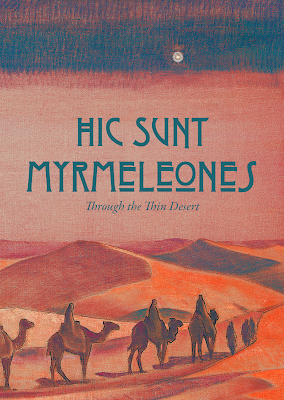
Regular readers will know that I have written about or around images of fictional Mars (and the other planets). Well, Marat of Red Berries for the Red Planet - occasional commentator on this blog - has put together a pocket bestiary of his own more specifically Martian setting. You'll find Hic Svnt Myrmeleones on DriveThruRPG here, currently at Pay What You Want.

The cover.

Anyway, this isn't just a signal boost from me. Time to put on the reviewing hat. Hic Svnt Myrmeleones (hereafter HSM) is quite a pleasant read. It's doing the decrepit, magic-ridden, faintly-Byzantine empire thing. Now, this is perhaps quite a stock setting by this point - A Princess of Mars is hardly new, and neither are the various Dying Earth properties (see also the perennial Aesthetics of Ruin). But like the young, vigorous, wild, vaguely-Viking setting (see below!) there's an obvious pleasure in seeing it done well. I believe, for instance, that Gus L's Fallen Empire posts are still loved

Time for some particulars. The Thin Desert is laced with strange beasts. The titular antlions are only part of this. Of particular joy are the Spellridden Jackals, Melachilisks and Road Elementals. These make the desert feel like a land that has been worked and used over and over - not just in terms of infrastructure, but in terms of magics, ideas and philosophies. A feeling I have tried (and more-or-less failed) to approach well in The Estates Immaculate.  

The main point I want to make is that I want a bit more of this. A series of bestiaries for the Red Planet. Get HSM and say good things about it on the internet.

***

I found a copy of The Taheiki in a secondhand book stall, in a translation by Helen Craig McCullough. Its a Japanese chronicle detailing a period of civil strife (not quite the more famous Senjoku jidai, but not far off). Can't really review such a thing, obviously (or it would feel bloody odd to do so).

Still, it's good to see Medieval Japan write about Medieval Japan - rather than a Kurosawa film or an Occidental comic strip or what have you. I mean, it has much of what you might expect: all the battles, Buddhist sects, poetry, Confucian anecdotes and colourful armour (Cf. this [Thanks, HCK!] - not quite beyond some of the written descriptions in the Taheiki) you could want - and more ritual suicides than I strictly speaking care for. Is it rather exaggerated? Indeed, but if you've done a bit of primary source reading before you'll pick up on it. The occasional footnote helps. 

Not one for everyone, I suppose. Still, this is probably easier to get into than Sei Shonogon, and while a familiarity with the Analects of Confucius and Po Chu-I will help, you can get by.

***

Robertson Davies was a Canadian academic and writer, perhaps best known for some of his trilogies - The Salterton, Deptford and Cornish trilogies. Lots of scholars from Ontario and a bit of Jung. These are not purely comedies, but frequently comic. Good reads: I possess the Penguin UK collected editions, with the older still-life style covers.

He was the founding Master of Massey College in the University of Toronto (site of a Chapel Royal!). He was an established writer by this time, and thus took up the habit of telling a Ghost Story each Christmas. This was self-conscoiusly in the manner of MR James and so there's a heavy element of pastiche in it - as Davies admits in his introduction. It was also for a specific audience and in a specific place: the modernist architecture of Massey College filled with mid-century Canadians. Davies is the narrator of all the stories, and finds himself drawn into such supernatural encounters as may befit a Master of a College. 

It's more comic than scary, and Davies is not immune to a few puns. Some of the more precise elements of the time and setting will have flown over my (British) head, even if I already knew who Sir John MacDonald and Pierre Trudeau were, or about Mackenzie King's Spiritualism. But I still enjoyed digesting these, one a night. Some as the 'Refuge of Insulted Saints' have a bit of Saki about them; some are a little like the tales of Max Beerbohm in Seven Men and Two Others. There's a little good comic malice or grotesquery in here - see 'The Kiss of Khrushchev' or the last story 'Offer of Immortality'.

Not perhaps a proper entry into the work of Robertson Davies, but fun all the same. Wikipedia informs me that this was reviewed in a 1984 edition of White Dwarf - how's that for a gaming connection?

***


To continue within academic pursuits, I chanced upon two essays on John Milton by TS Eliot. Naturally, I had to compare it with CS Lewis's Preface to Paradise Lost (also seen here). Lewis wrote in 1942, Eliot in 1936 and 1947. Both writers refer to one another in the respective texts: Lewis is not enamoured of Eliot - who had a chance to respond in 1947 and update his 1936 observations. 

Front inside cover of the Eliot.

Both refer to similar writers other than Milton: Samual Johnson and John Dryden among others, along with their contemporary Denis Saurat - a scholar that Dr Jeffrey Shoulson (currently of the University of Connecticut, I think) apparently identifies as at the heart of mid-twentith century discussions of Milton.

If you want to know what Eliot thinks about poetry, read his Two Studies. If you want to know about Paradise Lost, read Lewis's Preface. Given that the one was a professional poet (if there is such a thing) and the other an academic (yes, among other things) this should not be a surprise. Moving on.

***

An impulse purchase netted me a copy of Michael Scott Rohan's The Anvil of Ice, as reprinted by Gollancz Fantasy Masterworks. This is, I suppose, a sort of fantasy I haven't read in a while, in which a young man gets drawn to his destiny in a far-off land and develops magical powers. It even has the X of Y style of title, in which X = An Object and Y = An Elemental-style Force.

[The Blade of Wind. The Axe of Flame. The Ship of Death. The Robe of Night. The Book of Shadow. The Coins of Malice. The Fork of Balance. The Harp of Tranquility. The Horn of Winter. The Ace of Love. The Plough of Iron. The Lance of Bone. The Guns of the Dawn. The Throne of Blood. The Sword of Honour. The Glass of BlessingsThe Red Badge of Courage. The Elements of Style......]

Fine, a brief end to humour. ("Did it ever begin?") I don't tend to mention or discuss things I think worthless or unpleasant on these Miscellanies, so I suppose you'll have guessed that I appreciated Anvil of Ice. As last paragraph indicates, it's very easy to imagine a pretty uninspiring version of this sort of story. Even mentioning some of the features of the book - barely veiled references to Norse myth, an Appendix detailing 'the Old Chronicles' - make it sound like Tolkien pastiche.

What can one say? It works, like HSM above. The smithing elements are used to good effect: magic is not shown as performed by an instinctive point-and-click or Vancian meticulous preparation, but as a matter of craft. Rather like Tolkien's elves, not that I should make the comparison. The titular ice is not some mystical power; the anvil is not some magical device - the book is set during an encroaching ice age (quite possibly The Ice Age). The glaciers are over there, and even if they are baleful and malevolent, they don't need to be magic to be so (even if they are). 

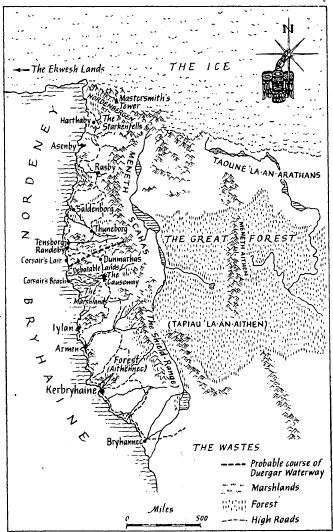
The barely-veilled Norse references aside (A chap on a horse referred to as Raven? Huh.) there's the suggestion that this is taking place on the Pacific coast of North America. See the map below; note the avian-form compass, reminiscent to me of Tlingit art. References to Thunderbirds also help.  I'm not quite sure how well-versed on the region Micheal Scott Rohan was: he was born and lived in Britain and died in 2018, and his website gives little mention of his studies. Still, it does help steer Anvil of Ice away from the generic. I'm glad not every fantasy is like this, but I'm glad I read this.

Mythic Maps on Twitter: "The Anvil of Ice - Michael Scott Rohan  https://t.co/l2inja3DNV" / Twitter

(Incidentally, I note from the brief Anvil of Ice Wikipedia page that this also was reviewed by White Dwarf in the 1980s. By the same chap who wrote the High Spirits review. Hmmmm....)

***

EDIT: HCK over at Grand Commodore is running a Play-by-Email game based on city states - including my own Saxherm. Take a look!

Friday, 24 June 2022

Eight Pious Arachnids

  1. During the years of strife, the Prophet Erimon was in the service of Argoz, High Prince of all Letarmine. When Erimon failed to obey Argoz in a matter of the interpretation of his dreams, he threw Erimon into a dark stone pit which contained giant spiders, there to be devoured. The seal of Argoz was placed over the pit, and Erimon was left there. But Erimon despaired not, and a veil of light was placed about him, and he sang of the Highest Heavens. When Argoz came to re-open the pit, he was shocked to see Erimon alive and well; he had even taught the spiders to make gestures of blessing, and to stamp their feet as if they were at the Festival of Palm Fronds. Great was the astonishment and sorrow of the High Prince!
  2. The blessed hermit St Arilan is said to have cast aside his possessions to take up a life of prayer and contemplation, living in peace with every beast of the earth and bird that steps upon the winds. However, the Hagiographies speak of him dressed in plain robes, for in the land of Rhoopagno the winters can be cold indeed. Rhoopagno tradition holds that these robes were woven for St Arilan by spiders that visited him in his cave; however, research by ecclesiastically-approved natural philosophers has demonstrated that this would be quite impossible.
       It is far more likely that the spiders provided thread with which the Saint was able to sew together the bolts of cloth given to him by the charity of the region. This does not stop tailors and weavers in Rhoopagno from dressing up as spiders on the Eve of St Arilan. Moreover, it is a custom of the region that every bobbin should have carved into one end an eight-legged image of a spider.
  3. The War of the Chalcedony Kings kept the pious daughters of the sage Octesian from maintaining his tomb shrine in a proper fashion. The tomb was of course complete, but the Ten-Day Seal had not yet been set in place. They were driven from their lands under the Caustic Edicts. However, when finally peace settled again over the land, they were able to return. They rejoiced, but were saddened that the tomb was still unsealed: creeping things could have entered the tomb, and flies - which, as any reputable sage will tell you, are merely a curdling of the Widdershins Force. 
       Yet when they reached the tomb, they found that no fly - neither the gadfly, nor the horsefly, nor the cranefly - had entered that place. All had been blocked by the webs of a benevolent spider - who was, through sad circumstance, better able to manifest the virtues of filial piety than the daughters of Octesian.
  4. By the accounts given in the Hymns of Drinian, the 11th Avatar of the Preserving Sovereign appeared on the Fifth Day of the Sixth Month, mounted on a heavenly steed. The steed took the form of a great spider of marble countenance, but four of its legs terminated in gold hoofs, like the hoofs of a mountain goat, and four of its legs terminated in bronze talons, like the talons of a forest hawk. Each of its eyes had the colour of a flawless pearl; the chittering of its mouthparts was like the temple sistrum and it span indigo silk to cover the body of the Avatar. This spider could run faster than the pheasant-flighted arrows shot by the Passarid Mothers and of all earthly foods would eat only dates and scallions.
  5. One summer month the hero-sage Mavramorn began a series of extreme ascetic exercises, designed to purify her soul. She threw down bow and spear, and retreated to the woods. She forsook the company of all comely youths and sweet-mouthed singers, deigning not to even look upon them. Even when not in a period of fasting, she would pluck a berry from a bush and then wait an hour and a half before consuming it. Her days were spent in prayer and meditation. 
       Beyond the woods were she did this, however, demons descended from the mountains, riding upon war-wagons pulled by tusked swine. Mavramorn knew of their presence, for her eyes saw clearly after her asceticisms. But she was bound to remain in the woods. Then, one afternoon as she sat in contemplation under a tamarind tree, a spider with its own notions of defence policy bit her upon the tricep. Mavramorn let out a highly unpleasant oath and batted at it. Having spoiled the effect of her ascetic exercises she sighed, sorrowing exceedingly, and went to retrieve her bow and spear.
  6. The maiden Prismia dwelt upon the farm of her father, a heathen. Her wish was to enter into a convent, yet her father wished her to make an advantageous marriage to the son of another heathen landowner. She sighed at this, and her sighs were lifted by a passing angel to the ear of the Pancrator. The Pancrator then caused a message to be taken to a certain spider in the barn of Prismia's father. One morning when Prismia woke, she saw that the spider had written the first two-thirds of the Sistine Creed in a vast web in the barn door. Her father was baffled, enraged, and then bowed to the inevitable.
  7. When Uvilas was driven from the city of Miraze, he fled to the rocks of Belisar, there to shelter among the jagged boulders. He reached the rocks and found a place to lay his head but was stricken by a fever and lay among the boulders for a month. No food had he, and only dew to quench his thirst. Yet spiders among the rocks came and found him stretched out and still and fed him on certain roots and berries and nourishing gums of that region. Therefore, no man of wisdom and respect goes among the rocks of Belisar, in memory of the sustenance given to Uvilas. 
  8. A bravo of the city of Glozellea was lounging near the Plaza of Fractured Stars. He spotted a fair maiden of sound health and radiant beauty passing by, and called out to her "Fair One! One whose hair falls like blossom! Tarry a short while. I have a sack of newly-roasted beans, but none to prepare mocha for me. Use those long-fingered hands, quite devoid of imprisoning rings, to prepare a brew of pleasure for us both!"
       The maiden hissed at him like an irritated cat, and directed her chaperon to make the signs of scorn and vexation towards him. Puzzled, the bravo slumped against a wall. A spider descended from a web and began to laugh at him "Hoo! Hoo! Hoo!"
       "Why do you mock me so?" said the young man. "Surely you know I could crush you beneath a boot-heel."
      "I merely thought," said the spider "that when my kind mate, the man has his head bitten clean off. It struck me as funny that you run so fast into the arms of your doom. Hoo! Hoo! Hoo!"
      The bravo, hearing this, resolved to live a healthier and more circumspect life.