Punth! At susnet, gaze across the irrigation ditches, out into the wilderness, where a great Prince impales a lion on a ten cubit spear!
(A new reader may wish to refer back to earlier articles).
Arms and the Qryth
As previously established, the military of Punth is split into two: the (human) Gendarme, nominally a territorial force with a law enforcement role and the Qryth themselves. The Qryth are meant as frontline soldiers and shock troops, there being nothing like a four-armed green giant to hold the line when needed. In practice however, Gendarmes may find themselves in the thick of a melee or as part of an expeditionary force.
An armed, trained Qryth is not quite the equal of a mounted knight in plate armour. They are slower than a charging horse, if faster than a human, and if hardy, not near as hardy as steel. And of course, a lone Qryth is far more at home on the sands of Punth than any chevalier and generally requires less of a baggage train. The Qryth in melee favour two-handed blades or tall shields and spears. The crossbow has resonance as a traditional weapon. A Qryth can carry and shoot a heavy crossbow with ease, and marksmanship is prized; thus a Qryth ambush is a terrifying thing. (This leaves aside their more ancient and exotic weapons).
A Qryth fighter would be known in their own tongue by certain high and ancient names (Astronaut, Espatier, Star Commander, &c.). Vertebraean usage tends to refer to a Qryth Knight, Commander, Marshall, &c.
While Punthite tactics might be outlined by portions of the Codes, fighters of one kind or the other have phrases that communicate tactics or commands rapidly.
Advancing: Forge ahead courageously, following the Sky Princes!
Retreating: If victory does not come today, it shall come tomorrow!
Engaging as a group: As one we shall meet the foe!
Engaging as an individual: By each of our efforts, we conquer the malicious!
Attack a certain target or point: Ignorance of correct teaching reveals flaws to be exploited!
Defend a certain target or point: Might is demanded at this spot.
Attack along a broad front: Correct teaching demands broad action!
Defend along a broad front: At the walls, the dutiful will stand.
Prioritise missile combat: The arm of the people is both long and swift!
Prioritise melee combat: The might of the soldier in the sword!
In days that are no more, sorcerers had the keeping of the people. Let those days come no more!
As the title suggests, the Punthite feeling towards magic users is far from positive. They are kept carefully guarded by special detachments of the Gendarmes. Because magic requires a language (spoken or otherwise) that alters the universe, they must learn odds and ends of languages beyond the Codes - the Codes not having any resonance with the energies of Vertebraean creation.
All this makes magic-users doubly untrustworthy. By custom they are kept chained - either literally restrained, or ritually adorned with chains that do not hamper movement but still indicate their status. Their faces are painted each day with horizontal stripes. An unpainted mage is either an escapee convict or a special forces operative - and much more likely the former than the latter.
Sorcerers that use their powers for the state are trained to communicate their actions for their handlers. A phrase roughly matches the school of a spell from the 52 Pages.
Energy: After catastrophe, we shall triumph!
Creation: From the Sky-Princes comes all plenty!
Change: That used for the state will be changed for the state.
Planar: From the beyond came the Sky Princes, ever benevolent.
Knowledge: In the Codes resides the key to all knowledge!
Illusion: The insolent and foolish see not our might.
Mental: A mind is honed by the Codes as a blade on a stone.
Restoration: If a man has fallen in the dust, let his neighbour bend to him.
Abjuration: Bend before the Sky-Princes, who blend might and wisdom!
Nature: Let all things bend to the state's will.
[This applies to clerical magic as well. ]
***
Gendarme Detachments
1. A civic patrol of five gendarmes, with truncheons, lathis and dirks.
2. A rural patrol of three mounted gendarmes, with lances and bows. Mounted infantry, not horse soldiers.
3. A detachment of guards for the work gangs. Seven gendarmes; three with whips and clubs; four with crossbows and short swords. They have a cart of their own with a canvas awning.
4. Judicial duties. A dozen gendarmes fill roles in the Ziggurat's judgement hall - door guards, wardens, ceremonial escorts, chasteners. Most carry a round shield and short sword. Each wear a sash with some relevant portion of the Codes written on it.
5. Border patrol. Eighteen gendarmes, with mounts and pack beasts. Most carry spears or bows. Their leader has a map of the area; his adjutant a detailed set of records.
6. Mercantile inspectors. Found in any of the regions that permit trade. Six gendarmes with truncheons or lathis; two armed scribes; three crossbowmen; one inspector.
7. Sorcerer's escort. One sorcerer (of relatively low ability). Three armoured gendarmes. Two gendarmes with padded truncheons, nets and long spears. One sorcerer's handler, with a short sword and extensive records. Four additional gendarmes; one securely built and boxy sedan chair.
8. Sky Prince's retinue. Four gendarme veterans with a variety of military weapons (broadswords, battle-axes, crossbows, medium armour, shields). Two armed scribes. Six additional gendarmes, with baggage animals. Oh, and somewhere there will be one of the Qryth.
9. Gendarme pioneers. A dozen gendarmes with spears, shields and crossbows. Two engineers. Six gendarmes with lathis and short swords to guard the work gangs. Two wagons carry tools and supplies.
10. Gendarme baggage train. Six wagons with draft animals; each wagon has a driver and guard - the guard with a crossbow. Eight outriders with lances and bows. Four other gendarmes with swords and shields.
Tuesday, 21 April 2020
Saturday, 18 April 2020
Punth: A Primer Ch. 4
Punth! The sun sets. Birds perch on the upper levels of the local ziggurat. Labourers fresh from the field at the communal dinner hear the rhythmic formulation of the Codes sung to the tune of the dulcimer and the tom-tom.
(A new reader may wish to refer back to earlier articles).
At the shops
As befits something very like a planned political economy, there is no formal currency used in Punth. The equivalent used by a local headman would be the 'day's labour', expressed in the phrase 'For those who work in the day, let shelter be prepared for them in the evening.'
Bed and board carries as part of its implication cost of fuel, cost of crockery, cost of blankets, and so forth. So the 'day's labour' amounts to the cost of a day's food and water plus the cost of a day's fuel plus various minuscule fractions of the cost of a house and household goods. Therefore, the Punthite labourer, even if his meals are taken communally and he lives in a state dormitory, is issued with discretionary resources (generally in the form of trade goods) to obtain things he might need.
Now, the choice of household goods is always going to be pretty limited. But having a Punthite hand over trade goods for household goods is a form of authentication that for instance, a new jug is required.
[The Codes actually list the required household goods. It's a little like a really boring domestic pastiche of Sei Shonagon's lists.]
A headman or scribe is given a slightly larger set of discretionary resources, because of their need to be ready for a number of activities - to interpret the Codes or to otherwise lead.
On top of these, a village or civic ward will have be expected to maintain a small surplus capacity to accommodate work gangs or gendarmes or visiting Qryth - as well as for other unforeseen issues. This will be in the control of a headman.
Therefore, a rural headman might deal with a visitor who can interpret the Codes like this:
Headman: All men should live in peace, from which comes plenty.
Visitor: Where there is labour, let there be comfort. Where there is thirst, let there be water. Where there is wind, let there be a shelter.
H: If the people are to be fed, work must be divided between them.
V: The blocked channel may be cleared.
[The Visitor brings out two iron axeheads]
H: May the fruits of the people stay with the people!
V: If a man has fallen in the dust, let his neighbour bend to him.
H:Who must rise first? The mighty.
[The Visitor brings out a handful of nails]
H: For those who work in the day, let shelter be prepared for them in the evening.
V: To the wise will come plenty.
Make no mistake; such trades are Black Market-equivalents. A headman or scribe will be unwilling to make them if there is a significant party of gendarmes in town, or an inspection or one of the Sky-Princes.
Looking further afield
Some trade does exist between Punth and other nations. This is facilitated by a class of scribes, usually only found in the cities, known as Procurators. They have a better notion of money as it is used in other lands and a loose familiarity with trading customs. Procurators will maintain a supply of specie or bullion with which to trade, as well as trade goods or issue plaques (small clay tablets giving the bearer permission to draw a certain set of resources from Punthite authorities).
Punth imports not only tools, iron and livestock but also a quantity of luxuries - dyes, precious metals, the like. These are often used to create monuments to the Codes or in maintaining Qryth households. It is half-known by the Qryth that gold is an effective conductor of electricity.
Antiquities from the time of the Sorcerer-King have been available cheaply in the past, with Punthite authorities knowing little and caring less about them - despite some having valuable scraps of archaic spellcraft.
The Procurators are known as being oddly straightforward dealers to the merchants outside Punth. The transactional cost of getting to Punth, negotiating the borders and learning enough of the Codes to get by is offset by the fact that trade is so often profitable. However, the Qryth loathe anyone else's scrutiny - and they may, if they deem it necessary seize your goods and your ship in time of emergency. Punth emergencies do not line up with what other nations may consider an emergency. Merchants are not known to linger in their ports, not that there is much that might appeal to a holiday-maker in them.
[I can't even claim to be even an amateur economist, and I'm glossing a little from Francis Spufford's Red Plenty - but this is the model for use in Punth. Limited supplies, few sellers, odd government interventions and motivations.]
(A new reader may wish to refer back to earlier articles).
At the shops
As befits something very like a planned political economy, there is no formal currency used in Punth. The equivalent used by a local headman would be the 'day's labour', expressed in the phrase 'For those who work in the day, let shelter be prepared for them in the evening.'
Bed and board carries as part of its implication cost of fuel, cost of crockery, cost of blankets, and so forth. So the 'day's labour' amounts to the cost of a day's food and water plus the cost of a day's fuel plus various minuscule fractions of the cost of a house and household goods. Therefore, the Punthite labourer, even if his meals are taken communally and he lives in a state dormitory, is issued with discretionary resources (generally in the form of trade goods) to obtain things he might need.
Now, the choice of household goods is always going to be pretty limited. But having a Punthite hand over trade goods for household goods is a form of authentication that for instance, a new jug is required.
[The Codes actually list the required household goods. It's a little like a really boring domestic pastiche of Sei Shonagon's lists.]
A headman or scribe is given a slightly larger set of discretionary resources, because of their need to be ready for a number of activities - to interpret the Codes or to otherwise lead.
On top of these, a village or civic ward will have be expected to maintain a small surplus capacity to accommodate work gangs or gendarmes or visiting Qryth - as well as for other unforeseen issues. This will be in the control of a headman.
Therefore, a rural headman might deal with a visitor who can interpret the Codes like this:
Headman: All men should live in peace, from which comes plenty.
Visitor: Where there is labour, let there be comfort. Where there is thirst, let there be water. Where there is wind, let there be a shelter.
H: If the people are to be fed, work must be divided between them.
V: The blocked channel may be cleared.
[The Visitor brings out two iron axeheads]
H: May the fruits of the people stay with the people!
V: If a man has fallen in the dust, let his neighbour bend to him.
H:Who must rise first? The mighty.
[The Visitor brings out a handful of nails]
H: For those who work in the day, let shelter be prepared for them in the evening.
V: To the wise will come plenty.
Make no mistake; such trades are Black Market-equivalents. A headman or scribe will be unwilling to make them if there is a significant party of gendarmes in town, or an inspection or one of the Sky-Princes.
Looking further afield
Some trade does exist between Punth and other nations. This is facilitated by a class of scribes, usually only found in the cities, known as Procurators. They have a better notion of money as it is used in other lands and a loose familiarity with trading customs. Procurators will maintain a supply of specie or bullion with which to trade, as well as trade goods or issue plaques (small clay tablets giving the bearer permission to draw a certain set of resources from Punthite authorities).
Punth imports not only tools, iron and livestock but also a quantity of luxuries - dyes, precious metals, the like. These are often used to create monuments to the Codes or in maintaining Qryth households. It is half-known by the Qryth that gold is an effective conductor of electricity.
Antiquities from the time of the Sorcerer-King have been available cheaply in the past, with Punthite authorities knowing little and caring less about them - despite some having valuable scraps of archaic spellcraft.
The Procurators are known as being oddly straightforward dealers to the merchants outside Punth. The transactional cost of getting to Punth, negotiating the borders and learning enough of the Codes to get by is offset by the fact that trade is so often profitable. However, the Qryth loathe anyone else's scrutiny - and they may, if they deem it necessary seize your goods and your ship in time of emergency. Punth emergencies do not line up with what other nations may consider an emergency. Merchants are not known to linger in their ports, not that there is much that might appeal to a holiday-maker in them.
[I can't even claim to be even an amateur economist, and I'm glossing a little from Francis Spufford's Red Plenty - but this is the model for use in Punth. Limited supplies, few sellers, odd government interventions and motivations.]
Sunday, 12 April 2020
More Unlikely Golems
Another bid to produced golems divorced from the elemental concept. These are inspired less by a distinction from Natural or Elemental ideas and more from a viewing of portions of the From Software video game Sekiro: Shadows Die Twice. I saw portions of this and was captivated by the textured appearance of the exaggerated, semi-mythic Feudal Japan it depicts.
My knowledge of the Sengoku era of Japan isn't that detailed or well-grounded, but the courtyards and turrets of the castles, gardens, shrines and monasteries seem in some case more an arena with appropriate set dressing than a realistic depiction. All the same, the drifts of leaves or bristling straw coats were curiously evocative of a closeness to and use of nature (despite having castles, monasteries, gunpowder, massive swords, &c), which does evoke a certain image of Japan.
Anyway, without necessarily being Japanese in any direct sense, it is a 'material-that-shows-its-natural-origin' that is meant to define these golems.
Basket Golem
In appearance: a wicker man, but without the sacrificial offerings. The head is squarish and larger than human proportions. Three main openings into the hollow centre - one in the head and one at the base of each leg (above the 'ankle' at the front').
Capabilities and properties: Hollow, flexible, lightweight. Capable of carrying a great deal inside itself.
Intended purpose: generally found in the ownership of agricultural buyers, touring rural districts with the golem as a self-propelled grain silo. (A basket golem made for a grain buyer is tighter woven than one for a dealer in potatoes, for obvious reasons). Some golems, as a cost-saving measure, have a seat for travel built into them. This can be rickety and precarious.
Location of the words of power that give it motion and purpose: Suspended on a plaque from the rim of the square head.
Dead Leaf Golem
In appearance: a greater drift of dead leaves, linked by vermillion threads that glints gently. If it rears up, it looks a little like a flat Green Man.
Capabilities: An excellent broom of sorts, gently picking across a floor to remove loose detritus.
Intended purpose: Cleaning, if stepped on they crackle alarmingly and can alert people to your presence. (Pine Needle Golems, a very expensive variant can muffle sound instead).
The words of power: Sewed into the one green, living leaf in the drift.
Compost Golem
In appearance: Largely like a regular clay golem. But made of compost. A broad funnel replaces the head. One arm is not compost, but wood, with a trowel in the end of it.
Capabilities: It's a walking compost heap, fed through the funnel. That knows when to extract portions of itself and spread them as directed.
Intended purpose: Composting.
The words of power: Set in a slot in the upper part of the wooden trowel arm.
Tile Golem
In appearance: Like a man in a sandwich board. But the sandwich board is made of lots of little sandwich boards. And so is the man's head and arms. His face looks a bit like several dormer windows. His head is topped with an ornamental antefix.
Capabilities: The tile golem can angle itself in several different ways, even bending right over backwards to form a shallow roof.
Intended purpose: A walking shelter, capable of holding itself in place over something for quite a while. More robust tile golems are used to shift great quantities of loose earth or other materials, forming a sort of whole-body smart-scoop.
The words of power: generally just behind the antefix, to prevent damage.
Moss Golem
In appearance: A teddy bear, with only a gentle dome at the neck instead of a head.
Capabilities: They walk quietly, blend in very well into undergrowth and have a soft skin on top of a solid centre. A moss golem is incapable of rolling.
Intended purpose: Moss golems can lift delicate things without breaking them, and are prized by ceramicists or antique dealers for that reason. They are also remarkable as stealth troops or commandos - if one remembers that stealth is a relative term given their size and weight.
The words of power: Carved into the head dome. This is frequently done to give the impression of a distinct 'face' uncovered by moss.
(Bonus thematically different golem!)
Distiller's Golem
In appearance: A normal clay or wattle-and-daub golem - but with a smoking metal chimney, and a hollow centre accessible by doors in the chest.
Capabilities: It is a normal golem, but with an arrangement of boilers, pipes and alembics inside to distill alcoholic spirits. Some advanced models can control parts of the distilling process themselves.
Intended purpose: by the laws of the land, a household is permitted to distil a quarter of a firkin of alcoholic spirits for its own use. Travelling distillers use these golems to move between rural homes offering their services.
Of course, said travelling distillers are often judged guilty of breaching the law on home distilling. Thus, their golems are often carefully made to look like run of the mill country golems.
The vicious rumour that some distillers have fitted their golem with a spigot and lighter to function as an eau-de-vie fuelled flamethrower has absolutely no truth to it.
The words of power: In a tablet in the head, generally - and concealed. A distiller may well have had an enchanter discreetly change the base spell.
[This is more France than Appalachia.]
My knowledge of the Sengoku era of Japan isn't that detailed or well-grounded, but the courtyards and turrets of the castles, gardens, shrines and monasteries seem in some case more an arena with appropriate set dressing than a realistic depiction. All the same, the drifts of leaves or bristling straw coats were curiously evocative of a closeness to and use of nature (despite having castles, monasteries, gunpowder, massive swords, &c), which does evoke a certain image of Japan.
Anyway, without necessarily being Japanese in any direct sense, it is a 'material-that-shows-its-natural-origin' that is meant to define these golems.
Basket Golem
In appearance: a wicker man, but without the sacrificial offerings. The head is squarish and larger than human proportions. Three main openings into the hollow centre - one in the head and one at the base of each leg (above the 'ankle' at the front').
Capabilities and properties: Hollow, flexible, lightweight. Capable of carrying a great deal inside itself.
Intended purpose: generally found in the ownership of agricultural buyers, touring rural districts with the golem as a self-propelled grain silo. (A basket golem made for a grain buyer is tighter woven than one for a dealer in potatoes, for obvious reasons). Some golems, as a cost-saving measure, have a seat for travel built into them. This can be rickety and precarious.
Location of the words of power that give it motion and purpose: Suspended on a plaque from the rim of the square head.
Dead Leaf Golem
In appearance: a greater drift of dead leaves, linked by vermillion threads that glints gently. If it rears up, it looks a little like a flat Green Man.
Capabilities: An excellent broom of sorts, gently picking across a floor to remove loose detritus.
Intended purpose: Cleaning, if stepped on they crackle alarmingly and can alert people to your presence. (Pine Needle Golems, a very expensive variant can muffle sound instead).
The words of power: Sewed into the one green, living leaf in the drift.
Compost Golem
In appearance: Largely like a regular clay golem. But made of compost. A broad funnel replaces the head. One arm is not compost, but wood, with a trowel in the end of it.
Capabilities: It's a walking compost heap, fed through the funnel. That knows when to extract portions of itself and spread them as directed.
Intended purpose: Composting.
The words of power: Set in a slot in the upper part of the wooden trowel arm.
Tile Golem
In appearance: Like a man in a sandwich board. But the sandwich board is made of lots of little sandwich boards. And so is the man's head and arms. His face looks a bit like several dormer windows. His head is topped with an ornamental antefix.
Capabilities: The tile golem can angle itself in several different ways, even bending right over backwards to form a shallow roof.
Intended purpose: A walking shelter, capable of holding itself in place over something for quite a while. More robust tile golems are used to shift great quantities of loose earth or other materials, forming a sort of whole-body smart-scoop.
The words of power: generally just behind the antefix, to prevent damage.
Moss Golem
In appearance: A teddy bear, with only a gentle dome at the neck instead of a head.
Capabilities: They walk quietly, blend in very well into undergrowth and have a soft skin on top of a solid centre. A moss golem is incapable of rolling.
Intended purpose: Moss golems can lift delicate things without breaking them, and are prized by ceramicists or antique dealers for that reason. They are also remarkable as stealth troops or commandos - if one remembers that stealth is a relative term given their size and weight.
The words of power: Carved into the head dome. This is frequently done to give the impression of a distinct 'face' uncovered by moss.
(Bonus thematically different golem!)
Distiller's Golem
In appearance: A normal clay or wattle-and-daub golem - but with a smoking metal chimney, and a hollow centre accessible by doors in the chest.
Capabilities: It is a normal golem, but with an arrangement of boilers, pipes and alembics inside to distill alcoholic spirits. Some advanced models can control parts of the distilling process themselves.
Intended purpose: by the laws of the land, a household is permitted to distil a quarter of a firkin of alcoholic spirits for its own use. Travelling distillers use these golems to move between rural homes offering their services.
Of course, said travelling distillers are often judged guilty of breaching the law on home distilling. Thus, their golems are often carefully made to look like run of the mill country golems.
The vicious rumour that some distillers have fitted their golem with a spigot and lighter to function as an eau-de-vie fuelled flamethrower has absolutely no truth to it.
The words of power: In a tablet in the head, generally - and concealed. A distiller may well have had an enchanter discreetly change the base spell.
[This is more France than Appalachia.]
Saturday, 4 April 2020
Exotic Breads
Bread, be it from wheat, barley, sorghum, millet or rye is a major staple. Short of a setting creating a whole new set of foodstuffs, a variety of breads should be available. Some of them might even be capable of something more than satisfying hunger.
1. The Brethren of the Lordly Prophet distribute alms-bread. These loaves have a portion of food baked into them, taken from the various offerings left at their monastery. Institutional catering and the vagaries of chance mean that this may not be always to the recipient's liking. (Roll 1d6; 1 = 'I really can't eat that!', 2-4 = Edible, 5 = Edible and fairly nice, 6 = 'Oh good! My favourite!' OR Find a low denomination coin in the bread.)
2. Mosstrooper's Bannocks. The Clayscrape Valleys are a notoriously rainy region. The local irregular troopers and reavers bake bannocks in the ashes of their fires, and have developed a method of banking them with a hard crust that keeps out the damp. One comic tale of a folk hero has him baking a particularly large bannock to float across a river, but such a feat is clearly implausible.
3. Whatever their reputation, the Forest Elves are not good bakers. An elf can learn to bake, but the elves of the deep forest are not agriculturists. The most conservative of them will not even eat mono-cultured grains. However, they see the need for a compact form of carbohydrate to feed their emissaries or warbands that leave the forests to find out what it is the younger folk are doing and tell them to stop it. Thus, they carry bags of 'Trail Powder'. This is a ground-down mix of starches and roots, which is mixed together with fresh edible leaves and a little water to form something like Bubble and Squeak - but with the texture of meringue.
4. Concord Loaves are provided at a reduced price by the cooperatives of the Popular Harmony League. These loaves are deliberately larger than is needed for the average human appetite, and the bread is of a soft sort that must be eaten promptly - therefore, the bread must be shared, or go to waste. The rumour that the League includes trace elements of a pacifying, relaxing narcotic in the bread has not effected the popularity of these loaves.
5. These flatbreads from the Sun River Kingdoms are easy to make, compact and tasty. However, traditionally they are used for pushing and scooping other foodstuffs and are generally consumed only by the greediest or the poorest; consuming them can leave create a very bad social impression.
6. Inferno Rolls are dense, with red-brown crusts and a sweet, slightly treacly taste. They have been baked over a ceaseless, fuel-less, blaze of hell-fire, but this has no especial impact on the rolls themselves - beyond a scent of sulphur on the breath of those who consume them. (Mock-Inferno Rolls, designed to reproduce the taste without the lingering scent are sold at triple the price for gastronomes.) Despite this, they remain popular and no long term ill-effects have been found in those who eat the rolls. It is quite another story for the bakers who must inhale the smoke and soot of hellfire and who sometimes exhibit an extreme piety.
7. Dwarf tuber bread is bulked out with root vegetables of various kinds, due to the limited arable land in the mountain realms. It is frequently baked with beer and is almost terrifyingly stodgy to anyone not a dwarf. Tuber bread keeps remarkably well, so long as it remains unexposed to sunlight.
8. Angel biscuits (not to be confused with Angel Wafers, which are a popular brand of sweetmeat printed with brief and often trite religious messages) are made with a mix of oatmeal derived from a miraculous growth of wild oats to a prophet in the wilderness and water from the sacred spring of a pious hermit. They are do not taste 'heavenly' as such, but eating one is generally sufficient. You have somehow eaten no more and no less food than you actually need. The feeling of fullness without being overstuffed is curious and sometimes disturbing. However, what is perhaps more remarkable is that the eater generally comes away with a strong sense of purpose and mission, as if they have just had a serious chat with Aslan.
9. It is generally accepted that one cannot stop fauns and satyrs from drinking to excess, even when such a thing would be very useful. The fauns of the Bear Coast groves, however, bake a spongey pancake using milk and various ground herbs. This slowly releases nourishing and analgesic properties that will blunt all but the worst hangovers, though it is time consuming to prepare and relatively expensive.
10. The Half-Giants of the Kuthan Highlands raise Cyclopian goats - goats standing as high as a horse, with one large eye in the centre of their foreheads and three horns. The marrow of these goats is mixed with cornmeal and baked into unleavened rounds. The resulting bread is edible for humans, but when moistened with a little vinegar, forms an excellent bait for many of the great cats of the highlands.
1. The Brethren of the Lordly Prophet distribute alms-bread. These loaves have a portion of food baked into them, taken from the various offerings left at their monastery. Institutional catering and the vagaries of chance mean that this may not be always to the recipient's liking. (Roll 1d6; 1 = 'I really can't eat that!', 2-4 = Edible, 5 = Edible and fairly nice, 6 = 'Oh good! My favourite!' OR Find a low denomination coin in the bread.)
2. Mosstrooper's Bannocks. The Clayscrape Valleys are a notoriously rainy region. The local irregular troopers and reavers bake bannocks in the ashes of their fires, and have developed a method of banking them with a hard crust that keeps out the damp. One comic tale of a folk hero has him baking a particularly large bannock to float across a river, but such a feat is clearly implausible.
3. Whatever their reputation, the Forest Elves are not good bakers. An elf can learn to bake, but the elves of the deep forest are not agriculturists. The most conservative of them will not even eat mono-cultured grains. However, they see the need for a compact form of carbohydrate to feed their emissaries or warbands that leave the forests to find out what it is the younger folk are doing and tell them to stop it. Thus, they carry bags of 'Trail Powder'. This is a ground-down mix of starches and roots, which is mixed together with fresh edible leaves and a little water to form something like Bubble and Squeak - but with the texture of meringue.
4. Concord Loaves are provided at a reduced price by the cooperatives of the Popular Harmony League. These loaves are deliberately larger than is needed for the average human appetite, and the bread is of a soft sort that must be eaten promptly - therefore, the bread must be shared, or go to waste. The rumour that the League includes trace elements of a pacifying, relaxing narcotic in the bread has not effected the popularity of these loaves.
5. These flatbreads from the Sun River Kingdoms are easy to make, compact and tasty. However, traditionally they are used for pushing and scooping other foodstuffs and are generally consumed only by the greediest or the poorest; consuming them can leave create a very bad social impression.
6. Inferno Rolls are dense, with red-brown crusts and a sweet, slightly treacly taste. They have been baked over a ceaseless, fuel-less, blaze of hell-fire, but this has no especial impact on the rolls themselves - beyond a scent of sulphur on the breath of those who consume them. (Mock-Inferno Rolls, designed to reproduce the taste without the lingering scent are sold at triple the price for gastronomes.) Despite this, they remain popular and no long term ill-effects have been found in those who eat the rolls. It is quite another story for the bakers who must inhale the smoke and soot of hellfire and who sometimes exhibit an extreme piety.
7. Dwarf tuber bread is bulked out with root vegetables of various kinds, due to the limited arable land in the mountain realms. It is frequently baked with beer and is almost terrifyingly stodgy to anyone not a dwarf. Tuber bread keeps remarkably well, so long as it remains unexposed to sunlight.
8. Angel biscuits (not to be confused with Angel Wafers, which are a popular brand of sweetmeat printed with brief and often trite religious messages) are made with a mix of oatmeal derived from a miraculous growth of wild oats to a prophet in the wilderness and water from the sacred spring of a pious hermit. They are do not taste 'heavenly' as such, but eating one is generally sufficient. You have somehow eaten no more and no less food than you actually need. The feeling of fullness without being overstuffed is curious and sometimes disturbing. However, what is perhaps more remarkable is that the eater generally comes away with a strong sense of purpose and mission, as if they have just had a serious chat with Aslan.
9. It is generally accepted that one cannot stop fauns and satyrs from drinking to excess, even when such a thing would be very useful. The fauns of the Bear Coast groves, however, bake a spongey pancake using milk and various ground herbs. This slowly releases nourishing and analgesic properties that will blunt all but the worst hangovers, though it is time consuming to prepare and relatively expensive.
10. The Half-Giants of the Kuthan Highlands raise Cyclopian goats - goats standing as high as a horse, with one large eye in the centre of their foreheads and three horns. The marrow of these goats is mixed with cornmeal and baked into unleavened rounds. The resulting bread is edible for humans, but when moistened with a little vinegar, forms an excellent bait for many of the great cats of the highlands.
Monday, 23 March 2020
Electric Bastionland: Worked Examples (2)
(Part One)
Deep Water: The Twining Sea

Currents
The Wick - swifter than expected; not as choppy as the other currents round the islands
Whale Lane - colder, deeper and clearer than other stretches of water.
Ungungstruk - draws silt from the coastal islets and deltas. A thick, dark current.
Features
A - Windshook: a rocky island dotted with high columns, seemingly natural (in fact partial ruins built of an abnormally smooth stone).
B - Vansittart Cluster: a number of little islands, with a few scattered houses. (A few sheep farms remain here, but the bulk of the population is currently a film crew).
C - Puffin Perch: a squarish black rock, covered in puffins (if the puffins leave, you may find the body of a nihilist, a straight razor and a cryptic letter)
D - Tescel: privately owned island, known for an artist's colony (many of the artists in question are past their prime; a lack of strong drink and narcotics has set some on edge).
E - Bruning's Knot: a tangle of weed and wreckage caught between the currents (a small family of wrecked sailors reside here and know the way through).
F - Three-Schilling: a watch station on an island (the station head does a good Black Market trade in Coast Guard supplies).
G - Angel's Plait: twining sandbanks, decorated with birds (pools of water between the banks can reveal stranded wildlife until the tides return).
Complications
Whale Lane, circling B: rough waves threaten to drive your vessel onto the rocks of Brensen, uppermost island of the Cluster.
Whale Lane, passing A: a giant squid, bearing the seal of a foreign power on its power harness. An eye swivels towards your vessel.
Whale Lane, far past D: in the distance, the shape of a vast albatross. It stoops and soars down to perch on your deck. About its neck - the corpse of a sailor. It begins to speak....
The Wick, past B: the missionary barge, the Heart of Skegness starts proselytising in morse code.
The Wick, approaching G: the sandbanks are covered by water - can you recall where they lay?
The Wick, in sight of C: a piratical submarine lurks in these waters and will surface and attack you purely for the opportunity of some fresh air and new faces.
Ungungstruk, skirting E: a strong wind draws you closer to the Knot.
Ungungstruk, circling D: a weather balloon appears to be following your ship.
Ungungstruk, in sight of F: the Coast Guard stage a surprise inspection. There has been a change the nautical licensing code.
The Underground: Deep Beneath the Hotel Messala

Rooms and Passages
A - Corroded Substation - an electricity substation; corroded, flaking fuses and rheostats between blank concrete walls. Arcs of electricity play off the depths of the substation, which sits in a sunken chamber at the junction.
B - Auto-Triage: a medical station with rows of examination coffers (someone placed in a coffer is categorised according to the severity of their wounds. Little or no medical assistance is offered by the automated systems).
C - Emergency District Information Hub - a small, well-equipped print shop and a formal room with a stage, pulpit and magic lantern projector (a hidden safe at the back of the printshop has partial details of civil defence regulations and the degrees of emergency law that may be imposed in time of war. You have not heard of any of the regulations involved, nor of some of the things they apparently ward against.).
D - Heliotrope Helix: a series of spiral tunnels, the ceilings of which gleam like the sun. (Intended so that people in the shelters could change environment and experience something like sunlight - but in a short space of time. Stay too long inside and you will get badly sunburnt).
E - Gaudy Street Seal: an internal gate in the emergency conduit, with a defensive bubble-turret. Named for the street above in chalked letters on the lintel. (Once closed, the gate will seal shut until the system detects that the gas attack has passed. The system is not in good working order.)
F - The Hive of Chains - a shaft, rising up into the regular basements of the Hotel. Chains, ready to lift or lower platforms hang down at every hand. (Some of the chains clatter ceaselessly; something below is shaking them.)
G - Automated Exchange: banks of enamelled stations, where telephone calls can be put through. But the wires are moving all by themselves. (The only calls being made are test calls between emergency stations, introduced by a unique piece of electronic music and a string of numbers).
H - The Discretionary Reception - a plush-carpeted room and four elevators. (An entrance to the hotel for guests desiring secrecy. Far larger than one would expect....)
I - Steel Cookhouse: two long metal counters, two stoves, two sinks. (Approach, and a number of unlabelled tins drop out of a chute. A voice will urge you to cook the best meal possible with these random ingredients.)
J - The Waste Disposal Offices - a dull door with a conspicuous nameplate. Inside, an office with several battered cupboards and a hatch. (This is where hotel employees gather to dispose of discarded luxuries, overlooked delicacies and other valuable items. There is a dumbwaiter directly from the kitchens.)
K - Guest Vault: A series of heavy metal doors, each with a code lock. Each door has a large sealed compartment through which objects may be passed. (You may find the guests inside, in one state or another).
L - The Cellar of Last Resort: the place where the rarest beverages for the hotel above are stored. They are hermetically sealed in individual caskets. (Discovering which casket is which requires knowledge of the symbols and abbreviations used by the caste of sommeliers).
Complications
A-B - A leaking pipe has spread water across the passage; this has been electrified.
B-C - As you pass down this corridor, the sensation of touch is completely absent from you. Even if you are clutching something tightly, you cannot feel it.
B-K - Several automated cleaning trolleys block passage. They are scouring the walls into harsh, acidic cleanliness.
C-D - Phosphoric primroses bloom from the iron of the floor grids. Do not tread on these.
C-K - Numerous jukeboxes begin playing music as you approach. Armed figures watch you approach; they do not react to this sound.
D-E - A fierce, disorientating buzzing intensifies as you approach E.
D-L - Birds sit in the passage; magpies, with wings of platinum and black iron. They eyes you in a hostile fashion.
E-H - Custodian Concierge: a respectful but very firm Concierge would like you to go no further away from H. Either go up, or go out.
F-I - Ahead of you, the floor begins to heat up. One more step, and you may fry.
I-C - The concrete slabs and iron grids of the floor fluctuate like the ripples of a pool.
I-J - A revolutionary cell is meeting here, and they do not wish to be disturbed or observed.
J-D - A turnstile bars your path. Several red lights blink into existence as you approach. Something is watching.
K-L - Clockwork scribes tick through here, trailing lists and inventories in their wake. Prepare to be stamped, inspected, briefed, debriefed and numbered.
L-H - Before you in the passage, a pepperpot-shaped automaton pushes a large barrel. It does not appear inclined to stop.
Stretches
B-F
1. Familiar as this passage is, the air around you becomes close. There is a constant shaking and the choking smell of engine exhaust. The winding of great tracks begins, only to stop at the sound of regular shrill plinking. A cannon roars.
2. Former foundations: vaults designed to support a structure that stood where the hotel now is stretch ahead of you. They are not always safe. Some are partially flooded.
3. Ahead of you the corridor is quite lightless. Nothing cuts through the darkness, though pale smoke can somehow still be seen in the air. From somewhere comes a great wind, and the walls no longer appear to be present.
4. Rubble ahead, the bitter scent of ash, and shrapnel fragments. But no bomb could pierce these cellars, surely? And no aerial raids have yet been spotted.
5. The piercing scent of bile is on the air. The tunnel narrows at the top, becoming the shape of an equilateral triangle in cross-section, walls covered in white and orange tiles. A hook-footed crab-like being clicks behind you along the corridor, oil oozing from its joints.
6. A white-painted corridor; coloured lines on the floor, with multiple dog-legs and a gentle slope. Deer of boiled leather and brass wire prance along it. If they come near you, they will entangle you in twining, tentacle like brass antlers.
Deep Water: The Twining Sea

Currents
The Wick - swifter than expected; not as choppy as the other currents round the islands
Whale Lane - colder, deeper and clearer than other stretches of water.
Ungungstruk - draws silt from the coastal islets and deltas. A thick, dark current.
Features
A - Windshook: a rocky island dotted with high columns, seemingly natural (in fact partial ruins built of an abnormally smooth stone).
B - Vansittart Cluster: a number of little islands, with a few scattered houses. (A few sheep farms remain here, but the bulk of the population is currently a film crew).
C - Puffin Perch: a squarish black rock, covered in puffins (if the puffins leave, you may find the body of a nihilist, a straight razor and a cryptic letter)
D - Tescel: privately owned island, known for an artist's colony (many of the artists in question are past their prime; a lack of strong drink and narcotics has set some on edge).
E - Bruning's Knot: a tangle of weed and wreckage caught between the currents (a small family of wrecked sailors reside here and know the way through).
F - Three-Schilling: a watch station on an island (the station head does a good Black Market trade in Coast Guard supplies).
G - Angel's Plait: twining sandbanks, decorated with birds (pools of water between the banks can reveal stranded wildlife until the tides return).
Complications
Whale Lane, circling B: rough waves threaten to drive your vessel onto the rocks of Brensen, uppermost island of the Cluster.
Whale Lane, passing A: a giant squid, bearing the seal of a foreign power on its power harness. An eye swivels towards your vessel.
Whale Lane, far past D: in the distance, the shape of a vast albatross. It stoops and soars down to perch on your deck. About its neck - the corpse of a sailor. It begins to speak....
The Wick, past B: the missionary barge, the Heart of Skegness starts proselytising in morse code.
The Wick, approaching G: the sandbanks are covered by water - can you recall where they lay?
The Wick, in sight of C: a piratical submarine lurks in these waters and will surface and attack you purely for the opportunity of some fresh air and new faces.
Ungungstruk, skirting E: a strong wind draws you closer to the Knot.
Ungungstruk, circling D: a weather balloon appears to be following your ship.
Ungungstruk, in sight of F: the Coast Guard stage a surprise inspection. There has been a change the nautical licensing code.
The Underground: Deep Beneath the Hotel Messala

Rooms and Passages
A - Corroded Substation - an electricity substation; corroded, flaking fuses and rheostats between blank concrete walls. Arcs of electricity play off the depths of the substation, which sits in a sunken chamber at the junction.
B - Auto-Triage: a medical station with rows of examination coffers (someone placed in a coffer is categorised according to the severity of their wounds. Little or no medical assistance is offered by the automated systems).
C - Emergency District Information Hub - a small, well-equipped print shop and a formal room with a stage, pulpit and magic lantern projector (a hidden safe at the back of the printshop has partial details of civil defence regulations and the degrees of emergency law that may be imposed in time of war. You have not heard of any of the regulations involved, nor of some of the things they apparently ward against.).
D - Heliotrope Helix: a series of spiral tunnels, the ceilings of which gleam like the sun. (Intended so that people in the shelters could change environment and experience something like sunlight - but in a short space of time. Stay too long inside and you will get badly sunburnt).
E - Gaudy Street Seal: an internal gate in the emergency conduit, with a defensive bubble-turret. Named for the street above in chalked letters on the lintel. (Once closed, the gate will seal shut until the system detects that the gas attack has passed. The system is not in good working order.)
F - The Hive of Chains - a shaft, rising up into the regular basements of the Hotel. Chains, ready to lift or lower platforms hang down at every hand. (Some of the chains clatter ceaselessly; something below is shaking them.)
G - Automated Exchange: banks of enamelled stations, where telephone calls can be put through. But the wires are moving all by themselves. (The only calls being made are test calls between emergency stations, introduced by a unique piece of electronic music and a string of numbers).
H - The Discretionary Reception - a plush-carpeted room and four elevators. (An entrance to the hotel for guests desiring secrecy. Far larger than one would expect....)
I - Steel Cookhouse: two long metal counters, two stoves, two sinks. (Approach, and a number of unlabelled tins drop out of a chute. A voice will urge you to cook the best meal possible with these random ingredients.)
J - The Waste Disposal Offices - a dull door with a conspicuous nameplate. Inside, an office with several battered cupboards and a hatch. (This is where hotel employees gather to dispose of discarded luxuries, overlooked delicacies and other valuable items. There is a dumbwaiter directly from the kitchens.)
K - Guest Vault: A series of heavy metal doors, each with a code lock. Each door has a large sealed compartment through which objects may be passed. (You may find the guests inside, in one state or another).
L - The Cellar of Last Resort: the place where the rarest beverages for the hotel above are stored. They are hermetically sealed in individual caskets. (Discovering which casket is which requires knowledge of the symbols and abbreviations used by the caste of sommeliers).
Complications
A-B - A leaking pipe has spread water across the passage; this has been electrified.
B-C - As you pass down this corridor, the sensation of touch is completely absent from you. Even if you are clutching something tightly, you cannot feel it.
B-K - Several automated cleaning trolleys block passage. They are scouring the walls into harsh, acidic cleanliness.
C-D - Phosphoric primroses bloom from the iron of the floor grids. Do not tread on these.
C-K - Numerous jukeboxes begin playing music as you approach. Armed figures watch you approach; they do not react to this sound.
D-E - A fierce, disorientating buzzing intensifies as you approach E.
D-L - Birds sit in the passage; magpies, with wings of platinum and black iron. They eyes you in a hostile fashion.
E-H - Custodian Concierge: a respectful but very firm Concierge would like you to go no further away from H. Either go up, or go out.
F-I - Ahead of you, the floor begins to heat up. One more step, and you may fry.
I-C - The concrete slabs and iron grids of the floor fluctuate like the ripples of a pool.
I-J - A revolutionary cell is meeting here, and they do not wish to be disturbed or observed.
J-D - A turnstile bars your path. Several red lights blink into existence as you approach. Something is watching.
K-L - Clockwork scribes tick through here, trailing lists and inventories in their wake. Prepare to be stamped, inspected, briefed, debriefed and numbered.
L-H - Before you in the passage, a pepperpot-shaped automaton pushes a large barrel. It does not appear inclined to stop.
Stretches
B-F
1. Familiar as this passage is, the air around you becomes close. There is a constant shaking and the choking smell of engine exhaust. The winding of great tracks begins, only to stop at the sound of regular shrill plinking. A cannon roars.
2. Former foundations: vaults designed to support a structure that stood where the hotel now is stretch ahead of you. They are not always safe. Some are partially flooded.
3. Ahead of you the corridor is quite lightless. Nothing cuts through the darkness, though pale smoke can somehow still be seen in the air. From somewhere comes a great wind, and the walls no longer appear to be present.
4. Rubble ahead, the bitter scent of ash, and shrapnel fragments. But no bomb could pierce these cellars, surely? And no aerial raids have yet been spotted.
5. The piercing scent of bile is on the air. The tunnel narrows at the top, becoming the shape of an equilateral triangle in cross-section, walls covered in white and orange tiles. A hook-footed crab-like being clicks behind you along the corridor, oil oozing from its joints.
6. A white-painted corridor; coloured lines on the floor, with multiple dog-legs and a gentle slope. Deer of boiled leather and brass wire prance along it. If they come near you, they will entangle you in twining, tentacle like brass antlers.
Lessons and Conclusions
You are meant to have all the notes on the page with the map - but A) that's not as such a blog-friendly format and B) I started drawing maps on A5 paper and so had to continue. So, draw your maps in an A5 space on an A4 sheet, I suppose.
It was a little difficult to establish a proper frame of reference on the currents on the Deep Water map for the complications - quite what a 'stretch of current' is isn't clear from the things on the map. Perhaps my 'Skirting Point X' or 'In Sight of Y' works.
I'm not China Miéville; it has been a little difficult to really put my mind to a living, breathing, self-contradicting metropolis. Bits of what I've done feel a little too much like a stage set, or an orrery Perhaps that makes this a useful thing to do again. Turning my Silent Quarter post into a borough of Bastion might be worthwhile..
 |
| (Like so) |
It was a little difficult to establish a proper frame of reference on the currents on the Deep Water map for the complications - quite what a 'stretch of current' is isn't clear from the things on the map. Perhaps my 'Skirting Point X' or 'In Sight of Y' works.
I'm not China Miéville; it has been a little difficult to really put my mind to a living, breathing, self-contradicting metropolis. Bits of what I've done feel a little too much like a stage set, or an orrery Perhaps that makes this a useful thing to do again. Turning my Silent Quarter post into a borough of Bastion might be worthwhile..
Thursday, 19 March 2020
Electric Bastionland: Worked Examples (1)
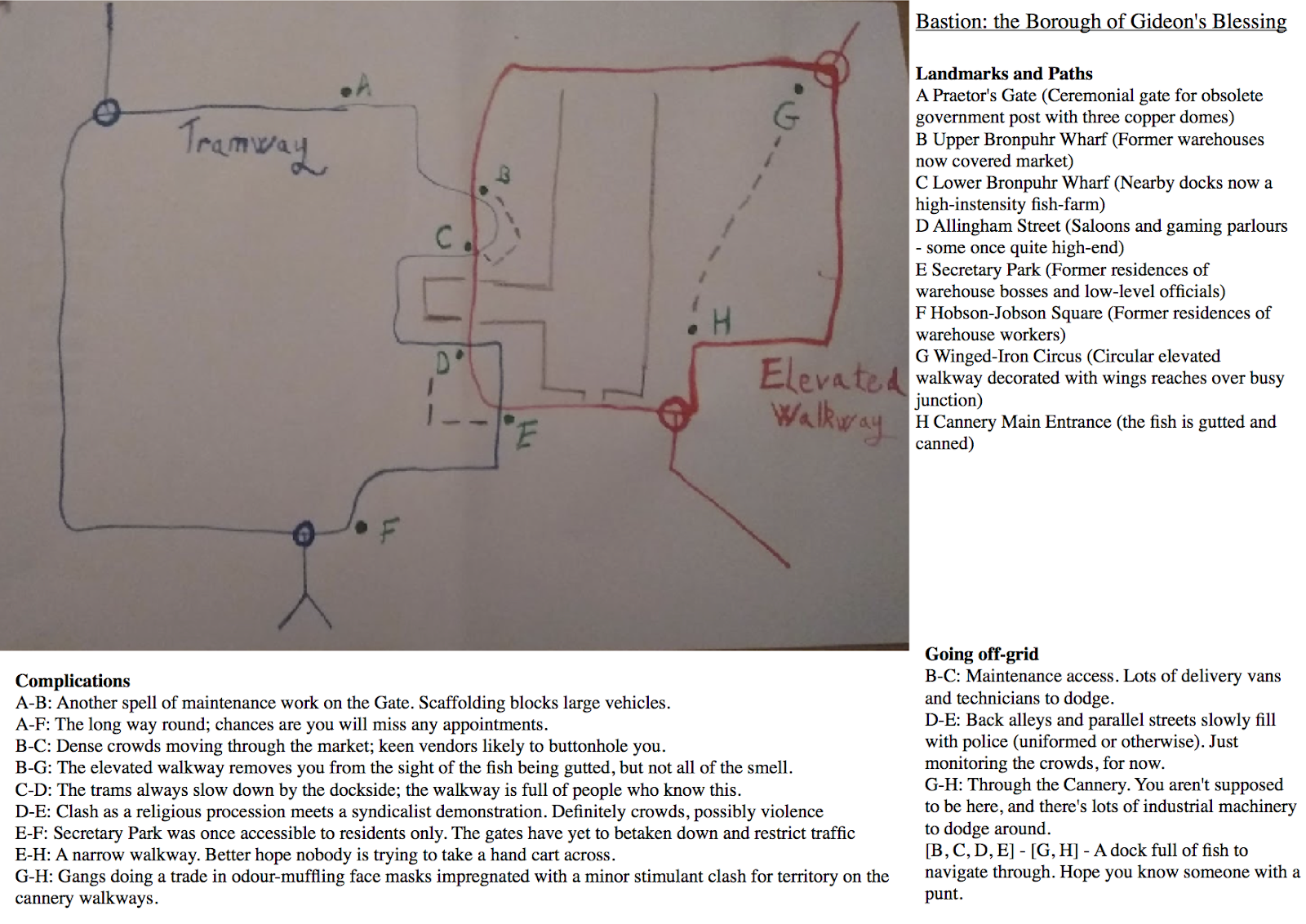
Using the Mapping pages from Electric Bastionland I have created several maps using the guidelines provided. There are two more to come...
Bastion: the Borough of Gideon's Blessing

Landmarks and Paths
A Praetor's Gate (Ceremonial gate for obsolete government post with three copper domes)
B Upper Bronpuhr Wharf (Former warehouses now covered market)
C Lower Bronpuhr Wharf (Nearby docks now a high-instensity fish-farm)
D Allingham Street (Saloons and gaming parlours - some once quite high-end)
E Secretary Park (Former residences of warehouse bosses and low-level officials)
F Hobson-Jobson Square (Former residences of warehouse workers)
G Winged-Iron Circus (Circular elevated walkway decorated with wings reaches over busy junction)
H Cannery Main Entrance (the fish is gutted and canned)
Complications
A-B: Another spell of maintenance work on the Gate. Scaffolding blocks large vehicles.
A-F: The long way round; chances are you will miss any appointments.
B-C: Dense crowds moving through the market; keen vendors likely to buttonhole you.
B-G: The elevated walkway removes you from the sight of the fish being gutted, but not all of the smell.
C-D: The trams always slow down by the dockside; the walkway is full of people who know this.
D-E: Clash as a religious procession meets a syndicalist demonstration. Definitely crowds, possibly violence
E-F: Secretary Park was once accessible to residents only. The gates have yet to betaken down and restrict traffic
E-H: A narrow walkway. Better hope nobody is trying to take a hand cart across.
G-H: Gangs doing a trade in odour-muffling face masks impregnated with a minor stimulant clash for territory on the cannery walkways.
Going off-grid
B-C: Maintenance access. Lots of delivery vans and technicians to dodge.
D-E: Back alleys and parallel streets slowly fill with police (uniformed or otherwise). Just monitoring the crowds, for now.
G-H: Through the Cannery. You aren't supposed to be here, and there's lots of industrial machinery to dodge around.
[B, C, D, E] - [G, H] - A dock full of fish to navigate through. Hope you know someone with a punt.
Deep Country: The Approach to the Joelite Range

Landmarks and Paths
A Second Nun Bend (A railway station largely dedicated to repairing the track dow to the river valley)
B Burn Reeving (A watch station is maintained at this point, despite the lack of river traffic or fishing trade)
C Pardoner's Crossing (The trains from the mines need to pass through here. That's all the importance it has.)
D Manciple Station (A former town, known for the cattle trade. Empty stockyards now inhabited by things other than cattle)
E Topaz Junction (Railway yard, with signal box and other buildings decorated with low-grade semi-precious stones from the mines)
F The Husband's Bath (By the junction of the rivers a large hole has been dug. Local stories claim a lazy husband was forcibly scrubbed there.)
G Barton Franklin (Once known for the quality of the waters; now known as the town you stop at one the way to the mines)
Complications
A-C Scree has blocked one of the rail lines
B-C A river toll levied at Pardoner's Crossing
C-E The signal station at Topaz Junction refuses to let anyone through. Desperate brigands hide there.
C-F The river is full of sharp rocks.
D-E Only one train in ten has any reason to stop at Manciple.
E-G The Prefecture Warden's deputies are conducting a search of the moors. You may be held at a way-station and interrogated.
Going Off-Route
Between A-C-F: Steep Slopes (Loose scree, dust, precipitous drops)
Between E-G: Damp Heath (hills, dense scrub, heather)
Downriver from F: Former Proving Grounds (Unexploded munitions, shell craters, barbed wire)
E-X: Out on the moors, a former hunting lodge can be seen. Behind it, something tall, covered in scaffolding.
F-X Across the river, the sandbag-clad bulk of an observation post.
G-X Below the railway cutting, a former sanatorium in heavily wooded grounds.
Part Two here.
Bastion: the Borough of Gideon's Blessing

Landmarks and Paths
A Praetor's Gate (Ceremonial gate for obsolete government post with three copper domes)
B Upper Bronpuhr Wharf (Former warehouses now covered market)
C Lower Bronpuhr Wharf (Nearby docks now a high-instensity fish-farm)
D Allingham Street (Saloons and gaming parlours - some once quite high-end)
E Secretary Park (Former residences of warehouse bosses and low-level officials)
F Hobson-Jobson Square (Former residences of warehouse workers)
G Winged-Iron Circus (Circular elevated walkway decorated with wings reaches over busy junction)
H Cannery Main Entrance (the fish is gutted and canned)
Complications
A-B: Another spell of maintenance work on the Gate. Scaffolding blocks large vehicles.
A-F: The long way round; chances are you will miss any appointments.
B-C: Dense crowds moving through the market; keen vendors likely to buttonhole you.
B-G: The elevated walkway removes you from the sight of the fish being gutted, but not all of the smell.
C-D: The trams always slow down by the dockside; the walkway is full of people who know this.
D-E: Clash as a religious procession meets a syndicalist demonstration. Definitely crowds, possibly violence
E-F: Secretary Park was once accessible to residents only. The gates have yet to betaken down and restrict traffic
E-H: A narrow walkway. Better hope nobody is trying to take a hand cart across.
G-H: Gangs doing a trade in odour-muffling face masks impregnated with a minor stimulant clash for territory on the cannery walkways.
Going off-grid
B-C: Maintenance access. Lots of delivery vans and technicians to dodge.
D-E: Back alleys and parallel streets slowly fill with police (uniformed or otherwise). Just monitoring the crowds, for now.
G-H: Through the Cannery. You aren't supposed to be here, and there's lots of industrial machinery to dodge around.
[B, C, D, E] - [G, H] - A dock full of fish to navigate through. Hope you know someone with a punt.
Deep Country: The Approach to the Joelite Range

Landmarks and Paths
A Second Nun Bend (A railway station largely dedicated to repairing the track dow to the river valley)
B Burn Reeving (A watch station is maintained at this point, despite the lack of river traffic or fishing trade)
C Pardoner's Crossing (The trains from the mines need to pass through here. That's all the importance it has.)
D Manciple Station (A former town, known for the cattle trade. Empty stockyards now inhabited by things other than cattle)
E Topaz Junction (Railway yard, with signal box and other buildings decorated with low-grade semi-precious stones from the mines)
F The Husband's Bath (By the junction of the rivers a large hole has been dug. Local stories claim a lazy husband was forcibly scrubbed there.)
G Barton Franklin (Once known for the quality of the waters; now known as the town you stop at one the way to the mines)
Complications
A-C Scree has blocked one of the rail lines
B-C A river toll levied at Pardoner's Crossing
C-E The signal station at Topaz Junction refuses to let anyone through. Desperate brigands hide there.
C-F The river is full of sharp rocks.
D-E Only one train in ten has any reason to stop at Manciple.
E-G The Prefecture Warden's deputies are conducting a search of the moors. You may be held at a way-station and interrogated.
Going Off-Route
Between A-C-F: Steep Slopes (Loose scree, dust, precipitous drops)
Between E-G: Damp Heath (hills, dense scrub, heather)
Downriver from F: Former Proving Grounds (Unexploded munitions, shell craters, barbed wire)
E-X: Out on the moors, a former hunting lodge can be seen. Behind it, something tall, covered in scaffolding.
F-X Across the river, the sandbag-clad bulk of an observation post.
G-X Below the railway cutting, a former sanatorium in heavily wooded grounds.
Part Two here.
Monday, 16 March 2020
Postcard Games: Improvised Playing Cards
In order to give your tabletop setting a little flavour, you might want to create a set of images or icons necessary to fuel, for instance, the symbols of the suits of playing cards, or the tiles of Mahjong or the signs of the Zodiac - or even the Loteria (thanks, Tim Powers). These aren't as such arbitrary, having their own heritage and meaning - but I would argue the way they are used can be and that any wider context for these (for instance, why the constellation of Capricorn is named as it is) rarely plays a part in their use.
I possess a (larger than necessary) collection of postcards purchased from Museums and Galleries over the years. These images would form the basis for the symbols involved. I decided to pick only the portrait orientated pictures - just as a real playing card. I excluded any repetitions or near-repetitions (for instance, Edward IV and Richard III, or two scenes of the Annunciation). I also excluded anything too close to an existing symbol (no fools or magicians), anything too modern or anything with an obvious literary root (a scene of HG Wells's Tripods, for instance).
The biggest grouping of symbols for fortune-telling, card games, aesthetic schemes &c, I thought to be the Tarot. So I drew three set of images:
4 Suits
3 Face cards
17 Major Picture cards (Major Arcana)
(This last figure was decided as being d12 + 10. That many unique images should serve most goals above. If putting a rule on this, I would say 1d6 suits, 1d4 face cards.)
So what did I get?
Well, we have our Suits:

Bears, Serpents, Rams and Owls. (I chose Serpent over Dragon to unify the suits as mundane beasts.)
Next, the face cards:

Huntsman, Syndic and Hierarch. Whoever these people may actually be, these are the names I am picking. Besides, 'The Hierarch of Rams' sounds rad.
And so, onto the picture cards:

The Flightless Bird, the Pyx and the Stylite.

The Charter, the Maiden of the Wilderness, the Battle

The Effigy, the Procession, the Mystic Rose [Cue TS Eliot]

The Companions, the Scholars, the Surgeon

The Glass, the Harper, the Hospitable Castellan

The Stairway, the Garden
[If you want to know where any of these come from, just ask and I'll post it in the comments.]
So, there it is. One pseudo-Tarot suitable for use in a constructed world at the tabletop, set aside from real iconography.
In-universe people might know and use the suits and face cards for games, but have no real knowledge of the picture cards. Your one fortune-teller or magician might know the meaning - and of course these meanings can be created in the course of play.
A method for creating sets of symbols - it could be used for artistic motifs or coats of arms or even street gangs (the South Side Mystic Roses?). Perhaps you don't even need postcards.....
I possess a (larger than necessary) collection of postcards purchased from Museums and Galleries over the years. These images would form the basis for the symbols involved. I decided to pick only the portrait orientated pictures - just as a real playing card. I excluded any repetitions or near-repetitions (for instance, Edward IV and Richard III, or two scenes of the Annunciation). I also excluded anything too close to an existing symbol (no fools or magicians), anything too modern or anything with an obvious literary root (a scene of HG Wells's Tripods, for instance).
The biggest grouping of symbols for fortune-telling, card games, aesthetic schemes &c, I thought to be the Tarot. So I drew three set of images:
4 Suits
3 Face cards
17 Major Picture cards (Major Arcana)
(This last figure was decided as being d12 + 10. That many unique images should serve most goals above. If putting a rule on this, I would say 1d6 suits, 1d4 face cards.)
So what did I get?
Well, we have our Suits:

Bears, Serpents, Rams and Owls. (I chose Serpent over Dragon to unify the suits as mundane beasts.)
Next, the face cards:

Huntsman, Syndic and Hierarch. Whoever these people may actually be, these are the names I am picking. Besides, 'The Hierarch of Rams' sounds rad.
And so, onto the picture cards:

The Flightless Bird, the Pyx and the Stylite.

The Charter, the Maiden of the Wilderness, the Battle

The Effigy, the Procession, the Mystic Rose [Cue TS Eliot]

The Companions, the Scholars, the Surgeon

The Glass, the Harper, the Hospitable Castellan

The Stairway, the Garden
[If you want to know where any of these come from, just ask and I'll post it in the comments.]
So, there it is. One pseudo-Tarot suitable for use in a constructed world at the tabletop, set aside from real iconography.
In-universe people might know and use the suits and face cards for games, but have no real knowledge of the picture cards. Your one fortune-teller or magician might know the meaning - and of course these meanings can be created in the course of play.
A method for creating sets of symbols - it could be used for artistic motifs or coats of arms or even street gangs (the South Side Mystic Roses?). Perhaps you don't even need postcards.....
Saturday, 14 March 2020
Electric Bastionland: First Thoughts
I put in a spot of money for the Electric Bastionland Kickstarter, and was duly rewarded with a PDF. So then, a few words on it, for the general discussion.
The book is roughly divided into three section: An Introduction with details of the Into the Odd rules, a list of character Failed Careers backgrounds and advice for play, involving details of the setting.
A presumed party of would-be adventurers automatically start with a debt and someone (or something) to whom they owe money. This skips neatly over the improbabilities of player characterisation and, frankly, allows a probable cause for the dangerous work of dungeon crawling in a city buzzing with money and possibility. Also, it adds an automatic contact - a mentor or benefactor, though also a predator. It's an elegant source of motivation.
This is bolstered by a list of Failed Careers and people you owe money to. It gives superb variety; there are about a hundred careers, each with unique items and skills attached. The city of Bastion, much like (for instance) Virconium or Gormenghast does not really have an official map or set of parameters. So the list of careers is the meat of the setting - setting up the main flavour of Bastionland. On top of that, the black and white art, full of blank faces and thin lines gives a very good impression of squalor, shabbiness, brash fashion and detached stylish opulence. There is a deliberate urban 'cool' to it in places.
Following this, as I said, is a set of advice for play. This is good, frankly. Neatly laid out, with bullet points grouped into threes. The advice for play and for the Conductor (GM or similar) seems sound - and, even if were you disagree with the philosophy, it is nearly laid out and comprehensible.
Electric Bastionland is not a toolkit for describing cities. Yes, as it says, Nobody's Bastion is incorrect, but Bastion is not a description of early-mid 20th century city life (and how to use that for tabletop RPGs). It is a more poetic rendering of the city, where the world is divided into Bastion, Deep Country, the Underground and the Living Stars. Other cities exist, but none can compete with Bastion. The City is moves and changes at astonishing rate - with nothing like a central authority, the Country is supremely hidebound, the Underground spectacularly dark.
One principles of the city boroughs of Bastion is that there is always a crowd; that if possible, a problem or obstacle should always be a human being. 'Mastery of People is Mastery of Bastion'. The city is always crowded, always living. Bastion has no business districts deserted at the weekend, no vibrant provincial towns with artistic colonies, no stifling domestic suburbs, no demands of a central government, no national spirit (nationalism within Bastion seems possible, but probably not of any simple type). Maybe I am thinking too much of the late twentieth century, mass communication and mass transit - but Metro-land and the Holloway of Diary of a Nobody certainly predate this.
It is a poetic cityscape, an archetype put into formal, almost ritualised terms for use on the tabletop. That isn't automatically bad - I've never felt that RPGs have to be simulations - but I like some of my wider context to be a little granular. It is so unremittingly urban-centric that I want to rejig my anti-urban setting to act as a mental counterweight. It works, and can work for a great many things.
I suppose I would square the circle by having Bastion as the metropole of a larger empire/alliance/federation &c, rather than the literal City beyond all Cities, even if it is that for all intents and purposes.
I like Electric Bastionland. I want to use Electric Bastionland. You may do so as well. I might post a few worked examples here. But remember what it is before you try to use the setting as it is on the page.
The book is roughly divided into three section: An Introduction with details of the Into the Odd rules, a list of character Failed Careers backgrounds and advice for play, involving details of the setting.
A presumed party of would-be adventurers automatically start with a debt and someone (or something) to whom they owe money. This skips neatly over the improbabilities of player characterisation and, frankly, allows a probable cause for the dangerous work of dungeon crawling in a city buzzing with money and possibility. Also, it adds an automatic contact - a mentor or benefactor, though also a predator. It's an elegant source of motivation.
This is bolstered by a list of Failed Careers and people you owe money to. It gives superb variety; there are about a hundred careers, each with unique items and skills attached. The city of Bastion, much like (for instance) Virconium or Gormenghast does not really have an official map or set of parameters. So the list of careers is the meat of the setting - setting up the main flavour of Bastionland. On top of that, the black and white art, full of blank faces and thin lines gives a very good impression of squalor, shabbiness, brash fashion and detached stylish opulence. There is a deliberate urban 'cool' to it in places.
Following this, as I said, is a set of advice for play. This is good, frankly. Neatly laid out, with bullet points grouped into threes. The advice for play and for the Conductor (GM or similar) seems sound - and, even if were you disagree with the philosophy, it is nearly laid out and comprehensible.
Electric Bastionland is not a toolkit for describing cities. Yes, as it says, Nobody's Bastion is incorrect, but Bastion is not a description of early-mid 20th century city life (and how to use that for tabletop RPGs). It is a more poetic rendering of the city, where the world is divided into Bastion, Deep Country, the Underground and the Living Stars. Other cities exist, but none can compete with Bastion. The City is moves and changes at astonishing rate - with nothing like a central authority, the Country is supremely hidebound, the Underground spectacularly dark.
One principles of the city boroughs of Bastion is that there is always a crowd; that if possible, a problem or obstacle should always be a human being. 'Mastery of People is Mastery of Bastion'. The city is always crowded, always living. Bastion has no business districts deserted at the weekend, no vibrant provincial towns with artistic colonies, no stifling domestic suburbs, no demands of a central government, no national spirit (nationalism within Bastion seems possible, but probably not of any simple type). Maybe I am thinking too much of the late twentieth century, mass communication and mass transit - but Metro-land and the Holloway of Diary of a Nobody certainly predate this.
It is a poetic cityscape, an archetype put into formal, almost ritualised terms for use on the tabletop. That isn't automatically bad - I've never felt that RPGs have to be simulations - but I like some of my wider context to be a little granular. It is so unremittingly urban-centric that I want to rejig my anti-urban setting to act as a mental counterweight. It works, and can work for a great many things.
I suppose I would square the circle by having Bastion as the metropole of a larger empire/alliance/federation &c, rather than the literal City beyond all Cities, even if it is that for all intents and purposes.
I like Electric Bastionland. I want to use Electric Bastionland. You may do so as well. I might post a few worked examples here. But remember what it is before you try to use the setting as it is on the page.
Saturday, 22 February 2020
Punth: An Interlude
The Primer: Chapters 1, 2, 3
Work on the land of Punth continues, albeit slowly. However, as I sketch out the next portion of the primer, I have been looking at setting and background.
In my one complete Punth hexcrawl I had laid out the complete background for Punth, the Qryth and so forth. I don't want to formally remove that from the Canon, but some of the questions of the setting should be left for interpretation.
People don't necessary pick up RPG books for a fully wrought adventure. I have no grand media empire to expect that anyone will be using all of Terrae Vertebrae. I'm not looking to fashion Lore. All worlds created in the course of gaming, I suspect, resemble Virconium more than they do Middle-Earth.
Of course, even a blank sheet of paper has limits, though one may draw whatever one wishes on it. The narrative in the hexcrawl post was fairly specific, but more about the past than the present. That narrative still holds fairly well to my image of Punth, but it is now the 'Lowest Common Denominator'. The story a scholar investigating Punth might most readily tell, based on generally accessible evidence. This is not the same as the absolute truth.
The Qryth are still green and four-armed; there was still a tower that fell, there are still deserts and sand-dunes.
But there are a few areas to decide for one's self:
- How sincere are the Qryth in their role as leaders - do they live by the Codes themselves?
- Can (and do) the Qryth communicate by other means than by the Codes?
- How competent are the Qryth? [Yes, stronger and faster than any human. But how well is Punth getting along?]
- What is the nature of the Ka-Punth's revolt against the Qryth? [Freedom fighters or terrorists?]
- If the Qryth were to die off, would the state of Punth maintain itself in roughly the same fashion?
- If the Qryth were to be contacted by their home planet, would they be welcomed home? Or have they been so thoroughly culture-warped and genefucked that they would never wish to?*
- What was the Sorcerer-King trying to accomplish?
- Can Punthites wield magic? Or must they rely on outsiders, willing or otherwise?
- Do the djinn have any genuine power, or are they only unquiet spirits?
- Do the djinn have any collective plan to regain their former power?
Anyway, the Primer rumbles slowly onwards. I might commission some art one of these days. An Appendix-N post might not be a bad idea.
*The Qryth's world presumably having developed along very different lines, so that a company of enlightened peaceable Star Trek-types could arrive to rescue a set of inbred maniac jarheads who have been playing the role of Colonel Kurtz with the natives - and react in horror.
Saturday, 15 February 2020
Alignment Embodiments
On the template establsihed by noisms:
Lawful Good - Aslan
Lawful Neutral - Judge Dredd
Lawful Evil - Mephistopheles
Neutral Good - Gandalf
True Neutral - Bartleby the Scrivener
Neutral Evil - King Casmir, Vance's Lyonesse
Chaotic Good - Asterix the Gaul
Chaotic Neutral - Conan the Barbarian
Chaotic Evil - The Un-Man from Perelandra
Any thoughts?
Lawful Good - Aslan
Lawful Neutral - Judge Dredd
Lawful Evil - Mephistopheles
Neutral Good - Gandalf
True Neutral - Bartleby the Scrivener
Neutral Evil - King Casmir, Vance's Lyonesse
Chaotic Good - Asterix the Gaul
Chaotic Neutral - Conan the Barbarian
Chaotic Evil - The Un-Man from Perelandra
Any thoughts?
Subscribe to:
Posts (Atom)