Warhammer Fantasy Roleplay, 1st and 2nd edition [Link]. The Skaven form a large part of that. In a comment of mine on one such review, I referenced the rats of Fritz Leiber's The Swords of Lankhmar as an inspiration for the Skaven. [Link] A month later here I am actually doing something about it, presenting a few extracts.
I would still contend that The Swords of Lankhmar is an inspiration on Warhammer Fantasy and the Skaven in particular - albeit an inspiration a few degrees lower than Michael Moorcock's Gods of Law and Chaos and that the Skaven have been notably reworked from their Lankhmarese ancestors.
I am quoting from the Mayflower Books paperback edition of The Swords of Lankhmar from 1970.
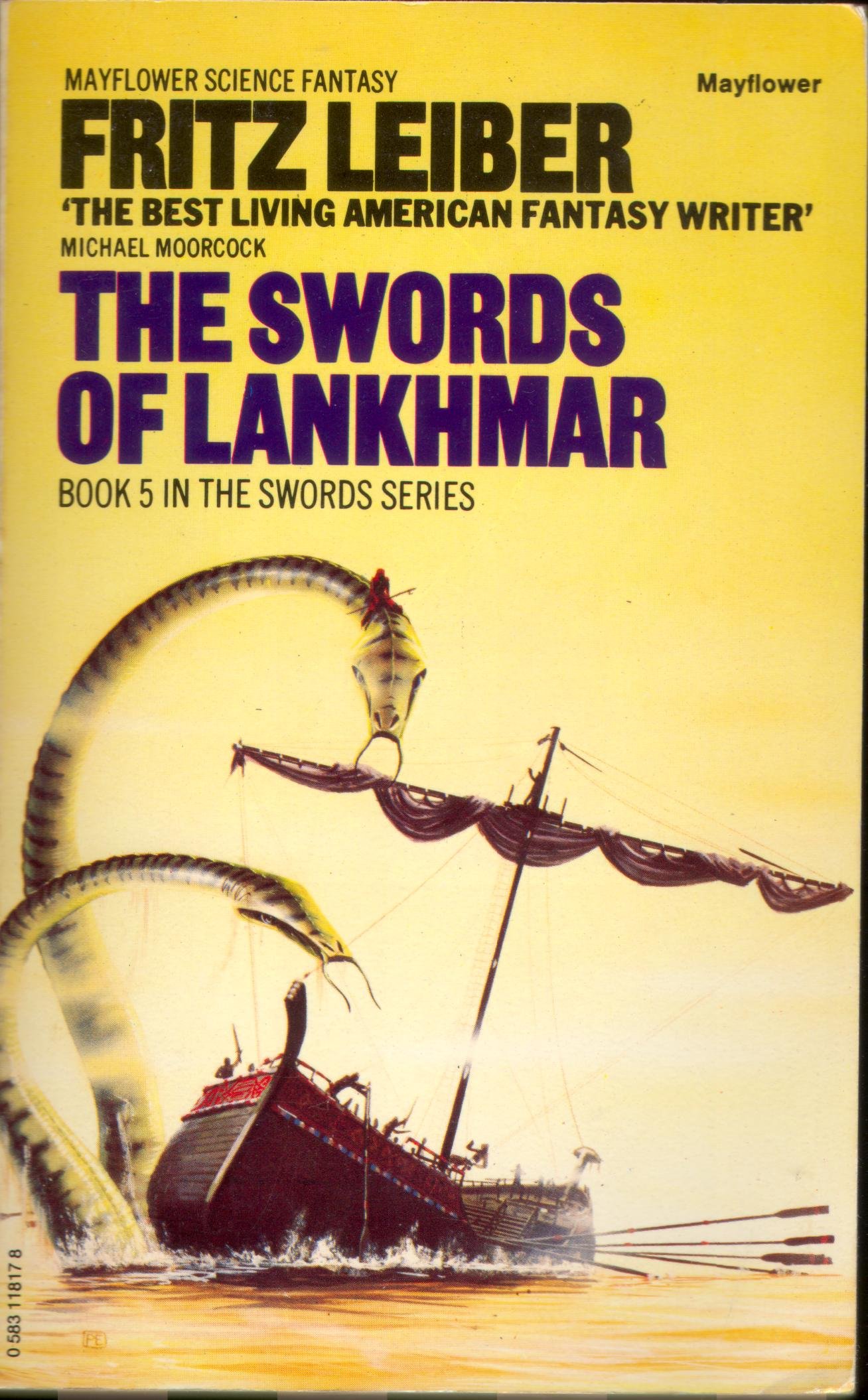 |
| Pictured. |
Those who lack knowledge of Leiber's adventures of Fafhrd and the Grey Mouser may wish to look them up first; see Wikipedia, for instance.
Chapter 5, Page 52. Skwee is a talented white-furred rat; Hisvet his carer (and more besides, not that our heroes know that yet).
The Mouser watched the little scene with clouded and heavy lidded wonder, feeling that he was falling under some kind of spell. At times, thick shadows crossed the cabin; at times Skwee grew as tall as Hisvet, or perhaps it was Hisvet tiny as Skwee. And then the Mouser grew small as Skwee too, and ran under the bed and fell into a chute that darkly swiftly sped him, not into a dark hold of sacked or loose delicious grain but into the dark spacious low-celinged pleasance of a subterranean rat-metropolis, lit by phosphorus, where robed and long-skirted rats, whose hoods hid their long faces moved about mysteriously, where rat-swords clashed behind the next pillar and rat-money chinked, where lewd female rats danced in their fur for a fee, where masked rat-spies and rat-informers lurked, where everyone - every-furry-one - was cringingly conscious of the omniscient overlordship of a supernally powerful Council of Thirteen, and where a Rat-Mouser sought everywhere a slim rat-princess named Hisvet Sur-Hisvin.
I should note now that the Council of Thirteen is in reference to the Nehwon legend that '...for each animal kind...there are always thirteen individuals having manlike (or demonlike!) wisdom and skill.' (Chapter 2, Page 26). A legend we learn to have some very real truth to it. The Grey Mouser here has in fact been drugged (not that he is presented as un-whimsical when not high as a kite), but the image of the under-empire and shrinking prefigures later events. This paragraph with its Council of Thirteen and political intrigues does seem to have much of the Skaven about it - albeit in a rodent polity that, however grim, seems significantly more pleasant than life in the Under Empire. The Skaven as eventually presented would, of course, separate out this Council of Thirteen and the white-furred rats into the political and religious leadership of the Skaven.
The rats of Lankhmar are not humanoid and are of normal size - albeit they are highly organised, armed and determined in their ambitions for dominance. The rat plague in Lankhmar produces the following speculation in Chapter 7, page 92.
Their behaviour made old folks and storytellers and thin-bearded squinting scholars fearfully recall the fables that there had once been a humped city of rats large as men where imperial Lankhmar had now stood for three-score centuries; that rats had had a language and government of their own and a single empire stretching to the borders of the unknown world, coexistent with man's cities but more united; and that beneath the stoutly mortared stones of Lankhmar, far below their customary burrowings and any delvings of man, there was a low-celinged rodent metropolis with streets and home and glow-lights all its own and granaries stuffed with stolen grain.
The ancient, unified, vasty empire of the rats. Skaven unity may be a tenuous thing, but this paragraph fits very nicely into some of Manola's thoughts more specifically on the Skaven here - their power, their depth, their secrecy. The Skaven may have gatling guns, weaponised plagues and ninja skills (among other things) and may be twice as cruel as any of the Lankhmarese rats but there seems a goodly thematic connection here - the Skaven as a (warped, diseased) limb of the tree with Leiber's roots.
***
I will also use this space quickly to mention the line between The Swords of Lankhmar and Terry Pratchett's first Discworld novel, The Colour of Magic. The obvious link is the brief appearance of pastiches Bravd the Hublander and The Weasel - not uncommon for the fantasy-satirising early Discworld books, though the prose style for those fragments concerning them seems decently Leiber-esque on a brief overview.
However, other elements emerge. The City of Ankh-Morpork might sound like Lankhmar, and be as rotten but Pratchett has denied a specific connection. The political offices of Overlord and Patrician have a similarity; the Lankhmarese symbols of starfish (and other piscatorial emblems in the palace and fleet of Lankhmar) chime with the seafood sweetmeats of the Patrician in The Colour of Magic. Lankhmar's tavern Silver Eel has a likeness to Ankh-Morpork's Crimson Leech. The various Guilds of Assassins and Thieves perhaps owe something to Leiber.
This early version of Pratchett's Death, irked by Rincewind's survival and active trying to ensure his demise must owe something to the Death of Nehwon (absent - at least personally - from the pages of Swords of Lankhmar). The Overlord of Lankhmar's vessel for slipping out of the bubble within which Nehwon is said to sit and through the oceans of the universe to another world bears a conceptual resemblance to the wizards of Krull and their vessel for journeying around Great A'Tuin. Nehwon's Year of the Leviathan or Month of the Serpent are similar to Discworld's Century of the Fruitbat or Year of the Intimidating Porpoise. I also rather suspect that Blind Io owes at least a little something to Ninguable of the Seven Eyes.
Finally, (and rounding off the animal theme of this post), the notion of Albatross mail might well be unique to these two fantasy series.