Showing posts with label Not Really a Review. Show all posts

Monday, 16 March 2026

Solomon and Saturn: Saxon Sages

I recently discovered the Old English dialogue of Solomon and Saturn. This is, of course, highly relevant to my interests

There are several of these dialogues, either in poetry or prose. They appear back to back in the same manuscript and are largely thought to have been written at the end of the first millennium. Saturn is here a Prince of the Chaldeans, though not without some measure of knowledge. Solomon is still Solomon, but without some of the more oriental aspects with which he is sometimes presented (see Kipling, for instance, aside from the whole business of summoning demons). 

Saturn calls on Solomon, setting him a series of questions, sometimes with a reward. He either trying to get details of the power of the Lord's Prayer, or quizzing him about the state of the life of man, the nature of creation and God's will. In the former he is sceptical and offers a sounding-board for Solomon's long discussions of the power of prayer. In the latter, he becomes a testing, probing presence; not diabolic, but clearing pushing at a few boundaries. 

Here's an example of the text:

SALOMON cwæð:

Þæt gepalmtwigude  Pater Noster
heofnas ontyneð,  halie geblissað,
Metod gemiltsað,  morðor gefilleð
adwæsceð deoflesfyr,  Dryhtnes onæleð.

Solomon said: The palm-twigged Paternoster opens heaven, blesses the holy, makes the Lord mild, fells murder, extinguishes the devil's ire, kindles the Lord's.

The Lord's Prayer is not only potent, but highly decorated: 'Golden is the word of God, studded with gems, it hath silver leaves...'. The letters of it are themselves given magical and specific associations.

prologa prima  ðam is . ᛈ . P. nama;
hafað guðmæcga  gierde lange,
gyldene gade,  ond a ðone gr[im] man feond
swiðmod sweopað;  ond him on swaðe fylgeð
. ᚪ . A . ofermægene  ond hine eac ofslihð.
. ᛏ . T . hine teswað  ond hine on ða tungan sticað,
wræsteð him ðæt woddor  ond him ða wongan brieceð.

prologa  prima,  which  is
named . ᛈ . P.: the warrior has a long staff, with
a golden goad, and brave he ever swipes at the
grim fiend; and in the track . ᚪ . A . pursues him
with mighty power and also strikes him. . ᛏ . T.
injures him and stabs him in the tongue, twists
his throat, and shatters his jaws.

The prose dialogue features a battle where between the devil and the Paternoster where they take on various forms:

Solomon said: The devil first will be in youthfulness, in the likeness of a child, then the Pater Noster will be in the likeness of the Holy Spirit. In the third instance the devil will be in the likeness of a dragon; in the fourth instance the Pater Noster will be in the likeness of an arrow, which is called brahhia dei. In the fifth instance the devil will be in the likeness of darkness; in the sixth instance the Pater Noster will be in light’s likeness. In the seventh instance the devil then will be in the likeness of a wild animal; in the eighth instance the Pater Noster will be in the likeness of a whale that is called Leuiathan.

Saturn even desires to know of the Features of the Paternoster.

Saturnus quoth. But what kind of head hath the Pater Noster?
Salomon quoth. The Pater Noster hath a golden head and silver hair; an although all the waters of the earth should be mingled with a the waters of heaven into one channel, and it should begin to rain them together upon the earth and all its creatures, yet might it stand dry under a single lock of the Pater Noster's hair; and his eyes are twelve thousand times brighter than all the earth, though it be overspread with the brightest lily-blossoms, and the leaf of every blossom should have twelve suns, and every blossom twelve moons, and every individual moon should be twelve thousand times brighter than it was ere Abel's murder.

'The world was young, the mountains green, no stain yet on the moon was seen'?

And in the Pater Noster’s right hand is the likeness of a golden sword, unlike all other weapons; its gleam is clearer and brighter than all the constellations of the heavens, than there are ornaments and fairness of gold and silver in all the earth: and the right edge of the lordly weapon, is milder and more moderate than all the sweetness or the perfumes of the earth; and the left edge of the same weapon, is fiercer and sharper than all [middle-earth], though between its four pinnacles it should be driven full of wild-beasts, and every individual beast should have twelve horns, and every horn twelve tines of iron, and every tine twelve points and every point should be twelve thousand times sharper than an arrow which has been tempered by a hundred and twenty hardeners. 

The assorted hyperbole and vast numbers and shifts of perspective are somewhat psychedelic, even faintly Hindu in a certain light.

Solomon was more famous; however, Saturn, the bold strategist, had the keys of certain books in which learning was locked. He wandered through all the lands: the land of India, the East Cossias, the kingdom of the Persians, Palestine, the city of Nineveh, and the North Parthians, the treasure halls of the Medes, the land of Marculf, the kingdom of Saul – where it lies south by Gilboa and north by Gadara – the halls of the Philistines, the fortress of the Cretans, the forest of the Egyptians, the waters of the Midians, the cliffs of Horeb, the kingdom of the Chaldeans, the skills of the Greeks, the race of the Arabians, the learning of Libya, the land of Syria, Bithynia, Bashan, Pamphylia, the border of Porus, Macedonia, Mesopotamia, Cappadocia, Christ’s homeland – Jericho, Galilee, Jerusalem.

Saturn is well-travelled, well-read - but not quite supernatural. He might be associated with gloom and be a fairly melancholy type and ask questions about old age, but isn't the god of old age.

Saturnus cwæð:
Nieht bið wedera ðiestrost,  ned bið wyrda heardost,
sorg bið swarost byrðen,  slæp bið deaðe gelicost.

Solomon cwæð:
Lytle hwile  leaf beoð grene;
ðonne hie eft fealewiað,  feallað on eorðan,
ond forweorniað,  weorðað to duste.
Swa ðonne gefeallað  ða ðe fyrena ær
lange læstað,  lifiaðhim in mane,
hydað heahgestreon,  healdað georne
on fæstenne  feondum to willan,

Saturn said: Night is the darkest weather, need the hardest of fates, sorrow the most oppressive burden, sleep is most like death.

Solomon said: Leaves are green for a short while, then later they fade, fall on the earth and decay, turn to dust. Just so, then, fall those who earlier persist for a long time in their sins – they live in crime, they hide great treasures, they hold them eagerly in strongholds, to the delight of  the enemies....

I've been dancing between two translations here, accessible by an academic library: that of Dr Daniel Anlezark and that of John Kemble. You can find the latter here and a third partial for comparison here.

It's not a unique piece of work: one sage setting riddles for another is a familiar enough pattern for Norse legend. But the introduction of Saturn and Solomon as protagonists is noteworthy, though not unique. There's a few interpretations I've come across since encountering this on the shelves a few days ago; that this is a form of catechesis is one. 

But I've not tapped the limits of what's in this poem - for instance, the vast bird, feared by the Philistines (and by Saturn) and called by them Vasa Mortis, due to appear at Doomsday. Anlezark says in his commentary 'the Vasa Mortis passage ranks as one of the most obscure in Old English'. Anyway, there's a greater variety here (if perhaps less focused) than in the tale of St Erkenwald. For your consideration?
Tuesday, 15 April 2025

March-April 2025 Miscellany

A busier than expected last few months, which included a chance find of Black Lamb and Grey Falcon, as memorably reviewed by Patrick Stuart. I don't plan to address that here - I'm not certain I'd really care to review it at all - but it's worth reading, however weighty a tome it is.

Some less weighty tomes included....

***

A Wonderful Welcome to Oz

That being a collection of The Marvellous Land of Oz, Ozma of Oz and The Emerald City of Oz. All written by L. Frank Baum, but put into one volume by A) The Modern Library Classics and B) Gregory Maguire, the author of Wicked. (Which you may or may not know as a sort of parallel narrative to The Wizard of Oz published in 1995).

The three volumes so picked are sequels to Baum's first, The Wonderful Wizard of Oz (1900); Marvellous Land (1904) and Ozma (1907) being the second and third books and Emerald City (1910) being the sixth. Baum, despite a sensational novel, was not good with money, and kept writing them through most of the rest of his life. A Wonderful Welcome to Oz maintains as near as possible the illustrations of John R. Neill, who illustrated most of Baum's Oz books.

I saw this second-hand and grabbed it, largely because I have no connection to Oz whatsoever. The 1939 film rather passed me by as a child, and I have never seen an edition on a library shelf. Yet we still have extensive reference to it, and various revivals or revisions or similar - as witness Maguire's Wicked, and adaptations thereof. 

So do I regret a childhood without Oz? I may say that I do not. In certain respects, it summons up the image of an Alice in Wonderland without the attendant dislocation and peril. The conceit and spleen of Wonderland's inhabitants is sharper than the whimsy and peevishness of the Ozites, however similar the narratives may be. There is a picaresque, unconnected quality to the plot, especially in Emerald City

It does all read as very American, of course. It is written by an American and Americans often appear; Oz itself is at the centre of a sparsely inhabited continent. This is on top of lunch-pails growing from trees, or the pragmatic and industrious conceit of the Tin Woodman. Perhaps it's something to do with the air of a well-fed and self-satisfied citizenry? Calling it America's fairyland makes a great deal of sense, I suppose. 

I note that in Oz, men are either A) Non-entities or B) Remarkable but pretty useless eccentrics. Women are sylphs possessed of wide-ranging magics, witches or (merely) driven, competent and practical. If a man happens to possess any of the latter traits, he will turn out to be a woman in disguise. (Applications of the above to any land other than Oz are made at the reader's own risk.) I wonder what Chesterton would have made of this?

Anyway, I remain (alas) unenchanted. 

***

The Etruscan, Mika Waltari (1955; translation into English published in Great Britain 1957)

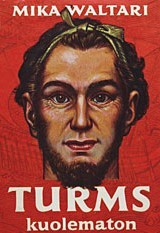
In its native Finland, this was first published as Turms, Kuolematon

A mercenary (Turms) in 5th century BC Greece has to uncover his own background and supernatural significance, believing himself to be cursed. A comment a year or so back brought it to my attention. I think I had heard of The Etruscan before (and Waltari, if only for being something like the only Finnish novelist with a Hollywood adaptation). I will push a little against Alec - Soldier in the Mist reads like Wolfe's use of Waltari's premise, and even plausibly might be a sequel (Turms sends off soldiers to aid  Persia in Xerxes's invasion of Greece towards the end of the book, and these might have included Latro.) There's also differences in tone: Wolfe's supernatural elements are more blatant and the appearance of historical figures more obvious (Pindar, Themistocles). Turms is doing something like writing his memoirs; Wolfe maintains the structure of Latro's day to day use of the scroll. 

The Etruscan also covers a longer span of time. Turms goes from cast-up soldier to maturity, with several years-long stays in various places or roles.  His gradual apotheosis involves not a little heartbreak and blood - and he aids some fairly vile people in his progress. It's just on the historical side of the border between fantasy historical fiction, maintaining that place despite Turms growing to become a sort of priest-king called a Lucumon and referring to himself as an immortal (Turms Kuolematon translating to Turms Immortal). An interesting comparison might be Votan. I think this will reward your curiosity. 

***

Another chance find was The Modern World, Steph Swainston. I think that a longer piece would be necessary to do justice to her Castle novels, but suffice it to say that I think they work fairly well. The central image of the Castle itself, with its competitive immortals, medieval stylings, mysterious Emperor and constant apocalyptic threat represent the sort of setting that would be good for those looking to do something with Space Knights outside 40k.

***

There is a new edition of The 52 Pages, together with the Next 52 Pages! I have a personal attachment to this system, and have used it for some of my work on this blog - but if you have an interest in a nice compact (and free!) RPG system, do take a look!

***

You may or may not know that there is a Price Drop for False Machine products - if you were on the fence, perhaps this is a time to take the plunge.


Sunday, 30 June 2024

May-June Miscellany 2024

Naomi Mitchison,  The Corn King and Spring Queen

Can't say I was as taken by this as False Patrick, but still very good. It's an interesting comparison with (say) some of the character work of Rose Macaulay or the pre-occupations of some of C.S. Lewis's lesser known stuff. There's also probably a big wedge of Bloomsbury Group in there that I'm too uptight and square to properly grok. 

Comparisons aside, this thing is rich. Rich interior lives, rich in its extensive cast, generous in the scope of the plot, rich in description: it reads as the work of someone who has done things with their hands often enough to know about sewing or ploughing or hunting or dancing what have you - rather than the perspective of someone who only knows plate armour through a video game. 

***

Eamon Duffy, The Stripping of the Altars

I've had this for ages, but only just got round to reading it. Well worth it, and quite digestible. The photographic plates help. It's clearly a standout work in its field - Cf. what Wikipedia says as a general assessment - and I see why it was referenced in my university courses. 

Should you read it? Well, I think that if you're an Anglosphere type with an interest (academic or practical) in your history and culture, reading a few chapters from the first half would be very worthwhile - for religious ignorance reasons gestured at in some of my recent work. If you've read any proper history you can spot Duffy's focus and/or agenda, but that's not necessarily important. 

***

Lucan's Civil War or Pharsalia

Almost finished this at time of writing. Not one of the more prominent classical epics, but an interesting read all the same. Part of this is the subject matter: the clash of Julius Caesar and Pompey the Great after the former crosses the Rubicon. Familiar territory, even fictionalised - but not in the conventions of the epic. The civil war angle is not neglected, and the tragedy of events is clear. Added to this is the fact that it is describing real battles and troop movements, and largely leaves out Divine intervention, makes it rather interesting to compare with Virgil or Homer.

All that said, there are some thoroughly sensational moments. A carefully described reading of the entrails in Book One, a consultation of a Thessalian witch, Cato's army harassed by snakes. Is this the B-Movie of Classical epics? (Probably not.)

Another consideration is that Lucan was writing in the early days of the Emperor Nero. There's some praise for his ancestor Julius, though however potent Caesar is, Pompey gets the more enduring praise. 

'Pharsalia', incidentally, is the name of a battle between Caesar and Pompey in northern Greece, in the region around the town of Pharsalus (now Farsala). So I suppose you could call Lucan's Civil War something like The Battle of Pharsal County (which sounds rather American) or The Clash of Farsalmark (for something faintly Nordic). 

I read the translation by Susan H. Braund, but I've been comparing material elsewhere - including the Early Modern rhyming version by Sir Arthur Gorges, which may be found here.

***

Celine and Julie go Boating, dir. Jacques Rivette, 1974

Have you ever wanted to see what would happen if someone took late-period Tim Powers and made it significantly more French? Well, here's a good place to start. The mix of a contemporary setting and a supernatural house is arresting and well-executed - once you've got into the groove of the film.

***

Metropolitan, dir. Whit Stillman, 1990

Utterly unseasonal, though I didn't know that when I picked it up. A curiously touching film, though this is in part perhaps the result of living in a young city while being less than aged myself. There's some interesting currents in it - and I suspect the use of the tune to Luther's hymn Ein feste Burg ist unser Gott is no mistake.

***

The Mark of Zorro, dir. Rouben Mamoulian, 1940

Starring Tyrone Power. You don't need me to tell you this is good or influential and I won't try to comment on the sword fights. Other people can do that. 

What I think makes this worthy of note - and it's something I don't see discussed to the same degree - is the elements of disguise and secret identity. Don Diego Vega - the man they call Zorro - is deliberately concealing his motives and character, making himself into a ridiculous, useless fop. There are good reasons to do this, and Vega clearly has or had some frivolous facets to his character - but unlike Robin Hood concealing himself or the various versions of Bruce Wayne that have appeared on the screen, this is painful or costly in ways that aren't seen elsewhere. His father is openly contemptuous of him, his mother loves him but in a somewhat disinterested way, his old teacher barks at him and he must humiliate himself in front of his love interest and the villain. High literature this isn't, but the willingness to put a distinct social (psychological?) cost on his subterfuge gives this a bit more weight (Cf. Christian Bale getting to have his cake and eat it too as both playboy and vigilante).

Dr Syn dealt with this from time to time as well, though there things are complicated by the Vicar of Dymchurch's dark past. 

***

There's a poem of C.S. Lewis I encountered recently. It doesn't really apply to my post on Saturn, but it's certainly adjacent to the whole matter.

Anyway, from 'La Roi S'Amuse':

Jove gazed
On woven mazes
Of patterned movement as the atoms whirled.
His glance turned
Into dancing, burning
Colour-gods who rushed upon that sullen world,
Waking, re-making, exalting it anew –
Silver and purple, shrill-voiced yellow, turgid crimson, and virgin blue.

(Cue for music.)

It's a complex bit of rhyming, tricky to read aloud. Find the rest here

***

Sinjin - a new piece of work by Mateo Diaz Torres, who did Pilgrim. Again, available on Itch.io. Black and white artwork from a variety of artists.

Quote:

A century ago, the Black Heron College performed an experiment into the nature of Death and caused a great disaster. The site of this catastrophe came to be known as The Saint John Forbidden Territory.   

A hundred by hundred yawning miles of sawgrass, palmetto hammock, winding river, and overrun industry—all reclaimed by the Dead. In the territory, the land forgets itself, geography flexing and twisting like a straining muscle, the progression of days stuttering and jumping like a broken zoetrope.  

You are a freelance exorcist, compelled or driven to enter the Territory. You wield the remnants of Death's instruments: arts and tools left over from Her now-unfinished work. It is your duty to carry on against the growing disaster. The depths spread, and the Dead stand against you.  Put them back in their graves.

No Appendix N provided, but I would agree with other reviewers in detecting the influence of Garth Nix's Old Kingdom books and Annihilation. Though the overgrown sprawling abandoned Louisiana buildings of season 1 of True Detective kept springing to mind. Southern Gothic abounds. 

The territory itself is a limited space that keeps changing. As a region, it's probably no bigger than a county - but, as above, it contorts. The fixed landmarks are the same, but the connecting elements will shift - as will the climate. There's something of Darkest Dungeon in this, in which an opulent and imperial mansion has an improbable number of rooms. Indeed, it would be interesting to have something like a quartet of Sinjin-esque regions one could enter.

Sinjin is worth your time - though there's something that caught my eye. The setting is '19th century pastiche not-Florida' - there's the implication of a state outside it, and several regions are mentioned, including the San Serafin of Torres's New Barbary setting. This has the side effect of making me think of what lies outside Sinjin. The organisations that send you into the territory are these slightly-too parallel groups of exorcists. 

Part of me itches for...well, A) a sketch of geopolitics and cultural shockwaves and B) asymmetry. To explain on the latter - the differences and clashes between groups and styles in the territory: professional and amateur, government and private, religious and secular, cautious and imprudent. But this is a very particular issue and should not put anyone else off.

Wednesday, 22 November 2023

Troika: Some Thoughts

I hadn't read Troika when it first came out, and made a splash. I saw on sale as a PDF, and acquired it. Now, some thoughts.

***

Troika: you may know - but I'm going to restate it anyway - who this is by. 'Written by Daniel Sell. Illustrated by Jeremy Duncan, Dirk Detweiler Leichty, Sam Mameli, and Andrew Walter.' These chaps are attached to the Melsonian Arts Council. 


What's it attempting to do? Time for a quote.

Here is Troika!: a science-fantasy RPG in which players travel by eldritch portal and non-euclidean labyrinth and golden-sailed barge between the uncountable crystal Spheres strung delicately across the hump-backed sky. 

What you encounter on those Spheres and in those liminal places is anybody’s guess — I wouldn’t presume to tell you, though inside this book you will find people and artefacts from these worlds which will suggest the shape of things. The adventure and wonder are in the gaps; your game is defined by the ways in which you fill them.


Does it achieve this? Hmm. Apologies, this is going to get into the sub-genre weeds. Now, to my mind Science Fantasy is something like CL Moore's Northwest Smith or Leigh Brackett's Eric John Stark. A twinning of Science Fiction and the Fantastical, something a touch more out there than the use of Barsoom for two-fisted adventures. 

I might suggest tentatively that Sword-and-Planet involves (whatever the mysteries required by the plot) a grasp of essential skills and understanding of the world: John Carter is of the profession of arms, and may apply himself to his chosen trade on Earth or Mars. Science Fantasy involves moving from the familiar to the strange by the characters: from the world of space flight and blasters to psychic aliens and time shifts. Cf. Star Wars: the mechanically-skilled farm boy enters not merely into a galactic war, but a journey with a spiritual dimension. Feudal Futures (or a category including Feudal Future) involve starting and staying in an unfamiliar place. 

But, of course, the most obvious influence on Troika! is Gene Wolfe's The Book of the New Sun. If you've read both, this isn't news. Reference to Cacogens, Clavigers, Alzabo, the Phoenix Throne, a familiarly phrased 'Journeyman of the Guild of Sharp Corners', Notules, golden-sailed space-faring ships....all due respect to the author, but this path of influence is fairly clear. Besides, the blatant isn't always bad: here are some tools for the Wolfe-like, use them as you will. 

Anyway, in some ways all I've written there is merely surface. The underlying meat is the mixture of science and magic, in less than clear-cut ways. In some media, the mixture or confusion is benign, and comprehensible: see the invocation of Clarke's Third Law in Marvel films, for instance, or the various magi-tech urban settings of some RPGs. In others, it is horrifying - whether one of Lovecraft's Great Old Ones is merely a incomprehensibly vast working-out of natural laws or a staggering violation of those laws, it barely matters, given the results. 

In The Book of the New Sun, it is dismaying to see such ruin as has resulted in a great confusion of science and magic, but not as such baleful. In Vance's Dying Earth, it is awe-inspiring (if still ruinous). If the melding or conflusion is thorough enough, we speak of the Weird, the uncanny. If I say New Weird, some minds will instantly move to Miéville's Bas-Lag. To my mind this is a less pure example than (say) Steph Swainson's The Year of Our War.

All this is to indicate, if I may, that Troika! reads as sufficiently immersed in its world to be more like New Weird and Feudal Future than Science Fantasy as I read it. It lacks a foot in the familiar. This probably suits its purposes, and is bolstered by the presentation. 

An example, if you will pardon me.

Troika, P.7, Character Creation

This is one of the pre-generated characters you can roll into. Now, what does this suggest to you? A retired reaver? Dad-bod Elric? Frank Frazetta's King of the Hill?

Well, here is how Dirk Detweiler Leichty chose to illustrate that entry:

There is a hammer, but not a Warhammer.

Now, Detweiler Leichty will be quite tightly linked in my mind to the grand decay and meshing of mechanical and biological and otherworldly shown in Silent Titans. Is this true for the bulk of Troika's intended audience? Perhaps. Either way, the restricted but vivid colour, the geometric slashes, the dense lines, the hints of a roiling interior, 'the interlacing of the imagined organic/personal with the imagined space', indicate a distinction from the familiar lines of fantasy art - the thousand variations on Viggo Mortensen's Aragorn on paperback covers, or the older technicolour depictions of the 'cod-archaism of a Renaissance faire'. Either way, this is a deliberate indication of something distinct: a suggestion of several moods rather than one set icon. 

So, Troika steps out boldly in a new direction. And doesn't trip over its shoelaces. 


Would I use it? You're talking to the wrong fellow, but I'll take a stab. Troika's a chunkier beast than the W-B&W-G-backed 52 Pages, but then it is seeking to indicate a mood and world definitely not D&D. Call it a hundred pages, minus the included adventure. 

The d66 system - simple enough once your head's in the right place. Luck as a stat always rings a little off to me - pace Fallout - but when other stats have been pared down so far or amalgamated into Skill and Stamina, I can see why you would want a nebulous 'significance' stat to move around a focus as desired. Thinking on it, a (relative) resignation to (or acknowledgement of) the whims of fortune or the workings of fate does seem fitting for the intended genre.

A few more words on how Advanced Skills are meant to be distributed in one's own Backgrounds would be preferable. There's some obvious models, but a step-by-step somewhere would be good.

The notion of a stack of items to indicate turns is all very well, but could be troublesome on the table -where does the stack live, who can see it, &c.

Pinch of salt to the above: this is all speculative. 


Gleanings: Things to pull out and use.

  • Witch-hair ropes 'immune to manipulation via magical means.'
  • 'Salt is the poor man's silver'.
  • Brittle Twigs is an impressively folk-lorish spell.
  • This description, from the spell Iron Hand - 'The common man does not appreciate exactly how close flesh and iron are when considered relative to, say, flesh and the smell of hot tea.'
  • The Donestre: strange deadly melancholy many-headed lions.
  • I think more settings can find room for Lamassu and Rhino-men.
  • Beef and Liberty is apparently one of those perennial human obsessions.
  • Pocket Gods seem an interesting extension on Lord Dunsany's various small deities


Conclusions: Well, I'm not certain that Troika hits a level of Conceptual Density for me. But then, I've read a bunch of Wolfe already, and even written something inspired in good part by him. So it might do something for you, and I cannot really regret flipping through Troika all that much. Modified rapture.

Friday, 25 August 2023

August '23 Miscellany - and a Notion Entertained

A few things to flag up for you, largely unrelated to recent posts - as well as brief section once again Entertaining a Notion.

***

A Return to Saxherm: if you hadn't already encountered it, HCK over at Grand Commodore has recently posted an audio version of his story 'The Crimes of Jack Daw', set in my own Saxherm, which was created using his city-state creator. (Check the comments of that post for a series of people drawing up their own cities, and perhaps make your own!)

***


I enjoy the work of Tim Powers, and so when I saw a paperback by his fellow Ashbless scholar James P. Blaylock, I decided to pick it up. That was The Stone Giant, and it rather left me cold. The obliviousness of its main character mixed oddly with the very directly fantastical elements. 

But seeing a copy of The Last Coin, I decided to try again.

This is more like his pal Powers. Set in Seal Beach, California (part of the greater Los Angeles area; I assumed reading it that it was a pastiche of somewhere rather than a real place), contemporary with the book's publication (1988) it is about the assembly of the Thirty Pieces of Silver paid to Judas Iscariot by an old man called Pennyman. But most of it is told from the point of view of Andrew Vanbergan, who is trying to open an inn, and deal with aged relatives, and get the right kind of breakfast cereal, and...

There is the perennial comment about how stupid people in horror films are, how they ought long ago to have gone down to the basement, and sat there with a shotgun pointed at the door. Vanbergan is, like the lead of The Stone Giant, oblivious and fussy and caught up with his own mundane troubles - and this is exactly as he should be. It is a wild leap for a man in 1988 to work out that someone is gathering thirty very particular pieces of silver, even if we know it from the prologue or the blurb. Watching someone not quite notice and not quite understand what is going on is exactly how this should be going. 

The grubby, furtive - petty, even - Vanbergan is an unlikely paladin (not that he ever really becomes one). Compare Indiana Jones, who is supposed to be somewhat ruthless and morally compromised, another unlikely saviour - but who has a handsome jawline and good suits and a winning smile, and eventually becomes another Hollywood icon. Obviously this man rescues the Holy Grail: that's just what he does. (Cf. Bond: 4/5 of his assignments were meant to be run of the mill, and lots of the books start with him grousing about paperwork. Fleming even intended his name to be boring! But a decade or so of movies and...) Anyway, Blaylock gets a portion of Grade-A kudos for maintaining the unlikeliness of his unlikely hero. 

The best book of its kind I've read? By no means. But the midpoint mix of obscure signs and obliviousness, mundanity and creeping horror is quite good. If I knew more about David Lynch, perhaps I'd call it Lynchian.

***

The Pantographia of Edmund Fry. A 1799 work collecting as many alphabets, scripts and writing systems as the author could get his hands on. It may be found here at the Internet Archive.

Rather lovely in its broad sweep and unique collection of printed scripts. Good to flip through, even if online. Fry does not quite distinguish continually between a script and an alphabet (e.g, on one page we have both the Gothic script found in High Medieval manuscripts and the alphabet of the Goths); likewise Danish is produced in the Latin Alphabet. Things like the Philosophic language of John Wilkins, Bishop of Chester are included - Cf. The Search for the Perfect Language, Umberto Eco. (Pantographia is at least of the spirit of TRoAPW).

Using it as a reference, it would irritate me that English and Saxon are distinguished - especially when one entry under English reproduces something by Alfred the Great. See also the entries for both High Dutch and German, or Ancient British and Celtic. The Pantographia reproduces languages from across the globe, some of them from quite far off and quite recent discoveries to Fry and his audience: see entries under 'Nootka Sound' or 'Friendly Isles'.

The colonial and imperial aspects are baked in, of course: the entry for New England (sandwiched between [pre-Rosetta Stone] Egyptian and English) does not appear to be in a dialect of the Pilgrims, but is possibly Wampanoag (see also Virginia and New Zealand). This practice is not consistent - see Ecclemach. The specimen text for many languages is the Lord's Prayer, be it Siamic, Orcadian, Formosan or Mohawk.

Terms are also unfamiliar - Esthonian, Esquimaux, EthiopicSclavonian, Manks, Saracen (as well as Arabic), Servian, Thibetan. I am unable so far to identify 'Molqueeren'; it looks like Dutch and is perhaps a sort of Frisian. 

Fry also introduces as Welch the 'Bardic Alphabet' of Edward Williams. There's something of a collision in this between the Romanticism (and Nationalism) of the late 18th and 19th centuries and the (mid-18th) Enlightenment project of encyclopaedias and catalogues: see also Ossian. It's tempting to view this as a narrative of Romantic-Nationalist passions and obsessions colliding with Enlightenment naïve benevolence - but that's perhaps a little too neat. Cf. the 'alphabet of Charlemagne'.

Anyway, none of those last few paragraphs should prevent you from at least leafing through this online. An interesting work and I would very much like to see an annotated version.

***

Tales of the Alhambra: a collection of stories and essays by Washington Irving of Sleepy Hollow and Old Christmas fame, written while mixing travel and diplomatic work in Europe, published in 1832. It is set in and around (surprisingly) the palace of the Alhambra in Granada. This was a chance find and an interesting one. My edition was enhanced by a variety of colour plates: the publisher has not identified the artists, and the internet is little help. I have identified some, but others are made more troublesome to find, especially when they appear mirrored and differently coloured on image sites. (And yet still they lack the name of an artist! Pah!)

Tales is in part a description of the Alhambra and the countryside around it, together with sketches of its inhabitants. It is not as such uncharitable, but it is through the lens of a Protestant republican American observing the customs of a Catholic kingdom in the Old World. I would call it benignly disposed next to  The Monk or Browning's 'Soliloquy of the Spanish Cloister', but they share certain elements. 

Anyway, Irving's Alhambra is full of earthy peasants, genteel poverty, Royal officials, guitars being played, chaperoned maidens in mantilla and basquiña, muleteers, maimed veterans and roguish contrabandistas. It's a more colourful account than that Sackville-West gives - in part perhaps because of the relative climates of Avila and Granada.

The other portion of Tales is stories, dealing either with the distant past or the present inhabitants of the Alhambra. In many of these, the presence of Moorish Spain makes itself felt - though of course Irving has already spent much time describing the architecture of the Alhambra . Sometimes honest peasants are shown the way to stashes of buried treasure in the ruins, or enchanted caves. This is frequently the work of ghosts. In others, the story is set during the Middle Ages and the conflict of the Emirate of Granada and the Kingdom of Castille. Some of this, with the presence of astrologers, gallant princes, talking birds and flying carpets shows the hand of the Thousand and One Nights

Other pieces, such as the chapter 'Mementos of Boabdil' (Muhammed XII), display a more grounded approach, with Irving ruminating on the history of the Moors in Spain towards the end of the Reconquista. This is, of course, not colourless: 'the splendid drama of the Moslem domination in Spain', 'if it be a true representation of the man, he may have been wavering and uncertain, but there is nothing of cruelty or unkindness in his aspect'. Likewise, there are some stories of intrigues between the Governor of the Alhambra and the Captain-General of Granada.

[That is, Captain-General of the Kingdom of Granada: united with much of modern Spain under the Crown of Castile but de jure separate until the 19th century. English Wikipedia will guide you inevitably towards the Captains-General of the Spanish Empire in the New World or modern high-ranking officers.]

All that aside, reading this made me entertain a certain notion. I have of late been marinading in Tolkien. My mind went to a great citadel, of the country and yet not of the culture, once a chief stronghold of the enemy, ruined and upon a time glorious, in strange relation to its neighbours...

"The Tower of the Moon" by Ted Nasmith

Let us look to Minas Morgul.

Once Minas Ithil, tower of the moon, renamed after its conquest to the tower of sorcery. Counterpart to Minas Tirith. Aragon II, King of Gondor and Arnor, commanded that it would be destroyed and that none would dwell there (The Return of the King, Ch. 15, 'The Steward and the King'). Ithilien, the land East of the Anduin that was once its territory became the domain of Faramir, Prince of Ithilien.

But even King Elessar would in time die, and pass the crown to his heirs: likewise the children of Faramir and Eowyn would take up the title of Prince. And how readily may a city be utterly erased? Minas Morgul would endure a time.

Generations on, none is meant to dwell in the ruins of Minas Morgul. But a watch is kept on the land once called Mordor, and this means that a guard must be kept in the Morgul Vale, as a principal pass through the Mountains of Shadow. So there is a garrison in Minas Morgul. And where there are soldiers, there must be armourers, and farriers, and cooks. And with settled non-combatants, there are families. And all must be fed, so suppliers and procurators and traders come and go.

But they must not dwell there: all say, and all are told, that they will one day leave and never return. However, in the meantime there they pause, and tell tales of the ancient decorated halls: of stashes of coin and precious gems found in the walls, of ancient yet keen-edged weapons of strange make, of charms and enchantments in flowing scripts. 

Yet it is firm law that Minas Morgul will not be occupied: if any go there, it is by the King's authority alone. So the Castellan of the Morgul Vale is directly appointed, unlike his near neighbour the Prince of Ithilien, who inherited his title. But even if Prince and Castellan get along quite happily, the men under each will clash, and claims of jurisdiction must be judged. Furthermore, any Castellan would rather be the Castellan of Minas Ithil, rather than bear the infamous name of Morgul - though any Prince would have none of it. 

Who comes and - pauses - in Minas Morgul, in the ruins from which all shadows have been chased? The regular soldiery of Minas Tirith. Detachments from the Fiefdoms, serving their term: archers of the Blackroot Vale, hillmen from Lamedon, Lossarnach fighters with great axes. Men of Dol Amroth, who wished to leave their homes, but would not be sailors. Work crews, that must one day be road menders or masons and one day be sappers and eidoloclasts. The Castellan, and such of his household as he cared to take into Morgul. Couriers and rangers of the Prince of Ithilien. Opportunistic traders of Near Harad, or from the Kingdom of Dale and the Lonely Mountain. Elves from the Gardens in Ithilien (see Appendix A of LotR).

Anyway, were I forced to create a Tolkien-derived fantasy dungeon, that's perhaps what it would look like.

Tuesday, 9 May 2023

Marchbanks at the Breakfast-Table

Recent reading has included The Papers of Samuel Marchbanks, by Robertson Davies (1913- 1995) and The Autocrat of the Breakfast Table by Oliver Wendell Holmes* (1809 - 1894). Both are the reported (comic) speech or writings of a slightly overbearing man of letters in their specific locale. Both were initially published in newspapers or periodicals; Autocrat in The Atlantic Monthly (as it then was) in 1857-58 and Marchbanks in the Peterborough Examiner (Peterborough in the Province of Ontario) in 1942. Holmes merely wrote for The Atlantic; Davies held various positions at the Examiner - both authors seem to have realised the possibilities of collection into a book fairly promptly.

Robertson Davies, 1982, according to Wikipedia.

A word on format and content: The Autocrat is a series of monthly columns collected into a volume. The Papers of Samuel Marchbanks (1986) contains The Diary of Samuel Marchbanks (1947, compiling weekly diary material from 1945-46), The Table-Talk of Samuel Marchbanks (1949, collecting observations of Marchbanks organised as if they were all uttered at a seven-course formal dinner) and Marchbanks' Garland (1986, made up from material in Samuel Marchbanks' Almanack, 1967, which was apparently organised by signs of the Zodiac. The Garland contains letters and diary entries alike). Davies has continued the metafictional game in Papers by presenting himself as editor, making extensive footnotes contextualising or commenting on material from the 1940s and even preparing an introduction with an aged but still unmistakable Marchbanks. 

This isn't quite a review, of course, merely a collection of thoughts. Still, I shall say that while I enjoy both, they work in different ways. They are commenting on different times with different mores. A different tone, of course: the unmistakably Yankee voice of Holmes is different to the Canadian Davies (as to which sort of Canadian - "I am the usual Canadian cocktail: Welsh, Scots, quite a bit of Dutch, a dash of Red Indian, but no English. And all, of course, dominated by the old Empire Loyalist bias." From The Paris Review's Art of Fiction interview series, No. 107, published Spring 1989). The poetic Holmes is distinct from the playwright and novelist Davies; the audience of the Autocrat are largely more gracious than those confronted by the spiky Marchbanks - who is cantankerous and a little fogeyish, where the Autocrat is domineering but gracious.

Oliver Wendell Holmes, Sr.

I am reading both from books, of course, though The Autocrat may be found online. It would be interesting to see both in their original periodical context. If no-one has done so already, a coffee-table book of high quality pictures of chapters of (say) David Copperfield or The Three Musketeers as originally serialised and presented next to adverts or columns on goodness knows what else would be a fine thing. 

Rating or scoring either The Autocrat or The Papers is fairly pointless, to my mind, but I have taken to reading a chapter of The Autocrat in the early afternoon and a dozen pages of Marchbanks before bed. Davies was more the journalist. Indeed, he does seem to have played to the crowd more - a frequent theme of The Diary (later Marchbanks deals with slightly more literary material) is the struggles of Marchbanks with his stove and snow-shovelling - something with which, I take it, householders of Ontario in the 1940s could sympathise. 

Indeed, Davies does seem to have used Marchbanks as a means to vent. Marchbanks is more independent and pricklier than I think he could have been, either as editor of the Examiner or as Master of Massey College (discussed previously here). Of course, Marchbanks has a set of experiences and background roughly identical to Davies. Wish fulfilment? Well, Marchbanks doesn't have a beautiful wife, or a series of elaborate affairs (could one have even eluded to such in the Peterborough Examiner?) or a sumptuous lifestyle. But perhaps. 

It's interesting seeing Davies's footnotes to Marchbanks's material in The Papers. This was in 1986; Davies was in his seventies. Some elements are toned down, some are made more explicit. His introduction even discusses an outlandish fetish enjoyed by Marchbanks. But there's a definitely fogeyish element to it, particularly in Davies commenting on a proclamation of Marchbanks frequently to the effect of 'This has, of course, only continued and become more so, such that...." 

Has the cosmopolitan, loosely liberal Davies been suborned by his grouchy alter ego? You will find people saying that this happened to Evelyn Waugh, as if to say: 'How dare the author of Vile Bodies become a Catholic and try to live as a country squire!' Well, I believe that Waugh was probably more embittered and splenetic than Davies, but even Waugh had some self-awareness - witness his later novel, The Ordeal of Gilbert Penfold, dealing with the hallucinations and paranoia of an elderly writer following a BBC interview (written not so long after Waugh's own BBC interview....). So I shall say that Davies is probably being a little indulgent, but I am not sure that this is a literary demerit. 


It occurs to me in writing this that columns of this kind have vanished - as far as I know from newspapers and periodicals. Humorous columns and comment remain, but generally at least nominally about something. If the desire for this sort of humour persists - and I think it does - where did it go? Into comedy as an independent entity, I suppose - the sitcom and the panel show. Ed Reardon's Week springs to mind. More specifically, I suspect that the most exact parallel to the Autocrat and Marchbanks might be online. The Blogger working under a nom-de-plume is a familiar enough presence. But the comic twists, the colourful griping, the conversations with fictional correspondents or sparring partners**, the chance to present yourself or an alter ego as rather neater and wittier - and dominating more conversations than you actually are - surely this is familiar? "In the future, we will all be The Autocrat for fifteen minutes." Of course, I suspect there is more self-discipline involved in creating and sustaining something like The Autocrat or Marchbanks than the common or garden Twitter account, which makes them worth revisiting. 


Anyway, a few items gleaned from The Autocrat and The Papers for your use and enjoyment.

Names of Samuel Marchbanks' correspondents include:

  1. Haubergeon Hydra
  2. Raymond Cataplasm, MD, FRCP
  3. Minerva Hawser
  4. Amyas Pilgarlic
  5. Cicero Forcemeat
  6. Mrs Kedijah Scissorbill
  7. The Rev'd Simon Goaste
  8. Apollo Fishhorn
  9. Nancy Frisgig
  10. Richard 'Dick' Dandiprat
Assorted encounters from the Breakfast-Table:

  1. Frontiersman and woodsmen have taken to using knives patterned in replica of the short swords of an ancient empire. What could this portend?
  2. A woman on a street-corner with a permanent lob-sided smile holds forth on the difference between the Albino Blonde and the Leonine Blonde.
  3. You can hear the ticking of your own brain, the constant whirring of the human clockwork. What will make this stop? What will deafen the noise? Who has done this to you?
  4. A group of pasty scholars have set up a sparring ring on the common. Their efforts to advance themselves in the Sweet Science appear sincere, but pitifully inexpert.
  5. A wild-eyed gentleman starts explaining the process of divine revelation to you in terms of the pearly spiralling chambers of an infinite nautilus shell. It is unclear whether you are going in to the centre of the shell (and the heart of all things) or out into progressively larger and more wondrous spaces. Perhaps both.
  6. Addressing an Assembly meeting, a veteran recently elected Consul stumbles over his words and uses some less than statesman-like expressions. His audience react with muted distaste to this, but are clearly willing to forgive him much on account of his scars. 


*Not to be confused with his son, the legal scholar and judge Oliver Wendell "You sure as shootin' better not be shouting fire in a crowded theatre down there," Holmes Jr.

**Who may not necessarily be Strawmen or Steelmen or what have you.

Thursday, 9 February 2023

Return to Yoon-Suin

As you are probably more than aware, there's a second edition of Yoon-Suin in the works. This is going to contain the original text - cleared up and corrected, along with several 'fully-mapped adventure sites'.

There's many a review of the first edition out there already - I won't try and do that again. But it strikes me as worth putting down some notes on the first edition (hereafter Y-S1) as a book, an object.

Dimensions first. Y-S1 was (infamously?) landscape and of very different proportions to other RPG books - see the photographs below.

Y-S1 compared with normal paperback in contrasting colours.

This gave it plenty of room to show off tables. The main thing you read in Y-S1 is tables, scanning across an entry on teahouses in the Yellow City or river tribes to determine quite what makes the House of the Rosy Half-Hour or the Mauvewater tribe unique, what assets and personality they have. 

The only book I really have of a comparable size.

In some ways, one would almost like the Journal of Laxmi Gupta Dahl to be a separate item - a pamphlet you could give players, or peruse separately. Reading this cover-to-cover is arguably a mistake. Y-S1's bestiary should be read with a particular region's chapter. 

Those regions themselves go out from the Yellow City at the delta of the God River. Mentally, between the Hundred Kingdoms* and the Yellow City, there are the haunted, claustrophobic jungles of Lamarkh and Lahag - as if in order to go from Byzantium to the Italian city-states you had to pass through Aguirre, the Wrath of God. (I know that doesn't makes much sense. I can only imagine that as you travel, you listen to this.) It's a strange contrast - the utterly untamed next to the height of (slug-man) civilisation. However, returning to the contents one sees that the Chapter on the Hundred Kingdoms follows that on the Yellow City and the Topaz Isles. 

Away from Lahag, then, on up to the Mountains of the Moon - to the tea and opium plantations. Again, we see the tables shine here, laying out the variety of commodities that drift down to the city. As that atlas of the Soviet Union above makes clear, there's a great many crops and foodstuffs that a society needs - the strategy-game streamlining of food-wood-metal never quite tells you enough. The eye dances across columns showing what this particular temple could be - and you weigh the possibilities of the options - the NPC options that would obviously compete, the rumours that they might spout, the bizarre options that may or may not fit the tone you want.

Further contrasts.

It is not for me to tell you how to hold a book while you read it - but I cannot really picture spread Y-S1 flat on the desk. The book needs to be cradled, the heaviest part resting on the inside of your forearm. It is not heavy, but its dimensions do give it a slight propensity to flop. 

Illustrations are by Matthew Adams. They generally fit the tone, but - perhaps down to the greyscale, perhaps due to the mental weight of the tables - makes relatively little impact. They punctuate the text, and (quite suitably) don't try and set the image of Yoon-Suin in stone. 

Fonts are generally quite plain - with the exception of some titles, set in something a little fancier and twining. This focuses the mind on the exoticism and wonder of the Purple Land before getting down to brass tacks. 

There is no particular conclusion to all this, of course. You will struggle to find a copy of Y-S1 anytime soon. But here's a little record of the first edition before we see what new things await us in the second.


*Realised in the course of writing this that Para Bellum Games named a faction in Conquest this. No especial resemblance to Y-S1, of course. The evocative name is not a hard one to conceive. 

Friday, 14 October 2022

Demon Bone Sarcophagus: Some Thoughts

A recent edition to my library is Demon Bone Sarcophagus, the latest production from Patrick Stuart (of False Machine) and Scrap Princess (of Monster Manual Sewn From Parts). The two have cooperated jolly successfully on several other things (Deep Carbon Observatory, Veins of the Earth, Fire on the Velvet Horizon), so I rather wanted to see what this adventure would be like.

[I imagine that everyone who reads this little scrap of the internet knows who Patrick Stuart is, but I do sort of feel I have to for the one lonely stranger who wandered in out of the cyber-cold.]

Of course, I wanted to see it so badly I backed the Kickstarter and you are reading the words penned by a TRAITOROUS CLERK. Beyond that, I'm a semi-regular correspondent with Stuart via blog comments and so forth. I don't think anyone was coming here drawn by the steely-white glare of my absolute objectivity, but that's how things stand, anyway. 

***

I'm not certain one should really try to describe what's going on in Demon Bone Sarcophagus (hereafter DBS). The discovery is part of the charm. Suffice it to say that there is a underground tomb to house the titular sarcophagus, ancient fire elementals, corporate overlords, china dolls and baboons. As you pick through the below there will be mild spoilers, at least.

***


***

The most obvious thing to mention and get out of the way: DBS had a troubled production, and the final product is less than perfect. Troubled production sounds like a euphemism - but it's merely the result of the sort of international disruption of which 2022 has seen plenty.  

There are errors in the text. Typos, portions outright missing, a few misplaced paragraph breaks. Page 60 refers to a carnifex where I'm fairly certain it should refer to a carnyx. Mind you, a trumpet that makes the sound of butchered swine and tortured minds* seems like a very Patrick thing.

I can't pretend I much like this, but I also can't pretend that that sort of regularity was what I was reading DBS for in the first place. The False Machine needs somebody to work on this - Obnoxious Pedantic Smilodon, perhaps?

***

Triangles: I hope you like them. It's thematically apt (the Fire Triangle) and acts as a form of constraint: the room shapes and entrances are going to be near-identical so the contents and inhabitants are what matters. The back fly-leaf has a player-facing map that gives away the structure upfront, even.

It would interest me to see how many dungeons or dungeon-like things come from this set in strict geometrical megastructures.  Crossing hexagon after hexagon of some vast hive. The megastructure angle is interesting, and ties DBS to Deep Carbon Observatory (hereafter DCO) - not just as portions of some elemental quartet of adventures, but the presence of the great chasm in the Observatory and the vast dam echo the fifty-foot triangles. 

***

DBS starts, well, rather in medias res. Not only do Our Heroes come across the site of an awful massacre (somewhat like No Country for All Men**), but it ties into the history of exploitation by the Frictionless Blue Glass Merchant Company and the vast tomb complex below them, which itself has been used and abused by different parties. It's all so much that it requires three pages from the charming Backstory Gastropod to explain it. Not that the energy built up by all this is discharged all at once, but unfurls gradually as the players (hopefully) get deeper and deeper into the tomb.

This is a Patrick Stuart speciality by now: see the beginning of DCO, or Silent Titans - "You Fools! My Dementia Bomb has wrecked your very minds!" One suspects that he knows this, and that this is why the proposed next part of Broken Fire Regime will be a heist - a matter of careful premeditated plans and calculations. Presumably. Until it all falls apart.  

I quite like all the backstory and strange opening scenario. It makes the whole thing more than a glorified travel guide

***

Speaking of the backstory, the Ancients and the Nobility of Fire are good. There is an element of the appropriate alienness to this. Part of this is down to the third sex, I suppose, but really it seeps in throughout: the vast strangeness of the war against the ice, the toys and treasures sealed up in the tomb, the shadows of power.

The characters encountered throughout are all quite nicely drawn. Some are notable as whizz-bang fascinating sights, but others have a little more to them.

The Ice Demons are highly unpleasant and persistent in their own hyper-focused varieties of particular cruelty. This is so much worse than most depictions of a supernatural generalised or abstract malevolence.

Anaracket Bonvive...Hmm. Well. There are a few books I have noted over the past few years, speculative fiction, that depict (or attempt to do so) a flawed female protagonist grappling with a vast (usually imperial) power structure. Some I've only read the blurb of, or a review, or other word of mouth. Some I've read, and quite possibly enjoyed. Ms Bonvive strikes me as in this vein, but living up to the hints of the publicity material of the above books. Twitchy, rebellious, paranoid, destructive of self and others.

***

I'm not good at talking about art. Or I don't think I'm very good at talking about art. Patrick Stuart has by this point, worked with artists other than Scrap Princess (IE, Dirk Detweiler Leichty) but their collabotation is pretty well estalished by this time. It's difficult to conceive of illustrations of Stuart's material not in the many-lined scrawly style Scrap has worked to develop. John Blanche or Klaus Kopinski maybe, some of Blake's neater stuff; for somebody cleaner perhaps this chap's stuff - though that's a little close to the 'dark, grimy painterly' style referenced here.*** (Wish I had a better term for that.)

Anyway, despite the Scrap-typical spiky images of the baboons or the angular scorched Flamethrower Skeletons or the hook-monster Reductor, there are some interesting variations on line and colour, as in the Obsidian Assassin or Boreala or Mordant Kaust.

This is on top of the twining fire-language glyphs and murals. These bridge the gap between intelligibility and alienness well. While looking like tongues of flame (Oh....). Map segments keep the overall big illustration designs while compressing it as suitable for presentation as part of a larger scheme. Actually, reading DBS over felt like staring at one of the more complex Gothic cathedrals and trying to identify saints and kings and twining floral motifs - and then somebody guides you through it all statue by statue with a telescope, and then you can step back and see the whole design again. Very different from, say, DCO's journey upriver or the slowly unwrapping Silent Titans.

Design and layout is not simple - but neither should it be. The colour and font choice fits the impressions of what is being discussed beautifully. There's a suitably arcane twisty font for titles and a few shades of beige and umber for backgrounds that hint at fire without trying to make a book with vermillion pages. Praise is presumably due to Maria Ku.

***

Maybe I could say more, but to attempt a summary... this isn't really like anything else you have on your shelves, even (really) other things by Patrick Stuart. Harping on originality when we have been told for centuries that there is nothing new under the sun isn't so very useful, but at least this shake of the kaleidoscope put the sequins in a very pretty arrangement. Take a look while there are still physical copies available. 


*Doubtless the first album of a Ruritanian Death Metal group.

**Josh Brolin sees the morass of dead baboons, wounded sloths, &c and mutters to himself "Bugger this for a game of Tiny Knights."

***Degenesis (a name I kept forgetting until I started saving the link) uses a lot of this


Saturday, 18 June 2022

States and Emergence: COULD YOU GOVERN A COUNTRY?

"Hey, the first Fighting Fantasy gamebook was in the 1980s, right?"

"Sure, 1982. But you can't call yourself a real true genuine grognard unless you've played State of Emergency."

"....what's State of Emergency?"


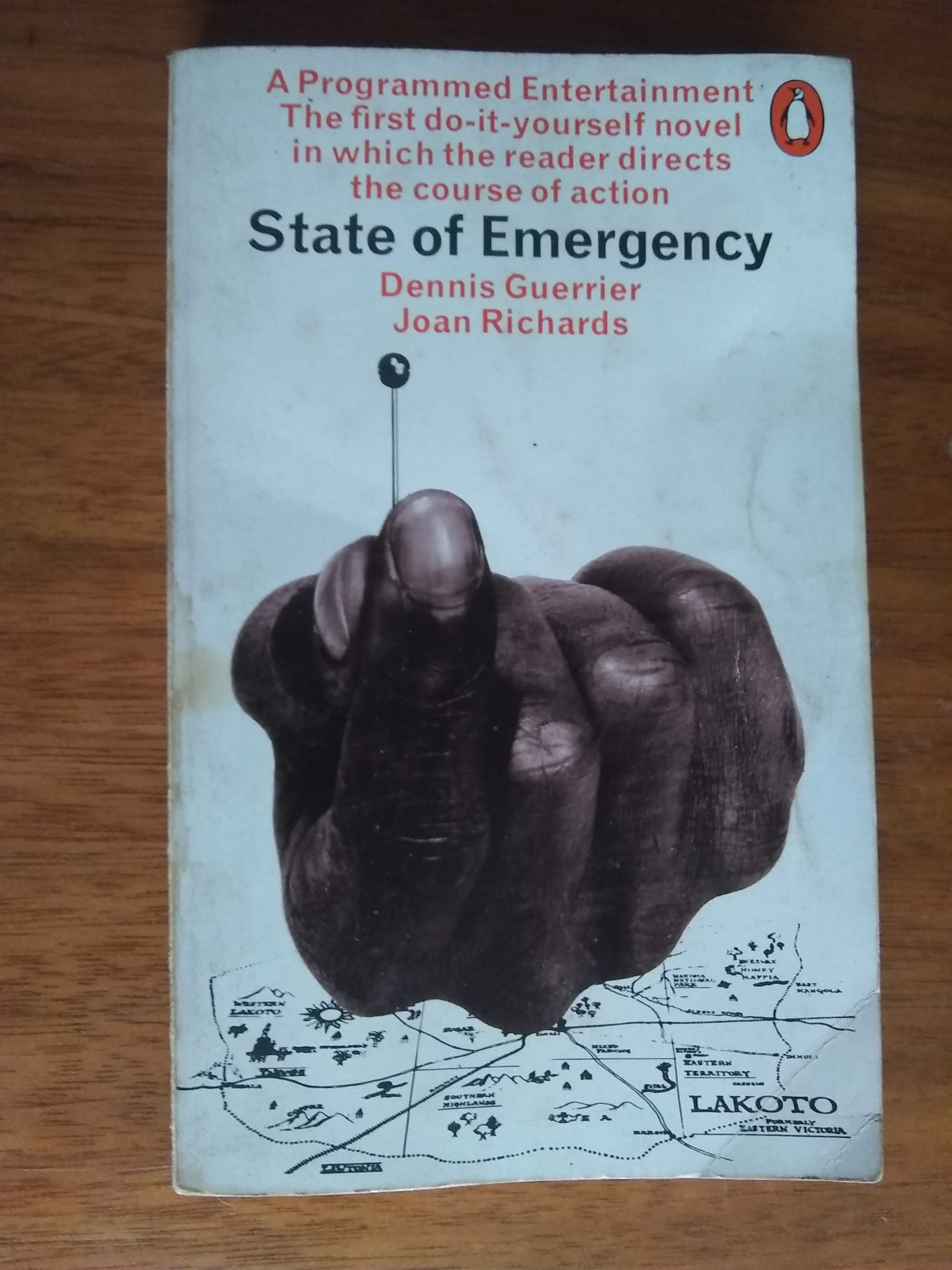
State of Emergency
is a 1969 'do it yourself novel' that Yr. Hmbl. Crrspndnt. found in a second-hand bookshop. It was written by Dennis Guerrier and Joan Richards, both civil servants. A paperback copy (below) was published by Penguin; William Heinemann issued a hardback. From the back cover:

COULD YOU GOVERN A COUNTRY? Would your decisions be better than those of its Prime Minister? This is your chance to find out. State of Emergency, the very first of its kind, combines a conventional novel with the technique of programmed learning. The reader is actively involved with the development of an emergent nation and the decisions which are made. 

Lakoto is an independent state within the British Commonwealth. Formerly Eastern Victoria, it was one of the last British colonies in Africa to be granted independence. Its Prime Minister, Toumi Okobo, is a man facing destiny, in a situation repeated many times today. Stricken by his estrangement from his British wife, Erica, and by the suspected disloyalty of some members of his Cabinet, and hampered by a grave lack of trustworthy information, he desperately needs an adviser whose judgement is sound.

You are at his shoulder. You can choose between the courses of action open to him. Could you govern Lakoto? Here is your chance to try.

"So where is this Lakoto place? Who lives there?"

Oto lind Lakoto!

Reader: 
    You may well feel you know as little about Lakoto as Fournier's prospective readers. In this event we suggest you read Appendix A page 243, before going any further. 

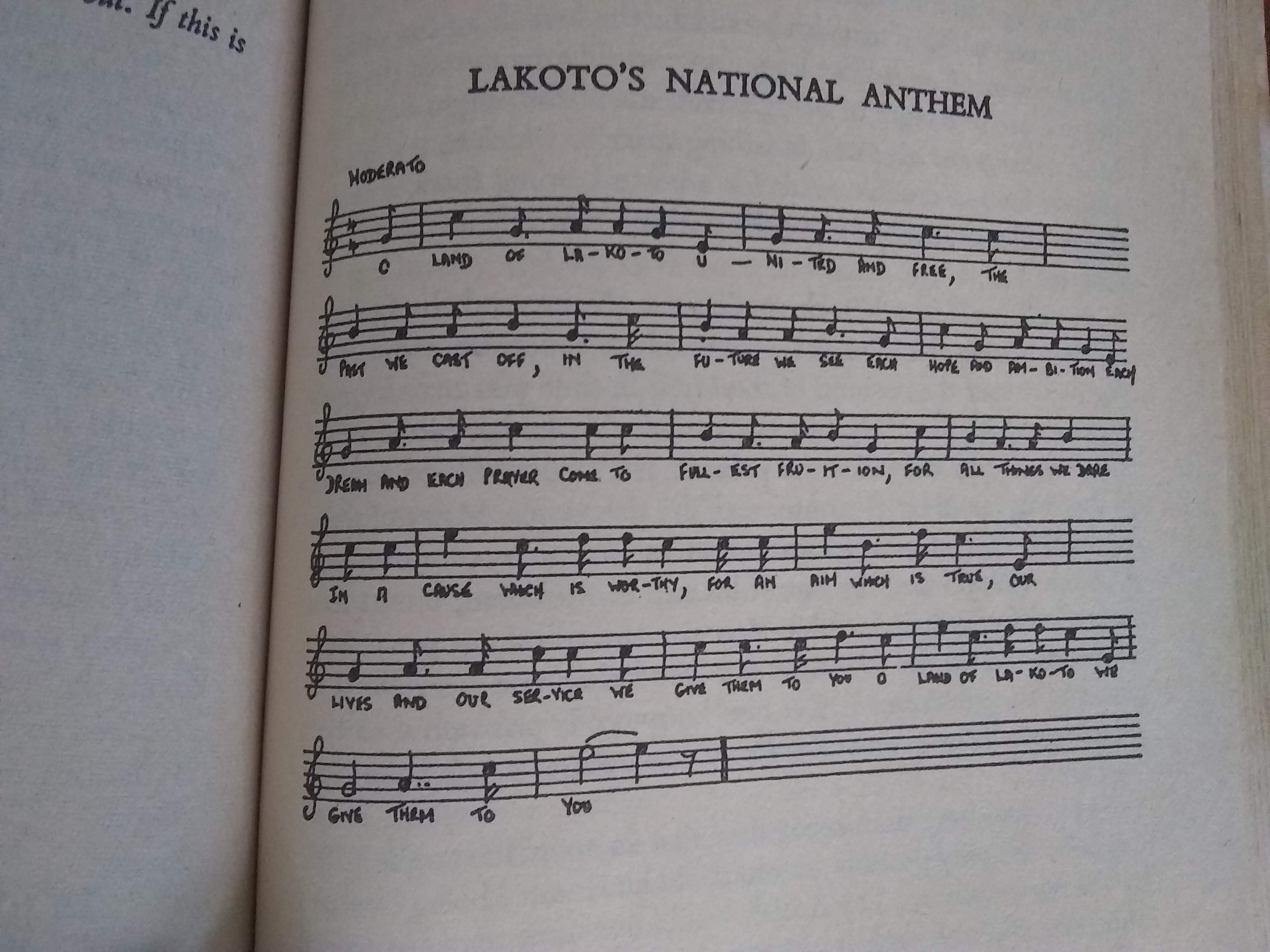
Lakoto is a landlocked Eastern African republic on the eve of independence. The majority of the population is made up of the Cantarbi people - who in the sixteenth century began to fall under the influence of Islamic expansion from their neighbour Mokoran, eventually gaining a Sultan. Accordingly, when it became a British colony in 1893 there was a strong Muslim minority that would grow to dominate many Lakotonese institutions. Other neighbours include East Kangola and Lawtonia - the latter apparently being rather like Rhodesia (although Rhodesia is mentioned as being alive and well in the course of the novel).


"Duly noted. And the tone of the novel?"

Rather like a certain kind of British thriller of the late 1960s-1970s. Bits of the prose are like the exposition segments in, say, Forsythe's Day of the Jackal.  There's the occasional illustration - Lakoto's flag, some postage stamps - and sketch maps in the back for the country and the capital, Tanabi. Information is sometimes presented as part of an in-universe document - newspaper articles, extracts from Hansard, confidential reports, the page of a notebook. (Some of this is in the Appendices, but not all). 

Incidentally, intentions might be good but language can be dated: hence the use of Moslem for Muslim throughout. The French journalist Fournier reflects the following in the introduction at a pre-Independence gala: 

Vicky Sarola just about summed up how he liked his Africa: with a European gloss on top but with definite hints of untamed forces prowling about not too far below the surface.

Adjust expectations accordingly.

The provided map of Lakoto. Enlarge if desired.

"What of our protagonist, Toumi Okobo?"

An Oxford-educated compromise candidate between the various independence movements. Born to a pro-British Cantarbi Chief in east Lakoto. Spent time in Britain and married Erica Okobo, née Williams. They have two children. His life as portrayed seems rather middle-class - a good but relatively modest official residence, he drives his own car and doesn't have an entourage of chauffeurs, aides and bodyguards. Maybe this is semi-plausible for someone in Okobo's shoes, but I would expect a few more secretaries and the like. The strain on his marriage is also a note that rather grounds him.

It is tempting to believe that Okobo was designed as a sympathetic protagonist for a (White, British) reader. Certainly, enough features of his life seem deliberately familiar: the novel can even take him back on a trip to London and Oxford. Is a sympathetic protagonist necessary for 'the technique of programmed learning'? Of course, the fact of his possible Anglophilia is not necessarily a useful trait in a newly independent Lakoto - an interesting trait to explore. 

The provided map of Tanabi. Enlarge if desired.

"Fine. So how does a do-it-yourself novel work?"

There are no paragraph numbers, only page numbers. And instructions:

DO NOT READ THIS PAGE UNTIL TOLD TO DO SO

Messages from the authors ('Reader: Please turn now to page 40.') are given in italics. Directions to the Appendices are given in the text and occasionally as footnotes. As to actually governing Lakoto....

[Spoilers, I guess. Supposing any of you really wanted to go out and read this fresh.]

You may join the first Cabinet Meeting of the newly independent Republic of Lakoto. Not only join it but also see if you can influence its decisions. [...] That is the broad picture; you will have learned the essential details from what you ahve read so far. What is the long-term solution?

Recruit professional men and technologists from other countries....Organise a comprehensive unemployment insurance scheme..... Seek more financial aid from Britain or any other country.....Concentrate on improving standards of education at all levels.

Let's say we want a comprehensive unemployment insurance scheme to 'relieve the poverty and reduce the possiblity of racial disturbances'. Turn to page 30.

Reader: 
    Your long-term solution would be to organise a comprehensive unemployment insurance scheme. With respect, you would have the country bankrupt in the short-term and would never reach the long-term. An unemployment insurance scheme can operate only where there is a large employed population and a low risk of unemployment. The first step to be taken... [....] It wants to become a modern society, not a soup-kitchen society. Please return to page 29 and choose another answer. Re-read Appendix B, if this will help you to choose.

Blighters! Which of us is meant to be Prime Minister, hmm? 

Did you guess the correct answer? That's right, it was in fact Education. (Education. Education.)

So, yes, Guerrier and Richards do this a lot. There's even one choice you can make where the advisor responds:

"I'm sorry, I know you don't mean it seriously."

"I'm sorry too," said Toumi. "I shouldn't be wasting your time with solutions which we both know are unacceptable."

This is even addressed directly at one point:

Reader: 
    You may feel at this point that the outcome of your choice has been 'stage managed', and that events would not have taken the turn described in the paragraphs you have just read. This may be true. It is possible that order might have been restored in Benallahi. However, what we are now seeing.....

The argument offered is not perhaps unreasonable, but the manner of presentation did make me snort.

Some policies are barred to you, as are some methods:

But Toumi found he was quite unable to approve cold-blooded murder. He had to find another, more subtle, method of getting rid of General Nashur.

Reader: 
    Your choice may have been the correct one. Time may prove that a ruthless leader, capable of authorising the death of his enemies, is necessary for Lakoto. But surely, this would be the first step.....

 [...]

Reader: 
    Toumi cannot dismiss Nashur. Neither can you. Please turn back to page 99 and select one of the other choices.

Blast it all, State of Emergency! Let me make some bloody stupid decisions! 

As indicated, the decision making process is quite narrow. This is at its most frustrating when discussing big domestic plans - long-term education policy, hydroelectric dams, the exploitation of oil or mineral wealth. Towards the end of the novel, the rapid pace of the titular state of emergency, the desperation and the diminishing options means that the narrow set of decisions offered makes more sense and feels more fitting. Or maybe I was just used to the technique of programmed learning.

Reader: 
    We have set out in this book to show that a country like Lakoto cannot survive as a viable economic proposition without outside financial and technical aid. That, given the political situation she is in, she cannot survive without military aid. If you really think she will be better off without aid, either we have put all the arguments badly, or you haven't read them properly. Rather than admit the former we are forced to conclude the latter, and suggest you go back to page 229 and make another choice.

Apparently I'm not that used to it. 

A veritable multimedia experience!

"So what was the point of all of this?"

Well, State of Emergency isn't really a good simulation of governance. There's some interesting political manoeuvring, but the reader doesn't exactly get to plan this out. The best way of fending off Nashur is given a level of detail and finesse that is not offered to the options for assassination or dismissal - maybe one could finesse a way to dismiss the General safely. 

I shall tell you what it puts me in mind of. One year at school, while other year groups were dispatched off on trips of one kind or the other, my own was kept back. We were herded into the main hall and addressed by the representative of an international development charity - I'm not being coy, I cannot recall which. The year group would form the Parliament of an emerging fictional African nation and select the options of a computer programme. This was all projected up onto a screen.

Anyway, the government collapsed. Well, fair enough. Young twits like us could well make poor decisions. Yet we were told that we could go back and try again online. Some did: I was told later that every single choice led to collapse.

At this point, somebody will doubtless mention Star Trek's 'Kobayushi Maru' - a training exercise for a no-win scenario. [Post-Colonial Africa: the only winning move is not to play.] Given the relative sedateness of the occasion (and of reading State of Emergency), I wouldn't call it an assessment of how we were meant to behave under such circumstances.  More likely, it was an exercise in sympathy. The age of the participants meant we well aware of the cases made for our support by charitable appeals. This meant that we had an awareness not just of the problems involved for a worker and his family in a famine-stricken region, but the problems for the state around that family.

State of Emergency seems planned to do something similar. The tone is, naturally, different, the level of detail higher, the Cold War ongoing - but the notion is the same. The pastiche of East Africa is faintly informative, but ultimately unspecific: one doesn't learn much from that. The decisions made by the state don't get played out in much detail: this isn't a lesson in statecraft. What is left? A sketch. The end is inconclusive, but the fact that Okobo (in the face of a breakaway region, civil strife and border incursions) has started taking aid from Communist China indicates part of how this may develop. 'This is how a rational, sane and sympathetic man can end up taking aid from a sinister foreign power,' Guerrier and Richards are perhaps saying. 'Don't back people in a position like Toumi Okobo into a corner.' Not the worst moral, if you need one.

"But this," said Vicky "is a documentary, not a play with a clever denouement and breaks for commercials. If anybody expects a nice neat ending in this situation they're too cut off from reality to worry about." She took the papers from him and put them on the table. "You're just not in the mood tonight," she said. "Let's have a drink and leave it til tomorrow."

Reader: turn to page 240.