Showing posts with label Possibly a Review. Show all posts

Monday, 20 July 2026

Palaces, Towers and Signs: A Review of Recent Novels

I have done something unusual, and read a string of books in a row all published in the last three-ish years. Might as well write about them.

***

R.F. Kuang, Babel, or the Necessity of Violence, 2022

Chances are you've heard of this: at least around me, it was in lots of shop windows. The second-hand paperback I found drips with comments and recommendations (Blackwell's Book of the Year, New York Times bestseller, The Daily Mail's Best Book of 2022 - which is a reminder of how a given newspaper or broadcaster isn't altogether wedded to an ideology).

Differences in translation form a kind of magic; this has been used to fuel European imperialism. Babel details events in the Royal Institute of Translation in an only-just-alternate 1836 Oxford. A Chinese orphan is brought to Britain and raised there, seemingly solely for the purposes of working as a Translator.

You know how this ends from the title - or the string of excerpts on the inside over talking about revolution, empire and academia. I don't intend to dissect this more than needed.

Babel is engaging enough; it never exactly dragged. But it is a Hedgehog of a Book, not a Fox - in Isaiah Berlin's division. It does one thing, and it does it fairly well, and it keeps doing it.

It has a problem, in that it is a book narrated by an educated, intelligent and well-read woman who thinks you are very stupid. (I would not claim that this reflects Kuang.) Every reference must be spelled out in the footnotes - and most of those footnotes mention something that there's a good chance you've come across in a high middle-brow source somewhere, or express a position you've seen in a post-colonial Jeremiad prominently placed in a bookshop lobby. ("Did you know that British food is bland? What are they doing with all those spices?" &c, &c. More interesting - and perhaps more in line with the thrust of the plot - would be something like an older French response, that Les Rosbifs are unsubtle, undiscerning - indeed, unbalanced - with their use of seasonings.) This is not merely a view expressed by crusty reactionaries or terminally-online culture warriors, incidentally

Here is where it nearly trips over its own tail (something which one would have thought afflicted Foxes more than Hedgehogs). It is not merely that Babel makes its argument obviously and forcefully, but that it does so the point of parody. A footnote mentions that University College has produced jurists for British-ruled India; very good. It gives their names as Robert Chambers, Edward West and William Jones; a suitable detail. It then feels obliged to tell you that all three were white - which is something that the reader (who has already encountered several strains of racism and other cultural frictions) had probably worked out for themselves already - they are highly placed men with Anglophone names in a country that was at least ninety percent white in the 1950s, even assuming notable flaws on the part of the surveys of the time. 

This is the sort of thing that turns pathos to bathos quite quickly. 'This is a monstrous and abominable act!' might say the propagandist - which loses effectiveness quickly if the propagandist shows their hand: 'As senior commissar of the 1327th Rifle Company, I must say that this is a monstrous and abominable act!'

Yes, there are exceptions to the rule. A formal announcement of status makes sense to establish legitimacy - 'As a Constitutional Monitor of the Social Federation, I can no longer stand for this. Commander, by authority of Section 29 of the General Military Code, I relieve you of duty!' Likewise, a piece of Rhetoric may play on status: 'As a Constitutional Monitor of the Social Federation, I have studied X, read Y and fully endorse Z - but even the commonest Federal Trooper has seen A, felt B and sensed C - and so will know full well that Z.' And one may think of recommendations: 'The Central Office of the Corps of Constitutional Monitors recommends this motion picture for its high level of research and insight into the problem of M, the issue of N and the contemporary matter of O.' The aforementioned footnote doesn't manage any of these. 

The general high quality of Babel makes flaws of this kind all the more apparent. I've seen this described as a nod to heavy-handed Victorian tomes, to which I can only say - those Victorian authors might have been projecting a world-view, but they weren't fighting a culture war.

Other issues are few, and some - like a 21st century-style Commemoration Ball in 1830s Oxford - are quite deliberate. There are some clumsy uses of language - thus, a reference to a force of soldiers supposed to be somewhat larger than a double-dozen as a platoon. An academic clergyman is referred to as 'Reverend Doctor Frederick Charles Plumptre' and not 'The Reverend Doctor Frederick Charles Plumptre' in a section when the additional word and syllable would have been entirely fitting; Plumptre's rank and status are being emphasised. Kuang has silver used in ways (like cleaning the water in London's canals) that would presumably lessen some of the urban blight and squalor that is later important. Likewise, silver is used for reasons it presumably need not be: silver for bells...which is a splendid passage until you think on it: is there a great convenience or magnificence or saving in using magical silver to keep bells in tune, that a decent bell-foundry couldn't provide? Ditto college towers, though the invocation of Babel makes some towers collapsing inevitable.

If I have to draw some conclusion ... well, the chances are, frankly, that you've read Babel or that you don't need to read it. 

And leaping to another Vulpine dichotomy: Babel might be a lion to scare away wolves, but is not a fox to recognise traps. It is a book of the middle and the mainstream; it would happily confront a right-leaning academic or a classical liberal columnist in a widely-read journal. But I don't think it's ever contemplated the world of literate, articulate, widely-if-inconsistently-read, statistic-wielding (none of those thing are equal to Good, Virtuous or Correct) right wing commentators on, say, Substack. At least, not as a Primary Source. Perhaps Kuang will not object to being a Leonine Hedgehog.

***

Thomas Peermohamed Lambert, Shibboleth, 2025

This one does need a summary. Edward is an Oxford student in his second year; in a bid for social cachet, he starts making rather a lot of a long-dead Muslim grandfather in Zanzibar. Cue plaudits and female attention.

On its own, that sounds predictable: a half-hour sitcom, living or dying by the comedian's skill. Certainly not something that can cover the span of three terms. It is given staying power by Edward's misadventures in love, and the range of human misunderstandings, vulnerabilities and flaws - and by a degree of knowingness on the part of all the characters. They are frequently headstrong or scheming or prideful, but rarely ignorant. 

The other thing that stops this being a one-trick pony is the range of side characters, aiding and abetting Edward's deception - including the Falstaffian Egyptian Youssef, a genuine Muslim. The various social justice activists are powerfully drawn, and get some decent stinging lines and self-awareness. Not that there aren't comic scenes drawing on the well-established (cliché?) image of the campus radical and xenophile. This isn't the only strong to Lambert's bow; the names, especially of minor characters are spectacular; Liberty Vanderbilt-Jackson is normal enough but see also Larry Pfister, Lolly Bunton, Francine Hogmany-Pung and (my favourite) Hepzibah Coulson-von Ribbentrop. The other great running joke is the string of absurdly named academic works: Borges: An Overdue DenunciationSeas incarnadine: Shakespeare, Macbeth and the menstruating body, The Quality of Mercy is not Stained: Shylock and the Poetics of Bodily Drainage - the trick is to make them only just plausible - which leaves Anus Mirabilis: The Spirit of Freud in the Letters of San Juan de la Cruz out in the cold, alas.

To some extent this is like Waugh's Decline and Fall; Edward's shyness and biddability rather echoes Paul Pennyfeather. But Edward's story is a more personal one for Lambert. 

It is also a more present one; the Trinity Term of Edward's second year begins with a clash between Israel and Hamas. This is intended as a novel of the moment, if with some themes of identity and social status that will last better than a political cartoon. It is present in one more way - Lambert is still writing, and he is even writing about Shibboleth, and has its characters in dialogues with the author. His thoughts on the relative success of his debut and the lack of understanding from his audience involved are interesting (and to some degree anticipated - hence the title), though I hope that this isn't a precedent. E.M. Forster writing about the lives of characters after the end of the novel years later in a little article is fine, but let's not have regular updates from authors.

People liked Shibboleth. I think that you will gain more from reading it than not.

***

Francis Spufford, Nonesuch, 2026

Nonesuch: once a palace, now a novel. The premise: it is 1939; an ambitious young lady in finance - Iris Hawkins - is drawn into a romantic encounter with a BBC television engineer. Unforeseen consequences draw her into a conflict with an equally young Mitford-esque fascist over a series of magical passages through time, and into meetings with angels.

Has Francis Spufford read any Tim Powers? If not, he really should do. Low-ish fantasy, in a historical setting with a veneer of science. Nonesuch isn't Declare, but they're not so very different - mid-twentieth century setting, trippy depictions. Spufford's angelic interventions may be the biggest difference. Other reviewers have noted the likeness to the mysteries of Charles Williams - which get a trifle too tied up in mystical visions to be really reliably good. Nonesuch also isn't Declare in that no-one is treating it as something for the Sci-Fi section of the bookshop; see this fulsome review.

Yes, Nonesuch isn't bad. Vivid characters (if ideas one has encountered many times before), and a beautifully rendered London, City and suburbs alike. Iris Hawkins is a rich and well-rounded figure with interesting flaws, if occasionally one suspects that she is the rich and well-rounded figure with interesting flaws that the Guardian wants her to be rather than the rich and well-rounded figure with interesting flaws that the Telegraph wants her to be. But this impression doesn't crop up too often - the most obvious intrusion was Iris thinking (in 1940) that the War against Germany was a War to extinguish Fascism. She has been established to be well-informed and not exactly apolitical - but she isn't a partisan or steeped in a given political doctrine. My impression is that neither popular attitudes nor government propaganda had brought the latter notion into being in 1940.

There is the occasional similar note of authorial smugness - look how grounded so-and-so is, look how sex-positive this is (there is also one thoroughly predictable reveal about Iris's Jewish boss). This does not always get in the way of carefully sketched emotion (at least, for our protagonists). Perhaps it is a consequence of living in the internet age: it is so easy to dig out a response or a retort or an alternative take - that the lack of one seems so irritating, so half-finished. 

I've seen reviews that get irritated by the poetry - I can't say I was. It does suffer from the fault of many a fantasy that introduces angels, in that none of the main characters even think about picking up any theology after meeting one! A few lines of dismissal would be enough, though perhaps that would only frustrate me.

Nonesuch ends on a cliffhanger: a sequel has been finished, though I don't know if there's a date for publication yet. I suspect that a full assessment will mean waiting for that sequel. 

Sunday, 12 April 2026

Mortal Ingenuity: A Retrospective of Mortal Engines

It was a dark, blustery afternoon in spring, and the city of London was chasing a small mining town across the dried-out bed of the old North Sea.

These are the first lines of Mortal Engines, by Philip Reeve - published 2001, and I suspect that I read it for the first time fairly soon afterwards. Frequenters of this blog (being handsome, discerning and well-read) will twig the similarity to the opening lines of Nineteen Eighty-Four - and I suspect that they will recognise how this might hook a young reader, or even an old one. I was that young reader, of course. 

Indeed, I am now also that old reader. A month or so ago I noticed that the 2018 film of Mortal Engines was available in the free-with-advertisements section of YouTube (the box office results may say why). I put it on while about a few household chores, and half-watched the entire thing. I had avoided the film when it came out - and, having watched it, this was not an unreasonable step to take. But a bad version of a good thing can make one think of the good thing, and it sent me back to read the books. Indeed, it also disposed me to take a look at the assorted thoughts of the internet - which have been blighted by the film or didn't touch on some worthwhile aspect, and so on - so, in I dive to get my thoughts down. 

My scope is limited to the initial Mortal Engines Quartet, published 2001-2006: Mortal Engines, Predator's Gold, Infernal Devices and A Darkling Plain. Other books in the same universe, if in different eras, have been published, as have short stories and some collected timeline and 'lore' material. Some reference may be made to these (not that I've kept fully abreast of new entries in the series) and, where vaguely useful, to the film. 

Premise

I don't intend to summarise the books here. But a few details may well be useful.

There has been an apocalypse, the Sixty Minute War. This took place around 2100 between (what Mortal Engines characters call) the American Empire and Greater China. Civilisation, and much of the planet was smashed up - by things that appear to have left the atomic bomb in the dust. North America is 'the dead continent'. As above, the North Sea is mostly gone. New mountain ranges cropped up. Many centuries later, civilisations have risen and fallen - as civilisations tend to. 

The great paradigm of the current age is that of the Traction City. Mankind either dwells on mobile cities - greater or smaller; see above London and the 'small mining town', Salthook - or in static settlements. Said static settlements band together in the Anti-Traction League, opposing the Traction Cities. Traction Cities (principally) move and (notably) will devour one another - as well as static settlements, so said League makes sense. (Traction Cities will harvest or gather natural resources, and trade, but after a millennium of the 'Traction Era' there is less possibility of the former outside the strongholds of the League). The practice of one Traction City consuming another has given rise to a school of thought, or even an ideology - 'Municipal Darwinism'.

The Mortal Engines quartet focuses on Tom Natsworthy (of London) and his journey with Hester Shaw out of London and into the wider world. Both characters are fifteen in Mortal Engines; Wikipedia labels the Quartet as 'young adult'. As nebulous as that phrase is, it's a useful-ish indicator of tone and approach - though we will see both grow to adulthood in a perilous and bustling world, full of moving cities, armies, airships, wastelands, pirates and the lost, fearful, technologies of the Ancients. 

Wikipedia will give you plot details if you want them, though frankly this post probably is most useful for someone who has read all four books. I'm not going to wallow in spoilers, but I shan't dodge them either. Anyway, be warned.


David Frankland did the original covers, which I still think quite the best.  There's a clear sense of the grimy and the mechanical, coupled with those limited colour backgrounds, that suggest something like a 1920s travel poster and the associated sense of adventure. 

In no particular order, then - 

Names

Reeve's characters have three sorts of names.

Cool: names right out of pulp adventure*. Thaddeus Valentine. Anna Fang. General Naga. Magnus Crome. Wolf von Kobold. Dr Zero.

Pompous: likely British, at least faintly and probably overtly posh. Herbert Melliphant, Chudleigh Pomeroy, Cynthia Twite, Thomas Natsworthy, Freya Rasmussen, Clytie Potts, Nimrod Pennyroyal, Dr Popjoy.

Gimmicky: displaced old-world phrases, faintly comic. Chrysler Peavey, Stilton Kael, Nintendo Tharp, Napster Varley, Saab Peabody.

Actually, this is quite a good indication of overall tone. If you can tolerate - or actively enjoy - the sort of sensibilities that these three sorts of names suggest, then you might enjoy Mortal Engines. The 'Gimmick' aspect and vein of comedy is more present in books beyond the quartet, where it can wear out its welcome a little. 

Whimsy and Humour

But such things are a balancing act. The presence of 'Tunbridge Wheels' as a mobile city is a sensical pun (and demands a Sensible Chuckle?); likewise the Arctic predator suburb of Wolverinehampton. Reeve has written what I take to be more overtly comic works for a younger audience than Mortal Engines, but can dial it back sufficiently. (A newspaper called The Wantage Weekly Waffle only has one mention, happily; this is distractingly comic - one says, risking the fate of the po-faced - and more to the point, not quite comic in the way the scene demands.)

You will sometimes see this sort of thing referred to as whimsy - and, indeed, there is a whimsical element in the notion of a moving city (still less one that retains some of its static characteristics: don't ask how they tend the vines in Bordeaux-Mobile, or what the terroir is like). Reeve is also an illustrator, and some of his renditions of traction cities make them seem rather charming. 

Not all his humour is quite so direct, of course. A firm of publishers is named Fewmet and Spraint; as those who recall The Once and Future King will know, this is a quiet indication as to the quality of some of what they publish. 

Consequences

Alongside such things is a real sense of weight to violence. Men may die quickly, but this is never exactly cathartic - especially not for our protagonists. Accident may kill as readily as intention, and it will absolutely kill your allies and would-be collaborators. Deep wounds, even if non-fatal, have later effects - very real disfigurement or long-term health conditions.

It goes a little further than that, mind you. Hurt feelings stay hurt, emotions flare high - deeds done in haste reverberate to dreadful effect. Which sounds like just what you should expect from a novel, but I suspect shouldn't be counted on in every book of the same kind as Mortal Engines.

While we're thinking of bodies, I note that there's a fair amount of urination and defecation in these. Which contributes to that sense of what bodies are and do. I wonder what age Reeve's children were when he was writing these? 

More to the point, this allows for some powerful blows when the time comes: the last paragraph of Mortal Engines has some fairly touching unsentimental sentiments, if you'll pardon the oxymoron.

Britishisms

Philip Reeve is British. He did not have an international audience in mind when he wrote Mortal Engines - indeed, that the United States is a wasteland may not have done much for his sales. I've noted some of the names above for their British characteristics: that London is front and centre in the first (emblematic) book is also important. 

Of course, London isn't Britain, nor is the traction city of London an inheritor of Britain (but it was in an earlier version of Mortal Engines). Britain is gone: some place names and other markers remain - but that there is a portion of London called Crouch End doesn't count for much.
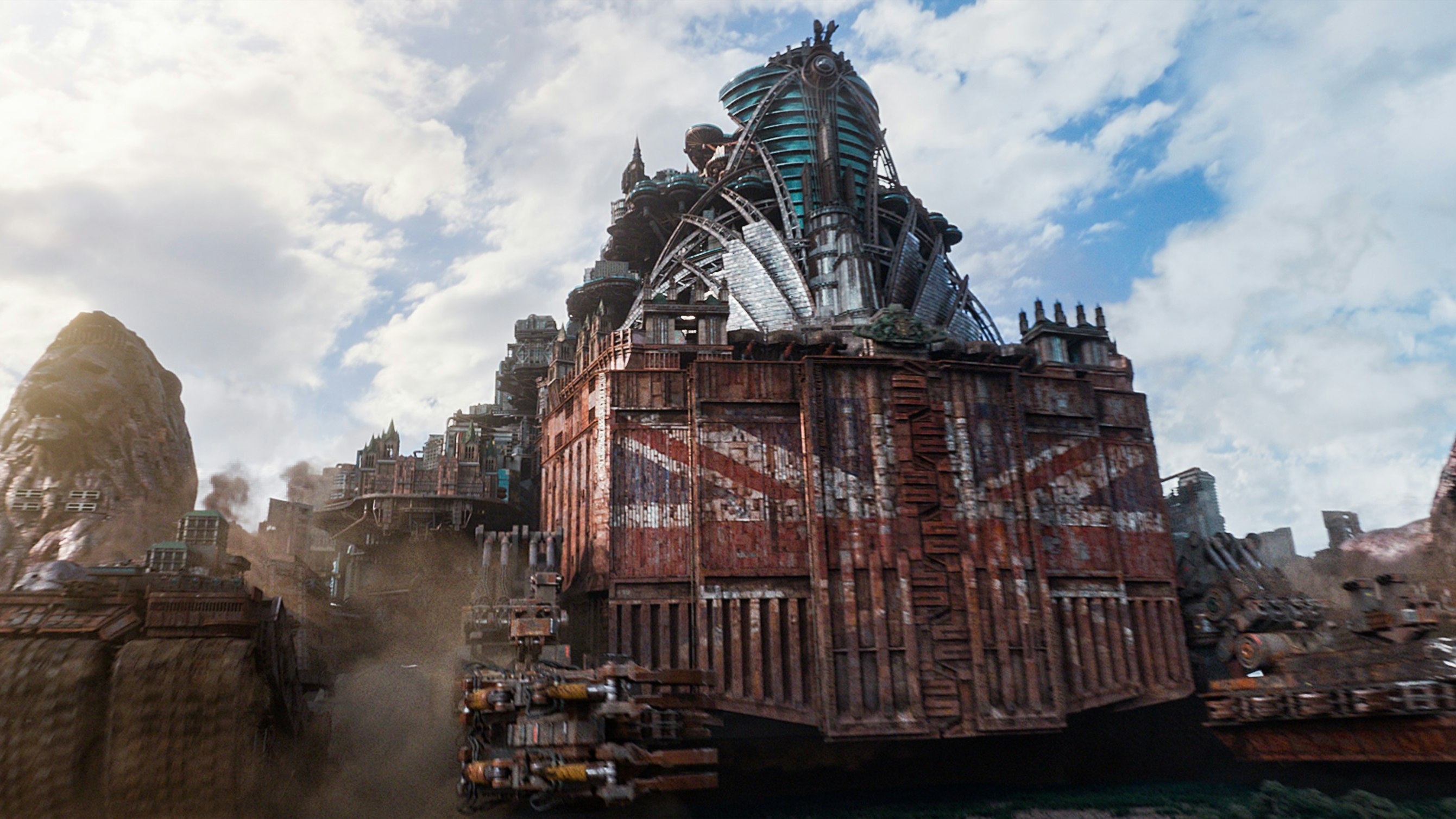
This is something that the 2018 film - with its Union Flag bedecked-maw and Trafalgar Square lions -  didn't take on board.

London's military elite are Beefeaters, not the Brigade of Guards or the SAS or the Gordon Highlanders or Cromwell's Ironsides. It is governed by a Mayor and a guild elite, not the King-in-Parliament. The focal point, the identifying feature of an exterior which is otherwise as vast and complex as Breughel's Tower of Babel is St Paul's Cathedral, not St James's Palace or Westminster Abbey or Tower Bridge (the film couldn't help itself, and included the Palace of Westminster; the guildhall even faintly resembles the former Greater London City Hall). A piece of concept art by Ian McQue shows even more - the Shard and the BT Tower and Battersea Power Station, in an artistic fantasia reminiscent of one of Laubin's capricci

I would argue this misses the point of St Paul's Cathedral. There's something eerie about the fact that it has survived when so much else has not (the London Museum of Mortal Engines is clearly akin to the British Museum and the Natural History Museum, but is in fact neither). When you learnt something of the Polytheism much of the world practices in the Traction Era, it becomes even stranger that this Christian temple survives intact. That it is finally the vessel containing the ancient and terrible superweapon MEDUSA bears this out. 

The David Frankland cover again. Think on how St Paul's is just discernible, think how it offers a sense of scale. Think also of the red, livid sky.

Airfix Characteristics

A world-building trick of Reeve's is to refer to makes and models of machinery in universe. Airships are Goshawk 90s or Murasaki Fox Spirits (and this will extend to parts: Jeunet-Carot aëro-engines, an envelope of Silicon-Silk from Shaun Guo....). A small revolver is a .38 Schadenfreude. Something like Jane's Fighting Ships for the Traction Era appears. Granted, significant parts of A Darkling Plain are set on the frontlines, but the business of bunkers and half-tracks and rocket troops conjure the same notion. That Germanic traction cities are frequently named 'Panzerstadt' may contribute to this.

If we are addressing this as a sensibility outside of genre features and expectations, I think the term 'Airfix Characteristics' is good, as in X with Airfix Characteristics. Science fiction with Airfix characteristics; Firefly has them, Star Trek doesn't.**

Extend as necessary, or as amuses: Steampunk with Airfix Characteristics. Bedroom Farce with Airfix Characteristics. Ostern with Airfix Characteristics. Southern Ontario Gothic with Airfix Characteristics.  

Airship (and flying machine) names, incidentally, fall into something like the pulp/pompous/gimmick division above. The 13th Floor Elevator. The Jenny Haniver. The Itsy Bitsy Teeny Weeny Yellow Polka-Dot Machiny. Group Captain Mandrake. The Shadow Aspect. The ArchaeopteryxDie Leiden des Jungen Werther. The Plum Blossom Spring. The Combat Wombat. The Requiem Vortex.

References and Nerdery

As the above may suggest, Reeve enjoys shoving a reference or two into Mortal Engines - frequently something at least faintly nerdy. The very name derives from Othello: Act III, Scene III. A certain amount of this is the product of inspiration. Star Wars and Lord of the Rings had their influence on Reeve - the former quite unsurprising, given that Mortal Engines has a climax with a super-weapon encroaching on a previously unassailable redoubt.*** Other influences exist. 

That a range of mountains is known as the Tannhäuser Mountains might well owe something to Blade Runner (could there be a narrow pass in those mountains, do you think? A defile, a passage, a gate?). Spear-carriers of fighter pilots are known as Ginger and Algy. That a German traction city is called Moloch-Maschinenstadt presumably indicates that it is an unpleasant place even by the standards of traction cities (unless things are unusually clean?). 

Historical periods are also addressed in a familiar and adroit way: the Blue Metal culture, the Raffia Hat Culture.

The Chapter names are rather telling in this regard: The Cabinet of Dr Popjoy, the Land of Mists, Brighton Rocks, The Childermass Experiment, The Sleeper Wakes.

Incidentally, Mortal Engines predates a general consciousness of Steampunk being its own thing. It fits into the aesthetic nicely, but it doesn't get bogged down in genre trappings.

***

There's a line in Predator's Gold that ties a lot of the above together. 

The sky was the colour of packet custard, streaked with rhubarb cloud.

  • It's whimsical: the sky as humdrum domestic dessert.
  • It's actually not a bad description for a certain sort of dawn, with pinkish clouds and soft yellowish light. Rhubarb, if not processed into pap, is in fact streaky.
  • It's quite possibly a reference to Neuromancer: 'The sky above the port was the colour of television, tuned to a dead channel.'
  • Rhubarb and custard is a British boiled sweet - and as a combination, would not be unlikely to be served as a dessert. 'Packet custard' presumably refers to Bird's Instant, or something quite like it.
Anyway, I liked this line. Though one wonders how any of the characters know what custard is in this world, like Winston Smith and rice spirit (thank you, Anthony Burgess).

***

Polytheism

As above, the Traction Era is Polytheistic. Clio, Muse of History is frequently called on by the Guild of Historians (there is a reference to her being 'blown backwards by progress into the future', which sounds unintentionally Buckleyesque). Ice Gods and Wind Gods are mentioned. Quirke was the Mayor who turned London into a Traction City, who has been deified. Statues and shrines dot cities and sit in airships. 

There's an extent to which this pushes Mortal Engines into a grand, varied, Faufreluchean setting, like the forehead tattoos of London guildsmen. It's also something that indicates that Reeve can 'do religion' in a way that George Lucas (for instance) doesn't. St Paul's Cathedral aside, Christianity has survived the Sixty Minutes War, even with Bishops and T.S. Eliot (though neither show up on London). The monotheist elements - 'I believe in one God, the Father, the Almighty...' - are seemingly unknown to unbelievers. Strangely, no other Abrahamic faith seems to have lasted, nor have Eastern Axial Age faiths like Jainism or Buddhism. There's monks and prayer flags in the Himalayas, but that's not necessarily the same thing.

Metafiction

There's bunch of metafictional elements that come into Mortal Engines. That several principal characters are historians - narrative-crafters, from a certain point of view - helps, of course. The history of the world is discussed, and later characters even go on to write up the events of the novels they are in (Predator's Gold is also the name of an in-universe sensational history). The final chapter of A Darkling Plain even involves that thing where a character begins telling the tale of the story they're in, beginning 'It was a dark, blustery afternoon in spring...'

Reputation (to be chased into the cannon - the mortal engine's - mouth) plays its own role in all this. In the course of the Quartet, reputations are made and lost, secrets are revealed. People tell stories about themselves.

Bildungsroman and Stalkers

Mortal Engines is about (among other things) youth. Tom Natsworthy and Hester Shaw come of age and begin making their own decisions. Happily, they don't have to spend an entire quartet doing this: there is a sixteen year time skip between Predator's Gold and Infernal Devices. But more to the point: these four books spend a fair amount of time thinking on how children are raised. Plenty of characters are the genre-standard orphans, but who they are raised by counts for a lot: the antiquarian Guild of Historians, an inhuman cyborg, a Fagin-like master of pickpockets, a dwindling population of loyal subjects. Further, have they been raised as a Tractionist or an Anti-Tractionist? This isn't just an ideological difference: in a rather town mouse and country mouse sense, traction city dwellers struggle when they have earth under their feet rather than a deckplate (those from static settlements don't seem to struggle in a comparable way - see Wren in Brighton in Infernal Devices).

Anyway, on top of all this are the Resurrected Men. Old Tech mechanical brains and devices are wired into corpses to bring them back into hideous life - principally to serve in combat. Given the lack of knowledge of Old Tech by the Mortal Engines period, this is an unreliable process - and not all Old Tech is created equal. So some Stalkers have half-memories of past lives, and the desire to learn more, and those who brought them back may wish them to have (or not have) those very memories. Stalkers, like children, must be raised: just ask Victor Frankenstein. 
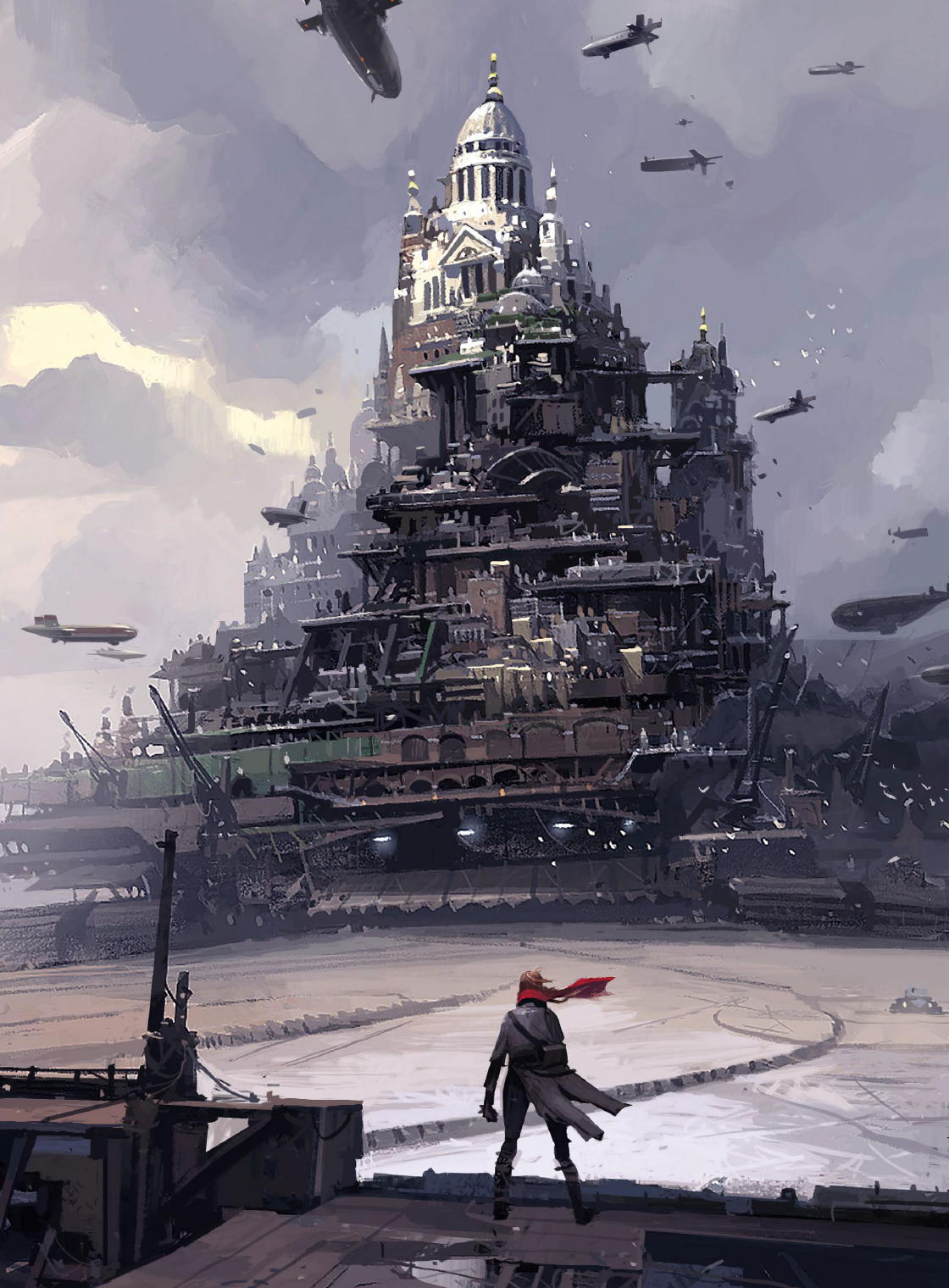
Ian McQue also did a cover for Mortal Engines. Not bad, despite the disproportionate St Paul's. It has some of the right spirit, even if it makes me think a little much of Disco Elysium.

Predators, Gold

There is an interpretation of Traction Cities and Municipal Darwinism, holding that the entire thing is really about capitalism, expansionism and exploitation. A specimen of this interpretation is here (though I think it a ramshackle piece). I am compelled to say that this isn't altogether wrong. The text makes it clear that Tractions Cities can be pretty unpleasant places to live, and Reeve knew what he was doing when he named the goddess of 'Unfettered Municipal Darwinism' as Thatcher - who is given a faintly Hindu aspect in her depictions: multi-limbed, dancing, all-devouring, as Shiva Nataraja.

Fine, it's not wrong, but it misses a few things, especially when stated baldly. Reeve has stated that part of the inspiration for Municipal Darwinism comes from the growth of Brighton into a conurbation - which (whether welcome or not) is far less malevolent than anything out of a Traction City. Also, Reeve, as Tolkien, dislikes allegory - and has stated that it's not a heartfelt metaphor for Capitalism.

That aside, I think that it's also informative to consider Mortal Engines in the light of the Cold War; indeed, especially from the point of view of a young, fairly liberal British man in the last decades of the Cold War.

[It feels a little odd making this slightly cavalier reading of biography and background, and I hope that Philip Reeve will pardon me if he reads this; I did meet him once, years ago - he signed my books and was really quite kind and charming.]

So: The world is imperilled by dreadful weapons [MEDUSA, ODIN], invented by those long dead (Oppenheimer dies in 1967, wunderwaffen maker von Braun dies in 1977; see also Richard Rhodes here again) for another country [The Ancients] and a cause not your own [The Sixty Minute War]. You [Tom Natsworthy] find yourself aligned (by birth as much as anything else) with those [the leadership of London] pointing those weapons at a foe with a very different way of life [the Anti-Traction League]. Learning more about that foe, it emerges that they're (reasonably) terrified of annihilation; it should not surprise you that they take steps against it [Anna Fang] - and even if you don't approve of it, that they should produce an extreme reaction to the threat [the Green Storm]. Naturally, you become quite disillusioned with childhood heroes [Thaddeus Valentine], though there's no guarantee you'll join with your old foe [Tom and Hester take to the Bird Roads].

[EDIT: Cf. this remark on '80s Britain.]

This is the sort of perspective that forgets or erases the Gulags and the cellars of the Lubyanka and Khrushchev burying the west, but it's not one that I find utterly unsympathetic - or utterly disconnected from reality. But the geopolitical-historical interpretation fits the outlines of Mortal Engines better than the blunt Municipal-Darwinism-bad expression.

The Anti-Traction League, it must be said, is not the Soviet Union or Warsaw Pact, and the Shield Wall of Batmunkh Gompa is defending against a threat in a way that the Berlin Wall wasn't. Russian traction cities (Arkangel, Traktiongrad, Gorky, Novaya-Nizhni, Smolensk, Omsk†) exist. The League seems to draw as much or more on the Third World as the Second World: there are no parades in Red Square or Five-Year Plans or Khrushchevka apartment blocks or Stakhanovite efforts in the factories (though that Northern Fleet of airships and the fuel and ammunition and spare parts for same had to come from somewhere...‡ ). One gets a more Maoist impression from the Green Storm and their cult of personality. Reeve is, happily, unwilling to make this monolithic: the mountainous strongholds of the Anti-Traction League might be in East Asia, the Indian Subcontinent and East Africa but Traction Cities include Zanzibar, Bamako, Perfume Harbour and Juggernautapur. 

Before anyone gets too keen about raising the left-wing banner over Mortal Engines, I would note that Reeve does not strike me as at all partisan or a zealot, and unwilling to engage very publicly with politics. Moreover, the sympathetic portrayal and actions of the Guild of Historians in Mortal Engines suggest a sort of small-c conservative position against progress and expansion: couple this with the non-Green Storm League elements and perhaps one arrives at some sort of 'Ealing Studios' Social Democracy; something which wouldn't much please Ayn Rand, Michael Foot or Robespierre. Indeed, the dreams of Magnus Crome and the Guild of Engineers that transcend the limitations of Municipal Darwinism as we know it (Mortal Engines, Ch. 34) remind one of nothing so much as the visions of progress by H.G Wells, a devoted socialist. 

Municipal Darwinism and Tractionism never gets an articulate spokesman, mind you - only prejudices and Tom Natsworthy at his most callow (unless there's one hiding in the very recent Thunder City or Bridge of Storms). Where is the Adam Smith of Municipal Darwinism? After a millennium there must have been one! Anti-Tractionism fits the reader's default position, and the text has to work less hard. ††

We may also consider the image of Tractionism as aping the sacrifices and trade-offs of the industrial revolution; something heightened by the nickname 'mossies' for the static settlements and the Green Storm, who openly vow 'death to cities'. It would make a certain amount of sense to me if a wider range of goods were available in traction cities, if medical technology were more advanced, if a greater range of culture was available. While no polity in Mortal Engines appears to be a liberal democracy as we may think of them, the concentration of population in a traction city might well mean that there is a greater chance of mass political engagement. None of this means life is necessarily any better: you could end up in back-breaking labour somewhere vile in a traction city due to central planning or competitive examination or one city consuming another - but you are far less likely to end up doing  back-breaking labour somewhere vile due to being of the wrong faith or caste. Slavery is not seen in the Anti-Traction League, though given how accepted it is elsewhere, it would be strange for it not to be present in one of the many members of the League (again, that air-fleet came from somewhere). 

It's worth noting, finally, that Philip Reeve appears to quite like Traction Cities. Certainly more than Swift did Laputa or Orwell did Manor Farm. An exception to the rule of Municipal Darwinism appears early in Mortal Engines in the form of Airhaven; the cooperation of the Traktionstadtsgesellschaft and the resort city of Brighton muddy the waters later. The conclusion of A Darkling Plain, with the birth of an ecologically friendly New London, complicates things further - as does the future state sketched in the final chapter. 

Traction Cities have been noted from the first have developed from nomadism - and the nomadism of those clans or the airship-travelling protagonists is treated quite sympathetically. Is this enough to to make them more than Infernal Devices (Predators seeking Gold on Darkling Plains)? Are they more than Mortal (threatening, fearful, deathly) Engines doomed to mortality? 

Frankly, the best way for you to decide is to read them. They were worth reading twenty-five years ago, they're worth reading today.


Previous Mortal Engines-related content here.

* "Catholics don't light candles any more, Brick."
"I do, sir. I'm Irish and my mother - "
"For Pete's sake! Bronson's not an Irish name."
"What kind is it, sir?"
"It's a pulp name. Now get going."
           'The Last Thrilling Wonder Story', Gene Wolfe 

** Compare remarks on las-pistols here.

***Reeve has a blogpost (5th May 2015) on seeing the first Star Wars in his youth, the interest he had in Ralph McQuarrie and how Star Wars 'was so popular that it even put an end to World War 2. Before Star Wars, schoolboys played Brits vs Germans in the playground, watched Colditz and Where Eagles Dare, and made model kits of Spitfires and Messerschmidt 109s.  After it, we played rebels vs stormtroopers and watched Blake's Seven and Battlestar Galactica.' It's quite good as a reminisce and I'm irritated that I can now only get hold of it through this blog viewer

† Incidentally, Anchorage, with its palaces, fur coats, glasses of tea and aristocracy certainly reads as more Russian than Alaskan. Maybe that just comes with Tractionist culture up on the ice.

‡ I can conceive a spirit-of-the-text answer where League arms works are mostly kept in moth-balls in peacetime, with the volunteer machinists keeping them in order outside of seasonal re-supply use or until the threat of a Traction City draws near.

†† It would be interesting to sketch out how an idealised peaceful consumption of one city by another would look as expressed by such a thinker. The gods of one Traction City brought into the fanes and temples of another, the merging of institutions (with senior and junior partners), the language barriers, the demographic transformation.

Tuesday, 10 March 2026

Frenchmen and Fairies in Space

There are the books I planned to read and the books I didn't plan to read. I didn't quite plan to read the books by, for and about Frenchmen in space.

***

Cyrano de Bergerac (1619-1655) L'Autre monde ou les états et empires de la Lune (1657), trans. Thomas St Serf (1624-c. 1669) as Selēnarhia, or, The government of the world in the moon a comical history (1659)

Bertrand de Fontenelle (1657-1757), Entretiens sur la pluralité des mondes (1686), trans. Aphra Behn (1640-1689) as A Discovery of New Worlds (1688)

Voltaire (1694-1778), Micromegas (1752), trans. Douglas Parmee, 2014.

Well, maybe that's not quite true. I had half an eye open for Micromegas, having seen it referenced in Terra Ignota. Further, Marat of Red Berries for the Red Planet had referenced 'Conversations on the Plurality of Worlds' in my TRoAPW Appendix N post. I didn't make the connection on first seeing my second-hand Hesperus Press copy, but soon did. 

Some notes on translators:

Aphra Behn was a remarkable author in her own right. I've read a number of her plays and novels. Many deal with affairs of the heart (I won't list her with Rochester as a libertine, though she's undeniably a coquette), and a number are set in the Catholic parts of the Low Countries - where she was a spy for Charles II. Her work Oroonoko: or, the Royal Slave (1688) has stayed in print these many years, and provokes much interest as a narrative of an African slave's early life and rebellion in Dutch Suriname. Accomplished as she was, Virginia Woolf's praise for her catapults her onto Feminist reading lists (though I note that in her translator's note, she takes a moment to complain about the foolishness of the Marquise); her Toryism is not necessarily stressed.

Thomas St Serf is far less well-known, but in digging up dates for this I found him to be the son of a Scottish Bishop (their surname is rendered as Sydserff, Sincerth, Sydceff and more, confusing the issue). In addition to his translation, he was also the producer of a short-lived Scottish newsletter, the Mercurius Caledonius - which has all been transcribed online.

Both are appropriate sources for TRoAPW - though Behn has perhaps the wider application. The Mercurius Caledonius would make a great deal of sense for characterising Malmery.
I note that other translations are available on Project Gutenberg.


Statue of Aphra Behn, outside the Beaney Library in Canterbury.
Again, unlike Rochester, I can't tell you which Warhammer Army she collected.
         

Let's look at some summaries. In Selēnarhia Bergerac's narrator projects himself to the Moon (following a crash in Canada - New France) using vials of dew. When he arrives at the Moon, he is taken as an animal, and presented to the queen as her beast. He is slowly drawn into lunar society - where meals are taken entirely as scents, poetry is used as money, the language is music (with proper names all rendered in musical notation) and other wonders abound. There are long disputations on natural philosophy (and whether the Moon is a Moon). 

Among other things, the men of the Moon enjoy audio books.

At the opening of the Box, I found in one of them ſomething of Metal, almoſt like our Watches, full of little ſprings, and almoſt imperceptible Machines : tis true, it is a Book, but a Miraculous one, which hath neither leaves nor letters. In fine,it is a Book, wherein to learn any thing, the eyes are altogether unneceſſary, and the ears are only to be uſed. When any one then hath a mind to read in it, he winds up with a great many little Springs this Machine, then he turns the needle upon on the Chapter he intends to peruſes and ſtraight, as from the mouth of a man, or ſome Muſical inſtrument, there iſſueth forth diſtinct and different ſounds, which the men of quality make uſe of in the Moon for the expreſſion of their thoughts.

 They also make use of mobile towns:

 Amongſt our Towns, dear Stranger, there be Motional and Fundamental; the Motional ones of that we are now in, are made as I ſhall  now tell you: the Architecture as you ſee of each Palace upholds it upon light wood; we make it upon four wheels: in the thickneſs of one of the walls, he puts ten great pair of bellows, whoſe ſnowts paſs by an Horizontal line thorow the laſt ſtory from one pinacle to the other; ſo that when they would remove the Town to another place (for they change the Air each ſeaſon)each one unfolds on one fide of his houſe large ſayls, juſt before the pipes of the bellows; then having bent a ſpring to make them play, their houſes, in leſs then eight dayes, by the continual guſts which thoſe windy Monſters vomit, are driven a hundred leagues: as for thoſe we call ſtable, they are almoſt like your Towers, except that they are of wood, and that they are pierced in the Centre, by a great and ſtrong Vice, which goes from the top to the bottom, to mount or diſmount them at pleaſure. 

The whole thing resembles more than a little Gulliver's Travels, though is (on the whole) less bitter and misanthropic. A sequel takes place in the Sun. 

A Discovery of New Worlds, by contrast, is an account of stargazing, in which a young astronomer instructs a young Marquise in the wonders of the cosmos. Accordingly, a lot of it is to do with orbital dynamics and Copernicus vs Ptolemy, but there are occasions for discussions of who dwells on the Moon and other worlds, and what sort of men they are. Do they fear eclipses, as men do on earth? Comparisons are drawn with the inhabitants of the New World prior to the arrival of Columbus; and, accordingly, the possibility of frequent travel between the Moon and Earth in time to come. There is also an extended passage discussing Ariosto - teachers now and then refer to cultural touchstones.

Then we have Micromegas. In which an inhabitant of the planet Sirius, the titular Micromegas has to leave the Sirian court after having written a heretical book - he was taught by that planet's Jesuits. They get everywhere! In journeying through the cosmos, he eventually lights on our solar system, and pays a visit to Earth in the company of a Saturnian. A problem presents itself: the Sirian is 24,000 feet tall and the Saturnian 6,800 feet tall. They eventually make microscopes to observe life on Earth, and begin conversations with a boatful of philosophers. Micromegas approves of Locke, but laughs mightily at the suggestions of a theologian from the Sorbonne quoting Thomas Aquinas, and promptly quits the scene.

What are we to make of all these? Well, one could see it as an evolution of astronomy: first the moon as fairyland, then the systematic examination of the solar system, then the vast beings and vaster distances of the galaxy. This is a narrow slice of Early Modern tales of star-faring, of course, so that's a little too glib. Indeed, the ideas don't only evolve: the use of microscopes and vast differences in scale in Micromegas are matched by discussion of a louse on a human body in Selēnarhia. There is the use of alien beings: Fontenelle's sober-ish speculation against Voltaire's whimsical culture-war puppets.

In any case, the attitudes and discussions are just those one might expect of TRoAPW. The curiosity for other worlds, the self-confidence, the whim and threat of lunar monarchs or star-archons - all might find a home in Calliste!

***

I did plan to read about Fairies in Space. Which is to say that I backed the Kickstarter for Queen Mab's Palace. It arrived a few weeks ago, and I have been slowly working my way through it.  

How to describe it? Well, we may turn to the author's own words:

This book is a Science-Fantasy Adventure story which follows the  a medieval scribe in his quest to to save six children, stolen from his village by Fairies and taken to Queen Mab's Palace.

The reader will quickly realise what the protagonist does not; this is no 'magic palace', but a gigantic, dying space ship, taken over by insane transhuman radicals and populated by mutants and loons. 

The author being, of course, Patrick Stuart. Queen Mab's Palace was illustrated by August Lake Cartland.

There's a few things to say about the conception of QMP. Much of it is detailed here, but I would note two things. First, that QMP was for a time meant to be read two ways: as a science fiction piece, and as a fantasy adventure - as in, one could flip the book around and read it right to left for a different experience. Second, that it was (like Stuart's other work) initially a game book: the structure of events, in which a quest has multiple destinations and interconnected possibilities presumably owes much to this, though this doesn't feel like an artefact of earlier versions (for reasons to be discussed below). The Appendices do, but this is a touch more charming and is integrated (or not-quite-integrated) into the story in a fitting fashion. The acquisition of a weapon, a map and a lamp in a bustling and mysterious market is a section that strikes one as very RPG; the division of weapons into man-killer, crowd-killer and Lady-killer is both a good moment to describe the world and enjoy the literary use of lists, and quite close to scrolling through the available weapons at an armourer in an RPG (the characterful purposes of such a categorisation are not lost on me).

A moment on art. The cover manages to be A) evocative, B) accurate but not slavish and C) good-looking. This is a hard set of qualities to fit together.

The interior illustrations tread a line between fantasy and science fiction, as they should, and largely do it well. Too far towards fantasy, and you get Arthur Rackham or Aubrey Beardsley. Too far towards science fiction and you get Chris Foss (whose mix of colour and detail and vastness would work quite well in places!) or H.R. Giger. Illustrations have to show some of the mechanical and high-science detail, along with the 'crunchy' chainmail and bracers and belts fantasy, and escaping into the impressionistic would be cheating. And it does this without summoning up comparison with John Blanche - who is good, but probably not good for fairies. Some elements dial up the whimsy too far, but an assertion of the artist's personal touch on the work is oft-times welcome, even where it doesn't quite align with text or tone (I've seen this said of Josh Kirby's illustrations for the Discworld, for instance, as contrasted with Paul Kidby). Bravo Cartland.

QMP's cover, shorn of the title. Found here

Having raised John Blanche, there is one way I think I would characterise QMP. The feudalistic or some-how devolved society in a generation ship is a well-established trope or feature of speculative fiction. Consider Heinlein's Orphans of the Sky, or Aldiss's Non-Stop, or Wolfe's Book of the Long Sun. Likewise, consider the mingling of the feudal and futuristic in Dune or A Canticle for Leibowitz. QMP does something not immediately so different to all of these, but differs in two ways. First, in that the voice is somehow more medieval: as if the whole of QMP could be a string of allegorical scenes - or, rather, as if it is something strange and bewildering that is being communicated by one whose nearest reference point is colourful, complex allegory (almost as if the author is very familiar with Edmund Spenser). This isn't perhaps constant, but is frequent enough to matter. (I'd comment on Shelley's poem Queen Mab here if I had anything more than a superficial acquaintance with it).

Second, in that it lingers in the Blanche-esque. That needs explaining: John Blanche's illustrations for Warhammer 40,000 are well known (or, at least, presumably well-known if you've found your way here!) but aren't always 'in focus'. That is to say, they are set next to army lists and functional prose and stat-blocks, which pull one away from the madness and ruin of Blanche. What is more, it does this without becoming Ian Watson - or a toy commercial (see here and here; contrast discussions here). The new reader shouldn't expect too much in the way of Warhammer, but I think that this is a way to express an element of what's going on in QMP.

I take it that the Frenchmen and Fairies reading this will consider this a recommendation. Goodness knows what the Star-Archons make of it.

Wednesday, 8 October 2025

Another Return to Yoon-Suin

Yoon-Suin has a second edition. I chose to do a little retrospective work when this news was announced, as you may see here. Now the new edition has arrived, something comparable is in order.


The new edition is, like the shell of a superior Crab-Man fighter, thicker, harder and glossier. There is more content in it, as the initial Kickstarter page made clear - largely in the form of new appendices (including Weapons, Treasure Tables and Collectors of Rarities) and twelve mapped adventure sites. However, the bulk of the text is the same - Opium Plantations, Elephant Shrines, Psionic Gharials and all. 


So, we turn to differences in presentation. An obvious distinction is the artwork. The watercolour-like wavering lines of Matthew Adams have been replaced by harder, somewhat pixellated artwork...by Matt Adams. This is consistently inconsistent, if you will. The artwork of Y-S1 didn't make the book: it was secondary to the table and materials inside in a way that isn't the case in a way that - say - wasn't true of something like a Warhammer Codex. I feel about the same way with the artwork of Y-S2. It doesn't get in the way, and nor should it: if each version of the Purple Land generated by a user is meant to be unique, then setting this in stone with definitive, intrusive artwork will rather get in the way of that. Generated is a curiously appropriate word. The illustrations make me think of something that a long-forgotten video game might have produced - and there are touches that make me think back to MS Paint as lovingly provided by Windows 98. There is one piece - towards the end of the chapter on the Hundred Kingdoms - that stands out in a bad way (not ugly, just out of place). None of it feels like it could exist in the Yellow City itself, which (curiously) helps maintain that degree of separation. 

(Real Yellow-City art would have to be so much more vivid and densely detailed; a sort of Rococo characterised by abundant, even excessive, use of one or two materials - and almost certainly with some kind of patina or wear. Some of the interior maps approach this.)  

Far better about setting the scene or establishing tone are the adventure sites at the end. These take on a number of forms - bounded or open-ended, above ground or as part of a dungeon - and are intended for different regions. Each seems to have a tantalising mix of the social and the violent, which makes excellent sense for Yoon-Suin's blend of cruelty and opulence. There's also some effort being made to make sure they all feel like different places, with a different set of physical challenges and distinct terrains. In several, the weather feels like it could prove as great a threat as anything else. The Mad Sorceress's Blessed Retreat hooks best in my mind. 

What's also worth commenting on is the new form of the tables. In place of the curving sans-serif font and alternating grey-and-white tables rows is something sharper, somehow more vertical. It's not always as direct, to my eye - but the tables work in about the same fashion as before. 


Perhaps the most interesting thing that I've picked up from dipping back into Yoon-Suin is how I find myself diverging from it. I certainly still admire it, and the structure and restraint it shows were very useful in conceiving some aspects of Punth. But I find that what I've worked on or written or conceived recently tends to have some strong central pillars of a culture or an intellectual system or something of that kind to be played with. This put me sort of at odds with Y-S2 on reading it. Where are the Slug-man lawmakers? The great philosophers and prophets? The conquerors and kingmakers? Even resisting the urge of great man theories of history, movements have figureheads and exemplars. Would I try to work the Purple Land's own home-grown amethyst Napoleon into full realisation? Perhaps not, but I might be tempted to build a pantheon or a set of dynasties or to build resemblances between groups in the interests of knitting all things together. 
Of course, this bodes well for play. Can one group pull together the scattered threads of the Purple Land? Knit together magic and statecraft and courage to produce an enduring legacy? One might say that the Yellow City and the great God River have seen an thousand such before, and seen their every statue crumble. If so, then we will be the thousand and first, and none the more ashamed for it. 


Monday, 3 June 2024

Seek not to know for whom the Moon Gackles

GACKLING MOON - the latest publication from Patrick Stuart. Except not purely the work of the False Machine, this time. As Kickstarter backers were warned:

This will be quite different to any standard False Machine book. Gackling Moon is a production of 'Formling' Press, run by Emile Frankel.

But it has roots in two sets of posts over on False Machine: here is the rising of the Gackling Moon - and here the mists part and reveal the Wodlands. Well, the Wodlands are now the Moonlands and everything has been set together in a hardback - which I have a few thoughts on.

Firstly, presentation is very different - beyond the obvious. Gone is the initial Wodlands illustration and the colours associated with it. The Gackling Moon hardback is white, with black and white interior illustrations. The book is counterintuitively white: summoning up images of our own Luna, rather than shattered, faintly goblinoid Gackling Moon. It also constantly taunts you with the prospect of spilling red wine or coffee on it.

Illustrations are provided by Tom K. Kemp (no relation?), working in a mix of charcoal and other analogue media enhanced with digital techniques. They are intended to act something like photographic plates in a museum catalogue (or similar). Sometimes this works quite well, as hazy images of a distant land or sketches by an archaeologist. Sometimes it looks unfitting - as if this expensive museum catalogue can't afford a decent photographer.

Text is in single columns of seriffed characters. The Printer's Imp has been left unchecked, which is vaguely fitting for Gackling Moon if loosely vexing to stodgy boring types like myself. Though there's something I dislike about the way the text curls around the page numbers.

Speak to us of the Moonlands.

Imagine a carefully imagined alien landscape, with numerous details about those who live there and how they survive. Improbably weather patterns and beasts, wily folk adopting uniquely geared folkways to match their land. Something like Villenueve's Dune and his sparse, echoing Arrakis or stark Geidi Prime - or the vision of the Southern Reach in Alex Garland's Annihilation.*
    And then someone comes and fires the Terry Gilliam Ray at it, sending several brilliant shafts of Terry Gilliam penetrating the scenic vista. Gilliam piercing everything. 

This sounds like a colourful exaggerated description to grab my audience; it is, in fact, basically true to the nature of the setting. Landscapes like the Plain of Anaesthetic Fire and the Asbestos Bedouin who dwell there interrupted by GOBLINS emerging in rickety steampunk submarines from the Vermillion Sea, quite possibly to the sound of Sousa marches played on ill-tuned and worse-conceived instruments. 

You may think this sounds a little tiresome, so described - and depending on your tolerance for Goblins - but it is neatly leavened by the sheer variety of Goblin, and the welcome appearance of the beautifully conceived Anti-Goblins. (I don't know where the name 'Esploradoj' came from, but it sounds just right.)

I'm also quite fond of the Manticore-hunting Nobles. The Incoherent Isles are beautifully drawn. 

And over it all, the changing face of the Gackling Moon casting baleful shadows across a tormented land - driving men into horrifying emotional extremes. 

Does it hang together? Does it have the certain spark?

Sometimes. Though I suspect that this is something to be mined for parts - little dimensional adjuncts and strange intrusions. (The Gackling Moon as Outside Context Problem?) The sort of thing that the Wilderness of Taroc and some of the rest of the material clustered under Translucent Polities gets at. One can imagine the Gackling Moon itself becoming a Gackling Comet, tearing across the realms of men causing terror and havoc in equal measure. Or one can imagine the phases of the Gackling Moon as quasi-divine Star Archons, coming in and out of alignment with the world below. 

However, certain elements of the presentation aren't pulling their weight. The Museum Catalogue elements could be leant into rather more heavily. If The Sabbat World Crusade is a benchmark, you need multiple sources of art. It worked in Fire on the Velvet Horizon because that was a region that felt the size of or as populous as (say) Northumbria: the Moonlands feel...the size of the Iberian peninsula maybe? The final essay by Frankel is rarely use and even rarer ornament: if you want to think about the image of the Heavens and what a Moon might mean, you are far better reading Chapter Five of The Discarded Image and meditating on 'dull sublunary lovers'.

Sooo...?

Read some of the blog posts and decide for yourself whether you think it would be useful to have them enhanced, expanded and bundled together somewhere. 


*I have read Frank Herbert; should I read Vandermeer? Answers on a postcard, to the usual place.

Tuesday, 5 March 2024

Coffin Nails: "Oh, so you like Feudal Weirdness, Solomon? How about you smoke the Entire Pack."

It should have happened the other way round.

Last Saturday I saw Part Two of Dennis Villeneuve's adaptation of Frank Herbert's Dune. I enjoyed myself, and think I shall do so if I rewatch it. Regarding adaptation, it goes deep in some places rather than shallow all over, to its credit. A decent enough picture.

However...

It goes quite hard on the minimalism. That works well for Arrakis, well for the acquisitive mania and pared-down souls of the Harkonnen, but not for everything. The first part had scenes that mystified and captivated more. The arrival of the herald (shown here) had me squinting up at the screen, examining the crowds of courtiers. What are they wearing? Why are they wearing it? What does it convey? Where did they find a carpet that long? Are those helmets functional or symbolic? See also the meme-spawning introduction of the Sarduakar. 

Spoilers of a mild kind - but the Imperial Court, as shown in Part Two, should share twin elements of both those scenes and doesn't quite. It looks a little spa-like. Which is a proper comparison with Arrakis (created by God to test the faithful) but still a little disappointing. Though there would be something interesting in an Imperial Court which wasn't full of Rococo decadence or Feudal display but full of athletic, highly religious, pleasingly-natured types. Everyone in it a superb physical, social and mental specimen, for good or ill. We've not had a really good Shaddam IV yet, in any of the three Dune screen adaptations. Not that it's necessarily a plum role, mind you. 

But before last Saturday, I had read Vladimir Sorokin's Telluria

Telluria by Vladimir Sorokin

This was picked as part of an ongoing reading group I tie into, so I read this in tandem with other people and their thoughts online. 

I will reproduce the back-cover summary of the above edition (New York Review Books). Written 2013, translated 2022.

Telluria is set in the future, when a devastating Holy War between Europe and Islam has succeeded in returning the world to the Middle Ages. Europe, China and Russia have all broken up. The people of the world now live in an array of little nations that are like puzzle pieces, each cultivating its own ideology or identity, a neo-feudal world of fads and feuds, in which no one power dominates. What does, however, is the appetite for the special substance tellurium. A spike of tellurium, driven into the brain by an expert hand, offers a transforming experience of death; incorrectly administered, it means death.

***

Well, what to say of this?

Telluria is deliberately lush. It colours feasts of a reborn Knights Templar, drugged indulgences by starving Bohemian artists, woodland rural scenes, entranced Russian peasants. Tailormade as a counter to Villeneuve's Dune? Not quite, but the contrast is stark. 

There is no main character: barely any ongoing narrative. There are fifty chapters, and perhaps forty-four stories. 

An early thought of mine was to compare it to Neal Stephenson's The Diamond Age. A book that hit me at just the right age, I think. There's an obvious comparison between the teaming phyles of The Diamond Age (Chinese, Japanese, Anglo-American Victorian, Boer, Zulu, Ashanti, Mormon, Maoist-Gonzoloist....) and the new feudal states of Telluria. Aside from a range of set dressing and interesting technologies bespoke crafted for the new states, a historical or geopolitical interpretation reveals itself: Stephenson writes 'after the end of history': The Diamond Age is a 1995 work, looking to the end of nation-states and the rise of distributed republics. But it sees the surpassing (in symbolic plot terms) of free-wheeling cyberpunk anarchist types and is a thematic (and possibly literal) sequel to Snow Crash. Telluria doesn't see the end of history, but does see the collapse of the great powers. There is the repeat of the Crusades, even as there is the repeat of the Boxer Rebellion. There are long stretches of Telluria discussing the fall of Russia, its post-imperial nature, its rapacity. Travel in The Diamond Age is rapid and frequent; in Telluria, rare, difficult and often reserved for the rich - cue reference to climate change, even if this is unmentioned in the text.  The Diamond Age looks beyond (from the American zenith of the mid-90s) to the collapse of states in a world of slickly manoeuvring corporations to the rebirth of state-like entities. Telluria looks beyond the final collapse of Russia, after the Tsar and after the Soviet Union (in a Russian moment of buttressed decline) to a variety of new polities.

Enough of the ripped-from-the-headlines material. That's not quite adequate for our purposes, anyway. I should also say that neither The Diamond Age nor Telluria are meant to be viewed as Eutopia or Dystopia. But I suspect Sorokin experiences higher highs and lower lows in his vision of Telluria than Stephenson for The Diamond Age. Some bits of Telluria would definitely look preferable to the present day to Chesterton or Tolkien, but by no means all of it. A deified Stalin (among other things) sees to that. 

Telluria is also thoroughly fleshly. I said lush above: there are some moments straight from Jonathan Swift, detailing the various horrors of human bodies and appetites. Orwell's essay on Gulliver's Travels is worth reading for detail and comparison. My mind also goes to Anthony Burgess - see his 'eschatological spy novel' Tremor of Intent or the lurid dystopia The Wanting Seed (that flips fascinatingly on its axis part way through). There are also some moments that seem as if they needs must come from a world that has had a time to saturate in widely available pornography, thanks to the internet. That's not that were Sorokin writing ten years earlier it would have been sexless, or even that I think Telluria too sexy for the Middle Ages! But the tone of variety, explicitness, repetition and niche appeal suggest a particular background influence. Gulliver is also worth mentioning because of the post-human appearances: Lilliputians, ogres, centaurs, cynocephaloi and more: engineered as toys or slaves. There is a thorough-going range of grotesques - all enjoying some of the same appetites and pleasures of baseline humanity. Which is as unmoored and adrift as the various polities of this new age.

Then there's Telluria itself. The shining nails. It's possible, tempting even, to see this as some sort of symbol for the Past's Inspiration (I resist the term nostalgia). Hazardous, intrusive, captivating, capable of inspiring love and courage and great deeds. That seems too simple - it is a way of accessing dreams, of achieving a fresh vision. It may be the fault of the age that so many of its dreams are so terrible. There's some portions that make it look redemptive, mind you, including some Ginsburg pastiche in the penultimate chapter than perhaps reframe earlier portions. Is the coward who 'bangs a nail into his head before battle' really an absolute coward, if his dreams of courage can be manifested? Of course, Telluria itself comes from a post-Russian republic in the Altai mountains. This is led by a remarkable caudillo, a former French soldier - and an 'Alpha Male' two short steps from being tongue-in-cheek (Cf. The Eiger Sanction?). It's difficult on to imagine that his policy with the nails is definitively good or redemptive (contra some interpretations), however red-blooded and life-affirming (a blasted slippery term) his chapter seems.

There is an awful lot of meditation and consideration - by foreigners and natives alike - of dead Russia, the scattered remnants of its culture, the appetites and drives and genius of the Slavic Soul. It doesn't actually conclude much about it, mind you. I'm almost certain missing one element or another of all this, thanks to reading this outside that cultural context. 

That said, Sorokin feels willing to dart around Europe (with some exceptions - the British Isles, Italy, only a sideways look at the Balkans and Scandinavia). There a variety of languages used in such cases to offer the proper tone for that locale. This is something of a polyglot work. There is no common language or culture - even the looser culture of international liberalism. 

Throughout there are smartphone like devices and AI assistants. It's unclear to what degree these are plugged in to something like our internet, but they certainly seem to be capable of an awful lot. Traditional literacy seems to have slipped out the window with their arrival - another link back to the Middle Ages. Or The Diamond Age. At any rate, they appear largely benign - and are unlinked to any one set of norms of cultures, which makes them a trifle more charming that the Alexas of this world. 

In the end, though, a frustrating piece. Theoretically, Telluria should be like walking through a room at the museum: Room 43, Art of The Low Countries, 16-17th C. Some of the paintings are religious scenes, some still-lifes, some group portraits - maybe there's one or two busts or cabinets with painted panels. But it should all be of a kind, share a family resemblance. I'm not sure Telluria really does always. In any case, in a gallery I can keep half an eye on other paintings as I examine one particular pieces, have an awareness of things. No such luck with Telluria: no sooner than you take your eye off it, it vanishes. 

For a contrast, I direct you to Patrick Stuart's review, to be found here.

And to this recent relevant image of his


Thursday, 28 December 2023

December '23 Miscellany

The same form of miscellany post as ever - nothing immediately festive, though I hope you have feasted.

***

I watched a film: Danger Close - about the battle of Long Tan, this being a prominent event in the Australian experience of the Vietnam War. 

The film is (in the nicest possible way) unexceptional. An interesting event, to be sure, and appealing in the way that films from outside Hollywood are - you've never seen any of these actors before, and can't attach stereotypes or type casting to them. And, of course, it's Vietnam shorn of the accumulated imagery and emotion of the American experience. Further, Danger Close has an utterly explicable but still faintly funny trait, in that it is a film from, for and by an English-speaking country about the Vietnam War that shows more Viet Cong faces than American ones. 

So why am I talking about it here? Well, it has some very fine procedural elements: we see the actions and reactions of platoons, of D Company (6th Battalion, Royal Australian Rifles), of the battalion's Lieutenant Colonel, of the task-force commander at Nui Dat. As well as the actions of artillery sections, fire control officers and air force liaisons. Communication, for artillery barrages, ammunition resupply and airstrikes - to say nothing of simple reports -  is a running feature. Hence, the title: Danger Close

Communication - accurate, timely, swift and clear communication - of this kind is a challenge.  Is this one that should be worked into tabletop play more? 'Roll a d20 to blow the correct notes on your bugle'?  Well, that's less satisfying. And I'm not sure the presence of (say) harmonicas or mobile phone keyboards at the table would be terribly pleasing either. 

One point of comparison is the video game Radio Commander, a strategy in which you keep track of units (once again in Vietnam) via conversations. Though the pre-recorded selectable responses there are a little dissatisfying when all else is raw and comparatively grounded.

I dare say this is the sort of thing that the more traditional sort of wargaming has worked out somewhere. More research needed.

***

The degree of 'punk' in Steampunk is a perennial discussion here and on associated other blogs. Generally, I've held that '__punk' is an artefact as a label and that Retrofuturist is a more helpful designation. 


Well, here's a gentleman tracing the history of Steampunk and making the case for punkishness. You might compare it with some of the ideas discussed in my Faufreluches posts. I can't say that I necessarily agree with the conclusions in the last part, but otherwise it's rather good. 

***

I found a second-hand Penguin edition of the Lais of Marie de France. They're pretty short, authentically of their time and nicely spiky. A useful reference point for Medieval Europe, as well as full of assorted supernatural happenings and vengeances. Read a couple over lunch.

***

Investigating Censor is a work on Itch.io by Dave Greggs - AKA HCK, the chap behind Grand Commadore, whose work may be known to readers of this blog. You'll find a few samples over at Grand Commodore if you want to go over those before taking the plunge.

Anyway, 'Investigating Censor is a dark rules-light RPG wargame set amidst a campaign by oracular warrior monks to eliminate a sect of human-sacrificing pirates.' For more first impressions, here's some art. 

It's been interesting interacting with a piece of Greggs's work as a PDF rather than a blog post. Things have a little more room to breathe. Greggs writes a lot - and I like it! But I do sometimes idly wonder what would happen if a seven-foot hairy-chested Editor with a pick handle and a set of brass knuckles sat behind him as he wrote. 

"So, Dave, what are you working on this morning?"

A few things I like about Investigating Censor:

Player Characters Organisation - Players are the titular Censors. It's a wonderfully evocative set of ideas - the mix of legal, customary and religious authority could be quite heady. The very title of 'Censor' throws you into a different set of social expectations and ideas. This is a strength of Dave Greggs, I would say - the Investigating Censor, the detectives of Starling and Shrike. It's reminiscent of 40k's Inquisitors or Rogue Traders, and rather more successful than Mass Effect's Spectres.

Setting - A febrile coastal region, recently gone through regime change and approaching some measure of equilibrium. I suppose I associate it largely with South-East Asia, but it's clearly not a neat one-to-one comparison. Appendix N of IC urges readers to make and share regions for IC, so I may have to do just that! 

(I also quite like Appendix P's tonal variants.)

Framing - The various districts you move into are described socially with 'Centres of Gravity' and 'Key Personalities'. I quite like this encounter framing: whether the local magnate is Young and Feckless or Old, Careworn and Senile or a vigorous Capital-S Schemer to rival Iago, there's still an awful lot that has to go on around them. Whether the planet is volcanic or stable, it is a planet and the moons better recognise that.

Layers - Every level of social encounter has a variety of motivations proposed, with further reaching in as needed. Naturally, a Vice District has its own set of power struggles and problems and obsessions - but then there are region-wide political plays, or secret societies trying to accumulate clout and leverage - or just run-of-the-mill psychopaths. 
  Add to this the various tendencies of your NPC Allies, who do not have your monastic background. Antipathy, opportunity, infatuation, addiction, social pressure can all make them crack. (Maybe you could treat this like Darkest Dungeon's afflictions. The Investigating Censor sending out another expedition is not unlike the Heir sending out another band....)

Alchemy, Fetches and Fetishes - This is a world rich with low-level magics and wonders, without falling into the video game-esque problem of brigands carrying Claymores that shoot Ball Lightning. The presence of Alchemy and various charms enhances this, and feels apt. IC is about a prosperous land ill-used, rather than a blasted heath. This wealth finding its way into narcotics and easing nostrums works better than some potions in RPGs.

I disliked nothing immediately in Investigating Censor. Some worked examples might be good, but one has been released on Grand Commodore. I might care for a little more unifying detail for the Cult of Protection, though it's not strictly speaking a bad choice to keep them loosely sketched against the strong presences of the Censors themselves. (In any case, too strict a 'Pirate Code' will make them sound altogether too Blackbeard-Caribbean).

If the above wasn't quite clear, this may be considered a recommendation.