Showing posts with label The 52 Pages. Show all posts

Tuesday, 15 April 2025

March-April 2025 Miscellany

A busier than expected last few months, which included a chance find of Black Lamb and Grey Falcon, as memorably reviewed by Patrick Stuart. I don't plan to address that here - I'm not certain I'd really care to review it at all - but it's worth reading, however weighty a tome it is.

Some less weighty tomes included....

***

A Wonderful Welcome to Oz

That being a collection of The Marvellous Land of Oz, Ozma of Oz and The Emerald City of Oz. All written by L. Frank Baum, but put into one volume by A) The Modern Library Classics and B) Gregory Maguire, the author of Wicked. (Which you may or may not know as a sort of parallel narrative to The Wizard of Oz published in 1995).

The three volumes so picked are sequels to Baum's first, The Wonderful Wizard of Oz (1900); Marvellous Land (1904) and Ozma (1907) being the second and third books and Emerald City (1910) being the sixth. Baum, despite a sensational novel, was not good with money, and kept writing them through most of the rest of his life. A Wonderful Welcome to Oz maintains as near as possible the illustrations of John R. Neill, who illustrated most of Baum's Oz books.

I saw this second-hand and grabbed it, largely because I have no connection to Oz whatsoever. The 1939 film rather passed me by as a child, and I have never seen an edition on a library shelf. Yet we still have extensive reference to it, and various revivals or revisions or similar - as witness Maguire's Wicked, and adaptations thereof. 

So do I regret a childhood without Oz? I may say that I do not. In certain respects, it summons up the image of an Alice in Wonderland without the attendant dislocation and peril. The conceit and spleen of Wonderland's inhabitants is sharper than the whimsy and peevishness of the Ozites, however similar the narratives may be. There is a picaresque, unconnected quality to the plot, especially in Emerald City

It does all read as very American, of course. It is written by an American and Americans often appear; Oz itself is at the centre of a sparsely inhabited continent. This is on top of lunch-pails growing from trees, or the pragmatic and industrious conceit of the Tin Woodman. Perhaps it's something to do with the air of a well-fed and self-satisfied citizenry? Calling it America's fairyland makes a great deal of sense, I suppose. 

I note that in Oz, men are either A) Non-entities or B) Remarkable but pretty useless eccentrics. Women are sylphs possessed of wide-ranging magics, witches or (merely) driven, competent and practical. If a man happens to possess any of the latter traits, he will turn out to be a woman in disguise. (Applications of the above to any land other than Oz are made at the reader's own risk.) I wonder what Chesterton would have made of this?

Anyway, I remain (alas) unenchanted. 

***

The Etruscan, Mika Waltari (1955; translation into English published in Great Britain 1957)
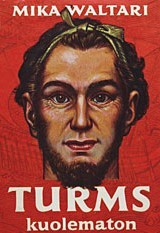
In its native Finland, this was first published as Turms, Kuolematon

A mercenary (Turms) in 5th century BC Greece has to uncover his own background and supernatural significance, believing himself to be cursed. A comment a year or so back brought it to my attention. I think I had heard of The Etruscan before (and Waltari, if only for being something like the only Finnish novelist with a Hollywood adaptation). I will push a little against Alec - Soldier in the Mist reads like Wolfe's use of Waltari's premise, and even plausibly might be a sequel (Turms sends off soldiers to aid  Persia in Xerxes's invasion of Greece towards the end of the book, and these might have included Latro.) There's also differences in tone: Wolfe's supernatural elements are more blatant and the appearance of historical figures more obvious (Pindar, Themistocles). Turms is doing something like writing his memoirs; Wolfe maintains the structure of Latro's day to day use of the scroll. 

The Etruscan also covers a longer span of time. Turms goes from cast-up soldier to maturity, with several years-long stays in various places or roles.  His gradual apotheosis involves not a little heartbreak and blood - and he aids some fairly vile people in his progress. It's just on the historical side of the border between fantasy historical fiction, maintaining that place despite Turms growing to become a sort of priest-king called a Lucumon and referring to himself as an immortal (Turms Kuolematon translating to Turms Immortal). An interesting comparison might be Votan. I think this will reward your curiosity. 

***

Another chance find was The Modern World, Steph Swainston. I think that a longer piece would be necessary to do justice to her Castle novels, but suffice it to say that I think they work fairly well. The central image of the Castle itself, with its competitive immortals, medieval stylings, mysterious Emperor and constant apocalyptic threat represent the sort of setting that would be good for those looking to do something with Space Knights outside 40k.

***

There is a new edition of The 52 Pages, together with the Next 52 Pages! I have a personal attachment to this system, and have used it for some of my work on this blog - but if you have an interest in a nice compact (and free!) RPG system, do take a look!

***

You may or may not know that there is a Price Drop for False Machine products - if you were on the fence, perhaps this is a time to take the plunge.


Saturday, 28 September 2024

The Rest of All Possible Worlds: Publish and Be Damned

The press is one of the great movers of the new age. If you are going to spread ideas or report on a new discovery or promulgate a new law, printed materials can make this happen.

This includes for player characters. A good way to build a reputation is to print an account of your travels and discoveries - even if people violently disagree, the fact that they have to publicly speak against you (or a pseudonymous figure that everyone in the know can identify) will allow your star to rise. 

For TRoAPW's purposes, we will speak of three sizes of publication:

  • Pamphlet
  • Treatise
  • Book

and three types of audience it may be geared to:

  • Broad-as-possible
  • General
  • Specific (and technical)

That's not necessarily low-, middle- and highbrow, but the connection could be made.

We may say that in a city (near the press itself, or on a notable trade route to get them) a fully-fledged book goes for 20 silver pieces, a Treatise 10 and a Pamphlet 2. 

Actually getting something printed and on the booksellers' stalls yourself requires one of the following:

  • Paying for it yourself
  • Convincing a printing house to print it - usually on the basis that there is a way for them to make their money back
  • Convincing a wealthy patron to put up the funds

Or, indeed, a combination of the above.

The costs of paying for it yourself are predictable enough: time and money.  Getting a printing house involved is likely end up with your work edited or suitably adjusted for the market.  Getting a patron involved may distract from your own fame, and indeed yoke you inevitably in the public eye to Lord X or Prefect Y or Arch-Priestess Z - aside from the tie of obligation involved. 

Of course, decent quality maps or illustrations will add to the cost of getting a book printed. 

It is assumed that if a character lacks the skills or inclination to sit down and write themselves, they may hire a hack to do it for them - usually at a rate a little below the average 'white collar' wage in the city you find them. A more highly placed collaborator can do a better job, but may cost more and absorb some of the resulting fame. 

So, what benefit comes from all this?

TRoAPW publishing sits alongside the usual set of carousing rules - but with wider social possibilities. If the Crucible Society want to gain fame from their exploits in the Bronzemount Free State or acclaim for their contributions to the field of Pneumametrics or draw attention to the plight of stranded sailors in the Alamgir Empire, then publishing can accomplish this. 

Looking across to The 52 Pages, in terms of hazard and unforeseen consequences, publishing looks more like 'Training' than the various other options. 

Unless a player wins the jackpot - the right book at the right time with the right distribution network and the right kind of people recommending it - it is assumed that any profits accumulating to them are fairly low. The roof stays over their heads. 

Actually trying to write for that kind of profit is difficult - by the time everyone's aware that they should be paying attention to (again) the plight of stranded sailors in the Alamgir Empire, that section of the market is swamped.
Writing on behalf of a cause or faction - Pneumametrics, say, or in favour of the Jointe in Tsymric - can get you a certain measure of publicity, but a smaller audience than you might hope.
In any case, player characters shouldn't be trying to be professional authors!


There are, of course, two more things to consider.

Firstly, grimoires. It is just about possible to pass on details of a spell without actually having to exactly reproduce a page of a grimoire. Think of an off-the-shelf spell as being like an equation with the final answer not yet given, but all the working shown - and which must then be rewritten for presentation in beautiful calligraphy. 

Accordingly, there are extra costs involved (even before you get to the point of dealing with the magical regulations for that jurisdiction). This involves things like specialist printing presses and secure 'behind the counter' retail transactions. Can't have someone else completing the equation!

So, a pamphlet length account of a new spell costs as much as an ordinary treatise, a treatise with (say) half a dozen spells as much as a full book and a full book with a good number of spells inside it - perhaps as much as ten times the cost of a romance.

***

Secondly, censorship.

Nowhere in Calliste has a formal freedom of the press, or of speech*. There may be city quarters where nobody cares what you say, or what you write - but a law may well have been broken all the same.

Let us speak of six levels of censorship.

  1. Review and adjustment of all printed material
  2. Review, adjustment of most
  3. Review, &c of many
  4. Review, &c of certain targeted works
  5. Review, &c laser-focussed on certain works
  6. Absolute minimum review.
1. and 6. are both basically non-existant- the former for reasons of state capacity, the latter for reasons of social structures.

This is further complicated by how keen the authorities are to actually carry out their duties. The lax censors of the Margravate of Fuchsunddachs may be commanded to review most material throughly (3.) but don't often manage this - unlike the Duchy of Brocq-et-Tod, whose Public Truth Commissioners carry out targeted censorship far more efficiently and dutifully. 

Thus, one pictures something like the below.

1

Painstaking review of all works


2

Painstaking review of most works

Lax review of all works

3

Painstaking review of many works

Lax review of most works

4

Painstaking review of targeted works

Lax review of many works

5

Painstaking review, laser-focused on certain works

Lax review of targeted works

6


Lax review, laser-focused on certain works

7

Absolute minimum review

But states don't have the same laws, or the same short-term policy objectives, or be rooted in the same cultures. The Grand Republic of Melesvulpia may have a robust tradition of political debate and broadsheets, but maintain public order via significant controls on what books of magic can be printed. 

So we might conceive of something like the below.


Books of Magic

Books of Magical Discussion

Political material

Religious material

Military material

1

Painstaking,

all works


Painstaking,

all works


Painstaking,

all works


Painstaking,

all works


Painstaking,

all works


2

Painstaking, most works

Lax, all works

Painstaking, most works

Lax, all works

Painstaking, most works

Lax, all works

Painstaking, most works

Lax, all works

Painstaking, most works

Lax, all works

3

Painstaking, many works

Lax, most works

Painstaking, many works

Lax, most works

Painstaking, many works

Lax, most works

Painstaking, many works

Lax, most works

Painstaking, many works

Lax, most works

4

Painstaking, targeted works

Lax, many works

Painstaking, targeted works

Lax, many works

Painstaking, targeted works

Lax, many works

Painstaking, targeted works

Lax, many works

Painstaking, targeted works

Lax, many works

5

Painstaking, laser-focused

Lax, targeted works

Painstaking, laser-focused

Lax, targeted works

Painstaking, laser-focused

Lax, targeted works

Painstaking, laser-focused

Lax, targeted works

Painstaking, laser-focused

Lax, targeted works

6


Lax

laser-focused


Lax

laser-focused


Lax

laser-focused


Lax

laser-focused


Lax

laser-focused

7

Absolute minimum review

Absolute minimum review

Absolute minimum review

Absolute minimum review

Absolute minimum review

This is not exactly complete - it leaves out, for instance, pornographic material. 'Targeted' in the above refers to a certain type of (EG) magical work - thus necromancy, mind control and so forth.

You will also note that Books of Magic and Books of Magical Discussion are different categories in Calliste. For reasons discussed above, they are different things (just one spell would be enough to make a theoretical tome into a Book of Magic). It may be assumed that most legal systems would wish to keep a closer eye on Books of Magic than Books of Magical Discussion, but Calliste is a big place with a wealth of little principalities and enclaves! 

Of course, it should be noted that states may also wish you to add something to a publication - a seal of approval, for instance. This is aside from states (or state actors) seeking, commissioning or encouraging publishing. 

Illegal presses may exist, allowing you to dodge the above but will have their own complications. The price will be at least comparable to a legal press - any costs (in time or coin) you avoid in not going before the censor you accrue in (for time) the necessary discretion an illegal press requires and (for coin) the premium they extract.

***

So as not to end on that note...TRoAPW is portraying a world in which substantial, influential works are being printed and circulated. Difficult to have an Enlightenment without that. Lawmakers are (perhaps) more often curious than censorious. Publishing in Calliste may be difficult, but it is also widespread. 

I don't insist on TRoAPW being a 'glass-half-full' setting (things might be going badly wrong!) but the glass definitely isn't empty.


*And, indeed, even places that proclaim both may have various organisations, cultural tendencies, &c. that suppress or discourage a certain kind of book.

Monday, 14 March 2022

The Rest of All Possible Worlds: Spell Schools

Another 'problem post' detailing debates and questions confronting the community of magic-users in TRoAPW

The spells quoted below are from The 52 Pages. 

Premise

That spells do different things is so obvious as to be not worth mentioning. That different spells sometimes work in very similar fashions is less readily apparent. Fire Dart and Flame Sphere have an obvious affinity, as do Detect Auras and Detect Magic. But despite the similarity between Create Rock and Conjure Wind, the precise nature and underlying logic of these spells is disputed. And given that different mages create and use different spells with very similar effects (Restimar's Instant Boulder against Belisar's Manifestation of Granite), the disputation gets even more troublesome. 

The categories spells are placed into are referred to schools. This conveys both that these spells are of a kind or group, that they are of a custom - a school of thought or use of magic - and that to manifest the features of this school, spell formulae and use must be taught.  

The State of the Art

Aside from the most obvious examples - as Fire Dart and Flame Sphere above - there has always been dispute over how to categorise spells. Wizard disputes with wizard, academy with academy, tradition with tradition. The growth of magical colleges that merge wizards of different traditions has made this ever more apparent. Where one stands on a theoretical position becomes ever more important and may dictate a course of study, the growth of magical talent or entry into a particular circle of mages. 

Pragmatic picking and choosing is still prevalent outside the (sometimes literal) ivory tower - but is now influenced by the ever-wider theoretical grounding given by masters to apprentices. Indeed, many wizards may not consciously identify with any given classification system at all. 

The disruption of older methods (by the Tabulators, or the Anti-Grimoireans) has created new ground for a grand division - not just between whether Dancing Lights is Illusion or Evocation, but if one should categorise on what a spell effects or uses or on what process a spell brings about

Thus, once the majority of spell catalogues in Calliste categorised their spells in the first fashion referring to 'The Lore of Shadows' or a 'Master of Gates'. Newer catalogues refer instead to 'the School of Illusion' or a 'Conjurer'. Those who adopt the newer method of categorising are known as Teleotaxists

Opponents of the Teleotaxists

Teleotaxists are most obviously opposed by Ontotaxists. By definition, these are a dedicated group of wizards with adequate free time and theoretical knowledge - rather than a hodge-podge coalition. The easiest way to tell a Teleotaxist from an Ontotaxist is to look at the titles they sport: does this wizard refer to herself as a 'Master of Winds' or a 'Ventilating Thaumaturge'?

An Ontotaxist model of the argument refers to Ontotaxists as 'Masons' and Teleotaxists as 'Millers'. The former is working with a medium, can perform both functional or artistic purposes - and more respected than a Miller. Whatever the relative wealth of a miller, they are far more commonly encountered and lack the cachet of a mason. Teleotaxists, for their part have more or less taken on the term Miller happily, employing bucolic imagery (maliciously whistling from morn till night), and gleefully referring to Ontotaxists as 'grist'. ("Your stony obduracy, oh mason, will be ground to the finest of powders by our ever-turning mill!")

The Teleotaxists Divided

Of the Teleotaxists, there are those that recognise that the division between Ontotaxists and Teleotaxists is less than useful. Noting the employment of nouns by one side and verbs by the other, they have attempted to to bridge the divide using gerunds. This has made them very unpopular and the Gerundists are very rarely heard from. 

The Polytaxists attempt to use both the Ontotaxist and Teleotaxist systems at once. This results in spells being referred to by long code strings, as 'BC/𝝭𝝘/7' or 'Leb - 2314 - p - 2477 - pf' or ever-growing combinations of arbitrary syllables as 'DivBanMiCha' - or strange blocky characters from constructed languages that are basically illegible  even to wizards, and troublesome to produce in freehand in one's grimoire. Polytaxists are derided as making a language fit only for golems, and thus speaking a language fit for golems - and thus jests abound that they are, in fact, golems. 

More successful than both are the Cryptotaxists. Such mages attempt to classify spells by using additional descriptors to hint at a mysterious source that cannot yet be detected or adequately defined. Some refer to a set of strange colours: 'This is a Blue spell'; 'This enchantment draws from the pool of Green magic'. Other modifiers are sometimes used : 'Of the Celestial School', 'A Perfumed incantation'. Still more Cryptotaxists refer to adjectives deriving from proper nouns, however derived: 'a glyph Telmarine'; 'an incantation Archenlandoise'.  Cryptotaxists are regarded as being somewhat pretentious, but they are still better received than the Polytaxists. 

Implications

Spell classification, of course, doesn't change the nature of the spells being cast. What the division between Ontotaxists and Teleotaxists does is change what spells are taught and by whom. The pyromancer is only subtlety different from the evoker, but if mages professes an expertise in both Transmutation and Divination rather than Change-Spells and Knowledge-Spells, there will be even less overlap. 

And the root structures of spells begin to change as well. As noted above, spell formulae have always differed. Therefore, a spell formulated with the firm belief that it is of one school rather than another will differ as well - if you have been used to one classification, moving to another may be difficult. Not impossible, but with that added layer of re-learning involved. 

Perhaps in time this might literally wall off Ontotaxists from Teleotaxists. All known spells (written or otherwise) have both 'noun elements and effects' - and 'verb elements and effects'. It would be near impossible for a spell to not do so. But as nounal Ontotaxists split from verbal Teleotaxists, so might spell formulation techniques. In time, even if all parties involved are using the same magical language, the same scripts for their grimoires - an Ontotaxist might be completely unable to parse a Teleotaxist-written spell, even a simple one. 

Does anything stand in the way of a great divide in Callistan magecraft? Well, non-magical patrons tend to look on the spell school debate as a wizard's pastime. Not terribly useful, but part of the cost of having spellcasters around. Of course, if an academy of wizards is in the service of the King for a particular purpose and the debate is preventing them from achieving that purpose, then there will be an intervention.

Less prominently, the mass of working journeyman mages who must and will use whatever spells they can get their hands on are a safeguard of sorts against divergence. Ad-hoc techniques to parse and align spells will be drafted every day by those at the coalface. But with growing interest in the uses of magic to address broad problems across society, and with growing efforts to promote magical understanding, starting with the academies, who knows if the one phenomenon will keep pace with the other?


Comments, nitpicks, &c welcome - I'd rather work out the problems now than later.

An obligatory reference to this part of Magical Industrial Revolution

Monday, 28 February 2022

The Rest of All Possible Worlds: Spell Levels

Another 'problem post' detailing debates and questions confronting the community of magic-users in TRoAPW

The spells quoted below are from The 52 Pages. 

Premise

Some spells are more complex, or have a greater effect, or a wider spread than others. Even the layman could tell that Fire Dart is doing less than Lesser Summon. Accordingly, magecraft has levels of skill and prowess involved. Even if a wizard is of journeyman status and presumably able to read wizard's script and work a spell, the initial spells they may work will be of a certain kind.  

The State of the Art

The wizardry of Calliste once worked this way: the spells your master gives you after serving your apprenticeship? Those are your 'first level spells'. 

Perhaps Arch-Proctor Sopespian feel that you should be taught Minor Summon before Unseen Servant in order to instruct you as to the unpredicatable nature of living magic - despite this being a more complex spell requiring greater reserves of your thaumic strength. 

Perhaps Restimar the Reticent feels that society at large is best served and mages are left unmolested when mischievous youngsters aren't taught Charm Person or Disguise

Perhaps Glozelle the Gamboge regards Translate as cheating, and that a young mage should get their grammar off by heart first before learning a useful short-cut for the field. 

Even beyond the Master-Pupil relationship, a Glozellian (or whoever) tradition ['Pointy gamboge hats will be worn on all formal occasions. If so desired, pupils may tuck ONE small flower into the hat-band.'] can develop over time, which ossifies the ruling on Translate above. 

Of course, wizarding traditions have matched and mingled sufficiently over the centuries. There are colleges of mages (and other institutions), in which the Restimari and the Glozellian can mix and compare notes. Some changes may have been wrought by this - but something still resembling the Glozellian tradition continues. And these changes are hardly universal: the Glozellians of Paviasse may have shifted their ban on Translate, but those in Malmery certainly haven't - and so the traditions proliferate. 

Enter the Tabulators. These are younger wizards who have decided to compose tables of spells, ranked by their cost in magical energies or complexity or some other objective factor than by what Glozelle (burnt to ashes fighting a dragon five centuries ago) or Restimar (emerges from his nacre crypt every four and sixty years to give cryptic advice, largely unrelated to the business of teaching) think. 

Opponents of the Tabulators

Those who stick to or recommend one tradition of magic are called Unicursalists. These are almost all 'Soft Unicursalists' - basically no-one but the most troglodyte would suggest that a wizard trained outside their tradition 'isn't doing magic' or 'isn't doing magic properly'. The Glozellian tradition is instead 'effective for these reasons' or 'particular relevant for these types of magic' or 'elegant' or  'tried and tested' or 'benevolent'.

Multicursalists are those who acknowledge there are many paths to teaching magic, each leading approximately the same place. They come from the newer formal magical institutions and colleges rather than isolated master-pupil relationships. A multicursalist might well acknowledge that the Tabualtors could accomplish their goal, but doesn't want to loose the perceived benefits of the evolved traditions. 

It is said scornfully by Tabulators that 'A unicursalist is only a multicursalist who can make up their mind.' No-one knows quite who first made the quip, and variations abound:  'A unicursalist is only a multicursalist with some pupils.' '...a multicursalist with an ego.' '...with a spine.' (&c.)

Tabulators will refer to unicursalists as 'mystogogues' and multicursalists as 'pædagogues'. Neither comparison is flattering. Tabulators in their turn are referred to as 'grocers' - that is, shelf-stockers and book-keepers. Their perceived naiveté and the style of the tables they get printed also won them the accolade 'Babes in the grid'. 

The Tabulators Divided

Among the Tabulators, two tendencies have developed. The first, the Naive school of thought, would (in theory) sell or make available the details of any spell to any wizard - as, basically, a matter of principle. Of course, if a twitchy young mage with bloodshot eyes, a serpent's-fang amulet and an obsidian ring shaped like a skull entered a Naive Tabulator's establishment, they may well think twice before selling or teaching them Lightning Bolt

Naturally, against the Naive are the Prudent Tabulators.  They are far more willing to set conditions on making a spell available, but will strive to make those conditions plain and transparent. The Naive regard this as rather too close to the multicursalists. 

Implications

As the reader may have gathered, the Tabulators are perhaps the closest thing to the disinterested magic shops appearing in video games, who apparently don't care about the potential problems involved in selling Acid Arrow to a scarred bloodstained stranger with too many weapons who pays you in strange coins that were last legal tender three centuries ago. 

This aside, there are other effects that the Tabulators' agenda would have on Calliste. Communities used to a certain set of wizarding behaviours would be disrupted as all sorts of spells are attempted by young mages. Economies used to a certain set of magical abilities being readily available would have to adjust quickly to the appearance of new services being offered and the dearth of previously relied-upon spells.

The stereotypical Tabulator institution is a shop with an attached training ground, not a school.  If the ideas of the Tabulators gain the upper hand, this may change. The old traditions with their named Primogenitors will diminish and new academies will take their places. A disruption to the supply of trained magicians is inevitable; princes and governors dislike this, but may be mollified by the prospect of more multi-purpose wizards. The apparent lawlessness of the Naive Tabulators makes them unappealing; several states may attempt to force them underground. 

Of course, the new status quo may be the wizarding shop, with its customer base of free-floating individualist wizards, without significant ties to schools or guilds.  Networks of patronage persist, as sources of occult power flow through new, informal channels.  Competition for sources of magic - spell catalogues and libraries, grimoires and eldritch idols - begins as the old order dies. Protection offered by the rich and powerful may become evermore appealing, and a new group of court magicians emerges.        


Comments, nitpicks, &c welcome - I'd rather work out the problems now than later.

Wednesday, 27 January 2021

Punth: A PDF

If you are a long-time reader of this blog, or have spent some time in the archives, you will have encounter my posts on the land of Punth and the Primer, detailing how that distant society operates. 

Well, that series has now reached its conclusion. I have taken those posts, tidied them up a little and laid all out in a PDF. The content is much the same as what you will find here - indeed, I have cut out a certain amount of superfluous material, and neither the post on Postmodern Architecture nor the discussion of who draws the best Green Martian will appear (end of this post).

However, the PDF A) draws these posts all into one place, B) lays everything out neatly on the page and C) makes the scattering of posts into something like an actual Primer - a single introductory resource. I have labelled it as a 'mechanically-guided setting', which seems correct. I don't know how much use you might have for my details of a fictional totalitarian state, but the Codes provide a novel way to interact with the setting and communicate something of the land of Punth.

As ever, the Primer makes use of The 52 Pages, found at Roles, Rules and Rolls.

You will find the PDF available at Itch.io, with a pay-what-you-want system attached to it. In future I may release a Revised Edition, or something of the kind - but for now I have no other plans for Punth. 

However, I have spoken for too long, and shall usher you in the direction of Punth: A Primer

Saturday, 3 October 2020

Punth: A Primer - Appendix N

Some of the below have been referenced in Chapters of the Primer and other blog posts. Other inspirations have not been hitherto mentioned. 

Genesis, Ch. 11 Verses 1-9 will provide you with the story of the Tower of Babel.

[The Wisdom literature of the Old Testament, or similar works of the ancient world, are not a specific inspiration, but are useful reading. The portions of the Codes in the Primer are not written on this model - Punth is atheistic - but it is still in the DNA of the Primer; see below.]

Snow Crash, Neal Stephenson

The discussions of Babel, language and Sumerian culture are more relevant to Punth than corporate warfare, hacking and the metaverse. 

Dune, Frank Herbert

The Book of the New Sun, Gene Wolfe

The chapters of Citadel of the Autarch devoted to the Ascian language (if you click on any link in this post, make it the second of these) are obviously vital, but the image of a collapsed space-faring civilisation is also arresting. The Azoth of The Book of the Long Sun is of interest as an artefact of a space-faring civilisation; I have discussed that here

Nineteen Eighty-Four, George Orwell

The element of Newspeak is most relevant. 

A Princess of Mars and the Barsoom series, Eric Rice Burroughs

Various interpretations of which are discussed here.

The Saga of Recluce, L. E. Modesitt, Jr.

Most notably Fall of Angels, Magi'i of Cyador, Scion of Cyador. Discussed here.

Declare, Tim Powers

The djinn of the desert owe a great deal to Declare.

Seeing Like a State, James C. Scott

The following reviews may be of use: A), B), C).

Reflections on the Revolution in France, Edmund Burke

Red Plenty, Francis Spufford

Warhammer 40,000

Star Trek

I cannot claim to have been thinking of any given part of Star Trek when writing on the origins of the Qryth, but as an image of space exploration advanced enough to invoke Clarke's Third Law as well as vigorous enough to produce the Qryth, it serves nicely. 

Chariots of the Gods?, Erich Von Daniken

I have not read Chariots of the Gods, but it serves as synecdoche for the whole of the 'Ancient civilisations were built by aliens' school of thought. 

Seven Pillars of Wisdom, T. E. Lawrence

More for the atmosphere of the desert than the events of the Arab Revolt.

The Pillow Book, Sei Shonagon

Tuesday, 29 September 2020

Playing in Punth

 OR, A Primer for the Primer

NB - the below is all untested. It is trying to provide a suitable framework to make the Primer usable, but the Primer rather than the system presented came first. 

There are really two ways to set a game in Punth. To have players create characters from outside Punth (or they could be Ka-Punth) and have them go in, or to have them create Punthite characters.

Punth was originally conceived as part of a larger world (see Ch. 7) - the Terrae Vertebrae of this blog. Other than in that Chapter and a few scattered other references, I have tried to make Punth able to be slotted into another fantastical setting. The Babel-myth elements and Near or Middle Eastern basis makes it perhaps an odd fit if you were to slap it down right next to, say, fantasy equivalents of Vietnam or the Tlingit lands - both in terms of culture and environment. However, I would contend that the meat of Punth is in the Codes and the position of the Qryth: the specifically Babel-like elements could be reduced, reformed or repositioned, as could the Near Eastern portions.

The question will be, how much of the Primer do you issue to players? 

If they create Punthite characters, the only in-character conversation they should do should be in the Codes. Ch. 5 and Ch. 6 are deliberately linked to the Character creation process of The 52 Pages (and probably aren't that far distant from other systems). Ch. 8 will be needed at this point also. Parts of these could be issued to players at creation. Ch. 9 is most useful for play, and will likely come up as you go along. Ch. 1's foundation story and creed and Ch. 2  act as introductions to Punth as the Codes would describe it. These could be introduced into play early, in a 'We will all rise and recite the Oath of Allegiance' sort of affair. 

Here's the contents of the Primer, with a schedule of how you could issue it to players playing Punthites.

Ch. 1 - Foundation & Creed - Soon in the Game

Ch. 2 - Entrance into Punth & Marriage - When desired

Ch. 3 - Punthite Justice - When desired

Ch. 4 - Trade in Punth - Soon in the Game

Ch. 5 - Arms and the Qryth - Character Creation

Ch. 6 - Occupations in Punth - Character Creation

Ch. 7 - Religion and Foreign Affairs - When desired

Ch. 8 - Names - Character Creation

Ch. 9 - Conditions - Character Creation

Ch. 10 - Goals - When desired

[If you go to, say, Ch. 5, you will spot the table of military encounters at the bottom. This is as much inspirational as mechanical, but is more for the GM's use. Chapters of the Primer as referred to for player use above probably don't need to include these, and I shall probably produce a document where these materials are separated.] 

Introducing Characters from outside Punth into Punth probably starts with the introductory hooks at the beginning of some of these blog posts: 

The land of the unbelievers, the fallen. A great desert, with who knows what lurking beyond. Where ten crusades have faltered. The Land of Punth.


South of the great mountains, south of the border provinces of the Empire lies Punth.  The tribes of the deep desert co-exist with the Ziggurat-Cities along the river, all under the eye of their alien lords.

Who are these strange folk? From where did they come?

Having thus whetted the appetite, the possibility of entering Punth can take place. Characters could enter tutored or untutored. The Codes are (for convenience) meant to be in a regional 'Common', if with a few variations in terms of dialect. Therefore, even the Untutored can read and speak the Codes once they see or hear them. Characters can communicate in Common (or other mutual languages) and not be understood by those who only use the Codes. 

Tutored here doesn't necessarily mean anything academic: it could be a sailor who knew Punth, or a merchant who trades there, or a diplomat or intelligencer briefing you on how to blend in. Ch. 7 (adapted if necessary) is presumably a must. Other than that, access to a Chapter will depend on the tutor - it is unlikely that a merchant will be able to teach you all (if any) of Ch. 5.

Untutored, of course, could imply any number of things: an unprepared expedition, a misfiring teleport spell, a pressgang. What it does mean is that the characters have little knowledge of Punth and none of the Codes. 

Tutored or Untutored, there is still a schedule at which the Chapters of the Primer should reach players: 

Ch. 1 - Foundation & Creed - Soon in the Game

Ch. 2 - Entrance into Punth & Marriage - On entrance

Ch. 3 - Punthite Justice - When desired

Ch. 4 - Trade in Punth - Soon in the Game

Ch. 5 - Arms and the Qryth - When desired

Ch. 6 - Occupations in Punth - When desired

Ch. 7 - Religion and Foreign Affairs - On entrance

Ch. 8 - Names - Soon in the Game

Ch. 9 - Conditions - Soon in the Game

Ch. 10 - Goals - When desired

***

I would like to make clear that the Primer by no means is meant to declare the whole of the Codes - that would likely be a work at least the size of a thick novel. The Primer is meant to make play in Punth possible and to introduce the Codes to players. From this position, people at the tabletop can introduce new Codes; if the GM is doing so, then they may be slipped in however convenient. If players are doing so, a veto system would be appropriate ('I'm not sure that's quite how Code 7.36.79 goes...shall we check with the scribe?'). 

Obviously, no Code is meant to be specifically advantageous for any one group ('When Three Men, an Elf and Two Fauns enter the land, the time of the Sky Princes is over!'). Faking a Code would require an ignorant or young Punthite, as well as the Charisma-related ability (or magic) to effectively sell this new 'Code'. This would not last long in one of Punth's cities!

The following list of questions is for GMs using the Primer to decide for themselves: 

  • How sincere are the Qryth in their role as leaders - do they live by the Codes themselves?
  • Can (and do) the Qryth communicate by other means than by the Codes?
  • How competent is the rule of the Qryth?
  • What is the nature of the Ka-Punth's revolt against the Qryth? 
  • If the Qryth were to die off, would the state of Punth maintain itself in roughly the same fashion?
  • If the Qryth were to be contacted by their home planet, would they be welcomed home? Or have they been so thoroughly culture-warped and gene-twisted that they would never wish to?
  • What was the Sorcerer-King trying to accomplish?
  • Can Punthites wield magic? Or must they rely on outsiders, willing or otherwise?
  • Do the djinn have any genuine power, or are they only unquiet spirits?
  • Do the djinn have any collective plan to regain their former power?