Showing posts with label C.S. Lewis. Show all posts

Sunday, 30 June 2024

May-June Miscellany 2024

Naomi Mitchison,  The Corn King and Spring Queen

Can't say I was as taken by this as False Patrick, but still very good. It's an interesting comparison with (say) some of the character work of Rose Macaulay or the pre-occupations of some of C.S. Lewis's lesser known stuff. There's also probably a big wedge of Bloomsbury Group in there that I'm too uptight and square to properly grok. 

Comparisons aside, this thing is rich. Rich interior lives, rich in its extensive cast, generous in the scope of the plot, rich in description: it reads as the work of someone who has done things with their hands often enough to know about sewing or ploughing or hunting or dancing what have you - rather than the perspective of someone who only knows plate armour through a video game. 

***

Eamon Duffy, The Stripping of the Altars

I've had this for ages, but only just got round to reading it. Well worth it, and quite digestible. The photographic plates help. It's clearly a standout work in its field - Cf. what Wikipedia says as a general assessment - and I see why it was referenced in my university courses. 

Should you read it? Well, I think that if you're an Anglosphere type with an interest (academic or practical) in your history and culture, reading a few chapters from the first half would be very worthwhile - for religious ignorance reasons gestured at in some of my recent work. If you've read any proper history you can spot Duffy's focus and/or agenda, but that's not necessarily important. 

***

Lucan's Civil War or Pharsalia

Almost finished this at time of writing. Not one of the more prominent classical epics, but an interesting read all the same. Part of this is the subject matter: the clash of Julius Caesar and Pompey the Great after the former crosses the Rubicon. Familiar territory, even fictionalised - but not in the conventions of the epic. The civil war angle is not neglected, and the tragedy of events is clear. Added to this is the fact that it is describing real battles and troop movements, and largely leaves out Divine intervention, makes it rather interesting to compare with Virgil or Homer.

All that said, there are some thoroughly sensational moments. A carefully described reading of the entrails in Book One, a consultation of a Thessalian witch, Cato's army harassed by snakes. Is this the B-Movie of Classical epics? (Probably not.)

Another consideration is that Lucan was writing in the early days of the Emperor Nero. There's some praise for his ancestor Julius, though however potent Caesar is, Pompey gets the more enduring praise. 

'Pharsalia', incidentally, is the name of a battle between Caesar and Pompey in northern Greece, in the region around the town of Pharsalus (now Farsala). So I suppose you could call Lucan's Civil War something like The Battle of Pharsal County (which sounds rather American) or The Clash of Farsalmark (for something faintly Nordic). 

I read the translation by Susan H. Braund, but I've been comparing material elsewhere - including the Early Modern rhyming version by Sir Arthur Gorges, which may be found here.

***

Celine and Julie go Boating, dir. Jacques Rivette, 1974

Have you ever wanted to see what would happen if someone took late-period Tim Powers and made it significantly more French? Well, here's a good place to start. The mix of a contemporary setting and a supernatural house is arresting and well-executed - once you've got into the groove of the film.

***

Metropolitan, dir. Whit Stillman, 1990

Utterly unseasonal, though I didn't know that when I picked it up. A curiously touching film, though this is in part perhaps the result of living in a young city while being less than aged myself. There's some interesting currents in it - and I suspect the use of the tune to Luther's hymn Ein feste Burg ist unser Gott is no mistake.

***

The Mark of Zorro, dir. Rouben Mamoulian, 1940

Starring Tyrone Power. You don't need me to tell you this is good or influential and I won't try to comment on the sword fights. Other people can do that. 

What I think makes this worthy of note - and it's something I don't see discussed to the same degree - is the elements of disguise and secret identity. Don Diego Vega - the man they call Zorro - is deliberately concealing his motives and character, making himself into a ridiculous, useless fop. There are good reasons to do this, and Vega clearly has or had some frivolous facets to his character - but unlike Robin Hood concealing himself or the various versions of Bruce Wayne that have appeared on the screen, this is painful or costly in ways that aren't seen elsewhere. His father is openly contemptuous of him, his mother loves him but in a somewhat disinterested way, his old teacher barks at him and he must humiliate himself in front of his love interest and the villain. High literature this isn't, but the willingness to put a distinct social (psychological?) cost on his subterfuge gives this a bit more weight (Cf. Christian Bale getting to have his cake and eat it too as both playboy and vigilante).

Dr Syn dealt with this from time to time as well, though there things are complicated by the Vicar of Dymchurch's dark past. 

***

There's a poem of C.S. Lewis I encountered recently. It doesn't really apply to my post on Saturn, but it's certainly adjacent to the whole matter.

Anyway, from 'La Roi S'Amuse':

Jove gazed
On woven mazes
Of patterned movement as the atoms whirled.
His glance turned
Into dancing, burning
Colour-gods who rushed upon that sullen world,
Waking, re-making, exalting it anew –
Silver and purple, shrill-voiced yellow, turgid crimson, and virgin blue.

(Cue for music.)

It's a complex bit of rhyming, tricky to read aloud. Find the rest here

***

Sinjin - a new piece of work by Mateo Diaz Torres, who did Pilgrim. Again, available on Itch.io. Black and white artwork from a variety of artists.

Quote:

A century ago, the Black Heron College performed an experiment into the nature of Death and caused a great disaster. The site of this catastrophe came to be known as The Saint John Forbidden Territory.   

A hundred by hundred yawning miles of sawgrass, palmetto hammock, winding river, and overrun industry—all reclaimed by the Dead. In the territory, the land forgets itself, geography flexing and twisting like a straining muscle, the progression of days stuttering and jumping like a broken zoetrope.  

You are a freelance exorcist, compelled or driven to enter the Territory. You wield the remnants of Death's instruments: arts and tools left over from Her now-unfinished work. It is your duty to carry on against the growing disaster. The depths spread, and the Dead stand against you.  Put them back in their graves.

No Appendix N provided, but I would agree with other reviewers in detecting the influence of Garth Nix's Old Kingdom books and Annihilation. Though the overgrown sprawling abandoned Louisiana buildings of season 1 of True Detective kept springing to mind. Southern Gothic abounds. 

The territory itself is a limited space that keeps changing. As a region, it's probably no bigger than a county - but, as above, it contorts. The fixed landmarks are the same, but the connecting elements will shift - as will the climate. There's something of Darkest Dungeon in this, in which an opulent and imperial mansion has an improbable number of rooms. Indeed, it would be interesting to have something like a quartet of Sinjin-esque regions one could enter.

Sinjin is worth your time - though there's something that caught my eye. The setting is '19th century pastiche not-Florida' - there's the implication of a state outside it, and several regions are mentioned, including the San Serafin of Torres's New Barbary setting. This has the side effect of making me think of what lies outside Sinjin. The organisations that send you into the territory are these slightly-too parallel groups of exorcists. 

Part of me itches for...well, A) a sketch of geopolitics and cultural shockwaves and B) asymmetry. To explain on the latter - the differences and clashes between groups and styles in the territory: professional and amateur, government and private, religious and secular, cautious and imprudent. But this is a very particular issue and should not put anyone else off.

Friday, 21 June 2024

Lewis and Saturn in the 41st Millennium

If at the height of heaven Saturn's
cold and harmful star were lighting his black fires.....

Pharsalia, Bk 1, Lucan, trans. Susan H. Braund

....at length old Saturn lifted up 
His faded eyes, and saw his kingdom gone,
And all the gloom and sorrow of the place....

Hyperion, Keats

I made a long comment on this post on Monsters and Manuals. noisms invited me to expand on it. 

1) noisms suggests an approach to Warhammer 40,000 - at least as far as roleplay is concerned - rooted in the theology of Christian speculative fiction authors as Lewis, Tolkien and Gene Wolfe. This wouldn't necessarily be apologetics, but would round out some of the ideas suggested by the setting. A 40k roleplaying game in which the PCs 'try to do good'. Wolfe (not unreasonably) is suggested as the most obvious point of comparison.

2)  It's tempting, taking that 'try to do good' remark, to imagine levering Pollyanna into the Grim Darkness of the Far Future. I would say noisms doesn't mean this, and further that the proposed 40k RPG would want to be of a tone with existing 40k. Further, I would suggest that there is a degree of material that can be found in the work of C.S. Lewis that fits this rather well. 

3) For completeness, I shall mention that Lewis did write about dystopian future states - notably in the lecture series collected as The Abolition of Man. As interesting as that might be, the future state of controlling pallid intelligences and hollowed-out underlings is a poor match with the Medievalism and decay of the 41st Millennium. An age of chains, not an age of rot; a panopticon-world, not a dungeon-world. 

Now, there's a quiet tendency to talk about the Chronicles of Narnia in terms of The Lion, the Witch and the Wardrobe. The events, tone and theme of that work are (relatively) bright. The instantly recognisable scene of Mr Tumnus contributes to this, as does the inclusion of Father Christmas and the repeated phrase of  'Always Winter, Never Christmas'. Narnia is peopled by talking animals, not human beings. While this tone isn't consistent through the entirety of LWW, this has a touch more of the childlike in it than later Chronicles. Where we might look is to that final work, The Last Battle.*

4) The theologian and literary critic Michael Ward wrote a book in 2008 called Planet Narnia: The Seven Heavens in the Imagination of C.S. Lewis. This is not an entirely obscure work - I'm not revealing anything very special here - the BBC made a documentary based on it and Ward himself is moderately prominent. 

Anyway, Planet Narnia lays out much of Lewis's writings on the seven heavens** of Medieval Cosmology - the Moon, Sun, Mercury, Venus, Mars, Jupiter and Saturn. Certainly Lewis (as one who taught Medieval and Renaissance literature) knew of these and wrote about them in non-fiction - see Ch. 3 of The Discarded Image. He wrote poetry on them - in part, it seems, as an intellectual exercise. The Cosmic or Ransom Trilogy was written in the 1940s, after the discovery of Uranus, Neptune and Pluto but focuses on the Medieval planets (the one reference seemingly to them makes it appear that they are older and have ceased to support life or relevance). The various planetary geniuses that go by the term Oyéresu (singular Oyarsa) have in them a resemblance to the Classical deities as rendered by Medieval minds.

Ward's thesis is that the varying tones in the Chronicles of Narnia are attributable to each book being connected to one of the seven heavens. 

--At this point, some of you may be wondering which book is connected with which planet. Well, if I may - please don't look that up now! Even granted that I've given the game away regarding Saturn in my original comment and in this post, I would be fascinated to know what your guesses would be. Answers in the comments.

I don't propose to lay out his full argument here, but it's a fascinating lens to examine them through. Some of you may be mulling over at this point 'Does this mean Lewis believed in astrology?' - Ward, of course, answers this. I might compress his response and my own thus: more than someone who refers to a person or thing as 'Lawful Evil', 'Chaotic Good', &c, but less than he did in the Trinity or Newton's Laws of Motion.

5) So, The Last Battle is Saturnine. What does that mean?

Myn is the ruine of the hye halles, 
The falling of the toures and of the walles
(Incidentally, thanks to the Middle English in Traitor General and the presence of a pardoner in The Armour of Contempt I'm pretty certain that Abnett knows his Chaucer.)

Quoting Lewis in The Discarded Image, we get : 'In the earth his influence produces lead; in men, the melancholy complexion; in history, disastrous events....He is connected with sickness and old age.....A good account of his promoting fatal accidents, pestilence, treacheries and ill luck in general occurs in [Chaucer's] The Knight's Tale....sometimes called The Greater Infortune, Infortuna Major'

'My dere doghter Venus,' quod Saturne, 
'My cours, that hath so wyde for to turne, 
Hath more power than wot any man. 
Myn is the drenching in the see so wan; 
Myn is the prison in the derke cote; 
Myn is the strangling and hanging by the throte; 
The murmure, and the cherles rebelling, 
The groyning, and the pryvee empoysoning: 
I do vengeance and pleyn correccioun 
Whyl I dwelle in the signe of the leoun. 
Myn is the ruine of the hye halles, 
The falling of the toures and of the walles 
Up-on the mynour or the carpenter. 
I slow Sampsoun in shaking the piler; 
And myne be the maladyes colde, 
The derke tresons, and the castes olde; 
My loking is the fader of pestilence.

The Knight's Tale, Chaucer
(Try reading it aloud.)

But Saturn is not Satan. Exactly. (Likewise, Jove is not God). See Bernardus Silvestris.

...the Usiarch Saturn, an ancient to be most strongly condemned, cruel and detestable in his wickedness savagely inclined to harsh and bloody acts. As many sons as his most fertile wife had borne him he had devoured newly born, cutting short the beginning of life....how destructive a threat he would pose to the future race of men by the poisonous and deadly property of his planet. While Nature, after observing his labours, judged him harsh and treacherous, yet she believed that the old man must be respected, as it was said that Chronos was the son of eternity and the father of time.

Cosmographia, Bernardus Silvestris, (Microcosmus 5.5-6),  trans. Winthrop Wetherbee

There is no avoiding Saturn, though one may escape the grasp of the Devil. His influence is more woeful than foul. 

Of course, this picture is complicated by Virgil - the Aeneid in Book VIII has a passage describing a Golden Age brought about by Saturn, as does Eclogue 4. These appear to be images that pre-date the melding of Roman and Greek myth. On a practical note, the Temple of Saturn in the Roman Forum was the state treasury - one doesn't place one's treasure in the keeping of a loathsome god. See also the Saturnalia, the festival with a brief return to an age of plenty and equality.

To turn (naturally) from Virgil to Dante, we ascend to the Paradiso. Dante and Beatrice pass through the spheres of Paradise, each associated with a Planet. Saturn is not named - Longfellow refers to the 'Seventh Splendour' in his translation (Canto XXI). His sphere is that of contemplatives - Dante meets with St Benedict and St Peter Damian.

There are also some fascinating extracts on Saturn from the astrologers/astronomers of the Islamic world (as Abu Ma'shar al-Balkhi), that were transmitted into Christian Europe. Some of these are familiar enough in terms of their content (melancholy, misfortune, cold, plague), though the level of detail is different to the literary uses of Saturn.*** Book Three of the Picatrix or Ghāyat al-Ḥakīm, however, (in addition to the claim that the image of Saturn is 'the shape of a black man wrapped in a green cloak with a dog-like head and a sickle in his hand') makes the claim that his is the 'retentive virtue' (Cf. Mars and the 'attractive virtue', or Jupiter and the 'augmentative virtue'). This is interesting as a Saturnine neutral quality, and applies itself equally to Time gnawing away at men, and to the holding or maintaining of wealth.

6) I doubt Lewis read the Picatrix - literature, not magic was his field - but it's an interesting contrast and part of the wider scheme. Either way, let's talk about Lewis's Saturn. 

By his own account, Lewis's own generation - who fought in the Great War and then wrote an awful lot about it - were born under Saturn. However, he denied the final authority of Saturn, the claim of the universe to be 'Saturnocentric'. Quoting Ward, that quality which Lewis called Saturnocentric 'means astringent, stern, tough, unmerry, uncomfortable, unconciliatory, and serious, though not necessarily profound or virtuous.' 

40k has of course, been quite willing to make reference to the Great War.

That Hideous Strength features a scene with the decent of the planetary influences into the manor at St Anne's. The introduction to Saturn goes like this:

All thought of that [the cold outside]: of stiff grass, hen-roosts, darks places in the middle of woods, graves. Then of the sun's dying, the Earth gripped, suffocated, in airless cold, the black sky lit only with stars. And then, not even stars: the heat-death of the universe, utter and final blackness of nonentity from which Nature knows no return.

Meanwhile, at the focus of Saturn's descent, things are different.

Saturn, whose name in the heavens is Lurga, stood in the Blue Room. His spirit lay upon the house, or even on the whole Earth, with a cold pressure such as might flatten the very orb of Tellus to a wafer. Matched against the lead-like burden of his antiquity the other gods themselves felt young and ephemeral. It was a mountain of centuries sloping up from the highest antiquity we can conceive, up and up like a mountain whose summit never comes into sight, not to eternity where the thought can rest, but into more and still more time, into freezing wastes and silence of unnameable numbers. It was also strong like a mountain; its age was no mere morass of time where imagination can sink in reverie, but a living, self-remembering duration which repelled lighter intelligences from its structure as granite flings back waves, itself unwithered and undecayed but able to wither any who approach it unadvised. [Characters] suffered a sensation of unendurable cold; and all that was strength in Lurga became sorrow as it entered them.

Ward mentions at this stage the 'godly sorrow' of St Paul in 2 Corinthians 7.8-11. If there is a Saturnine human character in That Hideous Strength, it is the Ulster scientist and rationalist Andrew MacPhee - a serious-minded type, sceptical of some of Ransom's wilder claims, apparently a happily unattached bachelor. By the conclusion, he is dressed in an 'ash-coloured and slightly monastic looking robe' - once again, note the reference to contemplatives. He may be a rough tribute to Lewis's tutor William Kirkpatrick.

An adaptation of Ward's chapter in Planet Narnia on Saturn may be found here. Those who recall that work will remember the scenes of darkness and despair, the leaden weight, the deceptions, the appearance of Father Time - to say nothing of the death of so many of its characters. The Last Battle, as he notes, ends with the return of the Jovial. We may compare Aeneid VIII here - Saturn's golden age comes after his displacement by Jupiter.

7) Fine: of the Seven Heavens, Saturn may be most apt for 40k. But how do we have a virtuous struggle - and even a victory - under Saturn?

First of all, to be Saturnine is different than to be Martial. This is not just a matter of degree - Infortuna Major and Minor - but also of quality. The bracing contest and clash of arms under Mars is different to the crushing weight of years under Saturn. This also means, I would say, less chance of an ongoing series. The regiment going on to another world, another battle. The contest must be final.

The protagonists must, I suspect, be on the defensive - or a 'best defence is a good offence' endeavour. But that which it preserves must be consistent with the Saturnine. A lonely outpost of survivors, a hospital of the maimed, a hermetically sealed library or a depopulated mega-structure, its furnaces and power plants finally cooling. Player Characters should be (as in the Saturnocentric quote above) stern and unconciliatory, though for 'Let justice be done though the heavens fall' reasons. Contest of arms should be costly and uncertain. 

"I tell you naught for your comfort,
Yea, naught for your desire,
Save that the sky grows darker yet
And the sea rises higher.

"Night shall be thrice night over you,
And heaven an iron cope.
Do you have joy without a cause,
Yea, faith without a hope?"

The Ballad of the White Horse, Bk. 1, GK Chesterton

I said before that this would this would involve 'a bitter struggle, despair, trudging, misfortune'. Trudging and footslogging is often rather neglected by 40k, at least when it comes to Space Marines; but for our purposes, an emphasis on fatigue and becoming overwhelmed is necessary - which takes the fun out of being a muscular super soldier. (Admittedly, the later Horus Heresy books had good moments of this.)

To repeat myself again, 'the triumph is in some distant preservation for a coming dawn (...a New Sun). Resting on the association with contemplatives and monasticism, perhaps we see an iteration of [the conclusion to] A Canticle for Liebowitz.' Interestingly, while the Imperium of Man is the natural fit for all the above, it strikes me that the Eldar would also fit quite well. Their tragedy and decline is as pronounced, of course, but we have not the short lives and brutal deaths of humanity, but the slow dwindling, like the space elves they are. 

Coupled to this is their method of preservation, the spiritstones. An Eldar soul may be retained in one of these rather than falling to Slaanesh in the Warp. They are gathered into the Infinity Circuits of their space-faring craftworlds. This does not appear to be much of a paradise, in so much as we know much of it. Death, but deliverance from damnation; an eternity of contemplation. Life for survivors among depopulated cities or amidst distant echoes of old friends - who must still be preserved. Of the craftworlds, Iyanden may express this best.

Anyway, I think that indicates ample scope for the Saturnine as a theme or mode in 40k. 


*Please assume, as in the original comment, that I am aware of some of the discourse and criticisms of The Last Battle and that I can add nothing the informed would find relevant or interesting to that here.

**Discussed and employed here before!

***See this article for some extracts. Also, the association of Saturn and the Jews, which may be the result of the connection between Saturn's day and the Sabbath. 

Monday, 14 February 2022

The Names of the Stars

I've used the geocentric or Ptolemaic model of the Solar System, (with the planets visible to the naked eye) as the basis for a few posts.  

This understanding of the cosmos is also employed, with variations, by C.S. Lewis, in one place or the other (Planet Narnia was a revelation). He's not alone. Dante models his Paradise after the Solar System, though this may be less well-remembered than the layers of the Inferno. Closer to home are the crystal spheres of Spelljammer. The classes of Sidereal Exalted derive from the visible planets and their associations; the list is completed by the Lunar and Solar Exalted. The esoteric panoply of astrological and alchemical symbols are a connected part of fantasy aesthetics; e.g, the cover of A Most Thoroughly Pernicious Pamphlet

While the Signs of the Zodiac as we know them seem to be out of the running, astrological conventions are not unknown in fantasy. To chose a fairly mainstream example, the Birthsigns of The Elder Scrolls series of video games (which strike me as, well, thuddingly obvious - 'You were born under the Sign of the Thief, guess what you're good at'). Where Capricorn, Scorpio et al appear it tends to be in the form of a somewhat arbitrary decision; see the Twelve Colonies of Kobol. They're a 'complete set' of images and can thus be used as an (uncontroversial?) artistic motif - as in the Wisconsin State Capitol, for one. The combination of completeness and variation associated with the Zodiac when taken as a whole perhaps explains their use on the dust jackets of The Reprint Society in the 1950s (see below), unconnected to the content of the book.

Image found here. Other variations on the theme are available.

But let's set all that aside. This isn't the time to discuss the planets - or the Zodiac, or indeed any given constellation. To give the bounds of my discussion, I am looking at the names of the stars that reach us out of the distant past. As interesting as the recent decisions of the IAU may be, I shall be considering the list of names below, found in an old copy of Norton's Star Atlas (the below being the 17th Edition from 1978).


The various naming conventions of star catalogues that give us, say, α Leonis, are useful but do not concern us here. 

Where, then, do the names of the stars appear? An obvious place to start is with science fiction. The (nominally) harder sort of science fiction uses them; witness the use of Rigel, Algol or Alnitak in Star Trek, Deneb in Blake's 7, Altair in Forbidden Planet, or Sid Meier's Alpha Centauri. Of course, the rather looser Hitchhiker's Guide to the Galaxy will also happily refer to Barnard's Star, Betelgeuse or 'an Arcturan megadonkey'. 

The use of such names is perhaps to be expected in a future history of mankind among the stars - though, in the case of sentient alien life emerging on the planets of one of these stars, the question of what name is used to refer to it would be a matter of dispute. It would be a suitable characteristic for an expansionist human star empire to apply the old Terran names of the stars - whatever the native population or a breakaway human colony think of that. 

You would expect this to come up in Warhammer 40,000. It doesn't; on second thought unsurprisingly, given the years of decay and ruin. The names of the stars do appear but as part of the lexicon of history and myth from which authors can draw names of people, places, organisations, &c: Vega, Antares, Arcturus, Sirius, Polaris, Polaris (duplication should not surprise us). A number of planets have been named for stars: AlgolDeneb - can one witness a sunset if one is standing on a star? Altair VII - presumably the seventh planet to orbit Altair - is a pleasing exception. The Imperial Stars don't have much more that a name and a colour scheme, but if anyone is going to make an army of them, I think we have a few names they can use. [Edit: Oct 2022. In Rath's Assassinorum: Kingmaker, an assassin without any particular astronomical or artistic education recognises Ursa Major from the ceilings of cathedrals, portraying the sky as seen from Holy Terra. Of course the old constellations would be a religious-artistic motif.]

Star Wars is, of course, set in a galaxy far far away, but one can't help thinking that Alderaan and Aldebaran share a certain kinship as names. Besides this, the very nature of the names of the stars gives the model of proper names - the majority of planets in Star Wars appear to have these rather than codes or catalogue-type names; Yavin 4 being an honourable exception. 

To shift genres briefly, fantasy gives us an entirely different use of the names of the stars. A number of names in Harry Potter are taken directly from the above list: Sirius, Regulus, Bellatrix - all members of the same family (names derived from constellations are among the wider family as well: Cygnus, Orion, Andromeda, Draco). The Blacks are among the older and richer families of wizarding Britain: the aristocratic pretensions of stellar, Latinate names are presumably to be contrasted with earthier, more typical names - further, these snobby, prejudiced people with the strange names aren't a bit like us and the protagonists. This isn't the sole reasons for such names, of course: Sirius is the Dog Star and, if you did not know it already, you can guess what sort of animal Sirius Black can turn into.

Weird fiction has a number of uses of the names of the stars; Carcosa, famously, is among the Hyades. Lovecraft wrote a story called 'Polaris', featuring the remote gaze of the stars on an ancient polar civilisation (as well as the sort of racial prejudice that is absolutely text rather than sub-text). More pertinent is A Voyage to Arcturus. This describes Arcturus as a double star, but it is no such thing - though this is hardly the limt of the novel's strangeness. It almost needn't have been set on Arcturus at all. However, I would note that the use of the stars as ancient (hence the deliberate use of the older names) and distant is the point. 

Martian canals were being charted by Schiaperelli in 1877 and in 1897 H.G. Wells revealed to us that Martians were blood-sucking machine-using imperialists who are vulnerable to disease (that is to say, just like Human Beings). Edison conquered Mars soon after. Later sword-and-planet fantasies like A Princess of Mars (1912) or the Northwest Smith stories of C.L. Moore (1933 onward) don't just involve journies through space but time as well. Therefore, in order to get distant, alien Weird Fiction, David Lindsay has to portray an interstellar journey, not merely an interplanetary one. 

You may be aware that A Voyage to Arcturus was an inspiration for C.S. Lewis's Cosmic Trilogy - but that these take place on the planets of our own Solar System. In such this case, the nearness of Mars (Malacandra) to Earth (Thulcandra) is no handicap: it is part of the revelations of that series that space is by no means as dark and unfriendly as the denizens of fallen, sinful Earth - the titular Silent Planet - would believe. 

Speaking of Lewis, I have highlighted above the use of Medieval cosmology in his work. As for stars, I would note the astronomy lesson of the half-dwarf tutor Doctor Cornelius given to Prince Caspian (in Chapter Four of Prince Caspian). Here they watch as 'Tarva, the Lord of Victory, salutes Alambil, the Lady of Peace.' The epithets 'Lord of Victory' and 'Lady of Peace' seems more apt for planets than the stars ('Mars, the Bringer of War', 'Mercury, the Winged Messenger') but a planet is, after all, a wandering star. (This neglects the stars in human form like Coriakin or Ramandu encountered on The Voyage of the Dawn Treader, but neither are currently being a star so I shan't discuss them).

Tolkien would place among his Valar Varda, Queen of the Stars (the subject of all those Elven songs invoking Elbereth Gilthoniel). The stars of Middle-Earth come in to being before the Sun and Moon with dews of the Silver Tree Telperion (vitally, the Elves awaken under the stars) and form Constellations similar to our own. 'Wilwarin, Telumendil, Soronúmë and Anarríma' are named by the Silmarillion. 'Menelmacar with his shining belt' is presumably Orion. Valacirca, the Sickle of the Valar, is the Plough rotated ninety degrees.'Carnil and Luinil, Nénar and Lumbar, Alcarinquë and Elemmírë' are named as individual stars, some with distinct colours. The Tolkien Gateway cites The History of Middle-Earth to indicate that these are the planets of the Solar System, but more named stars exist: Borgil, for one - which appears to be the Red Giant Aldebaran.

The Valar have as their responsibility Middle-Earth and indeed are based there for many ages before Valinor is lifted from Arda. In this regard, Varda's stars are not (cosmically) distant and unfeeling, but rather visible and amiable markers. One might compare them to the weathercock atop a Church spire in a nearby village: you will never touch it, but in returning from a long journey you may see it and be comforted. 

Fritz Lieber has Fafhrd and the Grey Mouser directed as to timing by their wizardly patrons in 'The Bazaar of the Bizarre' using the green star Akul - which is apparently visible even in the night sky of Lankhmar, City of Sevenscore Thousand Smokes. Perhaps it is made visible to the pair - the story does make use of wizardly enhancements of sight. 

That's been something of a digression, but I shall return to the subject at hand. Historical fiction will of course use the names of the stars, but one particular use stands out. This is the association of the people of Arabia with the stars. An early example is Lew Wallace's 1880 Ben-Hur (A Tale of the Christ). The horses of Sheik Ilderim (i.e, those used for the famous chariot race) are named for the stars: Mira, Sirius, Rigel, Antares, Aldebaran, Atair. The associations between the Arab World and astronomy can be as plain and superficial as the star and crescent symbol of Islam. A goodly number of the above names of the stars derive from Arabic - one thinks of Alnitak (al-nitaq), Megrez, or Algol (al-ghul) and the practice of Arab astronomy is witnessed by star catalogues like the Book of Fixed Stars. Ilderim in Ben-Hur explains this as the result of being in the desert at night, an explanation I recall from my schooldays (if with no firmer source than that). 

Of course, another explanation (also brought up by Ben-Hur) is the Magi of the Christmas Story, perhaps the most famous of astronomers royal. The Gospel of Matthew has them as 'wise men from the east' (μάγοι ἀπὸ ἀνατολῶν) in its Second Chapter. The Persian origin of the word 'Magi' aside, they are clearly not of Judea and the Near East, but from further off - the Middle East.  Later tradition would bring in the 'Three Kings' portion (echoing Old Testament prophecy about Kings worshipping the Messiah) and give them names (Balthasar, Caspar, Melchior) and countries of origin. Despite the precise countries varying, they do seem to stay between Ethiopia and India (there's the occasional Greek). Balthasar appears in Ben-Hur as an Egyptian. 

I note that a title as mainstream as the first Assassin's Creed video game had its Arab protagonist named Altaïr Ibn-La'Ahad. The name Altair may be as much in reference to the Aquiline characteristics of the game's order of asssassins as the star α Aquilae - but Assassin's Creed was made by Ubisoft Montreal and had what appears to be a group of Canadian and American writers, artists and designers. It would not suprise me if one of them encountered the name of the star (and its derivation) first.

Aside from fiction, there are many military uses of the names of the stars. Ships take names like HMS Sirius, HMS CastorUSS Mizar, USS Bellatrix.  Italian military aviation units are named for Antares or Vega. Star names are safe, aspirational, classical, respectable - and pay homage to the connection between astronomy and seamanship (they aren't as in-your-face as HMS Venomous or HMS Antagonist). One sees why they were used in cases like that of the USS Mizar (see Merak and Tarazed) in wartime expansions of a fleet; preferred, I should imagine, to the names that were given to the Flower-Class corvettes and sloops. Consider also the Polaris missile, not only safe, aspirational, &c but also conveying ideas of pre-eminence (literally at the top of the world), coldness, leadership and perhaps polarisation. A perfect name for Cold War American hegemonic efforts. 

[I feel compelled to include the USS Cor Caroli. Cor Caroli was a relatively recent star to be catalogued, being most firmly mapped in England in 1673 and named 'Cor Caroli', the Heart of Charles -  Restoration loyalties praising the heart of Charles I, King Charles the Martyr (Cf. Georgium Sidus). The USS Cor Caroli was built and launched under similar conditions to the USS Mizar and I take it the name was chosen for similar reasons - but it is still a cause of amusement to think that a ship of the United States Navy in the twentieth century was cruising round called 'The Heart of Charles I'!]

That may conclude an eclectic survey. You might start further investigation here. My thoughts above may also answer the question What is it to use the Real-World Names of the Stars in my work?

[An absence of the Names of the Stars - any stars - that catches my eye is in the Stormcast Eternals of Warhammer: Age of Sigmar. Sigmar himself might be God-King of the Celestial Realm, but this only seems to manifest in the ubiquitous comet and lightning motifs. The very names of the Eternals tend to the 'Lucius Skywalker' pattern - Latinate first name, second name noun-noun or adjective-noun (though there is some Punic representation in the shape of Hamilcar Bear-Eater). And yet the names of the stars make for great colourful High Fantasy names - as well as having a Warhammer-suitable thudding obviousness. Consider: Saiph Lionpuncher. Mizar Cometcrafter. Vindemiatrix Bronzehawk. Procyon Refeshingbeveragemaker.]

Two questions also occur: What is it to have named stars in your secondary world? What is it to have named stars be of consequence?

Well, Tolkien's named stars are right in the same mould as the stars of our world: they are named for similar reasons and organised in similar ways. Even if one imagines that the Elves when the world was young named and catalogued the stars in a very different fashion to the stargazers of (say) Bronze-Age Babylon. 

At any rate, it implies a measure of peace, security and scholarship to be able to track and name (say) around fifty stars - as well as, perhaps, permanent settlement. No doubt a nomadic people could recognise and track different stars, but the nature of star catalogues is such that I suspect they would be more likely to appear in a fixed community. (And if there aren't star catalogues but names of stars are acknowledged sufficiently widely, it means that this society is putting a quantity of work into transmitting those names). It also implies the preeminence of one set of star catalogues in a given culture: that red star is the Crimson Jewel, not the Scarlet Cross. Well, if everyone is speaking 'Common' no doubt they refer to the same stars and involve themselves in fewer disagreements over the names of nations.

What, then, is it for these stars to be of consequence? What if each School of Wizardry or Religious Figure or Blood-Oath Sorority of Magical Warriors is connected with a star? It's the difference between working in a office with ten people and working in an office of fifty. The dynamics and the feel of working and being in that group differ. A worshipper that has to answer to the various commands of the Twelve Olympians is someone with a different religious life to one answering the commands of the Fifty Star Archons (though that's still under Dunbar's Number). Those connotations of distance return once again.

I'm not certain those are very firm or very sound conclusions. And I've been in plenty of campaigns where I didn't have to refer to the stars at all to bring about the completion of a quest. But I hope this indicates some of the ways the Names of the Stars have enhanced or could enhance a work.


My thanks to the Three Mile Tree Brain Trust for their contributions in this matter. 

Sunday, 8 November 2020

The Orrery of Golems

An idea I've had knocking about for a while. Not really connected to other Golem posts, which have their own implicit setting.

The Keep of Malphoebe was the home of that most infamous of renegade sorcerers, able to maintain her wealth and carry on magical researches outside of the usual system of Universities and Guilds. The gaze of the Church and the Magistrates fell on her often, but she kept to the letter of the law whilst violently abusing the spirit of it, and was never tried for her misdeeds.

In the deepest basement of that looming trapezoidal donjon, with its five pentagonal turrets, there is a wide room, perhaps fifty feet across. In the centre of this, between scattered pillars you will find seven rings, surrounding a raised dais. Bands of inscriptions bind each ring to the dais. Each ring is a circuit, each trodden by a human figure. These are seven golems, composed largely of fired clay, but with intricate metal fittings.

Each is clearly one of the seven heavenly bodies that circle about Terrae Vertebrae in the celestial procession. From the centre out, we see Mani, Stilbon, Hesperus, Eliodromus, Pryois, Phaethon and Phaenon. This is an orrery, of a kind. No clockwork powers the movements of these spheres. But one can see the marks where the golems tread out their long circuits, wearing down the flagstones. Parts of the paved floor have clearly been replaced near where ever-changing Mani and nimble Stilbon make their swift circuits. 

The golems are given character by the things they bear, by the pattern of metal fittings about them and by the rough shapes of brow and body. Mani glitters in arabesques of silver, with a veil of silver wires, carrying a sistrum. Stilbon ports in ceremonial mode a petrified snake, with lustrous bands of amalgam about the torso and thighs. Hesperus holds several apples in one hand, a looking-glass in the other; Hesperus is decorated with lozenges of copper, which are alternately untarnished and covered in verdigris. Eliodromus holds a curling gilt whip and an ornate golden flambeau. Pryois stands angular in layers of rustless iron plate, with a plume of fine wires; Pryois holds both shield and spear, and bears other arms on belts and baldrics. Phaethon is robed toga-style in swathes of white tin and carries an ornate tin-patterened chalice and a judicial sceptre with a lightening-bolt motif. Phaenon is cowled in lead and leans upon a crooked vinewood staff; through a lead belt is thrust a reaping-hook.

Each golem is, as in Ch. 16 of C. S. Lewis's Perelandra, sexless. ('Masculine and Feminine meet us on planes of reality where male and female would be simply meaningless.....The two white creatures were sexless. He of Malacandra was masculine (not male); she of Perelandra was feminine (not female).'

Wright of Derby, The Orrery.jpg
Joseph Wright of Derby, A Philosopher Lecturing on the Orrery, 1766
(Paul Kidby did a Discworld pastiche of this for The Last Hero, and I can't find an online image of it).

These, that tread the path of the stars, are celestial proxies. Malphoebe used them to predict the arrangement of the planets and the times of various conjunctions, as well as the aspect of that planet in the mute pantomime of the constructs. The golems automatically match the pace of the planets across the sky, but a device built in the shape of a sundial on the dais can have its gnomon moved to increase their pace. However, Malphoebe did not only this but used the golems as foci, to foster benevolent or malevolent influences upon her enchantments, even outside of the naturally occurring celestial seasons.

If someone should attempt to remove the items they carry or the metal fittings, the golems will attack, though they will also try to continue on their path. 

If a golem has a serious obstacle in their path, they will attempt to remove it. 

If a golem is frozen in place is a way that does not effect their sense of time passing, they will then speed up to get back to where they should be. 

If the inscriptions linking the rings are removed, the golems will continue on their courses. 

If somehow the majority of metal fittings are removed from a golem, it will stand stock-still. (These are their link to the planets proper). If the fittings are restored - even crudely - they will move again.

The words of power for these golems are found in their items, rolled up as scrolls. If the sistrum, snake, looking-glass, torch, spear, sceptre and staff are broken, the golems will fall to their knees and cease movement altogether. There will be the sound of a great bell, though no bell may be seen. 

If the golems are all de-powered or otherwise obliterated, in 1d4 weeks a band of seven people may be seen in the footsteps of your band of adventurers. Clearly colourful characters, they are much remarked upon in the neighbourhood. These are a Rogue, a Mountebank, a Guide (Elf), a Militant, a Fighter, a Wizard and a Prophet. Each is of at least the second level. Several of them - for instance, the Fighter - may be surrounded by pets.


Mani and Eliodromus are as 'Luna' and 'Sol' would be to 'Moon' and 'Sun'. The first is Norse, the second Mithraic - that is, Greco-Roman workings on a Persian base. There's a few other influences in the above to draw it away from purely Olympian imagery.

The term 'The Human Orrery' has been in my mind for a while as a sorcerous device or a curiously rituralistic band of adventurers. Here it became both.

As it emerges, Armagh Observatory has a Human Orrery of its own. This differs significantly from the above.

Friday, 21 August 2020

The Magician's Nephew's Goose-Gold

I recently read over the proto-design document for Patrick Stuart’s Goose-Gold and Goblins (see here). There were elements in it that put me in mind of CS Lewis’s The Magician’s Nephew (first chronologically, sixth in publication order of the Chronicles of Narnia). I said I would outline how to apply it. More obvious sources of inspiration are Studio Ghibli films (hence the Shintobox elements) and fairy tales, but I think that The Magician’s Nephew specifically would be good to consider. I shall begin with the second paragraph:

(Chances are if you‘re reading this Blog you’ve read The Magician’s Nephew [hereafter TMN] anyway, but if you haven’t, do so).

In those days Mr Sherlock Holmes was still living in Baker Street and the Bastables were looking for treasure in the Lewisham Road. In those days, if you were a boy you had to wear a stiff Eton collar every day, and schools were usually nastier than now. But meals were nicer; and as for sweets, I won’t tell you how cheap and good they were, because it would only make you mouth water in vain. And in those days there lived in London a girl called Polly Plummer.

So: the real world elements of Narnia are here drawn from the past – the late Victorian era – rather than the 1940s and 50s of other Chronicles. This is not idealised (think of the later reaction of the Cabby and his horse to arriving in Narnia), but it is clearly thinking of a Britain (indeed, a London) before two world wars and Rationing. 

Goose-Gold and Goblins (hereafter GG&G) looks to give XP for Food, but there is something more in this. The implication of distant or neutral government (comparative with Wartime Britain or a post-war Welfare State) is fitting. Monsters like cruel teachers are also cited by GG&G.

Polly and Digory are our protagonists, and are both children (GG&G would have your characters either be quite young or quite old). Their families’ London houses are connected by the attic; so they meet and explore together.

It is wonderful how much exploring you can do with a stub of candle in a big house, or row of houses. 

The urban setting (for now!) isn’t quite right for GG&G, but the exploration of your local area (and the implicit decay of exploring a house with empty or unused rooms) is right.

Digory and Polly encounter his Uncle Andrew, who turns out to be an amateur magician. However, he’s not a kindly man (“Men like me, who possess hidden wisdom, are freed from common rules just as we are cut off from common pleasures. Ours is a high and lonely destiny.”). He spirits Polly away to unknown parts, and this is shocking – not just in the sense of being magic, but in its suddenness and violence. 

It was so sudden and so terribly unlike anything that had ever happened to Digory even in a nightmare, that he let out a scream.

Uncle Andrew turns out to inherited artefacts of Atlantis (so he believes) from a fairy godmother, who does not appear to have been terribly pleasant. A secluded, conceited, foolish, vain and seemingly rather lazy figure, he sits within two elements of GG&G – the unemployed Uncle of the ‘Pets’ section and the sinister but knowledgeable Well-Dweller of the player’s house. 

It’s notable that the magic Uncle Andrew can employ actually has fairly limited uses (he also doesn’t really know what he’s playing with). The rings he has made shift the wearer between dimensions, but little more. This seems to be in line with how GG&G would have magic appear. 

Digory’s mother is ill; his father is far and away in India. Both illness and absence are key motivations for adventuring in GG&G. Now, the Ketterly household does not appear to be impoverished (they can afford at least one servant and Uncle Andrew doesn’t appear to bring in any money). But the emotional consequences on Digory are present throughout TMN.

Playing on Digory’s young and uncertain courtesy, Uncle Andrew manipulates him into going after Polly. The place between worlds turns out to be a calm wood, rather than some kind of hallucinatory abyss.

From the illustrations to TMN by Pauline Baynes.
Both children are just in their street clothes, rather than festooned with gear and weapons.

They find themselves in the dead world of Charn and awaken the Witch-Queen Jadis. From the start she’s fairly unpleasant (and reveals herself to have gone in for MAD via terrible magic [Queen Jadis, Or How I Learned to Stop Worrying and Love the Deplorable Word]). However, there’s an element of mercy in Digory and Polly’s treatment of her – they aren’t murderhobos and you don’t leave a woman all alone in a dead world or a mystical wood. Ultimately, of course, she forces them to take her across dimension, but they don’t make up their minds to murder her out of hand.

Jadis’s rampage through London has little aesthetic bearing on GG&G, but the disputation of an established system may be thematically apt. Certainly, the confrontation between the amateur magician and the unpredictable evil they produce has some bearing on the potential for pacts with dark forces that GG&G contains. 


Jadis | Chronicles of narnia, The magicians nephew, Narnia
From the illustrations to TMN by Pauline Baynes. 
The only way to travel when in the Metropolis.


(Compare with Nesbit’s Story of the Amulet, in which an Assyrian queen rampages through Victorian London. And in which we visit the future utopia made by The Fabian Society). 

By means of magic rings, they all end up in Narnia at the moment of its creation by Aslan. The vitality of the new world suggests a cure for his mother to Digory. I don’t suppose I need comment on the natural and pastoral elements of Narnia, but I would note that this is a protean Narnia. The multiple terrains and spirits of the Shintobox are not really in evidence. 

This said, what we do have to grapple with are talking animals. Uncle Andrew reacts badly to them. The various logics of the bulldogs, bears, badgers, elephants, &c for dealing with him has something of the spirits about it. They do not quite know how to deal with the old wretch properly and they are quite strong enough to deal with him as they choose. However, we are stepping quite far away from the mute-but-ferocious Geese of GG&G.

Uncle Andrew’s unreasoning panic aside, Digory and Polly are in something of a bind themselves. Apart from intruding uninvited on the birth of a world, they have brought the witch Jadis into Narnia. As noted, they are both courteous youths and jump at Aslan’s offer to make amends. This is to be accomplished by the retrieval of an apple from a tree.

They are dispatched to do this without arms or weapons – no talking leopard is sent to assist them, only the winged horse Fledge (who would not be out of place in the list of Pets). This causes a rapider pace of travel than GG&G I think suggests, but that the main piece of assistance they are given is transport and shelter seems quite suitable for GG&G – see the Useful Things and Magic Things.

Pin by Megan Sawall on FOR NARNIAAA illustrations!! | The ...
From the illustrations to TMN by Pauline Baynes. 
Another use for a winged horse. 

The Garden where Digory must retrieve the Apple is noted as ‘a place which was so obviously private. You could see at a glance that it belonged to someone else.’ I see no immediate parallel in GG&G, but the logic of personal significance and magic strikes me as appropriate. 

Digory’s confrontation with Jadis (who has eaten of the fruit and become somehow of Narnia) has something of the magical spirits in GG&G and would be a direct match with the ‘Scheme Queen’ of the (loosely sketched) religion. Her temptations, half-truths and (temporary) sweetness of manner are right for a manipulative spirit in GG&G. Digory has no chance to defeat her by force of arms, but defies her all the same. 

The conclusion of TMN cannot be compared too closely to an open-ended RPG like GG&G, but the ceremony and opportunity for the exercise of Courtesy are noteworthy. Digory’s mother is (of course) cured; his father is soon given the chance to return (for good) from India. 

I’ve focused on TMN (out of all the Chronicles of Narnia) for its lack of armed violence and brevity of adventure (no untold years spent as Kings and Queens of Narnia). Beyond that, the invocation of a sick parent was an obvious spur to direct me to TMN. I’m not sure that GG&G will take a particularly Lewisian path, but some elements of sylvan Narnia full of satyrs, nymphs and talking beasts seems apt for it.

Saturday, 27 June 2020

Alternate Planets

Reading about Chalcidius's commentaries on Plato, I learnt that about a number of alternate names for the planets of the Ptolemaic universe.

These appear to have been names for Mercury through Saturn, either from the (lesser) gods of Pagan antiquity or from attributes of those gods. You will have to find them in the original text - translations seem to render them as Mars, Jupiter &c.

Mercury - Stilbon
Venus - Hesperus
Mars - Pryois
Jupiter - Phaethon
Saturn - Phaenon

This set me thinking. Often, when sketching out the bounds of a world for the tabletop, a creator will gravitate to one very like ours - if tweaked a bit. This might be out of an interest in a given period ("I'm very interested in Tang Dynasty China/Colonial Mozambique/High Medieval Poland/Arthurian legend/Byzantine theology/Incan agriculture,") or just a path of least resistance ("They're basically Vikings, O.K.?").

Starting with something familiar needn't be bad. Not being on a planet with two suns and five moons helps prevent questions about day-night cycles. But still, is somebody going to ask about them? And is that thing called immersion going to be broken if you say "Mars is bright tonight" or "Not-Jupiter is in the fifth house"?

Maybe. So, one might use the names above. As far as I'm concerned, Terrae Vertebrae now does.

But in order to make this into a slightly weightier post....

Each planet of antiquity had it's attendant planetary metal. Recalling my last post and the Latin names of the metals there, one might combine these with one of the various Latin words for star (a planet being, after all, a wandering star).

Thus, Pseudo-Venus might become Cupraster. Mars might be Ferrostella. Jupiter, perhaps, as Stannosidus (or even Stannium Sidius).

There are other possibilities - the Babylonians were astronomers too, and perhaps your players are less familiar with the names of their gods. Likewise the Chinese - but names like Chen-xing might sound a little too specific in terms of phonemes.

I am tempted to suggest the use of C.S. Lewis's Cosmic Trilogy, and the names of the Solar System's planets from that. But doing so would perhaps raise even more questions that just saying Jupiter.

Saturday, 2 November 2019

C.S. Lewis on Snow White

I had heard C.S. Lewis quoted as lamenting 'if only Disney did not combine so much vulgarity with his genius'. (I turned up a BBC News webpage from around the time of the recent film adaptation of The Lion, the Witch and the Wardrobe commenting on this).

However, in a copy of Lewis's A Preface to Paradise Lost (first published 1942), I find the following quote:

That strange blend of genius and vulgarity, the film of Snow-White, will illustrate the point. There was good unorginality in the drawing of the Queen. She was the very archetype of all beautiful, cruel queens: the thing one expected to see, save that it was truer to type than one dared to hope for. There was bad originality in the bloated, drunken, low-comedy faces of the dwarfs. Neither the earthiness, the avarice, nor the wisdom of true dwarfs was there, but an imbecility of arbitrary invention. But in the scene where Snow-White wakes in the woods both the right originality and the right unoriginality were used together. The good unoriginality lay in the use of small, delicate animals as comforters, in the true märchen style. The good originality lay in letting us at first mistake their eyes for the eyes of monsters. The whole art consists not in evoking the unexpected but in evoking with a perfection and accuracy beyond expectation the very image that has haunted us all our lives.

(Chapter VIII, Defence of this Style)

My secondhand copy. It's an amazing cover, though more yellow than my camera has captured.
The Oxford Paperbacks edition was first published in 1960.

Dwarf players: Earthy, Avaricious or Wise - Pick Two.

(If Earthy can be used in a Chaucerian sense, I look for Dwarven Wife-of-Bath figures to crop up soon at tabletops everywhere!)


[Not the scheduled programme, but this blog does have a few things it specialises in...]


Saturday, 29 June 2019

Priests, Beasts and Sacred Geese

If we consider a number of cases from real-world history and religion:

The Sacred Geese of Rome.

'What's that, Mr Hissy? Timmy's fallen into the aqueduct?'
(Image found here.)
This is a beautiful picture. Those are some implausibly fancy goose houses.

The Sacred Bull of Apis, in the Histories of Herodotus.

Crocodopolis, on the Nile and the sacred reptile there within.

The Sacred Cow of Hinduism and the various animal or half-animal incarnations of Vishnu.

The imagery of the Lion of Judah, or the Brazen Serpent.

The prophet Elijah being fed by ravens.

Odin's surveillance ravens; the cats on Freya's chariot and the goats that pull Thor's.

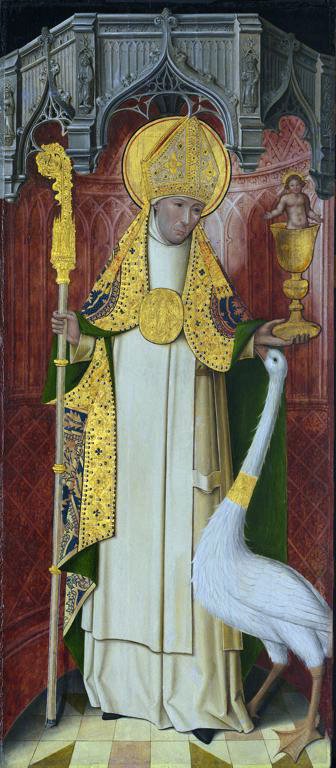
The tame bear of St Corbinian and the Swan of St Hugh of Lincoln.

Hug-lin-pi.jpg
St Hugh of Lincoln, being pestered at an inopportune moment.
Image found here.

To say nothing of literature:

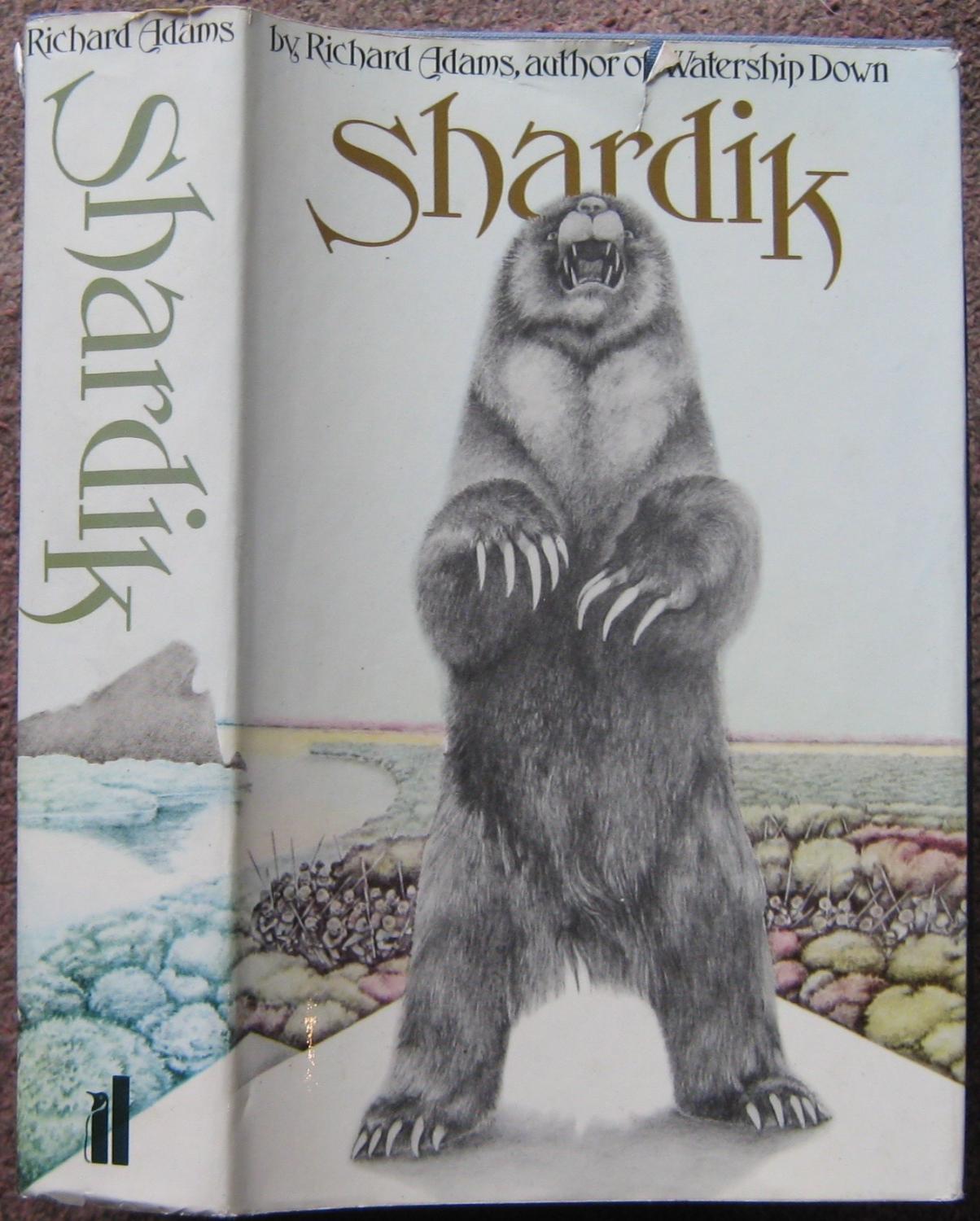
Shardik, the titular great bear of Richard Adams's novel.

Image found through AbeBooks.
Shardik is a pretty major influence on this post. That and the goose painting.

The Chronicles of Prydain, with their oracular pig and assistant pig-keeper.

The Chronicles of Narnia, with Aslan, who is definitely a lion, not one who is strong as a lion (as Trumpkin finds out) - and certainly not a tame lion.

Small Gods, and its numerous invocations of incarnate deities...

There is ample reason for clerics (prophets) to have an animal companion of some kind.

However: there is a distinction between a priest having a pet and a divine presence in the shape of a beast. The one is commonplace and adds little thematically; the other has some degree of greater interest. The distinction is much like that of G K Chesterton's Father Brown: he is a priest who solves mysteries, not a detective who sometimes says mass.

So, I shall determine a number of states in which a prophet in The 52 Pages might have a Sacred Animal around them and how this effects play.

This is deliberately dissimilar to spells like Call Familiar or Befriend Beast. The latter could hypothetically co-exist with the Sacred Animal.

Firstly, there is a theological status to consider:

1. Animal is God. Trying to herd or constrain the Sacred Animal is blasphemous. Aslan is not a tame lion. It has a direct line to the deity, or the Animal is the deity.  + 2 spell casts a day

2. Animal is Beloved of God. The believer must not direct the Sacred Animal, but may advise it as best possible. Any true Sacred Animal will listen - at least some of the time. No goad or leash is permitted. + 1 spell cast a day

3. Animal is Sacred The Prophet is the Animal's keeper. They are blessed, if not outright divine and may be guided or questioned - as a cleric might a hermit. Nonetheless, harsh or abusive treatment is blasphemous.

Then there is the nature of the animal to consider:

A. Animal may readily Ignore Man A bear, a lion, a dragon. Pretty terrifying, largely unstoppable. None of these could be a domesticated animal.  Start with 2 extra spells of a suitable school.

B. Animal may be Led by a Man A bull, a horse, a crocodile - you wouldn't want to tangle with them, but they are not the most fearsome of beasts. Some may be domesticated. Start with 1 extra spells of a suitable school.

C. Animal is Easily Controlled by a Man A goose, a dog, a tortoise - they may be actively domesticated  they certainly can be picked up.

The Sacred Animal functions rather like a Wizard's spellbook - it must be present at some point throughout the day for the Prophet to cast spells.

The movements of the animal are determined by the factors above, the player's choices and the GM's decisions (as well as what kind of animal it is - a bird can fly, but may be unwilling to go underground; a sacred whale is subject to numerous restrictions). A Sacred Animal might be tougher and cleverer than other animals - but it can still be killed (in what will doubtless form a new portion of divine scripture).

In play, (not that this has been tested) a Prophet with a 1A Sacred Beast (for instance) has the assistance of the Tiger Avatar of the Bone Goddess (IE, a larger than usual tiger will turn up and rip into your foes) and more spells and more chances to use them. However, said tiger goes where said tiger pleases.

A Prophet with a 3C Sacred Beast is rather in the position of Brutha from Small Gods (yes, I know the tortoise is Om himself); more guile and craft will be needed, though the player is freer to move around.

A 3A Sacred Animal is rather like the novel Shardik (never mind the actual theology of the Ortelgans); a massive bear roughly speaking on your side, but still a massive bear that goes it's own way.

A 1C Sacred Beast is powerful and portable - but the prophet is still compelled to acknowledge their demands, which may be awkward.

Dragons and other outsize beasts probably deserve an 'A+' ranking: you really can't follow them - but you don't have to so much; their spell granting influence lingers a little longer. They don't turn up often, but when they do, you have a dragon by your side, with all that entails. No A+ Sacred Beast can be a 3.

A SLIGHLTY SILLY GRIMDARK ALTERNATIVE:

You are playing a Prophet from the Church of Stern Feudal Monotheists. There is an inquisition, a hierarchy and flagellants.
The Church of Stern Feudal Monotheists once had an sainted exorcist that trapped demons in pigs. The pigs have been kept over the years and may be convinced by sundry means to perform magical spells for the benefit of the Church.
As a Holy and Devoted Servant, you have been entrusted with their use and will presumably evolve a humorous buddy-cop style relationship between yourself and a pig that occasionally speaks with a voice straight out of diabolical central casting to offer you a Faustian bargain.

A SLIGHLTY LESS SILLY GRIMDARK ALTERNATIVE:

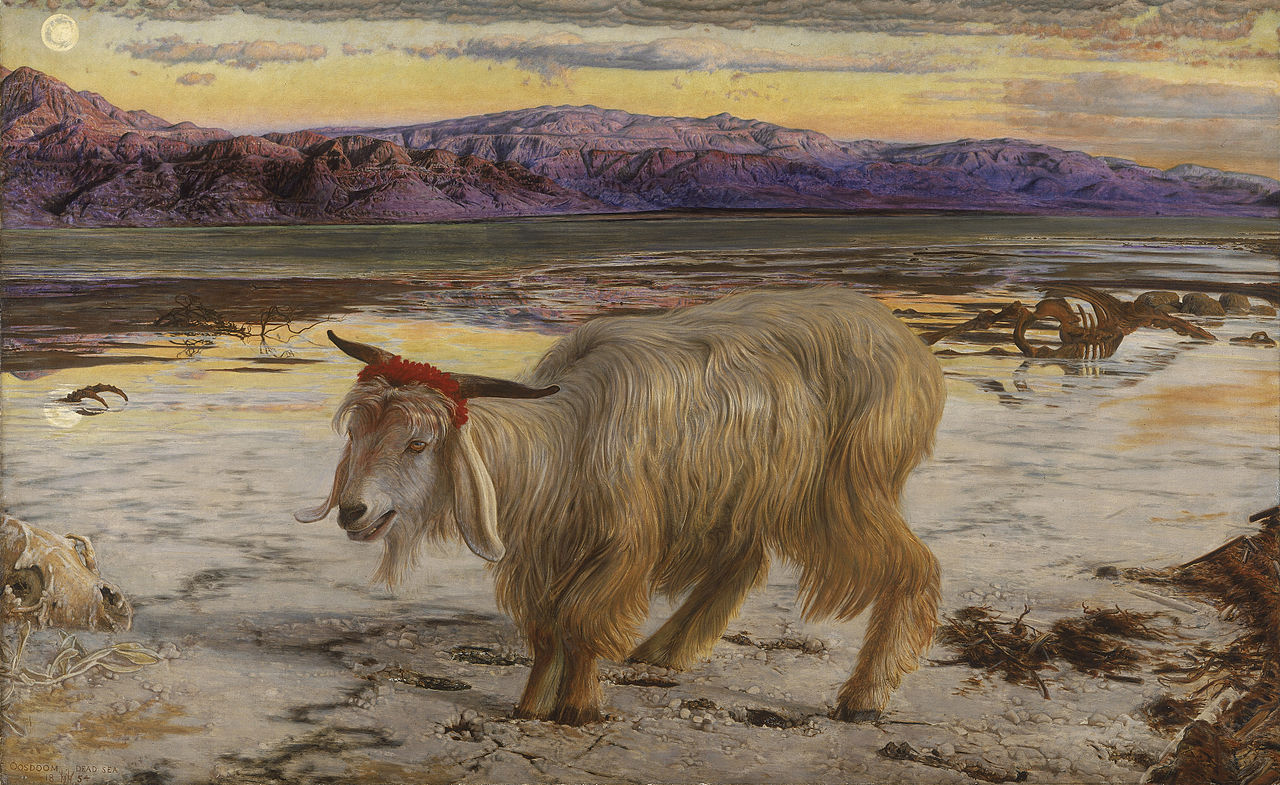
The Scapegoat, William Holman Hunt.
You have to follow this thing everywhere.
Found here.
The Beast is far from sacred, but must be supervised anyway by a Holy Man. It is a scapegoat, burdened with the sins of many and so a vessel of a certain degree of power. Your job is to bind the sins of many into it on your travels (there's your Level-up mechanic!), use it wisely and hopefully get it killed somewhere remote doing something useful.

Any thoughts?

Saturday, 9 February 2019

The River People and the Sea People

Here's something. A simplification of the ancient world for the purposes of deriving a flavourful setting.

Two points of derivation, coming from recent reading (as well as a visit to the current exhibition at the British Museum): Gene Wolfe's Soldier of Sidon (and, therefore, Latro in the Mist) and The Ancient Greece of Odysseus by Peter Connolly. The latter is an old textbook I recall from school: the benefit in it coming not from the summary-style retelling of the Iliad and Odyssey, but from the links it makes to Mycenaean artefacts and Trojan archeology, being an introduction to things like the Boar's tusk helmet, the figure-of-eight shield and the Dendra armour.  This is coupled with a very pleasing set of illustrations by Connolly, that impart a slightly less clean-cut look to the Classical World (next to what one might call the 'Clash of the Titans' approach). The Greeks and Trojans have fringed skirts to their tunics - rather than the clean white edges of other visions - as well as thick-featured, stiff-bearded faces.
Image result for figure of eight shield
An illustration from The Ancient Greece of Odysseus.
Note the odd, Sea People derived 'feather hat' on Aeneas (back, right).
Note also the horned helmets!

Anyway, all this produces a certain dichotomy from a broad-brush stroke account of the ancient world: between the islands of the Aegean and the Eastern Mediterranean, and the river kingdoms of the Fertile Crescent.

Throw into this a certain form of popular history: the sort that produces web articles with titles like 'Alexander the Great: Not so Great! Six Reasons WHY'. (This sort of thing irritates me as a rule: not because it comes to such a conclusion, but more because of its use of a contradiction to the established record as a piece of clickbait - to say nothing of the kicks people get out of being the 'brave new revolutionaries'. But apparently I'm not averse to using it for fantasy settings.)

Also, because I can find a way to put him into anything, C. S. Lewis. In The Dark Tower, a paperback anthology with some of his short fiction and portions of unfinished projects one comes across a few chapters of After Ten Years, which would have been a novel about Menelaus (called Yellowbeard) and Helen after the Trojan War; it is fruitless to speculate too much, but perhaps it would have been rather like Lewis's other novel of the ancient world, Til We Have Faces. (More on the titular tale of the Tower here). Aside from a lovely first chapter detailing the squalor and discomfort of forty men squatting inside a wooden horse for twelve hours, the description of the sack of the Trojan Palace feeds quite nicely into this.

"The room was full of a sweet smell, you could smell the costliness of it. The floor was covered in soft stuff, dyed crimson. There were cushions of silk piled upon couches of ivory; panels of ivory also upon the walls and squares of jade brought from the end of the world. The room was of cedar and gilded beams. They were humiliated by the richness. There was nothing like this at Mycenae, let alone at Sparta; hardly perhaps at Cnossus. And each man thought 'Thus the barbarians have lived these ten years while we sweated and shivered in huts on the beach.' "

Naturally, looting ensues.

SO: this is the world of a new setting. Forget Plato, forget Aristotle, forget the Parthenon. The Greeks are the Orcs of this setting: savages, raiders - who live on rough islands in the salt waters. Alexander, King of Macedon? The equivalent of the Urak-Hai. Even cunning Odysseus, remember, had to prove his identity at the end of the Odyssey by a feat of arms, bending and shooting a bow. Their alignment is chaotic.

They come from the sea, from the storms. They even worship the God of the Seas, the Earthshaker, the Great Chaos!
They are raiders and fighters, for those barren islands will not support crops like the fertile river mud will. 
Some of them even ride horses, pressing their thighs against a beast of the field rather than fighting from the war-platform of a chariot.*
They don't oil their beards. They don't even wear trousers!

The civilised folk are the Babylonians, the Egyptians, the Persians who live on rivers, by the tamed water. At this point, we should note the Babylonian myth of Marduk slaying Tiamat, dragon-spirit of the salt waters.  The link between the sea and chaos is rather well established by the Chaoskampf of comparative myth. These riverfolk are also scholars: astronomers, builders of the great ziggurats, recorders of history, wisdom, law and prophecy (Leviathan and Dagon needn't be the only Biblical reference here). I would note also at this point the cosmopolitan make-up of the Persian Armies in Herodotus and the allies of Troy in the Trojan War (Ethiopians and Amazons). Lawful alignment, of course.

Goodness knows how the Phoenicians and Hittites fit into all this. Semi-chaotic profit-driven merchants for the former and mountain-dwelling dwarf-archetyple smiths respectively, perhaps.

Of course, the 300** style portrayal of Sparta fits in marvellously well here as a noble savage or barbarian hero. However, this all needs a little more work before it comes together; perhaps a map. But I'm still somewhat satisfied with the background workings of it described here.


*I'm aware that the Greeks of the Trojan War used chariots and that cavalry-proper rather than chariots, but for the sake of accentuating the difference in the setting, I'm doing this. Besides, the Old Testament-esque feel of a law against riding a horse with ungirded thighs works rather well.
**Mandatory reference at this point to the Keiron Gillen graphic novel Three, which works rather well as the anti-300, making it clear quite how unpleasant Sparta could be. Very worthwhile read; the paperback edition comes with interview-commentary by a Professor of Spartan and Peloponnesian Studies.