It was a dark, blustery afternoon in spring, and the city of London was chasing a small mining town across the dried-out bed of the old North Sea.
These are the first lines of Mortal Engines, by Philip Reeve - published 2001, and I suspect that I read it for the first time fairly soon afterwards. Frequenters of this blog (being handsome, discerning and well-read) will twig the similarity to the opening lines of Nineteen Eighty-Four - and I suspect that they will recognise how this might hook a young reader, or even an old one. I was that young reader, of course.
Indeed, I am now also that old reader. A month or so ago I noticed that the 2018 film of Mortal Engines was available in the free-with-advertisements section of YouTube (the box office results may say why). I put it on while about a few household chores, and half-watched the entire thing. I had avoided the film when it came out - and, having watched it, this was not an unreasonable step to take. But a bad version of a good thing can make one think of the good thing, and it sent me back to read the books. Indeed, it also disposed me to take a look at the assorted thoughts of the internet - which have been blighted by the film or didn't touch on some worthwhile aspect, and so on - so, in I dive to get my thoughts down.
My scope is limited to the initial Mortal Engines Quartet, published 2001-2006: Mortal Engines, Predator's Gold, Infernal Devices and A Darkling Plain. Other books in the same universe, if in different eras, have been published, as have short stories and some collected timeline and 'lore' material. Some reference may be made to these (not that I've kept fully abreast of new entries in the series) and, where vaguely useful, to the film.
Premise
I don't intend to summarise the books here. But a few details may well be useful.
There has been an apocalypse, the Sixty Minute War. This took place around 2100 between (what Mortal Engines characters call) the American Empire and Greater China. Civilisation, and much of the planet was smashed up - by things that appear to have left the atomic bomb in the dust. North America is 'the dead continent'. As above, the North Sea is mostly gone. New mountain ranges cropped up. Many centuries later, civilisations have risen and fallen - as civilisations tend to.
The great paradigm of the current age is that of the Traction City. Mankind either dwells on mobile cities - greater or smaller; see above London and the 'small mining town', Salthook - or in static settlements. Said static settlements band together in the Anti-Traction League, opposing the Traction Cities. Traction Cities (principally) move and (notably) will devour one another - as well as static settlements, so said League makes sense. (Traction Cities will harvest or gather natural resources, and trade, but after a millennium of the 'Traction Era' there is less possibility of the former outside the strongholds of the League). The practice of one Traction City consuming another has given rise to a school of thought, or even an ideology - 'Municipal Darwinism'.
The Mortal Engines quartet focuses on Tom Natsworthy (of London) and his journey with Hester Shaw out of London and into the wider world. Both characters are fifteen in Mortal Engines; Wikipedia labels the Quartet as 'young adult'. As nebulous as that phrase is, it's a useful-ish indicator of tone and approach - though we will see both grow to adulthood in a perilous and bustling world, full of moving cities, armies, airships, wastelands, pirates and the lost, fearful, technologies of the Ancients.
Wikipedia will give you plot details if you want them, though frankly this post probably is most useful for someone who has read all four books. I'm not going to wallow in spoilers, but I shan't dodge them either. Anyway, be warned.
 |
| David Frankland did the original covers, which I still think quite the best. There's a clear sense of the grimy and the mechanical, coupled with those limited colour backgrounds, that suggest something like a 1920s travel poster and the associated sense of adventure. |
In no particular order, then -
Names
Reeve's characters have three sorts of names.
Cool: names right out of pulp adventure*. Thaddeus Valentine. Anna Fang. General Naga. Magnus Crome. Wolf von Kobold. Dr Zero.
Pompous: likely British, at least faintly and probably overtly posh. Herbert Melliphant, Chudleigh Pomeroy, Cynthia Twite, Thomas Natsworthy, Freya Rasmussen, Clytie Potts, Nimrod Pennyroyal, Dr Popjoy.
Gimmicky: displaced old-world phrases, faintly comic. Chrysler Peavey, Stilton Kael, Nintendo Tharp, Napster Varley, Saab Peabody.
Actually, this is quite a good indication of overall tone. If you can tolerate - or actively enjoy - the sort of sensibilities that these three sorts of names suggest, then you might enjoy Mortal Engines. The 'Gimmick' aspect and vein of comedy is more present in books beyond the quartet, where it can wear out its welcome a little.
Whimsy and Humour
But such things are a balancing act. The presence of 'Tunbridge Wheels' as a mobile city is a sensical pun (and demands a Sensible Chuckle?); likewise the Arctic predator suburb of Wolverinehampton. Reeve has written what I take to be more overtly comic works for a younger audience than Mortal Engines, but can dial it back sufficiently. (A newspaper called The Wantage Weekly Waffle only has one mention, happily; this is distractingly comic - one says, risking the fate of the po-faced - and more to the point, not quite comic in the way the scene demands.)
You will sometimes see this sort of thing referred to as whimsy - and, indeed, there is a whimsical element in the notion of a moving city (still less one that retains some of its static characteristics: don't ask how they tend the vines in Bordeaux-Mobile, or what the terroir is like). Reeve is also an illustrator, and some of his renditions of traction cities make them seem rather charming.
Not all his humour is quite so direct, of course. A firm of publishers is named Fewmet and Spraint; as those who recall The Once and Future King will know, this is a quiet indication as to the quality of some of what they publish.
Consequences
Alongside such things is a real sense of weight to violence. Men may die quickly, but this is never exactly cathartic - especially not for our protagonists. Accident may kill as readily as intention, and it will absolutely kill your allies and would-be collaborators. Deep wounds, even if non-fatal, have later effects - very real disfigurement or long-term health conditions.
It goes a little further than that, mind you. Hurt feelings stay hurt, emotions flare high - deeds done in haste reverberate to dreadful effect. Which sounds like just what you should expect from a novel, but I suspect shouldn't be counted on in every book of the same kind as Mortal Engines.
While we're thinking of bodies, I note that there's a fair amount of urination and defecation in these. Which contributes to that sense of what bodies are and do. I wonder what age Reeve's children were when he was writing these?
More to the point, this allows for some powerful blows when the time comes: the last paragraph of Mortal Engines has some fairly touching unsentimental sentiments, if you'll pardon the oxymoron.
Britishisms
Philip Reeve is British. He did not have an international audience in mind when he wrote Mortal Engines - indeed, that the United States is a wasteland may not have done much for his sales. I've noted some of the names above for their British characteristics: that London is front and centre in the first (emblematic) book is also important.
Of course, London isn't Britain, nor is the traction city of London an inheritor of Britain (but it was in an earlier version of Mortal Engines). Britain is gone: some place names and other markers remain - but that there is a portion of London called Crouch End doesn't count for much.
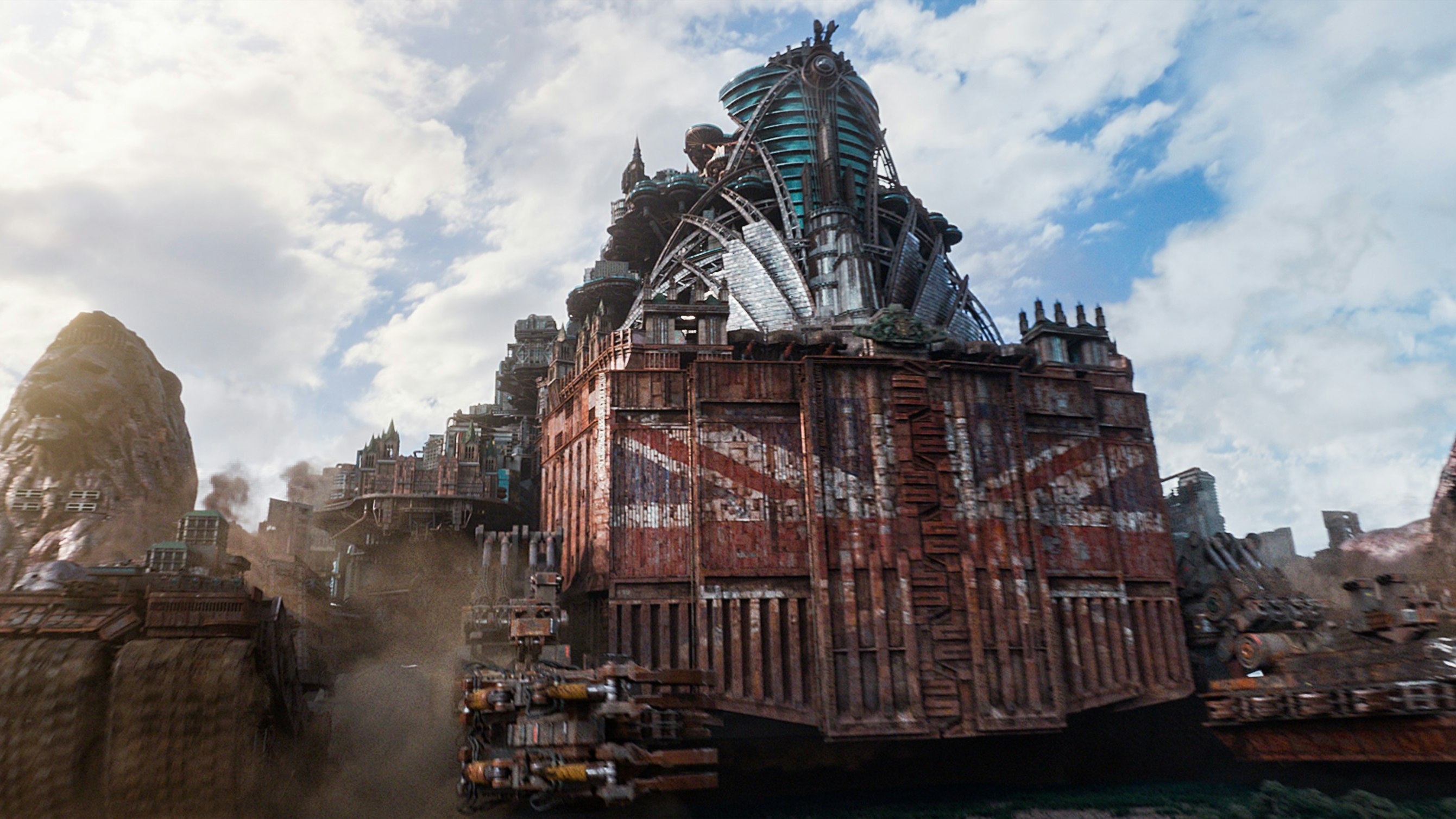 |
| This is something that the 2018 film - with its Union Flag bedecked-maw and Trafalgar Square lions - didn't take on board. |
London's military elite are Beefeaters, not the Brigade of Guards or the SAS or the Gordon Highlanders or Cromwell's Ironsides. It is governed by a Mayor and a guild elite, not the King-in-Parliament. The focal point, the identifying feature of an exterior which is otherwise as vast and complex as Breughel's Tower of Babel is St Paul's Cathedral, not St James's Palace or Westminster Abbey or Tower Bridge (the film couldn't help itself, and included the Palace of Westminster; the guildhall even faintly resembles the former Greater London City Hall). A piece of concept art by Ian McQue shows even more - the Shard and the BT Tower and Battersea Power Station, in an artistic fantasia reminiscent of one of Laubin's capricci.
I would argue this misses the point of St Paul's Cathedral. There's something eerie about the fact that it has survived when so much else has not (the London Museum of Mortal Engines is clearly akin to the British Museum and the Natural History Museum, but is in fact neither). When you learnt something of the Polytheism much of the world practices in the Traction Era, it becomes even stranger that this Christian temple survives intact. That it is finally the vessel containing the ancient and terrible superweapon MEDUSA bears this out.
 |
| The David Frankland cover again. Think on how St Paul's is just discernible, think how it offers a sense of scale. Think also of the red, livid sky. |
Airfix Characteristics
A world-building trick of Reeve's is to refer to makes and models of machinery in universe. Airships are Goshawk 90s or Murasaki Fox Spirits (and this will extend to parts: Jeunet-Carot aëro-engines, an envelope of Silicon-Silk from Shaun Guo....). A small revolver is a .38 Schadenfreude. Something like Jane's Fighting Ships for the Traction Era appears. Granted, significant parts of A Darkling Plain are set on the frontlines, but the business of bunkers and half-tracks and rocket troops conjure the same notion. That Germanic traction cities are frequently named 'Panzerstadt' may contribute to this.
If we are addressing this as a sensibility outside of genre features and expectations, I think the term 'Airfix Characteristics' is good, as in X with Airfix Characteristics. Science fiction with Airfix characteristics; Firefly has them, Star Trek doesn't.**
Extend as necessary, or as amuses: Steampunk with Airfix Characteristics. Bedroom Farce with Airfix Characteristics. Ostern with Airfix Characteristics. Southern Ontario Gothic with Airfix Characteristics.
Airship (and flying machine) names, incidentally, fall into something like the pulp/pompous/gimmick division above. The 13th Floor Elevator. The Jenny Haniver. The Itsy Bitsy Teeny Weeny Yellow Polka-Dot Machiny. Group Captain Mandrake. The Shadow Aspect. The Archaeopteryx. Die Leiden des Jungen Werther. The Plum Blossom Spring. The Combat Wombat. The Requiem Vortex.
References and Nerdery
As the above may suggest, Reeve enjoys shoving a reference or two into Mortal Engines - frequently something at least faintly nerdy. The very name derives from Othello: Act III, Scene III. A certain amount of this is the product of inspiration. Star Wars and Lord of the Rings had their influence on Reeve - the former quite unsurprising, given that Mortal Engines has a climax with a super-weapon encroaching on a previously unassailable redoubt.*** Other influences exist.
That a range of mountains is known as the Tannhäuser Mountains might well owe something to Blade Runner (could there be a narrow pass in those mountains, do you think? A defile, a passage, a gate?). Spear-carriers of fighter pilots are known as Ginger and Algy. That a German traction city is called Moloch-Maschinenstadt presumably indicates that it is an unpleasant place even by the standards of traction cities (unless things are unusually clean?).
Historical periods are also addressed in a familiar and adroit way: the Blue Metal culture, the Raffia Hat Culture.
The Chapter names are rather telling in this regard: The Cabinet of Dr Popjoy, the Land of Mists, Brighton Rocks, The Childermass Experiment, The Sleeper Wakes.
Incidentally, Mortal Engines predates a general consciousness of Steampunk being its own thing. It fits into the aesthetic nicely, but it doesn't get bogged down in genre trappings.
***
There's a line in Predator's Gold that ties a lot of the above together.
The sky was the colour of packet custard, streaked with rhubarb cloud.
- It's whimsical: the sky as humdrum domestic dessert.
- It's actually not a bad description for a certain sort of dawn, with pinkish clouds and soft yellowish light. Rhubarb, if not processed into pap, is in fact streaky.
- It's quite possibly a reference to Neuromancer: 'The sky above the port was the colour of television, tuned to a dead channel.'
- Rhubarb and custard is a British boiled sweet - and as a combination, would not be unlikely to be served as a dessert. 'Packet custard' presumably refers to Bird's Instant, or something quite like it.
***
Polytheism
As above, the Traction Era is Polytheistic. Clio, Muse of History is frequently called on by the Guild of Historians (there is a reference to her being 'blown backwards by progress into the future', which sounds unintentionally Buckleyesque). Ice Gods and Wind Gods are mentioned. Quirke was the Mayor who turned London into a Traction City, who has been deified. Statues and shrines dot cities and sit in airships.
There's an extent to which this pushes Mortal Engines into a grand, varied, Faufreluchean setting, like the forehead tattoos of London guildsmen. It's also something that indicates that Reeve can 'do religion' in a way that George Lucas (for instance) doesn't. St Paul's Cathedral aside, Christianity has survived the Sixty Minutes War, even with Bishops and T.S. Eliot (though neither show up on London). The monotheist elements - 'I believe in one God, the Father, the Almighty...' - are seemingly unknown to unbelievers. Strangely, no other Abrahamic faith seems to have lasted, nor have Eastern Axial Age faiths like Jainism or Buddhism. There's monks and prayer flags in the Himalayas, but that's not necessarily the same thing.
Metafiction
There's bunch of metafictional elements that come into Mortal Engines. That several principal characters are historians - narrative-crafters, from a certain point of view - helps, of course. The history of the world is discussed, and later characters even go on to write up the events of the novels they are in (Predator's Gold is also the name of an in-universe sensational history). The final chapter of A Darkling Plain even involves that thing where a character begins telling the tale of the story they're in, beginning 'It was a dark, blustery afternoon in spring...'
Reputation (to be chased into the cannon - the mortal engine's - mouth) plays its own role in all this. In the course of the Quartet, reputations are made and lost, secrets are revealed. People tell stories about themselves.
Bildungsroman and Stalkers
Mortal Engines is about (among other things) youth. Tom Natsworthy and Hester Shaw come of age and begin making their own decisions. Happily, they don't have to spend an entire quartet doing this: there is a sixteen year time skip between Predator's Gold and Infernal Devices. But more to the point: these four books spend a fair amount of time thinking on how children are raised. Plenty of characters are the genre-standard orphans, but who they are raised by counts for a lot: the antiquarian Guild of Historians, an inhuman cyborg, a Fagin-like master of pickpockets, a dwindling population of loyal subjects. Further, have they been raised as a Tractionist or an Anti-Tractionist? This isn't just an ideological difference: in a rather town mouse and country mouse sense, traction city dwellers struggle when they have earth under their feet rather than a deckplate (those from static settlements don't seem to struggle in a comparable way - see Wren in Brighton in Infernal Devices).
Anyway, on top of all this are the Resurrected Men. Old Tech mechanical brains and devices are wired into corpses to bring them back into hideous life - principally to serve in combat. Given the lack of knowledge of Old Tech by the Mortal Engines period, this is an unreliable process - and not all Old Tech is created equal. So some Stalkers have half-memories of past lives, and the desire to learn more, and those who brought them back may wish them to have (or not have) those very memories. Stalkers, like children, must be raised: just ask Victor Frankenstein.
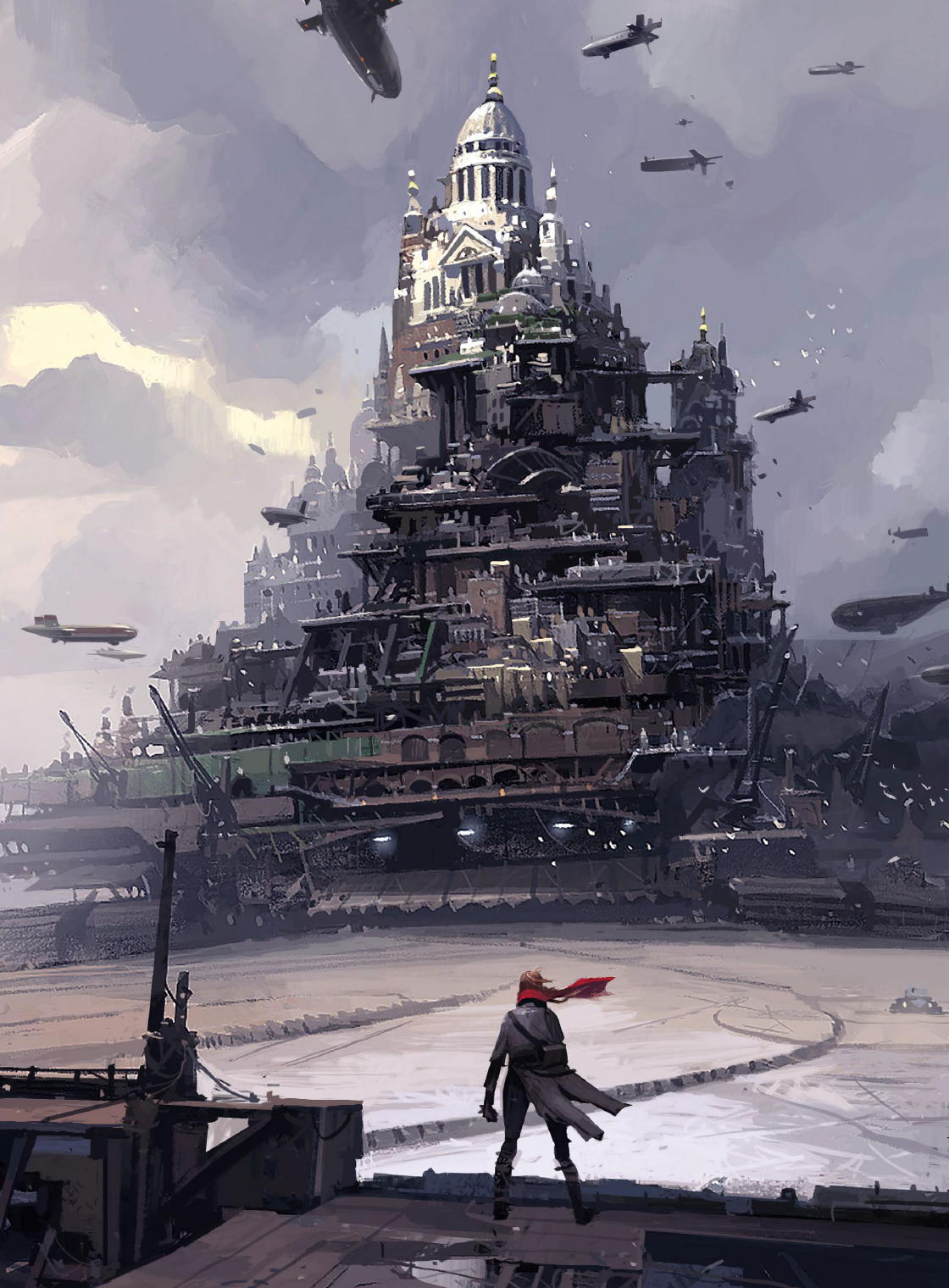 |
| Ian McQue also did a cover for Mortal Engines. Not bad, despite the disproportionate St Paul's. It has some of the right spirit, even if it makes me think a little much of Disco Elysium. |
Predators, Gold
There is an interpretation of Traction Cities and Municipal Darwinism, holding that the entire thing is really about capitalism, expansionism and exploitation. A specimen of this interpretation is here (though I think it a ramshackle piece). I am compelled to say that this isn't altogether wrong. The text makes it clear that Tractions Cities can be pretty unpleasant places to live, and Reeve knew what he was doing when he named the goddess of 'Unfettered Municipal Darwinism' as Thatcher - who is given a faintly Hindu aspect in her depictions: multi-limbed, dancing, all-devouring, as Shiva Nataraja.
Fine, it's not wrong, but it misses a few things, especially when stated baldly. Reeve has stated that part of the inspiration for Municipal Darwinism comes from the growth of Brighton into a conurbation - which (whether welcome or not) is far less malevolent than anything out of a Traction City. Also, Reeve, as Tolkien, dislikes allegory - and has stated that it's not a heartfelt metaphor for Capitalism.
That aside, I think that it's also informative to consider Mortal Engines in the light of the Cold War; indeed, especially from the point of view of a young, fairly liberal British man in the last decades of the Cold War.
[It feels a little odd making this slightly cavalier reading of biography and background, and I hope that Philip Reeve will pardon me if he reads this; I did meet him once, years ago - he signed my books and was really quite kind and charming.]
So: The world is imperilled by dreadful weapons [MEDUSA, ODIN], invented by those long dead (Oppenheimer dies in 1967, wunderwaffen maker von Braun dies in 1977; see also Richard Rhodes here again) for another country [The Ancients] and a cause not your own [The Sixty Minute War]. You [Tom Natsworthy] find yourself aligned (by birth as much as anything else) with those [the leadership of London] pointing those weapons at a foe with a very different way of life [the Anti-Traction League]. Learning more about that foe, it emerges that they're (reasonably) terrified of annihilation; it should not surprise you that they take steps against it [Anna Fang] - and even if you don't approve of it, that they should produce an extreme reaction to the threat [the Green Storm]. Naturally, you become quite disillusioned with childhood heroes [Thaddeus Valentine], though there's no guarantee you'll join with your old foe [Tom and Hester take to the Bird Roads].
[EDIT: Cf. this remark on '80s Britain.]
This is the sort of perspective that forgets or erases the Gulags and the cellars of the Lubyanka and Khrushchev burying the west, but it's not one that I find utterly unsympathetic - or utterly disconnected from reality. But the geopolitical-historical interpretation fits the outlines of Mortal Engines better than the blunt Municipal-Darwinism-bad expression.
The Anti-Traction League, it must be said, is not the Soviet Union or Warsaw Pact, and the Shield Wall of Batmunkh Gompa is defending against a threat in a way that the Berlin Wall wasn't. Russian traction cities (Arkangel, Traktiongrad, Gorky, Novaya-Nizhni, Smolensk, Omsk†) exist. The League seems to draw as much or more on the Third World as the Second World: there are no parades in Red Square or Five-Year Plans or Khrushchevka apartment blocks or Stakhanovite efforts in the factories (though that Northern Fleet of airships and the fuel and ammunition and spare parts for same had to come from somewhere...‡ ). One gets a more Maoist impression from the Green Storm and their cult of personality. Reeve is, happily, unwilling to make this monolithic: the mountainous strongholds of the Anti-Traction League might be in East Asia, the Indian Subcontinent and East Africa but Traction Cities include Zanzibar, Bamako, Perfume Harbour and Juggernautapur.
Before anyone gets too keen about raising the left-wing banner over Mortal Engines, I would note that Reeve does not strike me as at all partisan or a zealot, and unwilling to engage very publicly with politics. Moreover, the sympathetic portrayal and actions of the Guild of Historians in Mortal Engines suggest a sort of small-c conservative position against progress and expansion: couple this with the non-Green Storm League elements and perhaps one arrives at some sort of 'Ealing Studios' Social Democracy; something which wouldn't much please Ayn Rand, Michael Foot or Robespierre. Indeed, the dreams of Magnus Crome and the Guild of Engineers that transcend the limitations of Municipal Darwinism as we know it (Mortal Engines, Ch. 34) remind one of nothing so much as the visions of progress by H.G Wells, a devoted socialist.
Municipal Darwinism and Tractionism never gets an articulate spokesman, mind you - only prejudices and Tom Natsworthy at his most callow (unless there's one hiding in the very recent Thunder City or Bridge of Storms). Where is the Adam Smith of Municipal Darwinism? After a millennium there must have been one! Anti-Tractionism fits the reader's default position, and the text has to work less hard. ††
We may also consider the image of Tractionism as aping the sacrifices and trade-offs of the industrial revolution; something heightened by the nickname 'mossies' for the static settlements and the Green Storm, who openly vow 'death to cities'. It would make a certain amount of sense to me if a wider range of goods were available in traction cities, if medical technology were more advanced, if a greater range of culture was available. While no polity in Mortal Engines appears to be a liberal democracy as we may think of them, the concentration of population in a traction city might well mean that there is a greater chance of mass political engagement. None of this means life is necessarily any better: you could end up in back-breaking labour somewhere vile in a traction city due to central planning or competitive examination or one city consuming another - but you are far less likely to end up doing back-breaking labour somewhere vile due to being of the wrong faith or caste. Slavery is not seen in the Anti-Traction League, though given how accepted it is elsewhere, it would be strange for it not to be present in one of the many members of the League (again, that air-fleet came from somewhere).
It's worth noting, finally, that Philip Reeve appears to quite like Traction Cities. Certainly more than Swift did Laputa or Orwell did Manor Farm. An exception to the rule of Municipal Darwinism appears early in Mortal Engines in the form of Airhaven; the cooperation of the Traktionstadtsgesellschaft and the resort city of Brighton muddy the waters later. The conclusion of A Darkling Plain, with the birth of an ecologically friendly New London, complicates things further - as does the future state sketched in the final chapter.
Traction Cities have been noted from the first have developed from nomadism - and the nomadism of those clans or the airship-travelling protagonists is treated quite sympathetically. Is this enough to to make them more than Infernal Devices (Predators seeking Gold on Darkling Plains)? Are they more than Mortal (threatening, fearful, deathly) Engines doomed to mortality?
Frankly, the best way for you to decide is to read them. They were worth reading twenty-five years ago, they're worth reading today.
Previous Mortal Engines-related content here.
* "Catholics don't light candles any more, Brick."
"I do, sir. I'm Irish and my mother - "
"For Pete's sake! Bronson's not an Irish name."
"What kind is it, sir?"
"It's a pulp name. Now get going."
'The Last Thrilling Wonder Story', Gene Wolfe
** Compare remarks on las-pistols here.
***Reeve has a blogpost (5th May 2015) on seeing the first Star Wars in his youth, the interest he had in Ralph McQuarrie and how Star Wars 'was so popular that it even put an end to World War 2. Before Star Wars, schoolboys played Brits vs Germans in the playground, watched Colditz and Where Eagles Dare, and made model kits of Spitfires and Messerschmidt 109s. After it, we played rebels vs stormtroopers and watched Blake's Seven and Battlestar Galactica.' It's quite good as a reminisce and I'm irritated that I can now only get hold of it through this blog viewer.
† Incidentally, Anchorage, with its palaces, fur coats, glasses of tea and aristocracy certainly reads as more Russian than Alaskan. Maybe that just comes with Tractionist culture up on the ice.
‡ I can conceive a spirit-of-the-text answer where League arms works are mostly kept in moth-balls in peacetime, with the volunteer machinists keeping them in order outside of seasonal re-supply use or until the threat of a Traction City draws near.
†† It would be interesting to sketch out how an idealised peaceful consumption of one city by another would look as expressed by such a thinker. The gods of one Traction City brought into the fanes and temples of another, the merging of institutions (with senior and junior partners), the language barriers, the demographic transformation.
Do you think fumbling a baddie as badly as Tom did Hester should be a punishable offense?
ReplyDeleteBaddie might well be the word for Hester. But I think Tom's punished himself enough.
Delete("Poor Tom. Poor Hester....")
And here's the equivalent from a previous generation (one of the series I devoured as a teenager and now can scarcely remember):
ReplyDeletehttps://en.wikipedia.org/wiki/Cities_in_Flight
I do recall reading part of one of these at some point, though I didn't make the leap to Reeve. Something to revisit, perhaps.
DeleteGreat Poskitt, Mortal Engines! I will restrain my gushing (I am generally suspicious of fandom culture, but have to make a slight exception for this series, to the point where I went to see Reeve give a talk on it at Oxford a few weeks ago), and restrict myself to saying that you have captured the books' strange tonal balance very well. The mixture of silly puns and Boys Own adventuring with a surprising depth of melancholy and moral darkness probably isn't for everyone, but it's always worked for me. I wonder what you thought of the film? I will not extend my fanboyishness to a full-blown rant about all the ways it deviated from the book, and there was a lot, visually, that I liked. But I think its besetting sin was to botch the aforementioned tone by chickening out of nearly all the darker elements, particularly in the final act, where it just opted to rehash Star Wars rather than follow through on the fundamentally tragic arc of London and the Valentines.
ReplyDeleteBy all means gush - there's a reason this post is labelled 'Self-Indulgent'!
DeleteIn hindsight, I really should have made time and gone to that talk. But I think that I've found enough of Philip Reeve's remarks elsewhere to make up for that.
I'm glad I managed to reach some of the tone - there's a tendency for reviews or commentary to get rather caught up in the imagery or practicalities or heartfelt metaphors of the Traction Cities. And if I was going to devote time and energy to writing about it, I did want to make sure it was doing something new-ish.
As for the film - well, I've put some of my opinions on the city designs above. And there was something a little costume-drama about some of the scenes. There's a line that goes something like 'Whatever they're doing in that cathedral has nothing to do with God', which doesn't at all fit with the religious culture of the books; the scriptwriter either didn't read them or didn't care enough to sacrifice convenience and comprehensibility for them. Thinking back, the acting didn't quite do enough to suggest the emotions described by the narrative, however many lines stayed the same. But the lack of the darker elements really did rob it of weight. Although, while the ending is bad, it's a sort of half-rhyme (or perhaps quarter-rhyme) with the London conclusion of A Darkling Plain.
Thanks! For what it's worth, I don't think you missed anything particularly new at the talk, although Reeve was willing to be a bit less polite about the film than he has previously been (doubtless for sound reasons of etiquette and financial interest) in print. I think you're quite right that the movie's London aesthetic was a little heavy on tourist-brochure Anglophilia. Though, interestingly, by making the city so shiny and full of well-preserved British symbols (and by eliminating all reference to larger cities), it also made it feel less actually British. The film's London is an imperial apex predator at the top of its game, not the book's faded power making a last doomed bid for relevance using forces it can't really understand or control. If it is an allegory, it feels like Hollywood America reflecting on itself rather than us.
DeleteBut yes, ultimately it's more interesting to focus on the writing. It's such a mishmash, isn't it? On the one hand it's very clearly a children's book and a first novel, and sometimes an amateurishly written one at that (he can't even keep the tenses straight, for heaven's sake). And yet, there's an undertow that keeps pulling you in and dragging you onwards with a grin on your face. It's got, for want of a better word, traction. I've just read the battle scene in 'Chudleigh Pomeroy Sees It Through' again, and it's just this perfect mix of humour and dark pathos and punch-the-air spectacle. "Katherine started to realise that other Historians were watching from the shadows at the edges of the hall, lurking behind display cases, pointing steam-powered rifles through the articulated ribs of dinosaurs." The day that line doesn't make me smile is the day I'm beyond saving.
I really like the idea of a Adam Smith of the Traction Cities. To me it seems like a fun world building challenge, how do you come up with a plausible explanation for something that was unexamined or maybe irrational. The thing that comes to mind is pure economic dynamism. Maybe the wide range of industrial products that give that lived in feeling all come from the most mechanized cities, the Traction Cities. In that narrative London might be suffering exactly because it has less industry than a city of its size should. And the end of A Darkling Plain presents a Nikola Tesla flavored vision of industry powered by electric motors (and nuclear?).
DeleteAs an aside, crawling cities fighting eachother escaped to the FFG series of 40k RPGs where the planet of Zayth is a later stage world dominated by the traction cities.
I suspect that the period most liable to give rise to an Adam Smith is a century or so before the time in which Mortal Engines is set. Looking up one of Reeve's posts on his latest, Bridge of Storms, there's even a plot element where a town hopes to be eaten by London.*
DeleteLondon is the oldest Traction City, and has given birth to a number of Suburbs across the Traction Era - I wonder if there's an overexpansion or imperial vanity angle that could be worked there. Or King Lear but with mobile cities.
The end of A Darkling Plain is optimistic, but I wonder if you would see a period of intense competition to be the second or third Tesla-City. London had to scavenge, delve, beg, borrow and steal to get the components it needed. A peaceful transition might be possible, but a needle or two would have to be threaded.
I had heard of Zayth! Writing the post, it did strike me that 40k and Reeve are drawing from some of the same wells, and I think that 40k's original creators are of the same generation as him.
*https://philipreeveblog.blogspot.com/2025/08/bridge-of-storms.html?m=1#:~:text=Museion%20is%20actually%20hoping%20to%20be%20eaten%20by%20London.
Partly inspired by this post, I have now read Thunder City and Bridge of Storms, and one of their more interesting aspects is that they are indeed consciously set at the tail end of the Golden Age of Traction, when Municipal Darwinism was functioning quite well as a system of shared ethical norms, and towns still routinely cut their engines and raised flags of surrender to acknowledge defeat in a fair chase. I suspect a hypothetical Adam Smith of Tractionism (a possible candidate would be Florian Agfa- Storch, who articulated the theory of Municipal Darwinism at the Diet of Ulp and cheerfully submitted to his town being eaten by London afterwards) would lay emphasis on how the system has more or less entirely eliminated war, replacing it with an alternate form of contest that allows people room to express their primal hunter-gatherer instinct for competition and dominance, while channeling it away from violence and towards technological progress.
ReplyDeleteHowever, although this is all interesting from a worldbuilding perspective, I think the two newer sequels are ultimately a bit weaker for it; one of the things that helped the original tetralogy to counterbalance its sillier side was the elegiac air of a civilisation's last days, facing an end that was inevitable, necessary, but to be mourned nonetheless. The new books are deliberately lighter and brighter, and consequently feel a lot more staightforwardly childish (though there's nothing inherently wrong with that, especially as nostalgic thirtysomethings are presumably not the intended core audience!).
The update is much appreciated!
DeleteI had the same 'lighter and brighter' impression of the two newer sequels - as you say, not wrong, and quite in line with Reeve's other work. Fever Crumb, in contrast, had the 'birth of an era' angle going for it.
Off the top of my head – and bumping from Adam Smith and the 18th C – my obvious preference for a mid-Traction Era series which still had something going for it with the weight of an end or a beginning would be a Napoleon. (The world-spirit on a Traction City…) Thus: the image of a conqueror and reformer, cutting across or defying Tractionist/Anti-Tractionist divides being opposed by (naturally) London to re-instate the balance of powers and the Concert of the Great Hunting Ground.
To prod again at the vision of the Anti-Traction League, I wonder if in times of comparative security old-style war or raiding is common among its peripheral members (which maybe sort of justifies smaller/less obvious military-industrial complex: the League proper doesn’t want the tools of modern war in the hands of those with old grudges). It would be the sort of data point that gives rise to the ‘Statics are Barbarians, Tractionism sublimates human violence’ view.
Interestingly, the antagonist of Thunder City is something of a Napoleon figure, or at least a rough cross between Old Boney and Le Corbusier (spoilers ahead). He's a vaguely Italian-coded (name Gabriel Strega) prodigy from a small town that got digested by the protagonists' city when he was a child, then works his way up to take over the larger city at gunpoint and transform it into a ruthlessly utilitarian apex predator. He loses (to our handful of plucky misfits rather than an interpolitan balancing coalition, because this is the light-and-breezy version, though there's still a fair bit of a bloodshed - indeed, one thing I didn't like was that it seems to have got more blasé about this than the originals, which were very good at giving killing real weight and consequences), but it's implied that his way of doing things isn't going away and the ancien régime is never coming back. It's all a little bit underdeveloped compared to what it could have been, but perhaps I was underselling the extent to which there is still an emphasis on themes of historical change and things passing away!
Delete