Friday, 27 November 2020

Dungeon Emigrés

A comment on False Machine sent my mind in the direction of dungeon émigré groups. Now, this is a somewhat tongue-in-cheek exercise - applying the tropes of the Cold War to the trap-strewn dungeon of cliche. But there is no reason to assume that the Goblins of the Yellow Eye are an unshakeable monolith, ready to fight Our Heroes to the death, incapable of civil strife. So: splinter groups, refugees, ex-pats. 

Several tables below offer examples, all centred around a sizeable town or city.

What group is this? Roll d12

  1. Kobold dissidents, inciting fire and revolution against their draconic overlords.
  2. Goblin satirists of the Red Brows clan, whose unsubtle burlesques and avant-garde wall paintings vexed the wrong chieftain.
  3. A scion of the Drow aristocracy and retainers, forced out in the course of yet another court intrigue.
  4. Minotaur heretics, who have radically different notions on the proper worship of the gods of slaughter and thirst. Their debates are heated.*
  5. An Orc warlord and his huscarls, motivated by the perceived ingratitude of the Orc plebeian classes to throw their lot in with mankind.
  6. Cultist defectors, trying to either atone for misdeeds or get out before the summoning ritual begins.
  7. Goblins of the Blue Lips Clan, who have fled from the join-or-die assimilation policies of the Hobgoblin Hegemony.
  8. A train of misplaced phantoms and spectres cling tenuously onto a single grave slab, carried by a tomb guardian. They have been banished by foul magics from their centuries-old rest.
  9. A bundle of Orcs who have left before the new boss can enact the usual purges. 
  10. Deserters from the Dragon's Tooth Regiment of the Grand Skeleton Army, who have grown tired of pack-drill, roll-call and saluting pimply necromancer's apprentices who can't tell grave-dirt from bone-dust.
  11. A drake who has seen the writing on the wall and is negotiating his conditional surrender and residency in the city before a band of adventurers gets lucky.
  12. Roll twice; clearly two separate groups have elected to make common cause. 

An utterly unrelated picture of Ralph Fiennes as Coriolanus,
from a 2011 film adaptation. 

Where have they taken up residence? Roll d6

  1. An unused warehouse.
  2. A scattering of refugee shanties outside the city wall.
  3. They have a wing to themselves in a sympathetic Nobleman's home.
  4. Several garrets and apartments in the tenements of the Bohemian quarter.
  5. The squalid confines of a non-human ghetto.
  6. A suite of rooms at an expensive guesthouse. 

How motivated are they to go back? Roll d6

  1. "Give us money and arms, we'll go back tomorrow!"
  2. "One day soon, we'll be ready!"
  3. "One day..."
  4. "For the time being, our policy is to...."
  5. "It may take a generation, but...."
  6. "Ah, who cares about that anymore?"
Their Handler or Sponsor Roll d8

  1. A svelte, apathetic, functionary.
  2. An ambitious merchant prince.
  3. The Head of a charitable but well-resourced Religious Order.
  4. A calculating, farsighted statesman.
  5. A Romantically-inclined, socially-adept noblewoman. 
  6. A Chief Lecturer at a renowned Academy.  
  7. An ambitious, splenetic nobleman.
  8. A soft-spoken wizard with large glasses and ill-fitting robes.

An unrelated picture of Alec Guinness as George Smiley,
from the BBC adaptations of John Le Carre's novels. 


*Presumably they are debating whether one waits in the centre of the maze for victims, or if one should harry one's victims in an effort to drive them to the centre of the maze.

Sunday, 8 November 2020

The Orrery of Golems

An idea I've had knocking about for a while. Not really connected to other Golem posts, which have their own implicit setting.

The Keep of Malphoebe was the home of that most infamous of renegade sorcerers, able to maintain her wealth and carry on magical researches outside of the usual system of Universities and Guilds. The gaze of the Church and the Magistrates fell on her often, but she kept to the letter of the law whilst violently abusing the spirit of it, and was never tried for her misdeeds.

In the deepest basement of that looming trapezoidal donjon, with its five pentagonal turrets, there is a wide room, perhaps fifty feet across. In the centre of this, between scattered pillars you will find seven rings, surrounding a raised dais. Bands of inscriptions bind each ring to the dais. Each ring is a circuit, each trodden by a human figure. These are seven golems, composed largely of fired clay, but with intricate metal fittings.

Each is clearly one of the seven heavenly bodies that circle about Terrae Vertebrae in the celestial procession. From the centre out, we see Mani, Stilbon, Hesperus, Eliodromus, Pryois, Phaethon and Phaenon. This is an orrery, of a kind. No clockwork powers the movements of these spheres. But one can see the marks where the golems tread out their long circuits, wearing down the flagstones. Parts of the paved floor have clearly been replaced near where ever-changing Mani and nimble Stilbon make their swift circuits. 

The golems are given character by the things they bear, by the pattern of metal fittings about them and by the rough shapes of brow and body. Mani glitters in arabesques of silver, with a veil of silver wires, carrying a sistrum. Stilbon ports in ceremonial mode a petrified snake, with lustrous bands of amalgam about the torso and thighs. Hesperus holds several apples in one hand, a looking-glass in the other; Hesperus is decorated with lozenges of copper, which are alternately untarnished and covered in verdigris. Eliodromus holds a curling gilt whip and an ornate golden flambeau. Pryois stands angular in layers of rustless iron plate, with a plume of fine wires; Pryois holds both shield and spear, and bears other arms on belts and baldrics. Phaethon is robed toga-style in swathes of white tin and carries an ornate tin-patterened chalice and a judicial sceptre with a lightening-bolt motif. Phaenon is cowled in lead and leans upon a crooked vinewood staff; through a lead belt is thrust a reaping-hook.

Each golem is, as in Ch. 16 of C. S. Lewis's Perelandra, sexless. ('Masculine and Feminine meet us on planes of reality where male and female would be simply meaningless.....The two white creatures were sexless. He of Malacandra was masculine (not male); she of Perelandra was feminine (not female).'

Wright of Derby, The Orrery.jpg
Joseph Wright of Derby, A Philosopher Lecturing on the Orrery, 1766
(Paul Kidby did a Discworld pastiche of this for The Last Hero, and I can't find an online image of it).

These, that tread the path of the stars, are celestial proxies. Malphoebe used them to predict the arrangement of the planets and the times of various conjunctions, as well as the aspect of that planet in the mute pantomime of the constructs. The golems automatically match the pace of the planets across the sky, but a device built in the shape of a sundial on the dais can have its gnomon moved to increase their pace. However, Malphoebe did not only this but used the golems as foci, to foster benevolent or malevolent influences upon her enchantments, even outside of the naturally occurring celestial seasons.

If someone should attempt to remove the items they carry or the metal fittings, the golems will attack, though they will also try to continue on their path. 

If a golem has a serious obstacle in their path, they will attempt to remove it. 

If a golem is frozen in place is a way that does not effect their sense of time passing, they will then speed up to get back to where they should be. 

If the inscriptions linking the rings are removed, the golems will continue on their courses. 

If somehow the majority of metal fittings are removed from a golem, it will stand stock-still. (These are their link to the planets proper). If the fittings are restored - even crudely - they will move again.

The words of power for these golems are found in their items, rolled up as scrolls. If the sistrum, snake, looking-glass, torch, spear, sceptre and staff are broken, the golems will fall to their knees and cease movement altogether. There will be the sound of a great bell, though no bell may be seen. 

If the golems are all de-powered or otherwise obliterated, in 1d4 weeks a band of seven people may be seen in the footsteps of your band of adventurers. Clearly colourful characters, they are much remarked upon in the neighbourhood. These are a Rogue, a Mountebank, a Guide (Elf), a Militant, a Fighter, a Wizard and a Prophet. Each is of at least the second level. Several of them - for instance, the Fighter - may be surrounded by pets.


Mani and Eliodromus are as 'Luna' and 'Sol' would be to 'Moon' and 'Sun'. The first is Norse, the second Mithraic - that is, Greco-Roman workings on a Persian base. There's a few other influences in the above to draw it away from purely Olympian imagery.

The term 'The Human Orrery' has been in my mind for a while as a sorcerous device or a curiously rituralistic band of adventurers. Here it became both.

As it emerges, Armagh Observatory has a Human Orrery of its own. This differs significantly from the above.

Monday, 26 October 2020

Something for Your Shelves: The Well of the Unicorn

A rousing tale of swordplay and sorcery, an appealing love story and a shrewd and subtle commentary on problems of politics, morals, and philosophy, all at the same time. Laid in an imaginary world, in a setting resembling medieval Scandanavia, it tells of the swashbuckling adventures of young Airar Alvarson...The story is full of action, colour, conflict and intellectual conversation, peopled by such vivid characters as the genially sinister old Doctor Meliboë the enchanter and the rough, passionate soldier-girl, Evadne. It will not only grip your attention while you read it but also leave you with so much food for thought afterwards that you will presently want to go back and re-read it.

L. Sprague de Camp, as quoted in the Gollancz Fantasy Masterworks edition (pictured below).

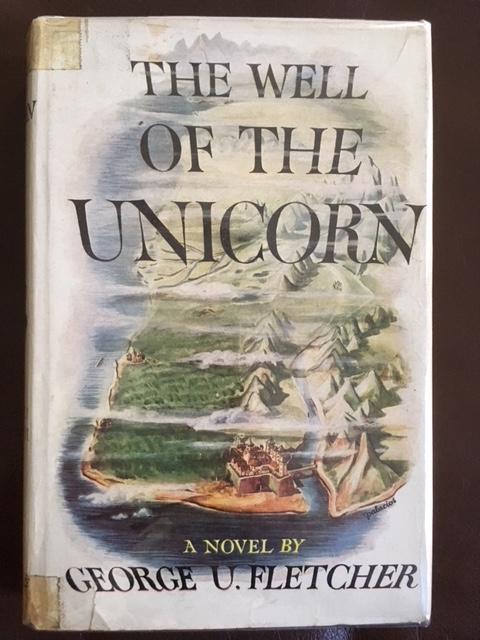
Let us establish this first: The Well of the Unicorn is a novel by Fletcher Pratt, first published in 1948 by William Sloane Associates under the name of George U. Fletcher (see cover of first edition, below). Fletcher Pratt (1897-1956) was, variously, a librarian, translator, and reporter - as well as an author. He wrote both a string of military histories, as well as collaborating with L. Sprague de Camp on The Incompleat Enchanter.

The first edition of The Well of the Unicorn. The landscape is a stylised Dalarna. 
Photograph taken from Abe Books.

The Well of the Unicorn he wrote alone, or almost alone. An element of its setting is taken from a short play by Lord Dunsany, King Argimenes and the Unknown Warrior (this play may be found on Project Gutenberg). It is set in an unnamed continent and deals with the division between the Dalecarles and the Vulkings for mastery of Dalarna. The two nations are of roughly similar types, but the Dalecarles were conquered by the heathen Dzik for a time, whereas the Vulkings were not. The rule of Argimenes expanded Dalarna into an empire ('The Empire') by marriage with an overseas Princess of the southern nation, Stassia, and the bringing of the yet more southerly Twelve Cities into the imperial fold. 

This latter was accomplished by the titular Well of the Unicorn - the Well of Peace, the World's Wonder. The well, it seems, will grant peace (if not virtue, or freedom, or other boons) to a king's reign. The reader slows learns about it by several 'Tales of the Well' embedded as stories within the narrative - but Airar Alvarson is not on a quest to find it, or to protect it from the Dark Lord. 

A Church is mentioned - apparently on the Christian model, but without any great discussion of its creed. Magic comes under its ban; magic is not common, but can be fairly readily learnt. Even if wizards and warlocks are few, the notion that magic could be employed is ever present and the Well acts as a pervasive religious-magic influence on the setting. Airar Alvarson certainly has a knack for it.

So, to the plot. Airar Alvarson, a Dalecarle of a good if impoverished family is evicted from the family farm. By contact with the enchanter Doctor Meliboë he is drawn into a conspiracy - the Iron Ring -  against the rule of Count Vulk, who deals with the Dalecarles ill. Thus begins a tale, that if dealt with reductively may seem familiar: A young, gifted man is thrust out into the world to fight tyranny as part of a rebellion; he wages war on several different fronts with bands of heroic irregulars and characterful mercenaries against a harsh, established, featureless military and falls in love. 

Well, this does have connections with previous musings on the place of a military in the products of popular culture. L. Sprague de Camp, from a review in Astounding Science Fiction Vol, 41 No. 4 describes it as being about 'the philosophy of government: how can men be organized to fight for their freedom without irretrievably losing that freedom in the process.'. That's not wrong. But aside from noting The Well's place as pre-Tolkien fantasy, I'd like to counter that reductive summary above. 

Firstly, Airar Alvarson is a callow adolescent rudely awakened by his eviction. He is rarely in a state outside of war or peril for much of the book. Doctor Meliboë* - whose introductory chapter has something of TH White's Merlin about it, albeit rather more sinister - is more Svengali than Merlin. Airar has no steady mentor, despite a stable youth (his father is alive, if elsewhere and linked to the Vulking regime). He becomes rapidly surrounded by the conspirators of the Iron Ring and mercenaries of the Twelve Cities. Even if he is capable of holding his own, those around him constantly have their own agendas. And Airar is enjoying the fruits of freedom, status and power - which leads to romantic or physical entanglements. His grappling with the latter causes no end of internal wrangling and argument.

Secondly, I would note that Fletcher Pratt's own work on military history has clearly paid off. The necessities of campaigning - of shelter and fodder, of forced marches and rough terrain, of keeping the peace between proud quarrelling men in the midst of many weapons - are very real. The accounts of battles and siege engines may be a little over-detailled for some tastes, but they can be arresting.

The cover of the Fantasy Masterworks edition.
I do not recall a scene quite as Gothic, but some of the magic in The Well has something of this tone.

A note on tone and style: the work is scattered with archaisms. Some reviewers associate this with E.R. Eddison, though The Well is far less developed in it's unique style than The Worm Ouroboros or Mistress of Mistresses. It can be an awkward style to read, but I got used to it (not everyone does). When reading it, my mind went to Walter Scott rather than anything else.  
Despite the violence of the book and the scattering of fade-to-black sex scenes, the Iron Ring still identify themselves by whistling a few verse of a song; trumpets still go 'Tira-Lira'; a nobleman urges on his troops by asking if they were 'suckled by rabbits'.** Perhaps we can see this as an outlier of the Walter Scott Fictional Universe that looks ahead to 1960s-70s historical/fantasy works; it certainly bypasses Tolkien.  

The Well of the Unicorn is at least interesting to talk about - who knows if the above has actually sold it to you as an appealing prospect. It's low magic setting may be arresting. I would argue, however, that it gives a fascinating example of 'clerical magic' in the Well. This isn't the parish priest giving you 1d6+1 hit points or Holy Water = Acid for Vampires, but is a pervasive social and cultural feature, which while it definitely works, offers mixed results. More to the point, it has deliberately spiritual (or possibly 'character-effecting') qualities to it rather than being a simple tool (Mother Atsilva healed your gangrenous leg wound; now you can go right back to plundering dungeons and killing orcs!). I don't know how one would go about modelling it, but it may be worth a thought.


*Micheal Moorcock is apparently appreciative of The Well, but I have not seen any explicit links between the names Meliboë and Melniboné.

**This just makes me want a big-budget Game of Thrones-esque TV series, but all the dialogue is relatively tame semi-Shakespearean material of this kind. All the blood and nudity you could wish for, but nary a four-letter word in sight. And a selection of actors that have to taken this very seriously indeed.

The Hollow Crown doesn't quite count.

Saturday, 3 October 2020

Punth: A Primer - Appendix N

Some of the below have been referenced in Chapters of the Primer and other blog posts. Other inspirations have not been hitherto mentioned. 

Genesis, Ch. 11 Verses 1-9 will provide you with the story of the Tower of Babel.

[The Wisdom literature of the Old Testament, or similar works of the ancient world, are not a specific inspiration, but are useful reading. The portions of the Codes in the Primer are not written on this model - Punth is atheistic - but it is still in the DNA of the Primer; see below.]

Snow Crash, Neal Stephenson

The discussions of Babel, language and Sumerian culture are more relevant to Punth than corporate warfare, hacking and the metaverse. 

Dune, Frank Herbert

The Book of the New Sun, Gene Wolfe

The chapters of Citadel of the Autarch devoted to the Ascian language (if you click on any link in this post, make it the second of these) are obviously vital, but the image of a collapsed space-faring civilisation is also arresting. The Azoth of The Book of the Long Sun is of interest as an artefact of a space-faring civilisation; I have discussed that here

Nineteen Eighty-Four, George Orwell

The element of Newspeak is most relevant. 

A Princess of Mars and the Barsoom series, Eric Rice Burroughs

Various interpretations of which are discussed here.

The Saga of Recluce, L. E. Modesitt, Jr.

Most notably Fall of Angels, Magi'i of Cyador, Scion of Cyador. Discussed here.

Declare, Tim Powers

The djinn of the desert owe a great deal to Declare.

Seeing Like a State, James C. Scott

The following reviews may be of use: A), B), C).

Reflections on the Revolution in France, Edmund Burke

Red Plenty, Francis Spufford

Warhammer 40,000

Star Trek

I cannot claim to have been thinking of any given part of Star Trek when writing on the origins of the Qryth, but as an image of space exploration advanced enough to invoke Clarke's Third Law as well as vigorous enough to produce the Qryth, it serves nicely. 

Chariots of the Gods?, Erich Von Daniken

I have not read Chariots of the Gods, but it serves as synecdoche for the whole of the 'Ancient civilisations were built by aliens' school of thought. 

Seven Pillars of Wisdom, T. E. Lawrence

More for the atmosphere of the desert than the events of the Arab Revolt.

The Pillow Book, Sei Shonagon

Tuesday, 29 September 2020

Playing in Punth

 OR, A Primer for the Primer

NB - the below is all untested. It is trying to provide a suitable framework to make the Primer usable, but the Primer rather than the system presented came first. 

There are really two ways to set a game in Punth. To have players create characters from outside Punth (or they could be Ka-Punth) and have them go in, or to have them create Punthite characters.

Punth was originally conceived as part of a larger world (see Ch. 7) - the Terrae Vertebrae of this blog. Other than in that Chapter and a few scattered other references, I have tried to make Punth able to be slotted into another fantastical setting. The Babel-myth elements and Near or Middle Eastern basis makes it perhaps an odd fit if you were to slap it down right next to, say, fantasy equivalents of Vietnam or the Tlingit lands - both in terms of culture and environment. However, I would contend that the meat of Punth is in the Codes and the position of the Qryth: the specifically Babel-like elements could be reduced, reformed or repositioned, as could the Near Eastern portions.

The question will be, how much of the Primer do you issue to players? 

If they create Punthite characters, the only in-character conversation they should do should be in the Codes. Ch. 5 and Ch. 6 are deliberately linked to the Character creation process of The 52 Pages (and probably aren't that far distant from other systems). Ch. 8 will be needed at this point also. Parts of these could be issued to players at creation. Ch. 9 is most useful for play, and will likely come up as you go along. Ch. 1's foundation story and creed and Ch. 2  act as introductions to Punth as the Codes would describe it. These could be introduced into play early, in a 'We will all rise and recite the Oath of Allegiance' sort of affair. 

Here's the contents of the Primer, with a schedule of how you could issue it to players playing Punthites.

Ch. 1 - Foundation & Creed - Soon in the Game

Ch. 2 - Entrance into Punth & Marriage - When desired

Ch. 3 - Punthite Justice - When desired

Ch. 4 - Trade in Punth - Soon in the Game

Ch. 5 - Arms and the Qryth - Character Creation

Ch. 6 - Occupations in Punth - Character Creation

Ch. 7 - Religion and Foreign Affairs - When desired

Ch. 8 - Names - Character Creation

Ch. 9 - Conditions - Character Creation

Ch. 10 - Goals - When desired

[If you go to, say, Ch. 5, you will spot the table of military encounters at the bottom. This is as much inspirational as mechanical, but is more for the GM's use. Chapters of the Primer as referred to for player use above probably don't need to include these, and I shall probably produce a document where these materials are separated.] 

Introducing Characters from outside Punth into Punth probably starts with the introductory hooks at the beginning of some of these blog posts: 

The land of the unbelievers, the fallen. A great desert, with who knows what lurking beyond. Where ten crusades have faltered. The Land of Punth.


South of the great mountains, south of the border provinces of the Empire lies Punth.  The tribes of the deep desert co-exist with the Ziggurat-Cities along the river, all under the eye of their alien lords.

Who are these strange folk? From where did they come?

Having thus whetted the appetite, the possibility of entering Punth can take place. Characters could enter tutored or untutored. The Codes are (for convenience) meant to be in a regional 'Common', if with a few variations in terms of dialect. Therefore, even the Untutored can read and speak the Codes once they see or hear them. Characters can communicate in Common (or other mutual languages) and not be understood by those who only use the Codes. 

Tutored here doesn't necessarily mean anything academic: it could be a sailor who knew Punth, or a merchant who trades there, or a diplomat or intelligencer briefing you on how to blend in. Ch. 7 (adapted if necessary) is presumably a must. Other than that, access to a Chapter will depend on the tutor - it is unlikely that a merchant will be able to teach you all (if any) of Ch. 5.

Untutored, of course, could imply any number of things: an unprepared expedition, a misfiring teleport spell, a pressgang. What it does mean is that the characters have little knowledge of Punth and none of the Codes. 

Tutored or Untutored, there is still a schedule at which the Chapters of the Primer should reach players: 

Ch. 1 - Foundation & Creed - Soon in the Game

Ch. 2 - Entrance into Punth & Marriage - On entrance

Ch. 3 - Punthite Justice - When desired

Ch. 4 - Trade in Punth - Soon in the Game

Ch. 5 - Arms and the Qryth - When desired

Ch. 6 - Occupations in Punth - When desired

Ch. 7 - Religion and Foreign Affairs - On entrance

Ch. 8 - Names - Soon in the Game

Ch. 9 - Conditions - Soon in the Game

Ch. 10 - Goals - When desired

***

I would like to make clear that the Primer by no means is meant to declare the whole of the Codes - that would likely be a work at least the size of a thick novel. The Primer is meant to make play in Punth possible and to introduce the Codes to players. From this position, people at the tabletop can introduce new Codes; if the GM is doing so, then they may be slipped in however convenient. If players are doing so, a veto system would be appropriate ('I'm not sure that's quite how Code 7.36.79 goes...shall we check with the scribe?'). 

Obviously, no Code is meant to be specifically advantageous for any one group ('When Three Men, an Elf and Two Fauns enter the land, the time of the Sky Princes is over!'). Faking a Code would require an ignorant or young Punthite, as well as the Charisma-related ability (or magic) to effectively sell this new 'Code'. This would not last long in one of Punth's cities!

The following list of questions is for GMs using the Primer to decide for themselves: 

  • How sincere are the Qryth in their role as leaders - do they live by the Codes themselves?
  • Can (and do) the Qryth communicate by other means than by the Codes?
  • How competent is the rule of the Qryth?
  • What is the nature of the Ka-Punth's revolt against the Qryth? 
  • If the Qryth were to die off, would the state of Punth maintain itself in roughly the same fashion?
  • If the Qryth were to be contacted by their home planet, would they be welcomed home? Or have they been so thoroughly culture-warped and gene-twisted that they would never wish to?
  • What was the Sorcerer-King trying to accomplish?
  • Can Punthites wield magic? Or must they rely on outsiders, willing or otherwise?
  • Do the djinn have any genuine power, or are they only unquiet spirits?
  • Do the djinn have any collective plan to regain their former power?

Sunday, 27 September 2020

Punth: A Primer Ch. 10 - Goals

This looks to be the final post of the Primer proper; two other posts are in the works to round things off.

Punth! Aristocratic republic of former astronauts. Long roads dividing a howling desert. Scribe schools engaged in mass call-and-repeat lessons in the baking sun. Gendarme patrols, regular as clockwork. Polychrome pillars and glazed bricks. Long-necked herbivores pulling carts; six-legged steeds for the Sky Princes. 

(Newcomers may wish to seek wider context here and here).

The Primer thus far has talked about professions, conditions and tactics: now we talk about Goals. Some of this will doubtless repeat earlier parts of the Primer, but it this Chapter still seems necessary. 

Security By the might of the Sky Princes are these lands secured.

Safety Shelter, plenty and benevolence: these sustain a sheltering, plenteous, benevolent populace. 

Find a Community The longing for a home is the longing for Correct Thought and those who speak it.

Find a work-team To be idle is to decay.

Prestige To be known as a vessel of Correct Thought allows transmission of Correct Thought.

Accomplishment The application of might and wit is properly praised.

Perpetuate Culture To the offspring of the Codes, let there be taught the Codes.

Expand Culture Where Correct Thought is not, there is only fruitless toil. This is no proper state for the populace.

Expand Territory Correct Thought has no borders. 

Find a new home Neither men nor land should be idle, but idle men and idle land may be set together and transformed.

Reform By the refiner's fire, both gold and the populace may be remade.

Re-invigrate/Repair Water refreshes the spirit; water with earth makes mud; from mud are shaped bricks; bricks restore the house.

Destroy Might joined with righteousness surpassed all other things. 

Defeat Cast folly into the dust.

To Die Well To die for the populace can be as worthy as to live.

Punish Malice is thwarted in the Servants of the People.

Harmony, Coordination From the scribe, instruction. From the labourer, action. For the populace, joy. 

Prosperity Where bellies are empty, let them be filled. Where granaries are empty, let them be filled. Where granaries are ruined, restore them.

Strength Might is won be devotion and wisdom. These come from the Codes. 

Good of the Qryth The might of the Sky Princes is wondrous and perfusive!

Good of Punth The lands and teachers of correct thought must be sustained.

Justice Who must rise first? The mighty. Who shall be raised up? The just.

Learning Correct thought is the pathway to all abilities that may be considered natural.

Wednesday, 16 September 2020

The Qryth: A Class for The 52 Pages

Half as big again as a full-grown man. Hunters; Soldiers; Magistrates; Central Planners. Green four-armed aristo-commisars, acting out Star Trek cargo-cult legends in colourful stone ziggurats!

Details of their history are found elsewhere (the background of Punth is found here and here); for now, I shall concentrate on physical features. Ten foot would be moderately tall for a Qryth. They possess two forward facing eyes, but set in what would be the forehead on a human. Skins tones vary between shades of ochre and green, but rarely approaching the bright green of grass or the solid dark green of moss. The Qryth are hairless, but have been known to use animal pelts in (perhaps unconscious) imitation of body hair. 

They possess four arms and two legs, the arms being set either side of the torso. The lower, slightly smaller set of arms is commonly used for fine-detail work or in expressions of intimacy. To greet someone with the upper arms only is - in fact and in verse - to propose a formal, distant relationship. The musculature of the limbs is somewhat helical to the viewer. 

The Qryth give birth to live young, although they do not suckle them and are, accordingly, breast-less. Eggs are swapped between Qryth, rather like seahorses. This is a private affair - though it is possible that Qryth mores have been shaped in this regard by their time in Punth. Likewise, the organs of generation are generally concealed. Male and Female are adopted as terms of convenience. This has relatively little bearing on the matter of Qryth behaviour: they are Sky-Princes before all else.  

Qryth youths go fairly promptly from parents to creches to isolated boarding schools. Given how few the Qryth are, their children are gathered together to create a lasting Qryth identity. 

One hundred years is a not uncommon age for the Qryth to reach - though having made your century is grounds for retirement. After the age of sixty (or thereabouts) the Qryth develop a distinct sheen and set of streaks to their skin, rather like the bark of a hornbeam. 

Qryth names are discussed here, in Ch. 8 of the Primer. 

This class should function with a party of adventurers from outside Punth or inside. Rogue Qryth are exceedingly rare, but this should not stop them from appearing on the tabletop. As much as Qryth do have a fairly rigid set of social roles, hunting trips, solo journeys and other forms of independent action are not unknown. 

In a Punthless and Codeless setting, adjust as necessary. 

So, to the mechanics - using, as before, The 52 Pages (downloadauthor's blog).


***
THE QRYTH

Size: 2

Move: 15

HP - d8+1+ CON +/-.

Attack Modifiers - +1/+1
Mind Save 5 + WIS +/-
Speed Save 7 + DEX+/-
Body Save  5 + CON +/-

Knowledge    Notice Detail   Hear Noise   Handiwork   Stealth   Athletics

      [X]                           [X]                    [X]                    [X]                      [ ]                 [X]

Must start with Background word Punth. This encompasses a Desert background, plus the unique traits of that land. Qryth prefer the warm and suffer in colder climes. 

Four Arms: A Qryth can carry more things at once than other people, though this does not translate to STR 18 encumbrance. They can, however, effectively wield a two-handed weapons and a shield simultaneously, or reload a Heavy Crossbow in one turn. A Qryth could carry two two-handed weapons, but would be obliged to use them alternately. 

Stealth and Size: The Qryth are used to trying to conceal themselves in the desert, though their size can work against them. Indoors, naturally, this becomes harder. A Qryth can go on all fours (legs and lower arms), making them lower but longer. Thus they can go inside human-size dwellings and still use the upper arms to fight or work - but this is relatively strenuous and going round corners is difficult.
If a Qryth below Lvl 3 has to spend a game turn like this, they take Fatigue Damage.
Some Qryth soldiers, akin to commandos, specialise in this sort of unglamorous work.

Qryth Anatomy: Healers from outside Punth will struggle to assist the Qryth. They can turn a Mortal wound to a Critical one, but they cannot Speed Recovery.
There is a One in Ten chance that a particular poison will not effect a Qryth.

Languages: A Qryth starts with twos Languages: the Codes and the script of Punth. 
Any language slots a Qryth player might otherwise possess are 'banked' until later levels. 
In the event that the Qryth are hiding a secret about how they speak, it is assumed that any Qryth would be cautious about saying as much. At least a few levels worth of cautious. 

Hirelings and Henchmen: Outside Punth, normal rulings apply. 
Inside Punth - it is always possible for a Qryth to find Hirelings or Henchmen, CHA notwithstanding. Social problems may arise from this, but not mechanical ones. 

Armour: Outside Puth, all Armour must be made specially for the Qryth. Extra costs will apply.
A Qryth may start with Light or Partial Medium Armour.

Level Advancement: +1 Melee, +1 Missile every Even Level

                                    +1 to all Saves every Odd Level

A player that wishes to roll up a Qryth must have at least 13 STR.
                                    
***

Suggested backgrounds and other details: Typically, a Qryth would be expected to be a Soldier, Magistrate, Tactician, Logistician, Pedagogue or Scholar-Poet. The first four of these will have a fairly formal rank structure (as before, a Qryth fighter would be known by certain high and ancient names  - Astronaut, Espatier, Star Commander, &c. Vertebraean usage tends to refer to a Qryth Knight, Commander, Marshall.)
The Qryth have a heavily ritualised, legendary idea of their own history. This extends to the various remaining gadget relics in their possession.
They tend to be ill-informed about magic and religion (both in terms of fine detail and how they fit into a wider picture).

***

The literary and socio-political inspirations for the Qryth have been covered fairly explicitly elsewhere (though I shall make a dedicated Appendix N post one day), so I shall here post a few bits for the look of the Qryth. Hopefully having read the above, you will have a mental image of your own, but a few reference points seem worthwhile.

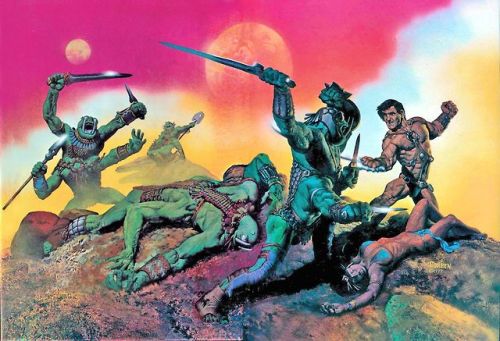
Edgar Rice Burrough's Barsoom stories offers the first inspiration for the look of the Qryth. The Green Martians (also Tharks) are the main reference. The Thri-Kreen of Dungeons and Dragons have a slight influence, but little more.  The Qryth are not insects.
#barsoom from Jewel in the Skull
Green Martians, are of course green, four-armed, fifteen-foot barbarians. This image found here.
(The 'Barsoom' tag on Jewel in the Skull is useful, but be warned that you will
see numerous mostly-naked folk in various things that might be considered clothing)

#richard corben from Jewel in the Skull
Some depictions have them more bestial than others.
Image found here; art by Richard Corben.
#barsoom from Jewel in the Skull
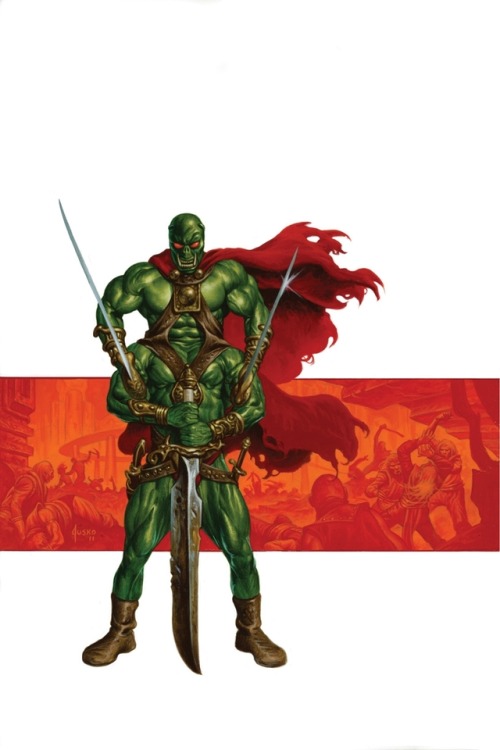
Others appear to be 1.5 green bodybuilders.
Image found here; art by Joe Jusko.

My preference is for the Qryth to be on the leaner side - and, of course, without tusks. The 2012 Barsoom adaption John Carter opts for something thinner than the above.  
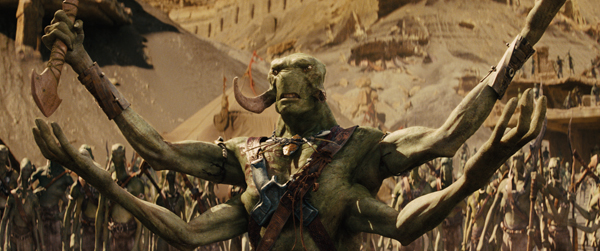
From the 2012 film John Carter.
I rather like this concept art for the same, by Dermot Power (his website).
This image, and others like it may be found here - do take a look.


[Notes and pictures on the Qryth architecture found here]

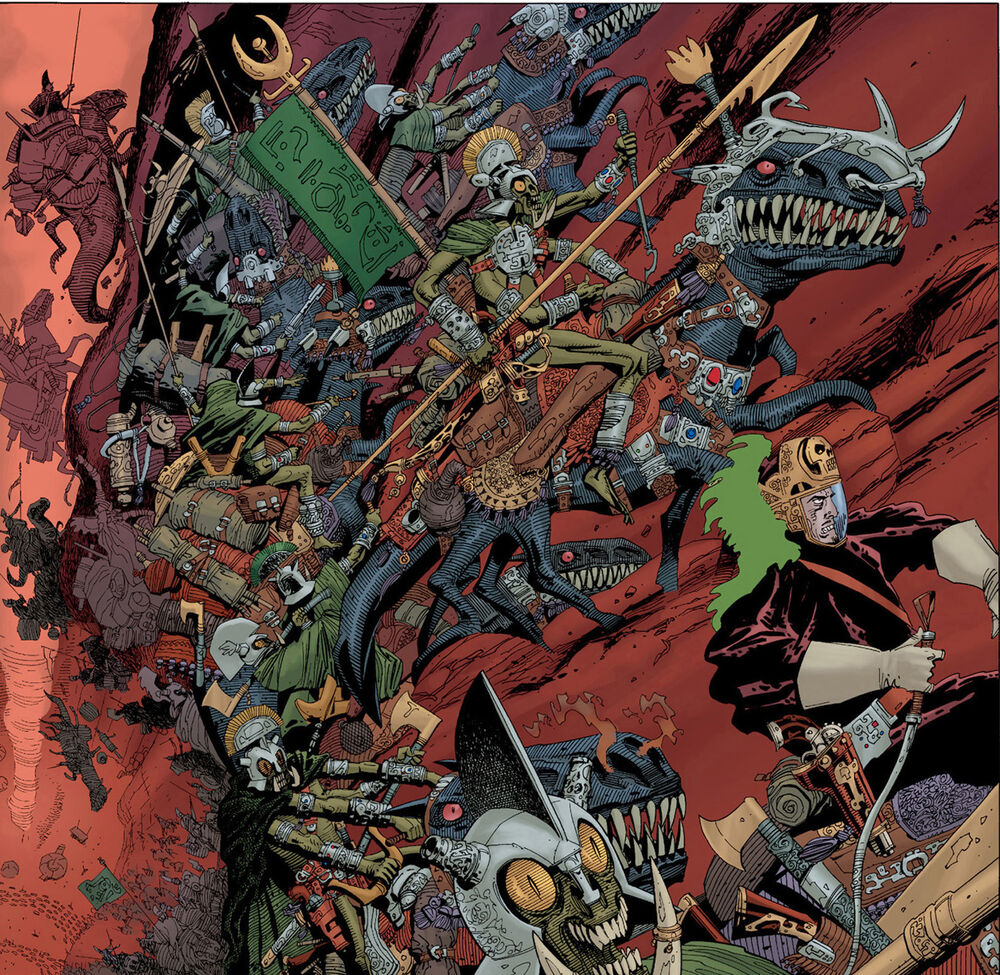
EDIT: I am properly reminded by a post at Vaults and Van Gogh of the Green Martians as portrayed by The League of Extraordinary Gentlemen. I've always time for Kevin O'Neill's art detailed art; these are vast and bulky, with skull-like faces, staring eyes and prominent teeth and tusks. Here they are off to fight the Martians from War of the Worlds.


Sunday, 13 September 2020

Punth: A Primer Ch. 9 - Conditions

Punth! Square cities by the bending river. Gene-mod oxen pull the ploughs. Goatherds gather their flocks into elevated shelters for fear of carnivorous leaping lizards.  Sentries with khaki fatigues and long spears.  

(Newcomers may wish to seek wider context here and here).

Punth has seasons, weather and varous social and physical conditions to communicate, same as any other land. Now, whilst those in the same community comprehend elements of this implicitly or by non-verbal cues, the incomer may not (be they Punthite or otherwise). Thus, a list of expressions from the Codes may be used to communicate these certain set of notions. 

***

Cold Chill as the desert night is the people without a code.

Heat The heat of noon is to be preferred to Incorrect Thought

Wet As full of water as the Codes are full of merit.

Thirsty A dry interior is like a man with his bones only.

Hungry Neither trees nor men should be hollow.

Exposed, in want of Shelter To be roofless is to be skinless.

Wounded If the body is broken, who may avail?

Poisoned/Stung  Foreign substances degrade the body.

Ill Sickness is rife where Incorrect Thought dominates. 

Enchanted Just as the body, the mind may be imprisoned and trammelled. 

Short of Supplies Action must persist, whatever the conditions.

Prosperous The wealth of nations is found in a proclaimed code.

Stunned Codeless are those that fall head-first.

Dying The fruits of Correct Thought persist, though its proponents fall. 

Disgraced The Sky Princes cast down only those who offend. 

Praiseworthy Dutiful them that strive, twice so them that succeed. 

Dirty The dust may soil it, but Correct Thought clears all stains. 

Rain The earth is refreshed, thus so are its inhabitants.

Thunder A noise from the heavens, as the knell of the Sky Princes.

Clouds All things but the light of Correct Thought may be hidden.

Sunny Merciless is the gaze of the sorcerer.

Winds The howling of the dunes scours those who do not follow Correct Thought. 

Sandstorm A thousand in directed motion will flay a giant. 

Migratory animals Watch for the turning of the year, as the roaming beast does.

Troop movement Make room on the roads, in the houses, in all other efforts, for the soldiers of the state.

Goods movement Bring the sought commodities to where they are needed; not all work is creation. 

Qryth visit The Sky Princes foot-fall is a wondrous trumpet-blast.

Government bulletin When adjustments to standard policy must be made, envoys will tell it.

A death A useful life is all the epitaph one needs.

A birth Offspring raised in the code are a social good surpassing all others. 


Friday, 4 September 2020

Black City, Wicked City

I read most of the Erast Fandorin novels a while ago. They're Russian mysteries and thrillers by a chap with the nom-de-plume of Boris Akunin, translated by Andrew Bromfield. The titular Erast Fandorin is a detective and some-time secret agent in late nineteenth-early twentieth century Russia.

I would describe them as slightly pulpy; to illustrate, the titular Fandorin is something of a polymath and dandy, with a Japanese manservant. The tone shifts as well: one novel can deal with state machinations and the wholesale destruction of a Balkan war, another can deal with a genteel mystery on a cruise liner. However, they have value in opening up new fields for me. They make (say) pre-revolutonary Moscow, a well established setting, that much more granular. To speak uncharitably, there would be the temptation for an English-speaking author to weigh pretty heavily in on the shadows of Revolution, and while a full cast of agitators, secret police, reformers and revolutionaries is on display, it's not the only thing going on. Akunin's Sister Pelagia stories (an Orthodox nun, somewhat in the vein of Father Brown) have a rural setting that occasionally verges on the Arcadian (while still being in 1890s Russia). 

Anyway, I recently picked up one of the later Fandorin mysteries, Black City. It is largely set in 1914 Baku (the capital of modern-day Azerbaijan, as football fans discovered for themselves last year). An oil boom is in full swing. There is a whole series of social tensions: Tsarist authorities hunting for terrorists, Nouveau riche millionaires driving up prices, working classes toiling in heavy industry, Islamic customs brushing up against the course of progress, the ethnic tensions of the Caucuses....

Black City (Erast Fandorin 12): Amazon.co.uk: Akunin, Boris, Bromfield,  Andrew: 9781474604444: Books
Cover of the English translation
(Andrew Bromfield for Wiedenfeld & Nicholson, 2018)

All of this comes with a riot of set dressing: a winding Medieval quarter straight from the Arabian Nights, modern hotels, casinos and boat clubs, oil fields and the extravagant mansions of their owners. Costume takes in the traditional dress of the mountains, ornate pre-war uniforms, frock coats and sheepskin caps. Technology: speedboats, motor cars, film cameras, automatic pistols - and horses, folk remedies and Damascene knives. 

It's an influence to throw into your list of inspirations, anyway. This post, set between larger projects, also serves as a coincidental tip-of-the-hat to Against the Wicked City, recently resurfaced. Baku is certainly in the milieu of that metropolis. 

Friday, 21 August 2020

The Magician's Nephew's Goose-Gold

I recently read over the proto-design document for Patrick Stuart’s Goose-Gold and Goblins (see here). There were elements in it that put me in mind of CS Lewis’s The Magician’s Nephew (first chronologically, sixth in publication order of the Chronicles of Narnia). I said I would outline how to apply it. More obvious sources of inspiration are Studio Ghibli films (hence the Shintobox elements) and fairy tales, but I think that The Magician’s Nephew specifically would be good to consider. I shall begin with the second paragraph:

(Chances are if you‘re reading this Blog you’ve read The Magician’s Nephew [hereafter TMN] anyway, but if you haven’t, do so).

In those days Mr Sherlock Holmes was still living in Baker Street and the Bastables were looking for treasure in the Lewisham Road. In those days, if you were a boy you had to wear a stiff Eton collar every day, and schools were usually nastier than now. But meals were nicer; and as for sweets, I won’t tell you how cheap and good they were, because it would only make you mouth water in vain. And in those days there lived in London a girl called Polly Plummer.

So: the real world elements of Narnia are here drawn from the past – the late Victorian era – rather than the 1940s and 50s of other Chronicles. This is not idealised (think of the later reaction of the Cabby and his horse to arriving in Narnia), but it is clearly thinking of a Britain (indeed, a London) before two world wars and Rationing. 

Goose-Gold and Goblins (hereafter GG&G) looks to give XP for Food, but there is something more in this. The implication of distant or neutral government (comparative with Wartime Britain or a post-war Welfare State) is fitting. Monsters like cruel teachers are also cited by GG&G.

Polly and Digory are our protagonists, and are both children (GG&G would have your characters either be quite young or quite old). Their families’ London houses are connected by the attic; so they meet and explore together.

It is wonderful how much exploring you can do with a stub of candle in a big house, or row of houses. 

The urban setting (for now!) isn’t quite right for GG&G, but the exploration of your local area (and the implicit decay of exploring a house with empty or unused rooms) is right.

Digory and Polly encounter his Uncle Andrew, who turns out to be an amateur magician. However, he’s not a kindly man (“Men like me, who possess hidden wisdom, are freed from common rules just as we are cut off from common pleasures. Ours is a high and lonely destiny.”). He spirits Polly away to unknown parts, and this is shocking – not just in the sense of being magic, but in its suddenness and violence. 

It was so sudden and so terribly unlike anything that had ever happened to Digory even in a nightmare, that he let out a scream.

Uncle Andrew turns out to inherited artefacts of Atlantis (so he believes) from a fairy godmother, who does not appear to have been terribly pleasant. A secluded, conceited, foolish, vain and seemingly rather lazy figure, he sits within two elements of GG&G – the unemployed Uncle of the ‘Pets’ section and the sinister but knowledgeable Well-Dweller of the player’s house. 

It’s notable that the magic Uncle Andrew can employ actually has fairly limited uses (he also doesn’t really know what he’s playing with). The rings he has made shift the wearer between dimensions, but little more. This seems to be in line with how GG&G would have magic appear. 

Digory’s mother is ill; his father is far and away in India. Both illness and absence are key motivations for adventuring in GG&G. Now, the Ketterly household does not appear to be impoverished (they can afford at least one servant and Uncle Andrew doesn’t appear to bring in any money). But the emotional consequences on Digory are present throughout TMN.

Playing on Digory’s young and uncertain courtesy, Uncle Andrew manipulates him into going after Polly. The place between worlds turns out to be a calm wood, rather than some kind of hallucinatory abyss.

From the illustrations to TMN by Pauline Baynes.
Both children are just in their street clothes, rather than festooned with gear and weapons.

They find themselves in the dead world of Charn and awaken the Witch-Queen Jadis. From the start she’s fairly unpleasant (and reveals herself to have gone in for MAD via terrible magic [Queen Jadis, Or How I Learned to Stop Worrying and Love the Deplorable Word]). However, there’s an element of mercy in Digory and Polly’s treatment of her – they aren’t murderhobos and you don’t leave a woman all alone in a dead world or a mystical wood. Ultimately, of course, she forces them to take her across dimension, but they don’t make up their minds to murder her out of hand.

Jadis’s rampage through London has little aesthetic bearing on GG&G, but the disputation of an established system may be thematically apt. Certainly, the confrontation between the amateur magician and the unpredictable evil they produce has some bearing on the potential for pacts with dark forces that GG&G contains. 


Jadis | Chronicles of narnia, The magicians nephew, Narnia
From the illustrations to TMN by Pauline Baynes. 
The only way to travel when in the Metropolis.


(Compare with Nesbit’s Story of the Amulet, in which an Assyrian queen rampages through Victorian London. And in which we visit the future utopia made by The Fabian Society). 

By means of magic rings, they all end up in Narnia at the moment of its creation by Aslan. The vitality of the new world suggests a cure for his mother to Digory. I don’t suppose I need comment on the natural and pastoral elements of Narnia, but I would note that this is a protean Narnia. The multiple terrains and spirits of the Shintobox are not really in evidence. 

This said, what we do have to grapple with are talking animals. Uncle Andrew reacts badly to them. The various logics of the bulldogs, bears, badgers, elephants, &c for dealing with him has something of the spirits about it. They do not quite know how to deal with the old wretch properly and they are quite strong enough to deal with him as they choose. However, we are stepping quite far away from the mute-but-ferocious Geese of GG&G.

Uncle Andrew’s unreasoning panic aside, Digory and Polly are in something of a bind themselves. Apart from intruding uninvited on the birth of a world, they have brought the witch Jadis into Narnia. As noted, they are both courteous youths and jump at Aslan’s offer to make amends. This is to be accomplished by the retrieval of an apple from a tree.

They are dispatched to do this without arms or weapons – no talking leopard is sent to assist them, only the winged horse Fledge (who would not be out of place in the list of Pets). This causes a rapider pace of travel than GG&G I think suggests, but that the main piece of assistance they are given is transport and shelter seems quite suitable for GG&G – see the Useful Things and Magic Things.

Pin by Megan Sawall on FOR NARNIAAA illustrations!! | The ...
From the illustrations to TMN by Pauline Baynes. 
Another use for a winged horse. 

The Garden where Digory must retrieve the Apple is noted as ‘a place which was so obviously private. You could see at a glance that it belonged to someone else.’ I see no immediate parallel in GG&G, but the logic of personal significance and magic strikes me as appropriate. 

Digory’s confrontation with Jadis (who has eaten of the fruit and become somehow of Narnia) has something of the magical spirits in GG&G and would be a direct match with the ‘Scheme Queen’ of the (loosely sketched) religion. Her temptations, half-truths and (temporary) sweetness of manner are right for a manipulative spirit in GG&G. Digory has no chance to defeat her by force of arms, but defies her all the same. 

The conclusion of TMN cannot be compared too closely to an open-ended RPG like GG&G, but the ceremony and opportunity for the exercise of Courtesy are noteworthy. Digory’s mother is (of course) cured; his father is soon given the chance to return (for good) from India. 

I’ve focused on TMN (out of all the Chronicles of Narnia) for its lack of armed violence and brevity of adventure (no untold years spent as Kings and Queens of Narnia). Beyond that, the invocation of a sick parent was an obvious spur to direct me to TMN. I’m not sure that GG&G will take a particularly Lewisian path, but some elements of sylvan Narnia full of satyrs, nymphs and talking beasts seems apt for it.