Thursday, 13 February 2020

Rogue Trooper: Nightmare Machines, Endless War and the First Person

Rogue Trooper began life in the British comic 2000AD, the work of Gerry Findlay-Day and Dave Gibbons. The time? The future. The place is Nu-Earth, a paradise world at a hyperspace junction devastated by years of war between two great alliances, the Norts and the Southers. This planet is so poisoned by chemical weapons that in most places humans cannot survive without a sealed chemsuit.

Hence the Southers created the GIs - Genetic Infantrymen - who can survive the poison atmosphere with no mask. But in their first action they were betrayed by a Souther general and massacred. One survived to hunt down the traitor outside the military chain of command- the titular Rogue Trooper. He is accompanied by the remains of his friends, personalities implanted in biochips attached to his war-gear, still speaking to him as he roams the poison wastes.

Enough of the summary. This is inspired by a reread of the first omnibus volume put out by 2000AD. There's some of Dave Gibbons's characteristic black and white art in that link, and you may conjure his name in connection with another blue post-human.

Originally found here: http://www.bbc.co.uk/cult/comics/2000adstrips/rogue/roguetrooper01.shtml
Many thanks to the chaps at the BBC.

The lone solider figure of Rogue is a familiar enough one, haunted literally and figuratively by his dead comrades - hoping not just to find the traitor, but to find new bodies for the biochips in his gear. His progress is told episodically, with miniature tale after miniature tale linked together - as one might expect from a weekly comic.

His own side, the Southers are rarely depicted in full view. We see odd units and the occasional glimpse of a distant (literally, on a satellite) command 'Millicom'.

(There is a constant interweaved future slang: Nu-Earth, the ruined city of Nu-Paree, with the Mitterrand Tower, 'Synth' applied to everything, the Nort exclamation of 'Nain!' or 'Stak!'. A bit goofy, maybe, but it gives a rolling gentle distinction to the language.)

Souther speech and habits look rather Anglophone; in time we would even see a Nort push into the 'Dix-i front'. Perhaps somebody had spotted the North-South angle. Either way, there is a sprinkling of American Civil War references: the cities of Memfizz and Nu Atlanta, the Georgia Volunteers, the song 'When the South goes marching in', the historic battle of Mek-Bull Run - even the port of Harpo's Ferry! [John Brown's body is a-rolling in it's grave...]

The Norts, however, are a far more interesting bunch. The Civil War angle is meant to perhaps imply some equivalence between the warring sides (in that both sides in a civil war are part of the same nation - they are kindred), though this is hardly how the Norts are portrayed. Inspired by the Nazis of Second World War comics (with a few Slavic overtones), they are by turns vicious and ugly, wearing full-face masks rather than the armoured astronaut-like Southers. Of course, we see far more of them. Rogue will walk into a firefight with some beleaguered Souther boys against an oncoming Nort force with superior weapons and help defeat them.

And such weapons! Guns, yes, but also vibro-daggers and lazookas. 'Decapitators' - hovering mines full of shrapnel. Automated sentry pillboxes. Drill-probes emerging from trench floors. Nort desert raiders riding genetically engineered 'Stammels'. Mountain troops on motorised snowboards. 'Blackmare' tanks the size of houses. The 'hard rain' of chem-suit piercing flechettes. Plantlike barbed wire, that traps and strangles its victims. Hallucinogen spraying tanks, that can appear as nightmarish vast spiders or snakes - or a float full of flowers and women. Laser-projected propaganda 'Holo-beam messages'. Poison saboteurs, nicknamed by the Southers 'Filth columnists'. The bizarre sight of the Sun Legions, Nort troopers apparently hang-gliding into battle from orbit (a notion so absurd they were later said to be extinct).

Well, what's the point of all this? Bizarre weapons and over-complex plans have some delight to them, to be sure. The need for a new hazard every few weeks also must have fuelled some creativity in the writers of the first run. But their is a sheer variety of complex industrial might levelled against the one lone trooper. It exudes a certain kind of atmosphere, found in a certain sub-genre.

The Protagonist has a weapon or two, and belongs to a nebulously defined organisation, often without clear ranks. The Antagonists are many, belong to a vast hierarchy and a equipped with startling variety. Not the Lone Wolf of Rogue Male, but something bigger, pulpier, set among the stars. Lone Space Wolf? [Sorry.] It's a matter I've considered before.

Of course, the Nort multiplicity of organisations (Army, Navy, Scum Marines, Sun Legion, Kashan Legions) is presumably meant to conjure up the different forces of Nazi Germany - the Wehrmacht, the SS, the SA, the Gestapo. Nonsense, in some ways - the Allies had quite as many different organisations and they could be just as characterful. A Gordon Highlander or Bengal lancer is a picturesque a sight as a soldier in full SS black.

Rogue Trooper has had a few spin-offs after the original run fell apart after the traitor general was found; Jaegir is perhaps the best, though it suckles from the teat of the grimdark rather. It tells the story of a Nort Kapitan-Inspector in the 'Office of Public Truth'.
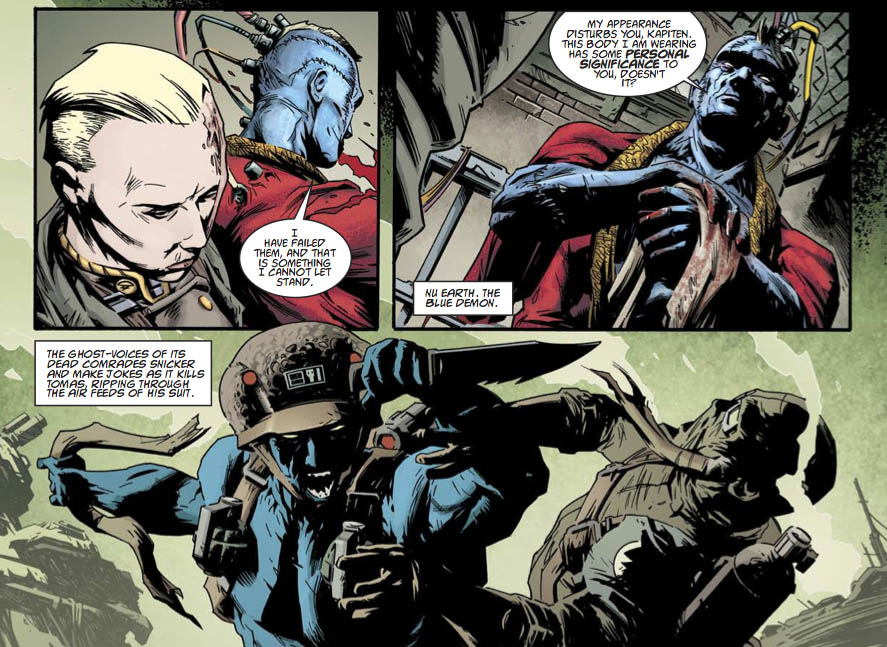
Complete with traumatic memories of Nu-Earth and the protagonist of the original!
From Jaegir: Circe, 2000AD Progs 1893-1899

It was made into a video game - a First Person Shooter, for which its narrative was almost perfectly suited. A lone soldier, the superior of any other, fighting hoards of enemies who can prove a challenge both in quality and quantity? Unfortunately, I am told by a relative who actually played it, that it was not much good. Duncan Jones is apparently adapting it for the screen - which will hopefully be better.

Speaking of FPSs, however, Rogue Trooper surely has a descendant in Killzone. I did not play them, but this brief series of games had a war between the Interplanetary Strategic Alliance (boring, vaguely American) and the Helghast (cool name, gas mask, black armour, British accents, swastika-like emblem). I invite you to consider their respective wiki pages.
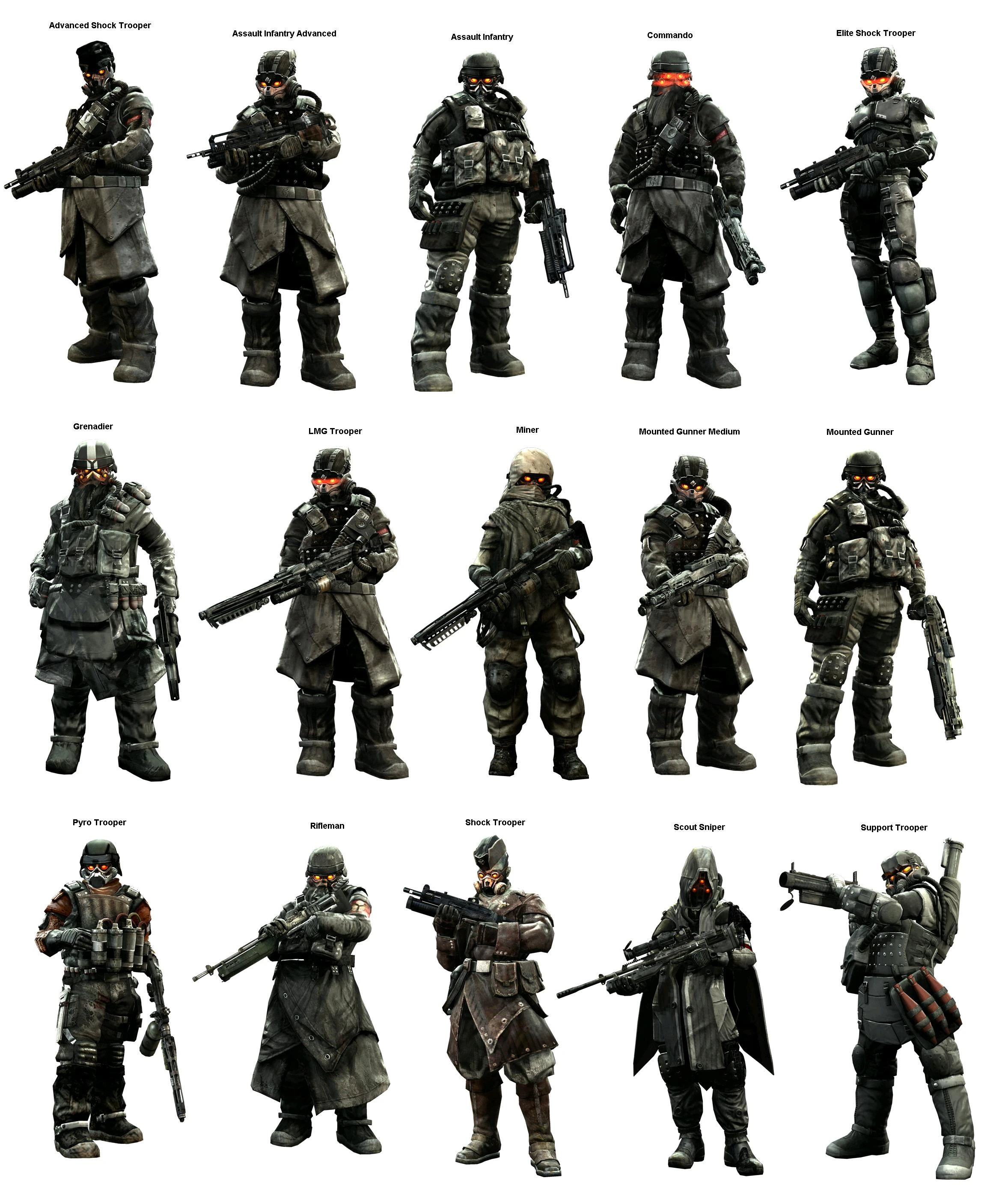
Quite what the difference is between a Shock Trooper and an Assault Infantryman, I should not like to say.
Found here: https://killzone.fandom.com/wiki/Helghast_Army

If the above does not suggest a Rogue Trooper parallel, perhaps the hazardous, polutted Helghan will.

It's an odd question - why not have well-defined Protagonist factions? Time is one factor - how long do you have to tell your audience about a place? A negative portrayal is probably quicker to rouse up than a positive one. The slow start of Peter Jackson's adaptation of Lord of the Rings allows for this, having to do quite a bit of heavy lifting for a presumed newcomer to Tolkien. Even here, of course, the portrayal is mixed: The Shire is innocent, but ignorant. Rivendell is the seat of wisdom, but lacking in the power it once had.

Why can I not get excited about the prospect of the ISA Constitution and Statue of Liberty? An ill-defined state can be whatever you want it to be, of course. Perhaps I'd rather have that than Gears of War with it's Coalition of Ordered Governments, created seemingly solely for the pun but giving obvious direction towards an authoritarian angle. Though the comparison between the Evil Empire (rules-based, governed, uniformed) and the Alliance of Freedom (anyone can pick up a gun and join) is one that may appeal to the libertarian. More than all this though, the lack of detail is sort of insulting - Shabby. Incomplete.

(The FPS antidote to the Lone Wolf may be early Call of Duty. As this chap lays out at length, each narrative gives a view of several units of ordinary men on several fronts. Call of Duty 3 may tread well-worn ground in Normandy and Western Europe, but does so switching between Americans, the British, the French Resistance, Canadians and Poles.)

Well, it all makes me appreciate tabletop wargames all the more. Each faction to be laid out with a variety of fascinating, characterful units; each to receive a ration of lore to back them. Rogue Trooper probably gave something to the feel of Warhammer 40,000; 2000AD was certainly an influence. I suppose this is what I enjoy in my war stories, or any story of great deeds. Multiple perspectives, variety, details, verisimilitude. I've been reading The Cruel Sea; Monserrat has some of these. Tom Clancy also, sometimes. I'm not sure that sort of story is always possible on film, however.

I have room for the mythic, indeterminate, bizarre or pulpy, and enjoy Rogue Trooper. There's something almost Passion-Play like about it. But it has some odd echoes elsewhere.
Wednesday, 5 February 2020

Excalibur, Armour, Dragons

A recent viewing of the 1981 John Boorman film Excalibur made me think lightly about costume.

Two light points to begin with:

1) Happy, dancing matrons in blockish medieval headdresses is by no means a bad look.
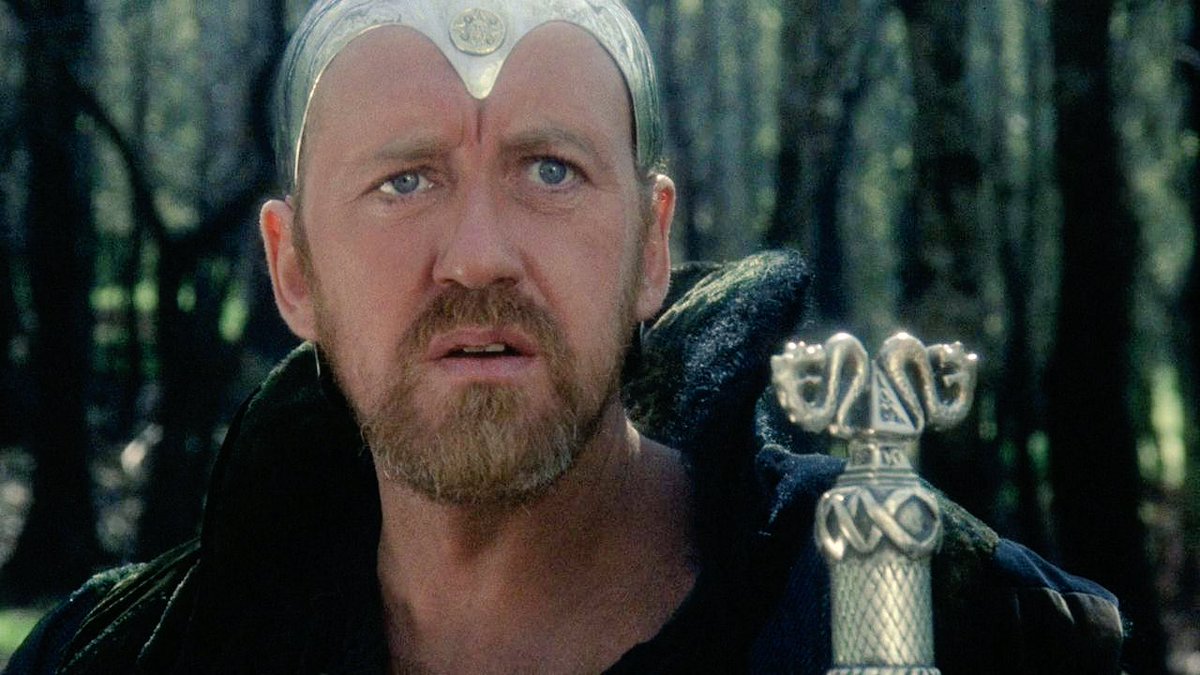
2) Congratulations to Nicol Williamson for playing the mighty wizard Merlin 'Chromebonce'.

WiccanInfaithCouncil on Twitter: "Excalibur's Merlin * 1981 ...

But more particularly, every scene is full of men wearing armour. Knights are almost perpetually in armour. Armour uncovered by tabards or paint or engraving. Obviously metal armour. It becomes almost part of their being. The knight is not determined by their weapon (other than Excalibur, everyone is quite happy to switch weapons every so often) or their personal heraldry (rarely in evidence, aside from flags - never focused on, really).

Before the coming of Arthur, this is crude, black iron armour, with conspicuous spikes or studs. There are prominent straps and jangling discs. Heavy masks cover the face. Pauldrons are weighty and asymmetric. Modred's rebels share this armour. There is something Orc-like in it, though this may be a Peter Jackson-inspired retrospective thought. At any rate, the message is clear: until Arthur comes, we are all orcs - and it is worth remembering that the knights of Camelot are the raiders and reavers that rode with Uther, or their sons.

At Camelot, however, armour is shinier, sleeker and symmetric. Better proportioned, cleaner. The effect is striking and doubtless intentional. When knights wearing the two different types of armour fight, it is as if a Space Marine of the 41st Millennium is fighting Captain America: the clear, colourful, human and heroic against the hulking, industrial and deliberately ugly. Or, indeed, like watching Darth Vader fight Luke Skywalker.

Modred himself, of course, wears gold armour with spiked edges, a sculpted breastplate and a helmet shaped like a human face. An imperial, trying-too-hard parody of a knight, perhaps. I suspect that this was in a different way what the costume designers were going for with Snoke in The Last Jedi, with his gold robe, bright throne room and elaborately armoured guards; no dull, vast machinery and black hood for him. A pity the look was not maintained for other antagonists.

The look of these armours is so uniform to imply a degree of unreality - could any set of armour be so   perfectly in keeping with its peers? But that's no real problem in this film.

***

One of the odder little details of the film are the pseudo-Nature worship angle of Merlin and Morgan Le Fay's magic. It's rather a step away from the tomes-and-alchemy Merlin of The Once and Future King, for instance. But it isn't (quite) the Celtic pagan remnant associated with Marion Zimmer Bradley (though interestingly, there is a constant 'Celtic Christianity'* feel to the Christianity of the film - beards, strange tonsures, gestures of blessing with oak branches).

Instead, we get strange paens to the possibly amoral force of the land called the Dragon. Difficult to summon up, unconcerned much with individuals and if not omnipresent, then certainly extensive in its presence. If it has a morality, the big-picture political concerns of Merlin and the health of the land are the closest thing it has.

The Prophet class of The 52 Pages might form an agreeable fit for a Merlin-esque character, or 'Prophet of the Great Dragon'.

Spell Schools: Knowledge, Nature, Illusion
Motto: Unite the Land and Make it Healthy
Symbol: Coiling serpent
Weapon: Staff, Metal Skullcap


*Not that we really have a solid idea of what that looked like, hence the scare quotes.

Tuesday, 28 January 2020

Fields of Light

Let us consider the 'big Empire' concept talked about by Joseph Manola in his (excellent) WFRP reviews. So we are on the same page, let's say that it can be expressed in the following way:

The Empire [or other generic Realm of Men] is big, but hollow. Between the cities are deep forests and mountains. There are few roads and fewer people; dark things lurk there. A fragile connection between towns and cites is maintained. The cities are full of people and wealth, protected by walls and cannon - but the a different darkness lurks there, in the sewers and slums and secret cult meetings.

Now, I realise that this could describe quite a few fantasy roleplaying settings. You can buy more things in cities, and the perils in them are likely to be different. But the Empire and the Old World will do best to illustrate this.

What if we deliberately invert this? I'll maintain (something like) the Mitteleuropean setting of Warhammer, for ease of reference.

***

We find ourselves in a world where the cities have been abandoned, with only high citadels enduring in the ruins of broken stone and crumbling houses. The plague took them, the famine took them - the rats took them. As the soldiers that still defend a few harbours and bridges might tell you, there is such a thing as Skaven.* Some brave or mad fools try and find wealth in the abandoned cities - a fruitless errand, for so little was left there.

Resettled, the countryside is full of wealth and well-populated. Population density is lesser than in cities, of course, but farmhouses are filled by extended families and household servants. There is no tiny isolated community as such; every village can produce a sufficient numbers of able-bodied workers or fighters.**

Trade goes on, but there are few places where merchants are permanently gathered. Rather, fairs are held at periodic times throughout the year in suitable locales. Even the grandest of these do not erect permanent structures to facilitate these. Merchants are not quite nomadic; they will rather store goods and coin in secure compounds in their own village.

The King? Only the greatest of local lords now, burdened with the expense of the royal progress. It would be unwise to tell him that, though. Besides, someone is expected to lead, or look like they are leading.

The great (though not sole) deity of these lands is Ypsilon, Lord of the Plough. Ypsilon of the Straight Furrow, Ypsilon of the Hedges, Ypsilon of the Silver Sickle. He is said to have been the first man to clear the fields and grow wheat - and then to defend those fields. His clergy make ritual journeys about the field boundaries, sanctifying the crop. The faithful are expected to pay a great deal of attention to the calendar, to set about their labours without complaint - and to take their spears with them to the field. The Harvest Festival is pretty hardcore. There are no cathedrals for the overseers of the faith - they sanctify the roads while the parish clergy bless the fields.

Learning is not found in the urban schools or universities, but in the independent monasteries set in fertile fields. High walls and full storerooms protect the libraries, as monks gather to dicsuss faith, magic and natural philosophy. Each monastery may evolve a particular speciality - alchemy, geometry, metallurgy, enchantment. Pilgrims wending their way between them carry books, ideas and devices. Each year, the world is further revealed.

Life in the country is good; a full day's work hopefully means a full belly, and the villages are safer by far than the towns. But despite this, there are whispers of rites in thorn-choked places, beyond the field edges. Worship of the gods of unbounded nature; the gods of unearned abundance, of choking rot, of hateful cold and of raw meat. Who knows what the villagers are hiding behind their hospitality? What lurks in the shadows of the orchard? What force could shatter a millstone?


I started with Early Modern Europe and I turned it into something like the Dark Ages: a loose net of civilisation, rather than points of light. A bit it of makes me think of 17th century Puritan New England, as well. Something far more focused on 'rural feudal' I suppose. But despite the bucolic edge makes a difference. Secret cults in creepy forests or isolated villages are perhaps expected; secret cults in hospitable taverns and village greens, perhaps not. 


*Rather like Vermintide, I suppose. Not that I've ever played it.
**This isn't quite 'Tory Utopia'. But a certain form of agrarian conservatism would be at home in it.

Tuesday, 31 December 2019

Nomad Babels of the Latter Deluge!

At some time in the 21st Century the rains began to fall, on the just and the unjust alike. Plain and desert, fen and field, hill and dale  - there was but rain. The waters rose and covered the earth.

Some survived on Arks. Righteous folk, craftsmen and preachers, they bought liners or restored hulks or commandeered the vast merchant ships into floating sanctuaries - taking with them animal and plant life to sustain themselves.

The peaks of mountains could be found among the waves, where life on solid ground could flourish again. Pristine islands, where humans could live peacefully and in harmony - with nature and themselves. Or, as the case may be, in no kind of harmony whatsoever. These paradises swiftly became known as Edens.

As the waters rose and the kingdoms of men were swept away, all thought that those not in the Arks or on the Edens had been lost. But it was not to be.

The ancient cities of the world, filled with sacred architecture and seated at the nexuses of lay-lines somehow rose up, despite their freight of unrepentant souls and festering sin. With ragged edges, fringes of seaweed and wave-washed streets they re-emerged, with much of their population undrowned. They do not float or bob like any natural material but they stay, somehow, atop the waves. But what is more, they have protectors.

Ancient spirits or new icons pull these through new seas. Rome is propelled by a doggy-paddling She-Wolf. Gog and Magog pull London by great chains - largely in the same direction. Cairo rides gracefully upon the crinkled hide of a giant crocodile. New York rejoices as it shelters behind the sea-weed skirts of Mother Liberty, her torch permanently grounded at Battery Park. Her course is assumed to be determined by public vote. The spirit of Mother Ganga moves Kolkata; her half-elephant steed Makara pulling the city across seas wider than any river.

In these cities, old ritual draws up new powers; miracle workers of the new age, the mystery cults of the city fathers, slum prophets and sorcerous advisors. The shattered science of the drowned world is put to use for new causes; vast profit and power can be found by freelancers and small operators. A time for adventure - and the possibility of escape from the befouled remnants of the old world...

Equal parts Mortal EnginesThe Scar and Leviathan (or, if you prefer, HMS Apollyon). A touch of the  swashbuckling and Biblical horror of Raiders of the Lost Ark is also thoroughly relevant. 

Saturday, 28 December 2019

Peregrine Prophet: AtWC's Traveller for the 52 Pages

The cleric is morphed by the 52 Pages into a Prophet; the reasoning (in part) being to detach the floating murderhobo miracle worker from any given religious hierarchy. Well, Joseph Manola's Against the Wicked City detaches the class from any religious implication in the form of the Traveller (whilst still having many options for in-universe religious belief and divinely empowered classes).

Anyway, while I'm not turning my back on divine-magic settings, this is a useful class to have. So I thought I would put together a 52 Pages version of the Traveller. This is not, to my mind, simply a secular prophet. It is a concentration of the Clerical role onto experience, healing and prudence. This could represent a member of a religious order quite well, or a faithful layperson. The emphasis on experience and wisdom could implicate, for instance, Gandalf, quite nicely as a high-level Traveller - you will recall that the Grey Pilgrim does a lot of travelling and does very little in the way of bells-and-whistles-magic-missiles magic.

***
THE TRAVELLER

Size: 1

HP - d6+1+ CON +/-.

Attack Modifiers - None, initially
Mind Save 5 + WIS +/-
Speed Save 5 + DEX+/-
Body Save  9 + CON +/-

Knowledge    Notice Detail   Hear Noise   Handiwork   Stealth   Athletics

      [XX]               [XX]                   [X]              [ ]              [X]             [ ]

Starts with two extra Languages (which cannot be Scripts; the Traveller can start with Writing if they have a INT score of 12 or above), and Spells: 1+INT bonus*. Spells must come from the Restoration list, though at Third Level the Nature Spells Befriend Beast or Nature's Gift can be chosen.

The Traveller must choose at least one 'Environment' background. They are particular apt at finding food, water, paths or shelter in this biome.

The Traveller is not bound by a creed like the Prophet. Nor are they bound by the Sacred Weapon rules - however, they must use civilian weaponry (travel doesn't leave the same time for weapon training).

Level Advancement: +1 Melee, +1 Missile every Fourth Level

                                    +1 to all Saves every Odd Level
                                    +1 Spell per level


Like Wizards, the Traveller is presumably a little older than other classes - they have had to have spent enough years in a position of relative maturity and responsibility. I don't know as this could be enforced for tabletop play, but it's not inappropriate to consider as an aspect of the character.

The Traveller is not necessarily charismatic, but they are expected to understand people - at least on a broader scale of differences in laws and mores. Suitable bonuses should be applied, deriving from their background words.
(IE, Larissa Hornung has chosen 'Sea' as a Background word, and was either a sailor or spent quite enough time on ships with sailors. Though she has never visited the Harbour of Freeling, her background word is sufficient give a bonus in her discussions with the customs officials).


*All spells are deemed to be proven-to-be-effective remedies or field surgery - compare the abilities of the Man of the World. Consulting a real physician is probably advisable for serious injuries - he's a Traveller, Jim, not a miracle worker.

Saturday, 16 November 2019

Gone to Ground: The Tale of a Huntsman

In my Mythago Wood review, I referenced thrillers like like Rogue Male or The 39 Steps or The Day of the Jackal - calling them low-tech, lone man tales. Low-tech and Lone Man might not always be strictly true, of course. The Jackal is able to contrive a concealed sniper rifle and fake passports; Richard Hannay finds allies here and there (Greenmantle, for instance, contains notable Lone Man segments centred on Hannay or Peter Pienaar, even if the protagonist is acting as part of a team). The term is, therefore, relative. These adventure stories have neither the cast of thousands of a Tom Clancy techno-thriller nor the military machinery thereof. Likewise, they do not have the Lone Man with a variety of gadgets that might mark out comic book superheroes like Batman, or the cinematic James Bond (pastiches of Bond often exaggerate this element; Wikipedia descriptions of Bond-imitators and other pulps are fascinating things).
To step away from what this is not, we might say that low-tech, lone man tales are often written in the first person, take place as much in the countryside as the city, have a relatively small amount of travel and discuss circumstances where human opponents will always be a threat, nameless henchmen or otherwise, and where weather and fatigue can be as deadly and fearful as the guards. This sub-genre or style is more often found in books than on the screen (the movie of The Day of the Jackal is an exception, but this is a difficult mood to capture on film).
The protagonist is as likely to rely upon survival gear as weapons (guns may be hard to come by; even when they find weapons they are likely to be a) improvised or b) non-miltary; hunting rifles not Tommy Guns), and is more likely an amateur than a professional. Even in The Day of the Jackal, when the titular Jackal is a professional assassin, he does not carry a gun for protection or as a problem solver; the things he relies most on are is disguises (including paperwork) and cars, which we may call 'survival gear' - neither are an immediate tactical asset.
I think all this makes a pretty good fit for elements of the OSR (or preferred splinter faction) on the tabletop, especially at low levels. Now, the party of adventurers is sufficiently well established and rather prevents the Lone Man angle. But the paucity of resources, the constant peril and the narrow focus has much to offer.
Therefore, I set my mind to work on a way of capturing this for a first level party. I'd tried it before for a group, but diverted from my starting point into packs of Goblin cannon fodder. What if it was just one man?

**********
GONE TO GROUND: An Adventure for Low Levels
Yant Nimrud is a dead man. This is not widely known, but he is. The Duke of Loengria’s huntsman and a minor baron in his own right, he is famed for his skill as a tracker and fighter. But this is no longer relevant, for Yant Nimrud is a dead man.
He attacked the Duke of Hostock in the Duke’s chambers before he was subdued. None know why; he had been well treated in Hostock; and there are no direct tensions between the two Duchies.
He might have been killed then, had he not been so well known. Nimrud is not one to seek fame, but his actions have spoken loudly. Every aristocrat knows his name, as do many of their retainers. The Duke of Loengria would also take his death poorly. So he was able to escape Hostock when being taken to a remote castle, despite his wounds.
Now either he must die, or he must be brought to Hostock to be a tool of Ducal realpolitik. For it would surely embarrass the Duke of Loengria to have his huntsman accused of being an assassin.
A wounded man of Nimrud’s size was seen pushing a handcart in Jurwood. Yant had clearly resorted to disguising himself as a peasant, an unexpected move for a man of his rank, though he had obtained money from somewhere. Unconfirmed reports mention him walking up into the farmland in the west of the Barony of Jurwood. Beyond that, lies the hill country and the border of the Duchy of Loengria.
But that was two months ago. The Duke’s agents have been foxed at every turn. Nimrud has not surfaced and is said to be on a long hunting trip.
The Duke’s stewards, acting through certain parties have begun to look for someone else to find Nimrud. Alive would be useful, but dead would be satisfying. 


***

How Nimrud went to Ground
Nimrud received funds from Haggard, the son of a Loengrian baron in Jurwood. He has not yet told anyone on Loengria yet, but his account books do show a large sum paid out around the time that Nimrud would have been in Jurwood. If he is quizzed directly about Nimrud, he will write to contacts in Loengria trying to get help for Nimrud.

Nimrud hinted to Haggard than he would lie low and then try and head back into Loengria. Haggard believes that this is what he has done. Haggard did not realise, then or now, quite how beaten up Nimrud was, or how taxing the hill country can be for a lone traveller on foot.
Nimrud passed through the village of Allingthal. He could not pass himself off as a tinker or peddler and said he was a travelling labourer. When offered work on one of the larger farms, he refused it, saying that he was bound for a farm further up the road.

***
Nimrud: His Hideaway
There is a dense scrap of woodland between two farms several miles away from Allingthal. Both farmers treat it as theirs, though it is no conceivable use to them. Nimrud is here, in what was once a sunken lane but is now thickly overgrown with thorn bushes and nettles. He has dug into the topsoil and soft sandstone, turning what was a hollowed-out shelter into a narrow entrance and a gallery back into the earth perhaps ten feet, where the roots of a large thorn bush help make a small grotto. Here he has placed a short chimney, so that a small fire can be lit at night. The burrow is reinforced with short poles, taken from a coppice. The handcart was dismantled to get it into the sunken lane; portions of it have formed a neat door to the burrow. This has now been carefully camouflaged. The only portions not used in the burrow where the metal rimmed wheels – which Nimrud found difficult to dismantle without causing too much noise. These were thrust into a thicket.


***
Nimrud: His Habits
Beyond the burrow, Nimrud has several other destinations. He makes use of a nearby stream for water and to wash. Several yards from the bank, several shallow scrapes in the earth show that he has become accustomed to use this spot as a latrine, carefully distant from the burrow. He is inclined to visit this in the morning, when Gilherz is milking his cattle.

A warren to the south serves as a spot to snare rabbits. These have served as a main source of fresh food, though he has done a little fishing, upstream from the washing area. He is able to forage for some food elsewhere.

A ditch with loose earth in it by a field edge indicates the spot where Nimrud has the spoil shifted by his excavations.
On Gilherz’s farm an unused shepherd’s hut works in two ways for Nimrud. It might act as a refuge for him, and he has concealed a few iron rations there. But it might serve as a decoy, so he has been discarding some of his scraps there, as if he has been using it regularly. Even if he doesn’t stay there, he monitors it, often around noon. He will occasionally build a small fire there in the early hours of the night.
Nimrud has also cultivated a barn on the outskirts of Beckwinth’s farm as a temporary hideaway, making sure he knows his way in. He will return sporadically to see if anything has changed. Nimrud only approaches the barn when in the cover of darkness.
The now-largely healed Nimrud has barely spoken to another human being in weeks. The work of his burrow occupied him for a time, but now his main structures comes from revisiting these locales. He will visit each of these at least once every three days. 


Allingthal is in the East.The dot marks Nimrud's burrow.The squares mark the habitats (From the top, clockwise: The fishing spot, The washing area, The shepherd’s hut, The warren, The field edge, The barn.) 


 ***
Nimrud: His Equipment
At the burrow, Nimrud has preserved ten days worth of rations and three days worth of clean water (the water must be used sparingly). Bare trickles of water can be gathered from dew, rain and condensation, but not enough for him to work at full strength.
Nimrud has a long knife, a bill hook for clearing brush (treat as an axe, though it can’t be thrown- an agricultural tool bill hook, not a poelarm) and has improvised a spear using a pole and a third knife (breaks on a fumble). He also has a sling, several pointed iron spits for cooking (treat as a d4 spear) and a short, broad iron pick, rather like an entrenching tool (treat as a club).

***
Nimrud: His Tactics
Nimrud might once have been stronger than any given player. But his injuries and his time in hiding have made him not timid or feral, but unwilling to engage with his opponents.
If he thinks he has been identified outside the wood with the burrow, Nimrud will try and feint a trail away from the wood and then return by an indirect path. If directly pursued he may try to pick off his trackers, or set traps for them – but this is a last resort.
If the burrow is discovered whilst he is around from it, he will try and gather supplied from Allingthal. This will be done either by theft or he will trust to his growth of beard to conceal his identity when paying the last of his coin to gather supplies to try the hill paths.
If the wood is surrounded, Nimrud will go to ground and wait as long as he may. Once the water runs out, he will risk a Scouting expedition.
If he is actively besieged in the burrow, he will not try and dig his way out (too hard, too loud and obvious to his besiegers). If the chimney is blocked, he will suffer the lack of fresh air and light. He will aim to kill the first man that comes through the door and can probably achieve this by merit of surprise.


***

Nimrud: Stats
Treat Nimrud as a 3rd Level Fighter, with above average if not extraordinary Strength and Dexterity. His endurance has been sapped through the long healing process; he is not suitted to a war of attrition. His concealment/stealth scores should be high, however.
He has no active mastery of magic, but the scenario loses its appeal if he can be brought low by any hedge wizard. Even if the GM does not choose to give him some sort of anti-magic amulet, he should have a high Will Save.


***

Other Hunters
Other agents of the Duke may be looking for Nimrud. These should be of a level with the players, somewhat similar adventuring parties. However, be warned. The more people looking for Nimrud, the more obvious they make themselves.

***
The Farmers
Gilherz lives to the east of Nimrud’s burrow. He lives on his farm with two daughters, two farmhands and an elderly female servant. He is generally suspicious of strangers on his land; even the seal of the Duke cannot phase him (partly because of his stubborn insistence on his rights, partly because he can’t quite believe that the Duke cares enough to come to his farm). He will reluctantly obey the local Baron (Rixon of Jurwood). He rarely has enough spare produce to sell.
Beckwinth lives to the West of Nimrud’s burrow. She lives on her land with a son and a daughter, her father-in-law, three farmhands and a serving girl. She is more welcoming of strangers than GIlherz, but still unwilling to let anyone trample her land. Beckwinth is willing to offer food and shelter – but usually at heavy rates. 


***

Allingthal and Jurwood
Allingthal is a small village, but big enough to contain a public house (not an inn – nobody stays there, though it acts as a de facto store), a smithy and a Shrine. The smithy only does very basic work; it will not sell any weapons beyond arrowheads and knives (though the knives are more meant as tools than anything else - you can't throw them reliably). You will struggle to find portable ‘trail ration’ style food. Peddlers visit at irregular intervals.
Jurwood is a market town big enough have available most general supplies (if not at city prices). No magic users or notable warriors have made a home here and finding plate armour or magical healing is impossible.
The land around Allingthal and Jurwood is well settled. Wolves are unlikely, orcs more so (though as one approaches the hill country, this may change). The climate is generally temperate, but the lack of extremes does not make it comfortable year round. Small woodlands, field boundaries and thick hedges make these lands denser than you would expect.


***

Nimrud: His Story
Nimrud will be almost glad to speak to another human being, even an enemy. His last actual conversation was with Haggard. This said, he is capable of suppressing his desire for talk.
If asked about his motives, he will be taciturn – at first.

Nimrud took as a lover a woman in Hostock. This was not generally known – she was from another land and not a part of the usual aristocratic circles. However, she was later arrested on false charges and died in custody. Rough treatment and an intermittent current of xenophobia brought this about, though the actual offenders among the Duke’s Men at Arms are unknown. The Duke would later discipline the more obvious bigots in among his guards in an effort to keep the peace.
Nimrud was more upset by this than he at first saw. Eventually, telling himself it was part of an exercise in stalking, he would ensure he came face to face with the Duke to confront him alone. He succeeded in this, but in the moment attacked him, before being subdued. 
In the moments of his attack and his preparations, he did not realise the political implications of what he did, seeing it purely as a personal affair. However, with a clear head he has begun to realise what a hole he is in: he is unlikely to be entirely safe for some time, and he has not had much in the way of revenge.
His return to Loengria and his home might allow for hiding and healing, and a quiet, private life. Or it might let him gather his strength for another assault on the unfeeling Duke.

***
What if nobody disturbs Nimrud?
In a week’s time, he will consider himself healed enough to make the trip across the hill country to Loengria. 

In a fortnight’s time, he will have cleared up most of his presence and gathered enough supplies to start the trek. Nimrud will steal if need be, or trust that his growth of beard will disguise him in Allingthal.

(If he detects his pursuers around this time, he will make for the hills).

After around sixteen days, he will reach the hills and be beyond the reach of the Duke’s law.


So, yes, this is effectively Rogue Male. And the GM may wish to read it in advance. Aside from that, the challenge of tracking and killing or capturing one well-armed, well-prepared opponent is novel enough change the tempo of play. Part of that change is about tracking limited food supplies, careful search techniques and the slow, gruelling nature of work in the field.

Saturday, 2 November 2019

C.S. Lewis on Snow White

I had heard C.S. Lewis quoted as lamenting 'if only Disney did not combine so much vulgarity with his genius'. (I turned up a BBC News webpage from around the time of the recent film adaptation of The Lion, the Witch and the Wardrobe commenting on this).

However, in a copy of Lewis's A Preface to Paradise Lost (first published 1942), I find the following quote:

That strange blend of genius and vulgarity, the film of Snow-White, will illustrate the point. There was good unorginality in the drawing of the Queen. She was the very archetype of all beautiful, cruel queens: the thing one expected to see, save that it was truer to type than one dared to hope for. There was bad originality in the bloated, drunken, low-comedy faces of the dwarfs. Neither the earthiness, the avarice, nor the wisdom of true dwarfs was there, but an imbecility of arbitrary invention. But in the scene where Snow-White wakes in the woods both the right originality and the right unoriginality were used together. The good unoriginality lay in the use of small, delicate animals as comforters, in the true märchen style. The good originality lay in letting us at first mistake their eyes for the eyes of monsters. The whole art consists not in evoking the unexpected but in evoking with a perfection and accuracy beyond expectation the very image that has haunted us all our lives.

(Chapter VIII, Defence of this Style)

My secondhand copy. It's an amazing cover, though more yellow than my camera has captured.
The Oxford Paperbacks edition was first published in 1960.

Dwarf players: Earthy, Avaricious or Wise - Pick Two.

(If Earthy can be used in a Chaucerian sense, I look for Dwarven Wife-of-Bath figures to crop up soon at tabletops everywhere!)


[Not the scheduled programme, but this blog does have a few things it specialises in...]


Wednesday, 30 October 2019

Something for Your Shelves: Mythago Wood


Another book up for discussion - curiously, once again with an introduction by Neil Gaiman: Robert Holdstock's Mythago Wood. I'm going to discuss matters in the book and its wider context below, but, yes,  I can recommend it.
This edition published 2014.

It is curious that quite a few places I have read about this it tends to get touted for it's originality. I don't disagree that it is a well-crafted and unique work, but it does seem to fit into a sub-sub genre niche quite nicely. I'd be tempted to place it alongside Alan Garner, Kipling's Puck of Pook's Hill (and Rewards and Fairies - which is the original context for the much-quoted 'If...' and arguably puts a different complexion on things), bits of TH White and Gaiman's own Stardust (noisms's discussion of rustic fantasy here may be relevant). I don't know if 'wooded wonderland full of historical/legendary figures in the British countryside' is its own category, but it almost feels like it should be, with its own sub-par parody. Categorisation, however, is not everything.

The rural (sylvan, even) setting aside, the proximity of the fantastical realm to the mundane is important and serves to separate this from a whole hinterland of vaguely Celtic fantasies. You'll note also that Mythago Wood is explicitly for an older audience that those mentioned above. It is perhaps easier to conceive that the wood (even a small wood) is full of fairies, knights and hunters as a child; Holdstock takes his time before entering the forest proper, spending at least half the book making the prospect of mythagos and a vast trackless woodland real.

The mythagos themselves - creatures of the imagination, particular to the mind of an individual but springing from wider cultural images - are notable. It is perhaps a sign of the times that I kept waiting   for this to turn into some wider point about the power of imagination (like something from a Gaiman-pastiche or a popular animated movie). Or indeed, for a darker, Pygmalion-esque angle to enter the picture (this makes me interested to read the sequels, the first of which has a female protagonist). In neither case does this happen, I am glad to say. The titular mythagos remain attached to myth: individual mouldings of a known archetype.

In the same way, part of me wondered if one character taking a firearm into the historic otherworld would be somehow punished by the story. There would be something odd about claiming a particular evil for gunpowder and cordite when so many die at the hands of those wielding Bronze or Stone Age weapons. But the mythagos come up to twentieth century, and gunpowder in the British Isles is older than that.

There's something of the Gothic to it. The crumbling ancestral house next to a source of occult terror, the shadow of a family behind and about you - The Fall of the House of Usher or the House on the Borderlands may come to mind. However, our protagonist is no aristocrat (it is a family of well-off yeomen, friendly but not close to the local squire - money is never quite a problem, but often looks like it might be and certainly would be if not for a quest leaving the world of banks behind) or occultist, whatever explorations his father may have made.

I wonder, could this story have been set in any other landscape? The wide places of a plain leave a little too much open to the eye, the featureless wastes of a desert are so barren of human habitation that the density of cultures and myths could not evolve in the same way and the mountains allow for a curious moment of revelation at the peak (a mythago version of Stardock could be something). A jungle seems too dense; a hedge-crossed bocage too cultivated, if almost as mysterious. An Earthsea (or Odyssey) style isle-studded sea could work. Something for the tabletop? Well, noisms casts doubt on that. But it won't hurt your play to read this.

***

One other thing: Mythago Wood is written in the first person, and shows a constant awareness of the weariness caused by travel and fatigue. This is an appealing trait in some forms of genre fiction and fuels my appreciation for thrillers like Rogue Male or The 39 Steps or The Day of the Jackal. Low-tech, lone man tales. You'll find out why I mention those next time....

Saturday, 12 October 2019

Punth: A Primer Ch. 3

Punth: where the scribes records details of the latest five-year plan on clay tablets beneath the eyes of watchful green four-armed aristo-commisars!

An ongoing topic here has been Punth and the Qryth. A desert land, split by rivers, ruled by four-armed folk taller than men - who take the tongues of people for their own.

As other posts have explained, Punth operates rather like Ascia in Wolfe's Book of the New Sun. Language is purely the product of the Codes - as written long ago by the alien Qryth. A Punthite can only communicate in extracts from the Codes.

If this is to be made into something usable, some of those Codes need to be available for use on the tabletop. Whilst I do not presume to write anything meticulously complete as the books of propaganda, law and instruction that constitute the Codes, I can at least produce a comprehensive slice of them. I shall attach to these encounter tables for the land of Punth.

[I suppose that first paragraph could be taken to mean that Punth is a satire of leftism or some sort of failiure state of progressivism. That capacity does exist, but that's not really the point.  There is something comical about trying to go as quickly as possible from Pharaohs and Pyramids to Soviets and Sputnik (as desirable as that might be), both because of the cargo-cult nature of it and because it seems so unlikely - as if Birmingham were the centre of a Venetian-style mercantile republic; or casting Calgary as the next Singapore. Seeing like a State (which I have now read!) and the failure of central planning - if it results from the thought and practice of the left or the right wing - may be the appropriate political text.

That said, the Qryth are meant to have some of the pathos of the shipwrecked - as well as the heroic stature of the Green Martians and the glamour of Star Trek.]

Before the Tribunal

A trial in Punth is conducted before a tribunal, which will usually include at least one of the Qryth. It takes a lot to come to trial - the pettier, breach-of-the-peace offences can be dealt with by a local headman or Gendarme sergeant by summary beatings* or withholding food. A trial in Punth does not involve a jury, nor does it really involve an advocate or legal adviser (an interpreter or spokesperson may be provided in the case of juveniles or foreigners.) Commercial or property disputes will probably be settled by a decision by the highest ranked local state official - who generally have a judicial role as well.

The trial is held in public at one of the ziggurats-citadels. A designated Official Witness (who is in fact probably working from numerous witness statements) will describe the offence. A few other witnesses may also be called, especially if they were the ones who were involved in the crime.
The accused may speak - though this is often fruitless, except for those who really know the Punth Codes. After all this, the judges will render a verdict.

Therefore, consider the following example trial. Aside from those named below, you may assume the presence of other petitioners, a scribe and sundry guards, Gendarmes, citizens &c.

Chief Judge: Let all who hear, attend.
CJ: When the Sky Princes speak, none else shall speak, for they speak wisdom.
CJ: When the Sky Princes command, none else shall, for theirs is might.
CJ: When the Sky Princes settle, none else shall, for in their gift is peace.
CJ: Let justice direct might. Let all who may attend. Let justice be marked and recorded.

Official Witness: If the people are to be fed, work must be divided between them. Therefore, offices and duties will be given to the just.
OW: All men should live in peace, from which comes plenty.
OW: If there strength at our gates, who shall come against us?
The foolish, the reckless, the malicious.
OW: The foolish will do as the malicious, though justice coupled with might stand against them.
OW: If a man has fallen in the dust, let his neighbour bend to him.

[OW gestures to AP]

Aggrieved Party, with a prominent wound to the head: Who must rise first? The mighty. Who shall be raised up? The just.
Aggrieved Party's Partner: All men should live in peace, from which comes plenty.
APP: When the sun is down, work must cease.
APP: Let each man be seen at his work.

OW: Let no man take more than is needed. May the fruits of the people stay with the people.
OW: The Sky Princes and the Servants of the People will the tend the ways of peace.
OW: Those who do not attend to correct teaching shall leave these places by such means as are best.

Associate Judge 1: May the fruits of the people stay with the people. Where there is harm, let it be seen by the just and amended by the mighty.

[OW proffers a tablet to the tribunal]

OW: That which withers may be replanted.
AP: The blocked channel may be cleared.

AJ1:  If a man has fallen to the dust, let his neighbour bend to him.

[CJ gestures to the Accused Man]

CJ: Let all who may attend.

AM: Where there is labour, let there be comfort. Where there is thirst, let there be water. Where there is wind, let there be a shelter.
AM: Offices and duties will be given to the just.
AM: When the Sky Princes command, none else shall, for theirs is might.

CJ: All voices in time will fall silent. But let the just speak last.

[CJ, AJ1 and AJ2 confer]

AJ2: Folly will lead to weakness; weakness to malice. By our efforts, let us suppress all three.
CJ: If two men fall to the dust together, they must bend to one another.
AJ1: Justice and might are offered to all.
AJ1: The Servants of the People will the tend the ways of peace.
AJ2: The spiteful seek to confound their victors
CJ: Where justice and might are in concord, all are in concord.

[The Judges turn to the court]

CJ: Let all who hear, attend.
CJ: To learn peace is to learn wisdom. To the wise will come plenty.
CJ: The Servants of the People will the tend the ways of peace.
CJ: For the People to prosper, many offices must be filled.
CJ: If the roads are clear, if the roof is sound, all will travel in safety and arrive to comfort.
CJ: Let justice direct might. Let all who may attend. Let justice be marked and recorded.

***
A man who occupies a minor office has come to the court. He has been attacked and robbed. The Official Witness describes the incident and recomends a spell on a Workgang. The wounded man is exhibited and accuses his attacker. The wounded man's wife mentions the time of the attack and how she knew the attacker.
A judge asks for details of what was taken or damaged. These are provided.
The accused man defends himself, blaming the wounded man for abusing his position.
The judges confer, and elect to send the accused man to a work gang. This is announced to the court.

***

Shades of the Fallen Tower

The spirits of those sorcerers who ruled Punth before the Qryth still linger in the desert. THe strongest are known to the desert tribes as djinn. Here are several ways in which they might manifest.

1. A spectre in armour, upright but still bearing the marks of their violent demise upon their person. ("Hamlet's father")
2. A man in the imperial finery of the ancient world, with a carefully benevolent expression.
3. A monarch, dressed for a ceremonial hunt. Their most notable feature is a long, well groomed beard (or crown of hair).
4. The head of a lion sits on a stone pedestal, although no blood shows from the neck stump. Bones are littered around it. The lion's head moves, eyes tracking your motions and the jaw moves.
5. In a depression in the dunes, something like vegetable oil bubbles and steams - though the puddle never reduces.
6. Within a small cave, there is an amphora of wine, which is quite fresh to the taste - though unlike any modern vintage. Those who taste will see the spirit of that place.
7. Thirteen large serpents who travel in convoy.
8. Someone is sitting on a rock, in the shade of an old pillar. They turn as you approach, but do not get up. They cannot rise, for the below the waist they are one with the rock.
9. A tall flame, most clearly visible at sunrise and sunset. At night it is gone entirely.
10. A cleft in the ground, where a vast flame burns constantly. Smoke steadily rises up.
11. An eagle with feathers of gold and lapis lazuli. It does not seem to flap its wings much when in flight.
12. As a tiger is to a house cat, this vast thing is to an elephant. Though it does not seem to leave footprints.
13. A floating palanquin with purple curtains. Inside is only a skull, resting crookedly on silk cushions
14. What's a goat doing out here?
15. Something gleams against the sun. When you squint, the planes of a tetrahedron seem to shimmer briefly.
16. A four-armed figure, with the head of a bird. Each hand toys with something that is either a weapon or an ornament.
17. Blue smoke rises from the platform of a chariot. The chariot is being pulled by winged jackals with bronze collars.
18. A tall, pillar of open air, about which the clouds cluster.
19. There is a voice on the wind, if you will only attend to it.
20. You, but prettier, better dressed and better groomed.


*'The people meeting in counsel may judge, but no one is to receive more than a hundred blows.'

Saturday, 14 September 2019

Something for Your Shelves: Doctor Syn

Over at False Machine a few months ago there was a few articles dealing with Robin Hood in various works of fiction and characters inspired by him. The concept of 'The Walter Scott Fictional Universe' was raised and discussed (this is worth a look into, if you haven't done so already). You may perhaps consider this a belated contribution to the conversation.

***

Who is Doctor Syn? That's perhaps the question of the work itself. The first book Doctor Syn: A Tale of the Romney Marsh, was published in 1915 by Russell Thorndike. Several others were written in the 1930s, and show the difference in content and themes. Here's the Wikipedia entry; here's a link to the Wikisource text of the first book.

Anyway, having given you a chance to encounter the work on your own terms, I'm going to offer my account of the stories. They are set in the late eighteenth century on the south coast of England in the village of Dymchurch on the Romney Marsh. This is the parish of Dr Syn - country vicar, old friend of the squire, Doctor of Divinity and a pillar of the quiet rural community. However, smuggling is afoot, led by the mysterious figure known only as the Scarecrow and his diabolically-costumed gang, the Night Riders - who are pursued both by customs agents and the Royal Navy. 

Of course, anyone with a name like Dr Syn is never going to be entirely what they seem. And given my invocation of Robin Hood earlier, you may have guessed by now that Dr Syn is the Scarecrow. Syn's past is not what it seems; a brilliant scholar at Oxford and a keen duellist, he seemed willing to settle down to the life of a village priest - until his Spanish bride ran off with another man. He pursued them to America, but was captured by pirates and in his quest for revenge turned to piracy himself, eventually earning infamy as the notorious Captain Clegg. Along the way he met Mr. Mipps, his mate and later sexton of Dymchurch. At last, wearying of piracy he sank his own ship and returned to England (where Dr Syn Returns picks up). Mipps in time joins him. Even as Syn looks to conceal his past, he longs to demonstrate his own prowess - and wishes to protect the smugglers that make up his parish from the harshness of the law. Thus, he takes up the guise of the Scarecrow. 

What makes these books notable? Well, 18th century smuggling yarns are nothing new, but these are well-executed and atmospheric. Dymchurch is a small place - this is no kind of epic - but the sense of place is quite strong. (The relative smallness of the place and stakes - a very human scale - perhaps contributes to its success). To my mind though, Dr Syn is the most compelling feature of these books.  Unlike Robin Hood, Zorro or Batman he is given a certain genuine unpleasantness. Firstly, he seems to enjoy the sport and power of smuggling - despite mastery of the smugglers of the marsh, he never quite manages to divert them from smuggling altogether. It is never an entirely heroic endeavour. 

Secondly, he is willing to kill in defence of his hidden identity - and not merely in combat (quite unlike Bruce Wayne, say). His position as parish priest, as well as his friendship with the squire and his ill-gotten gains him a great deal of sway over the village - which probably says something for the legal status of the Church of England at the time. (The elaborate codes of 18th century dress and manners are useful in making the hidden identity element seem a little more realistic; Dr Syn shaves off the locks of hair he wore as Clegg and dons a horsehair wig). Adding to this sinister aspect, the books are often have chapters written from the position of someone other than Syn, where his power, if never altogether malevolent, does seem overwhelming. His past as a pirate is rarely glossed over either; his eventual nemesis is a man whose tongue he cut out and he marooned.


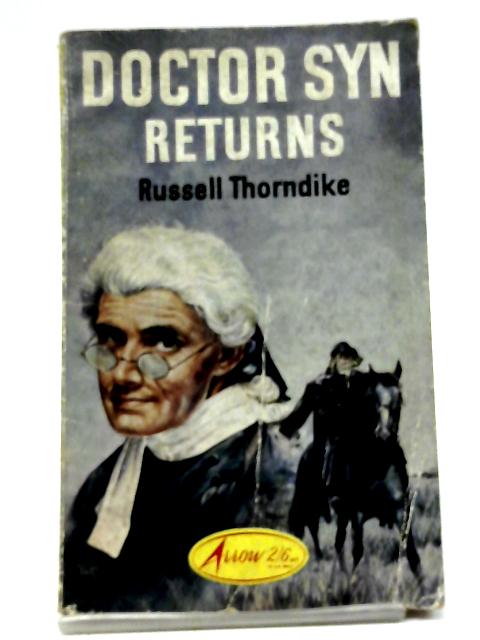
Dr Syn Returns, Published by Arrow Books, 1959


Thirdly, when he plays the villainous Scarecrow, he puts all his powers to it. Even if he is not (always) as such a killer, the use of demonic images and manners is dramatic  - especially coming from a Priest! The elderly woman who keeps a hidden stable for his great black horse, Gehenna, frankly believes him to be the Devil. Now, she was subject to delusions about being a witch before this, so our protagonist is trading on an old woman's madness for his convenience. It's an unsettling scene - the urbane Dr Syn actually saying 'Yes, I'm the Devil' and hamming it up properly. Whatever Batman's vampire-esque affect, it never quite reaches that extent. 

All this makes Dr Syn a troubling character - more so, I think than his counterparts detailed above. The tone of Thorndike's stories varies: sometimes it is all pure pluck and valour and not a corpse in sight. But all the same, the eerie quality of the Scarecrow and the darkness of the marshes persists.

I haven't been too keen on seeking out adaptations, though Dr Syn has been put to film a few times. A television series was made by Disney, starring Patrick McGoohan (of The Prisoner fame) and filmed in Romney; from what I've seen of it this isn't quite dark enough for my tastes (possibly a quality of the technology of the time) and makes Syn into slightly too heroic a figure - with occasional references to George III's tyranny for the American audience. There's a little too much of the Western in it for my liking. Hammer Horror also did a somewhat reworked version with Peter Cushing as 'Parson Blyss'. To my mind though, the adaptation most worth looking for is the one narrated by Rufus Sewell for BBC Radio. The pictures are better.