Some of you may recall that I suggested the Faun or Satyr (I use the term 'Caprine' may be used for the category of both) as a replacement in fantasy RPGs for Gnomes, Halflings or anything in that nippy and nimble/semi-magical/fun-loving mould.
An idle thought hit me when running over the Faun concept. What do they wear? Frequently, of course, caprines are portrayed wearing little. But unless you want fauns to magically carry round with them the warm clime of Arcadia, they will probably wear something, sometimes.
Moreover, it is generally recognised by fauns that a) other humanoids generally like certain portions of the body to be covered up and b) it is sometimes worth covering up vulnerable portions of the body (IE, when cooking, working in the forge or in melee combat).
Having goat legs, however, is good in that it is sufficient to keep off the worst of the weather - but fauns enjoy being relatively unhindered leg-wise: free to dance or leap or climb. This is not generally objected to in humanoid society; if you want caprines doing caprine things and doing them well, don't hamper them. Trousers and britches are out; skirts and kilts are a little too constrictive still. Yes, caprines can wear them and work in them - but this makes them look too similar to humans: disagreeable as one working at worldbuilding - or as a faun who is not shy about being a faun.
Therefore: the underlayer of caprine costume is something we may refer to as a 'modesty tabard'. It reaches to mid-thigh or lower, bears a certain resemblance to a white shirt and covers up what needs to be covered. (Speculate on any garments underneath at leisure - and elsewhere).
The upper torso can then be dressed much as a human upper torso [Probably a most sinister sentence in isolation]. However, a few further things to note.
Firstly, the modesty tabard can be further concealed or decorated by an ornamental apron. That is, further deflecting away attention from the tabard and transforming the utilitarian garment. Naturally, a satyr cook will wear a plain apron; goat legs do no resist hot soup.
Secondly, the garments on the upper torso are generally cut quite short, so they do not impede the legs. For example, a faun is more likely to wear a waist-length poncho than a slicker to keep off the rain. A faun is more likely to wear a tight pea-jacket than a long overcoat.
A caprine will not, under most circumstances, wear shoes. However, if attending a formal event or in a finely decorated house with expensive carpets, a caprine may wear galoshes to keep the mud and dirt of the street from their hooves. These are removed on entrance to the house.
Headgear presents a difficulty: caprines have horned heads. Horns that can vary in size, shape or position. A hat proper must be made to measure, bespoke; to best accommodate brim, dome - and horns. Thus it is more likely to see low-income fauns - or satyrs in some job where the hat might be lost or muddied - wearing turbans, shawls or other forms of more flexible headgear.
ARMS AND THE FAUN
Naturally, caprines must sometimes wear armour. By their nature, they are more likely to serve as light infantry or scouts than as heavy infantry.
(Caprines can ride horses. However, they must ride them side-saddle. Satyr cavalry is therefore either chariot based or mounted infantry in the dragoon fashion.)
Caprine armour might extend down the flanks - pteruges are not uncommon; greaves might be worn. But the faun must be able to move rapidly. Particularly heavy or cumbersome plate armour is largely unknown among caprines, even on the torso.
Helmets pose a similar difficulty to hats; a conscript satyr is more likely to be issued a series of metal bands that cross the head, leaving the horns poking through - rather like the leather-bound steel caps of the Early Middle Ages, but with strategic gaps. Helmet making among caprines is a rather specialist enterprise. The skilled helmet maker must accommodate the horns without making them into awkward prongs that direct a blow toward the skull. This can produce some extraordinary creations.
***
I believe this covers the basics of caprine costuming - largely on the logistical or mechanical side of things than this season's styles. If anything further crops up, I shall let you know.
Saturday, 17 February 2018
Thursday, 15 February 2018
Romanesque Fantasy
SO: I imagine readers of this blog have a notion of Gothic fiction and Gothic-themed fantasy. Regardless of any connection of this to Gothic fiction...
...Gothic architecture....
....or the fiction or the architecture of the Goths.
Let us say that it is characterised by (among other things) darkness, some level of decadence, a static culture or scenario in which the characters of the story find themselves, some air of the macabre and the potential for wonder and terror. (Maybe you think this is to over-egg the pudding; perhaps you feel it doesn't go far enough. If you have feel either way, you hopefully have a sufficient notion of the Gothic with which to proceed.)
Gothic architecture (and/or the revival thereof) played some role in conjuring this all up. Gothic architecture does not just mean 'Medieval'; it responds to a particular type and time. Maybe not a type and time as neatly defined as the reign of a King, but a type and time nonetheless.
What if one goes to the predecessor of Gothic architecture, the Romanesque? If you are not familiar with it, take yourself over to Wikipedia. Examples may appear throughout this post.
Romanesque fantasy is not about decadence, nor is it static. It is robust and growing, rather than hesitant and newborn. There is expansion.
Romanesque fantasy might be among or inspired by the ruins of the past, but it transcends them. It is not bound by them, nor is it devoted to them.
The cultural, political or other vital institutions of the state in Romanesque fantasy are vital. They might be top-heavy, but they are not moribund. Their scope is broad, but not utterly permeable. New ideas are able to emerge, but not without a struggle - and not where they might threaten what has been won.
Crusades might occur; Inquisitions would not.
Romanesque fantasy is robust, rather than delicate. It is not perfectly agreeable to the human. However, it is not bewildering in scope, nor narrow in body.
The Romanesque hero is somewhat like Charlemagne: a conquerer and a builder. If the Romanesque hero is on the back foot, or lesser in scope, he might be like Alfred the Great.
Conan the Barbarian is too primeval to be a Romanesque protagonist; Elric of Melnibone is too decadent. King Arthur is doomed to fail. Sir Galahad has his eyes set rather higher than heroism. Achilles is too much the fighter. John Carter is unmoored from his time and place. D'Artagnan is too much the rogue. If Prince Caspian is too rooted in Civil War in the book of the same name, he might be somewhat Romanesque in the Voyage of the Dawn Treader. Aragorn is not of Gondor in quite the way a Romanesque hero might be.
Speaking of Gondor, there is something definitely Romanesque about Minas Tirith - or might be in some tales from Middle-Earth. Note that Gondor's armies are varied, coming from a wide range of provinces and cultures (even forgetting allies such as Rohan) [See the arrival of the Captains of the Outlands, Dol Amroth, &c.]. It might be argued that Gondor's ruins define it too heavily, but a Romanesque fantasy is not devoid of ruin (why else reference Rome?). However, ruin must not master that world, though it might harry it.
Peter Jackson's motion picture adaptation of Lord of the Rings certainly used something like Byzantine or Romanesque architecture.
The Romanesque hero cannot just be a warrior. He is a King or Lord, which may well have a martial aspect.
In Romanesque fantasy, there is work to be done, relatively nearby. Within your own continent, there are dangerous frontiers; pagan barbarians, unsettled land, threatened neighbours; something of that sort.
Exhaustion or deprivation in Romanesque fantasy is more likely to be as the result of being at the end of a supply line, or having struggled for a great cause.
The Romanesque might be bounded on one side with the Dark Ages and on the other with the Twelfth Century Renaissance.
Questions the Reader may ask: Is this really a relevant genre or just a silly intellectual game? Is it worth considering? Could it become something? Would you like to know more? Comment away.
 |
| Many images courtesy of Wikipedia. |
...Gothic architecture....
 |
| Reims Cathedral |
....or the fiction or the architecture of the Goths.
 |
| The Mausoleum of Theoderic in Ravenna |
Let us say that it is characterised by (among other things) darkness, some level of decadence, a static culture or scenario in which the characters of the story find themselves, some air of the macabre and the potential for wonder and terror. (Maybe you think this is to over-egg the pudding; perhaps you feel it doesn't go far enough. If you have feel either way, you hopefully have a sufficient notion of the Gothic with which to proceed.)
Gothic architecture (and/or the revival thereof) played some role in conjuring this all up. Gothic architecture does not just mean 'Medieval'; it responds to a particular type and time. Maybe not a type and time as neatly defined as the reign of a King, but a type and time nonetheless.
What if one goes to the predecessor of Gothic architecture, the Romanesque? If you are not familiar with it, take yourself over to Wikipedia. Examples may appear throughout this post.
 |
| Maria Lach Abbey |
Romanesque fantasy is not about decadence, nor is it static. It is robust and growing, rather than hesitant and newborn. There is expansion.
Romanesque fantasy might be among or inspired by the ruins of the past, but it transcends them. It is not bound by them, nor is it devoted to them.
The cultural, political or other vital institutions of the state in Romanesque fantasy are vital. They might be top-heavy, but they are not moribund. Their scope is broad, but not utterly permeable. New ideas are able to emerge, but not without a struggle - and not where they might threaten what has been won.
Crusades might occur; Inquisitions would not.
Romanesque fantasy is robust, rather than delicate. It is not perfectly agreeable to the human. However, it is not bewildering in scope, nor narrow in body.
The Romanesque hero is somewhat like Charlemagne: a conquerer and a builder. If the Romanesque hero is on the back foot, or lesser in scope, he might be like Alfred the Great.
 |
| The Palatine Chapel of Charlemagne's Palace in Aachen |
Conan the Barbarian is too primeval to be a Romanesque protagonist; Elric of Melnibone is too decadent. King Arthur is doomed to fail. Sir Galahad has his eyes set rather higher than heroism. Achilles is too much the fighter. John Carter is unmoored from his time and place. D'Artagnan is too much the rogue. If Prince Caspian is too rooted in Civil War in the book of the same name, he might be somewhat Romanesque in the Voyage of the Dawn Treader. Aragorn is not of Gondor in quite the way a Romanesque hero might be.
Speaking of Gondor, there is something definitely Romanesque about Minas Tirith - or might be in some tales from Middle-Earth. Note that Gondor's armies are varied, coming from a wide range of provinces and cultures (even forgetting allies such as Rohan) [See the arrival of the Captains of the Outlands, Dol Amroth, &c.]. It might be argued that Gondor's ruins define it too heavily, but a Romanesque fantasy is not devoid of ruin (why else reference Rome?). However, ruin must not master that world, though it might harry it.
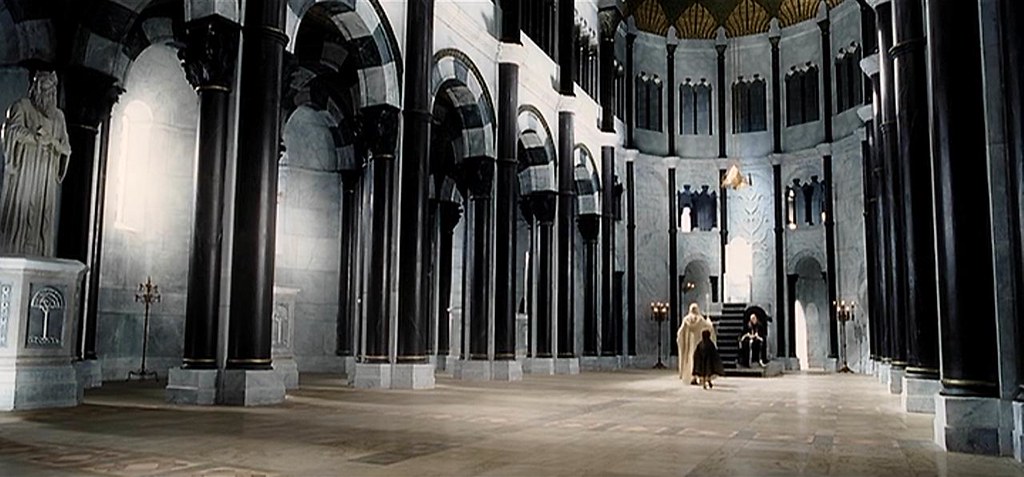 |
| From Peter Jackson's motion picture adaptation of The Return of the King. Interiors.... |
 |
| ...and exteriors. Gothic it isn't. While searching for those, I found this relevant site. Consume at your leisure. |
The Romanesque hero cannot just be a warrior. He is a King or Lord, which may well have a martial aspect.
In Romanesque fantasy, there is work to be done, relatively nearby. Within your own continent, there are dangerous frontiers; pagan barbarians, unsettled land, threatened neighbours; something of that sort.
 |
| Trier Cathedral |
Exhaustion or deprivation in Romanesque fantasy is more likely to be as the result of being at the end of a supply line, or having struggled for a great cause.
The Romanesque might be bounded on one side with the Dark Ages and on the other with the Twelfth Century Renaissance.
Questions the Reader may ask: Is this really a relevant genre or just a silly intellectual game? Is it worth considering? Could it become something? Would you like to know more? Comment away.
Friday, 9 February 2018
David Eddings: A Useful Source
On the basis that somebody has to do it, here it is. How one may apply bits of David Eddings to fantasy RPGs in interesting ways. The impetus to do so come from this article. (Really, do read this first, comments and all).
I am going to work on the Belgariad and the Mallorean, to limit the scope of things somewhat.
Is this meant to make you run out and read these books? By no means. But if it is part of the canon of fantasy literature, why not mine from this seam for one's RPGs?
0) The Rivan Codex
Why is the Zeroth point? Because it's cheating, if you will.
The Rivan Codex, in this context, is the name of a book of David Eddings's notes, world building, in-universe literature for the Belgariad and Mallorean - and his advice to authors. If you've ever thought Eddings was formulaic, this is where you find his formula (quite literally).
Either way, this is a source for world-building. Currency, dress, manners, forms of address can all be found here (whether or not they made their way to the books). In-universe religious scriptures are also available. If you needed to bring into being a society in-universe rapidly, this would be a decent crib with which to do so.
It was available as a paperback in Britain about a decade ago, so I shouldn't imagine it will be too difficult to find if you want it.
1) The alignment of deities to Peoples
The deities of the Belgariad and Mallorean are all aligned to a given nation. Fantasy RPGs all seem to rather opt for a form of monotheism on a somewhat Abrahamic model or something Hellenic - or some combination thereof. Either way, worship is available to all rather than having some measure of exclusion or cultural boundary about it. Perhaps so that the Half-Orc Chaotic Good Cleric of Kypris can be on speaking terms with the Drow Neutral Evil Cleric of Scylla.
However, this alignment offers a certain chthonic or archaic flavour of theology to proceedings. It tones down the interlinked world of trade and metropolises in favour of isolation, distance and pockets of unthought strangeness.
2) Caste and divisions of Peoples
Of these nations, affiliated to deities or otherwise, a number are divided up from a common origin. Several on the side of good derive from the sons of a hero-patriarch ancestor. Those on the side of evil, from the denizens of a city, exiled by their mad god.
National characteristics or castes aren't necessarily an obsession of the books in question, but they appear nonetheless. It could offer a certain historical-cultural depth or sense of time to a setting to have inhabitants have this to refer back to - and it isn't quite something I've seen elsewhere.
3) Merchants and Drasnia
Merchants keep playing a part in these tales; I won't say they are central, but Eddings tried in the time in which he was writing to play up the roles of a trade that he thought hadn't been displayed by the genre at that point. Perhaps things have changed. However, this still applies to the world you may be building - is it just made up of wizards and warriors? If so, is there a good reason?
Eddings's resident mercantile nation is thankfully not terribly reminiscent of Venice. Indeed, it is barely even sea-faring. Drasnia is northerly, cold and largely land-locked. It is famed for heavy infantry in battle. Early notes portray it as herding reindeer. A semi-Russian flavour hangs over elements of it, though not to the point of samovars, Soviets or tsars. The merchants of Drasnia all tie into the foreign intelligence departments of this kingdom, which seems a little heavy handed but can perhaps be forgiven. It is the easterly trade routes that sustain these merchants.
Drasnia seems like it should be quietly hooked onto other worlds as a form of contrast. I would characterise it as having a sort of quiet dynamism that contrasts with some rather manic depictions of mercantile bustle. Perhaps this appeals.
4) Demon-worshipping Tribes
There is an episode towards the end of the Belgariad in which our hero and two others must separate from the larger forces of justice and make their way across a dozen tundra. The tundra is inhabited by those tribes of races that were not adopted by any given deity. They have instead turned to summoning demons as protectors and totems of their particular tribe.
This calls out for a hexcrawl. A slow progress over difficult terrain, with hostile forces wielding unstable magics. The frozen ground dotted by totems and anti-demonic markings or trail signs. In the Belgariad, our heroes must rely on guile, despite their power. Perhaps this is an interesting mechanical usage: you might be level ten, but for the time being it will be most useful if you pretend to be level three. Fancy sword-play or potent magics will clearly demonstrate that you are a person of mickle might, and one to be watched - hence it will blow your cover.
5) Murgo gold
This makes an appearance in the early books of the Belgariad. The red gold of the Murgos (the most warlike of the nations serving the mad god Torak) is known for its quantity and its way of finding itself in hands of the corruptible - from whence it calls to its fellows and kindles greed for more in the heart of its owner.
Murgo gold, or something much like it, seems an excellent concept to employ in fantasy RPGs; a commonplace cursed treasure, detectable only by those in the know. What could be a more fitting thing to come out of a ruined, cursed place? A secondary, murky currency for the underworld or a burden for an adventurer - Murgo gold could be a useful mechanical addition to a game.
***
In closing this little missive, I should like to take a moment to note the quiet interest of dipping into The Rivan Codex and reading a little about Eddings himself. I have kept his books on my shelves, even where others have been removed. Even if this article, that which inspired it, and indeed my own view on his work comes from a place of relative detachment or even antipathy, I would not deny the man's success or that he was possessed of some skill as a teller of tales. David Eddings and his wife and long-time literary collaborator Leigh Eddings seem to have been the sort of All-American talented folk that appear in Neal Stephenson books. Part of me would like to know more about them - and, I suspect, to thank them.
I am going to work on the Belgariad and the Mallorean, to limit the scope of things somewhat.
Is this meant to make you run out and read these books? By no means. But if it is part of the canon of fantasy literature, why not mine from this seam for one's RPGs?
0) The Rivan Codex
Why is the Zeroth point? Because it's cheating, if you will.
The Rivan Codex, in this context, is the name of a book of David Eddings's notes, world building, in-universe literature for the Belgariad and Mallorean - and his advice to authors. If you've ever thought Eddings was formulaic, this is where you find his formula (quite literally).
Either way, this is a source for world-building. Currency, dress, manners, forms of address can all be found here (whether or not they made their way to the books). In-universe religious scriptures are also available. If you needed to bring into being a society in-universe rapidly, this would be a decent crib with which to do so.
It was available as a paperback in Britain about a decade ago, so I shouldn't imagine it will be too difficult to find if you want it.
1) The alignment of deities to Peoples
The deities of the Belgariad and Mallorean are all aligned to a given nation. Fantasy RPGs all seem to rather opt for a form of monotheism on a somewhat Abrahamic model or something Hellenic - or some combination thereof. Either way, worship is available to all rather than having some measure of exclusion or cultural boundary about it. Perhaps so that the Half-Orc Chaotic Good Cleric of Kypris can be on speaking terms with the Drow Neutral Evil Cleric of Scylla.
However, this alignment offers a certain chthonic or archaic flavour of theology to proceedings. It tones down the interlinked world of trade and metropolises in favour of isolation, distance and pockets of unthought strangeness.
2) Caste and divisions of Peoples
Of these nations, affiliated to deities or otherwise, a number are divided up from a common origin. Several on the side of good derive from the sons of a hero-patriarch ancestor. Those on the side of evil, from the denizens of a city, exiled by their mad god.
National characteristics or castes aren't necessarily an obsession of the books in question, but they appear nonetheless. It could offer a certain historical-cultural depth or sense of time to a setting to have inhabitants have this to refer back to - and it isn't quite something I've seen elsewhere.
3) Merchants and Drasnia
Merchants keep playing a part in these tales; I won't say they are central, but Eddings tried in the time in which he was writing to play up the roles of a trade that he thought hadn't been displayed by the genre at that point. Perhaps things have changed. However, this still applies to the world you may be building - is it just made up of wizards and warriors? If so, is there a good reason?
Eddings's resident mercantile nation is thankfully not terribly reminiscent of Venice. Indeed, it is barely even sea-faring. Drasnia is northerly, cold and largely land-locked. It is famed for heavy infantry in battle. Early notes portray it as herding reindeer. A semi-Russian flavour hangs over elements of it, though not to the point of samovars, Soviets or tsars. The merchants of Drasnia all tie into the foreign intelligence departments of this kingdom, which seems a little heavy handed but can perhaps be forgiven. It is the easterly trade routes that sustain these merchants.
Drasnia seems like it should be quietly hooked onto other worlds as a form of contrast. I would characterise it as having a sort of quiet dynamism that contrasts with some rather manic depictions of mercantile bustle. Perhaps this appeals.
4) Demon-worshipping Tribes
There is an episode towards the end of the Belgariad in which our hero and two others must separate from the larger forces of justice and make their way across a dozen tundra. The tundra is inhabited by those tribes of races that were not adopted by any given deity. They have instead turned to summoning demons as protectors and totems of their particular tribe.
This calls out for a hexcrawl. A slow progress over difficult terrain, with hostile forces wielding unstable magics. The frozen ground dotted by totems and anti-demonic markings or trail signs. In the Belgariad, our heroes must rely on guile, despite their power. Perhaps this is an interesting mechanical usage: you might be level ten, but for the time being it will be most useful if you pretend to be level three. Fancy sword-play or potent magics will clearly demonstrate that you are a person of mickle might, and one to be watched - hence it will blow your cover.
5) Murgo gold
This makes an appearance in the early books of the Belgariad. The red gold of the Murgos (the most warlike of the nations serving the mad god Torak) is known for its quantity and its way of finding itself in hands of the corruptible - from whence it calls to its fellows and kindles greed for more in the heart of its owner.
Murgo gold, or something much like it, seems an excellent concept to employ in fantasy RPGs; a commonplace cursed treasure, detectable only by those in the know. What could be a more fitting thing to come out of a ruined, cursed place? A secondary, murky currency for the underworld or a burden for an adventurer - Murgo gold could be a useful mechanical addition to a game.
***
In closing this little missive, I should like to take a moment to note the quiet interest of dipping into The Rivan Codex and reading a little about Eddings himself. I have kept his books on my shelves, even where others have been removed. Even if this article, that which inspired it, and indeed my own view on his work comes from a place of relative detachment or even antipathy, I would not deny the man's success or that he was possessed of some skill as a teller of tales. David Eddings and his wife and long-time literary collaborator Leigh Eddings seem to have been the sort of All-American talented folk that appear in Neal Stephenson books. Part of me would like to know more about them - and, I suspect, to thank them.
Saturday, 3 February 2018
Sphinxes and Sepulchres
A thought: Sphinxes are Mammalian dragons.
Allow me to explain the thought process. Four-legged beast, of vast size. Human or human-like intelligence - hence riddles. Combines aspects of different real animals. A guardian of treasure hordes? Perhaps not as such, but the 'Giza -> Pyramids -> Pharaohs -> Tomb treasures' connection is at this point a difficult track not to go down.
What does this mean? Well, first of all, let us spin this into something larger. Perhaps through a recent few posts at Coins and Scrolls.
Sphinxes come in many forms. The most well-known is a winged lion with a human head - the andro-or gyno-sphinx.

Others are known: ram-headed criosphinxes, falcon-headed hieracosphinxes. Some are merely rumours - jackal sphinxes, scarab-headed sphinxes (as Khepri).
What is the truth of this?
SPHINXES
The human-headed sphinx is the most charming and persuasive of sphinx-kind. It is the most prone to entering into wider society, but does so as a dragon might: with a firm awareness of it's own strength and superior status. It is also the most persuasive of sphinxes - at least to most humanoids. They glow, even in their human parts. They have largely given up the riddle game; it is considered either gauche or deeply dangerous to inquire about it.
Disposition: aristocratic, aloof, persuasive, charismatic.
Common hoards: coins, books of law, deeds and contracts, ledgers.
Breath/Bestowal: Clouds/Acquiescence
[In that the sphinx is not usually depicted as breathing fire, and in that I wanted to keep up the dragon angle, there is an 'and/or' selection - a physical effect, like fire, or something more abstract. The sphinx 'bestows an air of ____' and can direct this somehow, for use to their advantage. Pick and choose your poison.]
The criosphinx is often given over to religious impulses. It has the time and nous to embark on theological journeys mankind never could. A meditating criosphinx is deeply impressive; the horns and the fleece carry a rather priest-like air. This can, of course, go very badly wrong depending on what they worship.
Disposition: thoughtful, thorough, very still, fervent, given to pontificating.
Common hoards: relics, religious texts, prophets, religious art, iconoclasts (to destroy the wrong kind of art..)
Breath/Bestowal: ball lightening/universal semi-mystical perspective (you may not as such see anything that you didn't see before, but you are aware of the music of the spheres or what have you and the movement of the earth).
[If you wish, goat-headed sphinxes could appear. These are the same as criosphinxes, but somewhat more sinister.]
A hieracosphinx is ultimately a physcial, warlike beast. The strength of it's own will and limbs satisfy it above other things. They can be persuaded into battle - but that have never been called great strategists.
Disposition: clipped speech, laconic, scornful, restless, sardonic
Common hoards: trophies, flags, weapons, sporting goods; gladiators and athletes to demonstrate the latter.
Breath/Bestowal: Whirlwinds/Vertigo
One may encounter a jackal-headed sphinx. They lack the charm of some of their compatriots; less focused, less serene. They are not, as such, scavengers or parasites - but they do recognise that humanity (and the short-lived races as a whole) throw away a lot of stuff, which they can make use of- and are fascinated by. Although they are still relatively discerning, rather than accumulating piles of potshards. If you will, they do not live up to their fullest sphinx potential. Inveterate takers of shortcuts and hirers of mercenaries. Not, that is, that they cannot fight. A jackal sphinx is still a sphinx.
Disposition: indulgent, chatty, crafty, gregarious, opportunistic, relatively generous - they'll get it all back in good time.
Common hoards: bones, reliquaries, funerary gear, 'unconsidered trifles', exiles, beggars, outlaws
Breath/Bestowal: Sandstorms/Awareness of mortality
The scarab-headed sphinx has a relation for being largely incomprehensible and entirely aware of this. Do not compare this to riddles; there is no perfect solution. Nor are they, as we might think of it, tricksters - who often seem to have a goal, generally at your expense. The scarab-headed sphinx does not seek to set traps for you - despising as they do such an artificial form of mystery - but will rarely explain anything in a useful manner. Instead of just mentioning something you don't quite understand, they might somehow enable a connection between people that don't understand one another, or possess bewildering devices you can access freely. They are, quite simply, fascinated by that which people cannot understand - often including themselves. You might think of them as anthropologists or connoisseurs of bafflement.
This has led to them being touted as the ultimate in exotic experiences - but pleasure seekers are disappointed. A scarab-headed sphinx is far more likely to serve a very ordinary meal according to entirely unfamiliar social rules than it is to serve up a dish made with spices and viands from far-off lands. If you can bring them something that they struggle to entirely comprehend (with all their years of experience), they are likely to be thankful and not introduce you to alien folk who think that you have insulted them in some way very difficult to explain.
Disposition: scrupulously neutral, polite, inquisitive if directly engaged.
Common hoards: mediative images, multi-layered religious or philosophical allegories, strange tales of other lands (and recorders of the same), things out of place - either spatially, temporally or dimensionally.
Breath/Bestowal: Locusts/Hunger
An ox-headed sphinx (taurosphinx? bovosphinx?) is basically really quite pleasant and social. It may not be entirely convenient to have a sphinx in town, but you'll adjust. It will help you. You and your descendants will rely on its help. It likes plenty, prosperity, people raising families. Naturally, it hates adventurers. The more flexible will allow them some sort of deputy status with the local Watch or Guard or what-have-you. If you are down on your luck and after a home, that's fine. But your sword gets beaten into a plowshare or hang up above the mantle; you throw away the eldritch tomes. They may not be tyrants, but they have little time for the libertine. It is worth noting that they do not always choose human communities to make their homes in.
Disposition: friendly, like a schoolteacher; benevolent, well mannered (if they are coarse, it will be like a friendly innkeeper, not a sordid thug).
Common hoards: wealth - but productive or functional wealth - granaries, long standing tenant farmers, tools. You can imagine them keeping coins to invest or use after a fashion - whilst hating venture capitalists. Folk to operate all of the above; agriculturalists, industrialists or urban planners.
Breath/Bestowal: Milk and Honey/Herd instinct.
THOSE WHO FOLLOW SPHINXES
[or, The Sphinx-Spawned.]
Operating on this model, also linked above, we might ask what do the servants of sphinxes are like - whilst still working on the 'mammalian dragon' notion.
The kobold equivalent become servile, if semi-independant. I suggest that heightening the canine characteristics of kobolds is the way to go about this. From this, a hierarchy of dog-kobolds asserts itself; curs, hounds, and other such titles. Likewise, kobolds gain specialities (kobold retriever, seeing-eye kobold, Portuguese water kobold, St Bernards kobold). At one end of the implications of this, we see sphinxes breeding their own guard dogs - and the sphinx equivalent of Crufts and the Kennel Club.
A parallel to the Dragonborn is perhaps a humanoid with wider mammalian or avian features: a change of limbs, a different head, claws or talons. A resemblance to the Ancient Egyptian pantheon seems about correct - though put through a relatively martial wringer; as in something like Age of Mythology. Not being a deity herself, this hypothetical ibis-headed lady does in fact require armour, however tough the gifts of the sphinx may have made her.
As to the Servants or Sycophants of sphinxes, I can say little. They are as liable to be varied as sphinxes themselves. They are perhaps less liable to be outright power-worshippers than the servants of dragons. If we wanted to continue the Pharaonic pastiche, it is not at all unsurprising that they might preserve their bodies for use after death, much as mummies, knowing that their spirits might linger or be called back to continue their duties. The Dragonborn equivalents above might become part of this, death transforming them from warriors to courtiers. Mummification might especially be prevalent among the jackal-headed sphinxes - some of who probably possess armies that could give the Tomb Kings a run for their money.
SO WHAT ABOUT THESE SEPULCHRES?
[Or, The Dreadful Conclusion]
Partway through this, something occurred to me.
Dungeons and Dragons - or at any rate, a certain stereotype thereof - involves humanoid mammalian races going underground into sprawling dungeon complexes to fight with reptilian races and face off against an uber-reptile in the form of a dragon.
Lizardmen, goblins, kobolds, gorgons, wyverns, yuan-ti - all waiting for you in the labyrinth du jour. (Orcs, partaking of the natures of pig and lizard are anathema to both mammals and reptiles). The insidious elder race snakemen share in this especially.
Therefore, let the entire thing be inverted. Instead of fantasy Medieval Europe, full of humanoid races, the setting is in the tropics - which might be yet more Ancient Egypt, but let us not get tied to that concept more than we already have. This is inhabited by reptilian humanoids: the common lizard-folk, the snake men settling into the Elven elder-race nook, squat armoured crocodile people instead of Dwarves, sneaky chameleon-men instead of gnomes - and anything from this list if you want to get even stranger.
Adventurers from these kindreds - who are noble, virtuous, benign souls, or at least to the same extent as any player race in D&D - are assailed by creatures from the caves, that cannot stand the heat of the day and must lurk in the cold and damp. The most insidious even build lairs in the sewers and necropolises of the great cities. The brave and the foolhardy go down into the depths to drive out and confront these wretches, for money, glory or experience.
In the deepest and darkest of sepulchres, they may even encounter the dreadful sphinxes; cunning amalgams of beast and man, possessed of speech and silver tongues, of prodigious size and strength....
[This has become dreadfully silly. My apologies to anyone I've referenced!]
Allow me to explain the thought process. Four-legged beast, of vast size. Human or human-like intelligence - hence riddles. Combines aspects of different real animals. A guardian of treasure hordes? Perhaps not as such, but the 'Giza -> Pyramids -> Pharaohs -> Tomb treasures' connection is at this point a difficult track not to go down.
What does this mean? Well, first of all, let us spin this into something larger. Perhaps through a recent few posts at Coins and Scrolls.
Sphinxes come in many forms. The most well-known is a winged lion with a human head - the andro-or gyno-sphinx.
Others are known: ram-headed criosphinxes, falcon-headed hieracosphinxes. Some are merely rumours - jackal sphinxes, scarab-headed sphinxes (as Khepri).
What is the truth of this?
SPHINXES
The human-headed sphinx is the most charming and persuasive of sphinx-kind. It is the most prone to entering into wider society, but does so as a dragon might: with a firm awareness of it's own strength and superior status. It is also the most persuasive of sphinxes - at least to most humanoids. They glow, even in their human parts. They have largely given up the riddle game; it is considered either gauche or deeply dangerous to inquire about it.
Disposition: aristocratic, aloof, persuasive, charismatic.
Common hoards: coins, books of law, deeds and contracts, ledgers.
Breath/Bestowal: Clouds/Acquiescence
[In that the sphinx is not usually depicted as breathing fire, and in that I wanted to keep up the dragon angle, there is an 'and/or' selection - a physical effect, like fire, or something more abstract. The sphinx 'bestows an air of ____' and can direct this somehow, for use to their advantage. Pick and choose your poison.]
The criosphinx is often given over to religious impulses. It has the time and nous to embark on theological journeys mankind never could. A meditating criosphinx is deeply impressive; the horns and the fleece carry a rather priest-like air. This can, of course, go very badly wrong depending on what they worship.
Disposition: thoughtful, thorough, very still, fervent, given to pontificating.
Common hoards: relics, religious texts, prophets, religious art, iconoclasts (to destroy the wrong kind of art..)
Breath/Bestowal: ball lightening/universal semi-mystical perspective (you may not as such see anything that you didn't see before, but you are aware of the music of the spheres or what have you and the movement of the earth).
[If you wish, goat-headed sphinxes could appear. These are the same as criosphinxes, but somewhat more sinister.]
A hieracosphinx is ultimately a physcial, warlike beast. The strength of it's own will and limbs satisfy it above other things. They can be persuaded into battle - but that have never been called great strategists.
Disposition: clipped speech, laconic, scornful, restless, sardonic
Common hoards: trophies, flags, weapons, sporting goods; gladiators and athletes to demonstrate the latter.
Breath/Bestowal: Whirlwinds/Vertigo
One may encounter a jackal-headed sphinx. They lack the charm of some of their compatriots; less focused, less serene. They are not, as such, scavengers or parasites - but they do recognise that humanity (and the short-lived races as a whole) throw away a lot of stuff, which they can make use of- and are fascinated by. Although they are still relatively discerning, rather than accumulating piles of potshards. If you will, they do not live up to their fullest sphinx potential. Inveterate takers of shortcuts and hirers of mercenaries. Not, that is, that they cannot fight. A jackal sphinx is still a sphinx.
Disposition: indulgent, chatty, crafty, gregarious, opportunistic, relatively generous - they'll get it all back in good time.
Common hoards: bones, reliquaries, funerary gear, 'unconsidered trifles', exiles, beggars, outlaws
Breath/Bestowal: Sandstorms/Awareness of mortality
The scarab-headed sphinx has a relation for being largely incomprehensible and entirely aware of this. Do not compare this to riddles; there is no perfect solution. Nor are they, as we might think of it, tricksters - who often seem to have a goal, generally at your expense. The scarab-headed sphinx does not seek to set traps for you - despising as they do such an artificial form of mystery - but will rarely explain anything in a useful manner. Instead of just mentioning something you don't quite understand, they might somehow enable a connection between people that don't understand one another, or possess bewildering devices you can access freely. They are, quite simply, fascinated by that which people cannot understand - often including themselves. You might think of them as anthropologists or connoisseurs of bafflement.
This has led to them being touted as the ultimate in exotic experiences - but pleasure seekers are disappointed. A scarab-headed sphinx is far more likely to serve a very ordinary meal according to entirely unfamiliar social rules than it is to serve up a dish made with spices and viands from far-off lands. If you can bring them something that they struggle to entirely comprehend (with all their years of experience), they are likely to be thankful and not introduce you to alien folk who think that you have insulted them in some way very difficult to explain.
Disposition: scrupulously neutral, polite, inquisitive if directly engaged.
Common hoards: mediative images, multi-layered religious or philosophical allegories, strange tales of other lands (and recorders of the same), things out of place - either spatially, temporally or dimensionally.
Breath/Bestowal: Locusts/Hunger
An ox-headed sphinx (taurosphinx? bovosphinx?) is basically really quite pleasant and social. It may not be entirely convenient to have a sphinx in town, but you'll adjust. It will help you. You and your descendants will rely on its help. It likes plenty, prosperity, people raising families. Naturally, it hates adventurers. The more flexible will allow them some sort of deputy status with the local Watch or Guard or what-have-you. If you are down on your luck and after a home, that's fine. But your sword gets beaten into a plowshare or hang up above the mantle; you throw away the eldritch tomes. They may not be tyrants, but they have little time for the libertine. It is worth noting that they do not always choose human communities to make their homes in.
Disposition: friendly, like a schoolteacher; benevolent, well mannered (if they are coarse, it will be like a friendly innkeeper, not a sordid thug).
Common hoards: wealth - but productive or functional wealth - granaries, long standing tenant farmers, tools. You can imagine them keeping coins to invest or use after a fashion - whilst hating venture capitalists. Folk to operate all of the above; agriculturalists, industrialists or urban planners.
Breath/Bestowal: Milk and Honey/Herd instinct.
THOSE WHO FOLLOW SPHINXES
[or, The Sphinx-Spawned.]
Operating on this model, also linked above, we might ask what do the servants of sphinxes are like - whilst still working on the 'mammalian dragon' notion.
The kobold equivalent become servile, if semi-independant. I suggest that heightening the canine characteristics of kobolds is the way to go about this. From this, a hierarchy of dog-kobolds asserts itself; curs, hounds, and other such titles. Likewise, kobolds gain specialities (kobold retriever, seeing-eye kobold, Portuguese water kobold, St Bernards kobold). At one end of the implications of this, we see sphinxes breeding their own guard dogs - and the sphinx equivalent of Crufts and the Kennel Club.
A parallel to the Dragonborn is perhaps a humanoid with wider mammalian or avian features: a change of limbs, a different head, claws or talons. A resemblance to the Ancient Egyptian pantheon seems about correct - though put through a relatively martial wringer; as in something like Age of Mythology. Not being a deity herself, this hypothetical ibis-headed lady does in fact require armour, however tough the gifts of the sphinx may have made her.
As to the Servants or Sycophants of sphinxes, I can say little. They are as liable to be varied as sphinxes themselves. They are perhaps less liable to be outright power-worshippers than the servants of dragons. If we wanted to continue the Pharaonic pastiche, it is not at all unsurprising that they might preserve their bodies for use after death, much as mummies, knowing that their spirits might linger or be called back to continue their duties. The Dragonborn equivalents above might become part of this, death transforming them from warriors to courtiers. Mummification might especially be prevalent among the jackal-headed sphinxes - some of who probably possess armies that could give the Tomb Kings a run for their money.
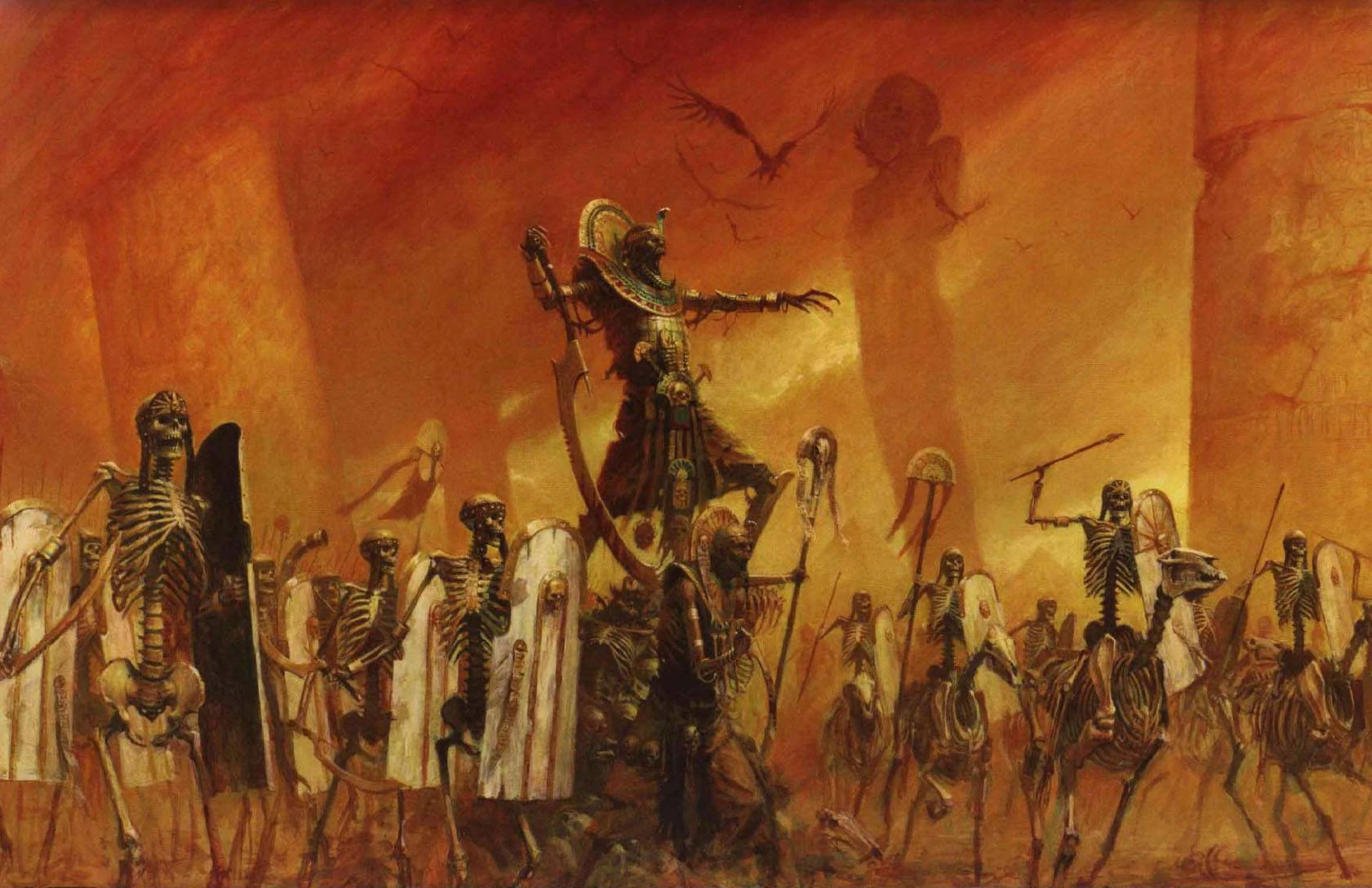 |
| Behind them, off to the left somewhere, is a jackal-headed sphinx saying "Go to 'em, lads!" - or words to that effect. |
SO WHAT ABOUT THESE SEPULCHRES?
[Or, The Dreadful Conclusion]
Partway through this, something occurred to me.
Dungeons and Dragons - or at any rate, a certain stereotype thereof - involves humanoid mammalian races going underground into sprawling dungeon complexes to fight with reptilian races and face off against an uber-reptile in the form of a dragon.
Lizardmen, goblins, kobolds, gorgons, wyverns, yuan-ti - all waiting for you in the labyrinth du jour. (Orcs, partaking of the natures of pig and lizard are anathema to both mammals and reptiles). The insidious elder race snakemen share in this especially.
Therefore, let the entire thing be inverted. Instead of fantasy Medieval Europe, full of humanoid races, the setting is in the tropics - which might be yet more Ancient Egypt, but let us not get tied to that concept more than we already have. This is inhabited by reptilian humanoids: the common lizard-folk, the snake men settling into the Elven elder-race nook, squat armoured crocodile people instead of Dwarves, sneaky chameleon-men instead of gnomes - and anything from this list if you want to get even stranger.
Adventurers from these kindreds - who are noble, virtuous, benign souls, or at least to the same extent as any player race in D&D - are assailed by creatures from the caves, that cannot stand the heat of the day and must lurk in the cold and damp. The most insidious even build lairs in the sewers and necropolises of the great cities. The brave and the foolhardy go down into the depths to drive out and confront these wretches, for money, glory or experience.
In the deepest and darkest of sepulchres, they may even encounter the dreadful sphinxes; cunning amalgams of beast and man, possessed of speech and silver tongues, of prodigious size and strength....
[This has become dreadfully silly. My apologies to anyone I've referenced!]
Thursday, 25 January 2018
The Saga of Recluce: A Few Remarks
I referenced L. E. Modesitt Jr.'s Saga of Recluce in a post a few weeks ago. Thought I'd say a little about this - the 'schedule' is overdue for something airy.
What is it? A series of fantasy books, set in the same world. The plots generally operate along the same formula, involving a young man, with magical abilities, cast away from his home, making a life for himself, falling in love, rising against an enemy, coming into his own. They've been pithily called fantastical Horatio Alger novels. That's perhaps not quite fair, but they 'making a life for one's self' segment always seems quite detailed. The magicians of the tale nearly all possess some skill or handicraft that supports them when they aren't doing magic (no Hogwarts for these folk - mostly). It's quite prominent, really - and I should argue that it is part of the charm. (A bit like literary third-person Minecraft - a similar set of joys, I mean to say.)
The setting is a world of several continents; Recluce is a large island of one such continent. Some people of this world can manipulate the powers of Order and Chaos - at some cost to themselves. The two powers clash not infrequently - Recluce is dominated by Order-Mages. This leads to a society that does not accept much in the way of disruption, and so those that cannot accept their place go out into a wider society, with all the powers of chaos potentially arrayed against you - especially if you are a nascent Order-Mage. An orderly society seems almost stiflingly wholesome and virtuous (order mages experience pain when telling lies), rather than dictatorial, feeding into that Horatio Alger current again. Look it up on Wikipedia or other suitable sources for something more in depth.
It's all fine enough stuff. The world is well-observed (though one gets tired of the observation that the chops in a rural tavern, the 'luxury item on the menu', have been reheated several times and probably aren't that much good). Technology levels increase as the series goes on, to the point of black powder and steam engines intruding onto a previously somewhat-Medieval world.
But throughout the series, especially in the Order-based societies, women have a roughly equal standing (deliberately contrasted with Chaos-based) to men - in terms of dress, social role and so forth. Not that one gets many female protagonists - the whole series has a fairly masculine tone, I might assert - war, social success, hard work and craftsmanship all have a place.
[Yes, those aren't perhaps inherently masculine. But they have that link.]
Not only this, but there's an emphasis on washing ones' hands, on relatively polite discourse, on thrift and prudence that turn the mind more to a 19th Century American West rural community - baked and worked goods, respectful and mannered discourse, a somewhat sceptical outlook on the world (religion does exist, but rarely intrudes into the life of the protagonists - though semi-religious cultural influences have part to play).
Is this another example of an off-the-shelf fantasy world (complete with well-thought out system of magic?). Well, it's pretty close, I suppose. Not that that's always bad. But there's a few things that crop up that change that in my mind. Which probably constitute Spoilers of some kind. See after the picture break.
So, as of the sixth book (said books rarely follow on directly from one another), we get confirmation of what had been hinted at previously. The Order and Chaos users of the world of Recluce are crashed astronauts, hurled from crashed spaceships across time and space - and perhaps dimensions. In the sixth, Fall of Angels, we get a Robinson Crusoe-esque survival story, about building a new state among hostile pseudo-medieval kingdoms with a starship crew of - mostly - 22nd Century women. Part of the joy of this is the craftsmanship-pioneer-building stuff elements, but a new element trumps it.
This element I take to be (roughly) the problem of maintaining a (for want of a better term) modern, liberal world view or values when the technological levels and cultural capital doesn't quite support this.
What do we get? Semi-military dictators, the foundation of female-dominated cultures as a counterweight to the rest of the world (Westwind men don't bear arms and are generally expected to sit there and be beautiful), the foundation of religions on manipulative grounds, breeding programmes for mages able to replicate some facets of lost technology. This isn't quite the half of it, in some ways.
This works into and contrasts the general third-act experience of the earlier, formulaic, books: the protagonist makes a home for themselves and their loved ones - but are forced by circumstances into action. Seeing as our protagonists are generally mages, said action is frequently full of mass slaughter, horrifying even to veteran soldiers. The efficiency of magical warfare versus drawn-out wars of attrition is frequently addressed; short term horror versus long-term evil. Rarely do our protagonists escape unscathed; rarely are they regarded as spotless paragons by their societies - gaining status by the raw fact of power rather than the acclaim of their peers. It's not altogether bleak - peace and all its attendant gifts can be attained. But it is not easy.
Having a formula means it can be changed up - that's half the fun of it. We get to see fully fledged military stories, life as a Chaos wizard (hitherto frequently straight villains), life on continents outside Recluce and Candar - and in the first ancient astronaut civilisation, Cyador, that maintained future-tech levels for a few generations. It takes a solid pseudo-fantasy base and works it through a little.
All this, as I said last time, is part of the charm of the Qryth. A little far from full-on science fantasy - but with a wonderful set of ideas to play with. There's a lot of stuff to dig into, and if these aren't the greatest of books, they're certainly good enough for their purposes - and you might find a little more.
What is it? A series of fantasy books, set in the same world. The plots generally operate along the same formula, involving a young man, with magical abilities, cast away from his home, making a life for himself, falling in love, rising against an enemy, coming into his own. They've been pithily called fantastical Horatio Alger novels. That's perhaps not quite fair, but they 'making a life for one's self' segment always seems quite detailed. The magicians of the tale nearly all possess some skill or handicraft that supports them when they aren't doing magic (no Hogwarts for these folk - mostly). It's quite prominent, really - and I should argue that it is part of the charm. (A bit like literary third-person Minecraft - a similar set of joys, I mean to say.)
The setting is a world of several continents; Recluce is a large island of one such continent. Some people of this world can manipulate the powers of Order and Chaos - at some cost to themselves. The two powers clash not infrequently - Recluce is dominated by Order-Mages. This leads to a society that does not accept much in the way of disruption, and so those that cannot accept their place go out into a wider society, with all the powers of chaos potentially arrayed against you - especially if you are a nascent Order-Mage. An orderly society seems almost stiflingly wholesome and virtuous (order mages experience pain when telling lies), rather than dictatorial, feeding into that Horatio Alger current again. Look it up on Wikipedia or other suitable sources for something more in depth.
It's all fine enough stuff. The world is well-observed (though one gets tired of the observation that the chops in a rural tavern, the 'luxury item on the menu', have been reheated several times and probably aren't that much good). Technology levels increase as the series goes on, to the point of black powder and steam engines intruding onto a previously somewhat-Medieval world.
But throughout the series, especially in the Order-based societies, women have a roughly equal standing (deliberately contrasted with Chaos-based) to men - in terms of dress, social role and so forth. Not that one gets many female protagonists - the whole series has a fairly masculine tone, I might assert - war, social success, hard work and craftsmanship all have a place.
[Yes, those aren't perhaps inherently masculine. But they have that link.]
Not only this, but there's an emphasis on washing ones' hands, on relatively polite discourse, on thrift and prudence that turn the mind more to a 19th Century American West rural community - baked and worked goods, respectful and mannered discourse, a somewhat sceptical outlook on the world (religion does exist, but rarely intrudes into the life of the protagonists - though semi-religious cultural influences have part to play).
Is this another example of an off-the-shelf fantasy world (complete with well-thought out system of magic?). Well, it's pretty close, I suppose. Not that that's always bad. But there's a few things that crop up that change that in my mind. Which probably constitute Spoilers of some kind. See after the picture break.
 |
| Cover of the first book. |
So, as of the sixth book (said books rarely follow on directly from one another), we get confirmation of what had been hinted at previously. The Order and Chaos users of the world of Recluce are crashed astronauts, hurled from crashed spaceships across time and space - and perhaps dimensions. In the sixth, Fall of Angels, we get a Robinson Crusoe-esque survival story, about building a new state among hostile pseudo-medieval kingdoms with a starship crew of - mostly - 22nd Century women. Part of the joy of this is the craftsmanship-pioneer-building stuff elements, but a new element trumps it.
This element I take to be (roughly) the problem of maintaining a (for want of a better term) modern, liberal world view or values when the technological levels and cultural capital doesn't quite support this.
What do we get? Semi-military dictators, the foundation of female-dominated cultures as a counterweight to the rest of the world (Westwind men don't bear arms and are generally expected to sit there and be beautiful), the foundation of religions on manipulative grounds, breeding programmes for mages able to replicate some facets of lost technology. This isn't quite the half of it, in some ways.
This works into and contrasts the general third-act experience of the earlier, formulaic, books: the protagonist makes a home for themselves and their loved ones - but are forced by circumstances into action. Seeing as our protagonists are generally mages, said action is frequently full of mass slaughter, horrifying even to veteran soldiers. The efficiency of magical warfare versus drawn-out wars of attrition is frequently addressed; short term horror versus long-term evil. Rarely do our protagonists escape unscathed; rarely are they regarded as spotless paragons by their societies - gaining status by the raw fact of power rather than the acclaim of their peers. It's not altogether bleak - peace and all its attendant gifts can be attained. But it is not easy.
Having a formula means it can be changed up - that's half the fun of it. We get to see fully fledged military stories, life as a Chaos wizard (hitherto frequently straight villains), life on continents outside Recluce and Candar - and in the first ancient astronaut civilisation, Cyador, that maintained future-tech levels for a few generations. It takes a solid pseudo-fantasy base and works it through a little.
All this, as I said last time, is part of the charm of the Qryth. A little far from full-on science fantasy - but with a wonderful set of ideas to play with. There's a lot of stuff to dig into, and if these aren't the greatest of books, they're certainly good enough for their purposes - and you might find a little more.
Saturday, 20 January 2018
Fifty Religious Processions: Hours of Prayer
Just a quick repackaging of the last post. Some entries were particular as to the time of day - others just seemed right for that hour, by my reckoning or whim. This is twenty entries from the original fifty. Most everything else can be scattered throughout the day.
Dawn
9. At dawn, the singing mendicants enter the city; by local traditions and their own Code, they must be gone by sundown. Many will quietly check into a hostel just outside the city bounds.
11. In the first light of day, several pale, panting young men burst forth from the overnight trials in the Legionaries' Mystery Lodge.
13. The Divine Crocodile is coaxed into motion, in what promises to be a terribly long day. Jewelled rings decorate its hide.
Noon
1. The fourteen-foot diameter great gilt sun wheel is rolled slowly along an avenue. Get out of the way, or risk the consequences.
12. Volunteer work gangs drag a vast new obelisk to the Monolith Fields.
31. With mirth, the selected young folk of the city go quickly to decorate the branches of the Silver Tree.
40. Noon, and a high-profile wedding party leaves the Cathedral. Admiring glances take in white horses, elaborate frocks and hired muscle clearing the way for the carriages.
49. The Order of St. Tancred processes from their commandary towards the Cathedral, armour glinting in the noonday sun. Drawn blades in their presence are anathema.
Sundown
22. At sundown, when the streets begin to empty, the lepers gradually make their way to the leper chapel outside the inner walls. A dull bell announces their passage. A heavily veiled municipal apothecary tracks their progress.
25. Lay brothers collect bundles of wood for the Season-end bonfire tomorrow night.
32. With gravity, the selected elders of the city go slowly to water the roots of the Silver Tree with river water, wine and milk.
35. Clerics draw blessed runes on the flag stones in coloured chalks. These are not to be disturbed until the procession tomorrow; to do so is the sign of the unbeliever or criminal.
48. The masked Confraternity of the Blessed Rack advance, bearing a float on their shoulders.
Night
7. Several heavily armed members of the dragon cult escort a cartful of treasure for their hoard.
28. That night a torch-lit procession of the Guild of St. Lorcan treads the boulevards of the artisan's quarter.
30. An oppressive silence at midnight blankets a hushed procession to the silent vaults of the Ancestor Kings.
38. A bonfire of the vanities is led by a charismatic priest. Explain that amulet about your neck! Does it have a valid purpose? Could that purpose be recreated in less decadent materials or methods?
41. This night is the Vigil of The Sacred Light. There will be an extravagant expenditure of candle-wax and lamp oil on the streets and homes of the city; many will parade with their own ornate lanterns.
Dawn
9. At dawn, the singing mendicants enter the city; by local traditions and their own Code, they must be gone by sundown. Many will quietly check into a hostel just outside the city bounds.
11. In the first light of day, several pale, panting young men burst forth from the overnight trials in the Legionaries' Mystery Lodge.
13. The Divine Crocodile is coaxed into motion, in what promises to be a terribly long day. Jewelled rings decorate its hide.
23. It is the Church's Day of Awakening! Temple bells sound, echoed by a thousand gongs from the homes of the city.
33. Burghers, Magistrates and Conscript Fathers march from the Moot to the Shrine of the Foundation, to pray for the good of the city in the coming legal year.Noon
1. The fourteen-foot diameter great gilt sun wheel is rolled slowly along an avenue. Get out of the way, or risk the consequences.
12. Volunteer work gangs drag a vast new obelisk to the Monolith Fields.
31. With mirth, the selected young folk of the city go quickly to decorate the branches of the Silver Tree.
40. Noon, and a high-profile wedding party leaves the Cathedral. Admiring glances take in white horses, elaborate frocks and hired muscle clearing the way for the carriages.
49. The Order of St. Tancred processes from their commandary towards the Cathedral, armour glinting in the noonday sun. Drawn blades in their presence are anathema.
Sundown
22. At sundown, when the streets begin to empty, the lepers gradually make their way to the leper chapel outside the inner walls. A dull bell announces their passage. A heavily veiled municipal apothecary tracks their progress.
25. Lay brothers collect bundles of wood for the Season-end bonfire tomorrow night.
32. With gravity, the selected elders of the city go slowly to water the roots of the Silver Tree with river water, wine and milk.
35. Clerics draw blessed runes on the flag stones in coloured chalks. These are not to be disturbed until the procession tomorrow; to do so is the sign of the unbeliever or criminal.
48. The masked Confraternity of the Blessed Rack advance, bearing a float on their shoulders.
Night
7. Several heavily armed members of the dragon cult escort a cartful of treasure for their hoard.
28. That night a torch-lit procession of the Guild of St. Lorcan treads the boulevards of the artisan's quarter.
30. An oppressive silence at midnight blankets a hushed procession to the silent vaults of the Ancestor Kings.
38. A bonfire of the vanities is led by a charismatic priest. Explain that amulet about your neck! Does it have a valid purpose? Could that purpose be recreated in less decadent materials or methods?
41. This night is the Vigil of The Sacred Light. There will be an extravagant expenditure of candle-wax and lamp oil on the streets and homes of the city; many will parade with their own ornate lanterns.
Thursday, 18 January 2018
Fifty Religious Progressions
As it says on the tin, Fifty Religious Progressions. They will later be subdivided into times of day. Some are flavourful; some have a definite mechanical impact.
Setting (nominally) suggests a Rome-analogue which somehow maintained pagan civic rites into the heights of High Medieval Christianity taking in the odd inflection from Renaissance/Reformation religious turmoil. Other doctrines/practices may appear. This should be somewhat applicable across settings- take what you want to take.
In terms of use, this is supposed to be offer a vision of a vast city, not quite predicable for any player in the events that take place in its streets (be they clerical or natives of the city - or both).
1. The fourteen-foot diameter great gilt sun wheel is rolled slowly along an avenue. Get out of the way, or risk the consequences.
2. Anchorites cry out prayers from their ox-drawn Porta-hermitage.
3. The Priests of Plenty, in multicoloured robes, scatter coins and sweetmeats from the back of their palanquin.
4. The Priests of Chance. in mismatched robes, scatter a number of packages from the back of their palanquin. Some packages contain coins and sweetmeats; many do not.
5. A procession of the Penitential Guard, with thick heavy shields chained to their arms.
6. At speed, several dragon-cultists canter along the street, waving torches and shouting in joy.
7. Several heavily armed members of the dragon cult escort a cartful of treasure for their hoard.
8. The Sacred Geese are carried upon cushions along the avenues of the city. They look distinctly smug.
9. At dawn, the singing mendicants enter the city; by local traditions and their own Code, they must be gone by sundown. Many will quietly check into a hostel just outside the city bounds.
10. A sacrificial bull, with floral garlands and gilded horns is carefully prodded along towards its destination. It seems to enjoy the attention.
11. In the first light of day, several pale, panting young men burst forth from the overnight trials in the Legionaries' Mystery Lodge.
12. Volunteer work gangs drag a vast new obelisk to the Monolith Fields.
13. The Divine Crocodile is coaxed into motion, in what promises to be a terribly long day. Jewelled rings decorate its hide.
14. Priests flank the Banners and Totems of the Warrior Societies as they are taken to be blessed in the assembly fields by the river.
15. A Bishop personally wields a great two-handed aspergilium to scatter water from St. Agnes' Fountain.
16. Each city parish makes a slow, methodical procession along the bounds of their parish, accompanied by cult banners and choirs. When two parish priests meet, the etiquette gets complex.
17. The street is splashed with sweet vinegar for the passage of the Icon of the Mother.
18. The street is cleared of undesirables, untouchables and foulnesses by the temple lictors before the Thrice-Blessed Prince can pass.
19. The street is cleared of men (or indeed, males of all types) by the Matrons of the Vestal Escort before the Hearth Nuns can pass.
20. Chanting ecstatics of the Thousand Names whirl past.
21. Thickly painted and heavily bewigged coryphees of the Mother Ungit trot down the street. The crowd parts in fear.
22. At sundown, when the streets begin to empty, the lepers gradually make their way to the leper chapel outside the inner walls. A dull bell announces their passage. A heavily veiled municipal apothecary tracks their progress.
23. It is the Church's Day of Awakening! Temple bells sound, echoed by a thousand gongs from the homes of the city.
24. Icons of the Sky-Fathers are carried delicately aloft by stilt-walkers.
25. Lay brothers collect bundles of wood for the Season-end bonfire tomorrow night.
26. A mobile lectern trundles down an avenue, a bass-voiced preacher clutching to the bouncing rostrum.
27. Five Vast Braziers of the Sacred Flame, mounted on handcarts, fill a narrow road with incense fumes.
28. That night a torch-lit procession of the Guild of St. Lorcan treads the boulevards of the artisan's quarter.
29. Cover your face! The statue of the Mother of Tears passes this way! Cover your face!
30. An oppressive silence at midnight blankets a hushed procession to the silent vaults of the Ancestor Kings.
31. With mirth, the selected young folk of the city go quickly to decorate the branches of the Silver Tree.
32. With gravity, the selected elders of the city go slowly to water the roots of the Silver Tree with river water, wine and milk.
33. Burghers, Magistrates and Conscript Fathers march from the Moot to the Shrine of the Foundation, to pray for the good of the city in the coming legal year.
34. The Sisters of Mercy distribute bread to the needy. The needy are watched carefully and policed discreetly by the Sororital Wardens.
35. Clerics draw blessed runes on the flag stones in coloured chalks. These are not to be disturbed until the procession tomorrow; to do so is the sign of the unbeliever or criminal.
36. Weary veterans trudge to the Baths to undergo the Purification Rituals.
37. At each junction of the Central Way, a different segment of a mystery play. The citizens troop past taking in the colourful renditions of Holy Writ.
38. A bonfire of the vanities is led by a charismatic priest. Explain that amulet about your neck! Does it have a valid purpose? Could that purpose be recreated in less decadent materials or methods?
39. Several bishops bless the crowds en route to what promises to be a most vexed synod. Adherents of rival doctrines pace the streets nearby, ready to defend their position by such means as they think suitable.
40. Noon, and a high-profile wedding party leaves the Cathedral. Admiring glances take in white horses, elaborate frocks and hired muscle clearing the way for the carriages.
41. This night is the Vigil of The Sacred Light. There will be an extravagant expenditure of candle-wax and lamp oil on the streets and homes of the city; many will parade with their own ornate lanterns.
42. A gang breaks of from a great crowd of children to accost you and chastise you. Why have you not paid them homage? Surely today is the Feast of the Innocents?
43. A long line of farmers, conspicuous in rustic gear, filter through the streets to present offerings at the Ecclesiastical Granaries.
44. The funeral of a prominent citizen; the mob parts for mantled mourners.
45. From the Basilica comes the reliquary under heavy escort. The gentleman over there can give you a full pedigree of its provenance, attesting that it is quite genuine.
46. It must be pilgrimage season. Travellers clog the hostelries, and the processional way is impassable.
47. Under the watchful eye of the Prefect of Discipline, two heretics formally recant their past misdeeds from inside mobile cages.
48. The masked Confraternity of the Blessed Rack advance, bearing a float on their shoulders.
49. The Order of St. Tancred processes from their commandary towards the Cathedral, armour glinting in the noonday sun. Drawn blades in their presence are anathema.
50. A King from a far-off Kingdom (practically a barbarian) comes to pray at the altars of the City. His tongue is strange, as is his dress; but his escort is imposing and they bear themselves with a certain barbaric splendour. Naturally, they shall be spreading largesse.
Setting (nominally) suggests a Rome-analogue which somehow maintained pagan civic rites into the heights of High Medieval Christianity taking in the odd inflection from Renaissance/Reformation religious turmoil. Other doctrines/practices may appear. This should be somewhat applicable across settings- take what you want to take.
In terms of use, this is supposed to be offer a vision of a vast city, not quite predicable for any player in the events that take place in its streets (be they clerical or natives of the city - or both).
1. The fourteen-foot diameter great gilt sun wheel is rolled slowly along an avenue. Get out of the way, or risk the consequences.
2. Anchorites cry out prayers from their ox-drawn Porta-hermitage.
3. The Priests of Plenty, in multicoloured robes, scatter coins and sweetmeats from the back of their palanquin.
4. The Priests of Chance. in mismatched robes, scatter a number of packages from the back of their palanquin. Some packages contain coins and sweetmeats; many do not.
5. A procession of the Penitential Guard, with thick heavy shields chained to their arms.
6. At speed, several dragon-cultists canter along the street, waving torches and shouting in joy.
7. Several heavily armed members of the dragon cult escort a cartful of treasure for their hoard.
8. The Sacred Geese are carried upon cushions along the avenues of the city. They look distinctly smug.
9. At dawn, the singing mendicants enter the city; by local traditions and their own Code, they must be gone by sundown. Many will quietly check into a hostel just outside the city bounds.
10. A sacrificial bull, with floral garlands and gilded horns is carefully prodded along towards its destination. It seems to enjoy the attention.
11. In the first light of day, several pale, panting young men burst forth from the overnight trials in the Legionaries' Mystery Lodge.
12. Volunteer work gangs drag a vast new obelisk to the Monolith Fields.
13. The Divine Crocodile is coaxed into motion, in what promises to be a terribly long day. Jewelled rings decorate its hide.
14. Priests flank the Banners and Totems of the Warrior Societies as they are taken to be blessed in the assembly fields by the river.
15. A Bishop personally wields a great two-handed aspergilium to scatter water from St. Agnes' Fountain.
16. Each city parish makes a slow, methodical procession along the bounds of their parish, accompanied by cult banners and choirs. When two parish priests meet, the etiquette gets complex.
17. The street is splashed with sweet vinegar for the passage of the Icon of the Mother.
18. The street is cleared of undesirables, untouchables and foulnesses by the temple lictors before the Thrice-Blessed Prince can pass.
19. The street is cleared of men (or indeed, males of all types) by the Matrons of the Vestal Escort before the Hearth Nuns can pass.
20. Chanting ecstatics of the Thousand Names whirl past.
21. Thickly painted and heavily bewigged coryphees of the Mother Ungit trot down the street. The crowd parts in fear.
22. At sundown, when the streets begin to empty, the lepers gradually make their way to the leper chapel outside the inner walls. A dull bell announces their passage. A heavily veiled municipal apothecary tracks their progress.
23. It is the Church's Day of Awakening! Temple bells sound, echoed by a thousand gongs from the homes of the city.
24. Icons of the Sky-Fathers are carried delicately aloft by stilt-walkers.
25. Lay brothers collect bundles of wood for the Season-end bonfire tomorrow night.
26. A mobile lectern trundles down an avenue, a bass-voiced preacher clutching to the bouncing rostrum.
27. Five Vast Braziers of the Sacred Flame, mounted on handcarts, fill a narrow road with incense fumes.
28. That night a torch-lit procession of the Guild of St. Lorcan treads the boulevards of the artisan's quarter.
29. Cover your face! The statue of the Mother of Tears passes this way! Cover your face!
30. An oppressive silence at midnight blankets a hushed procession to the silent vaults of the Ancestor Kings.
31. With mirth, the selected young folk of the city go quickly to decorate the branches of the Silver Tree.
32. With gravity, the selected elders of the city go slowly to water the roots of the Silver Tree with river water, wine and milk.
33. Burghers, Magistrates and Conscript Fathers march from the Moot to the Shrine of the Foundation, to pray for the good of the city in the coming legal year.
34. The Sisters of Mercy distribute bread to the needy. The needy are watched carefully and policed discreetly by the Sororital Wardens.
35. Clerics draw blessed runes on the flag stones in coloured chalks. These are not to be disturbed until the procession tomorrow; to do so is the sign of the unbeliever or criminal.
36. Weary veterans trudge to the Baths to undergo the Purification Rituals.
37. At each junction of the Central Way, a different segment of a mystery play. The citizens troop past taking in the colourful renditions of Holy Writ.
38. A bonfire of the vanities is led by a charismatic priest. Explain that amulet about your neck! Does it have a valid purpose? Could that purpose be recreated in less decadent materials or methods?
39. Several bishops bless the crowds en route to what promises to be a most vexed synod. Adherents of rival doctrines pace the streets nearby, ready to defend their position by such means as they think suitable.
40. Noon, and a high-profile wedding party leaves the Cathedral. Admiring glances take in white horses, elaborate frocks and hired muscle clearing the way for the carriages.
41. This night is the Vigil of The Sacred Light. There will be an extravagant expenditure of candle-wax and lamp oil on the streets and homes of the city; many will parade with their own ornate lanterns.
42. A gang breaks of from a great crowd of children to accost you and chastise you. Why have you not paid them homage? Surely today is the Feast of the Innocents?
43. A long line of farmers, conspicuous in rustic gear, filter through the streets to present offerings at the Ecclesiastical Granaries.
44. The funeral of a prominent citizen; the mob parts for mantled mourners.
45. From the Basilica comes the reliquary under heavy escort. The gentleman over there can give you a full pedigree of its provenance, attesting that it is quite genuine.
46. It must be pilgrimage season. Travellers clog the hostelries, and the processional way is impassable.
47. Under the watchful eye of the Prefect of Discipline, two heretics formally recant their past misdeeds from inside mobile cages.
48. The masked Confraternity of the Blessed Rack advance, bearing a float on their shoulders.
49. The Order of St. Tancred processes from their commandary towards the Cathedral, armour glinting in the noonday sun. Drawn blades in their presence are anathema.
50. A King from a far-off Kingdom (practically a barbarian) comes to pray at the altars of the City. His tongue is strange, as is his dress; but his escort is imposing and they bear themselves with a certain barbaric splendour. Naturally, they shall be spreading largesse.
Thursday, 28 December 2017
The Northern Reserve: A Punth Hexcrawl
Setting
The land of the unbelievers, the
fallen. A great desert, with who knows what lurking beyond. Where ten crusades
have faltered. The Land of Punth.
South of the great mountains, south of the border provinces
of the Empire lies Punth. The tribes of
the deep desert co-exist with the Ziggurat-Cities along the river, all under
the eye of their alien lords.
Who are these strange folk? From where did they come?
Many centuries ago, the land called Punth was like any other
human realm – but it was under, and had been for many years, the rule of a Sorcerer-King
and his cabal. Not content with wielding
power over the bodies of men, he extended his grip to their minds. He held
absolute sway over them for decades.
Then the sky fell on his head. Either by the final collapse
of his power, or divine intervention, or cosmic coincidence a vessel of shining
metal sundered his tower, his flesh and his spirit – though the vessel itself
was cracked utterly in so doing. The crew of the vessel called themselves the
Qryth; beings of another world. They are somewhat humanoid, typically ten feet
in height, generally having greenish skins and four arms, stronger than those
of men.
These Qryth found themselves stranded, with slim chance of
rescue. Fortuitously, they found themselves in a largely agreeable climate;
further, they had just decapitated a potentially hostile power. However, the
trauma to Punth levelled by not just a crashing star-ship but also the
shattering of a mind-control network was acute. The Qryth, out of both
benevolence and self-interest wished to rebuild Punth. Being the only sapient
creatures capable of meaningful volition and action in Punth, they naturally took
on leadership roles.
In order to give instruction to the people of Punth, they
created the Codes. A vast canon of instruction, teaching, law and thought. The
only means of communication after the arrival for the Qryth would be in
quotation from these Codes. Among the Punth, this is the case still. It would
be many years – at least a generation - before the Qryth met with the folk of
other lands and realised their error in the introduction of the Codes. When
they did so, they elected to maintain them for the sake of the psyche of Punth
and their own security on a strange world.
The humans that dwell in Punth are of two sorts then:
dwellers in fixed communities, that communicate solely in the Codes. The higher
one’s education or status, the more of the code is known. For a city to be a
city, it must have a centre with the entirety of the Codes, alongside a school
for their teaching and a dwelling for a Qryth overlord. The Qryth are not as
such tyrants. But to shake the influence of the ‘Sky Princes’ influence is nigh
on-impossible.
The other humans are the nomads, the outcasts. Shaken from
the pillars of society by the envoys or missionaries of other lands, they speak
freely. They call themselves the Ka-Punth, the ‘true’ Punth. Such stories as
they have of the fall of the Sorcerer-King are decidedly garbled. It is
rumoured that some fraction of his spirit, or that of one of his disciples,
still moves amongst the tribes offering magical knowledge and inspiring revolt.
They accept the de facto dominance of
the Qryth – who in their turn do not spend great quantities of blood and treasure
in pursuing them.
As for the Qryth themselves, they might live longer than
men, but all the first generation have died long ago, as have their offspring
and children’s offspring. Their energy-throwers, landscape engines and thinking
devices have decayed beyond practical or frequent use. They have detailed records,
but these rarely illuminating.
The neighbours of Punth are not friendly to the Qryth. This
may be due to a garbled account of the fall of the Sorcerer-King conflating him
and the Qryth, or a religious impulse based on free will, or the alien nature
of the Qryth. An understanding of the Codes and the influence they have
on the Punth makes sympathy for them limited.
The Reserve
This is a place chosen for its resemblance to the Qryth
homeworld and is designated as a place for their cultural heritage. As such,
humans are kept out. Ancient arts and the careful use of magic have recreated a
number of chimera resembling the species of the Qryth homeworld; kept for the
pleasure and education of the Qryth. This was, if not necessarily a violent
species, one that dwelt on a planet with many competitors. Moreover, the values
of their starship crews tended to valour, fortitude and strength - and were not
averse to hunting and fighting. This is no perfect reconstruction of the
homeworld, nor of its practices, nor its mores.
Nevertheless, the Qryth do not wish for the land they rule
to be devastated by the beasts they hunt. Barriers both physical and magical
bound the reserve, keeping the beasts in. The Qryth are not fond of magic or magicians
– who must, perforce, often operate outside the Codes. They are kept carefully guarded.
The Reserve lies close to the mountains that divide Punth
and the lands of the Nirvanite. Its position is far from the main passes or the
Western Seaboard. It has limited strategic value. Two similar reserves exist in the land of Punth.
 |
| Made using Hexographer. Hexes are three miles wide. |
00.10 A Camp of Ka-Punth have gathered here. They have
spotted the fires of the Dwarven expedition at 01.05 and would welcome an
introduction and/or interpretation. They would value the Dwarves as a trading
partnership or an ally against the Qryth.
01.05 Dwarves from the Dividing Mountains have come down
into Punth, making a periodic Reconnaissance into the hilly hinterlands. Their presence would not be appreciated by
the Qryth. Their maps are out of date, but would only trust other Dwarven maps
– not that any information you might offer would be valueless.
02.00 A Dwarven tunnel and the ‘beachhead’ for the Dwarves
in 01.05 It is guarded, but the guards are few, trusting to secrecy more than
numbers. They are still less than hospitable.
02.14 A camp of Ka-Punth, unaware of the Dwarves and merely
hoping to do some business in the town at 17.13. They would not appreciate the
trouble the Ka-Punth at 00.10 might stir up.
05.08 Outside the reserve on the south-west edge is a
shrine. This is a retreat for the most faithful servants of the Qryth, so that
they can be close to their masters. They are strictly prohibited from going
within, but are offered sumptuous views of the reserve. The priests,
functionaries and lordlings within are devoted to the Qryth; though might pay
heavily to infiltrate the reserve. The site is well-guarded; the Qryth may
visit them if they deem it fitting. If you could retrieve the shrine’s copy of
the Codes, this would be immensely valuable in moving among the Punth unseen.
Many foreign powers would deeply appreciate such a copy.
06.06 A Qryth monument. It is used in a few rituals; one day
in twenty it might be visited by a Qryth elder and two juniors; one day in a
hundred it might be visited by thirty Qryth of various ages.
06.07 The central territory of a pack of monstrous Qryth
fanglizards.
06.09 The central territory of a herd of Qryth
behemoth-beasts.
07.08 A Qryth monument. It is used more frequently than that
in 06.06. Nearly every day at noon, a few Qryth are seen there. Once a month,
it is possible to see several Qryth holding a vigil over several days around
it, seated on red rock dolmens around the monument.
08.05 The central territory of a herd of Qryth dire-kine.
08.07 Atop a thick column of rock is the hunting lodge of
the Qryth. It has something of a barbaric splendour, full of rooms built for
non-human proportions and tastes. It is filled with not only dwellings and
hunting trophies, but also Qryth records and reading-rooms as well as artwork
by the Qryth for the Qryth – much of it made in studios in the lodge. It is
heavily walled to prevent the beasts of the reserve attacking but on the north
side a culvert might offer a way in. The three roads merge into one before entering
the main gate.
08.10 Rough ground makes this a fine ingress point to the
reserve.
09.07 A group of Qryth pachyderms make their home here.
09.10 This is the main access point to the reserve from
across Punth. The gates are guarded and the garrison that patrols them and much
of the reserve edge resides here. Beside them in 10.10 and 10.11 is an oasis
and herds of cattle that are used to feed the beasts of the reserve.
10.05 This fort is used to house the apprentice magicians
that maintain the bounds of the reserve. They are guarded very well and have
little fondness for their guards or, necessarily, the Qryth. If they are
removed from their duties (by whatever means) the magical bounds will dwindle
in 1d4 weeks. The Qryth are averse to checking the bounds themselves; the whole
point of the reserve is to forget their human subjects. However, the lack of
magicians will be discovered in 1d3 weeks. If the bounds do fail, the beats
within will find ways over or around the walls in at least a week and a half.
10.09 A group of Qryth drakes have their homes here.
10.10 The oasis here sustains the cattle in 10.11.
10.11 Pens corral the cattle for the reserve here. The
beasts inside prey on one another, but it is considered preferable that they do
not wipe one anther out and so prey-species are introduced and patches of
vegetation cultivated. If the supply of cattle or feed was destroyed or
stopped, it would take some weeks before the animal population began to drop.
12.14 A watering hole marks the turn off from the highway to
the reserve. It is a good meeting point for traders.
17.00 Another Dwarven tunnel emerges here; the miners would
be glad of company.
17.13 A Punth town is here, complete with a ziggurat - the
equivalent, perhaps of an English Cathedral town. Being so close to the border,
it is well fortified. Being so close to the reserve, there are plenty of Qryth
present. Not necessarily populous, but important. If you could retrieve the
town’s copy of the Codes, this would be immensely valuable in moving among the
Punth unseen. Many foreign powers would deeply appreciate such a copy.
18.08 A Punth village is up the river here from 17.13. It
lacks any Qryth presence. The hetman, with his own unique take on the Codes, maintains
a quiet smuggling trade with the Ka-Punth and the Dwarves.
Making use of this:
real world and literary comparisons
I have described Punth and the inspiration behind it
elsewhere; the gist is Tharks +Ancient Astronauts + Ziggurats + Tower Of Babel [Cf. Snow
Crash?] + Ascian Language [Book of the New Sun, Loyal to the Group of
Seventeen] - though the
Ka-Punth have something of the Fremen.
Pithily, Babel meets Barsoom, on
the sands of Arrakis. Find a desert environment rule set that works for you.
Punth itself is vaguely Mesopotamian,
though costume and set dressing is probably more Arabic than Assyrian – though without
a direct Islamic equivalent or pastiche. Punth has changed in terms of
technology from the Bronze Age equivalent levels that the Sorcerer-King would
have had at his command, even if some features of that time (ziggurats) have been
maintained by the Qryth. There is something
vaguely reminiscent of the Maoist Cultural Revolution in the Codes. You may
choose to reflect this in the character of the more fanatical Punth.
The stats of the Qryth beasties
are up to you. The names are broadly drawn, but the beasts themselves ought to
be deliberately alien to players. Players are assumed to be coming into Punth;
if they have a familiarity with it, it is likely only to be as a Ka-Punth who
has wandered far from home.
No-one in universe could really
say where the Qryth are from, or how they got here. (Same goes for the Sorcerer-King
– who could easily be a Sorcerer-Queen, or a cabal of mages). Their story
shouldn’t lean too heavily on the
Chariots of the Gods. It should be a surprise when a Qryth elder tries to
use a laser pistol for the first time on the players!
It may be valuable drawing on
L.E.Modesitt Jr.’s Saga of Recluce
for inspiration – especially the Cyador
books. The tale of shipwrecked folk building a civilisation in a strange and
hostile place (and exactly what this means for their neighbours and descendants)
is interesting. The Qryth are unlikely to be religious in the same fashion as their
neighbours, if at all. This extends to the Punth, even in a world of clerical
magic.
[First time I've made something like this; it may be amended or revised in time. Comment appreciated.]
Friday, 15 December 2017
These are the Jokes
In writing that last post, it was brought to my attention that reference to comedy and humour is a part of world-building - possibly a neglected one. Or at least a useful tool in service of world-building.
The most obvious usage of this is in the exposition from Out of the Silent Planet just before the final act. The Sorns 'seldom got beyond irony'. The Hrossa are extravagant and fanciful. Of course, it would be a trifle on the nose to have all members of a given race of culture have uniform senses of humour.

Another prominent usage of this is by Gene Wolfe in The Castle of the Otter - The Castle of the Otter being essays, articles and the like on Wolfe's magnum opus The Book of the New Sun (if you are looking for it, find it in Castle of Days). This differs from Lewis by A) being about the sense of humour possessed by a selection of individuals - individuals largely from the same culture, but across a variety of positions within it - and B) by having actual jokes in it; one for each of the fifteens character. The article is actually called 'These are the Jokes' and is a super little piece of fiction in it's own right, revealing elements of the people on display and the world they dwell in.

Little snapshots of life are presented by this; what are the norms of this society, the exterior elements to it; what do people feel they can laugh at. Wolfe does it very nicely - some of the jokes are even funny, and if The Book of the New Sun is lacking anything, it may be humour.
Does this mean that your characters have to be constantly making puns, or going on flights of fancy, or making cutting personal remarks? No, never constantly. But having a good notion of what would make them laugh, or what the world around them thinks will make them laugh - that is something else.
The most obvious usage of this is in the exposition from Out of the Silent Planet just before the final act. The Sorns 'seldom got beyond irony'. The Hrossa are extravagant and fanciful. Of course, it would be a trifle on the nose to have all members of a given race of culture have uniform senses of humour.
Little snapshots of life are presented by this; what are the norms of this society, the exterior elements to it; what do people feel they can laugh at. Wolfe does it very nicely - some of the jokes are even funny, and if The Book of the New Sun is lacking anything, it may be humour.
Does this mean that your characters have to be constantly making puns, or going on flights of fancy, or making cutting personal remarks? No, never constantly. But having a good notion of what would make them laugh, or what the world around them thinks will make them laugh - that is something else.
Sunday, 10 December 2017
Malacandra Trio
***
The Sorn (Pl. variously Seroni or Sorns) is more or less humanoid - but far taller than any man, 'two or three times the height'. Further, despite the sorn's height it is spindly and 'top heavily pouted in the chest' with a drooping nose and mouth. Indeed, when Ransom encounters one tête-à-tête for the first time the face is unnervingly close to possessing human features, though soon 'the ideas of "giant" or "ghost" receded behind that of "goblin" or "gawk",'. The sorn's features are 'grotesque, not horrible.' It differs further from humanity in possessing a natural coat of something more feathery than furry; this coat is described in the sorns of one area as being white or creamy, but red for desert dwellers. Their hands are fan-shaped, have seven fingers-these being thin, something like a bird's leg. Their gait is certainly not human. They are capable of travelling carrying a man on their shoulders.
The sorn happily resides at altitudes that would imperil human life in the thinness of the air. They show a familiarity with abstract thought; a pfifltrigg says that 'no one learns the sorns' speech, for you can change their knowledge into any words and it remains the same.' This knowledge may be abstract, but can be put into practice; witness the oxygen cylinder Ransom must use on the heights- thought by seroni, made by pfifltriggi. They are not purely airy speculators either; examining the heavens with something like a telescope. Nor are they, somehow, a caste of theorists - one, Augray, supports himself as a shepherd, consuming milk and cheese. They possess names 'big-sounding' to the pfifltriggi - Augray, Arkal, Belmo, Falmay. They seem to be fairly solitary and 'make least account of females'. Their humour 'seldom got beyond irony'.
 | |
|
Size: 3
HP - d6+2+ CON +/-.
Attack Modifiers - +1 Melee.
Mind Save 9 + WIS +/-
Speed Save 5 + DEX+/-
Body Save 7 + CON +/-
Knowledge Notice Detail Hear Noise Handiwork Stealth Athletics
[XX] [XX] [X] [ ] [ ] [X]
Starts with Background Words: Mountain, Language: Old Solar, Spells: 1+INT bonus.
Level Advancement: +1 Melee every Fourth Level
+1 to all Saves every Odd Level
+2 Spells per level
Spells cast as Wizard. Spells are learnt through study, as a Wizard - but the 'flavour' of the Seroni magic is a logical, semi-mathematical process, rather than a messy, ecstatic intuitive matter.
***
The hross (pl. hrossa) are about seven feet tall, 'covered, face and all, in thick black animal hair, and whiskered like a cat.' They have short legs with webbed feet and a beaver-like tail. The hrossa is described as being 'something like a penguin, something like an otter, something like a seal; the slenderness and flexibility of the body suggested a giant stoat.' They wear few clothes, but bear girdles with tools and pouches. A 'greater crested hross' is mentioned - ten foot tall, a fine dancer.
Some dwell in the low river valleys, in communities that farm and fish. The hrossa is fond of poetry (or dancing) - excessively so, if the sorn Augray is to be believed. They are beyond this hunters - and make poetry about their hunting of ferocious beast called the hnakra. This poetry is not written down. They have names like Hnoh, Hhihi, Hyoi, Hlithnahi, Hnohra, Hyahi and Whin.
THE HROSS
HP - d6+2+ CON +/-.
Attack Modifiers - +2 Melee, +2 Missile
Mind Save 5 + WIS +/-
Speed Save 9 + DEX+/-
Body Save 7 + CON +/-
Knowledge Notice Detail Hear Noise Handiwork Stealth Athletics
[X] [X] [X] [X] [X] [X]
Starts with Background Words: River Valley, Language: Old Solar, and One Fighter Ability. They cannot start with any Scripts, but they are superior swimmers.
To play a Hross, a player must have CHA +1 - reflecting their command of poetry and general speech-craft.
Level Advancement: +1 Melee, +1 Missile every Even Level
+1 to all Saves every Odd Level
+1 Fighter Ability every Four Levels
 | |
|
***
For completeness's sake....
THE PFIFLTRIGG
HP - d6+1+ CON +/-.
Attack Modifiers - +1 Melee/+1 Missile.
Mind Save 7 + WIS +/-
Speed Save 9 + DEX+/- [They are shown to jump quite far]
Body Save 5 + CON +/-
Knowledge Notice Detail Hear Noise Handiwork Stealth Athletics
[XX] [X] [X] [X][X] [ ] [X]
Starts with Background Words: Underground, Language: Old Solar and Two Pfifltriggi Tools (see below).
Level Advancement: +1 Melee/ +1 Missile every Fourth Level
+1 to all Saves every Odd Level
+1 Pfifltriggi Tool every Level (see below)
A Pfifltrigg may carry a great number of tools that may perform some physical function similar to Energy/Creation/Change spells or an otherwise bulky item of equipment. These have the same limitations as such spells (only so much fireball juice in the fireball machine). They gain such items once per level and must manufacture them personally, providing time and money for raw materials, parts and testing.
 | |
|
Subscribe to:
Posts (Atom)