Omios Ures: a forthcoming RPG setting; samples of which may be found here. The world presented is young enough to be vital, settled enough to be resistant to change, developed enough to have significant power structures - and strange enough to be worth exploring. There's a pleasing, consistent tone to the colour palatte and Art Nouveau features. Not exactly a finished piece, but there's enough here to intrigue - something for your radar?
***
Omios Ures lists among its inspirations the video game Morrowind. This isn't something I played; I was of an age to see the take-up of its sequel in The Elder Scrolls, Oblivion - and the popularity of Skyrim. Morrowind was simply not on the radar. I think I first developed an image of it from this video. It has grown in significance over the last few years as references appeared to it - with the lanky, masked figure of Dagoth Ur taking on the status of a meme. At some point, I began to dig deeper - though all, alas, without the chance of actually playing it.
So, one filters through the available material. Immediately there is a contrast in the way the game is discussed, setting the wildness of in-universe documents with how the world is discussed by people simply playing the game. Then one follows up on how different iterations of how the world is described in different games, following on that first MrBTongue video. The region of Cyrodil goes from jungle to temperate and Han dynasty to Late Medieval - and it turns out that this retcon is accounted for and explained in-universe. The flow of time stops; the world is utterly reshaped - and yet the experience of the residents of Tamriel is meant to be roughly human-shaped, a world with farmers and smiths and scholars, the same as ours. So the account is distorted, fuzzy and uncertain. Then the turn to an ecosystem of internet sources; the Wiki, 'lore' videos, artistic analysis, assessment of influences, the accounts of some of the creators, comment and response to the accounts of those creators.
One is left with the image of a world that may be seen and manipulated a dozen different ways by a dozen different powers; by divinities and demons and magicians and what passes for scientists in a world of such fantastical powers - and, apparently, by people who are just really good with a sword. A nexus of sorceries and marvels to be explored....by wandering into a cave and slaughtering goblins for their pocket change.
"Twas ever thus; behold the interwoven realms of Planescape, behold the vistas of law and chaos, behold the dragons and the dungeons" Well, perhaps. To say nothing of the reading of Warhammer 40,000 that merely sees it as something where the Primary Colour Space Soldiers fight the Satanic Space Soldiers. But it's all made a deal more explicit by Morrowind.
Then one reads of the earlier entries in the Elder Scrolls and the generic tone of it all, and contemplate the overall attitude of how this setting is used and ask....was it worth it*? The layers of complication, the mock scripture, the composition of half-truths - in service of what? It seems as vain and self involved as superhero continuity; even where it is interesting or well-crafted, is it worth the effort to understand - to unpick the references and untangle the skein of influences and references?
 |
| Signature look of superiority sold separately. |
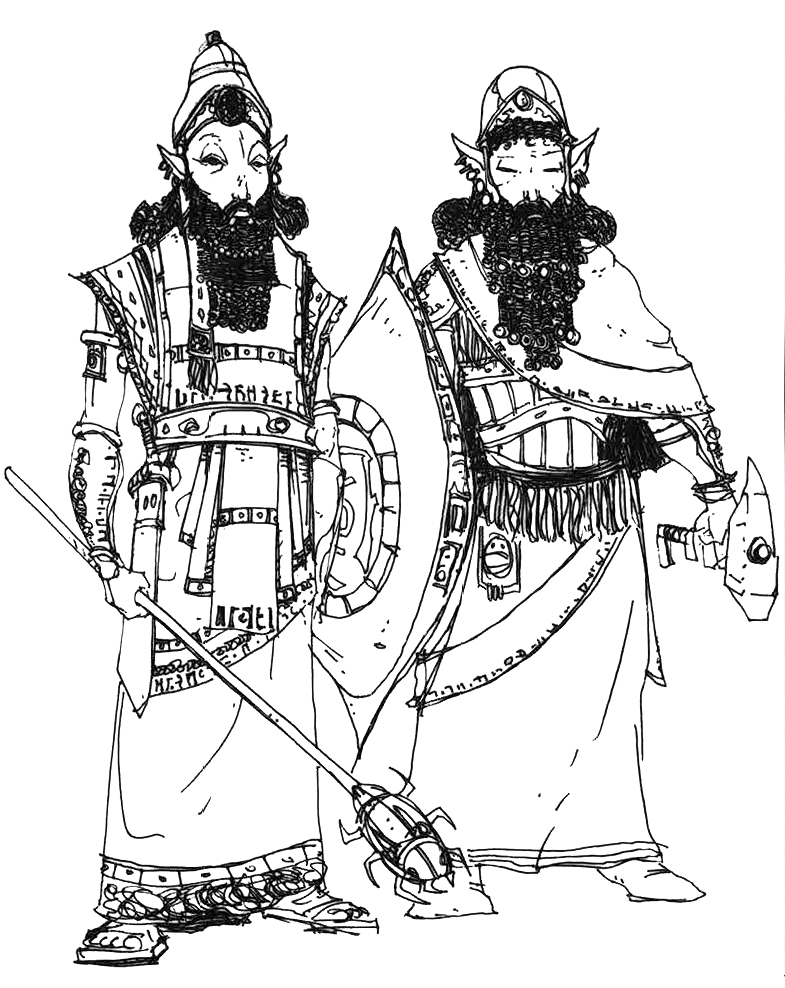
See above a piece of concept art of the Dwemer, the 'Dwarves' of the Elder Scrolls. The are (as the pointed ears may suggest) an offshoot of the Elves - being, like Tolkien's Noldor, Deep Elves. Then one encounters their faintly Assyrian designs, their magical automata, their strange brazen armour, their apparent agnosticism in a world of Divinities. One is left with an undeniably sense of conceptual density, even before delving into their fate. Morrowind..... probably is 'worth it'. It seems to have so expressed so alien a world, so strange an endeavour - taken in it's entirety - that it makes the world around it richer.

***
Alfons Mucha: you probably know what his style consists of; lots of Art Nouveau swirls and ladies in drapery, often acting as some personification. Which makes the exceptions more interesting. Some of his early work was quite specific; as posters for plays starring Sarah Bernhardt.
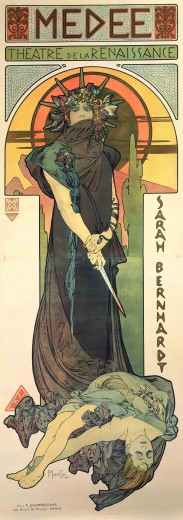 |
| As, for instance, Medea. |
This includes Bernhardt playing the Prince of Denmark.
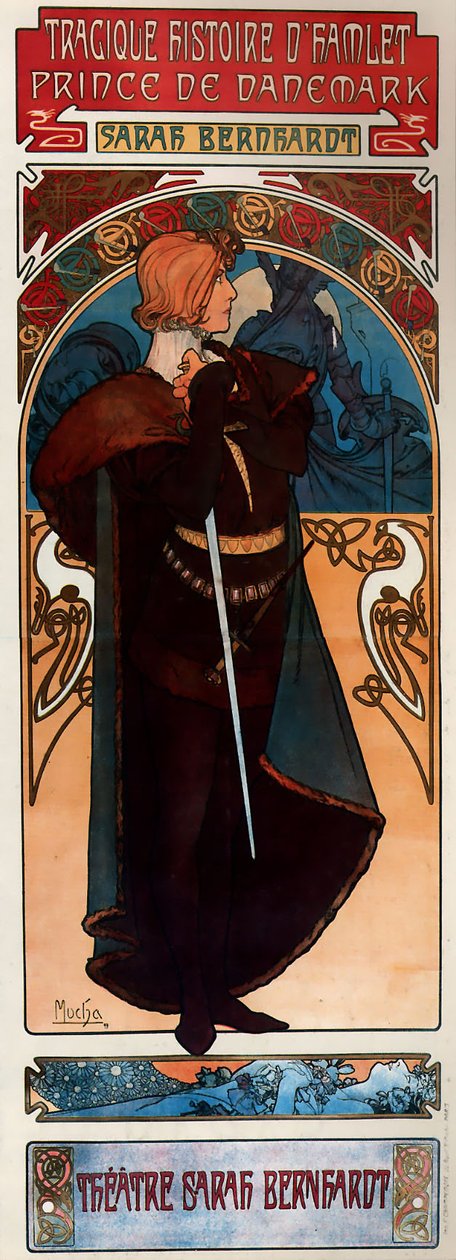
Which brought to mind a question: what happens when Mucha paints men?
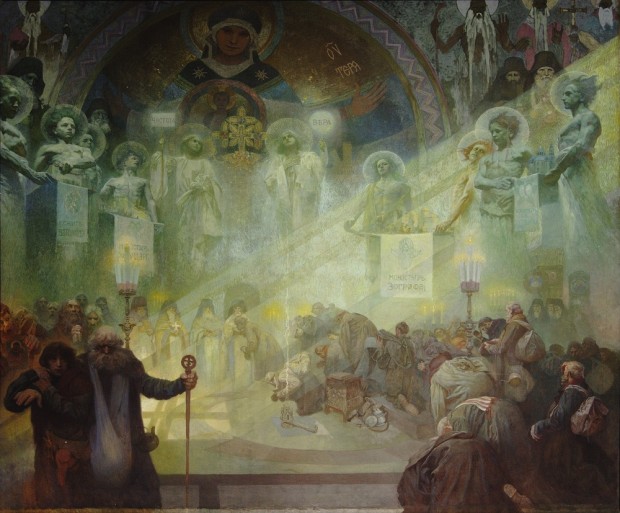 |
| From The Slav Epic. |
Well, one answer is that things start to get kind of Morrowind.
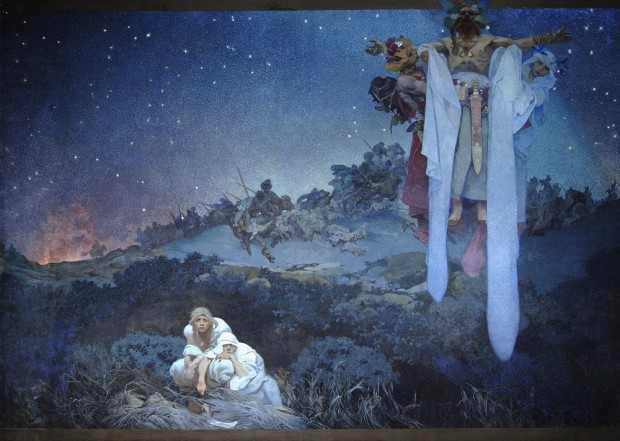 |
| Also from The Slav Epic. |
The ethereal air, the fine features, the swords and divinities....but I think this extends beyond The Slav Epic.
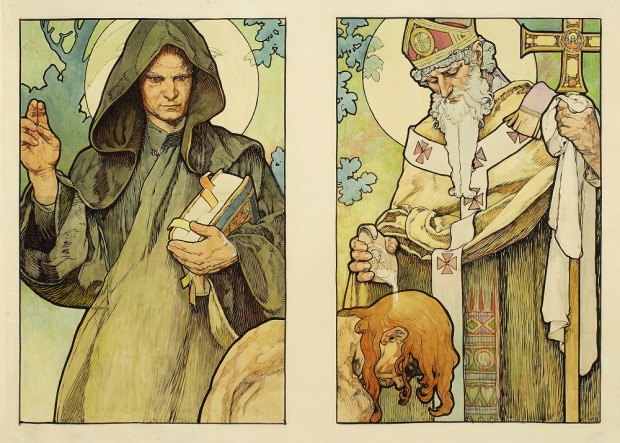 |
| Design for a stained glass window in St Vitus Cathedral, Prague. |
The dress and decoration above is explicitly Christian: SS Cyril and Methodius are being depicted. But the weight of cloth and ornament, the careful lines of the faces, the hagiographical subject matter - it pointed me towards Morrowind. Despite the lack of insectile armour and grey skins (although Vivec absolutely would wear that Medea costume).
Compare Mucha's contemporary Ephraim Moses Lilien.
***
A reference on Michael Kirkbride's inspirations mentioned Kahlil Gibran. I had never heard of him, so off one trots to Wikipedia - only to discover that his prose poetry collection The Prophet is one of the best-selling works of all time.
Trotting through through the Wikipedia best-selling page is, incidentally, an adventure. There's some fairly predictable classics - and then one gets to self-help books and Alcoholics Anonymous; I'd assumed the former occupied an outsize reputation to their actual popularity. Then there's the occasional bit of salacious sensationalism; a phenomenon that perhaps ended with Fifty Shades of Grey. Political memoirs (Nelson Mandela, Michelle Obama) make an appearance, as do popular science books (A Brief History of Time, Cosmos, The Naked Ape). The Soviet young adult fiction was somewhat unexpected but not unreasonable. Either way, presuming the figures presented to be true, a bit of an eye-opener.
Out of curiosity, I found a library copy of The Prophet. It sounded short and curious enough - a hundred and thirty pages, with (per a New Yorker article) margins you could drive a truck through. I was expecting - well, something tinged with a bit of Lord Dunsany**. The Wikipedia summary describes the city of Orphalese, the prophet Almustafa and the seeress Almitra. High adventure was clearly not on the table, but perhaps some interesting hint of the supernatural might occur.
Alas, this is not what one finds. You may check for yourself: here is the WikiSource version. This is disconnected, contradictory and quite unmoored from what goes on round it. The diction is King James Bible by way of the Thousand and One Nights. The morals are platitudes designed to ruffle few feathers in a secular-ish modern American milieu. Even when one turns to the Book of Proverbs or other pieces of Wisdom literature, it shows signs of being moored in a given time with given customs and peculiarities and artefacts. The Prophet does not.
Reading through it, you encounter a variety of vague paradoxes on a variety of topics: Work, Law, Marriage, Clothing and so forth. There's something of the Sermon on the Mount in it. But it is a vague, unsubstantial affair that provokes irritation or bafflement.
Yet - per the BBC - it is much quoted and admired; the high sales numbers we have already mentioned. Quoted academics attempt to compare him to Blake and Shelley; Blake's madness produced more interesting and intricate things than The Prophet. Gibran's life does not inspire admiration, as a reading of the afore-mentioned New Yorker article makes clear. It may well be I am being hard-hearted and cynical; that aside, however elegant Gibran's Arabic prose may in fact be or how bold his Lebanon-set short stories are one sees none of it in The Prophet. Nothing, it would seem, that called for the furore his death produced, though perhaps enough for quarter of a blog post.
***
I cannot, I'm afraid connect Oliver Cromwell with Morrowind. (If you can, answers on a postcard please, to PO Box....). However, I have recently finished reading Antonia Fraser's 1975 biography Cromwell: Our Chief of Men.
You might well go into it with a rough outline of Cromwell's life, as I did - and a knowledge of his reputation. Neither will necessarily change. But there is wonderful collection of fine detail - of his large family, of the pamphlets and newspapers of the time, of troop movements and religious disputes. Fascinating tit-bits emerge - like a scheme during the years of the Commonwealth for Universities in Leeds, York and Durham, or for the decimalisation of the currency (it'll never catch on). More seriously, details of the Lord Protector's foreign policy fascinate, including the hint that he entertained an anti-Papal alliance with the Cossack Khmelnytsky rebellion.
I can picture a work of subtle alternate history, like something by Susanna Clarke - in which, while a Restoration comes, assorted Cromwellian policies are far better embedded into the fabric of the Three Kingdoms. Decimalised currency, northern universities with a nonconformist bent, a successful Western Design leading to an English Hispaniola (maybe that's too big a change), a plain but imposing tomb of the Lord Protector at Naseby.
The accounts of foreign ambassadors go a long way in Fraser's text. Another factoid: apparently a letter from Muscovy dodged the issue of how to refer to Cromwell by referring to him as 'Oliver Utaditela' - that is, something like 'Supreme Commander Oliver'. (The Shogun Oliver?) Thus we come to the question of whether he wished to make himself a King. After a fashion, the marvel is that he didn't; many wanted it, the shape of the culture around him demanded it, foreign rulers assumed something like it, he wanted the necessary power to remake the British Isles, he'd have met with criticism of his arbitrary nature but he'd already encountered just that. What put him off? Faith, I suppose, or perhaps principle.
I found myself wondering where a modern Cromwell would come from. Decently educated, wealthy enough for comfort and political campaigning, devoted to his religion but not an impractical zealot, a dogged commander - not that one can raise regiments as one might once. Does the correct religio-cultural tranche still exist?
Such musings aside, this life of Cromwell is perfect for contemplating the recent past of Malmery.***
***
A recent publication that sparks interest: Frankenstein Rex. I recall speculating as an undergraduate about a world in which Dr. Frankenstein found a protector in the shape of a young Corsican artillery officer. After a scant generation, we see a nightmare world, where in the Revolutionary French Empire the levée en masse has taken on unholy meanings and proportions, and where the defensive guile of Arthur Wellesley is hard pressed to resist the reanimated. This isn't that, but it still sounds intriguing.
*A question that brings to mind this lesser-known Mitchell and Webb sketch.
**Which brings to mind an idle thought: what if people had readings from The Gods of Pegāna at their weddings?
***See also The Rage of Party.
No comments:
Post a Comment