Friday, 29 March 2019

The Eighteenth Century and the Enlightenment: A Loose Overview of Portrayals

This has come about for three reasons: Coins and Scroll’s new project; the imminent demise of G+ and having recently finished two novels set during the eighteenth century: Thackeray’s History of Henry Esmond and Thomas Pynchon’s Mason & Dixon
I do not claim that this is to be a comprehensive account of the ways the eighteenth century has been portrayed, but it may be of interest. There is a good distillate of Early Modern mores and technology by Joseph Manola at Against the Wicked City
"1. Everyone has guns. 2. Telescopes exist. 3. Printing is commonplace. 4. People have access to stimulants as well as depressants. 5. People have access to painkillers. 6. People might have access to phosphorus. 7. Rich people have pocket-watches."
Perhaps this post may offer material to create something like.
Before I begin, I shall be indulging ‘the long eighteenth century’ as a definition: taking the start as 1689. The focus of my regard shall be English language media.
FIRST, PIRATES
The pirate film is at least, in part, perhaps an essential introduction to the technologies and ways of the eighteenth century. Gunpowder weaponry is widespread; so is transoceanic travel. Rich cargos can be found in distant lands, as can the profits of same. Some portions of the world are charted, but by no means all of it. The difficulty of states exerting their authority on far-flung regions is clear.
It is interesting, looking at the summaries of some early pirate films, to see what degree piracy is forced upon our hero, perhaps as a response to injustice: Captain Blood has his start after the Bloody Assizes of Judge Jeffreys. There may be a background of pure rogues, but the hero has his reasons –which become everyone’s reasons. The Mutiny on the Bounty (as popularly portrayed) has something of this. Thinking on it, there seem to be few instances of explicit criminality as a motivation, however much it maybe gloried in.
An exception exists for Stevenson’s Treasure Island: Long John Silver, the archetypal pirate may be an amiable rogue, but his compatriots are hardly portrayed as anything like as good-natured. The revolt of the crew of the Hispanola is not quite an expression of liberty and heroism.
NOBILITY AND NATION BUILDING
Certainly in English literature, there is a great deal of this. The eighteenth century sees upheaval, to be sure, but this brings questions of identity to the fore. It is no strange thing that various British patriotic anthems date from this time. The Jacobite Rebellion, the exploits of the Duke of Marlborough and the Seven Years War all contribute to this. 
Thackeray’s History of Henry Esmond tackles both Jacobite plots and the War of the Spanish Succession, while his Barry Lyndon (and Kubrick’s film of the same) brings up the Seven Years War as central to Redmond Barry’s advance in the world. The flaws and nobility of the Jacobite Cause are played off against one another by Thackeray, as high hopes and self-sacrifice give way to a disappointing reality. 
Barry Lyndon is a wonderful film for this article: the long, high, isolating rooms; the low lighting from candles; the violent backdrop to a genteel world - even the children's magician with his invocation of the spectrum of visible light.
Another aspect of this is the world of letters. Thackeray brings the explosion of 18th century pamphleteers and essay writers to the fore in Henry Esmond; the title character even contributing to that world. There is a laissez-faire approach to the pamphlets: they can be censored and might well be, but the roots of the free press are on display here - and part of political discourse.
SQUALOR AND PREDATION
It will have not have escaped your notice that the Victorian author dominated the section titled Nobility. Well, Thackeray has his share of rogues and shabby deeds, but I do not think it wrong to say that the note of Squalor is clearer in later works.
The mind goes instantly to Gin Lane.
Two great recent accounts of the Enlightenment, Thomas Pynchon’s Mason & Dixon and Neal Stephenson’s Baroque Cycle rest soundly in this regard. Both take a certain delight in charting the course of scientists and aristocrats through grime-ridden city streets. Whilst the crowding and rapid growth of the Industrial Revolution might not have swollen cities, there is plenty of space for rookeries, debtor’s prisons, prostitution and slums. Even where Stephenson brings kindly or noble motives to the fore, one eye is on the squalor and pain of the times. Pynchon, however coated by conspiracy and framing device, is nothing if not more forthright in this.
For both authors, this is especially the case for the Transatlantic Slave Trade. Even if by both the treatment of slaves is contextualised as one of many unequal relationships of the time rather than a unique ill, it is still singled out and condemned by protagonists. (Stephenson deals with both the taking of slaves by the Barbary Corsairs as well as the trade of slaves in Sub-Saharan Africa). This is scarcely surprising for authors writing in the late twentieth and early twenty-first centuries. Of course, given the actual course of historical events, any rebellion or liberation needs must be a small scale affair.
The Picaresque dominates both: the high frivolity of massive wigs and frockcoats encountering sewage and upset. Which is distinct from the practicalities of everyday life (consider this chap, for instance).
MEASUREMENT AND ITS ABUSES

I have written on here before about Map of a Nation and the history of the Ordnance Survey. Even if that grows a little out of even the Long Eighteenth Century, it is still relevant at to consider. Not that that counts as a work of fiction.
Given the fame of astronomer George Mason and surveyor Jeremiah Dixon, their exploits in charting the Maryland-Pennsylvania border are front and centre here. The adverse effects of chopping a line through the landscape and the unintended (or, given Pynchon's Jesuit conspiracies, utterly intended) effects thereof are made quite clear - by the presumed knowledge of the reader as regards the eventual significance of the Mason-Dixon line, if no more.  The first portion of Mason & Dixon deals with the Transit of Venus in 1761; this is another indicator of the propensity for measurement by the minds of the eighteenth Century. Taking and repeating accurate measurements - learning the span of the globe and the particular parts thereof - is all part of the Enlightenment project. 
The world, by such methods, becomes easier to traverse and to comprehend - for those at the centre of information networks, at any rate. [If you want to bring up Seeing Like a State at this point, you can. However, the ills of Modernism are still a way off.] 'Mapping' as a concept extends to other fields - think, for instance, of the Linnean taxonomy.
WHAT ARE WE LEFT WITH?
Most of Manola's points stand. But we are looking not just at the Early Modern, but the incipient modern, for good and ill: the growth of political discourse, the mapping of the world and the drawing of boundaries, global commerce. Of course, it isn't the Modern World. It's all the discarded ideas and first efforts and groundwork that contributed, bundled up and dressed in a periwig. There's doubtless a lot I've missed (the American War of Independence, for one) - but these are some of the notes portrayal of the eighteenth century offer up.

Wednesday, 20 March 2019

In which a number of Biblical Settings Come Together

For those of you in Great Britain and with a television license, I shall mention that Darren Aranofsky's Noah is on BBC iPlayer. I watched it, having seen it upon release in the cinema; by my lights, it held up (especially comparing its constant sincerity to the latest Marvel snark-fest). Goodness knows what it does for you.

To briefly make a few points - this is a Biblical film drawing from the four Chapters in the Book of Genesis, as well as numerous of Aronofsky's own expansions and interpretations. The result steers clear of the historical drama angle of other Biblical films. The setting is more temperate in climate than the Near and Middle East; industry and environmentalism arise as themes; motivations are unclear, as is the divine will. Plus Anthony Hopkins appears as Methuselah wielding a flaming sword.

Firstly: let us compose a melange of the settings of Biblical films: the grand cast-of-thousands cities of Ben-Hur or The Ten Commandments with the empty spaces and industrial degradation of Noah. The harsh deserts of the former two also have an appearance. That is landscape; for society, we must think of a set of decadent empires and their verges, with subject peoples caught between them.  Lost artefacts and the ruins of lost kingdoms crust the land. The empires of the day may be cruel, but not unthinkingly so (Marsala as the exception, not the rule). Nonetheless, their presence to the people of the periphery may be hateful. At this point, I shall reference the 2009 American television serial Kings, based on the Biblical book of the same name (this is the only decent-ish clip I could find: Ian McShane as Not-Saul seems a compelling choice).

The supernatural also dots the periphery of these empires; from magical rocks (the zohar of Noah) to giants to signs and portents: the wilderness is the place for all these things. Thus it is a source of potential power, resulting in high-stakes conflict over magical artefacts (IE, Raiders of the Lost Ark; there is something appealingly recursive about a version of Raiders in a near-Bibilical setting) or powerful substances (Mad Max with Bronze-Age angel designed chariots and firearms powered by combustable rocks).

A free-wheeling combination: Bread and Circuses on one hand and vast industry-scarred wilderness on the other. Perhaps rather better as a thought experiment than anything else.

Saturday, 2 March 2019

Ilium and a Post-Literate Post-Apocalypse

Another brief post, but in the same tent (roughly) as the Trojan War piece from a few weeks ago.

I have been digging into Dan Simmons's Ilium of late, rereading in between other works. His work tends to either detailed historical horror (IE, The Terror, Black Hills) or far-future space opera with heavy reference to literature (Ilium/Olympos, but more prominently, Hyperion).

Anyway, one strand in Ilium/Olympos concerns the folk ('old-style humans') on a far-future earth who live century-long life spans with rejuvenation every twenty years. Their lives are idle and hedonistic, all necessary tasks for survival being carried out by biological robots ('the Voynix'). Teleportation nodes provide for all transport. Fatherhood is basically unknown, thanks to some tampering allowing for sperm storage - though women are only permitted one child. Said old-style humans can't even read.

They are set in a world where familiar features have warped and changed. Paris (population 25,000 - and considered a metropolis) has a vast crater at its centre and is overshadowed not be the Eiffel Tower but by a vast statue of a naked woman - semi-transparent and filled with a photo-luminescent red liquid (a 'Lost Age artefact'). For some reason, the Golden Gate bridge is now by Macchu Picchu. In the unpopulated areas between teleportation nodes of the 'faxnet', resurrected species lurk (smilodons, allosaurs and more). Folk killed by them, can be resurrected - if close enough to a node.

Functions similar to a smartphone, if more advanced, have been implanted into the residents of the future - but are taken so as part of nature that most of these functions have been forgotten. This, and most of the state of being enjoyed by folk in this time are the workings of the Post-Humans dwelling in a vast orbital ring (hence 'Old-style humans).

These are the remnants of humanity, dwelling in the structure of a forgotten world, lacking the skills or curiosity to explore or develop much; lightly and subtly governed by those who have gone before.

***

This is merely the setting. Then everything falls apart: the teleport ceases, the voynix turn nasty and things collapse - and no-one knows how to cope, miserable eloi that they are.

Think The Culture - but no Contact, no Special Circumstances - and then all the Minds vanish. And everyone is useless.

Naturally, the protagonists are the exception - or at any rate, get a head start on a vicious learning curve. Assisted by Odysseus, son of Laertes and a televison-equivalent viewing of the Trojan War (I won't explain that bit here, but this is the Classical connection).

***

I think this strand of Ilium has potential: quite a few post-apocalyptic settings have humanity in the ruins of the old world - but tend to have some form of community come together already by the start of the story. Likewise, there are a variety of settings where poorly understood technology looms over all (generation ship stories like Orphans of the Sky or Non-Stop do this), though the fruitless hedonism angle rather calls to mind Logan's Run. Perhaps more recent and relevant is the strangely named Horizon Zero Dawn, summarised and discussed in tabletop terms at Throne of Salt: the mechanical beasts that imitate prehistory especially.

But of course, the tribes of Horizon Zero Dawn or the monks of A Canticle for Liebowitz are fully developed by the start of the narrative. No-one has to work out hunting and gathering from scratch, let alone forging anti-voynix weapons. One could perhaps look to Kingdom Death Monster and its settlement and technology mechanics - scaled as appropriate (not to mention the extensive reskin!).

This feels quite current, in its way. Your technology has failed you now; you can't fix it and you didn't make it and now all your skills are useless (You used to work out? Super set of abs, but can you kill a charging aurochs? You used to garden? Lovely tulips, what do you know about crop rotation?). Humankind didn't just pull the ladder up after itself: they burnt the drokking ladder! An immediate switch from garden parties to fighting tyrannosaurs, with the accompanying learning curve.

Throwing in a visit from Odysseus (or similar) would be a way to soften things - but this is taking a catapult into Fantasy RPG land very quickly. Being able to read is nigh-on magic; being able to read and understand even more difficult: Old-Style humans probably don't even have a system of measurements. At the tabletop one could factor this in - using non-inidcative or nonsense names for real-world concepts (A mile is a faga; a hard drive is a blarter) in in-universe texts. Translation could evolve slowly.

You may wish to read Ilium and its sequel Olympos first. Don't ask me where the Proust-reading Jovian robots come into all the above, however.


Thursday, 28 February 2019

Shrines and Columns

It's been quite a gulf since the last post. Here's something short, however, that I'd like to share.

You may recall that I have an interest in Church architecture and in where that sits in urban surroundings. One oversight from that post - pillars and columns. Not those sat on by stylites, nor memorials like Nelson's Column or the Monument to the Great Fire of London (known, helpfully, as the Monument). We might also consider the Islamic world and the place of the minaret.

I refer to Columns bearing Trinitarian or Marian images. Here's a simple-ish one, from Prague.

13-03-30-praha-by-RalfR-116.jpg
Thank you, Wikipedia.

Of course, this is hardly an unknown. Tall monuments, from Trajan's Column to Cleopatra's Needle to the Menhirs of Brittany are hardly news. But some of these get impressively Baroque.

From Vienna.
Thank you, Wikipedia - again.
My own understanding of Baroque architecture may have been muted by the English variety (all due respect to Sir Christopher Wren), but that is still an impressive piece of cloud-wreathed work. But let's go one better.

Sloup Nejsvětější Trojice, Olomouc.jpg
Thank you, Wikipedia - a third time.
This is from a city in Moravia. Wikipedia lists eighteen sculptures as well as many reliefs: the Holy Trinity above and numerous saints below. Yes, there is a small chapel inside. I very much hope it is still functional and that processions of priests will troop out to it occasionally, disturbing traffic in the town square.

It is deliciously complex and prominent as a setting for something. Perhaps it would be some manner of Peculiar in a fictional setting. Within the fabric of the city, it would certainly be the focus of municipal concern and the devotion of city-dwellers. The start or finish, perhaps, of a procession.

If you take nothing else from this, make it an understanding of how cramped and layered a European city could be - the strangeness of historical buildings and the uses thereof.

Saturday, 9 February 2019

The River People and the Sea People

Here's something. A simplification of the ancient world for the purposes of deriving a flavourful setting.

Two points of derivation, coming from recent reading (as well as a visit to the current exhibition at the British Museum): Gene Wolfe's Soldier of Sidon (and, therefore, Latro in the Mist) and The Ancient Greece of Odysseus by Peter Connolly. The latter is an old textbook I recall from school: the benefit in it coming not from the summary-style retelling of the Iliad and Odyssey, but from the links it makes to Mycenaean artefacts and Trojan archeology, being an introduction to things like the Boar's tusk helmet, the figure-of-eight shield and the Dendra armour.  This is coupled with a very pleasing set of illustrations by Connolly, that impart a slightly less clean-cut look to the Classical World (next to what one might call the 'Clash of the Titans' approach). The Greeks and Trojans have fringed skirts to their tunics - rather than the clean white edges of other visions - as well as thick-featured, stiff-bearded faces.
Image result for figure of eight shield
An illustration from The Ancient Greece of Odysseus.
Note the odd, Sea People derived 'feather hat' on Aeneas (back, right).
Note also the horned helmets!

Anyway, all this produces a certain dichotomy from a broad-brush stroke account of the ancient world: between the islands of the Aegean and the Eastern Mediterranean, and the river kingdoms of the Fertile Crescent.

Throw into this a certain form of popular history: the sort that produces web articles with titles like 'Alexander the Great: Not so Great! Six Reasons WHY'. (This sort of thing irritates me as a rule: not because it comes to such a conclusion, but more because of its use of a contradiction to the established record as a piece of clickbait - to say nothing of the kicks people get out of being the 'brave new revolutionaries'. But apparently I'm not averse to using it for fantasy settings.)

Also, because I can find a way to put him into anything, C. S. Lewis. In The Dark Tower, a paperback anthology with some of his short fiction and portions of unfinished projects one comes across a few chapters of After Ten Years, which would have been a novel about Menelaus (called Yellowbeard) and Helen after the Trojan War; it is fruitless to speculate too much, but perhaps it would have been rather like Lewis's other novel of the ancient world, Til We Have Faces. (More on the titular tale of the Tower here). Aside from a lovely first chapter detailing the squalor and discomfort of forty men squatting inside a wooden horse for twelve hours, the description of the sack of the Trojan Palace feeds quite nicely into this.

"The room was full of a sweet smell, you could smell the costliness of it. The floor was covered in soft stuff, dyed crimson. There were cushions of silk piled upon couches of ivory; panels of ivory also upon the walls and squares of jade brought from the end of the world. The room was of cedar and gilded beams. They were humiliated by the richness. There was nothing like this at Mycenae, let alone at Sparta; hardly perhaps at Cnossus. And each man thought 'Thus the barbarians have lived these ten years while we sweated and shivered in huts on the beach.' "

Naturally, looting ensues.

SO: this is the world of a new setting. Forget Plato, forget Aristotle, forget the Parthenon. The Greeks are the Orcs of this setting: savages, raiders - who live on rough islands in the salt waters. Alexander, King of Macedon? The equivalent of the Urak-Hai. Even cunning Odysseus, remember, had to prove his identity at the end of the Odyssey by a feat of arms, bending and shooting a bow. Their alignment is chaotic.

They come from the sea, from the storms. They even worship the God of the Seas, the Earthshaker, the Great Chaos!
They are raiders and fighters, for those barren islands will not support crops like the fertile river mud will. 
Some of them even ride horses, pressing their thighs against a beast of the field rather than fighting from the war-platform of a chariot.*
They don't oil their beards. They don't even wear trousers!

The civilised folk are the Babylonians, the Egyptians, the Persians who live on rivers, by the tamed water. At this point, we should note the Babylonian myth of Marduk slaying Tiamat, dragon-spirit of the salt waters.  The link between the sea and chaos is rather well established by the Chaoskampf of comparative myth. These riverfolk are also scholars: astronomers, builders of the great ziggurats, recorders of history, wisdom, law and prophecy (Leviathan and Dagon needn't be the only Biblical reference here). I would note also at this point the cosmopolitan make-up of the Persian Armies in Herodotus and the allies of Troy in the Trojan War (Ethiopians and Amazons). Lawful alignment, of course.

Goodness knows how the Phoenicians and Hittites fit into all this. Semi-chaotic profit-driven merchants for the former and mountain-dwelling dwarf-archetyple smiths respectively, perhaps.

Of course, the 300** style portrayal of Sparta fits in marvellously well here as a noble savage or barbarian hero. However, this all needs a little more work before it comes together; perhaps a map. But I'm still somewhat satisfied with the background workings of it described here.


*I'm aware that the Greeks of the Trojan War used chariots and that cavalry-proper rather than chariots, but for the sake of accentuating the difference in the setting, I'm doing this. Besides, the Old Testament-esque feel of a law against riding a horse with ungirded thighs works rather well.
**Mandatory reference at this point to the Keiron Gillen graphic novel Three, which works rather well as the anti-300, making it clear quite how unpleasant Sparta could be. Very worthwhile read; the paperback edition comes with interview-commentary by a Professor of Spartan and Peloponnesian Studies.

Sunday, 6 January 2019

The Priesthood of the Rope: A New Class

It was after the great convocation of the faith in the Seventh Century of the Dominion of the Faithful that a great wave of new preachers, hermits and holy men emerged. Many emulated the model of St Roak or St Clunia, taking quite drastic vows of poverty, and encouraging others to do the same. To return to the roots of the Faith was the plan, however much the world had changed in the intervening years. Many of these new movements only lasted one generation; some waned in popularity naturally, some amalgamated with existing religious orders - some fell into darkness and error and were disbanded by order of the College of the Rite.

However, of all these orders the friars popularly known as the Brethren or Priesthood of the Rope have endured, despite the distance between their common practices and the views of the hierarchy. The Order of the Blessed Kordon (named for their founder) are known as mendicants, generally without fixed monastic communities - though a permanent station is kept by brothers of the order in the Holy City. They live simple lives, going amongst the poorest of the slums or to villages in the most desolate regions, bringing the Faith's message of comfort to the lowest - often living solely on the charity of those on the road with them. Founded in a time of much violence, among the pacifistic dictates of the order is that a member must not bear a knife longer than the length of their hand - and that it must only have a single edge. (By the letter of the law, they may borrow other bladed implements- the example is given of a scythe to work in the fields - but to keep them longer than the work requires is forbidden.)

The Brethren of the Rope are recognised by their simple robes, generally of whatever brown cloth can be readily found and belted about the middle with a simple rope, rather than a sash or belt. They are well-loved among many of the poor and are often lauded as examples of simple faith and the endurance that comes from it. Many are the miracles attribute to their piety

What is rather less well known is that the Order, for all their distance from the militarised aristocracy and profession of peace, are permitted to defend themselves, but are obliged to do solely through the use of the rope by which they are known. Snares and nooses have been known to trip unsuspecting highwaymen, lariats to restrain the footpad - the bolas to bring down wild beasts. It is whispered that the use of the rope is not purely defensive either. The rope may be used to restrain, but it can be put to darker purposes. A man-at-arms with many kills to his name must still breathe, and a dark alley-way is a place in which a garrotte may be about the neck before the victim even knows it. The corpses of corrupt taxmen, those running extortion rackets and enemies of the faith are often found without a single blow on their body.

Indeed, it is for this reason that the oppressors of the poor will often wear heavy gorgets about their necks (though it is rumoured that even these will not stop the techniques of Brotherhood of the Rope). It is not uncommon for a member of the Order, when invited to the house of an aristocrat, to be gifted a new set of plain garments, ostensibly as an act of piety - though the new robes will either be lack a rope or possess a subtly weakened cord.
Chap on the right is probably a superior in the Order.
(Painting is Jean-Léon Gérôme's L'Éminence Grise)
***

Out of Universe, this basically derives from me wondering why the chap with the lasso in Westerns is a goody and the chap with a garrotte in adventure films a baddy. (There is probably a very decent paper to be written by some semiotician on the connection between the lasso and the noose.*) It is also a sort of development of the 'clerics wield none-bladed weapons' idea.

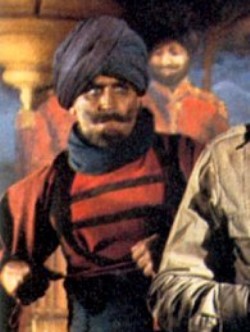
This is a character class for those who want to be this chap on the left...
Sean Connery in The Name of the Rose. I add the image more for the sake of the book than the character.

....this chap in Pankot Palace...
That's a certain be-hatted and whip-wielding archeologist he's creeping up on, if you hadn't guessed. 
...the sort of character played by this chap...
From The Coen Brothers' Hail Caesar (2016).
The scene in question may be seen here: presumably some of the Brethren do this sort of thing for fun.
...and with a spot of Friar Tuck for good measure. Add something of the wuxia martial arts picture as desired: how spectacular do you want your rope antics to be?

I've used the term brethren a great deal above, as well as the Western European Medieval norms of my Terrae Vertebrae setting. Naturally, neither masculinity nor Europe are necessary for the class, though some degree of organised religion probably is. The idea of the character class should be flexible enough to accommodate a dashing Robin Hood or Zorro type, a member of a desperate revolutionary cadre using whatever tactics they can, a sinister enforcer for the religious hierarchy or a peaceful monk caught up in violent surroundings carefully defending himself with non-lethal means.

With that, the nuts and bolts of the affair - using, as before, The Fifty-Two Pages as a basis.

***
THE ROPE PRIEST

Size: 1

HP - d6+1+ CON +/-.

Attack Modifiers - None, initially
Mind Save 7 + WIS +/-
Speed Save 5 + DEX+/-
Body Save  7 + CON +/-

Knowledge    Notice Detail   Hear Noise   Handiwork   Stealth   Athletics

      [X]               [ ]                        [X]              [X]              [XX]             [X]

Starts with one extra Language, and Spells: 1+INT bonus. Spells must come from the Abjuration or Restoration list**. All Rope Priests gain Animate Rope as a Cantrip at Level Two and may cast it a number of times equal to their level each day.

The Rope Priest's sacred weapon is a rope. The Rope Priest's religious motto might likely run something like 'Comfort the Oppressed and Live in Peace' (though this is setting dependant).

The Rope Priest must take the background words Religion and Rope. This ensures that the Rope Priest can manufacture ropes out of suitable materials given enough time, tie intricate knots, strengthen or repair ropes, know roughly how much weight a rope can bear, &c. 

Level Advancement: +1 Melee, +1 Missile every Fourth Level

                                    +1 to all Saves every Odd Level
                                    +1 Spell per level

Members of the Rope Priest's Order may entrust him or her with strong thin chains and other rope-like weapons at higher levels or if on a specific mission. 


* The only place I can think of that addresses this - not that I have been looking - is the final act of Terry Gilliam's Time Bandits (1981) in which cowboys summoned to defeat Evil yell 'Yee-haw! Let's have ourselves a lynching!', before bringing out the lassos. Given their fate, there is perhaps a degree of unspoken criticism here. 

**Throw in Nature spells if desired for a St Francis of Assisi variant. 


Sunday, 30 December 2018

The Silent Quarter

In the midst of the city is a place of absolute quiet. Its bounds are irregular, adhering to the property laws of several centuries and a few regime changes ago. 
Absolute quiet means exactly what it sounds (or, as it were, doesn’t sound) like. An enchantment has been placed on the quarter of the city, meaning no sound can be heard there. A struck drum will vibrate to the touch, but no drum beat will be heard. Yelling, laughing or weeping will produce appropriate sensation in the yeller, laugher or weeper and the suitable physical signs of a contorting face, streaming eyes and the like. No-one powerful enough to break the enchantment has felt it worth their while to do so; conversely, there are plenty who have felt it worth their while to make their home in the Silent Quarter as the city has grown around it.
The most obvious group to come to the Silent Quarter are scholars and mystics, who appreciate the quiet that the Quarter offers – renting cheap rooms or study cells in the boarding houses and study halls built for that purpose. Far from them (and hopefully downwind) are the slaughterhouses that deafen the clamour of penned-in nervous animals (and butchery of same) by placing themselves in the Silent Quarter. 
The quarter has been used for less industrious or straightforward purposes. Secure rooms (frequently the garret) of the boarding houses of the quarter are sometimes used to home those mentally ill folk who would be disturbed by the noise of the city proper. Of course, not being to hear a single thing and not being able to leave the quarter to go back among society is not necessarily a cause for sanity: the scholars and butchers of the Silent Quarter have ample opportunities to leave. Likewise, the Silent Quarter gives the kidnapper, footpad and murderer ample opportunity to pursue their work free of noise.
All this said, some prosper in a more wholesome fashion in the quarter. Mutes and the deaf can make a home here and converse in sign language - and all others must follow their lead. The borders of the Silent Quarter are home to numerous interpreters of this language, who help facilitate such liaisons as are necessary for those doing business in the quarter (they will sign words on a slate; just using the slate is considered awkward and impolite - and would doubtless count against you). Lip-reading is known, but has a greater possibility of error.
The entrances to the quarter are known as ports; these have only rarely been turned into active gates, but the streets that lead into the quarter are marked by statues of humanoid figures covering their mouths and ears. These are maintained by the citizens in adjacent houses and give a name to the street (the port of angels, the port of demons, the port of maidens, of babes, of fauns, of goblins…). 
Related image
The first two figures are from the port of bones.
I do not know where the third has come from.
Local government in the Silent Quarter has always been a problem. The nature of the quarter hampers efforts towards licensing, tax collecting and law enforcement. The layer of criminality in the quarter complicates this further, as does the general air of separateness from the outside world. The city watch patrols here much as anywhere else, but largely succeeds in removing criminal activity from the main thoroughfares rather than stamping it out. A regular tax is collected both on behalf of the city and the state, but estimates of what any given household owes are reliably lower than other urban areas. Town criers and the like are, naturally, unknown, but the city does provide the pay for signallers who raise the flags that signal the passing of the hours.  
It is into this place that you may one day walk, for it is the kind of spot that offers opportunities for those willing to seek them.
Ten Silent Quarter Features
  1. A man in country dress turns pale and begins to look very concerned as he walks past the statues of the port. He is presumably a newcomer.
  2. Officers of the watch chase after somebody into the quarter, their hue and cry having little to no effect on passers by. 
  3. A monastery crosses over the bounds of the quarter; the cells and library being within the silent zone; the chapel and refectory being outside. The monks may say their prayers at the approved hours then return to the realm of quiet.
  4. Members of a persecuted minority maintain a few houses within the quarter. The silence does very little to foster community spirit, but the quiet does prevent some forms of attack from their foes.
  5. Music is utterly pointless within the quarter, but mimes and dancers can earn money performing on the street corners. Heckling occurs via rude gestures.
  6. Horses are generally led through the Silent Quarter to prevent accidents from unheard hoofbeats or panic on the horses' part. An unwatched horse is cause for alarm, and there is one over by that trough. What has happened to the owner?
  7. The retinue of a visiting dignitary blow trumpets in a show of wasted pomp.
  8. A wizard, looking to make money, is advertising telepathic services and ‘mindspeech’ just outside the port of nymphs. The interpreters look at this with scorn and anger.  
  9. Litters and sedan chairs enter the quarter - largely with heavy curtains lowered.  This one is not only firmly shut up, but also well guarded.   
  10. The Voiceless House looms over one part of the quarter. This prison takes those whose speech is held to be dangerous: renegade wizards*, political agitators and leading heretics. Of course, imprisonment within the Silent Quarter is held by ancient statute to be an extreme form of punishment: all those in the House have their cases reviewed each year by the court. The time of this appeal is always kept secret, to prevent formation of mobs or intimidation of the judiciary. If you could learn the time of such a retrial, it would be valuable indeed.  

*Any magician capable of casting spells without a voice is unlikely to be caught - or taken alive.

Monday, 10 December 2018

Something for Your Shelves: John James's Votan

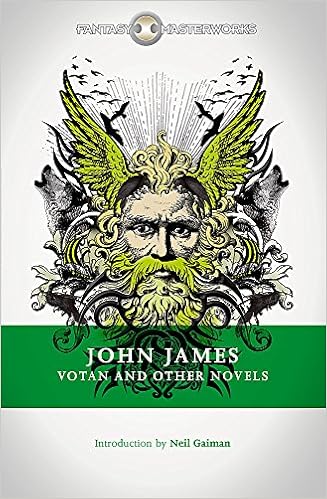
Found in a secondhand bookshop near York Minster, this was the first I had heard of John James. A three-book omnibus published by Gollancz in their Fantasy Masterworks line. Pictured below, it contains Votan, Not For All the Gold in Ireland and Men Went to Cattræth under the title Votan and Other Novels.  The collection has an introduction by Neil Gaiman. 
Image result for Votan and Other Novels
As pictured. 

I am going to focus purely on Votan (published first 1966) today. This is perhaps the most accessible of James's works in that collection and the one I can best discuss. I hope the following will show you why.

A brief discussion of what Votan is about. A Greek physician and priest with some mercantile connections is living on the German frontier of the Roman Empire in the first century AD is lured over the border into the trade links and battles of the Teutons - particiapting in and giving rise to the tales of Norse Mythology taking on and creating the guise of Odin (Photinus > Photin > Votin > Votan >Wodin > Odin). It is rarely outright 'fantasy', but I do not think it is wrong to call it fantastical, even if it is only slightly within the bounds of speculative fiction.

The trick, if you will, is in how James does this. Photinus is explicitly of his time; he never feels like a time-traveller, condemning his own time or trying to stand outside it. Part of this may be because he is an outsider for most of the novel: a Greek from the world of the Empire reacting to the world of the Norse. He is even putting on an act: impersonating a deity or a priest, not just to save his own skin, but in order to make a great deal of money from the profitable amber trade, as well as to leverage such other benefits as he may from the position he finds hismelf in. But even while he is putting on the act, he does it at the behest of a divine figure he seems to have a genuine belief in.

This never feels, I am glad to say, anything like the Hollywood-esque 'The TRUE Story behind the Legend!!' affair this might be. Even where James's prose gets a little too slick or humorous (Photinus on German costume: 'Trousers are funny things to wear. You can always feel them on your legs. It takes you a long time to get used to riding a horse with them, the cloth spoils the contact with the beast's side.'; 'It was wonderful to walk round with bare legs, like a real human being.'), it never feels glib or referential in that manner called 'fanservice'. Of course, this is a book full of reference to Norse myth, but one doesn't get the impression that Photinus is inventing this all out of whole cloth. He is inhabiting a role and has to keep moving and struggling to shift through intact.

So, why bring this up here? In part, because of the reaction to it. I made a search after reading it for writing about it, in addition to Gaiman's introduction (it occurs to me that if folk read the books Gaiman introduces as readily as they read the stuff he pens, this would be fine indeed). I dug up a brief article on James from Tor Books by Jo Walton. But eventually I bit the bullet and went to GoodReads. One of the longer reviews did not rate Votan highly; complaining of the excessive detail Re. German tribes (Vandals, Marcomannni, Frisians....) and trade networks. 

Well, the narrator is a merchant and is able to exercise his powers by sitting in Asgard at the centre of trade networks and between tribes; further, he is an outsider and must untangle this for hmself mentally, whilst standing apart from the Germans. Besides, he is taking on the role of Odin - a knowledge god. What could be more appropriate than demonstrating this?

But aside from my defence of James's Votan, what makes me write this post? Photinus's tale and status is rather reminiscent of a tabletop fantasy RPG player. He is from a different civilisation from that which he moves through and some of his abilities and knowledge come from this. He must learn the ways and tricks of this world. His financial motivation and cynicism is not unlike a certain vision of the player: the murderhobo model, though tempered by his vulnerability. He even shows the occasional, hidden scrap of sincere belief and religious fear - like a player paying occasional service to in-universe beliefs. 

In all, a book worth reading. 


Wednesday, 28 November 2018

Pistol Crossbows: A Jaundiced View


I am not fond of pistol crossbows appearing in media with a somewhat medieval theme. If someone says that they want to use one, I roll my eyes. They don't strike me as strictly possible even in a world of wizards, Dwarven metallurgy and the like. (I take it that the pistol crossbow is always intended as a faintly plausible mechanical device rather than something that works because it has been so heavily enchanted that it is effectively a crossbow themed magic wand). To make one of these roughly as powerful as a crossbow or handgun seems that it would need devices and materials beyond the abilities of the age. Crossbows are hard work; there is a reason why they possessed stirrups to fit your foot into or large cranks to bend the limbs of the bow. There is something static about them - for use behind the battlements, or behind a pavisse. They are not assault rifles; if a modern comparison had to be made, perhaps the anti-tank rifle is the correct equivalent: heavy, cumbersome, requiring a fixed position.

Thus, idea of people walking round with them like gunslingers is silly. The idea of being a gunslinger in a medieval or pseudo-medieval setting is silly, especially in a game. You, a twenty-first century player are trying to cope with challenges using a different set of ideas, resources or skills. You cannot act like Jim Lassiter, James Bond or Harry Callahan. There is a range of anachronistic comedy to be mined by this (a man asks for a martini in a world that doesn't drink much in the way of spirits, has no formal image of the cocktail and nothing resembling a cocktail shaker to be shaken, not stirred in).  But that isn't quite the same thing. Try and act with Bond's suaveness or Callahan's brashness (and their tactical equivalents) in the wrong setting and it will end poorly.

I suppose this is less a cry for absolute realism, but rather for the limitation of anachronism. But this is not an article full of invective for invective's sake. What brought this on? Honestly, a new film. A film I haven't even seen; the new Robin Hood picture. Here's a trailer, here's a shorter professional review, here's a longer more discursive review.  The appearance of automatic crossbows*, riot shields and casino-like parties put me in the frame of mind to think on this topic.

On reflection, there were a few pieces of media where I could stomach or even actively approve of such a thing as the pistol crossbow. In the later Discworld books they appear, in a moderate fashion (The Ankh-Morpork City Watch has been using crossbows throughout, but I always pictured these as carbine sized, and so a little more reasonable - besides the fact that the Watch rarely contends with heavily armoured targets).

Image result for paul kidby discworld watch
As in the front row here, Paul Kidby's cover to Night Watch.

However, in The Fifth Elephant one has mention of an assassin's weapon in the vein of the pistol crossbow: concealable, vicious, prohibited. It has the appearance of 'a long-handled hammer or perhaps a strangely-made telescope', it is readily concealable, though difficult to load: a strong man says he 'practically ruptured myself cocking it against a rock'. It is explicitly a one-shot device and may very well be the same thing as the 'spring-gonne' mentioned in The Truth (L-Space, the Discworld Wiki certainly thinks so). It is prohibited both by official law enforcement and the better regulated criminal world.

In terms of conventional warfare, Monstrous Regiment mentions the horsebow, as carried (at first) by an elite heavy cavalry regiment from a well-funded military. I quote from my worn 2004 Corgi Books paperback:

'She'd acquired two of the horsebows. stuck awkwardly through the straps of her pack. They were horrible things, rather like a combination of a small crossbow and a clock. There were mechanisms in the thick shaft, and the bow itself was barely six inches across; somehow, if you leaned your weight on it, you could cock it with enough stored energy to fire a nasty little metal arrow through an inch-thick plank. They were blued metal, sleek and evil. But there is an old milt'ry saying: better me firing it at you than you firing it at me, you bastard.'

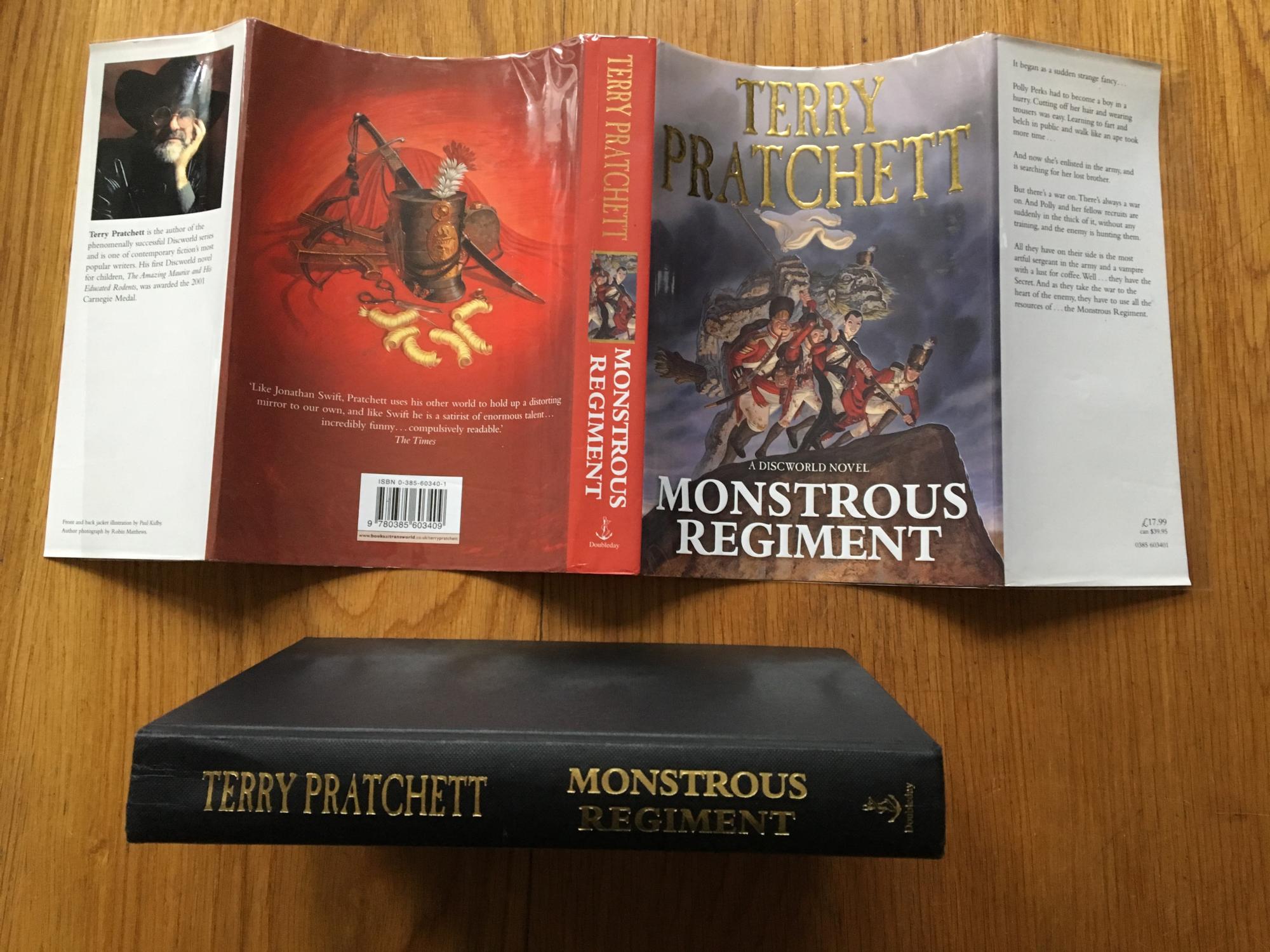
The British first edition of Monstrous Regiment had a dust-jacket by Paul Kidby with a still-life on the back cover,
depicting what I take to be horsebows, left and to the back of the shako.
I was lucky enough to find this picture of it on Abe Books.
To see them more clearly, you may wish to open this image to full-size in another tab.
I quite like this as far as pistol crossbows go: technologically advanced, relatively rare and difficult to use. Note also the main characters distaste for them; perhaps echoing the feelings of the British author: this is not simply a thing to point at the bad guys until they fall down. We get an explicit image of its potential for harm.

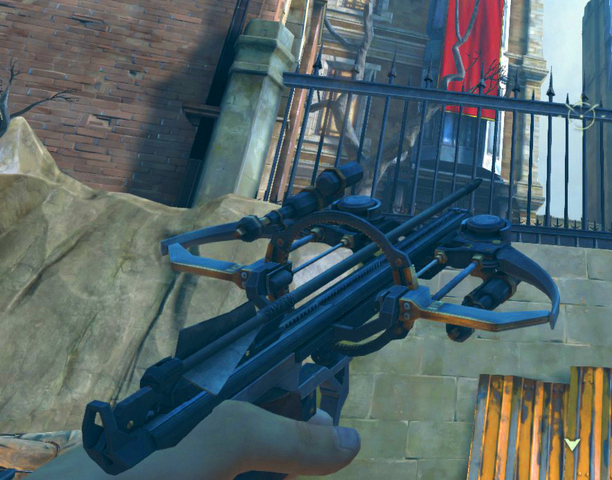
Stepping away from the Discworld (but not too far; I am told that Ankh-Morpork, among other things was an inspiration) the video game Dishonored** features a pistol crossbow. It is compact and quiet - fitting for a character that must climb over the masonry of the city of Dunwall and remain unseen. It is slow to reload, fitting the style of stealth gameplay: gentle movement, preparation, restricted resources. In this it resembles the silenced pistol of the popular imagination.

More images to be found on the Dishonored Wiki, but this one will serve as an example.
As for plausibility - well, there is only one of its kind, seemingly. It is made and upgraded by the protagonist's pet inventor. For all of its metal parts, it looks delicate somehow, as a microscope. Like dropping it would bend one of the mechanisms or jar something out of place. You certainly wouldn't try and pistol-whip someone with it.

(Bioshock Infinite: Burial at Sea featured a pistol crossbow of much the same type as Dishonored, albeit less fragile looking and Art Deco. See here for details. )

A mention should be made of the pistol crossbows of the Mad Max films, most prominently in the second film, The Road Warrior. They appear mounted on the wrist of many of the rampaging antagonists of that film***. They are compact and lightweight for those who must concentrate on driving a motorcycle, dune buggy or other heavily modified automobile.
Such as this gentleman. 
In a world with a limited supply of firearms or ammunition, they offer a viable alternative. They might not be terribly powerful, but no-one appears to be wearing terribly thick armour in the heat of the Australian wastes (to say nothing of clothing choices). Moreover, they are generally used at close range: speed up to the target, loose the bolt, drop back again. What one might refer to as a Perthian Shot.

* * *

Having gone over all these so thoroughly, what positive contribution can I make?

I have a few alternatives to the pistol crossbow, for compact projectile weapons - for preference, able to be used one handed.

1. Darts
2. Throwing knives
3. Sling (requires slingstones or bullets)
4. A slim weight on the end of a line - can be whipped out with tremendous force from a sleeve.
5. Shuriken, or similar slim throwing weapons
6. Slingshot (of the Y-frame and flexible strap variety)
7. Throwing axes; the sawn-off shotgun to the throwing knife's pistol.
8. Just give in and allow gunpowder weapons.

However, if you do insist on the presence of the pistol crossbow, here are a few ways to make it a little more interesting - by which I mean troublesome and palatable to my tastes. A pistol crossbow may be fast, cheap or good. Pick two.

1. It is a pistol crossbow, only slightly less deadly than a fullsize crossbow - but it breaks frequently. The bow is the weakest point.
2. The Discworld 'horsebow'. Expensive and difficult to source - there are few artisans that make them; those that do are contracted by the military and discouraged from selling their talents elsewhere. Reloading is hard; a military unit would have a reloading device clamped to a robust wagon in order to make this easier for the quartermaster.
3. The bow works fine, but cannot muster enough force to penetrate armour/thick monster scales, hide, &c. In order to correct this, a remarkablely potent (and expensive) poison has been smeared onto the bolts.
4. The bow works fine, but cannot muster enough force to penetrate armour/thick monster scales, hide, &c. In order to correct this it fires small pellets of asphyxiating, pain inducing spices and chemicals. Congratulations, you now have an expensive long-range pepperspray.
5. The bow works fine, but cannot muster enough force to penetrate armour/thick monster scales, hide, &c. In order to correct this, it fires thin tubes containing a potent acid. The acid is not uncommonly expensive; but the bolts with their aerodynamic hollow glass heads are.
6. The bow works fine, but cannot muster enough force to penetrate armour/thick monster scales, hide, &c. Instead, it fires a thin tough bolas intended to tangle, trip or throttle an opponent. This bolas is difficult to make,both due to the materials involved and the business of making it fly as intended.
7. Pistol crossbows exist, and are not uncommon - but are for sporting purposes only.  They might be accurate and more-or-less reliable, but they have approximate stopping power of an air rifle.
8. This pistol crossbow reloads quickly, doesn't break and will penetrate an inch of steel. This is because there is a demon (or Djinn, or mighty spirit, or other Demon-equivalent) trapped inside it. You are now carrying around the equivalent of a nuclear reactor on your hip.  Both purchasing this and keeping it are likely to be, in one fashion or the other, expensive.


*Thanks to Age of Empires II, I have long been aware of the Chinese repeating crossbow. This is quite clearly something else.
** I haven't played the second game in the series, but I believe most of my points still apply.
*** Of all places, something similar turned up in the Arthurian 1997 film Prince Valiant attached to knights' gauntlets.

Sunday, 18 November 2018

The Stygian Library: A few thoughts

Turns out this is my hundredth post. As a milestone of sorts, this will be a little longer than usual and as a treat it is actually immediately relevant and useful. Hoorah.


If I started the last review with a meditation on place, I cannot quite do the same here. I have been in many libraries, but never felt the same strangeness as a garden. Nor have I been in quite so many old libraries as formal gardens. But still, the manner of the structure is the same as The Gardens of Ynn. The strangeness of this place is brought forward. A place dedicated to preserving books, scrolls, collections of documents. Human-sized, perhaps – but not human friendly.
The literary antecedents of great libraries vary. The library of the Unseen University in Sir Terry Pratchett’s Discworld is the most obvious ancestor of the Stygian library; Pratchett even gets a dedication on the flyleaf. Jorge Luis Borges’s Library of Babel is the perhaps the tale that is most centred on a library – an especially inhuman one, at that. Borges may have inspired the late Umberto Eco in the Monastery’s library from The Name of the Rose (consider the librarian, one Jorge, of Burgos); the library of the Citadel of Nessus from The Book of the New Sun also seems to reference the elderly, blind Borges in the Argentine National Archives. The description of this library, found in The Shadow of the Torturer is perhaps the best fantastical treatment of book as object I have read:
"We have books here bound in the hides of echidnes, krakens and beasts so long extinct that those whose studies they are, are for the most part convinced that no trace of them survives unfossilised. We have books bound wholly in metals of unknown alloy, and books whose bindings are covered with thickset gems. We have books cased in perfumed woods shipped across the inconceivable gulf between creations– books doubly precious because no one on Urth can read them.
 "We have books whose papers are matted of plants from which spring curious alkaloids, so that the reader, in turning the pages, is taken unaware by bizarre fantasies and curious dreams. Books whose pages are not paper at all, but delicate leaves of white jade, ivory and shell; books too whose leaves are the desiccated leaves of unknown plants. Books we have here that are not books at all to the eye: scrolls and tablets and recordings on a hundred different substances. There is a cube of crystal here – though I can no longer tell you where – no larger than the ball of your thumb that contains more books than the library itself does. Though a harlot might dangle it from one ear for an ornament, there are not volumes enough in the world to counterweight the other. All these I came to know, and I made safeguarding them my life's devotion.
For reasons that should be clear towards the end of the review, I feel I should also mention the realm of horror. Think of the House of Usher, from the story by Edgar Allen Poe. Hardly short of books; choked, almost with the things. The narrator of The Raven paws over ‘many ’a quaint and curious volume of forgotten lore’. The antiquarian and the scholar will be familiar to readers of HP Lovecraft or MR James.
***
From Roger Corman's 1964 film of The Masque of the Red Death.
I have mentioned Poe, and cloaked figures in different robes will enter the tale shortly...
***
Where does this leave Emmy Allen’s latest work?
It exhibits the same structural features as The Gardens of Ynn. It is clearly positioned in the same light as the previous work.
[From the Introduction: Well, people seemed to like Ynn. So, here’s more in a similar vein. Ynn was outdoors, this is indoors. Different locations and monsters, but the same basic tone and structure.  ]
Yet it doesn’t strike the same note – nor should it; the indoors versus the outdoors – the library set against the garden. The wild breaking free of cultivation as opposed to the structured storage of knowledge. But of course this defies those ever-familiar OSR aesthetics of ruin and the Stygian Library is certainly not ruined. Aside from the network of ducts and feeds, the staff – the librarians of five different coloured robes – are alive and well and kicking (or as like to that state as may be said of those mysterious folk). Scholars may research in relative peace (supposing they can get in). Food and other essentials are provided; though in a far more genteel fashion than the one-man alcoves of the Library of Babel
Yes, you can move through the Stygian library with relative impunity. (There is perhaps a reason Pratchett never used L-Space for much in the way of adventure). The gateways to Hell, brains in a jar, giant beehives and so forth are quite deep into this otherwise cordial realm.  This is a library; expect books. There are simple, fairly intuitive rules about how to find a given book or piece of information. The librarians might even be able to help you. You may even be able to find different source of information; one of the most emblematic parts of the library are the devices to store and contain phantoms –spirits, ghosts – an artificial afterlife, perhaps for scholarly purposes. A series of mechanical computers even exist, rather similar to Hex, an artificial intelligence of Pratchett’s Discworld.
The ultimate purpose of the library has a degree of ambiguity about it*. It is extensive and intricate yet has no obvious goal (beyond perhaps facilitating the studies of others, and it is by no means clear that this is a purely philanthropic endeavour). A dungeon (or any adventure module in a contained place) tends to pose an obvious threat even if the players have no goal. The Gardens of Ynn had definite threat to life and limb in the form of the broken down intricacies of the garden, the crumbling edges of the pocket dimension and the Idea at its centre. This is hardly the case in the Stygian Library. The name, the dealings with Hell, the spooky librarians, the phantoms – none of it bodes well, but little seems directly or overtly malevolent. The librarians would likely thank you for pacifying those portions that are.
All this means that The Stygian Library acts as perhaps the equivalent of a Rorschach test or a Trolley problem for players. How willing are they to look for trouble? What think they to the methods of the librarians? There are clearly horrifying elements to the library. We might even consider that the Stygian Library, divorced from reality, is a sort of critique of knowledge for its own sake.** There is something horrific about the place that serves one purpose, divorced from all others. Think of the isolated, unproductive, decaying mansion; the company town; the oil rig; the research station; the prison planet; the factory spewing out products unbrought by any customer. You might tolerate these places; you would not wish for them. To what end are you doing all that reading? It can’t be healthy; you need to get outdoors more. Meet some people.***
Clearly, it is not just a mechanism for offering a moral conundrum to the player. My advice on the use of it is roughly the same to The Gardens of Ynn. Take care with presentation; remember that you are in a library. It is slightly less picturesque as a book than The Gardens of Ynn, less directly evocative – but in terms of knotty problems, for a conceit, for dilemma – it is clearly the superior of its predecessor. It is indirect and as cloaked in darkness as the Stygian Library should be.
See here for Emmy Allen's blog and here for a place to purchase The Stygian Library


*There is a given answer, but this – quite deliberately - conceals more than it reveals.
** Or knowledge at any cost. Think of Faust, perhaps. 
***All of which brings to mind the image of hulking barbarians, poised and arrogant rogues and ironclad paladins clanking or hacking though the library, disturbing the composure of the swots, nerds and pencilnecks therein dwelling.